My friend Fr. Ray Blake, parish priest in Brighton at St. Mary Magdalen has a very good entry on his blog. To a degree it represents also some of my own reflections in the last few days.
Let’s have a look:
Cardinal Castrillon Hoyos’ letter and Fr Lombardi’s response is still troubling me.
Obviously, we all want to root out the "filth that has infiltrated the Church", the Pope has made war on the sexual abuse of children by clergy and its cover-up. He has stressed that in this matter the members of the Church, including bishops, are not above the law and should co-operate with the civil authorities. Because of the horrific nature of such abuse and the long term affects of it on the victim, few could argue against such a stance with this particular crime.
My problem is my problem is the precedent it sets in the relationship of the priest and the Church with the law of the state, how far should our co-operation extend?
In the previous post most people have said that a priest should reveal those things told to him outside the confessional, as good Catholics they accept the inviolability of the "seal of Confession" but in today’s secular society the Confessional is hardly likely to constitute an acceptable legal defense in a civil court. [Furthermore, mark my word, the priest’s legal privilege in this regard is going to come under greater attack.]
In my experience spiritual direction is often linked to Confession, an hour long conversation may well lead into Confession. If someone has committed a serious sin as a priest my intention is to bring him to repentance. In some cases that might be my intention but necessarily the intention of person who has come to talk to me, in some cases this might be the object of a series of conversations lasting over a number of weeks and Confession my take place in the place where we are talking. [Therefore, what part of the process would be considered "under the Seal"? It seems that the whole thing is a matter of the "internal forum". But what would the state consider privileged?]
Therefore the problem for a priest is: what constitutes both confession and the confessional? [Does it have to be in a confessional? Obviously not. But in general if I have to hear a confession after a long discussion of some sort elsewhere, I say that we should for the confession use the confessional. That isn’t always possible. But that is what confessionals are for.]
What does a priest do when, for example, an airline pilot wants to talk about his relationship problems and in the conversation he then reveals he has drink problem, or a doctor reveals his drug problem, both of which place others at serious risk? What does he do when the daughter of an elderly confused father tells him she gets so frustrated she hits him regularly or locks the door of the house and leaves him sitting in his own filth for hours on end? On a more prosaic level what does he do when someone tells him about benefit or tax fraud.
The implication of what the Pope has been saying is that the priest should report these occurrences, "The Church is not above the law". In the past a priest would want to lead the sinner to repentance and to get them to resolve the situation themselves.
Looking at the worst case situations: in Uganda the law says homosexual acts are illegal and punishable by imprisonment, what does a priest in Uganda do when someone tells him he is engaged in homosexual sex? In China where underground Christianity itself is illegal, what is bishop or priest to do?
In England, a Catholic teachers might in the future tell a priest that they have denied a child her right to access contraceptive or abortion services, would he be expected to report the teacher?
We will be hearing more about this in the future.
It may be that we will see a new wave of martyrs.

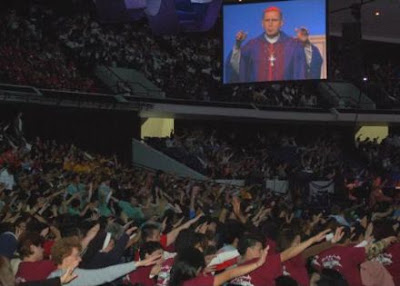 As you read keep in mind that Archbishop Gomez will be taking over in Los Angeles before too long.


 WVC on ROME 26/5– Day 53: Persevere!: “What flavor pastry? When I was in Italy, I found the pistachio croissants were too sweet for me. The chocolate…”






























