POPE TO TABLET….

You will recall that The Tablet recently published a dopey editorial about Vatican II. They got just about everything wrong. I wrote about it HERE.

It seems Pope Benedict agrees with me.

In his homily for the opening of the Year of Faith, His Holiness quoted John XXIII at the opening of the Council:

We now turn to the one who convoked the Second Vatican Council and inaugurated it: Blessed John XXIII. In his opening speech, he presented the principal purpose of the Council in this way: “What above all concerns the Ecumenical Council is this: that the sacred deposit of Christian doctrine be safeguarded and taught more effectively […] Therefore, the principal purpose of this Council is not the discussion of this or that doctrinal theme… a Council is not required for that… [but] this certain and immutable doctrine, which is to be faithfully respected, needs to be explored and presented in a way which responds to the needs of our time” (AAS 54 [1962], 790,791-792).

And later, he describes the Tablistas:

If we place ourselves in harmony with the authentic approach which Blessed John XXIII wished to give to Vatican II, we will be able to realize it during this Year of Faith, following the same path of the Church as she continuously endeavours to deepen the deposit of faith entrusted to her by Christ.  The Council Fathers wished to present the faith in a meaningful way; and if they opened themselves trustingly to dialogue with the modern world it is because they were certain of their faith, of the solid rock on which they stood. In the years following, however, many embraced uncritically the dominant mentality, placing in doubt the very foundations of the deposit of faith, which they sadly no longer felt able to accept as truths.

During the Year of Faith, the Tablistas – and the Fishwrapers – need to return to an “authentic approach” to the Council and, especially, to the fundamentals of the Faith.

Posted in Benedict XVI, Liberals, Linking Back, Year of Faith | Tagged , ,
6 Comments

QUAERITUR: A stable group petitioned the Extraordinary Form, but the “parish council” says NO!

From a young reader:

I am a sixteen year old boy, who has requested a TLM mass at my parish a number of times unofficially. After getting several unsatisfactory results, I decided to send a short concise petition to the bishop, because the nearest TLM mass is an hour and fifteen minute drive away occurring only once a month.

Twenty-six people signed the petition before I sent it off to the bishop a month ago. Today I just received a phone call from my parish’s faith formation coordinator. She told me that yesterday the parish council has had a “special” meeting to discuss the petition. Furthermore she went on to say that the parish council concluded that the parish does not need a TLM mass at this time. Afterwards she stated that she would call everyone who signed the petition informing them of their decision even though I did not send a copy of the letter to either the parish or the parish priest.(I told my parish priest that I was sending a petition and showed him the petition before it was signed).

I have not received a response from the bishop. What should I do?

First, I am pleased that you are interested in knowing and participating in the Extraordinary Form. This is your patrimony as a Catholic. You and all Catholics should have it available.

Second, parish councils are not mentioned in the Holy Father’s provisions promulgated in Summorum Pontificum. They are meaningless in this matter. The person mentioned in Summorum Pontificum is the pastor of the parish, the parish priest. He makes the decision. He should be required to make a specific response. He is the pastor, not the parish council. He can consult with a parish council, but he makes the call.

Summorum Pontificum says:

Art. 5, § 1. In paroeciis, ubi coetus fidelium traditioni liturgicae antecedenti adhaerentium stabiliter [previously continenter] exsistit, parochus eorum petitiones ad celebrandam sanctam Missam iuxta ritum Missalis Romani anno 1962 editi, libenter suscipiat. Ipse videat ut harmonice concordetur bonum horum fidelium cum ordinaria paroeciae pastorali cura, sub Episcopi regimine ad normam canonis 392, discordiam vitando et totius Ecclesiae unitatem fovendo.

Art. 5, § 1. In parishes, where there is stably present a group of the faithful attached to the previous liturgical tradition, let the pastor willingly receive their petitions that Mass be celebrated according to the Rite of the Missale Romanum issued in 1962. Let him see to it that the good of these faithful be harmoniously brought into accord with the ordinary pastoral care of the parish, under the governance of the Bishop according to canon 392, by avoiding discord and by fostering the unity of the whole Church.

From what you wrote, there are enough people interested that the parish priest, the pastor, must make a response. If the pastor won’t help you, then you must turn to the local bishop and/or the Pontifical Commission “Ecclesia Dei” in Rome.

If the bishop has already been informed, then you must send copies of all the correspondence to the Pontifical Commission “Ecclesia Dei” in Rome.

Summorum Pontificum says:

Art. 7. Where some group of the lay faithful, mentioned in art. 5 § 1 will not have obtained the things sought from the pastor, let the Diocesan Bishop be informed about the matter. The Bishop is strenuously asked that he graciously grant their desire. If does not want to provide for a celebration of this kind, let the matter be referred to the Pontifical Commission “Ecclesia Dei“.

Universae Ecclesiae, the document that clarifies some points of Summorum Pontificum, states:

14. It is the task of the Diocesan Bishop to undertake all necessary measures to ensure respect for the forma extraordinaria of the Roman Rite, according to the Motu Proprio Summorum Pontificum.

Save copies of all your correspondence, in both directions – everything you send and everything you receive. Make written notes of every conversation you have with anyone at the parish, focusing especially on the facts of the conversation, what exactly was said.

Persevere!

UPDATE:

A priest friend reminded me of this:

INSTRUCTION

ON CERTAIN QUESTIONS REGARDING
THE COLLABORATION OF THE NON-ORDAINED
FAITHFUL IN THE SACRED MINISTRY OF PRIEST

LIBRERIA EDITRICE VATICANA
VATICAN CITY 1997

Article 5§ 3. It is for the Parish Priest to preside at parochial councils. They are to be considered invalid, and hence null and void, any deliberations entered into, (or decisions taken), by a parochial council which has not been presided over by the Parish Priest or which has assembled contrary to his wishes.(86)

Article 5 § 2. Diocesan and parochial Pastoral Councils(83) and Parochial Finance Councils,(84) of which non-ordained faithful are members, enjoy a consultative vote only and cannot in any way become deliberative structures. Only those faithful who possess the qualities prescribed by the canonical norms(85) may be elected to such responsibilities.

(83) Cf. C.I.C., can. 514, 536.

(84) Cf. ibid., can. 537.

(85) Cf. ibid., can. 512, §§ 1 and 3; Catechism of the Catholic Church, n. 1650.

Posted in "How To..." - Practical Notes, Benedict XVI, Liturgy Science Theatre 3000, Our Catholic Identity, SUMMORUM PONTIFICUM, Universae Ecclesiae | Tagged ,
27 Comments

Benedict XVI on Year of Faith: “a pilgrimage in the deserts of today’s world, taking with us only what is necessary”

“Reference to the documents saves us from extremes of anachronistic nostalgia and running too far ahead, and allows what is new to be welcomed in a context of continuity.”

Thus, Benedict XVI during his homily for the Opening of the Year of Faith.  My emphases and comments:

Dear Brother Bishops,

Dear brothers and sisters!

Today, fifty years from the opening of the Second Vatican Ecumenical Council, we begin with great joy the Year of Faith. I am delighted to greet all of you, particularly His Holiness Bartholomaois I, Patriarch of Constantinople, and His Grace Rowan Williams, Archbishop of Canterbury. A special greeting goes to the Patriarchs and Major Archbishops of the Eastern Catholic Churches, and to the Presidents of the Bishops’ Conferences. In order to evoke the Council, which some present had the grace to experience for themselves – and I greet them with particular affection – this celebration has been enriched by several special signs: the opening procession, intended to recall the memorable one of the Council Fathers when they entered this Basilica; the enthronement of a copy of the Book of the Gospels used at the Council; the consignment of the seven final Messages of the Council, and of the Catechism of the Catholic Church, which I will do before the final blessing. These signs help us not only to remember, they also offer us the possibility of going beyond commemorating. They invite us to enter more deeply into the spiritual movement which characterized Vatican II, to make it ours and to develop it according to its true meaning. [And we need to have the Holy Father tell us what that is.  QUAERUNTUR: What is the “spiritual movement which characterized Vatican II”?  What is its “true meaning”?] And its true meaning was and remains faith in Christ, the apostolic faith, animated by the inner desire to communicate Christ to individuals and all people, in the Church’s pilgrimage along the pathways of history. [He reference to the apostolic faith (regula Fidei) and mention of history suggests his 2005 theme of continuity.]

The Year of Faith which we launch today is linked harmoniously with the Church’s whole path over the last fifty years: from the Council, through the Magisterium of the Servant of God Paul VI, who proclaimed a Year of Faith in 1967, up to the Great Jubilee of the year 2000, with which Blessed John Paul II re-proposed to all humanity Jesus Christ as the one Saviour, yesterday, today and forever. Between these two Popes, Paul VI and John Paul II, there was a deep and profound convergence, precisely upon Christ as the centre of the cosmos and of history, and upon the apostolic eagerness to announce him to the world. [I don’t want to rain on the parade here, but the Church has not been very successful at that since the Council.  Otherwise, would there be a need for a New Evangelization?] Jesus is the centre of the Christian faith. The Christian believes in God whose face was revealed by Jesus Christ. He is the fulfilment of the Scriptures and their definitive interpreter. Jesus Christ is not only the object of the faith but, as it says in the Letter to the Hebrews, he is “the pioneer and the perfecter of our faith” (12:2).

Today’s Gospel tells us that Jesus Christ, consecrated by the Father in the Holy Spirit, is the true and perennial subject of evangelization. “The Spirit of the Lord is upon me, because he has anointed me to preach the good news to the poor” (Lk 4:18). This mission of Christ, this movement of his continues in space and time, over centuries and continents. It is a movement which starts with the Father and, in the power of the Spirit, goes forth to bring the good news to the poor, in both a material and a spiritual sense. The Church is the first and necessary instrument of this work of Christ because it is united to him as a body to its head. “As the Father has sent me, even so I send you” (Jn 20:21), says the Risen One to his disciples, and breathing upon them, adds, “Receive the Holy Spirit” (v.22). Through Christ, God is the principal subject of evangelization in the world; but Christ himself wished to pass on his own mission to the Church; he did so, and continues to do so, until the end of time pouring out his Spirit upon the disciples, the same Spirit who came upon him and remained in him during all his earthly life, giving him the strength “to proclaim release to the captives and recovering of sight to the blind, to set at liberty those who are oppressed” and “to proclaim the acceptable year of the Lord” (Lk 4:18-19).

The Second Vatican Council did not wish to deal with the theme of faith in one specific document. [NB:] It was, however, animated by a desire, as it were, to immerse itself anew in the Christian mystery so as to re-propose it fruitfully to contemporary man. [The aforementioned “spiritual movement”?] The Servant of God Paul VI, two years after the end of the Council session, expressed it in this way: “Even if the Council does not deal expressly with the faith, it talks about it on every page, it recognizes its vital and supernatural character, it assumes it to be whole and strong, and it builds upon its teachings. We need only recall some of the Council’s statements in order to realize the essential importance that the Council, consistent with the doctrinal tradition of the Church, attributes to the faith, the true faith, which has Christ for its source and the Church’s Magisterium for its channel” (General Audience, 8 March 1967). Thus said Paul VI.

We now turn to the one who convoked the Second Vatican Council and inaugurated it: Blessed John XXIII. In his opening speech, he presented the principal purpose of the Council in this way: “What above all concerns the Ecumenical Council is this: that the sacred deposit of Christian doctrine be safeguarded and taught more effectively […] [Did that actually happen since the Council?  There’s more…] Therefore, the principal purpose of this Council is not the discussion of this or that doctrinal theme… a Council is not required for that… [but] this certain and immutable doctrine, which is to be faithfully respected, needs to be explored and presented in a way which responds to the needs of our time” (AAS 54 [1962], 790,791-792).

In the light of these words, we can understand what I myself felt at the time: during the Council there was an emotional tension as we faced the common task of making the truth and beauty of the faith shine out in our time, without sacrificing it to the demands of the present or leaving it tied to the past: [!] the eternal presence of God resounds in the faith, transcending time, yet it can only be welcomed by us in our own unrepeatable today. [NB] Therefore I believe that the most important thing, especially on such a significant occasion as this, is to revive in the whole Church that positive tension, that yearning to announce Christ again to contemporary man. [For Benedict, “the most important thing” is to “revive the tension” in “making the truth and beauty of the faith shine in our time, without sacrificing it to the demands of the present or leaving it tied to the past”.  Continuity not rupture.  Okay, Holy Father.  This is grand. But this is just a hope.  How do we do this?] But, so that this interior thrust towards the new evangelization neither remain just an idea nor be lost in confusion, it needs to be built on a concrete and precise basis, and this basis is the documents of the Second Vatican Council, the place where it found expression. [That means the texts.] This is why I have often insisted on the need to return, as it were, to the “letter” of the Council – that is to its texts – also to draw from them its authentic spirit, [As in good theological and biblical exegetical method, the letter both frees and tethers the spirit.] and why I have repeated [NB] that the true legacy of Vatican II is to be found in them. [in the texts.] Reference to the documents saves us from extremes of anachronistic nostalgia and running too far ahead, and allows what is new to be welcomed in a context of continuity. The Council did not formulate anything new in matters of faith, nor did it wish to replace what was ancient. Rather, it concerned itself with seeing that the same faith might continue to be lived in the present day, that it might remain a living faith in a world of change. If we place ourselves in harmony with the authentic approach which Blessed John XXIII wished to give to Vatican II, we will be able to realize it during this Year of Faith, following the same path of the Church as she continuously endeavours to deepen the deposit of faith entrusted to her by Christ. [Or… if we don’t learn from the past 50 years, we can make things far worse.  It is good that the biological solution has been clearing the way for a more sober reading of the event of the Council and its texts.] The Council Fathers wished to present the faith in a meaningful way; [This is interesting… watch this…] and if they opened themselves trustingly to dialogue with the modern world it is because they were certain of their faith, of the solid rock on which they stood. In the years following, however, many embraced uncritically the dominant mentality, placing in doubt the very foundations of the deposit of faith, which they sadly no longer felt able to accept as truths.  [BOOM!  I am glad that the Holy Father did not just gloss over this virulently destructive problem.  The Pope uses words like “trustingly” and “uncritically”.  He says that the participants in the Council were “certain of their faith. I think that not all the bishops who participated in the Council were naive and trusting.]

[QUAERITUR: Does the Church need a Year of Faith?] If today the Church proposes a new Year of Faith and a new evangelization, it is not to honour an anniversary, but because there is more need of it, even more than there was fifty years ago! And the reply to be given to this need is the one desired by the Popes, by the Council Fathers and contained in its documents. Even the initiative to create a Pontifical Council for the promotion of the new evangelization, which I thank for its special effort for the Year of Faith, is to be understood in this context. [Context:] Recent decades have seen the advance of a spiritual “desertification”. In the Council’s time it was already possible from a few tragic pages of history to know what a life or a world without God looked like, [the 20th century saw a couple nasty wars and the rise of secularism and materialistic Communism] but now we see it every day around us. [e.g., the Dictatorship of Relativism] This void has spread. But it is in starting from the experience of this desert, from this void, that we can again discover the joy of believing, its vital importance for us, men and women. In the desert we rediscover the value of what is essential for living; thus in today’s world there are innumerable signs, often expressed implicitly or negatively, of the thirst for God, for the ultimate meaning of life. [At the risk of being banal in such a lofty moment, “don’t it always seem to go that you don’t know what you’ve got ’till it’s gone”? – Joni Mitchell] And in the desert people of faith are needed who, with their own lives, point out the way to the Promised Land and keep hope alive. [Poetic.  Classic Ratzinger.  I will add that the People wandered for only 40 years, not 50.  Also, the People suffered in the desert.  And once they arrived in the Promised Land – which we are very far from, by the way – there was a lot of work to do and it would not have been easy.] Living faith opens the heart to the grace of God which frees us from pessimism. [Touché.] Today, more than ever, evangelizing means witnessing to the new life, transformed by God, and thus showing the path. [Is that also what “new evangelizing” means?] The first reading spoke to us of the wisdom of the wayfarer (cf. Sir 34:9-13): the journey is a metaphor for life, and the wise wayfarer is one who has learned the art of living, and can share it with his brethren – as happens to pilgrims along the Way of Saint James or similar routes which, not by chance, have again become popular in recent years. [Personal note.  I have thought about doing the camino.] How come so many people today feel the need to make these journeys? Is it not because they find there, or at least intuit, the meaning of our existence in the world? [PAY ATTENTION HERE] This, then, is how we can picture the Year of Faith: a pilgrimage in the deserts of today’s world, taking with us only what is necessary: neither staff, nor bag, nor bread, nor money, nor two tunics – as the Lord said to those he was sending out on mission (cf. Lk 9:3), but the Gospel and the faith of the Church, of which the Council documents are a luminous expression, as is the Catechism of the Catholic Church, published twenty years ago.  [I must note a lacuna.  The Holy Father can’t mentioned every possible thing. He has mentioned the Catechism and the Credo of the People of God.  He has not spoken about liturgical worship.  If there was a major development from the Council that made a decisive impact on the Church, it was the change to our liturgical worship that followed (in large part improperly) the mandates of the Council Fathers. I say that a necessary thing is our participation in the liturgical worship we owe to God by the virtue of religion.  It is claimed that a great insight from the Council was that the Eucharist is the “source and summit” of our Catholic lives.  Fine.  Let it be that.  By the “Eucharist” we have to mean both the Blessed Sacrament and the celebration of Holy Mass.  There is no way that this Pope does not also want us to renew our liturgical worship.  Popes can’t mention every possible thing in every address.  I wish, however, he had touched on our worship.  But this is not the last thing he will say or do for the Year of Faith.]

Venerable and dear Brothers, 11 October 1962 was the Feast of Mary Most Holy, Mother of God. Let us entrust to her the Year of Faith, as I did last week when I went on pilgrimage to Loreto. May the Virgin Mary always shine out as a star along the way of the new evangelization. May she help us to put into practice the Apostle Paul’s exhortation, “Let the word of Christ dwell in you richly, teach and admonish one another in all wisdom […] And whatever you do, in word or deed, do everything in the name of the Lord Jesus, giving thanks to God the Father through him” (Col 3:16-17). Amen.

Posted in Benedict XVI, New Evangelization, Our Catholic Identity, The Drill, Year of Priests | Tagged , , , , ,
21 Comments

DETROIT 13 October: Call To Holiness Conference

Those of you anywhere near Detroit will be glad to know that the 14th Call To Holiness Conference will be held on Saturday, 13 October.  Lot’s of information about the conference HERE. Today is the last day (until midnight EST) to register online, HERE.  Tickets can be purchased at the door, however.

Among those involved are:

Bp. Alex Sample – Bishop of Marquette
Fr. John Trigilio – author and EWTN
Fr. Frank Philips – St. John Cantius, Chicago
Fr. Brian Harrison – author, teacher
Dr. Monica Miller – teacher, pro-life activist
Mr. Louie Verrecchio – author, publisher
and the undersigned.

The Divine Liturgy will be celebrated for the conference at St. Josaphat Ukrainian Catholic Church and, on Sunday at noon, Bp. Sample will celebrate a Pontifical Mass in the Extraordinary Form at the famous Assumption Grotto.

DETROIT 13 October: Call To Holiness Conference

There is more information at the Te Deum blog.

Posted in Our Catholic Identity, The future and our choices, Year of Faith | Tagged ,
5 Comments

Leadership reconsidered

Reminds me of something.   What was it again…. hmm…

Leadership reconsidered

Posted in Lighter fare |
4 Comments

Reason #28867 for Summorum Pontificum

The folks who organize the education conference in L.A. are going to be sooooo jealous.

You might need to turn the sound down after a little bit.  I will not be blamed if your ears start to bleed.

[wp_youtube]MxfO7a7_bWs[/wp_youtube]

Posted in Lighter fare, Liturgy Science Theatre 3000, SUMMORUM PONTIFICUM |
95 Comments

Some feedback

From a reader:

I do not have any question to ask you, but I just wanted to say thank you for your promotion and education on your blog of the Extraordinary Form of the Mass. I have only been to Latin Mass twice so far, but right away I knew I had discovered a hidden gem of the Catholic Church. The Latin Mass is not difficult to understand and foreign as some make it out to be. It is so filled with reverence and rich in history- I can say with certainty that it made me proud to be a Catholic! Thank you for introducing it to me!

You are welcome.

The New Evangelization continues.

Posted in Brick by Brick, Our Catholic Identity, Reader Feedback, SUMMORUM PONTIFICUM | Tagged
7 Comments

Benedict XVI to change mind on women’s ordination? Have stranger things ever happened?

I picked this up from Eye Of The Tiber. I didn’t hear about this epoch-changing story in the MSM or the Catholic blogosphere, did you?

Hmmmm….  perhaps there is a conspiracy.

Benedict XVI to change mind on women's ordination? Have stranger things ever happened?Former LCWR President’s Dynamic Speech May Change Pope’s Mind On Female Ordination
ROME––Former President of the Leadership Conference of Women Religious, Pat Ferrell, delivered an electrifying speech yesterday to Pope Benedict XVI and top Church officials regarding the necessity of female priests. Many Vatican analysts now believe the speech will be the catalyst to female ordination. “It was one of the most insightful…one of the most profound talks since John Paul II gave the address that helped bring down communism,” an aide close to the Pontiff said, choking up. In an amateur video shot by one insider, Ferrell can be seen with tears in her eyes as she walks away from the podium after giving her address. The Pontiff, visibly moved by the passionate speech, stands with tears in his eyes and begins to clap, slowly. Gradually, his aides, one after another one, rise to their feet and begin to clap, louder and louder until the entire antechamber is filled with thunderous and uproarious shouts and whistles, as all begin to cheer, “Fe-rrell…Fe-rrell…Fe-rrell…”

I guess we all better make some adjustments.

I, for one, welcome our new female overlords.

Posted in Lighter fare, Women Religious | Tagged , , ,
59 Comments

Nuns On The Bus Warmed-Over: a stop at Ohio Dominican University

Apparently the Nuns On The Bus are still going ’round and ’round with their blatantly partisan political agenda.

From a reader:

The “Nuns on the Bus” tour has C-Bus for its next stop. This is the group that has been touring the country promoting the Democratic agenda. Spokesperson and media darling Sister Simone Campbell, you will recall, gave a speech at the Democratic National Convention. Sister Campbell has been an outspoken supporter of the new health care law, [think “tax-payer funding of abortion”, “HHS mandate”….] failing to get behind the bishop’s clear opposition and repeatedly calling the law “pro-life.” She has refused to speak out against the HHS mandate and, when confronted with her views on abortion, responded, “It is above my pay grade.” Really? I thought one of the primary missions in religious life is the evangelization of culture and the promotion of Catholic truth. It seems that abortion is well-within the pay grade of consecrated religious. And we wonder why the Vatican sees fit to reform the LCWR. [I don’t.]

Well, the plot thickens for the Nuns on the C-Bus. It seems that their main media stop is at none other than Ohio Dominican University: a Catholic college. [In the Diocese of Columbus.] This is not the first time that ODU has invited questionable speakers. In 2007 they invited dissident Sister Joan Chittister to give the commencement address.

In this political environment, and given the current investigation of the LCWR, it seems at the very least an act of grave imprudence to permit this event. It will cause inestimable confusion among the Catholic students of ODU, which I believe is the definition of scandal. This is reason #43264 for Ex Corde Ecclesiae.

P.S. I love the irony that the liberal wing of the Church so desperate want to minimize her “intrusion” into politics when it comes to issues of life and religious freedom, but they see absolutely nothing wrong with a representative of the Catholic Church coming to a Catholic university for the sole purpose of advocating a political position just weeks from a major national election, still less with the same representative giving a ringing endorsement of the Democratic platform by speaking at their national convention.


Posted in Biased Media Coverage, Blatteroons, HONORED GUESTS, Liberals, Magisterium of Nuns, Religious Liberty, The Drill, The future and our choices, Women Religious | Tagged , , , , , , ,
9 Comments

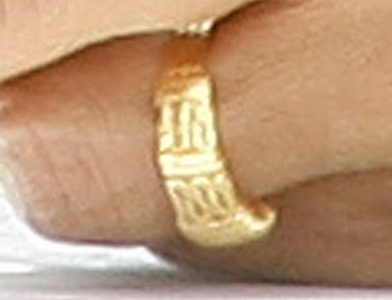
Pres. Obama’s wedding ring

Pres. Obama's wedding ringHere is something very interesting from WND:
NEW YORK – As a student at Harvard Law School, then-bachelor Barack Obama’s practice of wearing a gold band on his wedding-ring finger puzzled his colleagues.

Now, newly published photographs of Obama from the 1980s show that the ring Obama wore on his wedding-ring finger as an unmarried student is the same ring Michelle Robinson put on his finger at the couple’s wedding ceremony in 1992.

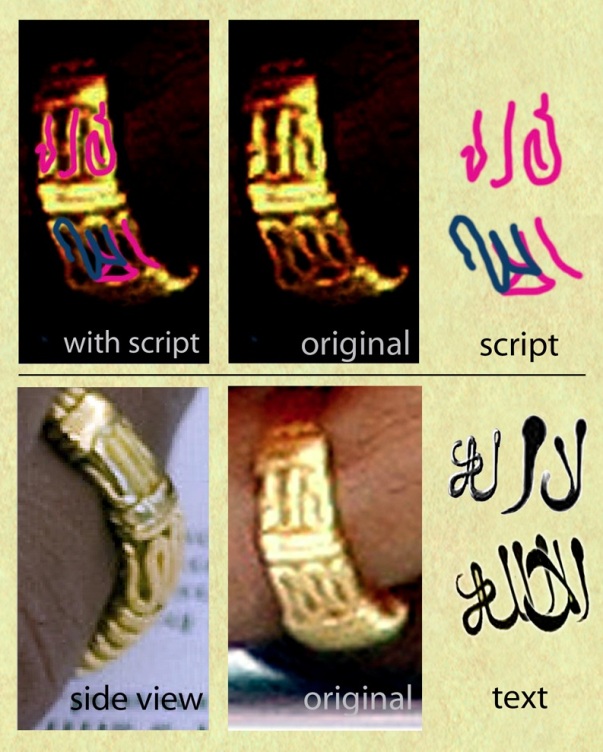
Moreover, according to Arabic-language and Islamic experts, the ring Obama has been wearing for more than 30 years is adorned with the first part of the Islamic declaration of faith, the Shahada: “There is no God except Allah.”

The Shahada is the first of the Five Pillars of Islam, expressing the two fundamental beliefs that make a person a Muslim: There is no god but Allah, and Muhammad is Allah’s prophet.

Sincere recitation of the Shahada is the sole requirement for becoming a Muslim, as it expresses a person’s rejection of all other gods

Egyptian-born Islamic scholar Mark A. Gabriel, Ph.D., examined photographs of Obama’s ring at WND’s request and concluded that the first half of the Shahada is inscribed on it.

“There can be no doubt that someone wearing the inscription ‘There is no god except Allah’ has a very close connection to Islamic beliefs, the Islamic religion and Islamic society to which this statement is so strongly attached,” Gabriel told WND.

[…]

Read the rest there.  There are many interesting photos.

Pres. Obama's wedding ring

Intriguing!

Posted in The Drill | Tagged , , , , , ,
56 Comments























