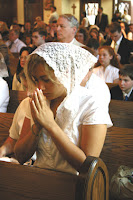
QUAERITUR: Can a traditionalist priest require women to cover their heads during Mass?

QUAERITUR: Can a traditionalist priest require women to cover their heads during Mass?From a reader:

I have read web sites from FSSP Traditional parishes that indicate women are to cover their heads during Mass. My understanding is that the requirement was removed from Canon Law, thus it is no longer a sin to not cover. However, if a traditionalist priest made it a requirement for his parish, or for his congregation in the case of a quasi-parish, would the woman sin by disobedience if she refused to cover her head, and could a priest make it a requirement in order to, for example, receive communion?

I am glad that this is only a hypothetical question and that no priest has been foolish enough to deny women Communion if they had no head covering.

News of that sort, if true, would provoke The Wrath Of The Whatever From High Atop The Thing.

Univerase Ecclesiae 28, which clarified some points of Summorum Pontificum, stated that those rubrical things and practices in force in 1962 which were in the Missale Romanum were to be maintained now.  Thus, no Communion in the hand, no altar girls, etc. Summorum Pontificum did not revive the canon of the old, 1917 Code of Canon Law concerning head coverings.

I think a case can be made that during celebrations of Holy Mass with the 1962 Missale Romanum it is good that women cover their heads.  As a matter of fact, why limit that to the 1962MR?  Let’s apply that the Ordinary Form as well!   That said, there is no law on the books right now that obliges women to cover their heads during Mass.   But think: New Evangelization…. Year of Faith… New Evangelization… Year of Faith….

So, while there is no strict obligation according to the law, the ethos of the older use of the Roman Rite creates a soft obligation, an environment in which people will of their own free will conform to what the older use is about.  That suggests a willingness on the part of women to use a head-covering in church.  It does not impose any hard obligation.  I don’t think anyone should look cross-eyed at a woman with an uncovered head in church for the Extraordinary Form.  That would be boorish.

Were I to hear that a priest would not give Communion to a woman for the sole reason that she was not wearing a head covering… well… let’s just hope that never happens.

Anyway… ladies… promote the New Evangelization during the Year of Faith and start wearing those chapel veils in church!


QUAERITUR: Can a traditionalist priest require women to cover their heads during Mass?
Posted in "How To..." - Practical Notes, ASK FATHER Question Box, Liturgy Science Theatre 3000, New Evangelization, Our Catholic Identity, SUMMORUM PONTIFICUM, Universae Ecclesiae | Tagged , , , , , ,
45 Comments

Is something being done about the “homosexual Masses” in London?

I picked this up from Marco Tossati at Vatican Insider – in Italian – about the homosexual Masses being celebrated in London in the Soho district at the Church of Our Lady of the Assumption and Saint Gregory (not at St. Patrick’s on Soho Square itself):

Messa gay a Londra, si muove la Dottrina della Fede (“Gay” Mass in London, the [Congregation for] the Doctrine of the Faith makes a move)

The offices of the Congregation for the Doctrine of the Faith have decided to deal with the problem of services celebrated in the district of Soho in the British capital

The new Prefect of the Congregation for the Doctrine of the Faith, (Archbishop) Gerhard Ludwig Mueller, intends, very firmly, to deal with the problem of the Mass which twice a month is celebrated in London, Warwick Street in Soho for homosexuals, lesbians, bisexuals and transgendered, with the approval of the Archbishop of Westminster, (Archbishop) Vincent Nichols. It seems that already in the recent past other dicasteries of the Roman Curia, at the request and solicitation of London Catholics, have asked for clarifications and have underscored the concerns connected with an initiative of this kind. Among other things, an expert on liturgy and theology noted that there is a danger that the initiative will lead to a ghetto-ization of the persons involved.

What bothers the sensibilities of London Catholics in the quarter and nearby area, is the form in which the Mass is celebrated. In the petition sent to (Archbishop) Nichols some time ago, and in copies sent also to some Roman congregations, there is a complaint that homilies are given that seem to justify behaviors considered wrong in the doctrine of the Church.

[…]

There is more there, but that’s what I have time for right now.

Posted in "How To..." - Practical Notes, Brick by Brick, Liturgy Science Theatre 3000, One Man & One Woman, Our Catholic Identity, The future and our choices | Tagged , ,
17 Comments

“I want to share why I choose to wear a veil… and why I love it.”

At the blog Fide Et Literis: By Faith & Learning there is a post entitled I love my chapel veil.

She wrote:

I recently read an article about the comeback of chapel veils entitled, “Head covering is thinly veiled patriarchy.” The author wrote to call out what us veil-wearers don’t seem to see – that “Catholics are not the Amish,” that this trend is anti-feminist, and that wearing a veil is “downright repressive.”

What I’d like to share is that I’m not a barefoot kitchen slave because I wear a veil, nor do I feel repressed as a woman. I want to share why I choose to wear a veil… and why I love it.

My first encounter with veiling happened when my husband and I were visiting my out-of-town sister-in-law about a year ago. We joined her family for Tridentine Mass one Sunday and it was only my first or second time ever attending the traditional Mass. My 12-year-old niece offered me a veil to borrow on our way there, noticeably excited to be able to share something precious of hers with her super cool soon-to-be aunt. I declined her offer. I’d never worn a veil before and really my only thought was, “This is weird.”

[…]

You can read the rest there.

Ah, the New Evangelization!

I will now back out of the room.

Posted in Just Too Cool, New Evangelization, Our Catholic Identity | Tagged , , ,
42 Comments

The Holy Father’s Wednesday Audiences will now include Arabic

ARABIC TO BECOME A PART OF THE POPE’S GENERAL AUDIENCE

Vatican City, (VIS) – Beginning on Wednesday 10 October, during the Holy Father’s weekly general audience, an Arabic speaker will join the other speakers who provide a summary of the papal catechises in various different languages.

In this way, in the wake of his recent trip to Lebanon and the publication of the Post-Synodal Apostolic Exhortation “Ecclesia in Medio Oriente”, the Holy Father intends to express his perpetual concern and support for Christians in the Middle East, and to remind everyone of their duty to pray and work for peace in the region.

A couple problems I can see with this are a) the audience will be longer and b) if they end using Arabic, some Arab-speakers will take it as an insult.

Sts. Nunil0 and Alodia, pray for us!

BTW… 22 October is the Feast of Sts. Nunilo and Alodia! Start planning.

Posted in Benedict XVI | Tagged , ,
6 Comments

The Synod so far: something missing….

As you know, the Synod of Bishops in meeting in Rome, again.  The theme this time: The New Evangelization for the Transmission of the Christian Faith

So far in the interventions (speeches) HERE I have not yet seen any mention of the internet.

“But Father! But Father!”, you might be tempted to interject, “The Synod is barely underway!”

I’m just sayin’.

Our time has been called “information age” by Bl. John Paul II and, according to Benedict XVI we live on a “digital continent”.

Also, are there good Twitter hashtags for news of the Synod?  #synod ? #bishops

UPDATE 10 October 1318 GMT

Archbishop Kurtz of Louisville, a participant in the Synod, is posting to a blog about his experience.  HERE.

Posted in "How To..." - Practical Notes, New Evangelization, Our Catholic Identity | Tagged
4 Comments

Jon O’Brien’s (“catholics For Choice”) spittle-flecked nutty in HuffPo about Sr. Walsh’s remarks

HuffPo has posted a spittle-flecked nutty from  Jon O’Brien, president of the disgusting pro-abortion catholic group, Catholics … catholics For Choice.

O’Brien’s nutty was sparked by a post on the USCCB blog by Sr. Mary Ann Walsh.

Sr. Walsh wrote:

“Going to Catholics for Choice for a so-called Catholic view is like asking Catholic Atheists (yet to exist, I think) to opine on the meaning of God.”

Heh heh. Kudos.  Sr. Walsh’s entirely appropriate remark got under O’Brien’s skin.  Perhaps O’Brien has yet a trace of guilt for promoting immoral things.  I don’t know.

Sr. Walsh pointed to the fact that catholics For Choice are catholic in name only.  They hijacked the descriptive word “Catholic” for the title of their politically oriented organization.

They must not be given a free pass.  Sr. Walsh spoke up.  O’Brien lashed out in HuffPo.

Jon O'Brien's ("catholics For Choice") spittle-flecked nutty in HuffPo about Sr. Walsh's remarksYou might enjoy reading O’Brien’s nervous reaction in its entirely, HERE.  Make some popcorn.

Leaving aside most of O’Brien’s piece, let’s focus on one point, in keeping with his title: “Nobody Gets to Say Who Is and Who Is Not Catholic”.  He wrote:

As somebody intimately familiar with the ways of the church, Sister Mary Ann knows that nobody gets to say who is and who is not Catholic. Not the priests, not the bishops and not the pope. One is a Catholic after baptism. Period. She might have her own opinions about who is a good Catholic or a bad Catholic, but her claims that we aren’t Catholic needs some fact-checking.

He’s right, of course.  Even excommunicated people are still Catholics.   Perhaps O’Brien should be excommunicated.  He perhaps could use some practical knowledge rather than just theoretical knowledge about his catholic identity.  Think of the authority being excommunicated would give him with his acolytes!

O’Brien also wrote:

 And as to my Catholicism, perhaps I’ll send her copy of my baptismal certificate, though I doubt she’d [Sr. Walsh] be appeased.

He has a baptismal certificate!  I guess he wins the argument with that one.  On the other hand, each and every priest who sexually abused children have baptismal certificates.  They are still Catholics, even in jail.

Baptized catholics remain baptized catholics in Hell, too.

The Church does, in fact, get to determine who is in communion with her and who is not.  The Church’s shepherds do, in fact, get to determine who can and can’t use the term “Catholic” in the names of their organization.  We all, in fact, get to form opinions about the catholicity of individuals and of organizations based on what they say and what they do.

I don’t think those priests – and nuns – who abused children were very Catholic in their actions.

catholics For Choice promotes abortion.  Killing children.  That doesn’t sound very Catholic to me.

O’Brien also wrote:

 As Catholics we take seriously our obligations to know and thoughtfully consider Catholic teaching. And in coming to our positions on abortion, family planning and other issues we have done so, and continue to do so. We didn’t make this up. We’ve got saints, cardinals, theologians and millions of Catholics on our side.

No, Jon, you are making this up.  Whom are you trying kid?  Catholics cannot in good conscience condone abortion.  Catholics cannot in good conscience promote abortion.

I doubt the saints O’Brien claims would be pleased to be counted as being on his side.  I hope those saints are asking God to grant O’Brien the graces needed for his conversion.  But wait!  On his side he also has “cardinals, theologians and millions of Catholics”?  BIG DEAL.  They have theologians on their side!  Wow!  Cardinals, too?  I’m sooo impressed!  Millions of Catholics?  That clinches it!

While I’m at it, O’Brien wrote:

“The church’s brand control over individuals ends the minute a person is baptized. From that point forward, we have the right — and the responsibility — to speak as Catholics on matters of social justice, including those that involve sex, sexuality and reproduction.”

Aside from the clear point in Catholic teaching that obedience is due to the Magisterium of bishops on matters of defined Catholic teachings, O’Brien must explain why his statement limits Catholics’ right and responsibility to dissent to “matters of social justice, including those that involve sex…”? What about their right and responsibility to dissent from other Catholic teachings, such as the divinity of Jesus, or the exclusive role of Christ in human salvation, or the trinitarian nature of God, or Mary’s role as Mother of God? What makes social justice such a privileged category for dissent?

catholics for Choice is dead wrong.  They promote evil and they claim that people can choose evil in good conscience.  Does that sound Catholic to you?

Holy Church has marks by which we recognize who she is.  These marks help us to know that we belong to the Church Christ founded, and not some reduced Church or some mere ecclesial community.  In a similar way, we can draw conclusions about Catholic identity, the catholicity of Catholics, by noting carefully and fairly both their words and deeds.   There is a great deal flexibility in this matter.  People make mistakes and, of course, remain Catholics.   People sin and remain Catholics.  The Church corrects them and they adjust their lives.  If erring people persist in their errors or sins after proper correction, then Holy Church can impose censures on them.  The Church can and does issue statements about those people or groups.  The Church can, in fact, say that people are not in communion with her or that they are in serious error.

Our tent is actually pretty big.  It is possible, however, to stray out of the tent.

I think O’Brien and catholics For Choice have strayed from the tent.  They stand in direct opposition to the Church’s clear moral teaching on a range of things, including the intrinsic evil of abortion.  They stand in direct opposition to the Church’s duly appointed shepherds, successors of the Apostles.

The USCCB should issue a clear, brief statement that catholics For Choice may not use the identifying term “Catholic” in the name of their anti-Catholic organization.

In the meantime…

Jon O'Brien's ("catholics For Choice") spittle-flecked nutty in HuffPo about Sr. Walsh's remarks

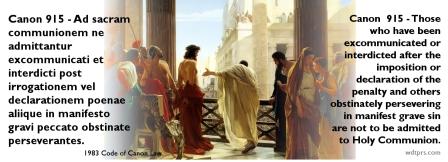
CLICK TO GET CAN. 915 STUFF

Posted in 1983 CIC can. 915, Biased Media Coverage, Emanations from Penumbras, Our Catholic Identity | Tagged , , , ,
16 Comments

Fr. John Hunwicke – redivivus

I was delighted to see an old RSS feed come back to life today after a long hiatus.

Fr. John Hunwicke, now a Catholic priest, has resumed posting to his blog now called Fr Hunwicke’s Mutual Enrichment, though it has the old URL address.

You might drop in or resubscribe.

Posted in Linking Back, Liturgy Science Theatre 3000, Mail from priests | Tagged
4 Comments

Blog mechanical notes and a comment on registration

Some people wrote that the blog was loading slowly.  Today I upgraded a few plugins and also the mobile theme.  Hopefully the blog is now a little faster and the mobile theme still easy to use.

Quite a few new registrations have been approved.  I have been pretty picky about the registrations, since the queue has been crammed with the heinous attempts from vile-spammers who will surely roast in the deepest cinders of Hell.    That field in the registration form that asks for information about yourself is the key.


Posted in SESSIUNCULA |
12 Comments

Reason #756 for why Anglicans must issue “Romanorum coetibus”

On his way out, Anglican Archbp. Rowan Williams really has to get his crew to issue Romanorum coetibus.  No, really.   They are so very… progressive.  They are so far ahead of us Catholics.

For example, I read in The Daily Telegraph that the Anglicans are trying to appeal to young people by having – I am not making this up – liturgical fashion shows.  No, really.

More teal vicar? Colourful clergy show off new robes on catwalk
It may shock traditionalists but vicars have taken to the catwalk to model the latest fashions in clergy robes.

Reason #756 for why Anglicans must issue "Romanorum coetibus"

The modelling ministers are showing off the latest designs at an annual Christian event nicknamed The Ideal Church Show this week.
But some of the outfits, from an electric blue dress for female clergy to a full Easter tableau on the front of a flowing white smock, may shock traditionalists used to a simple dog collar.
[NB:] Senior Anglican figures are hoping to show that the church is modernising and can attract younger audiences to it.
Seven clergy from churches in the North West will be taking to the ‘righteous runway’ to exhibit the designs at the Christian Resources Exhibition in Manchester this week.

Reason #756 for why Anglicans must issue "Romanorum coetibus"

Called Clergy on the Catwalk it features designers Juliet Hemingray, Hayes and Finch, Cross Designs and J&M Sewing.
The Bishop of Middleton, Rt Rev Mark Davies, said: “It will be interesting to see the variety of clergy robes produced by contemporary designers.
“The church has modernised so much in the past 20 years and what clergy wear reflects that change.
“Gone are the 50 shades of grey [Whoa!  Really?] and in has come a spectrum of colour and design which can be seen in everything from a Church of England royal wedding to the humblest Christening in one of our smaller churches.”
Among those taking part are five male and two female vicars.
One, Rev Taffy Davies of Macclesfield, said: “I have always longed to be a model cleric but I guess I’ll just have to settle for being a clerical model.”
The CRE event is dubbed ‘The Ideal Church Show’ because it features ecclesiastical suppliers who provide everything from church lighting to parish computer systems and even coffins.
The two day show is expected to attract around 3,000 visitors.

Yep… that’ll do it, alright.

Some years back the late Fr. Neuhaus quipped that the Anglican Church made irony redundant.

Posted in Lighter fare | Tagged , , ,
70 Comments

What happened to popular devotions and piety? A Cardinal opines.

During the Year of Faith we should work to revive popular piety and communual devotions.

A friend in Rome, Fabricius Magnus, sent me the following:

Sandro Magister has an article related to the pope’s visit to Loreto and reports of a conference on popular piety of last sept. He quotes an excerpt from Cardinal Vegliò’s address.

I was unable to retrieve a full text as it would have been useful to put what he says in a more defined context and Magister’s transcript does not provide the necessary emphases and quotation marks that would help us with a better understanding of the sense of the spoken Italian. For instance, I don’t agree that popular piety is always “sentimental” and necessarily scarce of biblical grounding, but Card. Vegliò might have said those parts with a tone that clarified his disagreement as well.

Bottom line, it is a comforting speech to hear from a cardinal. At least they know what’s going on here, and they deign to say it in public more often, as of late. Hopefully the young guns will put the necessary measures into practice.

I agree.

We need a revival of popular (“for the people”) devotions.

Here is the translation my friend sent.

THE DECEPTION OF A “PURE” RELIGION by Card. Antonio Maria Vegliò

The negative evaluation of popular piety was influenced by causes both internal and external to the ecclesial ambit. Among the former there prevailed the existence of partial and selective post-conciliar readings of the conciliar texts as well as a partial and self-serving interpretation of their doctrine. Among the latter causes we must register the important influence exerted by the theories of secularization. The acceptance of the theology of secularization on behalf of many ecclesial circles implied contempt for a Christianity expressed by exterior forms of which popular piety is certainly the most obvious example.
It was considered to be a superficial Catholicism, separated from life and historical engagement.

One of the results of the Council was the definition of the Church as people of God, which encouraged the associations of lay people. In this context, small groups arose which considered themselves more engaged. These “Catholics of engagement” or “progressive Catholics” adopted an attitude of contraposition against those Christians who would participate in the expressions of popular piety, and considered them as simpletons, ritualists, incapable of adapting to the new times, and in need of purification.

At the same time, they accused popular piety of superstitious nuances, of having moved away from reality, of alienating itself from Christian commitment, of being incapable of forming militants and promoting evangelical attitudes fostering development and liberation.

One of the most evident outcomes of the Council was the liturgical reform. And yet the development of such process wasn’t always as appropriate as hoped for. In the first place, and as a fruit of the enthusiasm the Council generated within the Church, it was presumed to be possible to develop such a reform at dizzying speed, without sufficient time to assimilate the conciliar texts and their subsequent implementation by the universal Church. Besides, and in certain initiatives, the conciliar teachings were subjected to erroneous and self-serving interpretations.

In quite a few instances there was the promotion of an excessively pragmatic liturgy, in which pedagogical and didactic elements abounded, to the detriment of its mysterious character, which led to neglect of chant, silence and gestures.

One of the praiseworthy goals was to achieve a purified religious experience in internal motivations as well as the external forms. The problem arose in the concrete way of the development of all this. A “pure”, rootless and abstract religiosity was promoted, which supposed among other things the elimination of religious traditions that were associated with magic, utilitarian or superstitious traits.

The conciliar assertion of the centrality of liturgy and the Eucharistic celebration led quite a few shepherds to suppress many popular practices on grounds that popular piety manifests itself, in various circumstances, under different forms from those envisioned by the official liturgical texts.  [An American bishop even went so far as to ban Exposition of the Blessed Sacrament.]

The reform stressed the greater importance Sacred Scripture had to have in the liturgical celebration. As a consequence, there was a negative evaluation of the scarce biblical presence in popular manifestations, many of which are poor in theology and biblical citations but rich in sentimentalism.

The promulgation of the Constitution Sacrosanctum Concilium in 1963 coincided with one the moments when the movement towards secularization had greater strength, and this influenced the application of the conciliar reforms. In such context, the liturgy was given an obvious temporal task, with the acquisition of a prophetic tone, the denunciation of social situations of sin and the call to engagement. Thus, popular piety was judged in a negative way, and charged with anesthetic effects in relation to social problems.

All these elements, which somehow made themselves present during the post-conciliar reform of the liturgy, translated into the indiscriminate and arbitrary suppression of numerous practices of popular piety. In this context, the words pronounced by Paul VI in 1973 during a public audience are eloquent:

“Authoritative voices recommend to us great caution with regard to the process of reform of traditional popular religious customs; to guard against extinguishing religious sentiment in the course of giving it a new and more authentically spiritual expression. A sense for what is true, beautiful, simple, a sense of the community, and also of tradition – where deserving of respect – must preside over the outward manifestations of worship, with a view to preserving the affection of the people for them”.

These popular devotions were and are still important.  By eliminating them, we amputated an important dimension of our Catholic identity.

Parish priests would do well to revive popular devotions.

For example, on Tuesdays at my home parish back in my native place, there was a public, communal recitation of the Novena of Our Lady of Perpetual Help by St. Alphonsus Liguori. The translation was thick with all the popular piety of Italians of St. Alphonsus day.  People loved.  After years they had it memorized.  The recitation of long prayers by an entire congregation has a powerful effect.  Following the Novena, there was Benediction of the Blessed Sacrament.  While the Sacrament was exposed, the Litany of the Sacred Heart was recited.  And there’s more!  After Benediction, people would come forward and kneel at the rail and the priest, together with another of the priest or deacon of the parish, would give individual blessings.  When everyone was blessed, priests would get into the confessionals and hear confessions, which would last until at least 9:30 pm.

This was the stuff of comfort and of vocations.

It was regular.  People came from all over because they knew it was always going to take place.  The chapel was always full.

This is the sort of thing we need to revive in the Year of Faith.

And yet there was a rush to get rid of these devotions.  Then the parish guilds and associations died away.  People stopped thinking about their church as part of the rhythm of their week.  Devotions were repressed with real brutality.

When I was in seminary in Rome, one summer the rector made a tour of some American cities.  I had to be involved, of course.  I arranged for him to stay for a bit at my home parish.   He was there on a Tuesday and saw what happened in the evening.  He was shocked.  He railed against what was going on and ran it down in no uncertain terms.  He scoffed at the Novena, which he knew in Italian.  He was very superior and knowing.  He was almost angry about the individual blessings after Benediction of the Blessed Sacrament.  Why should people want blessings?  Wasn’t Benediction enough?   I offered the explanation that the pastor had given me.  Many of the people who came each week knew they shouldn’t receive Communion because of the circumstances of their lives.  The chance to go forward to the Communion rail was a comfort to them. Devotions helped them remain connected to their Church and not let go.  The various things done each Tuesday reinforced each other rather than detract from each other.

We need more popular devotions.

Posted in "How To..." - Practical Notes, Fr. Z KUDOS, HONORED GUESTS, Our Catholic Identity, The Drill, The future and our choices, Year of Faith | Tagged , , , ,
21 Comments