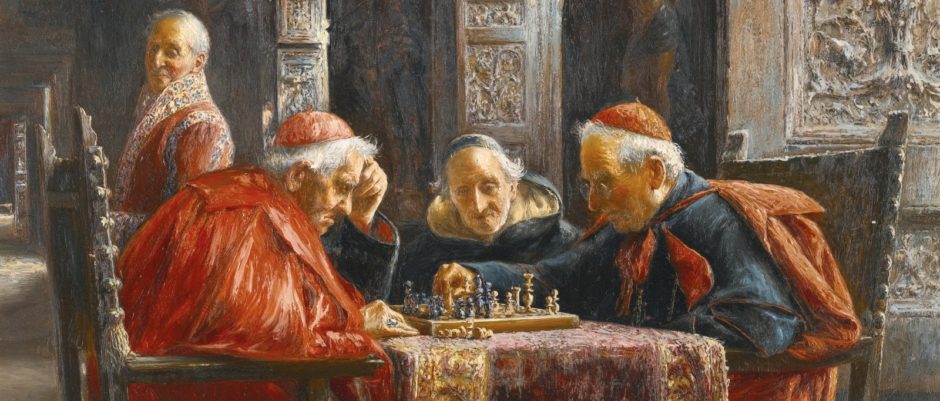
POLL: to chew or not to chew

There was a very spirited discussion in the last POLL post about Communion in the Hand.  There is also an active combox here.

The overwhelming response of readers of this blog responded that they prefer to receive normally on the tongue.  I applaud them.

I don’t think people who receive on the hand intend irreverence, but I contend that the generalized practice of Communion in the hand has severely damaged the faith of Catholic people in what the Church teaches about the Eucharist.

But there are other issues of reception of Communion which relate to the question of Communion in the hand or on the tongue.

Catholics believe that the Host and all small particles, the Precious Blood and small droplets of It, are the entire Body, Blood, Soul and Divinity of Jesus Christ.  This is the perfect and infallible teaching of the Church.  Every Catholic is bound to believe this and those who deny it are heretics.

However, we don’t really know how small is small, in the sense of our ability to recognize the accidents of bread and wine which remain after transsubstantiation.

Because we can’t recognize precisely when the accidents of bread or wine cease and the Real Presence of Christ in what remains has ceased, it is entirely reasonable to be cautious and conservative rather than casual and careless about what is a great Mystery.

Another question is how to consume the Host once it is administered by whichever method?

Chew or not?

Allow it to dissolve, soften and then swallow?

Hosts vary in size and consistency.

People have differing abilities to swallow.

Many people of a certain age who attended Catholic were strongly admonished by their teachers, probably sisters, never to chew.  They might have been told that that helps to keep some of the Host sticking to teeth.  They might have even been told by the pious and well-meaning that you hurt Jesus if you chew Him.

Assuming that you are receiving Communion through some normal means, with reasonably normal Hosts and not those ghastly (in my opinion) homemade "substantial bread" things, how do you consume the Host?

It is assumed that the conditions would be a little different if you are consuming by intinction, but you can still answer the question.

POLL CLOSED

How do you consume the Host?

  • Generally avoid chewing and allow It to dissolve or soften before swallowing (63%, 1,374 Votes)
  • Generally chew to some degree and then swallow (37%, 815 Votes)

Total Voters: 2,189

Posted in POLLS |
132 Comments

NEW TLM ANNOUNCMENTS

Every day I get notes from people asking me to be their college campus telephone poll, and advertise their TLM celebrations.

I am usually happy to do so, of course, especially for new TLMs placed on parish schedules.

But I am so overwhelmed with e-mail, I can’t possibly respond to everything.

So… use this entry to post announcements of TLMs for the near future.

Include the necessary who what when where how people need.  Post a parish site link if possible.

These Masses must be at approved churches/chapels in clear union with the Catholic Church.

This isn’t intended to be a discussion thread.

Remember:

NEW TLMs.

NEW TLMs.

NEW TLMs.

Not already scheduled, long-standing TLMs.

Posted in Brick by Brick, SUMMORUM PONTIFICUM |
26 Comments

POLL: communion in the hand

Do you believe that each particle of a Host is the Body, Blood, Soul and Divinity of Christ Jesus, God and man?

Do you receive Communion in the hand?

A reader sent two photos.  The first is of an unconsecrated communion host rest on the palm of a black glove.

This photo shows the fragments left behind.

"But Father! But Father!", some of you will perhaps be howling now.  "That’s a glove, not a hand!  We don’t know that that is what happens with hosts put into people’s hands!  That’s not fair!"

I grant that we don’t know.  I grant that palms are not gloves.   I grant that there are differences.

But …

Consider the lack of care with which many receive, how they move the Host around and handle it. 

Consider that often there is a more or less properly prepared EMHC also handling the Host.

Consider the condition of the skin of the palm. 

Consider the few seconds after a person transfers the Host from palm to mouth. 

Consider that the Host has been in contact not only with the palm, but the fingers of the other hand. 

Consider.

Let me be clear: I do not think people intend to be irreverent when they receive on the hand

Knowing that most Eastern Catholics have a different manner of receiving in both species, here is a question for you Latin Catholics.

POLL CLOSED

How do you Latin Catholics generally/habitually receive Holy Communion?

  • Directly on the tongue (including intinction) (84%, 2,425 Votes)
  • In the hand (16%, 474 Votes)

Total Voters: 2,899

Posted in Mail from priests, POLLS |
349 Comments

QUAERITUR: Biformal priests and the gravitational pull

I am guessing that this might freak out a few people, but here goes.   I received this from a regular reader via e-mail. 

My emphases.

A priest who regularly celebrates both forms of the Roman rite — and while celebrating the newer form sometimes finds himself through force of habit inserting gestures from the older form — forwarded to me the following question (regarding the particular GIRM 2002 norms appended below…):

"Given that Paul VI presumably did not foresee the regular celebration by priests of both the newer order of Mass and the traditional order, and given that Pope Benedict XVI sometimes appears to follow the older rubrics in ways not clearly consistent with the new rubrics — e.g., in regard to the gestures specified in No. 148 for the dialog before the Preface — how ought a ‘bi-formal’ priest interpret No. 42 of the IGMR 2002 as he attempts to celebrate faithfully both forms of the Roman rite, given a natural tendency for one form of celebration to influence the other over time?"

He has also mentioned Pope Benedict’s insertion of extra signs of the cross, e.g., before the priest’s communion. More generally, how is "the traditional practice of the Roman rite" to be interpreted, now that the Roman rite juridically has two equally valid forms

I myself wonder whether Pope Benedict might actual hope that some such "mutual enrichment" will occur.

—————————————-
GIRM 2002
Movements and Posture

42. The gestures and posture of the priest, the deacon, and the ministers, as well as those of the people, ought to contribute to making the entire celebration resplendent with beauty and noble simplicity, so that the true and full meaning of the different parts of the celebration is evident and that the participation of all is fostered. Therefore, attention should be paid to what is determined by this General Instruction and the traditional practice of the Roman Rite and to what serves the common spiritual good of the People of God, rather than private inclination or arbitrary choice.

"Bi-formal"…. what a term!

This raises good questions.

My own opinion is that Pope Benedict foresees that this "mutual enrichment" will take place over time.  It must.  I use the image of "gravitational pull", because I think that the newer form will be drawn more closely to the older form, and not the other way around.  I suspect that is what the Pope had in mind as well, namely, that the older should influence the newer, more than the newer would influence the older.  

Eventually, over who knows how long, perhaps there might be a kind of tertium quid which emerges organically from the dynamic of the the two forms in one Roman Rite.

However it may go, as the ’60-’80’s crowd of priests goes to dust, the younger men – lacking the baggage of that previous generation – will carry the project forward.

But the priest who wrote the notes above puts his finger on something: in celebration of the Novus Ordo, a man accustomed to the older form, will very naturally tend to adjust the Novus Ordo in the direction of the traditional form.  But in his style, or ars celebrandi, and in certain gestures, he will "trad" the Novus Ordo.  Last night, for example, in a parish Mass – Novus Ordo/English/versus populum – I quite automatically kissed the altar at "we pray that your angel may take this sacrifice from this altar…", and I quite automatically genuflected before receiving from the chalice.  An "oops" ran through my head, but… I admit not with very much regret.  Those things were not exactly "doing the red", after all.  They were mistakes.  But are they perhaps mistakes – I don’t know – in the direction things are supposed to go?  They were mistakes … but… from the Roman Rite!

The 2002MR has the return of the oratio super populum for Masses during Lent.  It has, for example, a Vigil of Ascension (Thursday, of course).  So, in the formularies and calendar, there have been adjustments back toward Roman elements even before Papa Ratzinger was elected.

Benedict XVI, Papa Ratzinger, did not implement Summorum Pontificum so that he could create discontinuity between two separate forms of the Roman Rite.  Think about it.

Based on what I remember of my conversations with him about this very topic years ago, he foresees that this will jump start the organic process of a living liturgical develop which was so brutally interrupted by the artificial/academic pasting together and then imposition of the Novus Ordo in Advent 1969.

The question remains: Is living, organic development in the Church’s liturgical life possible without violations of the codified rubrics? 

Posted in ASK FATHER Question Box, Mail from priests, SUMMORUM PONTIFICUM |
83 Comments

PODCAzT 81: Benedict XVI’s Letter on SSPX excomms; your voicemail

A fast PODCAzT this time.

I am so grateful to the folks who sent the new microphone and the boom.  They really help.

In this session I read Pope Benedict’s Letter to Bishops on the lifting of the excommunications of the SSPX bishops and add some of my own comments both before and after.

Then I delve into your wonderful voicemail!

  • A question about the older, traditional form of Sacrament of Penance.
  • A big family devours eggplant.
  • A priest talks about woes in Austria and implementing Summorum Pontificum.
  • A father uses my PODCAzTs to keep his kids quiet.

Wonderful!

In the meantime, I think the iTunes feed is working as long as this blog entry doesn’t scroll off the feed.  At least that is my present theory.


https://zuhlsdorf.computer/podcazt/09_03_13.mp3

Posted in Brick by Brick, Mail from priests, PODCAzT, SUMMORUM PONTIFICUM | Tagged , , , , ,
10 Comments

Fr. Finigan thanks his supporters in the best way

his Hermeneuticalness posted this notice:

Many thanks to all of you who have sent in contributions for vestments for the Sacred Liturgy via Damian Thompson’s Holy Smoke blog, and Fr Zuhlsdorf’s "pound Fr Finigan" campaign on his blog What Does the Prayer Really Say?. Tomorrow morning’s Mass (EF) will be offered for your intentions.


Lovely.  Thanks, Father!

Posted in Just Too Cool, Mail from priests |
8 Comments

POLL: chasubles

While the texts and gestures of Holy Mass are fixed in the official liturgical books, many other elements of the sacred action may be adapted to circumstances, cultures and customs.

We have great, though not unlimited, freedom with music, architecture, vessels and vestments.

Consider, for example, the various shapes of the vestment the priest wears during Holy Mass: the chasuble. 

There are the fuller "gothic" style and its many variations, the "Roman" style and its multiple alterations.  They can be full, long, wide narrow, elaborate or simple.  But all are possible for Holy Mass.

The Church has from time to time designated preferences among the vessels, but flexibility was always recognized.  Today, we are not restricted by law to any particular style of vestments, though law does require a chasuble to be worn, when one is available, by the priest celebrant.

What is your preference and your reasons for your preference?

POLL CLOSED

Which style of priest’s chasuble do you prefer?

  • "Roman" and its variants (narrower and more open) (55%, 940 Votes)
  • "Gothic" and its variants (full and draping) (45%, 770 Votes)

Total Voters: 1,710

Posted in POLLS |
60 Comments

A sudden session of sweet silent thought

I just had a remarkable experience.  It may have been the strength and particular hue of the light in my room right now that triggered it.

In a flash a memory flooded back to my conscious mind of standing behind a chair at the table in the dining room of St. Agnes parish in St. Paul many years ago, in the earliest ’80s when I was a shiny new Catholic. 

There was once a remarkable culture to that place, often focused in that room around that table. 

Remarkable days and dead friends summoned in a remembrance of things past.

Posted in Linking Back |
14 Comments

Today’s reworking of an ancient prayer in the Novus Ordo

I was struck by the Novus Ordo today, the so-called "Prayer over the gifts".  It is, in the 2002MR, a reworking of a prayer in the 1962MR, in its own turn from the ancient Gelasian and Hadrianum and Paduense Sacramentaries.

SUPER OBLATA (2002MR):
Praesenti sacrificio, quaesumus, Domine,
observantiam nostram sanctifica,
ut, quod quadragesimalis exercitatio profitetur exterius,
interius operetur effectu.

This is a reworked version of a prayer in the 1962MR on Ember Saturday in Lent, in the 1st Week:

SECRET (1962MR):
Praesentibus sacrificiis, quaesumus, Domine,
ieiunia nostra sanctifica:
ut, quod observantia nostra profitetur extrinsecus,
interius operetur
.

Perhaps some of you will take a crack at these and determine what the differences are.

Posted in LENT, WDTPRS |
17 Comments

WDTPRS: Thursday 2nd Week of Lent – Post communionem (2002MR)

We continue our project of looking at the Post communions of Lent:

Thursday – 2nd Week of Lent

This prayer was in the 1962MR on the Friday of the 2nd Week of Lent.  But it was the Secret!  Astonishingly, Bugnini’s all-consuming experts moved it to be a Post Communion.

POST COMMUNIONEM (2002MR):
Haec in nobis sacrificia, Deus,
et actione permaneant,
et operatione firmentur.

Actio can refer to an "action" or, more precisely, to liturgical celebrations of the sacred mysteries.  Sometimes the Eucharistic prayer is called an Actio.  In a sacristy you might see a little pro memoria card framed for priests indicating the name of the local bishop so that the priest can say his name properly "infra Actionem … during the Eucharistic Prayer".  Interestingly, operatio is not simply a "work" or "labor" but also a "religious performance, service, or solemnity, a bringing of offerings".  That meshes nicely with the deeper Christian meaning of actio and gives us a hint as to how to translate this prayer with something more than just a superficial rendering.  There is a conceptual connection between actio and operatio.

Permaneo, which is basically, "to stay to the end; to hold out, last, continue, endure, remain; to persist, persevere" is also, interestingly, "to abide in a way, rule, or mode of life, to live by, to devote one’s life to" as is attested to in the Vulgate.  The L&S confirms that firmo means, “to make firm or fast, to strengthen, fortify, support” and also, “to strengthen in resolution, to encourage, animate” or even “to confirm, show, prove; to affirm, assert, declare, promise the correctness or truth of a circumstance, statement.”  There is a conceptual connection between permaneo and firmo.

The Daily Missal (Baronius Press – 2007):
May these sacrificial offerings, O God,
both endure in us in action
and be confirmed in effect.

The words actio and operatio, conceptually related "doing" connected to the verbs ago and operor, both have a connotation of sacred liturgical service.  At the same time, they can simply point to our own daily undertakings.  These layers of meaning overlap and show us how there must be a continuity between how we participate at Holy Mass and how we act outside of the sacred precincts of the church or chapel we frequent.   The highest form of active participation is the reception of Holy Communion in the state of grace following a willed, active receptivity to what has been carried out in the sacred action of the Mass.  Christ is the ACTOR par excellence in the Mass.  In the actions of the priest, Christ is acting as the Head of the Body.  In the actions and receptivity of the congregation, Christ is in action as the Body, responding to and being directed by the Head.  Both together form Christ, Christus Totus, raising sacrifice on high to the Father.  Our participation then must be first and foremost active receptivity so that we have what is good to give back to God.

The et… et construction and the connects in concept between the pairs of words is high evocative.  Perhaps you will have some ideas about this.

Consider

actio <–> permaneo  ongoing
operatio <–> firmo    solid


Posted in LENT, WDTPRS |
Comments Off on WDTPRS: Thursday 2nd Week of Lent – Post communionem (2002MR)























