RECENT POSTS OF INTEREST and THANKS!

Here are a few links to posts that are scrolling along.

Also, I happily thank those of you who have been so generous in making donations.  It is a real boost when they come in, very encouraging.  I pray for people who send donations and remember benefactors periodically at Holy Mass.  The latest list which I will take along, tomorrow, will include

JP, MC, JC, AS, DG, JB,
ST, NMcD, RB, KA, KB,
EL Jr., LG, JH, R&DG,
ML, DF, FPN, MR, MK,
PC, GL, J&GG, EP, RS,
RB (with the B and the M families)
KT, JM, MJH, SH, JD,
AM, SA, SO’M, HE, PM (just added a few minutes ago)….

I derive a special pleasure in donations that come from my “protest” buttons.  It’s all a game, of course, as you know.  But the foundation of the game is serious business indeed.

Some books have come in and items from my amazon.com wishlist, such as a small bottle of good olive oil.  What a difference it makes!  I had a priest friend over for supper the other day and used the oil. However, more and more often its seems amazon is not including a packing receipt with the name of the giver.  I am, therefore, obliged to address myself to the guardian angels of the senders, who know who you are.

Many thanks to all you readers for your prayers, thoughtful (mostly) comments, and regular visits.

I also want to thank those of you who used my link to go to donate to the US Archdiocese for Military Services.  I had a nice note from Archbp. Broglio thanking us all for the encouragement.

Posted in SESSIUNCULA |
Comments Off on RECENT POSTS OF INTEREST and THANKS!

A new twist on attacking the new, corrected translation.

Do you remember the “What If We Just Say Wait?” priest in Seattle?  Fr. Michael G. Ryan tried to rouse up a movement to block the process of the new, corrected English translation of the Missale Romanum.  He had a lot of help from the liberal camp and their megaphones such as The Tablet (aka The Bitter Pill).

The Bitter Pill is giving Fr. Ryan more space.   They do this on the eve of the implementation of the Order of Mass in the new translation in England.  And thus the editors of The Pill confirm their bitterness.  Why work so hard to turn people against the translation?  Cui bono?

In this week’s number of the Pill Ryan makes a case that priests should implement the new translation as it is rather than adjust it according to their own brilliant theological insights and English style.

Fr. Ryan is not, however, advocating acceptance of the new translation from – as far as I can tell – a positive  motive.  His basic premise is that if the new Roman Missal is read as is, without priests making changes to the text, then people will quickly see how bad it really is.

Here is the last part of Ryan’s piece with my emphases and comments.

[…]

I intend to implement the new Missal and not change a word, no matter how questionable or offensive I may personally find it. Why? Not because I am a legalist or a purist. No, I will make no changes because I am convinced that, after all the years of wrangling and behind-the-scenes manoeuvring (including the shelving of the elegant and accessible 1998 Icel translation), the only way the new Missal will have its full impact is if the People of God can judge it for themselves without edits of any kind. [Hasn’t that always been the case?]

This is another way of saying that the new Missal should be allowed to stand on its own and be judged for what it is, not for what we priests decide to make of it. I am of the opinion that the Missal will in time – I’m guessing not a long time – be judged deficient, but an informed judgement will never be made if we priests, even for the best of motives, give our people not the new Missal but our version of it. So we should do whatever is necessary to prepare our people for the new Missal but not take on the responsibility for making it work by doctoring or diluting it. [Say the Black – Do the Red?]

I will understand if our senior priest ­brothers, who offer their services to parishes that would otherwise not have a priest, want to avoid all this by staying with the present Sacramentary for the celebrant’s parts. (They could make a good case with their bishops [?] that there is already a precedent for doing so in the provision made for the use of the Tridentine Rite or in the liturgical accommodations being made for the new Anglican ordinariate.) [Ridiculous.  First, the Extraordinary Form and the Anglican Use aren’t translations.  Also, local bishops do not have the authority to allow priests to use books that are not approved for use.  When the new book comes into force, the former will no longer be approved for use.] The same might be true for some of our international priest brothers who have worked to master the current texts and who may find that the new ones are tantamount to learning a brand new language. [Does that strike anyone as convincing?]

But for the rest of us who are doing our best to face ever-increasing pastoral challenges amid the relentless, though rewarding, demands of parish life, and who still embrace the Second Vatican Council’s vision of a collegially governed Church [Oooo… a little dig there!] – and of a liturgy in which the people are able to participate fully [Perhaps Father has a limited view of what “active participation” is, but let that go.] – we will best serve our people if we give them the new Missal just as it is. I doubt they will be slow to let us know what they think.

He is probably right.  Some people will let us know, and quickly.  Most people won’t say anything.

I suspect that Fr. Ryan’s circle, which has undoubtedly been conditioned by relentless sour grapes, will echo back to him what he has said all along: “But Father! But Father!  This translation is sooooo baaaad.  Can’t we have the old book back?”  In another parish, where the priest has been more favorable and optimistic, people may have a more positive reaction.

We who live in echo chambers, and blogs, should have a care not to think we are being universally affirmed.

Fr. Ryan’s proposal reminds me of a story about a late Archbishop of St. Paul and Minneapolis.  When, back in the day, the deacon put his miter on the archiepiscopal head, he put it on backwards so that the lappets, the attached ribbons, fell down over the archbishop’s face rather than down his back.  When the deacon reached to correct the mistake, the archbishop said, “Leave it.  That way people can see how stupid you are.”

One is left to wonder which of them looked stupider, the deacon who made the mistake or the guy with the lappets in front of his face.

I grant that the analogy limps, since the implementation of the new translation is a done deal, and in no way do I mean to imply that Fr. Ryan is intellectually challenged.  The deacon wasn’t stupid, he just made a mistake.  By his writings you can tell that Fr. Ryan is an erudite fellow.  But his recommendation to leave the translation be so that people can see how bad it is doesn’t leave me edified.  It grieves me that a priest would hope the Church will look bad in the eyes of the people in the pews.  Isn’t that, in effect, what he is promoting?

The new translation is not perfect.  I show that in my own comparisons of the Latin and the new, corrected translation week in and week out… but I don’t harp on it.  I don’t think the translation is as bad as Fr. Ryan suggests, but – yes – it could have been better.

Also, if the way Rome dealt with the production of the translation wasn’t always flawless, those involved nevertheless overcame the institutionalized lethargy imposed in the name of “collegiality” by liberal enemies of greater fidelity to the Latin original (and therefore clearer theology), and got the job done.  It may be that Fr. Ryan was really concerned mostly about style.  Most people who don’t like the new translation don’t like that it reflects more clearly the content of the original.

Nevertheless, I embrace Fr. Ryan’s proposal: What If We Just Say The Black? Leave it as it it is.  His motive is different than mine, but the old adage “the enemy of my enemy is my friend” seems applicable.  Fr. Ryan is right, but for the wrong reason.  Priests should in fact just say what is printed on the page without imposing themselves on the text and on the people.

As a sincere gesture of good will, I have sent a Say The Black – Do The Red New Translation edition coffee mug to Fr. Ryan.

And to Latin Church priests who, for whatever reason, don’t like the new translation of the Roman Missal:

Say Mass in Latin.

Finally:

Posted in Liturgy Science Theatre 3000, Mail from priests, Our Catholic Identity, SESSIUNCULA, The Drill | Tagged , ,
45 Comments

1st Friday of September

Remember: Today is Friday… the 1st Friday of September.

Posted in Our Catholic Identity | Tagged
8 Comments

Making sacred art with “theologically appropriate” techniques

There is a very interesting post at NLM today by David Clayton about the interplay of painting technique and theology in the creation (or should that be “subcreation”) of sacred art.

In sum, the writer brings in the point that one technique of painting (yes, I know people say “writing”) icons is to apply first the darker layers and proceed with increasingly brighter layers to demonstrate a theological point: light over comes darkness.

But there’s more to it than that.  Apparently that is not how earlier icons were painted.

Questions arise.

Do those who make vestments have to stitch theologically?  Is it enough, or even necessary, to pray while making them?   How about making Hosts for Mass?  Should musicians bang, blow and scrape theologically?   Is there a theological bowing technique?  Should members of a schola cantorum breathe in a more theologically appropriate way?

Mind you, there could be a difference between theological and prayerful.

Does the process matter?

In the final analysis, do I care if the workers who build my church prayed, or raised the walls brick by brick, in a way that was theologically apt for the wall?

Check out the NLM article.

Posted in "How To..." - Practical Notes, Brick by Brick, Just Too Cool | Tagged , , ,
21 Comments

Proper attire in and proper liturgical music

You should be checking out The Chant Cafe with some regularity.   I saw this over there.

I thought it was apt, considering I have also lately seen a few posts out there in the blogosphere about proper attire in church.

Let’s say I have a restaurant and I hope for people to be dressed properly so I establish a rule.

To eat here, you can wear: 1) black tie and traditional evening wear, 2) a suit and tie or long party dress, 3) a very nice sport coat and tie or cocktail dress or suitable woolen pants, or 4) some other neat clothing that is suitable to the atmosphere and culture of this restaurant.A couple shows up. He is wearing torn jeans and flip flops. She is wearing a bikini and sandals. They both claim option 4. The argument ensues. You can imagine the rest.

Now have a look at the description of the entrance rite for Catholic Mass from the General Instruction. Please read carefully.

When the people are gathered, and as the Priest enters with the Deacon and ministers, the Entrance Chant begins…. This chant is sung alternately by the choir and the people or similarly by a cantor and the people, or entirely by the people, or by the choir alone. In the Dioceses of the United States of America, there are four options for the Entrance Chant: (1) the antiphon from the Missal or the antiphon with its Psalm from the Graduale Romanum, as set to music there or in another setting; (2) the antiphon and Psalm of the Graduale Simplex for the liturgical time; (3) a chant from another collection of Psalms and antiphons, approved by the Conference of Bishops or the Diocesan Bishop, including Psalms arranged in responsorial or metrical forms; (4) another liturgical chant that is suited to the sacred action, the day, or the time of year, similarly approved by the Conference of Bishops or the Diocesan Bishop.Now think of what happened this past week in your parish. Do you recognize any similarities between that and the description above? Oh yes, option 4.

Check out The Chant Cafe and visit their combox too.

Posted in "How To..." - Practical Notes, New Evangelization, Our Catholic Identity, The Drill | Tagged , , , , ,
24 Comments

HUGE SIGN FAIL

At Ironic Catholic there is a photo of an amazing sign via Fail Blog.

Posted in Lighter fare, SESSIUNCULA |
15 Comments

What the Devil fears

Over at Vultus Christi there is a great post about Bl. Ildephonso Schuster, OSB, the Archbishop of Milan who died in 1954.  John Paul II declared him Blessed in 1996.

Bl. Ildephonso was one of the great liturgists of his day and was renowned as a holy man.

Vultus has a great quote:

As Cardinal-Archbishop, Blessed Schuster never failed to direct the energies of his priests toward the One Thing Necessary. A few days before his death he withdrew to the seminary he had built and there he delivered a final message to his seminarians, warning them of the futility of an apostolate without personal holiness:

I have no memento to give you apart from an invitation to holiness. It would seem that people are no longer convinced by our preaching; but faced with holiness, they still believe, they still fall to their knees and pray. People seem to live ignorant of supernatural realities, indifferent to the problems of salvation. But when an authentic saint, living or dead passes by, all run to be there. . Do not forget that the devil is not afraid of our [parish] sports fields and of our movie halls: he is afraid, on the other hand, of our holiness.

Go over to Vultus Christi for more.

Posted in "How To..." - Practical Notes, Just Too Cool, Our Catholic Identity |
8 Comments

If it’s broke, have a belt…

… and fix it.

I tend not to throw broken things away until I have tried to fix them.

I also don’t want anyone to wind up in hell, either. But that’s another topic.

Not too long ago, while traveling, my belt buckle broke, just fell apart. I stuck the pieces in my suitcase and brought them home.

Today I got out my ittybitty screwdrivers and repaired the belt. Belts are expensive!

This belt is reversible. The buckle is supposed to rotate (not fall off).

20110901-053744.jpg

20110901-053815.jpg

20110901-053822.jpg

20110901-053827.jpg

Belt recovered.

Use your stuff wisely.

Posted in SESSIUNCULA |
14 Comments

Description of Archbp. Chaput’s upcoming “installation” in Philadelphia

Latin Rite Ordinary Form ceremonies are, in my opinion, not as significant as the older Extraordinary way of doing things.  I have in mind the ceremonies surrounding, for example, the consecration of a church and its altar.

That said, the newer ceremonies are not nothing.

Here is a piece on the blog of CNS about the ceremony in which Archbishop Charles Chaput will be “installed” as the Archbishop of Philadelphia on 8 September.

PHILADELPHIA — There will be no knocking on the door when Archbishop Charles J. Chaput arrives to the Cathedral Basilica of Sts. Peter and Paul in Philadelphia on the feast of the Nativity of the Blessed Virgin Mary.

The custom of knocking on the cathedral door, which has been done by some U.S. bishops when they were received at a new diocese, is not a practice that the church prescribes for such a ceremony.  [It is, however, in the Extraordinary Form of the consecration of a church.]

What is called for in the church’s “Ceremonial of Bishops” is being followed closely for the reception of Archbishop Chaput, formerly of Denver, to Philadelphia.

According to Father Dennis Gill, director of worship for the archdiocese, here’s how the Sept. 8 service will go down. [well… “will progress”?  “will be ordered”?]

Archbishop Chaput, accompanied by Cardinal Justin Rigali, will be received at the door of the cathedral by the rector, Msgr. Arthur E. Rogers, who will present a crucifix and holy water. The archbishop will kiss the crucifix and sprinkle himself and those present with holy water.

They process into the cathedral and after kissing the altar, Cardinal Rigali takes his place at the cathedra and Archbishop Chaput takes a seat across the sanctuary next to the ambo.

The apostolic letter announcing the appointment of Archbishop Chaput to the Archdiocese of Philadelphia is presented and read.

Cardinal Rigali crosses the sanctuary and escorts Archbishop Chaput to the cathedra, the seat of the bishop.

The new archbishop is greeted by representatives of the local church; first by auxiliary bishops, then by clergy, women religious and lay people and lastly by civic officials and representatives of other faiths.

From this point, the Mass continues.

Archbishop Chaput has decided to give his first homily as archbishop of Philadelphia from the cathedra rather than from the ambo, according to Father Gill.

In giving media the rundown [why not just call it “the skinny” or “the straight dope”?  Since “go down” was used above, why not the “low-down”?] on the ceremony yesterday, the priest also mentioned that Archbishop Chaput had two special song requests for the installation [That word always leaves me thinking of spark plugs… software… silos…] service: “Gift of Finest Wheat” and “O God Beyond All Praising.” [I not too keen about the first, but the second is good.  Melody by Holst, no?] Both hymns are being included in the Mass.

CNS has its own combox, which you can visit.

Posted in "How To..." - Practical Notes, Brick by Brick, Liturgy Science Theatre 3000 | Tagged , ,
38 Comments

The Theological Studies dust up, NCR, creeping infallibility, and the ecclesial vocation of the theologian

There is a bit of a dust up concerning the journal Theological Studies, a prominent English language publication, sometimes useful and much venerated by liberals.

In 2004 Theological Studies published an article by two theologians arguing that the Church should change her teaching on the indissolubility of marriage.  Their article was published in full.  Two theologians, Germain Grisez and Fr. Peter Ryan, tried to respond in the pages of the same journal, to defend the Church’s teaching on marriage.  Theological Studies published the response article in June 2011, apparently after slow pressure was applied by the Congregation for the Doctrine of the Faith.  However, TS substituted their own comment in place if the author’s abstract, stating in a kind of disclaimer: “Except for minor stylistic changes, the article is published as it was received.”

However, Grisez and Ryan had actually adjusted their article after receiving feedback from peer review imposed by Theological Studies.  Grisez and Ryan submitted their adjusted article in 2009 and again in 2010, having used also the feedback.

TS was then going to publish Grizez and Ryan’s response in a truncated form, having cut out salient points and thus weaken their response to the 2004 piece.  The Congregation for the Doctrine of the Faith got involved.  Subsequently, 7 years after the fact, TS published the response article as submitted.  Those are the basic facts as I understand them.  The accounts are a little confusing.

CNA wrote a good and accurate summary about this here.  On the site of Catholic World Report there is also a good and accurate article about this with links to the articles in question and statements from those involved. A PDF of Grisez and Ryan’s article as it appears in Theological Studies can be read here, and a PDF of the Himes-Coriden article to which they were responding can be read here.

NCR has a couple articles about this.  NCR, however, probably through an error, left out that Grisez and Ryan had used peer review feedback.

It is all a bit confusing, but the bottom line is this.   To repeat: Theological Studies published an offering which asserted a contradiction to divine law clearly enunciated by the Church.  Two theologians responded with a defense of the proper teaching.  They went through some peer review at the behest of Theological StudiesTheological Studies still didn’t want to publish it in full.  When the CDF got involved – remember: the CDF is supposed to get involved when doctrine has been distorted, and it had been in the pages of Theological Studies Theological Studies started to play ball, with apparent reluctance.

Now NCR and their camp are now upset that Theological Studies had to publish the full response article defending Catholic teaching.

For example, Mr. Thomas Fox of the NCFishwrap wrote:

We report today that the Vatican’s orthodoxy watchdog department, the Congregation for the Doctrine of the Faith, has sharpened its focus on the way theology is being conducted in our church today. The purpose of the congregation is to uphold Catholic doctrine. The congregation, however, misconstrues its role when it becomes the arbiter of what constitutes Catholic theology, managing and even squelching discussions within the theological magisterium. Doctrine and theology should have separate places in the Catholic lexicon. …. [I]t is essential that journals like Theological Studies are free to support healthy discussions — and are not intimidated for engaging in them.

[…]

The problem here is that Theological Studies did not engage in anything “healthy” when it came to the responding theologians.

Another problem, and I am sure you spotted it, rests in the phrase “theological magisterium”.

I am pretty sure that what Fox means to imply here is that there is a “magisterium” exercised by theologians apart from the Magisterium as we understand the term today.

Strictly speaking, the term Magisterium is the teaching authority of the Roman Pontiff and the bishops as the successors of Peter and the Apostles.  It is part of the office of the hierarchy to teach official in the name of the Church and of Christ.  Theologians do not have that authority.  Theologians work to serve the Church’s teaching office, the Magisterium, exercised by the hierarchy, but they do not teach in the same way in place of the hierarchy or on their own.   That doesn’t mean that theologians are merely the mouthpieces of the hierarchy.  They are not enslaved.  They can indeed stretch out beyond Magisterial definitions, but always in the service of the Magisterium.  Theologians play an important role in explaining the Church’s teachings, making them fresh and understandable in each new generation.  They explore the implications of new developments.  But while the hierarchy can oblige Catholics the accept certain teachings, theologians cannot.

More over, theologians aren’t just scholars engaged in research or professional teachers.  If they are truly Catholic theologians they must also bear witness to the faith in their work.  They must be believers, faithful to the Magisterium, accepting the Church’s teachings, even when they are hard.  Insofar as theologians are also faithful and bearing witness to the Faith as the Church teaches, in that sense they edify and by analogy have a kind of magisterium of faithful witness.  The many of the Fathers and Doctors of the Church are examples of this.  Doctors such as St. Teresa of Avila and St. Therese of Lisieux are both Doctors of the Church though they were not members of the Church’s hierarchy.  They reflected in their lives and works something of the Church’s role as Teacher.  Their writings, however, do not bind our consciences in the way that defined doctrine binds us.  Even a great Bishop and Doctor such as Augustine of Hippo’s works are not the equivalent of the Church’s Magisterium.

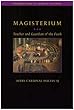
If you want a good examination of the Magisterium, try the late Card. Avery Dulles’ book Magisterium. Every seminarians and priest needs this book, by the way.  Also read the CDF’s Instruction on the Ecclesial Vocation of the TheologianNCFishwrap is a bit obsessed about papal authority and what they perceive as “creeping infallibility“.  But I digress.

That said, here is another bit from Mr. Fox:

Yes, the papacy should be the final authority in the church, but it has now become the only authority. Yes, theologians will always be prone to mistakes. Theologians must be true to their role and criticize one another, and at times the hierarchical magisterium must step in. However the magisterium cannot just tie itself to one school of theology and condemn all others.

Today little doubt exists there is a widening gap between many theologians and the episcopal magisterium. Some tension in this area will always exist, but the present gap is not good, not healthy.

Again, I don’t think what Theological Studies did was healthy at all.  TS should have published the response article, as adjusted by its authors after peer review without the CDF or any other referee having to get involved.

Think about what happened.

The CDF did not make the editor of Theological Studies publish a repudiation of the 2004 article.  All the CDF did was get them to publish an article defending Catholic teaching in response to an article contrary to Catholic teaching.

That’s what Mr. Fox calls “squelching”?

Another Fishwrap writer, Phyllis Zagano, promoter of the ordination of women to the diaconate, in her NCFishwrap defense of Theological Studies called the CDF the “Vatican Thought Police”.  This comparison will leave any reasonable and well-read person puzzled, because of its tone and by reason of the comparison itself.

Think it through. In 1984, Orwell’s Thought Police (the CDF on Fishwrapworld) suppressed and punished thoughtcrimes.  But it was Theological Studies, not the CDF, which suppressed the thoughtcrimes of the responders Grisez and Ryan.  The CDF wanted to make sure the other side of the argument was heard and not suppressed.  Zagano’s comparison isn’t very apt.

It is, however, pretty mean.

Then again, in the past, Ms. Zagano attacked Bishop Robert Finn of Kansas City-St. Joseph through a similarly weird, though far meaner, comparison.  She drew a moral equivalence between Bishop Finn and Arnold Schwarzeneger (unfaithful husband), Anthony Wiener (odd-ball misuser of Twitter), Dominque Strauss-Kahn (accused, possibly falsely, of attempted sexual abuse) and Egyptian businessman Mahmoud Abdel-Salam Omar (accused of sexually abusing a hotel maid), putting them all on the same team.  Read about that here.  And when I defended Bp. Finn, Zagano started attacking me.   But I digress.

Make up your own minds about this, but it seems to me that NCR doesn’t like the fact that someone on their team, Theological Studies, was required to play fair.  Furthermore, they are continuing with their campaign to support alternative “magisteria” over and against that of the Roman Pontiff and bishops in union with him.

Posted in Biased Media Coverage, Mail from priests, The Drill | Tagged , , , , , , , , , , , , ,
16 Comments