WDTPRS – Sunday after Ascension COLLECT (1962MR): the hour of need

The Collect for this Sunday is an ancient prayer, found in the Liber sacramentorum Augustodunensis (9th c.) and Liber sacramentorum Gellonensis (8th c.).

COLLECT – (1962MR):
Concede, quaesumus, omnipotens Deus:
ut, qui hodierna die Unigenitum tuum Redemptorem nostrum
ad caelos ascendisse credimus;
ipsi quoque mente in caelestibus habitemus.

Our hard working Lewis & Short Dictionary can have a little rest.  There is nothing especially noteworthy in the vocabulary.  Let us therefore move on to a straight-forward…

LITERAL TRANSLATION:
Grant, we beseech You, Almighty God,
that we, who believe Your Only Begotten Son our Redeemer
to have ascended on this day to heaven,
may ourselves also dwell in mind amongst heavenly things.

Bl. Abbot Columba Marmion, OSB (+1923), wrote in Christ in His Mysteries that

of all the feasts of Our Lord … the Ascension is the greatest, because it is the supreme glorification of Christ Jesus.”

Then, speaking about the very Collect we are looking at today, Bl. Columba says,

“This prayer first of all testifies to our faith in the mystery in recalling the title ‘Only-begotten Son’ and ‘Redeemer’, given to Jesus, the Church shows forth the reasons for the celestial exaltation of her Bridegroom;—she finally denotes the grace therein contained for our souls. … The mystery of Jesus Christ’s Ascension is represented to us in a manner suitable to our nature: we contemplate the Sacred Humanity rising from the earth and ascending visibly towards the heavens.”

Of course it is not only Christ’s humanity but our humanity that ascended into heaven.

Preaching on 1 June 444 St. Pope Leo I “the Great” said,

“Truly it was a great and indescribable source of rejoicing when, in the sight of the heavenly multitudes, the nature of our human race ascended over the dignity of all heavenly creatures, to pass the angelic orders and to be raised beyond the heights of archangels. In its ascension it did not stop at any other height until this same nature was received at the seat of the eternal Father, to be associated on the throne of the glory of that One to whose nature it was joined in the Son.”

Leo says in another sermon of 17 May 445,

“This Faith, reinforced by the Ascension of the Lord and strengthened by the gift of the Holy Spirit, has not been terrified by chains, by prison, by exile, by hunger, by fire, by the mangling of wild beasts, nor by sharp suffering from the cruelty of persecutors.  Throughout the world, not only men but also women, not just immature boys but also tender virgins, have struggled on behalf of this Faith even to the shedding of their blood.  This Faith has cast out demons, driven away sicknesses, and raised the dead.”

The knowledge that our humanity is now enjoying heaven can work wonders for us in the hour of need. Keep this in mind in time of trial.

We Catholics know that what was not assumed, was not redeemed (St. Gregory of Nazianzus).  Our humanity, body and soul, was taken by the Son into an unbreakable bond with His divinity. When Christ rose from the tomb, our humanity rose in Him.  When He ascended to heaven, so also did we.  In Christ our humanity now sits at the Father’s right hand.  His presence there is our great promise and hope.  It is already fulfilled, but not yet in its fullness.  That hope informs our trials in this life.

When the Lord ascended to heaven He did not lose touch with us His people in this vale of tears.  St. Augustine in s. 341 talks about Christ’s presence in every word of Scripture as Word equal to the Father; or as the mediator in the flesh dwelling in our midst; or Christ as the Head and Body together as in a spousal relationship, Christ and His Church intimately bound.

This means that Christ is not insensible to our sufferings.  Our faith in this unbreakable bond of Head and Body calls us to be clean and worthy of this saving intimacy.

Posted in WDTPRS |
2 Comments

Brick by Brick in Croatia

Brick by Brick in Croatia.

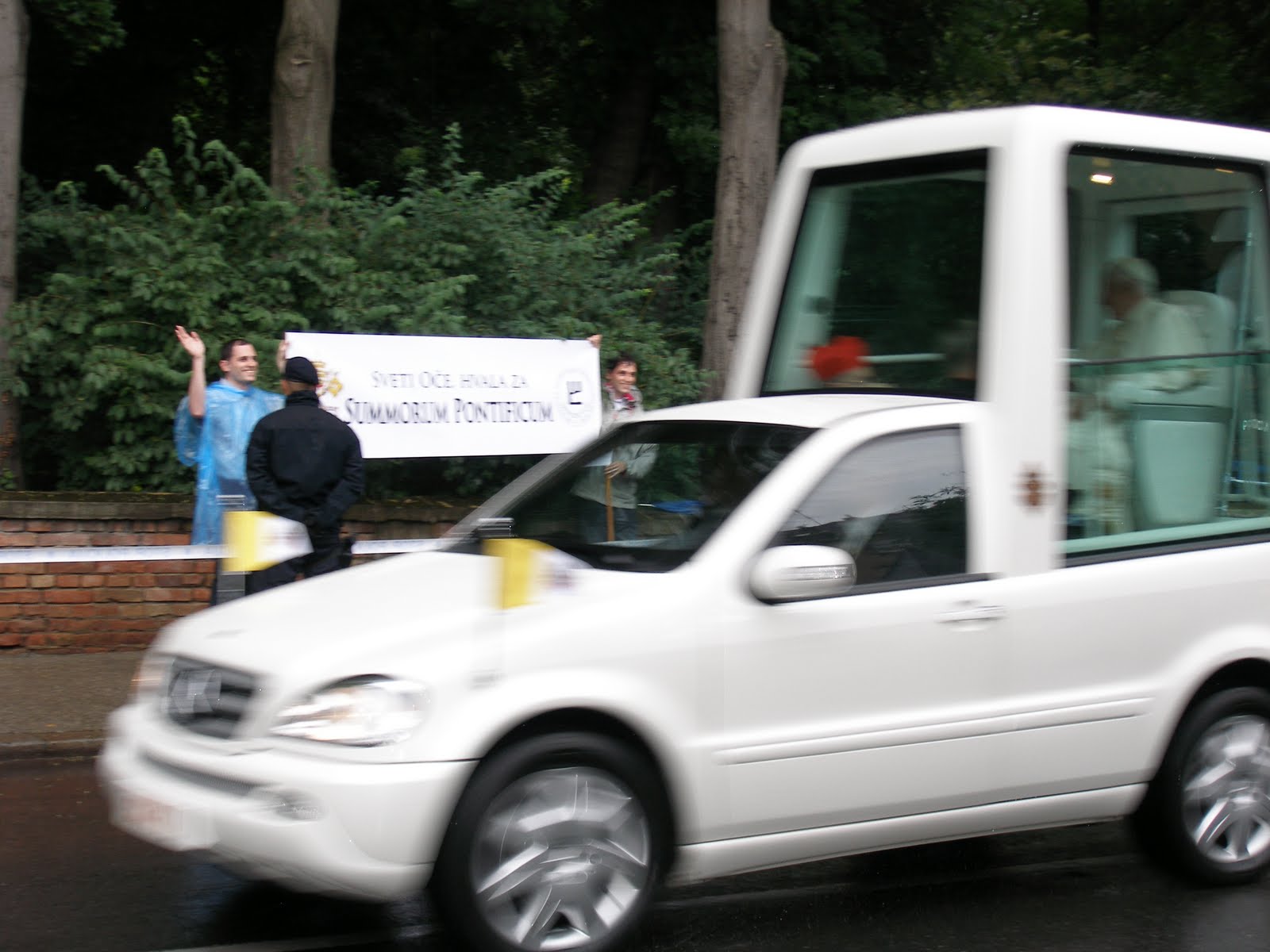
On the blog of Toma Blizanac i brat Marko (click, to give their stats a nice spike!) I see that some young fellows thanked the Holy Father, during his visit, for Summorum Pontificum.


Here you can see the Holy Father, looking at the sign as he passes.

Thank you, Holy Father, for Summorum Pontificum.

Posted in Brick by Brick, Lighter fare, SUMMORUM PONTIFICUM | Tagged ,
9 Comments

ATTENTION PRIESTS: Low Mass training seminar – USA – 12-16 September

There will be a training seminar in the USA for priests to learn the Extraordinary Form. It is offered by the FSSP. Click here for the page.

This five-day training workshop is hosted by Our Lady of Guadalupe Seminary in Denton, Nebraska.

Upcoming dates for Extraordinary Form Seminars:

Low Mass September 12 – 16, 2011 (Monday – Friday) $400.00

Posted in "How To..." - Practical Notes, SUMMORUM PONTIFICUM, The Campus Telephone Pole | Tagged , , ,
3 Comments

QUAERITUR: How to prevent a priest from ad-libbing during Mass

From a reader:

I hung around after Confession today to go to daily Mass at the Cathedral, and when the priest got to the part that’s normally, “Happy are those who are called to His supper,” the priest completely re-wrote it to, “Blessed are we who are brought to communion in this church.”

My understanding is the new translation’s style of language will make it more difficult for priests to ad lib. What can the new translation do to prevent priests who don’t just ad lib or change a word, but literally completely re-write parts?

What is to prevent a priest from ad libbing?

Off the top of my head I can think of a couple things.

First, abolish the use of the vernacular.

Second, and probably more feasible, would be to place a special server, a member of the Liturgical Police, in the sanctuary with a taser gun.  Tase the priest when he starts abusing the congregation through his ad-libbing.
Perhaps the taser gun could be black and red, just as a reminder.

After that, we all know what bishops and fellow priests ought to be doing in such a priest’s regard.

Lay people might offer strong expressions of disapprobation together with suggestions that the collection might not be all the priest would desire unless he shuts up and prays, if you get my drift.

What is to prevent ad-libbing?

Who knows.

Posted in "How To..." - Practical Notes, ASK FATHER Question Box, Liturgy Science Theatre 3000 | Tagged , ,
52 Comments

QUAERITUR: How to prepare for participation at Mass in the Extraordinary Form

From a reader:

I am a great fan of your blog and I learn a lot on a regular basis.
However, I am new to WDTPRS- have you in the past given tips and hints on how to start out in the 1962 Missal?

This seems like it would be good not only for me but for many other readers as well. For a Catholic like me, who knows the modern Church well but nothing pre-Vatican II, I would benefit from even more basic info.

The first thing I can suggest is going to Mass in the Extraordinary Form as often as you can.  Looking at the texts ahead of time will help.  Don’t sit in the front, at first.  If you sit a little farther back you can see what other people are doing in regard to posture.

Having a good hand missal will help as well.  The beautiful missals from Baronius Press or Angelus Press are marvelous aids for full, conscious and active participation.

There are often booklets available at churches where the older Mass is offered.  They are helpful too.

You could also look for resources online.  There are many places on the web which give the whole order of Mass and the day’s prayers.  For example, you could go to Divinum Officium and see the day’s Mass in Latin and English side-by-side.  You might want to use a missalette for the Novus Ordo and then compare them to each other, for the order of Mass at least, before going the first time.

There are also numerous videos on line and on DVD.  For a really solemn Mass, a Pontifical Mass with commentary, the Paulus Institute has a DVD of a spectacular Mass that was broadcast on EWTN.  There are a great number of videos on youtube.

After that, just try to experience Holy Mass in the Extraordinary Form.

Another thing.  You may be coming from a parish where you have been told that “active participation” means that you have to be doing something outwardly.  If you aren’t singing everything or saying everything or looking at the priest look at you, then you aren’t participating.  Critics of the older form of Mass claim that the congregation is forced to be “passive”.

That’s simply false.

True active participation is active receptivity to what Christ, the true Actor during Mass, wants to give us through Holy Church’s liturgical worship.  Our baptism makes us capable of participating at Mass and then we engage our will and minds to follow carefully the words and gestures of the sacred action.  This culminates in the perfect form of active participation, which brings the outward and physical and the inward and spiritual together: the reception of Holy Communion in the state of grace.

What I am aiming at here is that you may need a deeper view of what “active participation” means so that you are not from the very first moment left scratching your head about what to do or why people aren’t more outwardly expressive.  They aren’t passive, friend.  Not in the sense critics use.

I don’t think this should be seen as hard or daunting.  After all, lots of people over the centuries got along very well with the older form of Mass, people of every age and level of education.  It isn’t a mystery, even if it is the mystery, if you get my meaning.

Perhaps some of the readers here will have their own suggestions, based on their own experience.

Posted in "How To..." - Practical Notes, ASK FATHER Question Box | Tagged , , , , , ,
15 Comments

QUAERITUR: Starting a novena in the state of moral sin

From a reader:

Can a person in the state of Mortal Sin begin a Novena with the intention of going to Confession as soon as possible? It seems it won’t be efficacious if the soul was in sin when beginning a novena.

No prayer is in vain.

Certainly you can begin a novena of prayers even in the state of sin.  That seems like a very good time to start a novena of prayers, as a matter of fact, asking in particular the grace to make a good and thorough confession.

Just do it.

Posted in "How To..." - Practical Notes, ASK FATHER Question Box | Tagged , ,
7 Comments

Prayer before connecting to the internet – UPDATE! – New language

A long time ago now, I wrote a prayer for people to use before they got online and used the internet.  Originally in Latin, it has been translated into many languages (sometimes more than once).

I often forget to pray before using the internet.  I often fail in charity when using it.  This tool of social communication and research and entertainment has amazing upsides and spiritually deadly perils.  We all should be very careful in how we use it – and through – use each other, “use” in the finer sense of “treat”.

It has been a long time since I have received a new language version, but today I found a new one in my email box.

HUNGARIAN!

Az internetre lépés előtti ima:

Mindenható Atyánk, örök Isten,
aki a te képedre alkottál meg minket,
és azt parancsoltad nekünk, hogy keressük, ami jó, igaz és szép, különösen a te egyszülött Fiadnak, a mi Urunknak, Jézus Krisztusnak személyében, add meg nekünk, kérünk, hogy Szent Izidor püspök és egyháztanító közbenjárására az interneten való bolyongásaink közben kezünket és szemünket a neked tetsző dolgokra irányítsuk, és mindenkit, akivel találkozunk, szeretettel és türelemmel fogadjunk.
A mi Urunk, Krisztus által. Ámen.

I invite new versions. I would especially welcome an audio file of a native speaker of a language reading the prayer so that we can hear how it sounds.

Furthermore, at one point of other when the blog was moved to a different server, some of the international characters in some languages on the Internet Prayer Page got scrambled. The Korean and Mandarin versions, for example, were pretty much ruined. There are problems with characters in Croatian, etc. Furthermore, some of the versions I have posted are actually graphics rather than texts. Now that I know more about converting characters to code, I could use some help from you global readers in tidying up the page.

If you can send new versions, or help to fix some of the problems in those present, I would be grateful.

Posted in "How To..." - Practical Notes, Brick by Brick, Linking Back, New Evangelization, Our Catholic Identity, The Drill, The future and our choices | Tagged , ,
6 Comments

Fr. George Welzbacher – 60 years a priest – ad multos annos

I wrote this yesterday, and sent it to the blog from my phone, but it just didn’t post.

Yesterday I was at a luncheon held by priests for a friend of many years, Fr. George Welzbacher, who is today celebrating his 60th anniversary of ordination to the priesthood.

From time to time I have posted items from his “Pastor’s Page”.

Fr. Welzbacher is one of the smartest men I have ever met, one of the finest gentlemen in the true sense I have ever met, and one of the best priests I have ever met.

Please, kind readers, say a prayer for Fr. Welzbacher, and for an increase in vocations to the priesthood.

20110602-030549.jpg

20110602-030833.jpg

Posted in Just Too Cool | Tagged
7 Comments

REVIEW: Guessing how to sing that prayer? Not any more. Canticum Clericorum Romanum, Vol. I.

Clerics! Seminarians! Rejoice!

I received a new book for review from the Canons at St. John Cantius in Chicago.

This is a book they prepared.

Here is the LINK.  Before I even tell you about it, it costs US$275.

Worth every penny.

This is a book, if you are a priest, seminarian, lay person involved in liturgical worship in the Extraordinary Form, You.Should.Buy.

Go to the site.  They have some useful PDFs.

Priests, deacons (actual deacons and priests who serve as deacons), laymen who serve as “straw subdeacons”… must sing texts.  You wind up looking at examples of paradigmatic texts in, say, the Liber Usualis, and then you look at the Missale, perhaps making a photocopy, perhaps penciling in lines under the vowel where you are supposed to go up….

Sound familiar?

This book has it all.  Or almost this book, because it is volume ONE.

20110603-102033.jpg

20110603-102044.jpg

Adequately bound.    I am not quite sure it needs this many ribbons, but anything worth doing is worth over doing.

20110603-102053.jpg

The cover extends beyond the gilded pages, which will help to protect them

20110603-102103.jpg

The book is large enough to be held and, importantly, read easily.

20110603-102123.jpg

What’s in this book?

All the tones a priest, deacon or subdeacon, needs to sing every oration that must be sung during a Solemn (or Sung) Mass in the Extraordinary Form.

Wanna practice?   Every Sunday – even all the orations of Holy Week – you can work with musical notation for all the orations and all the readings for Mass rather then guess how to sing them.

20110603-102151.jpg

I am a good singer.  I know Latin.  I know how to sing an oration and readings in various tones.   But I make mistakes when I have to do them on off the cuff.

For priests who don’t have such a formation, it must be very hard to work up singing a reading from a Letter of St. Paul, a long Gospel.

Father… have a Solemn Mass?  You could sing directly from this book.  It will even lie open well on an altar stand (I tried it).  The binding is sewn.

It is not the most elegant binding.  It is uneven through the volume.  But it will last and the book lies open.

20110603-102202.jpg

Think about this.

Imagine you are a lay person, a member of group which wants the older form in your parish.  The priest is willing, but maybe reluctant.  He has looked at the Extraordinary Form but it is all still intimidating.  He was never trained in the chants, the music, what to sing.

You can buy this book and he can work from it.

This book can take a lot of guesswork and anxiety out of a more solemn, sung Roman Rite.

Also, nothing… nothing like it exists for the Ordinary Form.

Do you want to know how Roman orations are sung in their simple and solemn and ferial tones?

Don’t guess from a template.  But the book.

Give this book to every priest and seminarian and BISHOP you know.  Every BISHOP needs this book.

Here is how it is described:

This the perfect companion to the 1962 Missale Romanum at any sung Mass—whether it is the Missa Cantata, the Missa Solemnis, or the Missa Pontificalis!

Buy.

UPDATE:

I agree with the comment made over at Rorate that the titles on the pages for the Sundays and feasts, and even some rubrics within the chant staves, should have been in Latin. Not Latin, for Latin’s sake, but rather to make it more language-group neutral and therefore, perhaps, more marketable.

Posted in "How To..." - Practical Notes, Brick by Brick, Just Too Cool, REVIEWS, SESSIUNCULA, SUMMORUM PONTIFICUM | Tagged
7 Comments

Who will be the next Archbishop of Milan?

Pay attention to what happens in Italian Church politics and developments.

The intrepid Andrea Tornielli today reports that Angelo Card. Scola (Patriarch of Venice), and not Gianfranco Card. Ravasi, (Pres. Pont. Council for Culture) is on the short list to be the next Archbishop of Milan, along with a few others.  Apparently, the Congregation for Bishops will soon be meeting to look over the list of possible prelates and then make recommendations to the Holy Father.

Tornielli adds:

It is the first time in about a century that the naming of the Archbishop of Milan, the largest and most important diocese in Europe and one of the most important in the world, will come about according to the usual process as for other dioceses: for many decades the naming of the pastor of the Ambrosian Church has been decided directly by the Pope, without a process in the Congregation.

Even if there is the usual process, the Pope decides who goes to Milan.

One of the reasons why Milan is important to the non-Italian world is that whomever is appointed receives a huge injection of prestige and influence in the Italian Church, and therefore on the course of things for the larger Catholic Church.  Couple this with the fact that in the last consistory, Pope Benedict increased the number of Italian cardinals of voting age.

Posted in SESSIUNCULA | Tagged , ,
19 Comments