Robert Mickens on Pope Benedict and Summorum Pontificum. It is to laugh.

Damian Thompson has rightly shared with us Robert Micken’s little trip to the zoo.  Mr. Mickens, Rome correspondent for The Tablet (aka The Bitter Pill aka RU486), has taken exception to Pope Benedict and the provisions of Summorum Pontificum.

I’ll leave it to Damian to explain this.

VIDEO HERE.

Cardinal says Tridentine Mass at St Peter’s despite Robert Mickens’s doubts about legality of Pope’s decree

By Damian Thompson

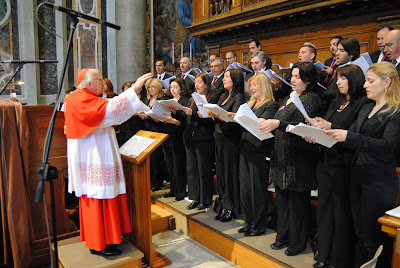
How’s that for chutzpah? The video above shows Walter Cardinal Brandmüller celebrating Solemn Pontifical Mass in the Extraordinary Form at St Peter’s Basilica in Rome yesterday morning. Yes, that’s right – a Tridentine High Mass on a Sunday morning at the very heart of the Catholic Church, taking place DESPITE a ruling from the Tablet’s Rome correspondent Robert (Bobbie) Mickens that Summorum Pontificum is of “dubious validity”.

Bobbie has noted in the past that Pope Benedict XVI is not a trained liturgist. It may be this fatal lack of training that led Papa Ratzinger to issue Summorum Pontificum, subject of a major conference in Rome last week, and then to compound his error with Friday’s Universae Ecclesiae, which puts pressure on bishops to stop blocking access to the traditional liturgy.

Bobbie was, famously, moved to helpless tears when the cardinals – contrary to his advice – elected Joseph Ratzinger pope. This weekend, however, he was in rather more pugnacious mood, mercilessly exposing the Holy Father’s imperfect understanding of Vatican II on a thread for the Commonweal blog. Over to you, Bobbie:

Letting aside the dubious validity of Summorum Pontificum for a moment (I’m happy to debate that with anyone in another moment), par. 13 of the newly released Instruction says that diocesan bishops are to “monitor liturgical matters” in their sees “always in agreement with the MENS of the Holy Father clearly expressed by the Motu Proprio”.

The mentality/intention/spirit (you choose the best word) of the Holy Father? What of the “mens” of the Council?

The very fact that the Council Fathers, by overwhelming majority, voted to reform the Tridentine Rite certainly means that – regardless of how one today judges the final result of that reform – the bishops realized that the pre-conciliar liturgy (lex orandi) no longer responded to the ecclesiology (lex credendi) that had developed over the preceding century and came to fruition at Vatican Council II.

Thus, to return to the pre-reform Roman Rite does not correspond – indeed, it is a betrayal – of the “mens” of the Council.

Never in the history of the Church were there two forms of the one Roman Rite. There were various Latin and Western liturgies, which in the post-Trent reform were cobbled into the Tridentine Rite. The Mass of Gregory the Great? The Ancient Roman Rite? Not according to the historical facts. It was as post-Reformation or Counter Reformation liturgy. And it certainly has no place in an ecumenical post-Vatican II Church.

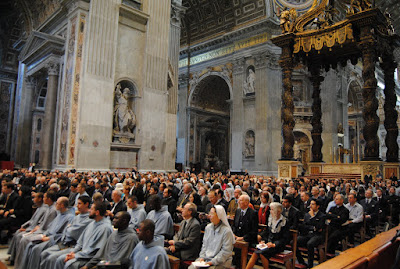
So there you have it. Presumably word of Mickens’s ex cathedra ruling failed to reach Cardinal Brandmüller in time, and he went ahead and celebrated the “cobbled-together” Tridentine Rite at the Altar of the Chair. Here’s a picture of the congregation (courtesy of the New Liturgical Movement):

The congregation: unaware of Mickens's doubtsThe congregation: unaware of Mickens’s doubts

How could this happen? Quick, send for a trained liturgist!

Posted in Green Inkers | Tagged , , , ,
29 Comments

Card. Burke’s sermon in Houston

With my emphases and comments, Cardinal Burke’s recent sermon…

PRO-LIFE PROGRAM, CATHOLIC CHARISMATIC CENTER
MASS FOR CLERGY
MONDAY OF THE THIRD WEEK OF EASTER
CATHOLIC CHARISMATIC CENTER
HOUSTON, TEXAS
MAY 9, 2011

Acts 6:8-15
Ps 119:23-24, 26-27, 29-30
Jn 6:22-29

HOMILY

Praised be Jesus Christ, now and for ever!

The trial, condemnation and execution of Saint Stephen Protomartyr is profoundly instructive for us who pray and work for the restoration of the respect for the inviolable dignity of innocent human life in our culture which sadly has become, in the words of Blessed Pope John Paul II, “a culture of death.” Saint Stephen was seized and brought before the Sanhedrin for speaking the truth about Our Lord’s Resurrection to those who preferred to hear the falsehood which justified a way of life contrary the law of the Lord. His enemies could not refute the truth which he announced, for he spoke in obedience to the Holy Spirit. They, therefore, resorted to a perversion of justice, to a trial based upon false accusations, in order to have him condemned to death. The reading from the Acts of the Apostles, to which we have just listened tells us that even those “who sat in the Sanhedrin … saw that his face was like the face of an angel.”[1]

When the high priest questioned Saint Stephen regarding the truth of the accusations brought against him, he gave an honest and complete account of his faith in Our Lord Jesus Christ as the fulfillment of all the promises of salvation, given by God the Father to His holy people. But, in the end, as the inspired account tells us, the Sanhedrin “cried out with a loud voice and stopped their ears and rushed together upon him.”[2] They took Saint Stephen out of the city, and there they executed him by stoning. Saint Stephen, for his part, remained faithful to Our Lord to the end, even to the perfect imitation of Our Lord in forgiving those who were putting him to death.[3] Saint Stephen fulfilled, to an heroic degree, the words of Our Lord in the Gospel, who responded to the question about how “to accomplish the works of God” with the instruction: “This is the work of God, that you believe in the one he sent.”[4] His martyrdom is a most powerful witness to the truth of the Resurrection, which we celebrate with greatest joy in this Paschaltide.

Like Saint Stephen, we, too, often experience resistance, even hostile resistance, to our proclamation of the truth of the Resurrection, especially as it is expressed in the Gospel of Life. The resistance may not be physically violent, as it was in the case of Saint Stephen, but it is nevertheless resistance. Our witness is often enough ignored or held to be an expression of extremism. We meet with indifference, or we are chided for a lack of dialogue with our culture and tolerance of a diversity of viewpoint.

In his homily during the Mass for the Election of the Roman Pontiff, celebrated before the conclave in which he was elected to the See of Peter, the then Cardinal Joseph Ratzinger spoke of how “the thought of many Christians” has been tossed about, in our time, by various ideological currents,” observing that we are witnesses to the “human deception and the trickery that strives to entice people into error,” about which Saint Paul wrote in his Letter to the Ephesians.[5] He noted that, in our time, those who live according to “a clear faith based on the Creed of the Church” are viewed as extremists, while relativism, that is “letting oneself be ‘tossed here and there, carried about by every wind of doctrine’,” is extolled.[6] In his Encyclical Letter Evangelium Vitae, Blessed Pope John Paul II also observed:

Too often it happens that believers, even those who take an active part in the life of the Church, end up by separating their Christian faith from its ethical requirements concerning life, and thus fall into moral subjectivism and certain objectionable ways of acting.[7] [People who not only partake of the life of the Church, your Joe Bagofdoughnuts, but also very public Catholics, for example those who are in political life, politicians who support abortion legislation or who are in a state of public impropriety and nevertheless receive Communion in a public act, often with the approval or tacit approval of their shepherds.]

Before this not uncommon phenomenon which thoroughly compromises the witness of the Church and her service to the world and its salvation, [the stakes are high] Blessed Pope John Paul II reminded us of our responsibility to confront the situation, with these words:

With great openness and courage, we need to question how widespread is the culture of life today among individual Christians, families, groups and communities in our Dioceses. With equal clarity and determination we must identify the steps we are called to take in order to serve life in all its truth.[8] [And so he seems to be moving from theory to practice.]

Each of us, in accord with his or her vocation in life and particular gifts [He is getting concrete.] received from Our Lord must be alert to whatever is compromising the proclamation and living of the Gospel of Life in our homes and parishes and other institutions, and must be ready to do our part to establish a strong and steadfast culture of life, beginning in the home and extending to the wider community[How?]

Each of us is called to have the courage of Saint Stephen in announcing the truth of the inviolable dignity of innocent human life, created in the image of God and redeemed by the Most Precious Blood of God the Son Incarnate, and in making whatever sacrifices are necessary to protect and foster human life. Each of us is called to recognize Christ in every brother and sister, and especially in the least, the tiniest, the most defenseless who have no one else to defend and protect them. In doing so, we well find the deepest happiness in this life and the fullness of happiness in the life which is to come. When we are ignored, belittled or resisted because of our courageous fidelity to the Gospel of Life, we should pray, as we prayed, with the words of the Psalmist, in response to the First Reading:

Though princes meet and talk against me,
your servant meditates on your statutes.
Yes, your decrees are my delight;
They are my counselors.[9]

[Pray, and vote.]

Those who would resist our testimony to the truth of the Gospel of Life should see on our faces the joy and peace of those who follow the law of the Lord. [This is not a small point.  Often when I speak to people who have strife in their families over issues of the Faith, I will at some point offer the suggestion that they should show to their loved ones who are fallen away or of a different or no faith, that they are joyful in the Faith, that being a Catholic brings joy.  Joy is attractive.  Gloom is not.  Persistent joy is alluring.]

In facing the many and difficult challenges of living the Gospel of Life in our time, let us, in a particular way, call upon the help of Our Lady of Guadalupe, the Mother of God who came to our continent to manifest the mercy and love of God toward all of His children, especially those experiencing any threat to their lives. [Think of the terror of some of the places in the Americas in the centuries before Our Lady appeared in Mexico.] She has assured us that she is with us in the Church as our heavenly Mother. She says to us today, as she said to Saint Juan Diego who felt the challenge of his mission as her messenger:

Am I not here, I, who am your Mother? Are you not under my shadow and protection? Am I not the source of our joy? Are you not in the hollow of my mantle, in the crossing of my arms? Do you need anything more? Let nothing else worry you, disturb you.[10]

Let us never fail to call daily upon the help of Our Lady of Guadalupe, Mother of America and Star of the New Evangelization. [New Evangelization.] She will not fail to be at our side as our mother and model of the Christian life. She who is the first and the best of the disciples of her Divine Son is our never-failing intercessor.

Our Risen Lord, seated in glory at the right hand of the Father and, at the same time, alive and active for us in the Church, now comes to meet us in the Eucharistic Sacrifice. He comes to make present anew the outpouring of His life for us on Calvary. He comes to unite our hearts with His glorious pierced Heart, so that we, with Him, may pour our lives in pure and selfless love of one another. With Mary Immaculate, under her title of Our Lady of Guadalupe, let us place our hearts completely into the Sacred Heart of Jesus, as did Saint Stephen, so that they make be purified and strengthened for our mission in the world, above all, the mission of proclaiming and living the Gospel of Life. Let us sustain the life of the Holy Spirit within our hearts through communion with Our Lord Jesus Christ, through the incomparable food which is indeed the Bread of Heaven, His Body, Blood, Soul and Divinity, given to us for the salvation of the world.

Heart of Jesus, our life and resurrection, have mercy on us.
Our Lady of Guadalupe, Mother of America and Star of the New Evangelization, pray for us.
Saint Joseph, Husband of Mary and Guardian of the Redeemer, pray for us.

Raymond Leo Cardinal BURKE
Archbishop Emeritus of Saint Louis
Prefect of the Supreme Tribunal of the Apostolic Signatura


[1] Acts 6:15.

[2] Acts 7:57.

[3] Cf. Acts 7:60.

[4] Jn 6:29.

[5] Cardinal Joseph Ratzinger, “Mass for the Election of the Roman Pontiff: Monday, 18 April: Homily by the Cardinal who became Pope.” L’Osservatore Romano Weekly Edition in English, 20 April 2005, p. 3. Cf. Eph 4:14.

[6] Ibid., p. 3

[7] Ioannes Paulus PP. II, Litterae Encyclicae Humanae Vitae, 25 March 1995, no. 95.

[8] Ibid., n. 95

[9] Ps 119 [118]:23-24.

[10] Nican Mopohua, nn. 119-120; Handbook on Guadalupe, p. 200.

Posted in Emanations from Penumbras, The Drill | Tagged ,
3 Comments

RECENT POSTS about “Universae Ecclesiae”

Here is an ongoing list of entries of not about the Instruction Universae Ecclesiae.  I will add as it grows.

Posted in SUMMORUM PONTIFICUM, Universae Ecclesiae | Tagged ,
Comments Off on RECENT POSTS about “Universae Ecclesiae”

Sunday

20110515-054253.jpg

Posted in SESSIUNCULA |
11 Comments

What the Ordinary Form brings to the Extraordinary Form: the question of Mutual Enrichment

Since Universae Ecclesiae has been issued the subject of the “mutual enrichment” of the older and newer, the Extraordinary and Ordinary Forms of the Roman Rite has reemerged.

For going on two decades now, I have been saying that – in the mind of Papa Ratzingerwere a more organic, long-term, process of liturgical growth and renewal and revision to be rekindled, there would eventually emerge a tertium quid, a form of the Roman Rite which would reflect the reforms mandated by the Second Vatican Council and the Roman Rite as received from the Church’s experiences of prayer over the centuries.  That didn’t happen with the Novus Ordo, because it was an artificial product assembled on a desk.  But the two forms, older and newer, used side-by-side, would create a gravitational pull upon each other.

I think that many years ago, Papa Ratzinger assumed that the newer, Ordinary Form, would have logical priority and that some influence of the older form would enter into producing the tertium quid.  Now, however, I am not so sure.  I sense a shift in the Force, as it were.  I suspect the Holy Father thinks that it may be the other way around now.  But, only time will tell.

There will certainly be an influence of the one upon the other, a mutual enrichment, a gravitational pull.  And that influence will grow enormously as the “Biological Solution” shifts the demographics of the clergy.  Younger men, without the baggage of the “spirit of the Council”, younger men, far more interested in the hermeneutic of continuity desired by Pope Benedict to be applied to all things Conciliar and post-Conciliar, are interested also in the Extraordinary Form.  And if they are not eager to use it themselves, they are at least open to it.  As more young priests – future bishops – begin to exercise ministry in the Church in every sphere of her life, many things will change.

But, back to the issue of mutual enrichment.

The Ordinary Form and Extraordinary Form are clearly – according to the mind of the Supreme Pontiff – meant to be “one alongside the other” (UE 6).  They will influence one another.  It stands to reason.

I think that the Extraordinary Form will dramatically reshape the Ordinary Form, especially in respect to ars celebrandi, but perhaps also in the reintroduction of elements lost in the reform.  It certainly will affect how priests see themselves and carry our their role.

However, I also believe that the Ordinary Form will influence, indeed has influenced how priests say the Extraordinary Form.

First, there was the near total loss of the Extraordinary Form which has made those who desired it be all the more careful and attentive and reverent.  In human affairs familiarity can breed contempt… or at least neglect.  In the words of Joni Mitchell, “Don’t it always seem to go, that you don’t know what you got till it’s gone.  They paved paradise and put up a parkin’ lot.”  The observance of the Extraordinary Form benefited from the oppression.

The shift in focus in the Ordinary Form from the priest at the altar, to the priest and the congregation, has more than likely been a great help as well.  I think that priests today are far more aware in their ars celebrandi that there are actually people out there, which drives them to be more careful and reverent and, in their words and actions, project themselves beyond the altar rail, not in a solipsistic way, but in a genuine desire as mediator to communicate what God desires to give through the sacred actions and words of the sacred mysteries.

Another point surfaced in the combox under another entry here, which I will get to.

As far as the ars celebrandi is concerned, for years, in the dark times when merely to want the older form as a seminarian meant certain expulsion from mainstream seminaries, I heard relentless criticisms of the old Mass because of the way priests used to say it.  That was pretty awkward, of course.  If priests do stupid things on their own, that is their fault.  In some ways elements of the rite can invite those choices, of course.  But it is the priest who says Mass, not the book which says Mass.

A common way to denigrate the older form of Mass was the sneering comment that priests would be scrupulous in how they, for example, said the words of consecration or made some gestures.  Some priests were terribly scrupulous. Because of training and their own desire not to commit sins, they took seriously the old teaching that defects of celebration were mortal sins.   When that was coupled with a scrupulous character and also the Jansenism that came from some seminaries, especially those with an Irish background under the influence of the French who had a terribly rigid approach to many dimensions of human life and the material world, the result for liturgy was not always optimal.

To make my point at last, perhaps the intervening years – which were unquestionably stained by the horrors of illicit and often deeply stupid experimentation and liturgical abuses and really bad taste – served to break the grip of some schools of approach, some of the perhaps Jansentic rigidity of scrupulous rubricism against which, I fear, much of the discontinuity crowd reacted so strongly as they threw off their shackles after the Council and went nuts, taking us along with them into the liturgical hole we have to climb out of now on the ladder of Summorum Pontificum.

I return to my point about the combox comment now.   Fr. Augustine Thompson, OP, left an interesting comment.  He picked up on my my point that the Ordinary Form will also exert a gravitational pull on the way the Extraordinary Form.  Heresy to some traditionalists… but the truth. Priests are men of their own times, not just of ages past.

Fr. Thompson observes:

Having been ordained over 25 years,  and having celebrated Mass on every unimpeded day (e.g. Good Friday) but one, I have celebrated the old rite (Dominican) at least a 1000 times and the new rite (Roman) many more times.  And there are things that celebrants, especially new celebrants of the old rite can learn from the new.

In particular, I have noticed that new celebrants of the Dominican Rite often try to rigidly correlate the gestures (e.g. at the Per Ipsum) with the words because the rubrics insert “make cross,” “pick up host,” etc. into the middle of sentences.  The sense of freedom that comes from the new rite (where the gestures made are generally those that come naturally to the priest), gives a sense of personal ownership of the motions.  When I urge new celebrants to just know what gestures to make and make them naturally as they read the words, they discover that the whole action is more graceful (and the gestures end up in the right place).  Now I learned fluidity of motion from constant practice — and only finally accomplished it when I stopped scrupulous attempts to rigidly follow the rubrics — and then I realized that, had I allowed myself the sense of freedom of the new rite from the beginning, this might have come faster.

Admittedly, the goal is to celebrate fluidly and elegantly, and to do so as the rubrics indicate.  But a “novus ordo” sense of freedom had help a new old rite celebrant to do this more naturally.

I am sure that there are other examples of times when my celebration of the new rite helped me with the old.  (And vice versa.)

Discuss in a thoughtful way, having first reread what you may wish to share, and then asking yourself: “Does this contribute anything useful”?

Posted in "How To..." - Practical Notes, Brick by Brick, Linking Back, Mail from priests, Our Catholic Identity, SUMMORUM PONTIFICUM, The Drill, The future and our choices, Universae Ecclesiae, Wherein Fr. Z Rants | Tagged , , , , , ,
79 Comments

Help on the issue of PODCAzTs and the “feed”

While I was making the LENTCAzTs people wrote asking me to make a separate “feed” for them, or that they were not appearing in iTunes.  They did for me, btw.

I use Podpress for my audio projects.   I guess I don’t know how to use it very well.

If any readers out there are familiar with Podpress and how the iTunes feeds work and could lend a hand, it would be appreciated.

Posted in "How To..." - Practical Notes, PODCAzT | Tagged , ,
Comments Off on Help on the issue of PODCAzTs and the “feed”

Pontifical Mass at the Altar of the Chair – roundup

Initial comments:

Card. Brandmueller wound up being celebrant for the Pontifical Mass at the Altar of the Chair in St. Peter’s Basilica.  Card. Canizares should have been the celebrant, but he had by accidentally scheduled a flight, apparently because he had been under the impression that this was going to be a Low Mass.  Things happen.  They had a couple Cardinals to spare, however.

Cards. Levada, Bartolucci were there, and one other Cardinal of Holy Roman Church.

The place was jammed, I hear.

I am sure there will be a torrent of photographic eye-candy.  The variety of choir dress should be interesting.

UPDATE:

The ever-present and diligent John Sonnen of Orbis Catholics has video and photos.

His video is on Youtube.

[wp_youtube]B7LNu6jCmes[/wp_youtube]

Sounds as if they used Palestrina’s Missa Papae Marcelli, nisi fallor.

A photo or two… but go to his site.

Here is something you don’t see very often… a Cardinal directing a choir.

A little more video:

[wp_youtube]iVrMOKYcTPQ[/wp_youtube]

UPDATE:

Photo album with lots of photos, here.

Posted in Brick by Brick |
27 Comments

Msgr. Bux tells it as he sees it. WDTPRS POLL for SEMINARIANS ONLY.

Over at Messa in Latino there are some posts about the talks being given at the conference going on in Rome for Summorum Pontificum. One of the talks was by Msgr. Nicola Bux, originator of the Bux Protocol.  Bux speak, as we say in Italian, “fuor dai denti”, bluntly.

Bux’s talk was about the older form of Ordination of priests in the pre-Conciliar Pontificale Romanum.

Messa in Latino didn’t give even a sketchy account of the talk.  We will get it eventually.  But they did relate a few bullet points.  Here they are.  The subscriber base of the Fishwrap are going to love #2:

  1. The liturgy requires purity of heart and profound humility.  No, therefore, to hamming it up and theatrics.
  2. Where there is abuse of the liturgy, there are certainly grave moral distortions.
  3. Only a bishop and a priest exercise the priesthood, not the deacon.  What is the priesthood?  Mediation between man and God, a role before which priests, if they took stock of it fully, would tremble.
  4. St. Paul wrote to Titus: pure doctrine, sound doctrine, secure doctrine. These are the criteria tp discern true doctrine from false.  And all this is recalled in the old rite of Ordination: how true, therefore, is the rule of Proper of Aquitane: lex orandi, lex credendi.

Yah…. liberals are going to luuuuv #2.

Keep in mind that the new Instruction says that bishops cannot use the old Pontificale Romanum to ordain men who are not members of those specialized institutes we all know about.   Although… although… I bet the Holy See would grant permission were a bishop to request it.

Think about it.

I don’t think many of today’s seminarians would choose the new rite over the old rite once they compare them side by side and think about them for a while.

I would be pleased to receive email from seminarians on this point.   Write to me and tell me.  Seminarians could also canvass their fellows at their seminaries.  Give me the results.  I’ll post them.

QUAERITUR.  Latin Church SEMINARIANS:

If you were given the choice, would you prefer to be ordained with the older, pre-Conciliar form or the newer book, the rite reformed by Paul VI and John Paul II, even in Latin?  Which?

I will preserve your anonymity of course.  Use the contact link on the top header menu and put SEMINARIAN WRITES ABOUT POLL as the subjectYou must tell me what seminary you are from.  I won’t give you up, don’t worry.  I don’t care which option you would choose: I just want an accurate picture.

OLDER RITE: 38
NEWER RITE: 6

UPDATE:

Some are asking to see the older form of ordination.  Sancta Missa has a pdf of an old Pontificale Romanum.


Posted in Lighter fare, Liturgy Science Theatre 3000, POLLS, SUMMORUM PONTIFICUM, The Campus Telephone Pole, Universae Ecclesiae | Tagged , ,
16 Comments

WDTIRS: Universae Ecclesiae 22: Drilling into the Latin and English (Dioceses without “qualified” priests)

I was sent a question about the Latin of Universae Ecclesiae 22.

Friends, the more I look compare the Latin and the Released English “translation”, the more apparent it is that the Latin is a better, stronger document than the English – as it stands.

Therefore, if you hear someone running down Universae Ecclesiae in some way, or trying to diminish its implications, you may want to look together at the Latin version in order to verify whether there criticism holds up.  Obvious, no?

Here is UE 22:

22 – In Dioecesibus ubi desint sacerdotes idonei, fas est Episcopis dioecesanis iuvamen a sacerdotibus Institutorum a Pontificia Commissione Ecclesia Dei erectorum exposcere, sive ut celebrent, sive ut ipsam artem celebrandi doceant.

RELEASED ENGLISH:
22. In Dioceses without qualified priests, Diocesan Bishops can request assistance from priests of the Institutes erected by the Pontifical Commission Ecclesia Dei, either to the celebrate the forma extraordinaria or to teach others how to celebrate it.

Exposco is more than simple “ask”.  It has at least the force of posco, which is “to ask for urgently; to beg, demand, request, desire”.  Exposco is “to ask earnestly, to beg, request, to entreat, implore”.

But, back to fas est.   Fas, as a word in Canon Law, isn’t as strong as nefas is in its negative sense.  If nefas really really bad. In Canon Law nefas is applied to things such as selling the Eucharist or relics or violating the Seal of confession.  Nefas is something like “intolerable” or “really-super-bad”.  On the other hand, fas is not “really good” or “praiseworthy”.  It fas isn’t as forceful as a positive as nefas is as a negative.  But, fas est is more than “can”… the bishop can ask help.  Of course, he can ask for help.  That’s obvious, isn’t it?

Would anyone have ever suggested that a bishop can’t ask for help from, say, the FSSP?  Absurd.

So, while fas est episcopis exposcere isn’t “it is a super-dandy thing for bishops to implore”, it is more than “bishops can ask”.

I contacted three canonists about this fas est.  Canonists #1 and #2 aid that it has the implication of something laudable, but without the same force as nefas is a negative. Canonist #3 saw it as merely a way to make the point an obvious point.  I am not using the majority-wins-thing here, particularly because of the esteem with which I hold Canonist #3.

I will go with “an obvious thing for diocesan bishops to do is …”

WDTPRS VERSION:
22. In Dioceses where qualified priests are lacking, an obvious thing for diocesan bishops to do is earnestly to ask assistance from priests of Institutes set up by the Pontifical Commission “Ecclesia Dei“,  either in order that they celebrate [Extraordinary Form’s rites] or that they teach the art of celebrating (artem celebrandi).

RELEASED ENGLISH (again):
22. In Dioceses without qualified priests, Diocesan Bishops can request assistance from priests of the Institutes erected by the Pontifical Commission Ecclesia Dei, either to the celebrate the forma extraordinaria or to teach others how to celebrate it.

That ars celebrandi is becoming a term of art, if you’ll pardon the pun.  Ars celebrandi was an important topic of discussion during the 2006 Synod on the Eucharist and then in Benedict XVI’s Post-Synodal Exhortation Sacramentum caritatis.

Let’s look at the section in Sacramentum caritatis.

Ars celebrandi

38. In the course of the Synod, there was frequent insistence on the need to avoid any antithesis between the ars celebrandi, the art of proper celebration, and the full, active and fruitful participation of all the faithful. The primary way to foster the participation of the People of God in the sacred rite is the proper celebration of the rite itself. The ars celebrandi is the best way to ensure their actuosa participatio. The ars celebrandi is the fruit of faithful adherence to the liturgical norms in all their richness; indeed, for two thousand years this way of celebrating has sustained the faith life of all believers, called to take part in the celebration as the People of God, a royal priesthood, a holy nation (cf. 1 Pet 2:4-5, 9) (115).

The Bishop, celebrant par excellence

[…]

Respect for the liturgical books and the richness of signs

[…]

[…]

Art at the service of the liturgy

[…]

Liturgical song

[…]

Moreover, during a Q&A session the Pope once responded to a question from a priest from the Diocese of Albano, Italy.  My emphases and comments.

Q: As priests, we are called to celebrate a “serious, simple and beautiful liturgy,” to use a beautiful formula contained in the document “Communicating the Gospel in a Changing World” by the Italian bishops. Holy Father, can you help us to understand how all this can be expressed in the “ars celebrandi?”

B16: … “(A)rs celebrandi” is not intended as an invitation to some sort of theater or show, but to an interiority that makes itself felt and becomes acceptable and evident to the people taking part. [How many times have I said that once a priest learns to say the older form  of Mass, that experience changes the way he says the newer form.  Also, a good experience of the newer form will impress also on the priest using the older form that there are people out there.  Congregations are over time deeply affected by the priest’s modus, hopefully ars celebrandi.  The greater the number of priests who learn to say the older form, the faster and the deeper liturgical renewal will be implemented in the Church, with the subsequent changes among God’s people and their corners of the world.] Only if they see that this is not an exterior or spectacular “ars” — we are not actors! — but the expression of the journey of our heart that attracts their hearts too, will the liturgy become beautiful, will it become the communion with the Lord of all who are present. Of course, external things must also be associated with this fundamental condition, expressed in St. Benedict’s words: “Mens concordet voci” — the heart is truly raised, uplifted to the Lord. We must learn to say the words properly. [Sounds like UE 20 -b, doesn’t it?]

Sometimes, when I was still a teacher in my country, young people had read the sacred Scriptures. And they read them as one reads the text of a poem one has not understood. Naturally, to learn to say words correctly one must first understand the text with its drama, with its immediacy. It is the same for the Preface and for the Eucharistic Prayer. [Of course the Canon is silent in the Extraordinary Form.  There are, however, many ways to “speak”.]

[…]Thus, the words must be pronounced properly. There must then be an adequate preparation. Altar servers must know what to do; lectors must be truly experienced speakers. Then the choir, the singing, should be rehearsed: And let the altar be properly decorated. All this, even if it is a matter of many practical things, is part of the “ars celebrandi.”

That ars celebrandi in UE suggests to me that there is something the Extraordinary Form can teach the Ordinary Form and vice versa.

Posted in "How To..." - Practical Notes, SUMMORUM PONTIFICUM, Universae Ecclesiae, WDTPRS | Tagged , , , , , ,
6 Comments

QUAERITUR: Would a request for meatier sermons offend a priest?

From a reader:

I was just wondering if you, as a priest, would find it offensive if you a received a letter from a parishioner encouraging you to spend more time catechizing from the pulpit?

We have a wonderful, holy, orthodox priest at our parish. He occasionally hosts little talks or educational sessions, and he is clearly well-educated and articulate.

But his homilies are a little…thin. They tend to be somewhat vague and kind of…blandly spiritual. I would like to encourage him to bring these insights to his homilies, so I have considered writing him a letter asking him to discuss “hot topics” like contraception, cohabitation, the sinfulness of missing Mass, the importance of confession, etc.

Would you be offended to receive such a letter? Is there a more appropriate route to talk, or should I just relax and thank God I have a good pastor?

Would I be offended?  No.  For my part, I wouldn’t be offended were the letter respectful.  But then I don’t think I have ever been asked for heavier sermons.  Lighter, yes.  I have also been set upon by deeply offensive, offending and offended people with red-raging eyes and ears-shooting-steam because I explained what the Church says.  I have actually been spat upon in a narthex after a Mass while still wearing my vestments, and not as an accident in the course of spittle-flecked grand-mall liberal pique.

The General Institution of the Roman Missal says:

65. The Homily is part of the Liturgy and is strongly recommended, for it is necessary for the nurturing of the Christian life. It should be an exposition of some aspect of the readings from Sacred Scripture or of another text from the Ordinary or from the Proper of the Mass of the day and should take into account both the mystery being celebrated and the particular needs of the listeners.

The needs of the listeners.

I am reminded of Augustine on the sometimes painful process of correction.  The doctor doesn’t stop cutting just because his patient is screaming for him to stop.

The homily/sermon can certainly, must certainly, be used also to catechize – a term which is pretty broad.  But I think we have to be careful as the Church’s preachers not to make Mass into a didactic exercise.  In a sense, all preaching involves repetition of the Church’s doctrines, and explanations of who we are and what we do as a result… and don’t do.  But the pulpit isn’t the lecture hall podium.

A preacher does well to make reference to the readings and the feast, but, from there he can really go just about anywhere.  The beautiful thing about the Faith is that it is so interconnected and the history of our Church goes back, well… to creation, if you think about it.  We have lots of material to work with.

That said, I think it is okay for you to tell the priest that you would like a bit more meat along with the mashed potatoes.

Would you as a father of growing children be offended by, “Please, father, may I have some more of those slightly bitter but nourishing Brussels sprouts?”

Okay, some fathers – priests – are very touchy.  But if you are diplomatic, I don’t imagine there should be a problem.

At least he will know you are listening.

Posted in "How To..." - Practical Notes, ASK FATHER Question Box |
23 Comments