Prayer request

Prayers please.  Perhaps St. Michael is a good choice.  Thanks in advance.
Posted in SESSIUNCULA |
Comments Off on Prayer request

22 March: St. Nicholas Owen, martyr

The 2005 Roman Martyrology has this entry:

7. Londinii in Anglia, sancti Nicholai Owen, religiosi e Societate Iesu et martyris, qui multos annos latebras pro sacerdotibus condendis exstruxit, quapropter sub Iacobo rege Primo incarceratus et gravissime tortus, demum in eculeum coniectus Christo Domino gloriose obsecutus occubuit.

Anyone want to take a crack at this?

St. Nicholas Owen was an amazing fellow.

I am deeply impressed by the stories of the English martyrs.

Posted in Saints: Stories & Symbols | Tagged
17 Comments

Sen. Scott Brown (R-MA) wants tax payer money to fund Planned Parenthood

Via Catholic Vote:

Sen. Scott Brown, R-MA, is one of the only Senate Republicans who favor legal abortion. So today’s news that he will vote to keep tax money for Planned Parenthood is not shocking, but it is still disappointing.

Catholics, especially in Massachusetts, can let their voices be heard by calling Senator Brown’s office at (202) 224-4543.

Here’s the statement that Senator Brown issued today:

“I support family planning and health services for women. Given our severe budget problems, I don’t believe any area of the budget is completely immune from cuts,” he said. “However, the proposal to eliminate all funding for family planning goes too far. As we continue with our budget negotiations, I hope we can find a compromise that is reasonable and appropriate.”

Except it isn’t reasonable or appropriate to give this notorious organization another dime.

Posted in Emanations from Penumbras | Tagged ,
13 Comments

QUAERITUR: Defection from the Catholic Church

From a reader:

My brother, a fallen away Catholic, is getting married outside the Church. He asked me to be best man.

I had the understanding that a Catholic can release himself from the obligations to get married in the Church etc. by sending a letter to his local pastor (i.e. a formal act of apostasy). That is what I ultimately communicated. It was not an easy conversation.

Now, I’m verifying what I had previously read, and it seems that may be incorrect due to the motu proprio, Omnium in mentem, which removed the statements in the Canon about formal acts of defection.

Meanwhile, other family bridges may be burning, and I will follow the Church’s law, no matter the cost. But I need to know what the law is.
Might you clarify, or refer me to someone/something that could?

Since Omnium in mentem took effect on 9 April 2010, defection from the faith no longer has any canonical effect.  “Defection” does not release one from ecclesiastical law, including the observance of canonical form in marriage.

Once a Catholic, always a Catholic is not just cultural, or emotional… it is juridical.    Baptism to death, friends.

From 23 November 1983 until 9 April 2010 if one formally “defected” from the faith, one was released from certain merely ecclesiastical laws, including the observance of canonical form ofr marriage.

Merely walking away or attending a non-Catholic Church does not qualify as a formal defection. That makes one a “lapsed Catholic”.

Whether you can serve as best man at this “non-wedding,” there is no canonical prohibition to do so and no penalty.  But I think your participation is a sign that you agree with what he is doing.  You should consult your parish priest, but I think that is a bad idea.

Posted in "How To..." - Practical Notes, ASK FATHER Question Box | Tagged , , ,
10 Comments

WDTPRS: Tuesday in the 2nd Week of Lent

COLLECT (2002MR):
Custodi, Domine, quaesumus,
Ecclesiam tuam propitiatione perpetua,
et quia sine te labitur humana mortalitas,
tuis semper auxiliis et abstrahatur a noxis,
et ad salutaria dirigatur.

Propitiatio in its fundamental meaning meanings and “an appeasing, atonement, propitiation”. The dictionary of liturgical Latin Blaise also gives us a view of the word as “favor”. This makes sense. God has been appeased and rendered favorable again towards us sinners by the propitiatory actions Christ fulfilled on the Cross. We have faithfully (?) renewed these through the centuries in Holy Mass. Mortalitas refers, as you might guess, to the fact that we die, our mortality. Inherent in the word is the concept that we die in our flesh. So, you ought also to hear “flesh” when you hear mortalitas.

Labitur is from labor. This is not the substantive labor but the verb, labor, lapsus. It means, “to glide, fall], to move gently along a smooth surface, to fall, slide; to slide, slip, or glide down, to fall down, to sink as the beginning of a fall”.

Auxilium, in the plural, has a military overtone. There is also a medical undertone too, “an antidote, remedy, in the most extended sense of the word”. Pair this up with noxius, a, um, which points at things which are injurious or harmful. There is a moral element as well or “a fault, offence, trespass”.

PenanceSalutare, is (n) is “salvation, deliverance, health” in later Latin and the Vulgate. This is a very interesting word, which I wrote about at length in one of my weekly columns. You remember. That was the time I put the English version into Shakespearean iambic pentameter. Suffice to say, a “health” is like a “toast”.
LITERAL TRANSLATION
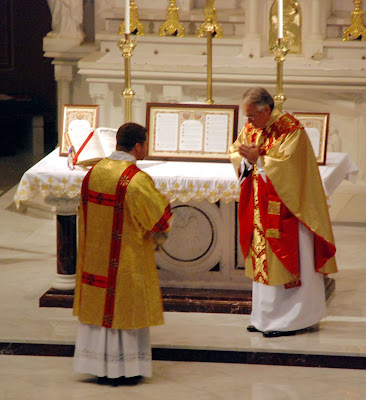
Guard your Church, O Lord, we beseech You,
with perpetual favor,
and since without You our mortal flesh slides toward ruin
by means of your helping remedies let it be pulled back from injuries
and be guided unto saving healths.

There are different ways to do this, but I wanted to place in evidence the image of health and the flesh and medicine.

An important Patristic, Christological image in the ancient Church is Christus Medicus, the Christ “Physician”. He is the doctor of the ailing soul. St. Augustine does amazing things with this image.

NEW CORRECTED VERSION:
Guard your Church, we pray, O Lord, in your unceasing mercy,
and, since without you mortal humanity is sure to fall,
may we be kept by your constant helps from all harm
and directed to all that brings salvation
.

LAME-DUCK ICEL:
Lord, watch over your Church,
and guide it with your unfailing love.
Protect us from what could harm us
and lead us to what will save us.
Help us always, for without you we are bound to fail
.

You decide.

Posted in LENT, WDTPRS |
8 Comments

Prayer request: Archbp. Buechlein – Indianapolis

From the website of the Archdiocese of Indianapolis:

Archbishop Daniel M. Buechlein suffers
a mild stroke
Archbishop Daniel M. Buechlein, O.S.B. suffered a mild stroke on March 18 and has been admitted to St. Vincent Hospital in Indianapolis.
The archbishop is resting comfortably at St. Vincent. He is alert and talking with his doctors and has been visiting with a few priests of the archdiocese.
The archbishop became dizzy while at home on March 18 and called 911. After undergoing tests at St. Vincent, doctors determined that he had suffered a mild stroke.
The archbishop said the day-to-day operations and ministries of the archdiocese would continue as normal while he recuperates. He said he would appreciate everyone’s prayers.
Archbishop Buechlein has suffered a series of health problems over the past three years. In 2008, he was diagnosed with Hodgkin’s lymphoma and underwent several weeks of chemotherapy and radiation treatments. The treatments were successful and he is cancer free.
In 2009, Archbishop Buechlein had shoulder replacement surgery and in 2010 he had surgery to remove a benign tumor from his stomach.

News may be updated on the archbishop’s condition as the archdiocese get more information.
Posted in SESSIUNCULA | Tagged
7 Comments

QUAERITUR: Seminarian looking for Latin tools

I want to get the readership into this with suggestions.

From a reader:

I’m a seminarian for ____. I’ve been trying to get hold of a good ecclesial Latin dictionary and grammar for awhile and haven’t had much luck. Do you perhaps know where I could find one or which ones are good?

Have at.

I think beginning students of Latin should use Classical tools.

Posted in "How To..." - Practical Notes, Brick by Brick | Tagged
34 Comments

Latin in the Ordinary Form, seminary. Wherein Fr. Z rants.

I am forever lamenting the sloppy, inaccurate term long used by many of the traditionalist camp, “the Latin Mass”, to describe older, pre-Conciliar form, Extraordinary Form, Usus Antiquior, “Tridentine” Mass, even Traditional Latin Mass or TLM.

The Latin Mass… ought to be the Novus Ordo, the Ordinary Form as well.   Our liturgical language in the Latin Church is Latin and I don’t have to rehearse the why of that yet again.

I have long been concerned that the rise in the use of the older form, the TLM would drive the use of Latin out of the Ordinary Form entirely, would isolate the use of Latin in the ghetto of the traditionalists.

I read this in the Catholic Herald, the UK’s best Catholic weekly with my emphases and comments.

Why don’t we have more Novus Ordo Masses in Latin?

If you want a complete new rite Latin liturgy you have to go either to the very top or bottom of Britain

By Francis Phillips on Monday, 21 March 2011

A recent letter in the Catholic Herald has caught my eye. The writer, Susan Carson-Rowland, was raising the question of the new English translation of the Mass, which she described as a “true rendering of the definitive Latin text to replace the inaccurate version we have endured for 40 years”. [Let’s call it a “truer rendering”.] This situation has been lamented many times over during the last 40 years, both by traditionalists and those, like myself, who attend the Novus Ordo, and I have nothing new to add to the debate. What struck me about this letter was its author’s final question: “Why don’t we have Mass in Latin and avoid all this tiresome palaver?” [Do I hear an “Amen!”?  Let there be more Latin.  People can use the translation they prefer.  A great solution to those who are whinging about the new, corrected translation.]

I only understood the full force of the question when I happened to attend an ordination to the diaconate at the Oxford Oratory last week. The Mass, sung in Latin according to the Novus Ordo, with the readings and rite of ordination in English, was celebrated magnificently. Bilingual service books were provided for those of us who had forgotten, or were unfamiliar with, the Latin. Of course, having a professional choir helped, though the congregation joined in singing the responses, the Credo and the Pater Noster. And it was a special occasion; I understand that generally Oratories celebrate Mass in the vernacular, while providing at least one Mass in Latin on Sundays and on solemnities.  [Latin should not be relegated to “special occasions”, as if it were some aberration.  What does it mean for our identity as Catholics if we never or only rarely hear the language of our Rite?]

My mole in the Association of Latin Liturgy tells me that the whole point of this association during the last 40 years has been to encourage the use of Latin (and the musical treasury of the Church, including plain chant) in the Novus Ordo, in an attempt to prevent Latin being swept away altogether. Their remit has been the document on the liturgy which stated: “The faithful must be able to say or sing together in Latin the parts of the Mass which pertain to them.”  [It is the obligation of pastors of souls to see to that, btw.  Liberals love to quote their bits and pieces of Council documents.  They don’t like this bit from SC 54 very much.]

Have the aims of the association failed? Judging from the ordinary practice of almost all parish Masses it would appear so. There are only three Oratories in this country and, as my mole further points out, if you want a complete new rite Latin liturgy you have to go either to Pluscarden Abbey in Moray, Scotland, or to St Cecilia’s Benedictine convent in Ryde, Isle of Wight – either the extreme north or the extreme south of the country.

Back to the question raised in the letter to the Herald: why don’t we have Mass in Latin?

First, Latin Church clergy don’t know Latin any more.  That is not their fault for the most part.  It is the fault of those in charge of formation and of bishops of the past and present.  The Code of Canon Law specifically says that seminarians must be very well-trained in Latin (c. 249).   So, if they aren’t, why are the formators telling bishops that they are well-trained?  When a man is ordained, someone must stand in front of the bishop and declare that the man is properly trained.  They aren’t.

Is the solution more Latin in seminary?  I guess so.  Are we willing to add years to seminary training?

It strikes me that by the time a man reaches major seminary it is practically too late to give him a good working knowledge of Latin.  So many things are already loaded onto seminarians, we would have to add a year or two to their formation to give them both Latin and Greek.   Sometimes I have mused that before major seminary training begins in earnest, the men should have a propaedeutic year during which they do little else than learn Latin and Greek, read the Catechism of the Catholic Church and Baltimore Catechism aloud, and serve every kind of Mass and sing chant.  Perhaps also be given a few little seminars on basic sewing, cooking, how to read spread-sheets and balance a checkbook, and small-engine repair.  Enough for a first year.  Build on that.

But I don’t think we should fall into a trap of thinking that major seminary is language school.  Seminarians need the Latin before they start.

That said, they can at least learn enough to pronounce the words properly, know where the best tools and resources are found, and also learn that it is valuable and important for our identity as Catholic priests.

We need more Latin everywhere.

Thus endeth the rant.

Posted in "How To..." - Practical Notes, New Evangelization, Our Catholic Identity, The future and our choices, Wherein Fr. Z Rants | Tagged , ,
69 Comments

Thanks

Many thanks to a reader, not sure who you are, who sent music CD’s of The Sixteen singing English polyphony.  I have on right now Robert Fayrfax Missa Albanus.  It is so beautiful it almost hurts.

And while I am thanking this unknown soul, I will thank everyone who has used the donation button or wishlist, and who has purchased anything from amazon using link here, who has bought coffee mugs and other things, or who has refreshed their coffee supply by patronizing Mystic Monk Coffee.  I know those Carmelites in Wyoming appreciate it!  You are helping them build their monastery.

I remember benefactors in pray daily and regularly say Mass for their intention.  It is a duty and privilege.  On Wednesday I have an open slot for intentions and I will once again say Mass for the intention of those who have been benefactors.

Furthermore, thanks for the voting in that Readers’ Choice award thing.  Your support is a boost. Thanks for the participation in the Spiritual Bouquet for Pope Benedict.  Thanks for listening to the LENTCAzTs.  Tell your friends about them, if you would.

Finally, while I cannot/do not answer every email with requests for prayers, sometimes for very serious things, when I read them I stop at that moment and say a prayer appropriate for the request and I remember them in my daily rosary and also at the Mementos for the living or dead in that day’s Mass or the next day’s.  I especially ask in return prayers for an important intention of my own.  Many hands make light work.

Posted in SESSIUNCULA |
Comments Off on Thanks

Brick by continuity brick in Macon, Georgia

From a reader about St. Joseph’s Catholic Church in Macon, GA where Fr. Allan McDonald is building brick by brick.  You will remember Fr. McDonald from his rodent wars and his efforts at true continuity in liturgical worship.  Fr. McDonald has a blog called Southern Orders where you can see photos of the Mass described below.

This is to alert you to the solemn high TLM celebrated for the solemnity of St. Joseph by occasional WDTPRS commenter “southernorders” (Fr. Allan McDonald) who is the pastor of St. Joseph Catholic Church in Macon, GA.

Story dispersed in 3 posts here, here and here.

Two points:

  • Full deal with choir singing Schubert’s Mass in G Major, not in some fancy cultural center like London or NY or Chicago or Washington, but just an ordinary parish church in Georgia. No fancy professional musicians, just an ordinary parish choir.
  • Not some special one-shot occasion, rather the parish’s principal celebration of its patronal feast of St. Joseph.

Maybe an example of the use of the extraordinary form for the most special and solemn liturgical occasions in ordinary parish life.

Fr. McDonald is perhaps doing the most thorough job of parish liturgical reform that I personally know about, anywhere in the country. Monthly TLM, with all the principal parish Masses (OF and EF) sung and chanted throughout (including the Canon in the OF). His people take the roof off, both OF and EF. True Vatican II participation?

WDTPRS KUDOS to Fr. McDonald.

Posted in "How To..." - Practical Notes, Fr. Z KUDOS, Just Too Cool, New Evangelization, Our Catholic Identity | Tagged ,
14 Comments
























