A mordant observation about the Week for Christian Unity

I missed this on the great Fr. Blake’s blog the other day.  Fr. Blake is the P.P. of St. Mary Magdalen in Brighton.

About the week of Christian Unity:

Strange that it should be more acceptable to welcome into one’s pulpit or lead prayers in one’s church the local female liberal Methodist minster but trying to invite a priest of the Society of Pius X would throw up all types of problems and worst, suspicions!

Spot on, Fr. Blake.

In the meantime, Benedict XVI is the Pope of Christian Unity.

Posted in Pope of Christian Unity | Tagged
38 Comments

Inspiration for a March for Life in London

This gives me the opportunity to link back to two interesting posts!

First, remember the post HERE, linked to a post on Fr. Finigan’s blog, about the possibility of a March for Life in London?

I received this from a reader:

I’ve just read the item on your Blog about the March for Life in Washington on Monday 24th January.  As it happens I was part of the March this year because I was over in Washington attending a conference on Shariah Law (that’s a story for another day) and was invited to join the March when I attended Mass at a local Church in McLain Virginia on the Sunday.  (The liturgy incidentally was absolutely beautiful and a packed parish church)

I have a set of photos from the march and I took the opportunity to talk to a number of the marchers and take notes. There were an incredible number of lively intelligent and articulate young people taking part and I was extremely impressed. I took a number of pictures.

I am hoping to get the pictures up on the Internet in the next couple of days and will let you know once I have.  The event was impressive and did make me feel ashamed that nothing similar was happening in Britain.

He attached this photo:

That sign, carried by “ByzanTeens” (clever), reminded me of this great statue at the Metropolitan Museum in New York City, about which I posted HERE.

This pair of statuettes represents the Visitation of the Blessed Virgin Mary to Elizabeth.

They date from the early 14th century and come from Switzerland.  They are carved walnut and have very well-preseved paint and gulding.

In this representation, you will note the odd rock crystal cabochons.

These crystals were intended to allow the one who prayed before them to see the babies in the wombs of Mary and Elizabeth.

Medieval ultrasound.

Posted in Emanations from Penumbras, Just Too Cool, Linking Back | Tagged ,
6 Comments

QUAERITUR: What sort of candles can be blessed at Candlemas?

From a reader:

If I bring personal candles to the EF mass on Candlemass, must they be made of beeswax? Can they be entirely made of non-beeswax (paraffin)?
Not sure if the old regulations about things like this still apply to the EF.

We had a really good discussion about candles and what they can be made of HERE.

Given that discussion, and based even on the modern rules, my opinion is that it is far better for the candles to be wax candles, at least in part.  That is certainly the case for anything to be used in church.  I suppose it could be less strictly applied to candles not for use in church.

Still… let those candles be wax candles if at all possible.

Posted in "How To..." - Practical Notes, ASK FATHER Question Box, Linking Back | Tagged , ,
Comments Off on QUAERITUR: What sort of candles can be blessed at Candlemas?

Habeas corpus: The Curious Cause of Bp. Fulton Sheen

From CNA:

Peoria diocese restarts Archbishop Fulton Sheen’s beatification cause

Peoria, Ill., Jan 27, 2011 / 01:46 pm (CNA/EWTN News).- The Diocese of Peoria has resumed its promotion of Archbishop Fulton Sheen’s cause for beatification despite its dispute with the Archdiocese of New York over the final resting place of the great evangelist’s remains.

In November 2010 the diocese said it was no longer in a position to continue its nine years of work on Archbishop Sheen’s beatification and canonization. The Archdiocese of New York’s failure to transfer Sheen’s body to a cathedral tomb in his hometown of Peoria had upset the diocese and stalled plans to create a national shrine for him there.

Now Bishop Daniel R. Jenky of Peoria has announced that the Archbishop Fulton John Sheen Foundation has resumed its efforts to advance Sheen’s cause.

“After further consultation, and having heard the desire of the faithful to see the cause advance, Bishop Jenky, as president of the Sheen Foundation, is happy to work with the postulator in Rome and is hopeful that the cause will advance quickly,” the foundation said in a Jan. 27 statement.

The foundation added that the Archdiocese of New York’s failure to fulfill a verbal promise to transfer Sheen’s remains caused “great upset and even scandal among those who had so long supported the cause.” The people and clergy of the Diocese of Peoria were “particularly distressed,” it said.

Patricia Gibson, chancellor of the Diocese of Peoria and an officer of the Sheen Foundation, explained that Bishop Jenky felt compelled at the time to pause the beatification effort “in light of the months of unresolved questions regarding the transfer of the remains.”

“Even though this issue remains unsettled, Bishop Jenky received encouragement from cardinals, bishops and the faithful from around the world, and especially from within his own diocese,” she said. Bishop Jenky has asked the Vatican congregation for saints to help resolve the question of the tomb, while also definitively deciding to continue the foundation’s work to advance Archbishop Sheen’s cause.

[…]

Posted in Saints: Stories & Symbols | Tagged , , , , ,
32 Comments

TOTAL FAIL

I picked this up from CMR:

Locking children into failing schools just wasn’t enough. Now, we’re locking up mothers for trying to send their kids to better schools.

This is madness. A mother has been sent to jail for lying about her residence because she was attempting to send her kids to a better school district.

If you ask me, the union thugs and their cohorts in Congress and state legislatures around the country should be the ones facing time for locking children into failing schools.

Time Magazine reports:

Much of the poltical rhetoric on education reform has centered on the ability of parents to send their children to better schools, particularly in situations where they were forced to send them to schools that were failing. But in the case of Kelley Williams-Bolar, her desire to get her children better educational placement landed her in jail, and may well derail her aspirations of becoming a teacher herself.

Williams-Bolar, 40, and her two children live in housing projects in Akron, Ohio. For two years, she sent them to school in the Copley-Fairlawn district, where her father lived, because it was a safer environment — the high crime rate in her area drove her decision. The suburban school district hired a private investigator to find their residential records and it turned out she listed the children as living in that district, although they actually stayed with her.

Technically, that qualifies as a felony since she falsified records, and Judge Patricia Cosgrove sentenced her to two concurrent five-year prison sentences. She suspended the sentence, though, in favor of a 10-day jail sentence, 80 hours of community service and three years probation. She had been working as a teaching assistant for special needs children and earning a teaching degree, but since she is now a convicted felon, under Ohio law she cannot earn that degree.

[…]

Never has the word “FAIL!” been more appropriate.

Posted in Throwing a Nutty |
45 Comments

Blessings at Communion time… again

Vote for Fr. Z!I just hammered out my weekly column for the paper.  Among other things I wrote about the issue of blessings during Mass at Communion time.

I have written about this before (try HERE and HERE and HERE and HERE and HERE and HERE and HERE …).

Here is something of what I wrote this week:

[…]

We are in the section of Mass called the Ritus communionis, the preparation for and reception of Holy Communion.  We can dispense with a look at the rendering of the Our Father, since the translation is not changing.  Let us then skip to the part immediately following, known as the rather medical sounding “embolism”.

The embolism (from Greek embolismos, “insertion, interpolation”) is the section between the end of the Lord’s Prayer and the fraction rite (during which the Host is broken).  In the Extraordinary Form of the Roman Rite the priest says this prayer quietly as he takes the paten, the small plate for the Host, from underneath the linen corporal, makes the sign of the Cross upon himself with it, and, having kissed the paten, slides it underneath the Host which was lying upon the corporal.  None of that is done in the newer, Ordinary Form.

In Eastern Rites, after the Lord’s Prayer the priest blesses the people.  Then, taking up the Eucharist, he utters the ominous “The Holy to the holy!” This is both an invitation to come to Communion and a warning not to approach unworthily.   There was a blessing in Western liturgies as well.  The liturgical scholar Joseph Jungmann in his Mass of the Roman Rite says that in Gallic liturgies a blessing was given not as a preparation for but as a substitute for Communion, after which those not partaking could leave.

Plus ça change… I suppose.  The more things change, the more they stay the same.

These days it is not rare that people will come forward at Communion time and, if they don’t receive, make some signal to receive a blessing instead.  There may also be the rite of the rush to the parking lot, which continues all through the distribution of Communion.  The parking lot is a modern development, but the theory remains pretty much the same.

This column isn’t about the moment of Communion itself, but the tidbit about blessings in lieu of Communion provides a segue to the subject of these fairly common practice of blessings at Communion time.  I may be stumbling toward the third rail by bringing this up, but from what I understand blessings at Communion are not permitted.

You have seen the drill: people not intending or able to receive go forward in the regular manner, but instead of receiving Communion they cross their arms over their chests as a signal to bless them.  In 2008 the under-secretary of the Congregation for Divine Worship sent a letter (Prot. No. 930/08/L) with observations about this practice.  NB: this was a private response, not an official.  But it’s not nothing.  The letter states the obvious. The moment for a blessing during Mass is at the end.  Moreover, the letter repeats that lay people may not give blessings.

It seems that this practice developed mainly to make people feel good, which isn’t the point of any of the rites of Mass.  Receiving a blessing is not the same as receiving Communion.  The practice therefore is not well-proportioned to the dignity of that moment at Mass and should be avoided for that reason alone: it gives the wrong impressions.

I don’t believe there is an official condemnation of this practice from the Congregation.  Does there have to be? There is not an explicit condemnation of doing hand-stands at Communion time either. We all know the oft repeated point of the Church’s law that no one, bishops included, may not on their own authority add to or subtract from the rites Holy Church issues in its liturgical books (cf.  SC 22 et al.).  And yet that is precisely what is happening with these blessings at Holy Communion time.  It may be that approval will be given someday for these blessings.  But, would that not merely put the giving of blessings at Communion on a par with Communion in the hand or the introduction of girls serving at the altar? Both of those practices were contrary to the law and, because of widespread liturgical abuse, eventually approved.   But I digress.

For the Gallic version of these pre-Communion blessings in the Carolingian period a deacon would say “Humiliate vos ad benedictionem… humble yourselves (bow) for the blessings.”  The bishop, with mitre and staff, pronounced the blessing making three signs of the Cross, much as we see them do today at the end of Mass and other times. They would even add some reflection on the meaning of the feast being celebrated.  According to Jungmann, Pope Zachary complained to St. Boniface in 751 in a letter about the introduction of these pontifical blessings into the Roman Rite.  It seems there has ever been a struggle to keep gabby clerics in check.

[…]

Meanwhile…

[CUE MUSIC]

When you’ve had a hard day fighting off the introduction of contra legem customs during Holy Mass, why not relax with a WDTPRS mug of piping hot Mystic Monk Coffee?

I am sure one of the reasons you go to Holy Mass regularly, apart from not wanting to go to hell, is to feel spiritually refreshed from your contact with the Lord.  You want to get back out there in the world and do what God put you on earth to do!   I am not suggesting that renewing yourself at Mass and renewing your supply of Mystic Monk Coffee are on par with each other… but perhaps refreshing your supply will in fact help you avoid hell too!   Think about it!

Are you thinking about it?  Not working?

Okay, it doesn’t work for me either, but the whole point of these is to make outrageous connections so that you’ll buy coffee from those traditional Carmelites in Wyoming to help them build their monastery.

Is it working yet?

If it isn’t perhaps the knowledge that the Carmelites are running a sale on their chocolate covered coffee beans right now might just do the trick.

Ground, or whole bean, or chocolate-covered beans, Mystic Monk Coffee!

It’s swell!
Posted in Linking Back, Liturgy Science Theatre 3000 | Tagged
19 Comments

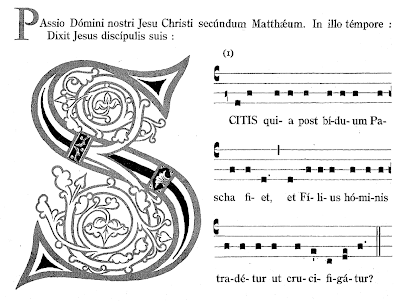
Books for singing the Passion during Holy Week in the Extraordinary Form

My friend Jeffrey Tucker – who just a few says ago found me a version of the Apostle’s Creed in Latin with chant notation for a project I was working on – has posted at Chant Cafe an entry about having obtained the books for singing the Passion in the Extraordinary Form.  He has digitized them and made them available in PDF format.

Very cool.

They are in black and white only.  Perhaps he will be moved, in his goodness, to give us color versions as well.

After all…

Say The Black Do The Red

Posted in Just Too Cool | Tagged ,
4 Comments

“And with your spirit”

From the Catholic Herald, the UK’s best Catholic weekly, with my emphases and comments.  I edit because of length.  The author, Fr Milner died in December, [Stop now, dear reader, and say a prayer for the author.] a few months after writing this article.

Why ‘and with your spirit’ is right

Fr Austin J Milner OP explains the rationale for one of the most striking and controversial changes in the new English Mass translation

By Fr Austin J Milner OP

Perhaps one of the most difficult of the changes which people will be asked to make when the new translation of the Roman Missal comes into use will be that from “And also with you” to “And with your spirit”. People have got used to the former. It makes good sense. Why change it?

“And with your spirit” is the literal translation of et cum spiritu tuo, which itself is a literal translation from the Greek. This phrase, whether in Greek or in Latin, was quite strange to the ancient world. It appears only in Christian writings. It already forms part of greetings at the end of some of the Pauline Epistles: “The grace of our Lord Jesus Christ be with your spirit brethren. Amen” (Gal 6:18; cf Phil 4:23; Philemon 25); “The Lord be with your spirit. Grace be with you” (2 Tim 4:22).  [It is also in the Hebrew Old Testament in Ruth 2:4.]

[…]

Some today object that such an interpretation of the response gives too much emphasis to the priesthood of the one who presides to the detriment to the priesthood of the whole assembly. But this was certainly not the intention of Theodore of Mopsuestia or St John Chrysostom.

The former says in the homily already quoted: “It is in this sense that the phrase ‘And with your spirit’ is addressed to the priest by the congregation according to the regulations found in the Church from the beginning. The reason for it being that when the conduct of the priest is good it is a gain for the whole body of the Church, and when the conduct of the priest is unholy it is a loss to all. All of them pray that through peace the grace of the Holy Spirit may be accorded to him, so that he may strive to perform his service to the public suitably.”

And St John Chrysostom in a homily on Pentecost says: “If there was no Holy Spirit there would be no shepherds or teachers in the Church, for these also come through the Spirit. As St Paul says: ‘In which [flock] the Holy Spirit has established you shepherds and bishops’ (Acts 20:28). Do you not see how this also comes about through the Spirit? For if the Holy Spirit was not in the common father and teacher when just now he went up into the sanctuary and gave all of you the peace, you would not all have answered: ‘And with your Spirit.’

“For this reason, not only when he goes up into the sanctuary and when he addresses you and when he prays for you do you shout this answer, but when he stands at the sacred table and when he begins to offer the awe-inspiring sacrifice – the initiates will understand what I say – he does not touch the offerings before he himself has begged for you the grace of the Lord and you cry in answer to him: ‘And with your spirit.’ By this reply you are also reminded that he who is there does nothing, and that the right offering of the gifts is not a work of human nature, but that the mystic sacrifice is brought about by the grace of the Holy Spirit and his hovering over all. For he who is there is a man, it is God who works though him. Do not attend to the nature of the one you see, but understand the grace which is invisible. Nothing human takes place in this sacred sanctuary. If the spirit was not present there would be no Church assisting, but if the Church stands round it is clear that the Spirit is present” (PG 50,458-459).

This Syrian interpretation of “And with your spirit” is by no means the only one to be found in the various commentators on the liturgy, both eastern and western. But the fact that from the end of the fourth century this reply was only made to those in major orders confirms that it was a very widespread understanding.

So to conclude, when we begin again to say “And with your Spirit” instead of the banal “And also with you”, we should understand that we are not referring to the soul of the priest as distinct from his bodily existence. We are making reference to the awe-inspiring mystery of our common redemption and healing through the Holy Spirit whom the resurrected Jesus has sent into our hearts. In particular we are referring to the special grace gift of the Spirit by which men are made priests, praying that that grace will continue to enable them to perform all their duties in holiness in the service of the priestly people of God, and reminding ourselves that, as St John Chrysostom puts it, the minister at the altar “does nothing, and that the right offering of the gifts is not a work of human nature, but that the mystic sacrifice is brought about by the grace of the Holy Spirit and his hovering over all.”

Posted in Brick by Brick, WDTPRS | Tagged ,
29 Comments

Funny stuff

From the National Catholic Register with my emphases and comment:

11 Craziest Things I’ve Ever Heard in Church

by Matthew Archbold

1) Whispered by a father in the pew behind me to his children who were being a little noisy: “When we get to the car I’m testing all of you on what the gospel was. And if you get it wrong you’re dead.

2) Whispered by my daughter minutes before going up for her First Communion: “Dad, I think I’m gonna’ throw up.” (She did. Our parish priest later came to our home to offer her the Eucharist but she was still sick so we waited until the next week.)

3) Said by priest who noticed that two birds had flown into the Church and were dive bombing parishioners: “Oh, I know how to get the birds out of here. I’ll baptize them and then they’ll only come back twice a year on Christmas and Easter.” [I have a story about a bat and a wedding and gauzy white material that’s pretty funny.]

4) Deacon in January 2009: “There’s been a lot of talk about ‘hope’ recently and I think we’ve all gotten excited and inspired about it.” (I thought about raising my hand and saying “Not me” but I didn’t.)

5) Jesuit priest from the altar right after Communion: “Are the dancers ready?” Uh-oh.

6) Little girl talking to her younger sister just after Communion in the pew in front of us: “Ha ha. I get Communion but you’re too little.” This was accompanied by a little celebratory dance.

7) My nine year old daughter to my eight year old while walking into Church: “You have to sing because my teacher said you get twice the credit for praying if you sing.” That night they asked me if we could sing our nighttime prayers. I said no. [That’s the old “qui cantat bis orat” thing.  What they leave out is the “qui BENE cantat bis orat”.]

8) Priest: “Oh the Book of Revelation is a bunch of hooey.” [Fail.]

9) An usher said to me and my wife while handing us the bulletin: “Whoa five kids. You really take this Catholic thing seriously, huh?”

10) Priest at the beginning of Mass: “If this is your first time here, we do things a little differently…Now give the person next to you a hug.” [Not funny at all, really.]

11) During the homily a woman said to her husband: “This is a really boring bulletin.”

Posted in Lighter fare, SESSIUNCULA |
57 Comments

A March for Life in London?

From His Hermeneuticalness, Fr. Finigan:

The Catholic Herald is floating the idea of holding a March for Life in London. This is an excellent idea: we wouldn’t be able to match the scale of the US March but we could certainly make an impact. It would also be an important opportunity for the Catholic Church to witness to the value of human life as well as co-operating with those other Christians and people of other faiths who share our convictions on this issue.

The article recognises the possible problems but I agree that these could be overcome by marshalling some of our energetic and enthusiastic young pro-lifers. See: Let’s take courage and hold a March for Life in Britain.

For an idea of what happens in the USA, see the official March for Life website and many US blogs which cover it. You do need to look at the blogs to find out much about it. As the Herald said:

If you rely on the television or daily papers for your news this is probably the first you’ve heard of it. Even in the United States it barely registered in the mainstream media.Fr John Boyle was there and has posted a slideshow of photos from the march. It also worth looking at his advance information from a couple of weeks ago.

Posted in Emanations from Penumbras | Tagged
10 Comments