I posted about the USCCB’s Doctrine Committee and their examination of Sr. Elizabeth Johnson’s book on the Trinity which seems to be heretical.
NCFishwrap covered this too. Bottom line: Feminist theologian = good. USCCB Doctrine Committee = bad.
Sr. Johnson, CSJ, has responded to the USCCB’s statement. Her response is worth a glance with my emphases and comments.
Response by Dr. Elizabeth Johnson C.S.J., March 30, 2011:
It is heartening to see the Bishops Conference give such serious attention to the subject of the living God. [/sarcasm] I appreciate how this statement acknowledges the laudable nature of the task of crafting a theology of God, and the number of issues on which the statement judges that I am “entirely correct.” [Imagine yourself reading Sr. Johnson’s book. Now imagine yourself walk into a shop full of broken clocks.] The book itself endeavors to present new insights about God arising from people living out their Catholic faith in different cultures around the world. [I think that is code for “different religions”. I could be wrong.] My hope is that any conversation that may be triggered by this statement will but enrich that faith, encouraging robust relationship to the Holy Mystery of the living God as the church moves into the future. [Perhaps Sr. Johnson is a small-c catholic. And the church will move into the “future”, when it abandons traditional Catholic teaching about the Trinity and the language we use to describe the Trinity.]
I would like to express two serious concerns. [Rather than all the other serious concerns? Rather than the concerns that aren’t serious?] First, I would have been glad to enter into conversation to clarify critical points, but was never invited to do so. [“conversation… invited”.] This book was discussed and finally assessed by the Committee before I knew any discussion had taken place. [At this point I must ask… because I don’t know… did Sr. Johnson submit her book to a bishop or his delegated censor librorum? Also, why should anyone have to alert her that her book is being studied? She put it out in public in the first place!] Second, one result of this absence of dialogue [read = invited conversation] is that in several key instances this statement radically misinterprets what I think, and what I in fact wrote. [Indeed?] The conclusions thus drawn paint an incorrect picture of the fundamental line of thought the book develops. [NB: “fundamental line of thought”. That is a noteworthy phrase.] A conversation, which I still hope to have, would have very likely avoided these misrepresentations. [We’ll never know. Sr. Johnson can now print an explanation of her “fundamental line of thought”. If she wasn’t able to make her thought clear enough to be understood by the very smart people who studied her book for the USCCB, perhaps she can take another run at it. Are people in the CDF who can help? ]
That being said, as a scholar I have always taken criticism as a valuable opportunity to delve more deeply into a subject. [Fair enough.] The task of theology, classically defined as “faith seeking understanding,” calls for theologians to wrestle with mystery. [But… Catholic theologians are not autonomous.] The issues are always complex, especially on frontiers where the church’s living tradition is growing. [Am I wrong, or does this sound like “evolving”, but not in the sense of “development in doctrine” along the lines Newman might recognize.] Committed to the faith of the church, [And what is the church?] I take this statement as an occasion to ponder yet further the mystery of the living God who is ineffable. [It is a good thing. Bp. Trautman isn’t on the USCCB’s Doctrine Committee. Er…um… well… you know what I mean. Did I just write that? You see… I didn’t make the fundamental line of my thought clear. Bp. Trautman objected to the use of “ineffable” in the new, corrected English translation of Mass. See? It is possible to get at that fundamental line of thought!]
At this time I will make no further statements nor give any interviews. [I suspect that the reason for this is that she is worried that the next step is that the powers that be will remove her mandate to teach in a Catholic school.]
If Sr. Johnson can indeed remain silent in this regard and then make corrections to how she expresses her “fundamental line of thought”, then the system will have worked.
It might have worked a while back, but it is working now.
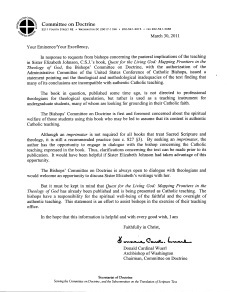 US Bishops do care about theology and what is being taught and written. For example, even though we already knew this, Sr. Elizabeth Johnson’s book on the Trinity, Quest for the Living God, is not a good book.



 Elizium23 on Daily Rome Shot 1116: “The origin of difference and division, the pharmakos represents evil both introjected and projected. Beneficial insofar as he cures—and for…”




























