Christian leaders against deviant activists ‘hijacking’ Martin Luther King

What did Martin Luther King really say?

He didn’t, and wouldn’t, say that there was a moral equivalence between skin color and deviant inclinations.

From CNA with my emphases and comments:

Christian leaders rally against gay activists ‘hijacking’ Martin Luther King legacy
By Kevin J. Jones

Atlanta, Ga., Jan 17, 2011 / 02:12 pm (CNA/EWTN News).- On the observance of Martin Luther King Day, African-American leaders noted the slain civil rights figure’s Christian position on cultural issues like abortion and sexual ethics. Illinois religious and political leaders also organized to challenge the “hijacking” of the civil rights movement by homosexual political activists.

Dr. Alveda King, full-time director of African-American Outreach for Priests for Life and King’s niece, cited her uncle’s advice columns written for Ebony magazine in 1957 and 1958.

“In advising men and women on questions of personal behavior 50 years ago, Uncle Martin sounded no different than a conservative Christian preacher does now,” she commented. “He was pro-life, pro-abstinence before marriage, and based his views on the unchanging Word of the Bible. Today, Planned Parenthood would condemn Dr. Martin Luther King, Jr. as part of the ‘religious right’.”

King reported that one of her uncle’s columns concerned a young man who had impregnated his girlfriend and refused to marry her, resulting in a “crime,” a euphemism for abortion. Martin Luther King, Jr. advised the man that he had made a “mistake.”

He also urged another reader to abstain from premarital sex, saying that such activity was contributing to “the present breakdown of the family.”

“Dr. Martin Luther King, Jr. was a man of peace, justice, and most of all a man of God,” Alveda King continued, suggesting that he would be working today to secure justice for those in the womb endangered by abortion.

In Hillside, Illinois more than 40 African-American religious and political leaders gathered on Jan. 17 at Freedom Baptist Church to lament the misrepresentation of King’s legacy. [Here it comes…] During the Illinois House debate on the issue of civil unions for homosexuals, two backers of the proposal compared same-sex “marriage” to interracial marriage.

[Bogus] Comparisons between homosexual rights and civil rights have become increasingly common in recent decades. In its own Martin Luther King Day message, the National Gay and Lesbian Task Force’s executive director Rea Carey also [crassly] invoked the leader.

“We believe that were he alive today, Dr. King would be standing with the lesbian, gay, bisexual and transgender community as we too reach for equality,” she said. [and returned to her hallucinogenic mushrooms.]

However, the press conference of African-American leaders in Illinois challenged this view. Its announcement denied that opposition to discrimination based on “immutable, non-behavioral, morally neutral condition like race” was equivalent to an effort to “normalize and institutionalize deviant sexual relations.”

David Smith, executive director of the Illinois Family Institute, was of a similar view.

“Skin color is not analogous to behavior,” he said.

“Homosexual activists and their allies are advancing their subversive moral and political goals by hijacking the rhetoric of the Civil Rights Movement and Martin Luther King Jr.’s legacy,” [Well put.] the Institute said in a press release. It said attempts to associate “philosophical conservatives” with racism and bigotry constituted intimidation.

“We shouldn’t allow the exploitation of the legacy of Dr. King to be exploited for the destructive purposes of the movement to normalize homosexuality and demonize traditional moral beliefs.”

A similar press conference was scheduled to take place in East St. Louis.
Posted in Throwing a Nutty | Tagged ,
49 Comments

Continence and married deacons/priests

Yet another about deacons.  This would also concern priests in the Latin Church who, as married ministers in other churches, were received into the Roman Church and ordained.

A few days ago distinguished canonist Ed Peters posted on his fine blog an entry about CIC 1983 277, which concerns clerical “continence”.

I particularly liked his statment:

Canon 277 (and the immemorial tradition behind it) either means what I say it means, or it doesn’t.

The Catholic Encyclopedia defines “continence”:

Continence may be defined as abstinence from even the licit gratifications of marriage. It is a form of the virtue of temperance, though Aristotle did not accord it this high character since it involved a conflict with wrong desires–an element, in the mind of the philosopher, foreign to the content of a virtue in the strict sense. Continence, it is seen, has a more restricted significance than chastity, since the latter finds place in the condition of marriage. The abstinence we are discussing, then, belongs to the state of celibacy, though clearly the notion of this latter does not necessarily involve that of continence.

Prof. Peters has stirred up the ant hill, for sure.

Now he has posted: “Why Canon 277 § 3 does not allow bishops to exempt clerics from the obligation of continence”

I shall carefully watch the unfolding drama.

Posted in The Drill | Tagged , ,
90 Comments

REVIEW: 2011 Angelus Press Calendar

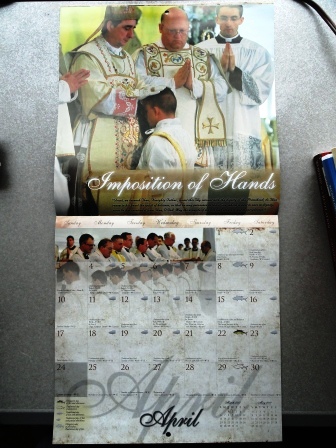
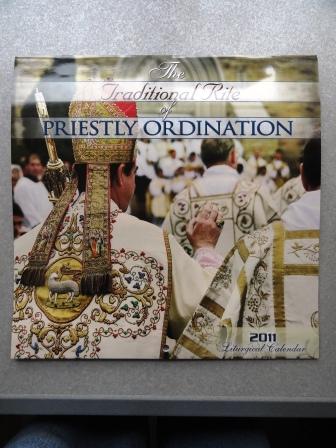
The kind folks at Angelus Press sent me again this year their wall calendar.

ordination

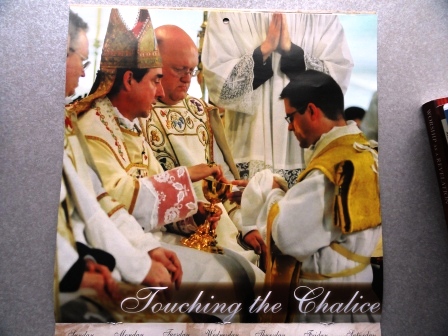
This year the calendar features beautiful photos of the illicit but valid ordinations to the priesthood of some of their members, and, it appears, a benedictine monk (at least a religious with hair shaved in the “corona”).

REVIEW: 2011 Angelus Press Calendar

The photos take you through the main points of the older form of ordination, showing some things that are now, sadly, missing.  They should be restored, in my opinion.  I digress.

REVIEW: 2011 Angelus Press Calendar

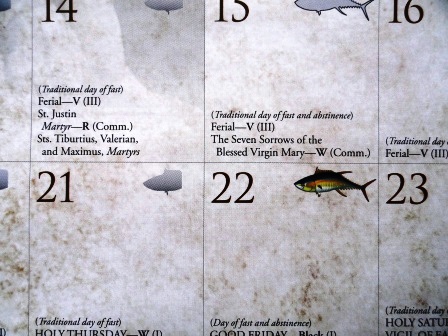
The days show indications for fasting.

REVIEW: 2011 Angelus Press Calendar

I look forward to the day that when men who are ordained to the SSPX they will be able to exercise their priestly functions licitly, side by side with the Church’s priests, and they will contribute as well to the restoration of so much that we have lost, particularly in our Catholic worship.

In the meantime, nice calendar.

Posted in REVIEWS | Tagged , ,
23 Comments

What are deacons really for?

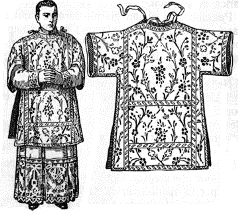
dalmaticIt seems these days that I am writing fairly often about matters concerning deacons.

I was alerted to a post on the blog of the learnéd Anglican Fr. Hunwicke‘s site.

My emphases and comments:

I recently heard a immensely depressing sermon … I had better not say where or when, or friends will be cross with me … on what ‘diaconate’ means. Depressing: because (culpamus) it was woefully ignorant of current scholarly opinion; and because (ascendendo) it was equally ignorant of the Tradition of the Western Church; and, finally (laetamur), because, as happens more and more often nowadays, these two standards of which it was ignorant are convergent and, even, consistent.

In 1990, Mr John N. Collins published his DIAKONIA Re-interpreting the Ancient Sources (OUP). You can probably fiddle around with Google and discover that its conclusions, more than two decades later, have not been disturbed. If you have queries about details in what I am about to write, a reading of Collins will probably answer them; I am not going to summarise him at any greater length than one paragraph.

Collins began by identifying a particular understanding of diakonia which became fashionable in Protestant circles in the middle of the twentieth century; and then infected the Latin Church too. [Pay attention…] It saw diakonia as meaning self-giving service to the poor and needy. Based on a misreading of Acts 6, it appealed to Christians at a time when ecclesial structures were losing power and prestige. “OK”, it cheerfully claimed, “if you’ve lost your power and status you can still surreptitiously claw it back by asserting the moral high ground of humble service”. Collins demonstrated, from examination of profane and sacred Greek usage, that the word diakonia, and its cognates, have a quite different root sense: that of one person’s commissioned service to another person.

So the essence of the concept is not the following of Christ who came to ‘serve rather than to be served’. [NB:] The Deacon’s basic purpose is not to be washing the feet of the lowest of the low (just as the nature of the Church is not, as we have so frequently been told, to be the Servant Church). Such things may be worthy in themselves … may, indeed, be the charism of particular holy people. But they are not what diakonia is fundamentally all about.

What is it about? In its essence it is about serving, being commissioned to serve, the Bishop, the Eucharistic celebrant; about serving him in the administration of the Lord’s Body and Blood; serving him in the proclamation of the Holy Gospel. Not a philanthropic service but a cultic, liturgical service. In as far as their duties may extend in the direction of philanthropy, it is instructive to observe the role they have in ‘Hippolytus’: the deacons are to attend the Bishop and report to him who are sick so that he, if it seem good to him, may visit them. [!] Their ministry is to the Bishop, not to the needy. This role survives in the Anglican Ordinal: the deacons are “to search for the sick, poor, and impotent … to intimate their estates, names … unto the Curate”.
Continues.

Of course, it is possible for offices to develop a bit over the centuries as we come to understand them more deeply.

More what Fr. Hunwicke wrote is certainly a good corrective.  And I am sure it will not be welcome in many circles.

Posted in The Drill | Tagged ,
21 Comments

First fruits of Anglicanorum coetibus

At the site of the Ordinariate Portal there is a photo of one of the former Anglican Bishop saying his first Mass.  He is, of course, now a Catholic priest.

Fr. Andrew Burnham said Mass for the first time at the Oxford Oratory.

Note the Benedictine Arrangement of the altar.

I suspect that this photo gives you a sense of why liberals are lukewarm to hostile to the Holy Father’s provisions.

For a huge version of the same, click the image.

First fruits of Anglicanorum coetibus

WDTPRS kudos to Fr. Burnham.

And Benedict XVI is the Pope of Christian Unity.

Posted in Just Too Cool, Pope of Christian Unity | Tagged ,
7 Comments

Of star gazing and tattoo removal

OphiuchusI heard about this last week, but never got around to it.

From The Irish Times:

Zodiac now 13-strong as Ophiuchus signs in

The Irish Times

CÍAN NIHILL

THINK YOU’RE a Pisces? Think again, because the star sign you thought was yours may be incorrect. That’s according to an astronomer who has discovered there are 13, not 12, zodiac signs. [Don’t panic.]

[…]
[Parke] Kunkle, a professor in the Minnesota Community and Technical College, talked about how a wobble in the Earth’s axis had caused a change in star constellations. As a result, there is a new sign, Ophiuchus – better known as the serpent holder – that wasn’t present 3,000 years ago when Babylonians introduced zodiac.

Prof Luke Drury, head of the astronomy and astrophysics section of the Dublin Institute for Advanced Studies, explained the process, known as “precession”.

“If you think of the Earth as a wobbling or spinning top that is not quite vertical, the spin top moves around in a shape a bit like a cone. The Earth spins exactly the same way,” he said.

Ophiuchus“Astronomers have known about this for a very long time. [What else do they know and aren’t telling?] It has been one of the constant criticisms of astrology, which isn’t a science and doesn’t allow for it.”

While the sign many people were born under may change, it doesn’t necessarily mean you have to remove that scorpion tattoo just yet: [Whew!   What a relief.] some astrologers, particularly in the western world, use a system that is Earth, not star, based.

The new zodiac dates are: Capricorn: Jan 20th – Feb 16th. Aquarius: Feb 16th – March 11th. Pisces: March 11th – April 18th. Aries: April 18th – May 13th. Taurus: May 13th – June 21st. Gemini: June 21st – July 20th. Cancer: July 20th – Aug 10th. Leo: Aug 10th – Sept 16th. Virgo: Sept 16th – Oct 30th. Libra: Oct 30th – Nov 23rd. Scorpio: Nov 23rd – Nov 29th. Ophiuchus: Nov 29th – Dec 17th. Sagittarius: Dec 17th – Jan 20th.

How do you break it to someone that he is an Ophiuchus?

Posted in Global Killer Asteroid Questions | Tagged ,
30 Comments

Good news, please

Shall we start a new work week with some of your good news?

Posted in SESSIUNCULA |
35 Comments

Westminster Cathedral: hordes, throngs, mobs demanding ordination of women

Mulier Fortis has an amusing note in her post about the ordination of the former Anglican bishops.

I was slightly amused to see this photo on Facebook. The hordes of supporters calling for the Holy Father to ordain women…

Westminster Cathedral: hordes, throngs, mobs demanding ordination of women

…almost outnumbered by the cameraman and the interviewer…

It is to laugh.

Posted in Throwing a Nutty | Tagged ,
23 Comments

PODCAzT 115: Singing the Eucharistic Prayer; Fr. Z sings and rants

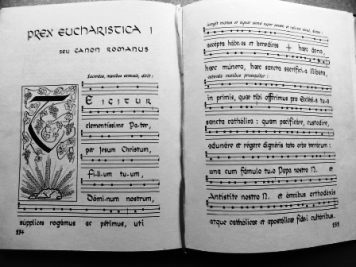
Inspired by a reader’s email question, I dug out my volume of the Ordo Missae in cantu to talk about and then sing the Roman Canon, 1st Eucharistic Prayer, in Latin.  So, this is also a PRAYERCAzT and an ASK FATHER answer.

I had a question in my email today:

I recently attended a Mass where the celebrant sang–in a crooner’s voice–the entire canon, including the Consecration. This wasn’t chant or plainsong. It sounded like Dean Martin. Would something like this meet with official approval?

PODCAzT 115: Singing the Eucharistic Prayer; Fr. Z sings and rantsAs part of my answer, I will sing for you the Roman Canon using the Ordo missae in cantu.  I’ll insert here the name of the Pope and some hypothetical bishop, John, and go from there.

Vote for Fr. Z!Singing the canon can be done in the Novus Ordo.  Whether you should or not is another question.  It makes Mass longer, of course.  Also, if you have orchestral or polyphonic settings of the Sanctus and Benedictus you have the whole question of whether or not to do what was done traditionally, that its have the celebrant continue with the silent recitation of the Canon while the Sanctus is being sung, and then, after the Sanctus is concluded PODCAzT 115: Singing the Eucharistic Prayer; Fr. Z sings and rantscontinue with the consecration sung aloud.  Then return to the silent recitation while the Benedictus is sung, until singing aloud the doxology.  That is in keeping with the way things were done for centuries and it works.  The rubrics, however, militate against this.  It would be good to have a deeper discussion of the value of having a silent Canon, at least from time to time.  Joseph Ratzinger suggested this in one of his books and I think he would not have changed his mind.

Also, if there are priests out there who are determine to gripe about the new translation, I suggest they start using Latin.

This is a “how to” project, for priests.https://wdtprs.com/wp-content/legacy/audio-archive/podcazt/11_01_16.mp3

Some older PODCAzTs:
PODCAzT 115: Singing the Eucharistic Prayer; Fr. Z sings and rants

114 11-01-07 Sing those Litanies!
113 10-12-12 More winter poems
112 10-12-08 Winter poems
111 10-12-23 4th Eucharistic Prayer; don Camillo (Part IX); digressions included
110 10-08-19 Learning the Roman Canon in Latin for Seminarians
109 10-08-17 A dust up in ancient Carthage and parishes that schism
108 10-07-23 The new translation of the 3rd Eucharistic Prayer; Fr. Z digresses and rants
107 10-07-01 Most Precious Blood and your sins; Interview with Fr. Finigan
106 10-06-25 John Henry Newman’s Kindly Light

Posted in "How To..." - Practical Notes, ASK FATHER Question Box, PODCAzT, PRAYERCAzT: What Does The (Latin) Prayer Really Sound L | Tagged , , , ,
24 Comments

Sunday Supper: guest spot

I haven’t posted any Sunday Supper entries for a while, for various reasons (none of which being “I forgot”).

Today, however, I want to bring to your attention a great idea I saw in the “Power Player of the Week” segment on Fox News Sunday, hosted by Chris Wallace.

Sunday Supper: guest spotWallace this week interviewed his own wife, Lorraine Wallace, about a feature of their family life which has become the topic of a book she put together.

Mr. Sunday’s Soups.  “More than 75 delicious homemade recipes to bring your family together.”

Because of their busy Sunday schedule – for a long time – the Wallaces have had soups on Sundays. Soup is always, easy to make in large or small quantities, of infinite variety and provides great flexibility for serving times. Their custom of having soups helped them maximize the potential of having the whole family eat together.

On a personal note, I had the opportunity to work with Chris Wallace pretty closely for several days in Rome when Bl. John Paul II. I was a Fox News contributor at that time.  Mr. Wallace is a great gentleman.  I have a sense from having known him a little that the family dimension of this book will also be edifying and worthy in its own right.

Eating together is one of the points behind my Supper Supper posts. We have to eat together more often, strengthen those ties which bond so well at the table.

The point Lorraine Wallace is making with her book is underscored by the inclusion of lots of photos and items about their family life, not just recipes.

For various reasons right now, haven’t been posting Sunday Supper posts, though I would like to.  I welcome this “guest spot”.

I would be happy to have guest spots from readers in the future.  If you would like to contact me, maybe we can set up a schedule for guest contributions.  There would have to be notes about how to make what you make, why you chose it, where it comes from, and, of course, photos and tips.

Posted in "How To..." - Practical Notes, HONORED GUESTS, Just Too Cool, Lighter fare, The future and our choices | Tagged , ,
7 Comments