More on the new tapestry with the tiara on the papal coat-of-arms

The other day I and others posted about the change made to the tapestry that is hung from the window of the papal apartments in the Apostolic Palace when the Holy Father  leads the Angelus on Sundays and feasts.

The tapestry displays the papal coat-of-arms.

The new tapestry  had a version of the coat-of-arms showing the traditional papal tiara rather than a miter.

There is a story now about this from CNS which includes an disappointing conclusion:

VATICAN CITY — A gift can be appreciated and used even when it’s not perfect. [What a catty thing to write.] That seems to be what happened last Sunday when a different papal coat of arms appeared on a tapestry hung from the window of Pope Benedict XVI’s apartment.

A closeup of the tapestry used Sunday, featuring the tiara. (CNS/L’Osservatore Romano)

The Catholic blogosphere has been abuzz since Sunday with images, questions and opinions about the tapestry because it featured a crown or tiara topping the crest, rather than the miter Pope Benedict chose — apparently very intentionally — when he was elected in 2005.

“The pope’s coat of arms has not changed. It is what was explained at the beginning of his pontificate,” Jesuit Father Federico Lombardi, Vatican spokesman, told Catholic News Service this morning.

The 2005 explanation of the elements of the pope’s crest — including the decision to replace the traditional tiara with a bishop’s miter — is available  on the Vatican website:

The tapestry featuring the pope’s official coat of arms — with a miter. (CNS/Paul Haring)

“The Holy Father Benedict XVI decided not to include the tiara in his official personal coat of arms. He replaced it with a simple miter, which is not, therefore, surmounted by a small globe and cross as was the tiara. The papal miter shown in his arms, to recall the symbolism of the tiara, is silver and bears three bands of gold (the three powers: Orders, Jurisdiction and Magisterium), joined at the centre to show their unity in the same person.”

Father Lombardi said Sunday’s tapestry — the one with the tiara — was a gift, hung “without any intention of changing the crest.”

He also said, “If it is used again, it will be modified” to match the pope’s official coat of arms, featuring the miter.

Posted in Lighter fare |
40 Comments

A cautionary tale for bishops who permit liturgical dance

My friend Fr. Blake, the great P.P. of St. Mary Magdalene in Brighton, gets a tip of the biretta for this    o{]:¬)

From ICN:

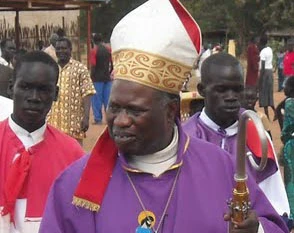
Card. WakoSudan: assassination attempt on Cardinal

An assassination attempt on Cardinal Zubeir Wako, the Catholic Archbishop of Khartoum took place on Sunday. The attack happened as the Cardinal was leading the Eucharistic celebration at the Comboni Playground in Khartoum.

A suspect, who was identified as Hamdan Mohamed Abdurrahman,  infiltrated the congregation and joined the liturgical dancers in front of the altar. He made his way to the front of the group and held up a dagger within four steps of Cardinal Wako, before he was spotted by the Master of Ceremonies, Mr Barnaba Matuech Anei who was next to the cardinal, who caught and disarmed him. He was then handed over to the security guards who had missed him earlier.

“The man  might have infiltrated and entered the playground early, and hid himself amongst the faithful because we had very intense security check-in at the gates,” Mr Matuec said.

“We want to find out what was his mission in the Church was, and why he was carrying a dagger with him. [Why he had a knife?  Why do you think he had a knife?  Was he going to give it to the Cardinal as a gift?  Did he want His Eminence to autograph it?] After that, we will see what to do next. We must know his background and identity. If he has people backing him to carry out such actions in the church, we would like to know,” he said

[…]

The Catholic Church has filed a case against Hamdan. When interrogated on Monday at Military Central Committee of the Sudan Armed Forces, Hamdan testified that he was an Arab Misseriya from Southern Kordofan State. He is being detained at the police station in Khartoum and will be taken to the court for further action.

International experts warn that the life of Christians in Northern Sudan will be in danger if Southern Sudan secede during the self-determination referendum.

Let that be a warning to you!  Liturgical dance can kill you!

It’s been killing liturgical dignity for years.

CNA‘s story.

Posted in Liturgy Science Theatre 3000 | Tagged , ,
20 Comments

Where is Pope Benedict’s liturgical vision getting traction?

The gentlemanly Sandro Magister has an interesting piece on Chiesa today about how liturgical vitality is found somewhere other than in Eurocentric regions.

Ratzinger’s Best Pupils Are in Sri Lanka and Kazakhstan

They are the bishops Ranjith and Schneider. They follow the pope’s example in the liturgical camp more and better than many of their colleagues in Italy and Europe. [To the European bishops’ ongoing shame…] One revealing test is the manner of giving communion at Mass

by Sandro Magister

ROME, October 14, 2010 – In Sri Lanka, the bishops and priests dress all in white, as can be seen in the unusual photograph above: with the entire clergy of the diocese of Colombo, the capital, diligently listening to its archbishop, Malcolm Ranjith, who is likely to be made a cardinal at the next concistory. [Perhaps.  I hope so.]

Michael Uwe LangIn his diocese, Archbishop Ranjith has proclaimed a special year of the Eucharist. And to prepare for it, he gathered all of his priests for three days of intensive study in Colombo, where he brought in two outstanding speakers from Rome: Cardinal Antonio Cañizares Llovera, prefect of the Vatican congregation for divine worship, and Fr. Uwe Michael Lang, a member of the same congregation and an adviser for the office of pontifical liturgical celebrations.

[…]

MosebachNot only that. In order to offer more insight to his priests during the three days of study, Archbishop Ranjith brought in from Germany a Catholic writer of the first rank, Martin Mosebach, also the author of a book that has raised a great deal of discussion: “Eresia dell’informe. La liturgia romana e il suo nemico.” And he asked him to speak precisely on the Church’s disarray in the liturgical field.

All of this for what ultimate aim? Ranjith explained this in a pastoral letter to the diocese: to rekindle faith in the real presence of Christ in the Eucharist, and to teach how to express this faith in appropriate liturgical signs.

For example, by celebrating the Mass “facing the Lord,” by receiving communion on the tongue instead of in the hand, and by kneeling to receive it. In short, with those actions that are distinctive traits of the Masses celebrated by pope Ratzinger. [Exactly.]

*

The striking thing about this and other similar news is that Benedict XVI’s work to restore vitality and dignity to the Catholic liturgy seems better understood and applied on the “outskirts” of the Church than in its European center of gravity[Again, to the ongoing shame of the bishops in Europe and other places which are closely associated.]

It is no secret, for example, that Gregorian chant is today more vibrant and widespread in some countries of Africa and Asia than it is in Europe.

Among the guidelines given by Archbishop Ranjith for the Eucharistic year in the diocese of Colombo is, in fact, that of teaching the faithful to chant in Latin, at the Mass, the Gloria, the Credo, the Sanctus, the Agnus Dei.

In the same way, Benedict XVI’s decision to liberalize the use of the ancient missal alongside the modern one – for a mutual enrichment of the two forms of celebration – seems to be understood and applied in Africa and Asia better than in some regions of Europe[The shame compounds.]

*

Another proof of this concerns the way in which communion is given to the faithful: in the hand or on the tongue, standing or kneeling.

The example given by Benedict XVI [Pope Benedict prefers to give an example rather than directives.] – on the tongue, and kneeling – finds very few imitators above all in Europe, in Italy, and even in Rome, where almost everywhere communion is still given in the hand to anyone who approaches to receive it, in spite of the fact that the liturgical norms permit this only in exceptional cases.

In Palermo, where the pope went last October 3, some of the local priests refused to get in line to receive communion from him, simply to avoid taking part in an action with which they do not agree. [To their everlasting shame.]

The rumor has also spread that at the Masses celebrated by the pope, people kneel because they are before him, and not to adore Jesus in the most holy sacrament. [A particularly vicious rumor.] A rumor that finds a hearing even though for some time communion has also been given to the faithful on the tongue and kneeling by the cardinals and bishops who celebrate under the pope’s mandate.

It is no surprise that the article that www.chiesa dedicated in mid-September to the meaning of kneeling in adoration before God and the Eucharist raised protests from various readers, including some priests. [To their shame.] The main argument brought out against kneeling for communion is that the model and origin of the Mass is the Last Supper, where the apostles were seated and ate and drank with their hands. [It is far more likely that they reclined.  Moreover, we are not 1st century Jews.  We are 21st century Catholics who have since the 1st century learned a thing or since about what the Lord did for us.]

It is the same argument adopted by the Neocatechumenals to justify their “convivial” way of celebrating the Mass and taking communion, to which they continue to adhere in spite of the fact that that Church authorities – among whom, however, they boast some supporters, like substitute secretary of state Fernando Filoni – have ordered them to respect the liturgical guidelines. [This is a good reminder.  Their liturgy was corrected by the Holy See.  They have, for the most part, yet to comply. I had a conversation about this very thing a few days ago with some people who are pretty familiar with them.]

Here as well, to find the parishes, the dioceses, the priests and bishops who act and teach in full harmony with Benedict XVI, it is easier to go looking on the “outskirts” of the Church: for example, in remote Kazakhstan, in ex-Soviet central Asia.

Dominus EstThere, in the diocese of Karaganda, all of the faithful receive communion on the tongue and kneeling. And there is a bishop there, the auxiliary of Karaganda, Athanasius Schneider, who has written a little gem of a book on the subject, entitled: “Dominus est – It Is the Lord! Reflections of a Bishop of Central Asia on Holy Communion.”

The book is in two parts. The first recounts the heroic life of those Catholic women who during the years of communist rule brought communion to the faithful in secret, defying the prohibitions. And the second explains the faith that was at the origin of that heroism: a faith in the real presence of Jesus in the Eucharist that was so strong as to be willing to die for it.

And it is against this background that Bishop Schneider revisits the Fathers of the Church and the history of the liturgy in the West and in the East, shedding light on the origin and reinforcement of this adoring manner of receiving communion kneeling and on the tongue.

When pope Ratzinger read Bishop Schneider’s manuscript in 2008, he immediately ordered the Libreria Editrice Vaticana to publish it. And it did, in Italian and Spanish.

The English edition of the book has a preface written by the archbishop of Colombo, Ranjith.

It seems to me that a great deal could be accomplished toward “the new evanglization” were these liturgical strategies adopted widely.
Posted in Brick by Brick, New Evangelization, Our Catholic Identity | Tagged , , , ,
14 Comments

Bugnini: “I am the liturgical reform!”

Our friends at Rorate have posted something worthy of your attention.

Bugnini: “I am the liturgical reform!”  [I can hear it.  Along the lines of “L‘état, c’est moi!” he would have said “La riforma liturgica,sono IO!”]

Fr. Anscar Chupungco OSB, former president of the Pontifical Liturgical Institute in Rome, a leading critic of Liturgiam Authenticam and Summorum Pontificum, and undisputed guru of the Philippine liturgical establishment, [He is the guru of “inculturation”.] published “What, Then, Is Liturgy? Musings and Memoir” this year.

The book contains revealing snapshots of the behind-the-scenes of the liturgical reform under Paul VI and John Paul II, as well as extended reflections on the liturgy mixed with criticisms of the policies of the current Pontificate.

The book also contains Chupungco’s proposals for further changes to the Roman rite to continue what he sees as the unfinished agenda of the post-Conciliar liturgical reform. I [i.e., Rorate] intend to post various quotes of interest over the next several days.

From the Claretian Publications edition of the book, pp. 3-4:
After several decades of liturgical reform there are still contrasting opinions about what the council had really intended to achieve. I had the occasion to ask Fr. Cipriano Vagaggini, another mentor of mine and one of the framers of the Liturgy Constitution, what “substantial unity of the Roman rite” meant. The phrase is obscure, yet crucial to inculturation. His answer was quite revealing: “I asked the same question when we were drafting the Constitution but no one in the commission had an answer!” Strange indeed are the ways of the Spirit during the council and surely after the council. But if it is any consolation at all, tension can be considered an encouraging sign that people’s interest in the liturgy has not abated over the years. [Are you encouraged?] When Abbot Primate Benno Gut of the Benedictine Confederation established the Pontifical Liturgical Institute in Rome in 1962, professors of theology, like prophets of doom, alerted him that liturgy [which liturgy?] was a fad that would not exceed their lifetime.

Annibale BugniniIn his posthumous book The Reform of the Liturgy, 1948-1975 Annibale Bugnini keeps record of much opposition to the conciliar and postconciliar reform. Among the most antagonistic groups that he has identified the following clearly harbor a countercultural mentality. [Remember… Chupungco is the guru of “inculturation”.  He wants to affirm cultural trends.] The first is Una Voce, an international group, for the defense of Latin, Gregorian chant, and sacred polyphony against the vernacular and modern music. The second are splinter groups that were often hostile to the liturgical changes being advanced by the Holy See.

Among them Bugnini names the American Catholic Traditionalist Movement and individuals like the Italian journalist Tito Casino, who in his book La tunica stracciata acidly attacked the use of the vernacular; Cardinal Alfredo Ottaviani and Cardinal Antonio Bacci, who staunchly supported opposition to the new Missal because of its alleged “heretical”, “psychologically destructive,” and “Protestant” elements; and the French Abbe Georges de Nantes, who called for the ousting of Pope Paul VI, whom he accused of heresy, schism and scandal. Even some of the devout faithful that frequented the Mass were adverse to the use of the vernacular. In the Church of Sant’ Anselmo an elderly lady corrected me as I was offering her Holy Communion: Non dicitur ‘Il corpo di Cristo,’ sed ‘Corpus Christi’!” (In perfect Latin she bade me say “The Body of Christ” in Latin, not in Italian.)  [That is actually quite a blistering dress down, when you stop to think about it.]

Bugnini himself, then secretary to the Congregation of Divine Worship, was not spared. He was a systematic person who programmed the liturgical reform and courageously pushed its implementation against all oppositionI remember that in one of his visits to the Pontifical Liturgical Institute he declared, “I am the liturgical reform!” In more ways than one his self-assessment was correct. The postconciliar reform would not have progressed with giant steps had it not been for his dauntless spirit and tenacity.

To crown his liturgical accomplishments the Vatican promoted him to the rank of papal delegate to Iran, [Yah, right.  THAT was quite a promotion!  What an award for services rendered.] where he became famous in the secular world for successfully negotiating the release of American hostages.

Revealing.

Posted in Liturgy Science Theatre 3000, The Drill | Tagged ,
39 Comments

Msgr Pozzo on a “para-Council” and misinterpretation of Vatican II

A reader sent a link to an engaging address given at Wigratzbad (the FSSP HQ) by the Secretary of the Pontifical Commission “Ecclesia Dei” back on 2 July about “Aspects of Catholic ecclesiology in the reception [assimilation] of Vatican II”.

He is addressing the intrepretation of the Conciliar documents.

The article is on the site of DICI.

Here is an excerpt.   I suggest you read the rest there.

Msgr. Pozzo’s analysis of the influence of the para-council

Msgr. Pozzo intends to prove that, concerning two controversial points (the first being the unity and uniqueness of the Catholic Church, along with the question of the expression subsistit in from Lumen Gentium 8, and the other—the relations between the Catholic Church and other religions, including ecumenical and interreligious dialogue) “the authentic proclamation of the Church, with regard to its absolute claim, has not been modified substantially with the teaching of Vatican II.”

Hence one can only wonder why the conciliar documents, which in Msgr. Pozzo’s view are so clearly in conformity with Tradition, have given rise to a contrary interpretation on this point. [Some readers will be tempted to jump in and say that the Council documents were riddled with “time bombs”, that they were made purposely ambiguous on certain points.] The Roman prelate asks the question and answers:  “What is the origin of the interpretation of discontinuity or of rupture with Tradition?  It is what we may call the conciliar, or more precisely, para-conciliar ideology which took hold of the Council from the beginning and superimposed itself on the proceedings.  By this expression we do not mean something concerning the documents of the Council, nor the intention of the participants, [All the participants?] but rather the general framework of interpretation in which the Council was placed and which acts as a sort of internal treatment [conditionnement intérieur] affecting our subsequent reading of the facts and the texts.

The Council is not the same thing as the para-conciliar ideology, but the story about that ecclesial event and about the mass media has served in large part to mystify the Council, and that is precisely the para-conciliar ideology. [Certainly entities such as IDOC played their part in distorting the Council’s teachings.] In order to show all the consequences of the para-conciliar ideology as an historical event, one would have to examine the Revolution of 1968, which was based on the principle of breaking with the past and radical change in history.  In the para-conciliar ideology, the 1968 Movement meant a new paradigm for the Church in breaking with the past.” [And that wasn’t in play before and during the Council?]

Msgr. Pozzo concluded that we must use “the hermeneutic of reform in continuity” recommended by Benedict XVI “to address controverted questions, thus freeing, so to speak, the Council from the para-council that has become mixed up with it, while preserving the principle of the integrity of Catholic doctrine and of complete fidelity to the deposit of faith handed down by Tradition and interpreted by the Magisterium of the Church”.

At the end of this presentation, one question remains:  can the para-council denounced by the Secretary of the Ecclesia Dei Commission be identified with the post-conciliar period?

[…]

This is an engaging piece.   Read and discuss.

BTW… it really is worth reading.  It ends with this:

On the one hand, Monsignor Pozzo proposes liberating the Council from the para-council, and on the other hand, Amerio and Radaelli demand that the Roman Magisterium stop being “pastoral” so as to be clearly dogmatic.  This is the heart of the debate about Vatican II, which Msgr. Gherardini calls “a much needed discussion”.

Posted in New Evangelization, Our Catholic Identity | Tagged , ,
10 Comments

QUAERITUR: non-liturgical seasonal decorations in the sanctuary

From a reader:

Since it is now Autumn, the liturgy committee of my parish has
decorated the sanctuary, including the high altar, with all sorts of
Autumn decorations like pumpkins, bundles of grain/straw, baskets and the like.

Are these types of non-liturgical decorations of the sanctuary
allowed, prohibited, encouraged, discouraged, or what?

I think the only prohibition would be that of good taste and a proper understanding of what  a sanctuary is for.

What is this?  The lobby of an IHOP?  Is this a girl scout project?  What’s next?

I am unaware of any specific law baring baskets and pumpkins from sanctuaries.  I wish there were one, but there isn’t.

It seems to me that liturgical colors and the changing of the texts and music is decoration enough.

Okay… I have been under the weather and feeling crotchety today.  But… puhleeze…

Posted in ASK FATHER Question Box |
20 Comments

A priest writes about his love of the Novus Ordo

Here is a counterpoint to the position many of the readers will have.

You should also check out his blog.  You will find that he is a fellow traveler.  This fellow is no liberal.

The Happy Priest: Why I Love to Celebrate the Mass of Vatican II

By Fr. James Farfaglia
10/12/2010

CORPUS CHRISTI, TX (Catholic Online) – Since the close of the Second Vatican Council (1962-1965), the Catholic Mass of the Latin Rite has been the focal point of intense debate and, in some cases, conflict within the Roman Catholic Church

As a Catholic priest I have been very happy celebrating the reformed liturgy of the Second Vatican Council.  Although I do not have any problem with anyone who has an affinity to the Tridentine Latin Mass (now also referred to as the “extraordinary form”), I personally do not share in that same affinity. Based upon long experience, I firmly believe, that properly understood and correctly implemented, the Mass of the Second Vatican Council is a better liturgy and that there was a real need for the Church to reform the Tridentine Latin Mass. [We shall see if he addresses the fact that what the Council mandated for a reform is not actually the reform we got.]

Unfortunately, many Catholics have been deprived of the beauty of what the Second Vatican Council actually intended.  As a priest, I have made it my mission in life to do what I can to promote a correct understanding and implementation of the liturgical reform of the Second Vatican Council.  I personally disagree with those who claim that we need a reform of the reform.  I believe that we simply need to implement the reform correctly.

Unfortunately, shortly after the close of Vatican II, the liturgical reforms that the Council set in motion were upset by ignorance, misinterpretation and even infidelity.

I really love celebrating the reformed liturgy of the Second Vatican Council, now called the ordinary form.  I understand what was changed and why. I find these changes to be very beautiful, [There’s that “beautiful” again.  I hope there will be examples of what he means.] meaningful and exciting.  The Liturgy, especially the Sunday Liturgy, fills me with intense joy and draws me into the mystery of God.

Why do I prefer the ordinary form of the Catholic Mass?

The use of the vernacular in the liturgy came from the Vatican II document on the liturgy, Sacrosanctum Concilium.  However, it must be understood that the principles elaborated in this Vatican II document were already being widely developed in what was called the Liturgical Movement which began during the Pontificate of St. Pope Pius X and which became a very intense movement from the Pontificate of Pius XII right up to the opening of the Second Vatican Council (1962 – 1965).  There were even isolated places where the Holy See allowed the use of the vernacular in the Latin Rite before Vatican II.  We should also remember that the Eastern Catholic Church has always used the vernacular in their liturgy.  So, let us keep in mind that the vernacular is not a new idea.  [Is this an example of what is “beautiful”?  The lame-duck ICEL translation?  And if the Eastern Churches used “vernacular”, they were not using just common sounding language.]

Personally, I think that the widespread use of the vernacular is good reform from the Second Vatican Council. [Even if we grant that the use of vernacular can be at times of advantage, the Council actually said that Latin was to be retained and that the vernacular could be used at times and in limited ways.   So, if we are dedicated to implementing what the Council actually said, we should be using a great deal more Latin, no?] This is particularly true with the Liturgy of the Word.  However, it was not the mind of the Council, nor is it the intention of the Church today, that the Latin language should be considered something of the past, never to be used again in the Catholic Church.  The liturgical life of a parish must be in the vernacular, [“must” be?  Really?  Why?] but it is also very important that Latin, both in the prayers of the Mass and the liturgical music, should be present frequently throughout the liturgical year.

Nationally, there is an interesting phenomena occurring: while some older priests and laity are repelled by any use of Latin, conversely more and more young priests and laity are finding the use of Latin to be exciting, fulfilling and very spiritual.  Parish choirs directed and filled with young people are singing Gregorian Chant and polyphony.  [And yet parish liturgies “must” be in the vernacular.]

One of the most noticeable reforms of the Missal of Pius V has taken place with the Liturgy of the Word.  In my opinion, this was one of the best reforms because it allows the Word of God to be proclaimed in the language of the people and it provides a greater variety of biblical texts for the enrichment of our spiritual life.  [We could grant this point, though perhaps the three readings on Sunday was not such a good idea.]

The Liturgy of the Word on Sundays and Solemnities is comprised of three selections from the Bible.  Outside of the Christmas and Easter Seasons, the First Reading is always taken from the Old Testament.  During the entire liturgical year, the Second Reading is always taken from the New Testament.  The Gospel passage is taken from any of the four Gospels: Matthew, Mark, Luke and John.  The Liturgy of the Word follows a three year ABC cycle which provides a rich variety of readings from the Sacred Scriptures.

Between the First Reading and the Second Reading, one of the 150 Psalms is sung or said.  The Responsorial Psalm provides a prayerful meditation between the two passages from the Bible[Frankly, I think this is one of the least successful changes in the post-Conciliar reform.] Between the Second Reading and the Gospel, the Alleluia verse is sung or said. [It was ever so.]
The other reform that I really enjoy is the variety of Eucharistic Prayers during the Liturgy of the Eucharist. [I cannot agree.]

For many centuries, the Mass had only one Eucharistic Prayer, which we now call Eucharistic Prayer I. Immediately after the Second Vatican Council, the Church added three more Eucharistic Prayers to the collection. Eucharistic Prayer V, Eucharistic Prayers I and II for Reconciliation, and Eucharistic Prayers of Children have followed since.

Eucharistic Prayer II is an adaptation of the Eucharistic Prayer found in the third century. Scholars believe that Saint Hipolitus composed this prayer.  [Ummm… no, they don’t.  That was all pretty much wrong.] Eucharistic Prayer III is a new composition that while similar in some respects to the First Eucharistic Prayer, does incorporate some elements from other sources.  Eucharistic Prayer IV is related to an ancient prayer used in Egypt and later adapted into what came to be known as the Anaphora of St. Basil. [And no one uses it.]

Finally, Sacrosanctum Concilium gave us the words active participation[No, these words and the concept behind them were around for quite some time before the Council.  the Council adopted them and made them a centerpiece of the Constitution on Liturgy.] At the time of the Council of Trent, the Catholic Church was going through a very difficult time.  The sacrificial nature of the Mass, the ministerial priesthood and transubstantiation were all under intense attack from the Protestant reformers.  Therefore, the Church decided that the liturgy should emphasize these essential aspects of our faith.  [Problem: All those things are under intense attack now.  And not just from Protestants, but from within the Church herself.]

The concept of active participation within the Catholic Mass, as understood by Sacrosanctum Concilium and the Liturgical Movement leading up to the Second Vatican Council, restores the proper participation of the laity due to their membership within the priesthood of the faithful. [I am not so sure that we are talking about a “restoration” of active participation, particularly in view of the fact that “active participation” has been so very misunderstood.] Thus, the reformed liturgy of the Second Vatican Council brought about a beautiful [there it is again] relationship between the ministerial priesthood and the common priesthood of the faithful.  [In what way did the older form of Mass not do that?]

On the First Sunday of Advent 2011, we will be using a new translation of the English Mass.  I can’t wait!  What a gift! [FULL AGREEMENT.] In preparation for this great moment in the life of the Catholic Church I will be offering a series of articles regarding the meaning and significance of this important development.

I agree with much of what this priest is saying.  I have seen what can be accomplished by using the Novus Ordo properly, in continuity with our tradition, in fidelity to the books.   However, the parishes where that was actually done, where the liturgy of the Second Vatican Council was actually implemented in that spirit were as rare as hen’s teeth.

While the writer seems to be trying to avoid openly negative references to the older form of Mass, his overarching effect was to … how to say this… run it down as inferior?

He is surely entitled to his preferences.  He gives some reasons for what he thinks, though they are not always crystal clear to me how they fit with the actual mandates in Sacrosanctum Concilium.

At the end I am left with a few questions.

Pope Benedict determined that the older form of Mass was to be more widely available and experienced.  He did this for a reason.  Why?   He sees that our worship has experienced discontinuity and rupture.  Pope Benedict, before his election (and after) has been a proponent of a reform of the reform.  Is the writer out of step with Pope Benedict’s thought?  Perhaps we could frame this in terms of a “new liturgical movement”, rather than a “reform of the reform”.  Either way, if we actually did what the Council asked, we would see in our parishes a Mass that resembled much more the older form.  And if that is the case, if the older form remains the model for the Roman Rite (and I think that is in part what Pope Benedict was signaling), then we are pushed to ask another question: Why not just use the older form?

Realists can answer that, of course.

Another point.

The older form of Mass has a pretty good track record, all in all.  Take a look at a list of saints and try to determine which Mass they attended.  Was it the older or new?   The great centuries of missionary work of the Church were accomplished with which liturgy?  Older?  Newer?  You can go on from there.  The point is that the older form has a pretty good track record.  We don’t yet know what sort of track record the newer form has.   I suppose we could look at the numbers of confessions heard these days, but … I don’t want to pile on.  To be fair, the Novus Ordo has been a short blip so far.  And we haven’t seen it implemented properly.

That said, I can understand quite well what the priest is driving at and I even share some of his views about the newer form of Mass.

I am all for a proper implementation of the Novus Ordo.  Let’s actually give it a shot!  After all, it really hasn’t been tried.

Posted in Our Catholic Identity, SUMMORUM PONTIFICUM, The Drill | Tagged , ,
55 Comments

BLOG RENEWAL: a helpful tweak

I had heard from some of you that it was very hard to find the link/button for adding comments under entries.  The link was in very small letters, gray, together will a few other links.

With some help today I modified the stylesheet and … ta da! … the link is now in black, bold letters.

Have a look at the bottom of an entry.

All for you.

Posted in "How To..." - Practical Notes |
13 Comments

Archbp. Vigneron warns about dissenters ball in Detroit

It is hard to know just how much effect this will have, but the Archbishop of Detroit had no choice but to issue a public statement about an upcoming conference of dissent to held in the Archdiocese entrusted to his care.

From the freep with my emphases:

Archdiocese of Detroit: Stay away from liberal Catholic conference

By Niraj Warikoo
FREE PRESS STAFF WRITER

The Archdiocese of Detroit is warning Catholics in metro Detroit — including priests and ministers — to stay away from a national conference of liberal Catholics to be held in Detroit next year. And Archbishop of Detroit Allen Vigneron is calling upon organizers of the conference to cancel their plans, saying they are in opposition to the Catholic faith. [I would be stunned if they actually did.]

The American Catholic Council, which calls for church reforms and greater openness, [No!  That is not what it is calling for.  Couching it in this language is deceptive.  They are not calling for “openness”.  They are calling for dissent and a violation of the Church’s teachings.] is set to hold a national gathering in June 2011 featuring progressive [liberal dissenter] Catholic leaders near the 35th anniversary of the ‘Call to Action,’ a Detroit gathering in 1976 that urged reform [dissent] and was held by the late Cardinal John Dearden of Detroit.

The liberal group claims there is too much secrecy and hierarchy in the Church; it also calls for greater acceptance of gays and lesbians, [Again, this is wrong.  The Church does accept them.  The Church will not accept their sins.] and women in leadership roles. It wants women and married priests. [Rather like the editorial board of the New York Times, come to think of it.]

“Serious sexual and financial abuses have resulted,” from problems in the Catholic Church, the group says in a newsletter. [Must we note that those problems were caused by sin and by people who violated the Church’s teachings and laws as well as civil law?]

Their conference next year is to feature a range of Catholic speakers who have been critical of the Vatican, including controversial Swiss priest Hans Kung. [And after his talk there will be a break for the participants either to play some shuffle board or to change their Depends.] The liberal group says its efforts are done in the spirit of the Second Vatican Council, whose 50th anniversary is also next year. [Was there ever a better example of what Pope Benedict calls “the hermeneutic of discontinuity and rupture.]

But in a statement released Tuesday, the Archdiocese of Detroit slammed the American Catholic Council, saying “the goals proposed are largely in opposition to the teachings of the Second Vatican Council.” [Perhaps an exercise in understatement.  I wonder if understatement works in Detroit…. hmmm…]

The Archdiocese, which oversees 1.3 million Catholics, says that some of the scheduled speakers at next year’s conference “espouse positions which are clearly contrary to Catholic faith.”

“The Archdiocese of Detroit cautions any Catholic against participating in the American Catholic Council local listening sessions and national gathering in June 2011,” the archdiocese said in its statement. “Catholic parishes, schools, and institutions are not to host any meetings, gatherings, or listening sessions associated with the planning of the June 2011 American Catholic Council. Priests, deacons, and ecclesial lay ministers will want to avoid lending support to such a misguided effort.” [Will there be consequences if they do?]

Archbishop Vigneron said “this national gathering…distorts the true Spirit of Vatican II.”

Vigneron “asks us all to pray for the guidance of the Holy Spirit so that we may embrace authentic development of faith and morals, and shun efforts which threaten unity,” the statement said.

A spokesman for the American Catholic Council was not available to comment Tuesday, but their website says the conference is set for June 10 to 12, Pentecost weekend. The group says on its website it wants to “celebrate the ideas of Vatican II.”  [Funny way to celebrate.]

I am lead to wonder if any of the organizers and potential participants in this Call to Dissent confab – other than Fr. Kung – have ever read the documents of the Vatican II.

WDTPRS kudos to Archbishop Vigneron for stating clearly what should be clear.

Here is the statement on the Archdiocesan website.  I like this line:

The archdiocese wishes to commend and embrace all true efforts at Church renewal – the American Church Council’s agenda is not such an effort.

In the meantime ….
Buy some coffee!
[CUE MUSIC]

After a long day of fending off geriatric heretics, why not relax with a WDTPRS mug filled to the brim with piping hot Mystic Monk Coffee.

Heretics hate Mystic Monk Coffee a lot!  That savory goodness reminds them that they have placed their souls, and the souls of others, in peril of going to a place where they can never never never have Mystic Monk Coffee even if they wanted some!   Or any other coffee, come to think of it.  Well… maybe airplane coffee.  Yes, I’m sure now.  They will have to drink airplane coffee.

Battle heresy and dissent!  Annoy liberals now!  Show your love for the truth!

Refresh your supply today!

Not just Monk Coffee … Mystic Monk.

It’s swell!

UPDATE 1828 GMT:

I see that the National Catholic Fishwrap, in the guise of reporting, is promoting the dissenters event.

Posted in Biased Media Coverage, Our Catholic Identity, The Drill | Tagged ,
41 Comments

After Nobel to Liu Xiaobo, repression of other dissidents

From Asia News:

After Nobel to Liu Xiaobo, repression of other dissidents

The government is concerned that, spurred on by the prestigious award, Chinese human rights activists will organize new protests or demonstrations. Police unleash a wave of arrests and round the clock surveillance on virtually every “sensitive” home. Meanwhile, Liu Xia, wife of the author of Charter ’08, complains: “My house arrest is illegal.”

Beijing (AsiaNews) – The awarding of the Nobel Peace Prize to Chinese dissident Liu Xiaobo, a university professor and author of the democratic manifesto Charter 08, has unleashed a wave of repression against human rights activists in China. According to Chinese Human Rights Defender, police are currently holding at least a dozen people in detention or under house arrest: the government fears demonstrations in support of Liu and his wife, Liu Xia, currently illegally detained under house arrest.

The security officials are guarded the house of Liu in the last days, has increased considerably the number of policemen around the building. The police also follows the well-known constitutional expert Zhang Zuhua, who is accompanied in each shift. On 12 October, the activist in Beijing Fan Yafen was blocked by guards in the house: it had to give an interview. Currently, more than 20 agents are monitoring him.

On 11 October, even lawyer Pu Zhiqiang, who defends the human rights activists, was put under house arrest. Zhou Tuo, a Democrat, is one of the “four gentlemen of Tiananmen”; since October 9 he has been under house arrest and no contact has been made with him. But the repression has not remained confined to Beijing on 11 October in Deyang, Sichuan province, the activist Li Yu was detained and interrogated. Her crime is to have texted some friends to celebrate the new Nobel Laureate. The police ordered her “not to organize anything.”

Also in Sichuan the police have the houses of Mu Jiayu and Li Guohong, in Chongqing, under surveillance since the announcement of the prize. On October 12, Chen Yunfei was brought home after he tried to reach other dissidents. Liao Shuangyuan and Wu Yuqin, members of the Forum for Human Rights in Guizhou, disappeared on 8 October, they were in Beijing to attend a dinner in honour of Liu Xiaobo, when they were stopped by police. Wang Sen, a democracy activist from Sichuan, is under house arrest.

Meanwhile, Liu Xia has protested against the “illegal arrest” that the Chinese authorities have imposed on her in a message posted on Twitter. “I protest strongly against the government which has actually put me under house arrest illegally.” A few hours ago Xia Liu said, also on Twitter,  that Chinese authorities have stopped her meeting a Norwegian diplomatic delegation who came to check on her conditions of detention in her home in Beijing. The U.S. and European Union have called on Beijing to grant the woman freedom of movement.

Posted in SESSIUNCULA |
5 Comments