Archbp. Chaput to conference of religion journalists

There is a long piece on CNA about an address given by His Excellency Most Rev. Charles Chaput of Denver.  Here are some snips with my emphases and comments:

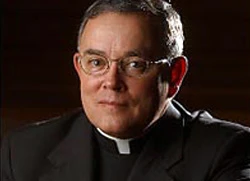
Archbp. ChaputPrejudiced journalism ‘diminishes public life,’ warns Archbishop Chaput

Denver, Colo., Sep 24, 2010 / 12:55 pm (CNA/EWTN News).- Delivering the featured address at a religion news writers conference in Denver on Friday, Archbishop Charles Chaput commented on what he believes to be the new secular “orthodoxy” within American media and warned that slanted journalism “diminishes public life.[Dangerous because it doesn’t seek truth.]

On Sept. 24, the Denver prelate made his remarks as keynote speaker at the 61st annual Religion Newswriters Association conference at the city’s Westin Tabor center downtown.

Opening his speech, Archbishop Chaput underscored that a  “free press is part of the American identity, and also one of its best institutions. I respect that. I value what journalists do for the same reason I value the importance of religious faith in American life – both in the private home and in the public square.”

In that regard, he added, the “kind of journalism that tracks our religious life is so important because it’s the profession where two of our defining freedoms meet.”

A responsible press, and a faith shaped by the God of charity and justice, share two things in common: a concern for human dignity, and an interest in truth,” the prelate noted. “Freedom means that our choices matter.  It also means that our mistakes have consequences.”

Archbishop Chaput then referred to famed 20th century author George Orwell and how his controversial work titled “Animal Farm” – which critiqued the Soviet regime in Russia in the mid 1900s – was initially suppressed from publication.

[…]While “I do know reporters and editors whom I admire, and whose fairness and skill I commend,” said the archbishop, “I think the deficiencies in today’s coverage of religion are too real to ignore.”

The “Christian story now told in mainstream media” depicts the faith as “a backward social force and a menace to the liberty of their fellow citizens.”

[…]

Read… discuss.

Posted in SESSIUNCULA, The Drill, The Last Acceptable Prejudice | Tagged
4 Comments

Outstanding analysis of Papal Visit by Samuel Gregg

In another entry, I suggested that I needed better analysis of Benedict XVI’s visit to the UK.

Lupus in fabula, is I believe the customary phrase.

This comes from Samuel Gregg of the Acton Institute, and one of the smarter writers I know.

Benedict’s Creative Minority

By Samuel Gregg

In the wake of Benedict XVI’s recent trip to Britain, we have witnessed—yet again—most journalists’ inability to read this pontificate accurately[Do I hear an “Amen!”?] Whether it was Queen Elizabeth’s gracious welcoming address, Prime Minister David Cameron’s sensible reflections, or the tens of thousands of happy faces of all ages and colors who came to see Benedict in Scotland and England (utterly dwarfing the rather strange collection of angry Kafkaesque protestors), all these facts quickly disproved the usual suspects’ predictions of low-turnouts and massive anti-pope demonstrations.

Indeed, off-stage voices from Britain’s increasingly not-so-cultured elites—such as the celebrity atheist Richard Dawkins and others whom the English historian Michael Burleigh recently described as “sundry chasers of limelight” and products of a “self-satisfied provincialism”—were relegated to the sidelines. As David Cameron said, Benedict “challenged the whole country to sit up and think.

The RealmOf course the success of Benedict’s visit doesn’t mean Britain is about to return to its Christian roots.  [On this point, turn to books by Aidan Nichols. ] In fact, it’s tempting to say present-day Britain represents one possible—and rather depressing—European future.

In an article  welcoming Benedict’s visit to Britain, the UK’s Chief Rabbi Jonathan Sachs observed, “Whether or not you accept the phrase ‘broken society,’ not all is well in contemporary Britain.” The facts cited by Sach were sobering. In 2008, 45 percent of British children were born outside marriage; 3.9 million children are living in poverty; 20 percent of deaths among young people aged from 15 to 24 are suicides; in 2009, 29.4 million antidepressants were dispensed, up 334 percent from 1985. [Holy cow.]

Such is the fruit of a deeply-secularized, über-utilitarian culture that tolerates Christians until they start questioning the coherence of societies which can’t speak of truth and error, good and evil, save in the feeble jargon of whatever passes for political correctness at a given moment[OORAH!  That’s it.]

[But wait… there’s more!] But what few commentators have grasped is that Benedict has long foreseen that, for at least another generation, this may well be the reality confronting those European Catholics and other Christians who won’t bend the knee to political correctness or militant secularism. Accordingly, [At the same time as he is trying to revitalize Catholic identity…] he’s preparing Catholicism for its future in Europe as what Benedict calls a “creative minority.

The phrase, which Benedict has used for several years, comes from another English historian Arnold Toynbee (1889-1975). Toynbee’s thesis was that civilizations primarily collapsed because of internal decline rather than external assault. “Civilizations,” Toynbee wrote, “die from suicide, not by murder.”

The “creative minorities,” Toynbee held, are those who proactively respond to a civilizational crisis, and whose response allows that civilization to grow. One example was the Catholic Church’s reaction to the Roman Empire’s collapse in the West in the 5th century A.D. The Church responded by preserving the wisdom and law of Athens, Rome and Jerusalem, while integrating the invading German tribes into a universal religious community. Western civilization was thus saved and enriched.

This is Benedict’s vision of the Catholic Church’s role in contemporary Europe. In fact, it’s probably the only viable strategy. [Who can disagree?] One alternative would be for the Church to ghettoize itself. But while the monastic life has always been a vocation for some Christians, retreat from the world has never been most Christians’ calling, not least because they are called to live in and evangelize the world.

Yet another option, of course, is “liberal Catholicism.” The problem is that liberal Catholicism (which is theologically indistinguishable from liberal Protestantism) has more-or-less collapsed (like liberal Protestantism) throughout the world. For proof, just visit the Netherlands, Belgium, or any of those increasingly-rare Catholic dioceses whose bishop regards the 1960s and 1970s as the highpoint of Western civilization.

Even the Economist (which strangely veers between perceptive insight and embarrassing ignorance when it comes to religious commentary) recently observed that “liberal Catholics” are disappearing. Long ago, the now-beatified John Henry Newman underscored liberal Christianity’s essential incoherence. Liberal Catholicism’s future is that of all forms of liberal Christianity: remorseless decline, an inability to replicate themselves, and their gradual reduction to being cuddly ancillaries of fashionable lefty causes or passive deliverers of state-funded welfare programs. [Perfect.  But for now those who embrace liberal Christianity in the ranks of the Catholic Church still hold some power.]

By contrast, Benedict’s creative minority strategy recognizes, first, that to be an active Catholic in Europe is now, as Cardinal André Vingt-Trois of Paris writes in his Une mission de liberté (2010), a choice rather than a matter of social conformity. This means practicing European Catholics in the future will be active believers because they have chosen and want to live the Church’s teaching. Such people aren’t likely to back off when it comes to debating controversial public questions. [I think our European readers will confirm this.  My friends, at least, will.]

Second, the creative minority approach isn’t just for Catholics. It attracts non-Catholics equally convinced Europe has modern problems that, as Rabbi Sachs comments, “cannot be solved by government spending.”

A prominent example is Metropolitan Hilarion Alfeyev, Chairman of the Orthodox Patriarchate of Moscow’s Department for External Church Relations. A deeply cultured man, who’s completely un-intimidated by either liberal Christians or militant secularists, Hilarion has conspicuously cultivated the Catholic Church in Europe because he believes that, [NB] especially under Benedict, it is committed to “defending the traditional values of Christianity,” restoring “a Christian soul to Europe,” and is “engaged in common defence of Christian values against secularism and relativism.” Likewise, prominent European non-believers such as the philosophers Jürgen Habermas and Marcello Pera have affirmed Europe’s essentially Christian pedigree and publically agreed with Benedict that abandoning these roots is Europe’s path to cultural suicide. [I used this argument when the Holy Father’s visit to England was beginning.]

Lastly, creative minorities have the power to resonate across time. It’s no coincidence that during his English journey Benedict delivered a major address in Westminster Hall, the site of Sir Thomas More’s show-trial in 1535.

When Thomas More stood almost alone against Henry VIII’s brutal demolition of the Church’s liberty in England, many dismissed his resistance as a forlorn gesture. More, however, turned out to be a one-man creative minority. Five hundred years later, More is regarded by many Catholics and non-Catholics alike as a model for politicians. By contrast, no-one remembers those English bishops who, with the heroic exception of Bishop John Fisher, bowed down before the tyrant-king.

[NB] And perhaps that’s the ultimate significance of Benedict’s creative minority. Unlike Western Europe’s self-absorbed chattering classes, Benedict doesn’t think in terms of 24-hour news-cycles. He couldn’t care less about self-publicity or headlines. His creative minority option is about the long-view.

The long-view always wins. That’s something celebrities will never understand.

Dr. Samuel Gregg is Research Director at the Acton Institute. He has authored several books including On Ordered Liberty, his prize-winning The Commercial Society, The Modern Papacy, and Wilhelm Röpke’s Political Economy.

Outstanding.

Posted in Caption Call, Classic Posts, Fr. Z KUDOS, New Evangelization, Our Catholic Identity, Pope of Christian Unity, The Drill, The future and our choices |
18 Comments

POLL ALERT: WSJ on clerical celibacy

The Wall Street Journal is running a little poll on the issue of celibacy.

WSJ POLL

And the results at the time of this writing:

Results

UPDATE 20:24 GMT:

Results

UPDATE 22:35 GMT:

Results

UPDATE 25 Sept 12:27 GMT:

Results

It seems that the poll has moved somewhat since the original posting!

Posted in POLLS | Tagged ,
55 Comments

Anglican newspaper’s view of the Pope’s visit

In conversations with smart people I know, we have been thinking over the Papal Visit to Scotland and England. We have been parsing also the news coverage after the event.

Not great analysis. We have seen stories, but not very good analysis. And there is analysis to be had.

But let’s look at The Church Times, the Church of England (that’s Anglican) for some analysis and an upbeat appraisal from an Anglican newspaper.

‘Christ, not self’ is theme as Pope’s visit draws crowds
by Ed Beavan

POPE BENEDICT XVI’s state visit to Britain was an overwhelming success and a positive contribution to his Church’s relations with the Church of England, several senior Anglican clerics said this week.

The Pope, who is 83, visited Edin­burgh, Glasgow, London, and Bir­ming­ham, in a packed itinerary.

At a press conference before his arrival in Scotland on Thursday of last week, the Pope called on Roman Catholics and Anglicans to be “in­struments of Christ” and to “follow together the priority of Christ and not themselves”. [The Pope showed that admirably, especially at Hyde Park.]

[…]

The Dean, [of Westminster Abbey] the Very Revd Dr John Hall, spoke afterwards of an “im­mensely moving” service, and a “genuine respect and extraordinary chemistry” between Pope Bene­dict and Dr Williams. “What came across was the Pope’s personality: he was very friendly, and showed a very profound respect towards our tradi­tions in the service here.

He obviously appreciated the music, [After the Sistine Screamers, who wouldn’t?] he was delighted to hear that the tune to the first hymn, ‘Christ is made the sure foundation’, had been written by a former organist Henry Purcell, whom he had heard of. There was an intense prayer in the shrine, and, after that, before he gave the bless­ing with the Archbishop of Can­terbury, he bent over and kissed the altar, and this spontaneous gesture was a potent symbol. [The writer gets how Benedict works.]

“I believe the whole trip surpassed expectations, and its significance was highlighted by the large numbers of people who turned out to see the Pope.”

The Dean believed that the visit would strengthen relations between the RC Church and the C of E.

The President of the Methodist Con­ference, the Revd Alison Tomlin,  [Was she the one with the long gray hair?] was among the women ministers who also met the Pope at the Abbey. This was not a token gesture, she said, but highlighted the “breadth of the Chris­tian Church in this country”. She be­lieved that the visit would help ecumenical conversations.

Speaking on Vatican Radio, Dr Williams said that the day had been “enormously happy”, and that the Pope’s reception had been “hugely positive”. Evening prayer had been “in­tensely moving for everyone who was there”. He dismissed as “prepos­terous” talk of conflict between the two Communions over Anglicanorum Coetibus.

[..]

[NB] Numbers at a demonstration against the Pope in London on Satur­day were estimated between 5000 (the police figure) and 15-20,000 (the organisers’ figure). [LOL!]

[…]

The Bishop of Winchester, the Rt Revd Michael Scott-Joynt, who was present in Lambeth, Westminster, and Birmingham, said that the visit had gone “extremely well”. There was, he said, “substantial mutual respect and appreciation” between the Pope and Dr Williams. Both leaders had said significant things, particularly about Christian participation in public life.“Both leaders noted there are, as we know, differences between the two Churches, but it seems to me we saw the outstanding progress that has been made in the last 40 or 50 years. Roman Catholic and Anglican bishops inter­mingled on the Friday, and this was not just in a formal way, but because we value each other as colleagues in the mission of this country.”

The Bishop of Chichester, [If only I could remember that limerick that Msgr. Schuler used to recite.  It had a great use of Latin.  Apparently this limerickable bishop repeated things thrice… “which is ter“.] Dr John Hind, who had been at Lambeth Palace and Westminster, said that the crowds would not “easily forget the warmth of his [the Pope’s] human­ity”. “Pope Benedict seems to have left the UK with a very positive view of our country and its people — even of our weather, although it was touch and go for a while on Sunday morn­ing. Those who have followed the visit will have formed a no-less-positive view of Pope Benedict.

Posted in Pope of Christian Unity, The Drill | Tagged
5 Comments

BLOG RENEWAL UPDATE

ANOTHER UPDATE:

I fixed the “threaded” or “nested” comments feature.

___

I added links at the bottom of each entry so that you can email, print, and share posts to various social networking sites.  I added just a few social networking sites I have heard of.  There are options for several dozen more that can be added, depending on interest.

ANOTHER UPDATE:

I have a do list I am working on.

  • Figure out how to insert a DATE partition on the page, as the old them had.  You will remember that there was a separator for each day so you could easily see which entries were posted on which day. [DONE]
  • Find the place and insert code for the padding in the left margin of the entry-title. [DONE]
  • Soften the color of the entry background a tad. [DONE]
  • Think though the typography. [DONE]
  • Consider ads for good Catholic projects. [ONGOING]

_____

Many thanks to the great Vincenzo for the header!
_____

There is still a great deal to be done. But as you can see the blog is not imploding. Tomorrow will bring some modifications including, I hope

  • a mobile theme [DONE]
  • a good registration form [DONE]
  • tweaks to the theme [ONGOING]
  • a better comment form [DONE]
  • some sort of header [DONE]

The header, I understand, for this theme must be 940×198 pixels. In the meantime…

[CUE MUSIC] Buy some coffee!

When you’ve had a tough day fighting aftershocks of The Vortex…

… reach for that handy mug of Mystic Monk Coffee!

Refresh your supply now!

It’s swell!

Posted in SESSIUNCULA |
Comments Off on BLOG RENEWAL UPDATE

Will Anglicans find a Catholic home by the end of the year?

Benedict XVI is the Pope of Christian Unity.

As Pope of Christian Unity he issued Anglicanorum coetibus which provides for ecclesial structures for traditionally-minded Anglicans seeking communion with the Catholic Church.

This was in the background during the Holy Father’s recent visit to Scotland and England. But it came into the spotlight on the last day of the visit during the Pope’s address to the assembled bishops of the UK.

A mere few days after the conclusion of the visit there was a press release from the USCCB indicating that the new point man for Anglicans is Archbishop Wuerl of Washington, D.C.

Now I read in the UK’s best Catholic weekly, The Catholic Herald a story by the lovely and persistent Anna Arco.

Britain could have an Ordinariate by the end of the year, it emerged today.

Sources say that the Rt Rev Keith Newton, the flying bishop of Richborough and the Rt Rev Andrew Burnham, the flying Bishop of Ebbsfleet [You have to love that image…] will [not “might”] take up the special canonical structure, which allows groups of Anglicans to come into full Communion with Rome without losing their Anglican identity, before the end of the calendar year.

Groups of Anglicans are already forming across the country in preparation for joining an ordinariate, according to the blog of the retired Bishop of Richborough, the Rt Rev Edwin Barnes.

In his October pastoral letter, Bishop Burnham wrote that ordinariate groups would likely be small congregations of thirty or so people.

Traditionally-minded Anglican clergy from the South of England were gathering at a Sacred Synod in Westminster today to discuss the future direction of the Church of England. The meeting was called by the Rt Rev John Ford, the Anglican Bishop of Plymouth. He invited the signatories of a 2008 open letter to the Archbishop of Canterbury, Dr Rowan Williams and the Archbishop of York, Dr John Sentamu, which expressed reservations over women bishops.

The meeting was being held only days after Pope Benedict told Catholic bishops in England and Wales and Scotland to see the offer made in the Apostolic Constitution Anglicanorum coetibus as a “prophetic gesture”.

The apostolic constitution was a topic discussed at the Synod, according to Bishop Burnham.

In a statement Bishop Burnham said that Anglicanorum coetibus offered “Anglo-Catholics the way to full communion with the Catholic Church for which they worked and prayed for at least a century and it is a way in which they will be ‘united and not absorbed’.[“united and not absorbed”]

He said that discussions were under way about how the “vision of the Apostolic Constitution” could be implemented” and said the first people to take up the initiative would require vision and courage.

He quoted Pope Benedict’s speech to the bishops of England, Wales and Scotland, saying the Holy Father set his offer to Anglicans “firmly within the developing ecumenical dialogue” and said it was an “an exciting initiative for those for whom the vision of Anglican Roman Catholic International Commission (ARCIC) of corporate union has shaped their thinking over recent years”.

The issue, he said, was “the ministry of the Pope himself, as the successor of St Peter. Anglicans who accept that ministry as it is presently exercised will want to respond warmly to the Apostolic Constitution”. He said: “Those who do not accept the ministry of the Pope or would want to see that ministry in different ways will not feel able to accept Anglicanorum Coetibus.

Bishop Burnham added: “The decision to respond to the provisions of the Apostolic Constitution is not dependent on the decisions of the General Synod or on any particular issue of church order. The initiative should be judged on its own merit. It will require courage, and vision on the part of those who accept the invitation, particularly amongst the first to respond.

“Although there are few practical details at present in the public forum, discussions have already been taking place as to how the vision of the Apostolic Constitution can be implemented. It is expected that the first groups will be small congregations, energetically committed to mission and evangelism and serving the neighbourhood in which they are set.”

In the pastoral letter, the third in series about the ordinariate, Bishop Burnham described two reasons for taking up the offer made in Anglicanorum coetibus and said that it taking up the offer was not a matter to be considered lightly.

He wrote: “Joining the Ordinariate is not a matter to be considered lightly. [This is important…] Clergy who do so put their stipends and pensions, their homes and their security at risk. In some cases the response of laity will be so enthusiastic that whole congregations might be able to move together, with their parish priest. In most cases, the Ordinariate groups will be church-planting new congregations, congregations of perhaps only thirty or so people to start with, but thirty enthusiasts nonetheless.

“Such congregations of activists will probably grow rapidly, but there, of course, lies another risk. There are many clergy and laity who would love to possess the courage for this pioneering venture but they simply do not. Not everyone is at heart a risk-all pioneer. Not everyone can be: we all have real responsibilities to families to balance against the radical demand of the Gospel.”

There is some speculation that October 9, the feast of Blessed John Henry Newman, [So, the date of the “feast” is official … for those permitted to observe it?] Britain’s most prominent Anglican convert to Catholicism, could be the date on which an ordinariate will be announced.

[…]

I remember a conversation many years ago with a friend who was Anglo-Catholic and eventually swam the Tiber.  She said that, at a certain point, she argued with her friends that, were the Bishop of Rome to ordain a woman, then and only then would she accept it.  At that point, she realized, she knew she had to join the Catholic Church formally.

Pray for those who are discerning what to do.

Posted in Pope of Christian Unity, SESSIUNCULA | Tagged ,
9 Comments

QUAERITUR: Can choir director teach a song at homily time?

From a reader:

I am a choir director and my pastor would like me to teach the congregation a song during the homily. He will introduce me and I come to the front and take over from there. I am uncomfortable with this.

Wondering if I obey or if this represents a liturgical abuse that allows me to refrain.

I think you should do your best to talk him out of this bad idea.

Let us review Redemptionis Sacramentum:

[64.] The homily, which is given in the course of the celebration of Holy Mass and is a part of the Liturgy itself, “should ordinarily be given by the Priest celebrant himself. He may entrust it to a concelebrating Priest or occasionally, according to circumstances, to a Deacon, but never to a layperson. In particular cases and for a just cause, the homily may even be given by a Bishop or a Priest who is present at the celebration but cannot concelebrate”.

[65.] It should be borne in mind that any previous norm that may have admitted non-ordained faithful to give the homily during the eucharistic celebration is to be considered abrogated by the norm of canon 767 §1.  This practice is reprobated, [Which means it so thoroughly forbidden that it cannot be reestablished even by custom over time.] so that it cannot be permitted to attain the force of custom.

[66.] The prohibition of the admission of laypersons to preach within the Mass applies also to seminarians, students of theological disciplines, and those who have assumed the function of those known as “pastoral assistants”; nor is there to be any exception for any other kind of layperson, or group, or community, or association.

Posted in ASK FATHER Question Box | Tagged ,
17 Comments

Archbp. Wuerl to be point man in USA for Anglicanorum coetibus

The USCCB issued a notice that His Excellency Most. Rev. Donald Wuerl, Archbishop of Washington, D.C., will oversee the process for traditionally-minded Anglicans who desire to make use of the provisions the Holy Father issued in Anglicanorum coetibus.

USCCB News Release
10-166
September 23, 2010

FOR IMMEDIATE RELEASE

Doctrine Of The Faith Congregation Names Archbishop Wuerl To Guide Bringing Anglican Groups Into Catholic Church In U.S.

WASHINGTON(September 23, 2010)—The Vatican Congregation for the Doctrine of the Faith (CDF) has named Archbishop Donald Wuerl of Washington to guide the incorporation of Anglican groups into the Catholic Church in the United States.

In this position, he is a delegate of the congregation and heads the U.S. bishops’ ad hoc committee charged with assisting CDF in implementing the apostolic constitution Anglicanorum coetibus. Pope Benedict XVI issued the document in November 2009 to provide for establishing personal ordinariates for Anglican groups who seek to enter corporately into full communion with the Catholic Church.

The personal ordinariate is a canonical structure similar to a diocese that covers the area of a bishops’ conference. This permits the incoming Anglicans to be part of the Catholic Church while maintaining aspects of their Anglican heritage and liturgical practice.

Other members of the ad hoc committee are Bishop Kevin Vann of Fort Worth, Texas, and Bishop Robert McManus of Worcester, Massachusetts. The committee will be assisted by Father Scott Hurd, who was ordained an Episcopal priest in 1993, joined the Catholic Church in 1996, and was ordained a Catholic priest for the Archdiocese of Washington in 2000. Father Hurd will assist Archbishop Wuerl as staff to the ad hoc committee and a liaison to the United States Conference of Catholic Bishops (USCCB).

Interested Anglicans are asked to contact Archbishop Wuerl through the Washington Archdiocese.

The ad hoc committee has two tasks:

  1. To facilitate the implementation of Anglicanorum coetibus in the United States
  2. To assess the level of interest in such an ordinariate in the United States.

Benedict XVI is the Pope of Christian Unity.

Posted in Pope of Christian Unity, SESSIUNCULA | Tagged ,
20 Comments

The Catholic Herald reviews the Holy Father’s Papal Visit

The UK’s best Catholic weekly, the Catholic Herald, has an issue devoted in large part to the Holy Father’s recent visit to Scotland and England.

You will want to be sure to check it online and, if you can, in print.  The print edition promises even more.

The Catholic Herald

The Catholic Herald

Posted in SESSIUNCULA |
1 Comment

Filipino Archbishop really seems to understand Pope Benedict

Archbishop Jesus Dosado of Ozamis

Archbishop Jesus Dosado

Our friends at Rorate found an extended piece from UCANews (you might remember the liturgical opinions of its editor).  You will want to read this whole thing, but here it is with my emphases and comments:

The liturgical renewal I would like to see
By Archbishop Jesus Dosado of Ozamis

Looking back, some of the culprits for me for the gradual loss of the true reform of the liturgy were the so-called “liturgists” who were more like technicians and choreographers rather than pure students of liturgy. [OORAH!]

They had a peculiar affinity for refined liturgical celebrations coupled with disdain for the old rites and devotions. Unfortunately, some bishops, not pure students of liturgy either, gave in to their terrorist proclivities. [I must say it is refreshing, from a bishops.]

A search for creativity and community were dominant projects in “reform-minded” Catholic circles in the 1960s and beyond. In itself, this might not have been bad. But the philosophy that the community was god, and that “God” was not fully “God” without the community was the source of ideas that have done most damage to the Church.

This secular notion of community made its way into the liturgy to gradually supplant the inherited Christian tradition.

These self-appointed arbiters of the reform were, and I hate to say this, liturgical hijackers who deprived ordinary parishioners – and bewildered pastors – of their right to the normative worship of their own Church. Hence, there was the need for a reform of the reform.

[Tell me if this doesn’t sound familiar…] A major goal of Pope Benedict XVI is the restoration of our Catholic identity. Liturgy is a key component of such an endeavor.

Benedict’s broad liturgical approach can be described in terms of “continuity,” i.e. recovering elements of the liturgical tradition which he believes were too hastily set aside or downplayed in the immediate period after the Second Vatican Council.

The idea of a new liturgical movement came with strength from his book, Spirit of the Liturgy.

A relevant section: “I am convinced that the crisis in the Church that we are experiencing today is to a large extent due to the disintegration of the liturgy … in that it is a matter of indifference whether or not God exists and whether or not he speaks to us and hears us. … Such circumstances will inexorably result in a disintegration. This is why we need a new Liturgical Movement, which will call to life the real heritage of the Second Vatican Council.”

[This is good…] Pope Benedict XVI in his Pastoral Letter to Catholics in Ireland situated the sexual abuse of children in the wake of fast-paced social change and a decline in adherence to traditional devotional and sacramental practices. [Change the way we pray, you change what we believe.]

To his priests in the Diocese of Rome he said, “In the Eucharist we do not invent something, but we enter into a reality that precedes us, more than that, which embraces heaven and earth and, hence, also the past, the future and the present. … Hence, the liturgical prescriptions dictated by the Church are not external things, but express concretely the reality of the revelation of the body and blood of Christ and thus the prayer reveals the faith according to the ancient principle ‘lex orandi – lex credendi.’” (“the law of praying establishes the law of believing.”)

To be sure, the Pope has great regard for the Novus Ordo. He issued a Letter to the Bishops on the Occasion of the Publication of Summorum Pontificum where he narrated why he wanted to expand the use of what is now called the Extraordinary Form of the Roman Rite and, in so doing, he deliberately responded to the fear that this expansion was somehow intended to demote the Novus Ordo or undermine the Vatican Council’s call for liturgical reform, saying it was unfounded.

For the former Cardinal Joseph Ratzinger, (now Pope Benedict XVI) the liturgy is of its nature an inheritance, a space we inhabit as others have inhabited it before us. It is never an instrument we design or manipulate. Self-made liturgy is a contradiction in terms, [!] and he distrusts liturgies that emphasize spontaneity, self-expression and extreme forms of local inculturation.

In his own book, Spirit of the Liturgy, Cardinal Ratzinger scathingly compared such liturgies to the worship of the Golden Calf, “a feast that the community gives itself, a festival of self-affirmation. Instead of being worship of God, it becomes a circle closed in on itself: eating, drinking and making merry … It is a kind of banal self-gratification … no longer concerned with God but with giving oneself a nice little alternative world, manufactured from one’s own resources.”

In his view, the liturgy is meant to still and calm human activity, to allow God to be God, to quiet our chatter in favor of attention to the Word of God and in adoration and communion with the self-gift of the Word incarnate.

The call for active participation seems to Benedict XVI to have “dumbed” down the mystery we celebrate, and left us with a banal inadequate language (and music) of prayer[Do I hear an “Amen!”?]

The “active participation” in the liturgy for which Vatican II called, he argues, emphatically, does not mean participation in many acts. Rather, it means a deeper entry by everyone present into the one great action of the liturgy, its only real action, which is Christ’s self-giving on the Cross. [“actual participation”]

We can best enter into the action of the Mass by a recollected silence, and by traditional gestures of self-offering and adoration – the Sign of the Cross, folded hands, reverent kneeling.

For the Pope, therefore, liturgical practice since the Council has taken a wrong turn, aesthetically impoverished, creating a rupture in the continuity of Catholic worship, and reflecting and even fostering a defective understanding of the Divine and our relationship to it.

His decision to permit the free celebration of the Tridentine liturgy was intended both to repair that rupture and to issue a call to the recovery of the theological, spiritual and cultural values that he sees as underlying the old Mass[Yes.  This one gets it.]

In his letter to the bishops of July 2007, he expressed the hope that the two forms of the one Roman liturgy might cross-fertilize each other, the old Missal being enriched by the use of the many beautiful collects and prefaces of Paul VI’s reformed Missal, and the celebration of the Novus Ordo recovering by example some of the “sacrality” that characterized the older form.

[For some time I have thought that, perhaps, Anglicanorum coetibus was also intended as a model for the SSPX.  But I digress.  Watch how His Excellency moves from Summorum Pontificum to…] It is just like Anglicanorum Coetibus, the Apostolic Constitution providing for personal ordinariates for Anglicans entering into full communion with the Catholic Church, about which the Pope talked to the Bishops of England and Wales in their ad limina visit.

“It helps us to set our sights on the ultimate goal of all ecumenical activity: the restoration of full ecclesial communion in the context of which the mutual exchange of gifts from our respective spiritual patrimonies serves as an enrichment to us all,” Anglicanorum Coetibus reads.

Despite Summorum Pontificum, Pope Benedict himself has only celebrated the ordinary form of the Mass in public, “facing the people” in the manner of the Novus Ordo, using modern languages, all as stipulated in the Liturgical Books of the different countries where he celebrated. [I would say “mostly”, not “only”.]

Many people, for example, were waiting for him to use “for many,” instead of “for all” in the United States, but he did not do so. [We all will be doing so, soon.]

The Pope celebrated ad orientem (to the east) once more at the newly renovated Pauline Chapel, whose altar was repositioned so that it could be used to celebrate both ways – and the Pope chose the traditional direction in the Mass he celebrated with members of the International Theological Commission. [And at other times in the Sistine Chapel.]

Small changes to the accessories, vestments and ritual rubrics point to the Pope’s Reform of the Reform. On Corpus Domini of 2008 he began to give Communion exclusively on the tongue to the kneeling faithful.

In November of that year with a new master of pontifical liturgical ceremonies, the Crucifix and candle holders returned to the papal altar, from which the post-Conciliar liturgical reform had taken them away putting the Cross to the side and replacing the candelabra, if at all, by little temple lights.

On the Feast of the Epiphany last year, the Pope wore the guitar-shaped [well…] so-called Philippine [Actually, after St. Philip Neri.] chasuble instead of the post-Conciliar flowing chasuble, to underscore the continuity between past and present, manifested through liturgical vestments.

Then there are the ritual silences during the liturgies, observed after readings, after psalms, after the homily, and most especially, after Communion.

With these silences, [NB] the Pope is starting to educate the faithful who follow papal liturgies to a better, more appropriate attitude of concentration and meditation.

What is the Pope up to? In the words of Monsignor Guido Marini, “I think what the Holy Father is trying to do is to wisely bring together traditional things with the new, in order to carry out, in letter and spirit, what Vatican II intended, and to do it in such a way that papal liturgies can be exemplary in all aspects. Whoever takes part in, or watches, a papal liturgy should be able to say, “This is the way it should be done. Even in my diocese, in my parish![Do I hear an “Amen!”?]

And that is how I would like the direction of the liturgical renewal to take with the Mass to be recast, yes, but in order to remain what it is, Calvary and the Upper Room.

Huge WDTPRS kudos to Archbp.

https://www.amazon.com/dp/0898707846?tag=whatdoesthepr-20&camp=0&creative=0&linkCode=as1&creativeASIN=0898707846&adid=0R8XVH2A2HJT96RN2AZW&
Posted in Brick by Brick, Fr. Z KUDOS, New Evangelization, Our Catholic Identity, Pope of Christian Unity, SESSIUNCULA, SUMMORUM PONTIFICUM, The Drill | Tagged , ,
17 Comments