“Benedict goes to Westminster”

The phrase that comes to mind is "Nixon goes to China".

Day 2 Benedict’s trip has blown John Paul II’s trip out of the water.  I don’t mean that John Paul’s trip wasn’t important or that the crowds weren’t as big.  But we have to consider who the players are, and what is taking place and where.  What John Paul did was great, but what he did, didn’t matter as much as what Benedict is doing.  John Paul’s  effort was a continuation of what Paul VI and John XXIII had done.  Benedict builds on that, but his project is something quite different.

It is probable that quite a few people are not fans of all the people involved.  This isn’t just any Pope, it is a German Pope with the reputation of saying "No" all the time.  That in itself makes what he is doing more impressive.  Also, this is taking place at Lambeth Palace, Westminster Hall and, Westminster Abbey, which three places tie together the separation of the Church of England, the Crown from the Catholic Church.

What we got today was rapprochement with the state and with the C of E at the same time.  Of course, the two go together.  This was clear from today’s events.  Had a Pope addressed a joint session of Congress would not been nearly as significant as what happened today.

Rapprochement is not communion.  No one takes it for that.  But in a sense Pope Benedict, and the Crown, and the Church of England, have found some closure today.

Today it was as if a treaty has been signed.  The treaty is in the symbolism, rather than on a piece of paper.  The essential element of the treaty states: we are over it.  We may have a long way to go to be emotionally over it, and we still have a lot to digest.  But we recognize that there is no going back. 

There may not be a way of going forward either.  In concrete relations between the Cof E and the Catholic Church, we may actually be stuck.  But we cannot go back to the way things were before in our relations.  Something new has transpired in between the Crown, the C of E, and the Church.  Do achieve this, Pope Benedict had to give something up.  At the same time, he didn’t give up anything essential.

Symbols are important.  Today’s rapprochement is symbolic, but not less real for that.  The Vicar of Christ, Peter, went to England in a state visit.  Perhaps John Paul II would have made a state visit back when, had there not been the tension over the Falkland Islands.  But the fact is, his was not a state visit.  That had to wait until today. 

Benedict gave up something in giving symbolic recognition to the Church of England.  He has shifted the way they will talk.  That doesn’t mean Benedict thinks that they are on an equal footing.  I refer you to Dominus Iesus.  Run, don’t walk, to read it again.

Westminster PalaceThink about this, as well.  Benedict is not liked by liberals and secular humanists, and probably by many of Archbp. Williams colleagues.  The fact that he is not liked, he is in fact reviled by many in England, made his words and gestures more effective.  Had a liberal done this, the symbol would not have made as much difference.  People would have shrugged and said, "Well, he’s a liberal.  What do you expect?"  But this is Papa Ratzinger, and not some theoretical future Papa, say… Ravasi.  This Pope went to England. 

Who this Pope is is one of the reason why this Pope is the Pope of Christian Unity.

It is interesting to watch and listen to Pope Benedict.  He doesn’t show signs of doubt. 

No matter what happens at the Newman beatification on Sunday, I don’t think today can be overshadowed.  No documents were signed, but this sealed something in Anglican Catholic relations.

As I have argued before on this blog, when Pope Benedict engages in ecumenical relations he gives things up.  But he never gives up anything that is essential.  Anzi as the Italians say.  On the contrary, he affirms what is essential.  This is why Pope Benedict’s ecumenical gestures, and his relations with academia and civil authorities, are markedly different from those of his predecessors.  He wins real common ground.

Again, something was given away today, but nothing essential.  As a matter of fact, the essential was affirmed.  Benedict said there are still problems in relations with the Crown and the Church of England.  We have done as much as we can and now we will put them before the Lord.  That’s what Pope’s do.

A couple more notes:

Anglicanorum coetibus played no role in today’s high-stakes churchcraft.  I imagine that Rowan Williams has the sense of this.  Pope Benedict’s visit will help the Anglicans get over Anglicanorum coetibus. As a matter of fact, AC assumed the place which Rome thought it had all the time.  Anglicans today had the opportunity to view AC through Benedict’s lens. Rowan Williams Pope Benedict Lambeth

Moreover… looking back at Archbp. William’s words and Pope Benedict’s words, you had a strong sense from Pope Benedict of Apostolic Tradition.  You don’t get that from what William’s said.  History of Europe, okay.  The other part?  Not so much.

Rowan Williams is clearly smart and eloquent. You have the sense in listening to him that he is so smart and eloquent that he doesn’t have to rely on anything other than his eloquence.  Anglicans don’t have teaching authority. They are left with being persuasive, eloquent, charming.  The C of E is lucky to have him right now.  If they didn’t, if they had someone who wasn’t eloquent, they would be flying apart even faster than they are.

On the other hand, Pope Benedict, who is clearly able and willing and happy to rely on the authority of his office, doesn’t have to worry about the sound of his mellifluous tones floating back to him, or seeing the rapt attention in the faces of his listeners.  All he does is deliver his straight forward message, eloquent in its authority and force, if not in its delivery.  Pope’s have an advantage that way.

Williams today spoke of the need to be persuasive through the example of lifestyle, etc., and not through political organization or clout in the public square.  He seems to shy from clear articulation of what Pope Benedict is perfectly comfortable with saying in the public square.  I am open to correction if I am wrong about this, but this is my impression.

In that speech at Lambeth Palace, Benedict said "we Christians must never hesitate to proclaim our faith in the uniqueness of the salvation won for us by Christ".  In the paragraph before Benedict was taking about pluralism and other religions.  In making his interfaith point, he points to what secularist humanists do (deny the transcendent, holiness, the true grounds of human dignity, etc.).  Then Benedict did something that, it seems to me, Williams won’t do.  Benedict said, I repeat…: "At the same time, "we Christians must never hesitate to proclaim our faith in the uniqueness of the salvation won for us by Christ."  Williams’ talk does not say anything like that. 

I am not saying that Archbp. Williams doesn’t believe in Christ.  I am not saying or hinting at all that he is shy about naming Christ.  It is just that when it comes to the issue of the Christian voice in the public square, the Archbishop of Canterbury doesn’t talk at all like the Bishop of Rome. He will name Christ, truly, but he won’t make Benedict’s claim.

Westminster AbbeyIn that Vesper’s address Williams presented Christ as a model of service.  We meet Christ’s almighty power in Christ’s service.  Yes.  But, in reading it again, does he make any strong claims about faith in Christ over against other humans?  He just doesn’t talk about that.  The pastor in the Church "bows down in reverence before each human person".  Fine.  Silence about certain dimensions of Christ doesn’t mean he doesn’t believe in them.  He just doesn’t say much about those things.  Why might that be?  It may be that if you are interested in your discourse being picked up by Jews and Muslims, and every other group in a pluralistic society, you won’t stress Christ in speaking as being more than example.  Don’t emphasize what gets in the way.  I am not suggesting that there is something lacking in his faith in Christ.  I am restricting myself to his style.  I hope I am not being unfair, but there was something missing from his discourse today and I was intent on hearing it.

Benedict is, on the other hand, fearless. Salvation comes only through Jesus, and he says it. 

On the airplane heading to Scotland Benedict said: "Where there is anti-Catholicism I will go forward with great courage and joy."

Benedict has gone to Westminster. 

I think he has changed the conversation there.

I am eager to read also what the good analysts in England have to say about today, which was certainly the high point of the state visit.  I know that my friend Fr. Finigan will have good insights.  These are some thoughts, after watching the three important events today at Lambeth Palace, Westminster Hall, and Westminster Abbey.

Posted in SESSIUNCULA |
16 Comments

In honor of the Papal Visit to England…

… I am indulging in barley water as I watch and write notes.

I discovered Barley Water through the hospitality of Fr. Chris Basden at St. Bede’s in Clapham Park.

In the rectory kitchen it taunted me from the counter until one day I tried some at Father’s behest.

Better living through beverages.

Posted in Lighter fare, SESSIUNCULA | Tagged
24 Comments

“our evenings swoon in pallid skies more suddenly”

From the Laudator:

Edward Dowden, In September, from his Poems (London: Henry S. King & Co., 1876), p. 160:

    Spring scarce had greener fields to show than these
    Of mid September; through the still warm noon
    The rivulets ripple forth a gladder tune
    Than ever in the summer; from the trees
    Dusk-green, and murmuring inward melodies,
    No leaf drops yet; only our evenings swoon
    In pallid skies more suddenly, and the moon
    Finds motionless white mists out on the leas.
    Dear chance it were in some rough wood-god’s lair
    A month hence, gazing on the last bright field,
    To sink o’er-drowsed, and dream that wild-flowers blew
    Around my head and feet silently there,
    Till Spring’s glad choir adown the valley pealed,
    And violets trembled in the morning dew.

Posted in SESSIUNCULA | Tagged
8 Comments

Benedict XVI’s address for Vespers in Westminster Abbey

Westminster AbbeyAt Vespers, Archbp. Williams said inter alia:

“St Gregory was the first to spell out … the magnitude of the gift given to Christ’s Church through the life of St Benedict … who, through a relatively brief Rule of life, opened up for the whole civilisation of Europe [Europe and Christianity are inseparable.  Separate them and you wind up with Hitler and Stalin.] since the sixth century the possibility of living in joy and mutual service, in simplicity and self-denial, in a balanced pattern of labour and prayer in which every moment spoke of human dignity fully realised in surrender to a loving God. [Just a while ago, Williams spoke about influencing the public square by example.  I think Benedict would be more inclined also to political action.] The Benedictine life proved a sure foundation not only for generations of monks and nuns, but for an entire culture in which productive work and contemplative silence and receptivity—human dignity and human freedom—were both honoured.”

“In this building with its long Benedictine legacy, we acknowledge with gratitude your contribution to a Benedictine vision for our days, [This is quite the statement.  Gracious.] and pray that your time with us in Britain may help us all towards a renewal of the hope and energy we need as Christians to witness to our conviction that in their relation to God men and women may grow into the fullest freedom and beauty of spirit.”

Speaking of the need for the Church to nurture and protect human life and dignity, freedom and growth, the Archbishop will say, “There is, we know, no authority in the Church that is not the authority of service:  that is, of building up the people of God to full maturity.”

Westminster AbbeyWilliams made a subtle reference to St. Augustine of Hippo’s search to balance, as a bishop, otium and negotium:

Our own culture, a culture in which so often it seems that ‘love has grown cold’, is one in which we can see the dehumanising effects of losing sight of Benedict’s vision.  Work is so often an anxious and obsessive matter, as if our whole value as human beings depended upon it; and so, consequently, unemployment, still a scourge and a threat in these uncertain financial times, comes to seem like a loss of dignity and meaning in life.  We live in an age where there is a desperate need to recover the sense of the dignity of both labour and leisure and the necessity of a silent openness to God that allows our true character to grow and flourish by participating in an eternal love.

It may be necessary to look at Archbp. Williams’ address in a separate post.

However…

The Holy Father gave this address during a Vespers service in Westminster Abbey, once Catholic.

Benedict XVI Westminster AbbeyDear friends in Christ,

I thank the Lord for this opportunity to join you, the representatives of the Christian confessions present in Great Britain, in this magnificent Abbey Church dedicated to Saint Peter, [who has just returned] whose architecture and history speak so eloquently of our common heritage of faith. [Common… yes.  I more ways than just in name.  Remember also how the Pope spoke of the architecture of St. Patrick’s Cathedral in NYC.  Architecture is language.] Here we cannot help but be reminded [and now a main point of what Pope Benedict is aiming at in his pontificate and in this visit] of how greatly the Christian faith shaped the unity and culture of Europe and the heart and spirit of the English people. Here too, we are forcibly reminded that what we share, in Christ, is greater than what continues to divide us. [And when it comes to the battle against the dictatorship of relativism, this will remain true for a while, at least.]

I am grateful to His Grace the Archbishop of Canterbury for his kind greeting, and to the Dean and Chapter of this venerable Abbey for their cordial welcome. I thank the Lord for allowing me, as the Successor of Saint Peter in the See of Rome, to make this pilgrimage to the tomb of Saint Edward the Confessor. Edward, King of England, remains a model of Christian witness and an example of that true grandeur to which the Lord summons his disciples in the Scriptures we have just heard: the grandeur of a humility and obedience grounded in Christ’s own example (cf. Phil 2:6-8), the grandeur of a fidelity which does not hesitate to embrace the mystery of the Cross out of undying love for the divine Master and unfailing hope in his promises (cf. Mk 10:43-44).  [In the background is, of course, the role of faith in the public square.  Men of faith called to govern, govern also from their faith.  Faith is not relegated to the private sphere.]

This year, as we know, marks the hundredth anniversary of the modern ecumenical movement, [the ecumenical dimension of the trip… and what ecumenical efforts must unite in… is emerging strongly.] which began with the Edinburgh Conference’s appeal for Christian unity as the prerequisite for a credible and convincing witness to the Gospel in our time. In commemorating this anniversary, we must give thanks for the remarkable progress made towards this noble goal through the efforts of committed Christians of every denomination. At the same time, however, we remain conscious of how much yet remains to be done. In a world marked by growing interdependence and solidarity, we are challenged to proclaim with renewed conviction the reality of our reconciliation and liberation in Christ, and to propose the truth of the Gospel as the key [not "a key"] to an authentic and integral human development. [Global interdependence in the secular reflects the need for interdependence in the sphere of organized religion.] In a society which has become increasingly indifferent or even hostile to the Christian message, we are all the more compelled to give a joyful and convincing account of the hope that is within us (cf. 1 Pet 3:15), and to present the Risen Lord as the response to the deepest questions and spiritual aspirations of the men and women of our time.

As we processed to the chancel at the beginning of this service, the choir sang that Christ is our "sure foundation". He is the Eternal Son of God, of one substance with the Father, who took flesh, as the Creed states, "for us men and for our salvation". He alone has the words of everlasting life. In him, as the Apostle teaches, "all things hold together" … "for in him all the fullness of God was pleased to dwell" (Col 1:17,19).

WestminsterOur commitment to Christian unity is born of nothing less than our faith in Christ, in this Christ, risen from the dead and seated at the right hand of the Father, who will come again in glory to judge the living and the dead. [According to the Lord’s criteria, which are HIS.  We must make intimately OURS what we can understand of them both by revelation and by reason.] It is the reality of Christ’s person, his saving work and above all the historical fact of his resurrection, [Since the Person of Christ and His triumph are historical FACTS, it is insane for the "humanist" to discount them!] which is the content of the apostolic kerygma and those credal formulas which, beginning in the New Testament itself, have guaranteed the integrity of its transmission. [Again, this wasn’t just made up.  This is fact.] The Church’s unity, in a word, can never be other than a unity in the apostolic faith, in the faith entrusted to each new member of the Body of Christ during the rite of Baptism. It is this faith which unites us to the Lord, makes us sharers in his Holy Spirit, and thus, even now, sharers in the life of the Blessed Trinity, the model of the Church’s koinonia here below.

Dear friends, we are all aware of the challenges, the blessings, the disappointments and the signs of hope which have marked our ecumenical journey. Tonight we entrust all of these to the Lord, confident in his providence and the power of his grace. We know that the friendships we have forged, the dialogue which we have begun and the hope which guides us will provide strength and direction as we persevere on our common journey. At the same time, with evangelical realism, we must also recognize the challenges which confront us, not only along the path of Christian unity, but also in our task of proclaiming Christ in our day. Fidelity to the word of God, precisely because it is a true word, [True, in that it is from God.  When the word is man’s alone, it is passing and undependable.] demands of us an obedience which leads us together to a deeper understanding of the Lord’s will, an obedience which must be free of intellectual conformism or facile accommodation to the spirit of the age. [NB:]  This is the word of encouragement which I wish to leave with you this evening, [Now go back and read it again.] and I do so in fidelity to my ministry as the Bishop of Rome and the Successor of Saint Peter, [The Petrine ministry Christ gave the Church as a necessary element of its character.] charged with a particular care for the unity of Christ’s flock.

WestminsterGathered in this ancient monastic church, we can recall the example of a great Englishman and churchman whom we honour in common: Saint Bede the Venerable. At the dawn of a new age in the life of society and of the Church, Bede understood both the importance of fidelity to the word of God as transmitted by the apostolic tradition, and the need for creative openness to new developments and to the demands of a sound implantation of the Gospel in contemporary language and culture.

This nation, and the Europe which Bede and his contemporaries helped to build, once again stands at the threshold of a new age. May Saint Bede’s example inspire the Christians of these lands to rediscover their shared legacy, to strengthen what they have in common, and to continue their efforts to grow in friendship. May the Risen Lord strengthen our efforts to mend the ruptures of the past and to meet the challenges of the present with hope in the future which, in his providence, he holds out to us and to our world. Amen.

Pope Benedict said that this is the message he wanted to give as Peter:

Fidelity to the word of God, precisely because it is a true word, demands of us an obedience which leads us together to a deeper understanding of the Lord’s will, an obedience which must be free of intellectual conformism or facile accommodation to the spirit of the age.


Westminster Abbey

Posted in Pope of Christian Unity, SESSIUNCULA | Tagged ,
29 Comments

Benedict XVI at Westminster Hall to civil authorities

WestminsterThis is a speech I have really been waiting for. 

Remember, this is a state visit.  This is where the point is made.

In a sense, this brings some closure to the gulf which opened since the time of Henry VIII.

I will update with thoughts.

Mr Speaker,

Thank you for your words of welcome on behalf of this distinguished gathering. As I address you, I am conscious of the privilege afforded me to speak to the British people and their representatives in Westminster Hall, a building of unique significance in the civil and political history of the people of these islands. Allow me also to express my esteem for the Parliament which has existed on this site for centuries and which has had such a profound influence on the development of participative government among the nations, especially in the Commonwealth and the English-speaking world at large. Your common law tradition serves as the basis of legal systems in many parts of the world, and your particular vision of the respective rights and duties of the state and the individual, and of the separation of powers, remains an inspiration to many across the globe.

As I speak to you in this historic setting, I think of the countless men and women down the centuries who have played their part in the momentous events that have taken place within these walls and have shaped the lives of many generations of Britons, and others besides. In particular, I recall the figure of Saint Thomas More, the great English scholar and statesman, who is admired by believers and non-believers alike for the integrity with which he followed his conscience, even at the cost of displeasing the sovereign whose "good servant" he was, because he chose to serve God first. [Primacy of God in public affairs.  Belief in God is not merely a matter of the "private" sphere.] The dilemma which faced More in those difficult times, the perennial question [starting point] of the relationship between what is owed to Caesar and what is owed to God, allows me the opportunity to reflect with you briefly on the proper place of religious belief within the political process.

WestminsterThis country’s Parliamentary tradition owes much to the national instinct for moderation, to the desire to achieve a genuine balance between the legitimate claims of government and the rights of those subject to it. While decisive steps have been taken at several points in your history to place limits on the exercise of power, the nation’s political institutions have been able to evolve with a remarkable degree of stability. In the process, Britain has emerged as a pluralist democracy which places great value on freedom of speech, freedom of political affiliation and respect for the rule of law, with a strong sense of the individual’s rights and duties, and of the equality of all citizens before the law. While couched in different language, Catholic social teaching has much in common with this approach, in its overriding concern to safeguard the unique dignity of every human person, created in the image and likeness of God, and in its emphasis on the duty of civil authority to foster the common good.

And yet the fundamental questions at stake in Thomas More’s trial continue to present themselves in ever-changing terms as new social conditions emerge. Each generation, as it seeks to advance the common good, must ask anew: what are the requirements that governments may reasonably impose upon citizens, and how far do they extend? By appeal to what authority can moral dilemmas be resolved? These questions take us directly to the ethical foundations of civil discourse. If the moral principles underpinning the democratic process are themselves determined by nothing more solid than social consensus, then the fragility of the process becomes all too evident – herein lies the real challenge for democracy.

WestminsterThe inadequacy of pragmatic, short-term solutions to complex social and ethical problems has been illustrated all too clearly by the recent global financial crisis. [This is new.  Natural law argument here?] There is widespread agreement that the lack of a solid ethical foundation for economic activity has contributed to the grave difficulties now being experienced by millions of people throughout the world. Just as "every economic decision has a moral consequence" (Caritas in Veritate, 37), so too in the political field, the ethical dimension of policy has far-reaching consequences that no government can afford to ignore. A positive illustration of this is found in one of the British Parliament’s particularly notable achievements – the abolition of the slave trade. The campaign that led to this landmark legislation was built upon firm ethical principles, rooted in the natural law, and it has made a contribution to civilization of which this nation may be justly proud.

[NB] The central question at issue, then, is this: where is the ethical foundation for political choices to be found? The Catholic tradition maintains that the objective norms governing right action are accessible to reason, prescinding from the content of revelation. According to this understanding, the role of religion in political debate is not so much to supply these norms, as if they could not be known by non-believers – still less to propose concrete political solutions, which would lie altogether outside the competence of religion – but rather to help purify and shed light upon the application of reason to the discovery of objective moral principles. [Not to impose, but rather to speak from within the public square.] This "corrective" role of religion vis-à-vis reason is not always welcomed, though, partly because distorted forms of religion, such as sectarianism and fundamentalism, can be seen to create serious social problems themselves. And in their turn, these distortions of religion arise when insufficient attention is given to the purifying and structuring role of reason within religion. [Here is an echo of what the Pope has spoken of in his 2006 Message for Peace and in the Regensburg Address, at al.]  It is a two-way process. [Note my thoughts on inculturation when it comes to liturgy.  This is a different dynamic.] Without the corrective supplied by religion, though, reason too can fall prey to distortions, as when it is manipulated by ideology, or applied in a partial way that fails to take full account of the dignity of the human person. [The problem of the secular humanist.] Such misuse of reason, after all, was what gave rise to the slave trade in the first place and to many other social evils, not least the totalitarian ideologies of the twentieth century. This is why I would suggest that the world of reason and the world of faith – the world of secular rationality and the world of religious belief – need one another and should not be afraid to enter into a profound and ongoing dialogue, for the good of our civilization.

WestminsterReligion, in other words, is not a problem for legislators to solve, but a vital contributor to the national conversation. In this light, I cannot but voice my concern at the increasing marginalization of religion, particularly of Christianity, that is taking place in some quarters, even in nations which place a great emphasis on tolerance. [In other words here in England.] There are those who would advocate that the voice of religion be silenced, or at least relegated to the purely private sphere. There are those who argue that the public celebration of festivals such as Christmas should be discouraged, in the questionable belief that it might somehow offend those of other religions or none. And there are those who argue – paradoxically with the intention of eliminating discrimination – that Christians in public roles should be required at times to act against their conscience. [This is also appropriate for the political discourse in the USA when it comes to "health care".] These are worrying signs of a failure to appreciate not only the rights of believers to freedom of conscience and freedom of religion, but also the legitimate role of religion in the public square. I would invite all of you, therefore, within your respective spheres of influence, to seek ways of promoting and encouraging dialogue between faith and reason at every level of national life.  [Framed as a civil rights issue.]

Your readiness to do so is already implied in the unprecedented invitation extended to me today. And it finds expression in the fields of concern in which your Government has been engaged with the Holy See. In the area of peace, there have been exchanges regarding the elaboration of an international arms trade treaty; regarding human rights, the Holy See and the United Kingdom have welcomed the spread of democracy, especially in the last sixty-five years; in the field of development, there has been collaboration on debt relief, fair trade and financing for development, particularly through the International Finance Facility, the International Immunization Bond, and the Advanced Market Commitment. The Holy See also looks forward to exploring with the United Kingdom new ways to promote environmental responsibility, to the benefit of all.

I also note that the present Government has committed the United Kingdom to devoting 0.7% of national income to development aid by 2013. In recent years it has been encouraging to witness the positive signs of a worldwide growth in solidarity towards the poor. But to turn this solidarity into effective action calls for fresh thinking that will improve life conditions in many important areas, such as food production, clean water, job creation, education, support to families, especially migrants, and basic healthcare. Where human lives are concerned, time is always short: yet the world has witnessed the vast resources that governments can draw upon to rescue financial institutions deemed "too big to fail". Surely the integral human development of the world’s peoples is no less important: here is an enterprise, worthy of the world’s attention, that is truly "too big to fail".

WestminsterThis overview of recent cooperation between the United Kingdom and the Holy See illustrates well how much progress has been made, in the years that have passed since the establishment of bilateral diplomatic relations, in promoting throughout the world the many core values that we share. I hope and pray that this relationship will continue to bear fruit, and that it will be mirrored in a growing acceptance of the need for dialogue and respect at every level of society between the world of reason and the world of faith. I am convinced that, within this country too, there are many areas in which the Church and the public authorities can work together for the good of citizens, in harmony with Britain’s long-standing tradition. For such cooperation to be possible, religious bodies – including institutions linked to the Catholic Church – need to be free to act in accordance with their own principles and specific convictions based upon the faith and the official teaching of the Church. [Catholic schools] In this way, such basic rights as religious freedom, freedom of conscience and freedom of association are guaranteed. The angels looking down on us from the magnificent ceiling of this ancient Hall remind us of the long tradition from which British Parliamentary democracy has evolved. They remind us that God is constantly watching over us to guide and protect us. And they summon us to acknowledge the vital contribution that religious belief has made and can continue to make to the life of the nation.

Mr Speaker, I thank you once again for this opportunity briefly to address this distinguished audience. Let me assure you and the Lord Speaker of my continued good wishes and prayers for you and for the fruitful work of both Houses of this ancient Parliament. Thank you and God bless you all!

More later as I think about this.

Posted in SESSIUNCULA |
23 Comments

Benedict XVI’s address to Anglican Archbp. Williams at Lambeth

The Holy Father paid a courtesy visit to Anglican Archbp. Rowan Williams at Lambeth Palace.

My comments at the end.  First, I must say that Archbp. Williams gave a good address which I am starting to drill into.  But he did say:

“…Your consistent [Pope Benedict] and penetrating analysis of the state of European society in general has been a major contribution to public debate on the relations between Church and culture, and we gratefully acknowledge our debt in this respect.

“Our task as bishops is to preach the Gospel and shepherd the flock of Christ; and this includes the responsibility not only to feed but also to protect it from harm.  Today, this involves a readiness to respond to the various trends in our cultural environment that seek to present Christian faith as both an obstacle to human freedom and a scandal to human intellect. [NB, British Humanist Ass.] We need to be clear that the Gospel of the new creation in Jesus Christ is the door through which we enter into true liberty and true understanding: we are made free to be human as God intends us to be human; we are given the illumination that helps us see one another and all created things in the light of divine love and intelligence…

“Our presence together as British bishops here today is a sign of the way in which, in this country, we see our task as one and indivisible.  The International Anglican-Roman Catholic Commission on Unity and Mission has set before us all the vital importance of our common calling as bishops to be agents of mission.  Our fervent prayer is that this visit will give us fresh energy and vision for working together in this context in the name of what a great Roman Catholic thinker of the last century called ‘true humanism’ – a passionate commitment to the dignity of all human beings, from the beginning to the end of life, and to a resistance to every tyranny that threatens to stifle or deny the place of the transcendent in human affairs. [Dictatorship of relativism.]

We do not as churches seek political power or control, or the dominance of Christian faith in the public sphere; but the opportunity to testify, to argue, sometimes to protest, sometimes to affirm – to play our part in the public debates of our societies… We shall be effective defenders or proclaimers of our faith when we can show what a holy life looks like, a life in which the joy of God is transparently present.  And this means that our ministry together as bishops across the still-surviving boundaries of our confessions [Boundaries which are becoming more solid and wider.] is not only a search for how we best act together in the public arena; it is a quest together for holiness and transparency to God, a search for ways in which we may help each other to grow in the life of the Holy Spirit…

“…Holiness is at its simplest fellowship with Christ; and when that fellowship with Christ is brought to maturity, so is our fellowship with one another.  As bishops, we are servants of the unity of Christ’s people, Christ’s one Body.  And, meeting as we do as bishops of separated church communities, we must all feel that each of our own ministries is made less by the fact of our dividedness, a very real but imperfect communion.  Perhaps we shall not quickly overcome the remaining obstacles to full, restored communion; but no obstacles stand in the way of our seeking, as a matter of joyful obedience to the Lord, more ways in which to build up one another in holiness by prayer and public celebration together, by closer friendship, and by growing together both in the challenging work of service for all whom Christ loves, and mission to all God has made.”

Here is the text of the Holy Father’s address:

Your Grace,

It is a pleasure for me to be able to return the courtesy of the visits you have made to me in Rome by a fraternal visit to you here in your official residence. I thank you for your invitation and for the hospitality that you have so generously provided. I greet too the Anglican Bishops gathered here from different parts of the United Kingdom, my brother Bishops from the Catholic Dioceses of England, Wales and Scotland, and the ecumenical advisers who are present.

You have spoken, Your Grace, of the historic meeting that took place, almost thirty years ago, between two of our predecessors – Pope John Paul the Second and Archbishop Robert Runcie – in Canterbury Cathedral. There, in the very place where Saint Thomas of Canterbury bore witness to Christ by the shedding of his blood, they prayed together for the gift of unity among the followers of Christ. We continue today to pray for that gift, knowing that the unity Christ willed for his disciples will only come about in answer to prayer, through the action of the Holy Spirit, who ceaselessly renews the Church and guides her into the fullness of truth.

It is not my intention today to speak of the difficulties that the ecumenical path has encountered and continues to encounter. Those difficulties are well known to everyone here. Rather, I wish to join you in giving thanks for the deep friendship that has grown between us and for the remarkable progress that has been made in so many areas of dialogue during the forty years that have elapsed since the Anglican-Roman Catholic International Commission began its work. Let us entrust the fruits of that work to the Lord of the harvest, confident that he will bless our friendship with further significant growth.

[NB:] The context in which dialogue takes place between the Anglican Communion and the Catholic Church has evolved in dramatic ways since the private meeting between Pope John XXIII and Archbishop Geoffrey Fisher in 1960. On the one hand, the surrounding culture is growing ever more distant from its Christian roots, despite a deep and widespread hunger for spiritual nourishment. On the other hand, the increasingly multicultural dimension of society, particularly marked in this country, brings with it the opportunity to encounter other religions. For us Christians this opens up the possibility of exploring, together with members of other religious traditions, ways of bearing witness to the transcendent dimension of the human person and the universal call to holiness, leading to the practice of virtue in our personal and social lives. Ecumenical cooperation in this task remains essential, and will surely bear fruit in promoting peace and harmony in a world that so often seems at risk of fragmentation.

At the same time, we Christians must never hesitate to proclaim our faith in the uniqueness of the salvation won for us by Christ, and to explore together a deeper understanding of [wait for it] the means he has placed at our disposal for attaining that salvation. [Principle among which is the Church Christ established, which has valid apostolic succession, sacraments and the Petrine ministry.] God "wants all to be saved, and to come to the knowledge of the truth" (1 Tim 2:4), [That requires a teaching authority as well as proclamation of the Word.] and that truth is nothing other than Jesus Christ, eternal Son of the Father, who has reconciled all things in himself by the power of his Cross. In fidelity to the Lord’s will, as expressed in that passage from Saint Paul’s First Letter to Timothy, we recognize that the Church is called to be inclusive, yet never at the expense of Christian truth. Herein lies the dilemma facing all who are genuinely committed to the ecumenical journey.

In the figure of John Henry Newman, who is to be beatified on Sunday, we celebrate a churchman whose ecclesial vision was nurtured by his Anglican background and matured during his many years of ordained ministry in the Church of England. He can teach us the virtues that ecumenism demands: [Which are?] on the one hand, he was moved to [1] follow his conscience, even at great personal cost; and on the other hand, the warmth of his [2] continued friendship with his former colleagues, led him to explore with them, in a truly eirenical spirit, the questions on which they differed, driven by a deep longing for unity in faith. Your Grace, in that same spirit of friendship, let us renew our determination to pursue the goal of unity in faith, hope, and love, in accordance with the will of our one Lord and Saviour Jesus Christ.

With these sentiments, I take my leave of you. May the grace of the Lord Jesus Christ and the love of God and the fellowship of the Holy Spirit be with you all (2 Cor 13:13).

It seems to me that there is a new item on the agenda of ecumenism: combating relativism.

I don’t think that the Anglicans are up to that task.  They are the established Church of England.  History suggests that they are into accommodation.  They don’t get their marching orders from Parliament.  Rather, they morph their doctrine according to the trends of the majority of the people.  There is a lag, but the gap eventually closes over time.  

How long will it be before the Church of England embraces the present secularism of England?  Some will resist it.  There is some resistance now.  But I suspect they will cave in.  How will it be before they have lesbian bishops, rites for homosexual marriage, and then of course rites to bless divorces of homosexual marriages, rite to bless unions with the under-aged….  They will embrace whatever predominant trend come along.

Where does Pope Benedict think ecumenical dialogue with Anglicans will go?  Does Pope Benedict think that the Anglicans are going to stand up to relativism?  Probably not.  

Nevertheless, Pope Benedict, Pope of Christian Unity, must speak with the Anglicans as partners in the battle against relativism.  That’s what Popes do.  At the same time, he is speaking to the average person out there who has some common sense.  Someone who doesn’t think that it is okay simply to change doctrine to fit the trends.  This listener would not be pleased at the way things are going, but would also perhaps be a little intimidated by the prevailing culture and be afraid to raise a voice too loudly in the public square.  She would see, however, that the Catholic Church doesn’t go wobbly.  That would make her think.

Posted in Pope of Christian Unity, SESSIUNCULA | Tagged ,
3 Comments

VORTEX REPORT: What is that … growth?

As you know, my friends and I have been exploring …


We managed to send in the remote probe to take photos of the thing, a portentous plant or growth of some kind, in or near the epicenter of the ecclesial force vectors emanating from the Chancery of the Diocese of Kansas City St. Joseph, The SSPX parish St. Vincent’s and, of course, the HQ of the National Catholic Fishwrap.

Our investigations may have actually changed the balance of forces!  We saw, for example, that the NCR the other day praised Bp. Finn!

Some of the data has come back and we have subjected it to analysis.  While I wait for the Holy Father to arrive at Lambeth Palace, I decided to share some of the ominous findings.

Here is some of the analysis:

Sorry the tree ID has taken a while.  It’s been a bit perplexing because what I can see of it doesn’t quite match any of the classic descriptions.  The leaves look like something between a chestnut and a beech (both in the same family, at least), but the twigs are definitely not beechy (smooth and grey), nor are some of the characteristics quite like the native chestnut that appears in my guides.  However, it is quite possible that the specimen is a hybrid of American and Chinese chestnut; they hybridize freely and are being used as ornamental plantings to replace the native chesnuts that have almost been wiped out by chestnut blight.  The hybrids have much better resistance to the fungal blight.  I can’t see some of the characters we would use to ID things because there are no fruit or flowers to be seen.  Were there any burs or nuts around?  I can’t tell what the trunk looked like.  Single stem or branched near the ground?  Color?  Smooth or rough?  Leaves hairy on the underside?  Twigs smooth or hairy?  All of those characters might help, but you could also ask the KC streets department if they have arecord of what they planted there, assuming they are in charge of it.  :-)  Anyway, our best guess is some hybrid chestnut.  (For the person who wanted the Linnean name, the genus would be Castanea and the species unknown, but possibly a hybrid of dentata and mollissima; Castanea means chestnut, dentata = toothed; mollissima = very soft).  Of course, we could be wrong.  “We” includes me, my plant systematist colleague, […], and her PhD student.


There it is.

I think we may have to send the probe in again.

In the meantime, steady your nerves now with a piping hot mug filled with….

It’s swell and not a bit portentous!

Posted in Classic Posts, Global Killer Asteroid Questions, Lighter fare, Linking Back | Tagged ,
5 Comments

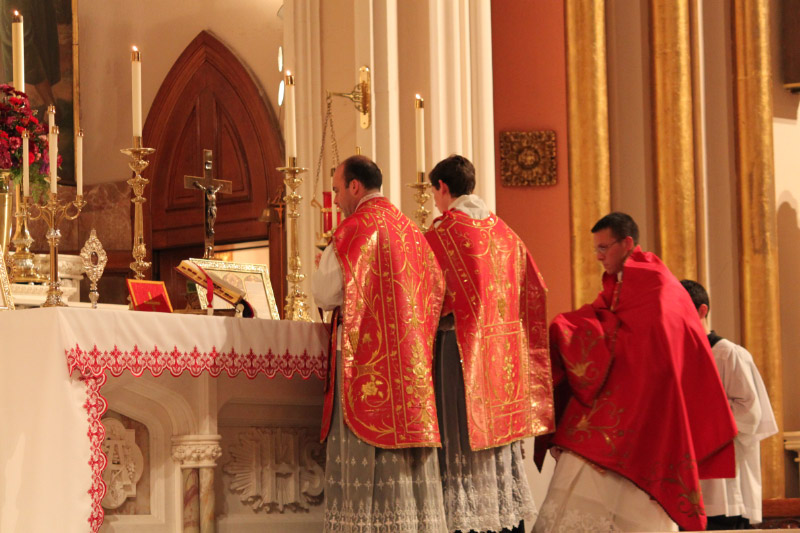
Beautiful Mass in Philadelphia for the Feast of the Exaltation of the Cross.

There was a beautiful Mass in Philadelphia for the Feast of the Exaltation of the Cross.

The Mass was at at St. Paul’s Church.

The celebrant was the Pastor of St. Paul’s Church, Fr. Gerald Patrick Carey; the deacon was Fr. Richard McFadden of St. Charles Borromeo Church, Cornwells Heights across from the National Shrine of St. Katherine Drexel; and the sub-deacon was Friar David Spencer, O. de M. from the Monastery of Our Lady of Mercy.

Brick by brick.

Posted in Brick by Brick, SUMMORUM PONTIFICUM |
6 Comments

Five Algerians Held In Plot Against Pope

From SKY:

Five Algerians Held In Pope Plot Terror Swoop

Five Algerian men have been arrested over a potential threat to the Pope, Sky News sources say.

Armed counter-terror officers swooped on a business premises in central London in the early hours of the morning.

The suspects, who are aged 26, 27, 36, 40 and 50, are being held and questioned under the Terrorism Act 2000.

Sky News crime correspondent Martin Brunt said: "The Pope’s itinerary continues today.

"His security arrangements have been reviewed and nothing has changed in terms of the level of protection around him.

"I was at a briefing last week around the whole issue of the Pope’s security and the point was made then that there was no known threat or intelligence to suggest a plot against the Pope.

"What the police are dealing with today is something that has cropped up in the last 24 hours."

The business where the arrests were made is now being searched, as well as homes in north and east London.

Sky sources say that although the suspects are Algerian the plot did not originate overseas.

A spokesman for Scotland Yard said: "Initial searches have not uncovered any hazardous items.

"Today’s arrests were made after police received information. Following initial inquiries by detectives, a decision was made to arrest the five men.

"Following today’s arrests the policing arrangements for the Papal visit were reviewed and we are satisfied that our current policing plan remains appropriate.

"The itinerary has not changed. There is no change to the UK threat level."

A spokesperson for the Catholic Bishops’ Conference of England and Wales said: "We have absolute confidence in the security operation to protect both the Pope and the public.

"The Pope is enjoying a wonderful visit, warmly welcomed wherever he goes.

"This morning he has met with school children at the ‘Big Assembly’ and faith leaders from across the country at the multi-faith event."

A spokesman for the Vatican confirmed the itinerary would not change.

"We are calm, the Pope is happy and we go on with the same joy we have had until now," he said.

From the the Enchiridion of Indulgences, #25:

A partial indulgence is granted to the Christian faithful who, in a spirit of filial devotion, devoutly recite any duly approved prayer for the Supreme Pontiff (e.g., the Oremus pro Pontifice):

V. Let us pray for our Pontiff, Pope Benedict.

R. May the Lord preserve him, and give him life, and bless him upon earth, and deliver him not to the will of his enemies.

Our Father.  Hail Mary.

Let us pray.

O God, Shepherd and Ruler of all Thy faithful people, look mercifully upon Thy servant Benedict, whom Thou hast chosen as shepherd to preside over Thy Church. Grant him, we beseech Thee, that by his word and example, he may edify those over whom he hath charge, so that together with the flock committed to him, may he attain everlasting life. Through Christ our Lord. Amen.

Posted in SESSIUNCULA |
24 Comments

Benedict XVI’s presser on the airplane to Scotland

presser Benedict XVIOn the airplane winging to Scotland, the Holy Father took a few questions from journos during a brief presser.

Q. – Your Holiness, … during the preparation for this journey there have been contrary discussions and positions. The country has a past tradition of a strong anti-Catholic position. Are you concerned about how you will be received?

B16. – …. I must say that I’m not worried, because when I went to France I was told: "This will be a most anticlerical country with strong anticlerical currents and with a minimum of faithful." When I went to the Czech Republic it was said: "This is the most non-religious country in Europe and even the most anti-clerical". So Western countries, all have, each in their own specific way, according to their own history, strong anticlerical or anti-Catholic currents, but they always also have a strong presence of faith. So in France and the Czech Republic I saw and experienced a warm welcome by the Catholic community, a strong attention from agnostics, who, however, are searching, who want to know, to find the values that advance humanity and they were very careful to see if they could hear something from me in this respect, and tolerance and respect for those who are anti-Catholic. Of course Britain has its own history of anti-Catholicism, this is obvious, but is also a country with a great history of tolerance. And so I’m sure on the one hand, there will be a positive reception from Catholics, from believers in general, and attention from those who seek as we move forward in our time, mutual respect and tolerance.  [NB:]  Where there is anti-Catholicism I will go forward with great courage and joy[OORAH!]

Q. – The UK, like many other Western countries – there is an issue that you have already touched on in the first answer –it is considered a secular country. There is a strong atheist movement, even for cultural reasons. However, there are also signs that religious faith, particularly in Jesus Christ, is still alive on a personal level. What can this mean for Catholics and Anglicans? Can anything be done to make the Church as an institution, more credible and attractive to everyone?

B16. – I would say that a Church that seeks to be particularly attractive is already on the wrong path, [OORAH] because the Church does not work for her own ends, she does not work to increase numbers and thus power. [Interesting.  She does work to increase her numbers, of course.  But she doesn’t do this for the sake of what humanists and LCWR sisters do to increase numbers: power.  Benedict has said before that we may have to content ourselves with a smaller but more dedicated Church.] The Church is at the service of another: she serves, not for herself, not to be a strong body, rather she serves to make the proclamation of Jesus Christ accessible, the great truths and great forces of love, reconciling love that appeared in this figure and that always comes from the presence of Jesus Christ. In this regard, the Church does not seek to be attractive in and of herself, but must be transparent for Jesus Christ and to the extent that she is not out for herself, as a strong and powerful body in the world, that wants power, but is simply the voice of another, she becomes truly transparent for the great figure of Christ and the great truth that he has brought to humanity. [It’s not about Benedict.  It is about the Lord he points to.] The power of love, in this moment one listens, one accepts. The Church should not consider herself, but help to consider the other and she herself must see and speak of the other. In this sense, I think, both Anglicans and Catholics have the same simple task, the same direction to take. If both Anglicans and Catholics see that the other is not out for themselves but are tools of Christ, children of the Bridegroom, as Saint John says, if both carry out the priorities of Christ and not their own, they will come together, because at that time the priority of Christ unites them and they are no longer competitors seeking the greatest numbers, but are united in our commitment to the truth of Christ who comes into this world and so they find each other in a genuine and fruitful ecumenism.  [Interesting that the Holy Father took this in the direction of talking about Anglicans.  He is going to be getting off the airplane soon and meeting briefly with Archbp. Rowan Williams.  This is a Pope (of Unity) who issued Anglicanorum coetibus.  He knows that the Catholic Church is very attractive to discontented Anglicans.]

Q. – Thank you Your Holiness. A third question. As is well known and as was also highlighted by recent surveys, the sexual abuse scandal has shaken the confidence of the faithful in the Church. How do you think you can help restore that trust?

B16. – First, I must say that these revelations have been a shock for me, not only a great sadness. It is difficult to understand how this perversion of the priestly ministry was possible. The priest at the time of ordination, after having prepared for this moment for years, says yes to Christ, to be his voice, his mouth, his hands and serve Him with his whole life, so that the Good Shepherd who loves and helps and guides to the truth is present in the world. How a man who has done this and said this may also fall into this perversion is difficult to understand. [Mysterium iniquitatis.] It is a great sadness, a sadness that even the authority of the Church has not been sufficiently vigilant and not fast or decided enough in taking the necessary measures. ["not fast enough"!] Because of all of this, we are in a time of repentance, humility, and renewed sincerity. As I wrote to the Irish bishops, I think we now realize its a time of penance, [YES] a time to renew and relearn humility with complete sincerity. Regarding the victims, I would say there are three important things. Our first interest is for the victims: how can we repair the damage done? What can we do to help these people overcome this trauma, to regain their life and rediscover confidence in the message of Christ? Care, commitment to victims is the first priority, with material, psychological, spiritual aid. Second, the problem of the guilty persons. The just punishment is exclusion from all possibilities of access to young people because we know that this is a disease and free will does not work where there is disease. So we have to protect these people against themselves and find ways to help them, protect them against themselves and exclude them from any access to young people. The third point is prevention in education, in the choice of candidates for the priesthood to be so careful that, as much as humanly possible, we exclude future cases. And I would now also like to thank the British Bishops for their attention and cooperation with both the See of St. Peter and with public bodies. It seems to me that the British Bishops have done a great job in their attention to the sensitivity of the victims and the law and I am very grateful to them for this.

Q. – Your Holiness, the figure of Cardinal Newman is obviously very significant: you have made an acception [exception] for Cardinal Newman to preside over the beatification. Do you think that his memory will help to overcome divisions between Anglicans and Catholics? What are the aspects of his personality which you would like to give stronger emphasis to?

B16. – Cardinal Newman is mainly, on the one hand, a modern man, who took on all of the problems of modernity, he experienced the problem of agnosticism, the impossibility of knowing God, of believing; a man who throughout his life was on a journey, a journey to let himself be transformed by the truth, in a search of great sincerity and great willingness, to learn more, to find and to accept the path to true life. This modernity of his inner-being and life points to the modernity of his faith: it is not a faith in the formulas of a bygone age, it is a most personal form of faith, lived, suffered, found through a long process of renewal and conversion. He is a man of great culture who on the one hand participates in our sceptical culture of today, [An important dimension of the Holy Father’s message: participate in the public square!] in the question: "Can we understand something certain about the truth of man, of the human being, or not? And how can we arrive at the convergence of the verisimilitude? ". A man who, on the other hand, with a great knowledge of the culture of the Church Fathers, he studied and renewed the internal genesis of the faith, thus acknowledging his figure and his inner constitution, he is a man of great spirituality, a great humanism, a man of prayer, of a deep relationship with God and a relationship with himself, and therefore also of a deep relationship with the other men of his and our time. So I would say these three elements: the modernity of his existence, with all the doubts and problems of our existence today, his great culture, knowledge of the great cultural treasures of mankind, his constant quest for the truth, continuous renewal and spirituality: spiritual life, life with God, give this man an exceptional greatness for our time. Therefore, it is a figure of Doctor of the Church for us, for all and also a bridge between Anglicans and Catholics.

Q. – And one last question, this visit is considered a state visit – this is how it has been qualified. What does this mean for relations between the Holy See and the United Kingdom? Are there are major points of common accord, particularly given the great challenges of today’s world?

B16. – I am very grateful to Her Majesty, Queen Elizabeth II, who wanted to give this visit the rank of a state visit and who expressed the public nature of this visit and also the common responsibility of politics and religion for the future of continent, for the future of humanity: [Without Christianity, Europe won’t be Europe.  Indeed without the Catholic Church.] the large, shared responsibility so that the values that create justice and politics and which come from religion, share the journey in our time. Of course, the fact that legally it is a state visit, does not make this visit a political matter, because if the Pope is head of state, this is just an instrument to ensure the independence of his message and public nature of his work as pastor.

In this sense, the State visit is substantially and essentially a pastoral visit, a visit in the responsibility of the faith for which the Supreme Pontiff, the Pope, exists. [Because being "pastoral" is what Popes do, even when it is a state visit.] Of course, the character of a state visit focuses attention on the converging interests of politics and religion. Politics is essentially designed to ensure justice and with justice, freedom, but justice is a moral value, a religious value, and so faith, the proclamation of the Gospel connects with politics in justice and here common interests are also born. Britain has a great experience and a great record in combating the evils of this time, misery, poverty, disease, drugs and all these fights against misery, poverty, slavery, abuse of man, drugs [How are they doing?] … are also the goals of the faith, because they are the aims of the humanization of man, so that the image of God be restored against the destruction and devastation. Another common task is the commitment to world peace and the ability to live peace, peace education and establish the virtues that make man capable of peace. And, finally, an essential element of peace is the dialogue of religions, tolerance, openness to one another and this is a deep aim both of Britain, [Perhaps aimed at the UK’s Muslim population?] as a society, and of the Catholic faith: to be open to the outside world, open to dialogue, in this way to open to truth and the common path of humanity and to rediscovering the values that are the foundation of our humanism!

Posted in SESSIUNCULA | Tagged ,
20 Comments























