US Catholic, Bp. Trautman renew attack on new translation

UPDATE: 19 June 1703 GMT:

Remember New Math?

3.  I don’t really pay enough attention at Mass to notice how good or bad the translations are.
Agree  1%
Disagree  96%   
Other  9%

__________

ORIGINAL POST
__________

Erie’s Bishop, His Excellency Most Rev. Donald W. Trautman, that inveterate champ of inclusive language and enemy of the Holy See’s norms for liturgical translation, continues his campaign against the revision of the translation of the Roman Missal abetted by US Catholic.

The piece in US Catholic, offered online on 16 June, is recycled.  I looked at it already here.   US Catholic was conducting a poll about the new translation, with Bp. Trautman’s piece as a preface – probably to condition the voters toward a certain kind of response.

I will look again at the first part of the recycled Trautman piece, and then cut away to the poll results US Catholic produced.

My emphases and comments.

Lost in translation [I wonder how many times by now that has been used.]
Wednesday, June 16, 2010
By Meghan Murphy-Gill

Bishop Donald Trautman

Why the new Mass prayers may be confusing. [By which he is suggesting that they are. ]

I was leading a group discussion on the merits of the renewed liturgy of Vatican II [Where do you suppose he was leading them?] when John, a middle-aged businessman, commented, “I can’t imagine my life without the liturgy; it strengthens me each week—but I never understood the Mass until we had it in English.”  [I think it is an amazing thing to be able to "understand" Mass, given that it is a great mystery.]

Some in the group said the liturgy was why they became Catholic; others said the liturgy was why they stayed in the church. All of these individuals had experienced the power of the liturgy to transform lives. That liturgy is about to undergo a face-lift [Hmmm… a good image?] with a new translation of the texts for the Mass.

What prompts this new translation? In 2000 Pope John Paul II authorized a new edition of the Roman Missal, the book that contains the texts of the Mass. The new translation of it is slated to be ready for use next year.

In 2001 the Vatican Congregation for Divine Worship and the Discipline of the Sacraments issued new principles and directives for translating from the original Latin into the vernacular in a document called Liturgiam authenticam. Following these new norms, the translation of the new Missal has intentionally employed a “sacred language,” [This has been a real problem for Bp. Trautman, who has implacably asserted that sacred liturgy should not have sacred language.  Rather, it should be every day and immediately apparent to all present.  Since he works from a premise that average people in the pews can’t understand very much, the language bar has to be set pretty low.] which tends to be remote from everyday speech and frequently not understandable. For example, the Preface, or opening of the Eucharistic Prayer, of the Assumption says of Mary’s delivery of Jesus: “She brought forth ineffably your incarnate Son.”  [HUZZAH!  Had His Excellency not at some point used the word "ineffable" in some form, I would have had to add it myself.  "Ineffable" is a major stumbling block for the good bishop.]

When the bishops at the Second Vatican Council made the historic decision that the liturgy of the church should be in the vernacular, [No, Your Excellency.  The Council made the decision that the liturgy was to remain in Latin.  (SC 36) Mass was to remain in Latin. The Fathers said that there were some circumstances in which the vernacular could be used, but that the liturgy was to remain in Latin.   Clerics and religious were to say their Office in Latin.  (SC 101)   Pastors of souls were to ensure that their flocks could sing and speak those parts pertaining to them in Latin.  (SC 54) Gregorian chant, which is in Latin, must have primacy. (SC 116)] there was no mention of sacred language or vocabulary. [This is risible.  If someone had suggested to the Fathers of the Council that non-sacral, banal, an everyday style of language should be used in the sacred liturgy, they would have been laughed out of the Basilica.] The council’s intent was pastoral — [Though we don’t know what that means, exactly.] to have the liturgy of the church prayed in living languages. [Bp. Trautman repeats this often and forcefully every time he addresses this question. The Council’s intent was that the language of liturgy remain in Latin Can H.E. produce a citiation from the Counci’s documents to the contrary?  Some text that contradicts the clear requirement of the Council Fathers in SC 36?] Translated liturgical texts should be reverent, noble, inspiring, and uplifting, but that does not mean archaic, remote, or incomprehensible.  While the translated texts of the new Missal must be accurate and faithful to the Latin original, they must also be intelligible, proclaimable, and grammatically correct. Regrettably the new translation fails in this regard.  [What Bp. Trautman has done here is set up a false dichtomoy, a fictitious contradiction between "sacred" and "pastoral".  On his planet, the "sacred style" derived from the norms of Liturgiam authenticam is opposed to "pastoral".]

Did Jesus ever speak to the people of his day in words beyond their comprehension? Did Jesus ever use terms or expressions beyond his hearer’s understanding? [ALL THE TIME!  He had to go back constantly and explain things!]  Jesus did explain the parable of the sower privately to his disciples in Mark (4:10-12) and Luke (8:9-10). In John 6 many of Jesus’ disciples found his Bread of Life discourse hard to accept. In these instances it is the message—not its vocabulary—that required further explanation. [His Excellency is merely recycling now.  We have examined this less than worthy argument before. ]

[…]

[At the very end of his piece, Bp. Trautman offered this, which in fairness must be included.]

With the recent approval of the text of the new Missal, the real task begins. It will then be incumbent on bishops and pastors of the church, along with others in liturgical and educational ministries, to catechize and convince the people that the new Missal is an improvement on the current one.

[But then he adds….]

Is that completely true?

And the survey says…

[A note on the survey results: There is at least one thing U.S. Catholic subscribers and uscatholic.org visitors agree on: They are concerned about liturgy. Fewer than 1 percent said they don’t care enough to have an opinion on the new translations. But their enthusiasm plays out in very different opinions on the language of the Mass.

Nearly 90 percent of subscribers [Note this distinction…. "subscribers".] said they prefer the Mass in an easy-to-understand translation of the Latin, but only 15 percent of more than 3,500 who responded to a quick poll on uscatholic.org feel the same way.

Why the difference? [NB:] The number of respondents to our monthly online quick polls usually spikes when various Latin Mass advocates link to them from their blogs — especially when we ask for opinions on the liturgy. Some of these Latin enthusiasts also took the whole survey, thereby skewing the results to be less reflective of our regular readers.  [Why are people who want Latin "enthusiasts"?  Why when they respond to an open poll do they "skew" a poll?]

[And since the results were not what the editors wanted…] For the print magazine, we chose to highlight only the responses of 477 U.S. Catholic subscribers. [ROFL!  People who subscribe to US Catholic are mostly liberals!] Those results are shown here, but we’ve also included the results of everyone who took the survey, both online and in print. [This should be interesting]]

Total results:

1. I think the new texts for the Mass will be:
A regrettable change and worse than the current texts.  40%
A welcome improvement over the current texts.  52% [majority]
Not much better or worse than the current texts.  3%
Nothing I care too much about.  1%
Other  4%

2. I think the new translations are part of an attempt to roll back the liturgical reforms of Vatican II.
Agree  54%   
Disagree  34%
Other  9%

3.  I don’t really pay enough attention at Mass to notice how good or bad the translations are.
Agree  1%
Disagree  96%   
Other  9%
[106%!]

4.  I would prefer that the Mass be prayed:
In a translation that is in natural, easy-to-understand English.  55% [What a surprise!]
In a translation that is as literal as possible.  14%
In Latin.  24%
Other 7%

5. More elevated language will help restore a much-needed sense of mystery to the Mass.
Agree  43%
Disagree  51%
Other  6%

6.  I worry that young people and those considering joining the church will be turned off by a liturgy that sounds esoteric or out of touch to their ears.
Agree  52%  [Again, I am shocked!]
Disagree  42%
Other  6%

U.S. Catholic Subscribers only:

1. I think the new texts for the Mass will be:
A regrettable change and worse than the current texts.  81%  [ROFL!]
A welcome improvement over the current texts.  7%
Not much better or worse than the current texts.  6%
Nothing I care too much about.  1%
Other  5%

2. I think the new translations are part of an attempt to roll back the liturgical reforms of Vatican II.
Agree  81%   [ROFLOL!]
Disagree  14%
Other  5%

3.  I don’t really pay enough attention at Mass to notice how good or bad the translations are.
Agree  2%
Disagree  95%   
Other  3%

4.    I would prefer that the Mass be prayed:
In a translation that is in natural, easy-to-understand English.  89% [Hoot!]
In a translation that is as literal as possible.  4%
In Latin.  3%
Other  4%

5. More elevated language will help restore a much-needed sense of mystery to the Mass.
Agree  10%
Disagree  81%   [They are nothing, if not consistent.]
Other  9%

6.  I worry that young people and those considering joining the church will be turned off by a liturgy that sounds esoteric or out of touch to their ears.
Agree  82%   [Disaster looms.]
Disagree  10%
Other  8%

Posted in Biased Media Coverage, Linking Back, SESSIUNCULA, Throwing a Nutty | Tagged ,
58 Comments

The Feeder Feed: Renaissance edition

Here is a painting at the Metropolitan in Manhattan, depicting Eve with Cain and Abel, an unusual subject.  It is by the Florentine Bacchiacca (+1557 – Francesco d’Ubertino). 

It once included the figure of Adam, and so this painting was cut down.  We know this because there is another version in Philadelphia.

The Feeder Feed: Renaissance edition

Bacchiacca was a student of Perugino and so the standing figure of Eve looks like Perugino’s Apollo and Marsayas in the Louvre.  Have a look.

Back to Bacciacca.

Here is the Bacchiacca in Philly which shows the original composition.

The Feeder Feed: Renaissance edition

Back to New York’s Bacchiacca.

On the nearby branch one finds this colorful bird, perhaps a parrot?

The Feeder Feed: Renaissance edition

Posted in SESSIUNCULA, The Feeder Feed | Tagged , ,
3 Comments

QUAERITUR: wearing a rosary

A reader asks:

I live in an area with a large Hispanic population and I see a lot of men and boys wearing Rosaries around their necks. Is it sacreligious to do so? Please enlighten me.

You mean they use their necks as if they were rear-view mirrors?

I don’t think it is sacrileges in itself to wear a rosary.  Many religious orders and institutes have a form of the rosary as part of their habit. 

I suppose it would depend on the attitude of the wearer and the other things that person may be doing or displaying.  Sadly there may be a touch of superstition involved in wearing a rosary, as if it were a magic talisman. 

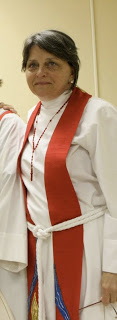
Meanwhile, over at Bad Vestments… always a hoot… there are so many things wrong with this picture, it’s hard to know which to pick on first.

QUAERITUR: wearing a rosary

Posted in ASK FATHER Question Box | Tagged
31 Comments

US Episcopalian “Bishop” Shori in England, hat in hand

From Damian:

Southwark Cathedral allows woman bishop to carry mitre but NOT to wear it

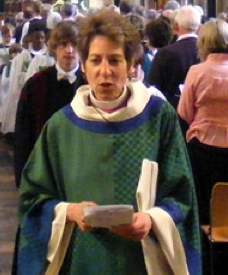
US Episcopalian "Bishop" Shori in England, hat in handThe Presiding Bishop of the Anglican Church in America, Katherine Jefferts Schori, was allowed to carry her mitre when she presided at the Eucharist in Southwark Cathedral last Sunday – but not to wear it. Why? Not because The Episcopal Church (TEC, the current name of her denomination) recently ordained a lesbian priest. Indeed, the Dean of Southwark, Colin Slee, had to clarify that point at Evensong. The “practising lesbian” issue was irrelevant, he made clear, even though that’s the cause of a formal rift between Lambeth and TEC, and stops American Anglicans from sitting on various committees.
No: the mitre was had to stay folded because Ms Schori is not recognised as a bishop by the Archbishop of Canterbury – yet. Wearing it on her head would break a rule imposed by +Rowan. But carrying it?

Fine. And note the bishop’s shirt underneath her alb. (A quick footnote: until a few decades ago, some evangelical bishops would have their mitres carried in front of them rather than wear them – not because they doubted their episcopal orders, but because mitres as hats as opposed to symbols were popish.) However, Dean Slee (an old mate of mine who wants to see Anglicanism follow the logic of liberal Protestantism properly and quickly) does personally recognise Jefferts Schori as a bishop, even if he’s not ready to pick a fight with Lambeth over headgear.

So, she’s a bishop in Southwark Cathedral, a simple priest in Lambeth Palace, and a lay person masquerading as a priest in Southwark’s Forward in Faith parishes.

There may even be one or two churches which, adhering to the position taken by some Anglo-Catholics in the 1980s, recognise her as a deacon but not a priest. No one has yet denied that she’s a woman. Anyway, Jefferts Schori is cross, though I can’t help wondering: couldn’t she (a) have left her mitre in her suitcase, thus avoiding embarrassment, or (b) quickly popped it on in Southwark, thus affirming her status? I doubt that anyone would have lunged forward and knocked it off her head. Though, with the C of E in its current skittish mood, who knows?

yeech

Posted in SESSIUNCULA |
44 Comments

Benedict’s visit to England and popular Catholicism

His Hermeneuticalness has a good entry about the upcoming papal visit to England.   I am glad it also provides a link to the wonderful Anna Arco.

Yesterday, Anna Arco posted her interview with Archbishop Nichols concerning the papal visit. His Grace rightly draws attention to the importance of the meeting of the Holy Father and Queen Elizabeth. That will surely be one of the greatest photo opportunities of recent times.

There is still considerable frustration about many aspects of the visit, and particularly the failure to organise a major event which people can attend en masse. Of course we can watch it all on the television and I arranged a while back for the big screen in the parish club to be reserved for the duration of the visit, but we can, after all, watch footage of the Pope most days via the Vatican’s YouTube channel or EWTN. People want to be able to say "I was there" not "I watched it on the telly".

Apparently there will at least be the possibility of lining the streets: it is important for Catholics to do so in large numbers, cheering, singing and waving flags. (Now would be a good time to start learning by heart the verses of God bless our Pope!) There also needs to be plenty of footage posted on YouTube of the crowds in response to the inevitable mainstream channel "not as many people as expected" claims.

In Loss and Gain, John Henry Newman characterised Catholicism as "the popular religion". An estimated 286,650 people turned out for the visit of the relics of St Therese last October. The liberal establishment did not expect that. Popular Catholicism is far from dead in England.

Posted in New Evangelization, Pope of Christian Unity |
22 Comments

QUAERITUR: Saying the Office for an Old Testament saint from the Martyrology

From a reader:

While reading the martyrology yesterday, I saw that today (6/14) has the prophet Elisha listed. I remembered your posts reminding your readers that the Church commemorates old testament figures and that "if there were no other saint in the liturgical calendar taking precedence, we are told that we indeed could take a saint from the Martyrology." (post of May 9, 2009)

Because there’s no solemnity/feast/memorial today in the general Roman calendar, I thought about praying the Liturgy of the Hours for the optional memorial for Elisha. How would I do that? Which common would I use, the common of "holy men"?

If you don’t know how this would be done with the OF LOTH, would you know how it would be done for the EF Divine Office?

Hmmm… I don’t know!

I suppose the common of Holy Men would be right, in the case of an OT figure.

Discuss.

Posted in "How To..." - Practical Notes, ASK FATHER Question Box | Tagged
6 Comments

Will Card. Ouellet be going to Cong. for Bishops?

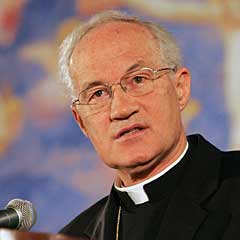
Will Card. Ouellet be going to Cong. for Bishops?While we don’t yet have an official notice, it may be that the next Prefect for the Congregation for Bishop will be His Eminence Marc Card. Ouellet, 66 year old Archbishop of Quebec, rather than Card. Pell of Australia.

Andrea Tornielli has news.

As I have mentioned on this blog, I got to know Card. Ouellet a bit in Rome and found him to be an upstanding fellow.  I actually mentioned him some years ago as papabile one day.  This move would make him even more so.

I mentioned Card. Ouellet for this, here.

Note that, in addition to French, he speaks English perfectly as well as Italian and Spanish and he has the strong use of German because he worked on von Balthasar, if memory serves.  For years he has been involved with Communio, the theological journal aligned with the Ratzinger school (rather than Concilium aligned with the Rahner crowd). He taught in a seminary in Colombia with the Sulpicians, he taught in Rome at the John Paul II Institute, worked on the Curia, and went on to be Archbishop Primate in Quebec. 

He is an ecclesiastical rocket man.

I have heard him preach several times and, even in Italian, he was impressive.

My theory is that the Prefect of Bishops has to be able to speak English because the Holy Father is focused on reshaping Anglophone bishops conferences. More on that here.

Tornielli says the announcement will be made next week.

Posted in SESSIUNCULA | Tagged
24 Comments

QUAERITUR: conflict with priest over receiving Communion kneeling

QUAERITUR: conflict with priest over receiving Communion kneelingFrom a reader:

My pastor refuses to give me Holy Communion on my knees.  I approached him privately.  He claims that I am denying him his rights as a priest, destroying unity……he has tried to compromise with me by requiring me to sit in one pew where he can give me communion inconspicuously.  My family does not fit in this little pew.  So if I don’t arrive early enough to get into the right seat, I have no right to receive kneeling.  I have written our bishop, who is unlikely to be sympathetic to my desire for reverence.  Can you advise?  We live in a one parish town, and generally travel on Sundays for a TLM.  I am a daily communicant now, but I feel sick about all this.

First, Redemptionis Sacramentum says clearly:

[90.] “The faithful should receive Communion kneeling or standing, as the Conference of Bishops will have determined”, with its acts having received the recognitio of the Apostolic See. “However, if they receive Communion standing, it is recommended that they give due reverence before the reception of the Sacrament, as set forth in the same norms”.

[91.] In distributing Holy Communion it is to be remembered that “sacred ministers may not deny the sacraments to those who seek them in a reasonable manner, are rightly disposed, and are not prohibited by law from receiving them”. Hence any baptized Catholic who is not prevented by law must be admitted to Holy Communion. Therefore, it is not licit to deny Holy Communion to any of Christ’s faithful solely on the grounds, for example, that the person wishes to receive the Eucharist kneeling or standing.

The priest may wish to offer that there are "other grounds".  He would be wrong. 

If he argues that you are not acting in unity with his wishes… er um… the majority of the congregation at that parish, it must also be acknowledged that he is not acting in unity with the Church’s clear legislation and your rights as a member of the faithful.

If you brought this up with the local bishop or …. better, anQUAERITUR: conflict with priest over receiving Communion kneelingd… the Congregation for Divine Worship, they must back your right to receive kneeling.  It sounds as if you have not received an answer from your bishop yet.  You might wait for the bishop’s response. 

However, at any time you may write to the Congregation.

His Eminence
Antonio Card. Canizares Llovera
Prefect of the Congregation for
   Divine Worship and Discipline of the Sacraments
Palazzo delle Congregazioni
P.za Pio XII
00120 VATICAN CITY

Include copies of everything you have done or received.  Read this.

But do remember to examine your conscience. Be sure that you are not merely being stubborn, rather than being merely reverent.

Posted in ASK FATHER Question Box | Tagged ,
37 Comments

A Met moment

Back at the Met I just emerged from the Picasso exhibit – whom I loathe – feeling the need to wash.

I was consoled by a Caravaggio at the exit.

A Met moment

I must now dash back into time as quickly as possible to the 14th century.

A Met moment

Ahhhh….

Duccio… from around 1300.

And note the similar balustrade in Bellini’s version, 200 years later.

A Met moment

Posted in SESSIUNCULA |
29 Comments

QUAERITUR: Strange baptism: priest says words but deacon pours water

From a reader:

So Father, this weekend I attended the baptism of my cousins daughter. 

The PRIEST said the words properly, BUT this perfectly healthy priest was NOT baptizing the child, the "DEACON of the word" was doing the pouring of the water. 

Father held the microphone and naught else. 

The DEACON did the anointing with oils, as FATHER said the prayer. 

Legit? Simply odd?


Invalid. 

The "baptism" needs to be repeated.

Before writing this I consulted an appropriate ecclesial authority for an opinion.

I would immediately relate this to the local bishop.

Write up everything with photos and videos if there are any of the baptism.   Documentation, proofs, are very useful.   In addition, you might get written descriptions of what happened from others who were there.

Send them to the local bishop and also to the Congregation for the Doctrine of the Faith.

Send a cover letter, with a description, but without your own editorial comment.

Indicate to the bishop that you have sent a copy to the Congregation.

His Eminence
William Card. Levada
Prefect for the Congregation
   for the Doctrine of the Faith
Palazzo del Sant’Uffizio
00120 VATICAN CITY

Posted in ASK FATHER Question Box |
170 Comments