Pet peeves about the Rapture

There is an odd theory among some Christians called "the Rapture".  With no solid basis in Scripture, some think that, as the End approaches, suddenly the "saved" will disappear.  The rest of us poor souls will be left in this vale of tears to endure the nasty tribulations that follow.

Some of these rapturites have figured out yet another way to make money off this error.

After all, as Rahm would say, we ought to be able to profit from a disaster.  Right?

Thus, we find the site… and I am not making this up: After The Rapture Pet Care.

Yes, you too can have your pets taken care by some unlucky loser who didn’t have the foresight to be "saved" and thence raptured.

Perpend:

We have created a database structure that is stored on multiple secure servers, with multi-location online and offline password-protected backups. While I don’t intend to be here when the Rapture occurs, we are building a network of non-Christians who have agreed to rescue and care for our members’ pets if we all disappear.

Yes, it seems funny at first. But, if you believe there is a coming Rapture, and you love your pets, it becomes serious. And that’s what we are – serious about the safety and care of your pets, as well as your peace of mind.

There is a registration fee of course.

Okay… I admit it.  I am a little jealous. I wish I had thought of this.  But I digress.

Posted in Lighter fare | Tagged
44 Comments

WDTPRS: 4th Sunday after Pentecost – COLLECT (1962MR)

WDTPRS: 4th Sunday after Pentecost - COLLECT (1962MR)Today’s prayer is found in ancient sacramentaries, such as the Veronese and the “Hadrian” version of the Gregorian, and the so-called Gelasian.  It is unchanged in the “Tridentine” form of the Missale Romanum as my trusty copy of the 1570MR shows.  It survived the Consilium’s hack and grafters who pieced together the Novus Ordo as the Collect for the 8th Sunday of Ordinary Time.

COLLECT: (1962 Missale Romanum):
Da nobis, quaesumus, Domine,
ut et mundi cursus pacifico nobis tuo ordine dirigatur:
et Ecclesia tua tranquilla devotione laetetur.

Some vocabulary from the mighty Lewis & Short Dictionary.  Cursus can mean anything from “course, way, journey” to “course of a ship”, the “flow of conversation” and “postal route”.  Dirigo is “to give a particular direction” or “to lay or draw a straight line”.  It was used, among other things, to indicate ordering an army to march to a certain point or to direct or steer a ship on its course.    Ordo means too many things to get into in depth.  Suffice to say that it can refer to the “methodical arrangement, class or condition.” By extension it is applied to everything from the “orders” of the clergy, the way trees are planted, the lines of an army, or the banks of rowers in a ship.  Pacificus is a composite of pax and facio meaning “peacemaker” or “peaceable”.  The problem with that laetetur is that it could be from the deponent laetor or passive from laeto.  Because of those ablatives in that clause, I am opting here for the passive, like dirigatur.   Among the things that devotio means are “fealty, allegiance, piety, devotion, zeal.”

LITERAL VERSION (1962MR)
Grant us, we beg, O Lord,
both that the course of the world be set by Your methodical peace-producing plan for us
and that Your Church may be made joyful by means of tranquil devotion.
 
Despite the wordy literal translation I have given this time, I will lend to this a rather poetic aspect. 

Notice that in our collect’s vocabulary there are traces of military and nautical imagery. 

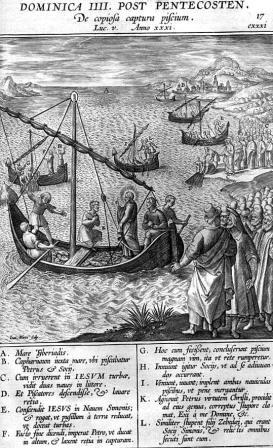
Try reading this prayer with the mental image of a ship.  Its great Captain sets its course upon the sea. So great is the Captain that He can command calm waters and a favorable wind as well.  The ship can be seen as the world.  In this case I see the ship as the Church in the world, the Church Militant, which is not an unfamiliar image to those familiar with the Barque of Peter.  The sea it sails upon is the deep and turbulent world we live in.  The Captain is our Lord Jesus Christ, who calmed the stormy waters and commanded Peter to walk to Him upon them.  He entrusted His ship to Peter, to steer it in His stead.  Once all has been put into proper order, made “ship-shape and Bristol fashion”, our own sense of loyal zeal, our devotion, is the wind that the Captain uses to steer the ship upon the course He sets, carrying us its crew to the port and safe haven.

The word pacificus brought to mind an antiphon of First Vespers of Christmas: “Rex pacificus magnificatus est, cuius vultum desiderat universa terra… The peacemaker King, whose glance the whole world longs for, has been exalted.”  Is not the sight of God, “in whose will is our peace”, our true desire?  Is that not the port and safe haven we journey towards in the turbulence of this world?

We must look more intently at devotio… devotion. 

According to St. Thomas Aquinas (+1274) writing in his monumental Summa Theologiae, devotio is an “active” virtue.  The Angelic Doctor wrote:

“The intrinsic or human cause of devotion is contemplation or meditation. Devotion is an act of the will by which a man promptly gives himself to the service of God. Every act of the will proceeds from some consideration of the intellect, since the object of the will is a known good; or as Augustine says, willing proceeds from understanding. Consequently, meditation is the cause of devotion since through meditation man conceives the idea of giving himself to the service of God” (STh II-II 82, 3).

The Jesuit preacher Louis Bourdaloue (1632-1704) translates this into “a devotion to duty”. What we do, including our “devotions”, must help us keep the commandments of God and stick to the duties of one’s state in life before all else.

In other words, there is an interplay between our devotions and our devotion.

Each of us has a state in life, a God-given vocation we are duty bound to follow. We must be devoted to that state in life, and the duties that come with it, as they are in the here and now.

That “here and now”, hic et nunc, is important.

We must not focus on the state we had once upon a time, or wish we had, or should have had, or might have someday: those are unreal and misleading fantasies that distract us from reality and God’s will.

If we are truly devoted and devout (in the sense of the active virtue) to fulfilling the duties of our state as it truly is here and now, then God will give us every actual grace we need to fulfill our vocation. Why can we boldly depend on God to help us? If we are fulfilling the duties of our state of life, then we are also fulfilling our proper roles in His great plan, His design from before the creation of the universe. God is therefore sure to help us. And if we are devoted to our state as it truly is, then God can also guide us to a new vocation when and if that is His will for us.

Faithful in what we must do here and now, we will be open to something God wants us to do later.

This attachment to reality and sense of dutiful obedience through the active virtue devotio is a necessary part of religion in keeping with the biblical principle in 1 John 2:3-5:

And by this we may be sure that we know Him, if we keep His commandments. He who says ‘I know Him’ but disobeys His commandments is a liar, and the truth is not in him; but whoever keeps his word, in him truly love for God is perfected. By this we may be sure that we are in Him: he who says he bides in Him ought to walk in the same way in which He walked.

Before the creation of the universe God knew each one of us and desired us and loved us. 

He called us into existence as a precise point in His great plan, His economy of salvation.  He gives us a part to play in that plan and gives each of us the tools and talents we need to fulfill it.  If we devote ourselves with real devotio to our state-in-life and strive to carry out His will, God will give us every actual grace we need since we are furthering His great plan. 

This is why I suggest above that our devotion can be like the wind that the Captain uses to direct our great ship.  More than just being the “hands on deck”, we play a vital part in the actual forward motion of the ship. We are not merely being hauled along upon the “alien merits” of Christ, as some Protestants call God’s saving intervention.  While we truly depend on Him and Him alone, while we truly do not merit what He provides, mysteriously it is part of His plan. He brings it to pass that His work becomes ours and ours His.  He “makes it so”.  

A Somewhat Smoother Version:
Grant, we beseech you, O Lord,
that the course of the world be steered by your plan for peace
and that your Church be filled with joy from tranquil devotion to that plan.  

Or a bit more poetic:
O Lord, we beg Thee to grant
that the peaceful steerage of the world’s course be set according to Thy plan
and that Thy Church be made full with joy from our tranquil devotion.  

Lame-Duck ICEL (1973 translation of the 1970MR):
Lord,
guide the course of world events
and give your Church the joy and peace
of serving you in freedom.

It is very hard to strike a balance between the literal, which can be awkward and wordy, and the simple, which can be banal and miss the real impact of the prayer.

Posted in SESSIUNCULA, WDTPRS |
3 Comments

Another really bad call by an ump/referee: US robbed at World Cup

Why was US go-ahead goal disallowed?

Play video

Why?

Historic U.S. World Cup win erased by awful referee call

Fans and players of the national team are livid tonight after it had a World Cup win turned into a draw because of a questionable call by Malian referee Koman Coulibaly in the 86th minute, wiping out what appeared to be a perfectly good and pivotal goal by Maurice Edu against Slovenia.

 The ref’s decision also cost the United States a slice of soccer history; in 80 years, no team had ever rallied from a two-goal deficit to win a World Cup game.

According to Landon Donovan, the referee even refused to explain what the foul was assessed [!?!] for after the game (referees are not required to explain their decisions to reporters or players at the World Cup).

[…]


It’s not just baseball.

FIFA has not explained the bad call.

I don’t think they can explain the bad call, other than bad officiating.

In the meantime, my condolences to HF about Germany.

Posted in SESSIUNCULA | Tagged , ,
39 Comments

Is it time for the papal tiara?

From His Hermeneuticalness:

I very much hope that the Mgrs Ganswein and Marini persuade the Holy Father that the restoration of the tiara is the next step in the reform of the Papal Liturgical Ceremonies and that the visit to Great Britain would be the perfect opportunity to wear the Belgian Tiara. As all Germans and Italians know, the British love ceremony and are very good at it. Furthermore, everyone has heard of the Crown Jewels and knows that Her Majesty the Queen is one head of state who would not be upstaged by such fine headgear.


Do I hear an "Amen!"?

Is it time for the papal tiara?

Posted in SESSIUNCULA |
65 Comments

Get a life!

I understand BP’s Tony Haywood has his life back now.

In other news, I hear some … folks… are advocating a boycott of BP.

Did it occur to them that BP needs income in order to clean up the mess they caused?  People need jobs?

Is their desire to destroy an oil company because it is… an oil company?

I think people can disagree about how to treat BP, but the fact remains that BP has to clean up the mess, BP needs money to clean up the mess, and people depend on BP for their livelihood.

Will the people who advocate the boycott offer to pay for the cleanup and the lost income?

Posted in SESSIUNCULA |
30 Comments

The Feeder Feed: baby edition

There are new birds at the feeders.  They are literally new: some of them are babies.Twitter

Some shots will following in the next days.

Here is a adult male Hairy Woodpecker with baby in tow.  The young one makes a noise like a squeaky toy and absolutely shadows the adult.

The Feeder Feed: baby edition

Hasn’t really figured out how to get to the part with the food…

The Feeder Feed: baby edition

Not a baby Oriole, though I saw an immature example earlier today.

The Feeder Feed: baby edition

Not a baby Bunting, proverbial or otherwise.

The Feeder Feed: baby edition

This immature Grosbeak has been using the "backstays" to get at the food.

Still learning the ropes.

The Feeder Feed: baby edition

Not a baby woodpecker.

The Feeder Feed: baby editionThe Feeder Feed: baby edition

The birds are delighted that I am back.  Their gluttony is the proof.  I will warmly appeal, therefore, for donations.

Posted in The Feeder Feed |
9 Comments

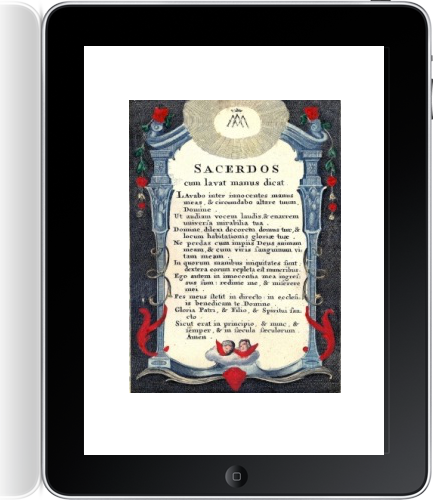
iPad replacing altar Missal? WDTPRS POLL

Some years ago I wrote in my weekly column in The Wanderer:

An excerpt:

I hesitate to add this, for surely a few people will freak out… but once upon a time in a WDTPRS column I joked about having a liturgical laptop Missal: Sacramentarium Cyberense Romanum, ….  [It could be] covered with the color of the day and solemnly carried and incensed, etc.  [From a digital Antiphonale] monks in choir stalls in a dark church would sing their office over glowing screens.

And because you just can’t make some things up fast enough… I must also confess that I once wound up saying Mass privately from a laptop.  My missal had grown legs and I was stuck for a couple days somewhere without any book.  It was use the laptop or not say Mass at all.  I chose the laptop.  I had no printer where I was.  I had digitally photographed the whole 1962 Missale Romanum and had it on my hard drive.  I just copied the necessary pages to a folder, numbered them in order so all I had to do with the Picture Manager was click to "turn" the "page".  It worked fairly well.  I am not saying that that is a long term solution, but it could help you at least during the learning process.

 Now I read this.

iPad coming to church altars with daily missal app

(AP) – 50 minutes ago

ROME — An Italian priest has developed an iPad application that will let priests celebrate Mass with an iPad on the altar instead of the regular Roman missal.

The Rev. Paolo Padrini, a consultant with the Vatican’s Pontifical Council for Social Communications, said Friday that the free application will be launched in July in English, French, Spanish, Italian and Latin.  [In this case, I hope it will be complete.  I found iBreviary to be… sub-optimal.]

Two years ago, Padrini developed the iBreviary, an application that brought the book of daily prayers used by priests onto iPhones. He said the iPad application is similar but also contains the complete missal — containing all that is said and sung during Mass throughout the liturgical year. [Since the Missal is less complicated, perhaps it will be complete.  However…. will it be only the 2002 Missale Romanum? And what to do, for English, about the translation?  Other languages have already updated their translations.]

Pope Benedict XVI has sought to reach out to young people through new media.

This might be useful for people in the pews.

Can you envision?  Pews full of people following Mass on iPads?  Would they also perhaps by watch YouTube videos?

Let’s have a little WDTPRS POLL.

Chose the best answer (even if the answer isn’t perfect) and give your reasons in the combox.

{democracy:68}

UPDATE:

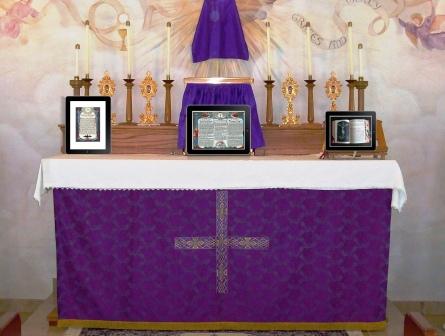
I think you would have to have 4 iPads for the traditional Mass.

iPad replacing altar Missal? WDTPRS POLL

iPad replacing altar Missal? WDTPRS POLL 


Posted in "How To..." - Practical Notes, POLLS, SESSIUNCULA | Tagged
81 Comments

QUAERITUR: ordination in traditional form without minor orders

QUAERITUR: ordination in traditional form without minor ordersFrom a reader:

I had a question regarding ‘regular’ seminarians getting Extraordinary Form ordinations. 

I’m going into the seminary this fall for my diocese, so it would be a while before I get to ordination (if, God willing, I do), but I’ve been wondering about something. 

If the bishop would permit an EF ordination, do you have to go through all the minor orders as part of that, or do you just get ordained as a deacon and priest using the appropriate rubrics? 

Not sure how that would work.

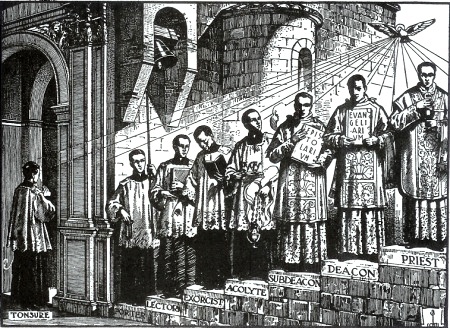
No, you would not have "climb the stairs", as it were, of the traditional minor orders.  You could be ordained a deacon or priest directly with the older form of ordination.

There is a fine logic to "climbing the stairs", but the validity of Holy Orders does not depend on the reception of the minor orders.

A word of advice. 

As a man about to enter the seminary, I wouldn’t bring it up.

That said, I am more and more of the opinion that we should rethink the changes made to these ministries and minor orders.

Posted in ASK FATHER Question Box, SESSIUNCULA | Tagged
31 Comments

QUAERITUR: marrying in the state of mortal sin

QUAERITUR: marrying in the state of mortal sinFrom a reader:

If a couple marries in a Catholic Church in a state of mortal sin, is the marriage still valid or not?

Assuming that everything else is in order, namely, both of the couple are free to marry, they are baptized, they understand and accept the essentials of the sacrament and intend to live by them, they follow the proper form, etc etc., then – yes – such a marriage should be valid.

Validity of sacraments does not depend on the state of grace of the recipient.

Baptism and Confession and Anointing all can forgive the mortal sins of the one who receives them.

The Eucharist can be confected by a priest in the state of mortal sin, though if received… well… see St. Paul’s admonition to the Corinthians (cf. 1 Cor 11).  But the state of soul of the recipient does not affect the validity of the Eucharist.  It is a heresy of the highest order to suggest that Christ is not truly present in the Eucharist unless the recipient believes or is in the state of grace.

Confirmation, Holy Orders, Matrimony are validly received in the state of mortal sin. 

That is to say, the sacrament is truly conferred.  A man ordained in the state of mortal sin is truly ordained, the confirmand is confirmed, the member(s) of the couple, truly married.  The state is conferred. 

In the case of baptism, confirmation, priesthood, the ontological change to the person’s soul takes place, and they will forever be baptized, confirmed or ordained… even in the eternal punishments of Hell if they die in mortal sin.  Matrimony ends with the death of one of the couple.

However, in all these cases (with the exception of baptism and, in a way, penance) the sacramental graces of the sacrament are not truly theirs until they return to the state of grace (the newly baptized is in the state of grace, as is the newly absolved, provided his confession was a good one, is absolved).  Even though there is an ontological change with some sacraments, it is as if those sacraments slumber until they wake up and become effective in the person’s soul with the state of grace.  We don’t know how God may give prevenient (forerunner) graces through those particular sacraments to help the person, inspire the sinner, to repent and seek absolution.  Sacramental graces are actual graces.  We receive them when we are in the state of grace.  God in love and mercy gives another kind of actual grace which urges the sinner to repentance.

So, if someone in the state of sin gets married, he or she is truly married… they are married.  But the advantages of sacramental graces which flow from the sacrament of matrimony will not be theirs until they are in the state of grace.  

Think about the nobility, but difficulties, of the married state.  The couple receives the gift of this vocation so that they can help each other to salvation.  They can be tremendously helpful to each other.  They can be horribly damaging to each other.  Married people need all the supernatural helps they can get!  It seems to me a first duty of a married person to love God more than the spouse and to seek always to be in the state of grace for both their sake.

If person marries in the state of sin, he or she should probably confess disrespect for the sacrament received, improperly approaching such an important moment which God offers to help the person to salvation.  If the person married in the state of sin received Communion during the Nuptial Mass, he or she must confess that sacrilege as well. 

That said, God is rich in mercy and love.  His forgiveness is ours for the sincere asking.

Posted in ASK FATHER Question Box, SESSIUNCULA | Tagged ,
33 Comments

Sacerdotal kitchen solidarity

Fr. Christensen, a priest of the Diocese of Sioux Falls, of White Around the Collar, has posted something of his own kitchen endeavours. WDTPRS desires to express solidarity.

Father prepares caprese and a roast.

Sacerdotal kitchen solidarity

Posted in Mail from priests |
6 Comments