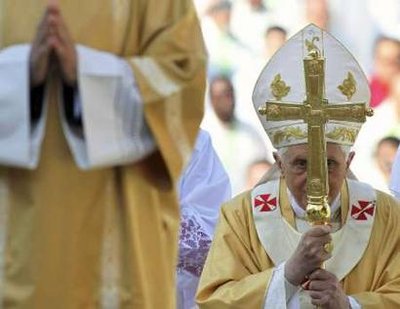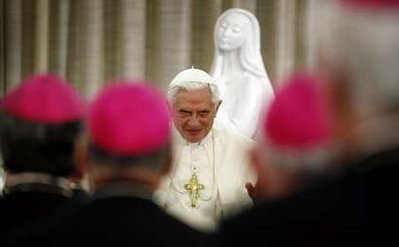
Benedict XVI to bishops in Fatima

Benedict XVI to bishops in FatimaThe Holy Father gave this talk to bishops in Portugal.

When the Holy Father gives talk, it pertains to all of us, in this digital, interconnected age.

When the Holy Father entrusted priests to Our Lady’s Immaculate Heart he included all priests.

When the Holy Father addresses some bishops, he is addressing all bishops.

My emphases and comments:

Dear Brother Bishops,

I thank God for giving me this occasion to meet all of you here at the Shrine of Fatima, the spiritual heart of Portugal, where multitudes of pilgrims from all over the world come looking to discover or to reinforce their certainty in the truths of Heaven. [A strong endorsement of the messages of Fatima as well as a statement about our Catholic identity.] Among them has come from Rome the Successor of Peter, [He has referred to himself as a pilgrim many times.] accepting the oft-repeated invitations and moved by a debt of gratitude to the Virgin Mary, who herself transmitted to her seers and pilgrims an intense love for the Holy Father which has borne fruit in a great multitude which prays, with Jesus as its guide: [Get this.] Peter, "I have prayed for you, that your faith may not fail; and when you have turned again, strengthen your brethren" (Lk 22:32).  [Again, I love these juxtaposition of the Marian and Petrine dimension of the Church.]

[Watch this…] As you see, the Pope needs to open himself ever more fully to the mystery of the Cross, embracing it as the one hope and the supreme way to gain and to gather in the Crucified One all his brothers and sisters in humanity. [This is a bit humbling for me, especially having known the Pope before his election.  The Pope is saying here that he has failed in some ways in his love of Christ crucified.  He says that he needs to have a deeper conversion.  This is humbling.] Obeying the word of God, he [Benedict] is called to live not for himself but for the presence of God in the world. [Remember that this is to bishops.] I am comforted by the determination with which you too follow me closely, [Here is something for pastors of souls… get this! …] fearing nothing except the loss of eternal salvation for your people,  [HOLY COW!] as was clearly expressed in the words of greeting spoken by Archbishop Jorge Ortiga upon my arrival in your midst, and which testify to the unconditional fidelity of the Bishops of Portugal to the Successor of Peter. [The cura animarum… so seldom spoken of today.  I wonder… I wonder how many pastors of souls really think in terms – primarily and foundationally – of the salvation of the souls in their charge.  They do what they do for the salvation of souls.] From my heart I thank you. I thank you as well for all the attention that you have given to organizing my Visit. May God reward you, and pour out the Holy Spirit in abundance upon you and your Dioceses so that, with one heart and with one soul, you may bring to completion the pastoral work which you have begun, [And echo of ordination?] that is, offering each member of the faithful an exacting and attractive Christian initiation, one which communicates the integrity of the faith and genuine spirituality, rooted in the Gospel, and capable of forming free and generous labourers in the midst of public life. [Again, we need strong Catholic identity for the sake of what we bring to the public square.  Also, I hear in that reference to "labourers" an echo of Papa Ratzinger’s motto from his coat-of-arms, "Co-workers in the truth".]

In truth, the times in which we live demand a new missionary vigour on the part of Christians, [Is this a propaedeutic for a "new evangelization" in Europe?] who are called to form a mature laity, identified with the Church and sensitive to the complex transformations taking place in our world. [Catholics in the public square.] Authentic witnesses to Jesus Christ are needed, above all in those human situations where the silence of the faith is most widely and deeply felt: among politicians, intellectuals, communications professionals who profess and who promote a monocultural ideal, with disdain for the religious and contemplative dimension of life. In such circles are found [Here we go…] some believers who are ashamed of their beliefs and who even give a helping hand to this type of secularism, which builds barriers before Christian inspiration. And yet, dear brothers, may all those who defend the faith in these situations, with courage, with a vigorous Catholic outlook and in fidelity to the magisterium, continue to receive your help and your insightful encouragement in order to live out, as faithful lay men and women, their Christian freedom. [Even if they must be martyrs ("witnesses").]

You maintain a strong prophetic dimension, without allowing yourselves to be silenced, in the present social context, for "the word of God is not fettered" (2 Tim 2:9). People cry out for the Good News of Jesus Christ, which gives meaning to their lives and protects their dignity. In your role as first evangelizers, it will be useful for you to know and to understand the diverse social and cultural factors, to evaluate their spiritual deficiencies and to utilize effectively your pastoral resources; what is decisive, however, is the ability to inculcate in all those engaged in the work of evangelization a true desire for holiness, in the awareness that the results derive above all from our union with Christ and the working of the Holy Spirit.

In fact, when, in the view of many people, the Catholic faith is no longer the common patrimony of society and, often, seen as seed threatened and obscured by the "gods" and masters of this world, only with great difficulty can the faith touch the hearts of people by means simple speeches or moral appeals, and even less by a general appeal to Christian values. [Which is why I constantly pound the need for renewed worship in continuity with our tradition, worship which is transcendent and mysterious.] The courageous and integral appeal to principles is essential and indispensable; yet simply proclaiming the message does not penetrate to the depths of people’s hearts, it does not touch their freedom, it does not change their lives. What attracts is, above all, the encounter with believing persons who, through their faith, draw others to the grace of Christ by bearing witness to him. The words of Pope John Paul II come to mind: "The Church needs above all great currents, movements and witnesses of holiness among the ‘Christifideles’ because it is from holiness that is born every authentic renewal of the Church, all intelligent enrichment of the faith and of the Christian life, the vital and fecund reactualization of Christianity with the needs of man, a renewed form of presence in the heart of human existence and of the culture of nations (Address for the XX Anniversary of the Promulgation of the Conciliar Decree "Apostolicam Actuositatem", 18 November 1985). One could say, "the Church has need of these great currents, movements and witnesses of holiness…, but there are none!"

In this regard, I confess to you the pleasant surprise that I had in making contact with the movements and the new ecclesial communities. [The Holy Father has written of the importance of new movements before his election as an important ecclesial structure – along with the parish – for the future.] Watching them, I had the joy and the grace to see how, at a moment of weariness in the Church, at a time when we were hearing about "the winter of the Church", the Holy Spirit was creating a new springtime, awakening in young people and adults alike the joy of being Christian, of living in the Church, which is the living Body of Christ. Thanks to their charisms, the radicality of the Gospel, the objective contents of the faith, the living flow of her tradition, are all being communicated in a persuasive way and welcomed as a personal experience, as adherence in freedom to the present event of Christ.

The necessary condition, naturally, is that these new realities desire to live in the one Church, albeit with spaces in some way set aside for their own life, in such a way that this life becomes fruitful for all the others. The bearers of a particular charism must feel themselves fundamentally responsible for communion, for the common faith of the Church, and submit themselves to the leadership of their Bishops. [They can’t go off on their own and still be faithful Catholics.] It is they who must ensure the ecclesial nature of the movements. Bishops are not only those who hold an office, but those who themselves are bearers of charisms, and responsible for the openness of the Church to the working of the Holy Spirit. We, Bishops, in the sacrament of Holy Orders, are anointed by the Holy Spirit and thus the sacrament ensures that we too are open to his gifts. Thus, on the one hand, we must feel responsibility for welcoming these impulses which are gifts for the Church and which give her new vitality, but, on the other hand, we must also help the movements to find the right way, making some corrections with understanding – with the spiritual and human understanding that is able to combine guidance, gratitude and a certain openness and a willingness to learn.

This is precisely what you must foster or confirm in your priests. In this Year for Priests now drawing to a close, rediscover, dear brothers, the role of the Bishop as father, especially with regard to your priests. [Do I hear an "Amen!"?] For all too long the responsibility of authority as a service aimed at the growth of others and in the first place of priests, has been given second place. Priests are called to serve, in their pastoral ministry, and to be part of a pastoral activity of communion or oneness, as the Conciliar Decree Presbyterorum Ordinis reminds us, "No priest is sufficiently equipped to carry out his mission alone and as it were single-handed. He can only do so by joining forces with other priests, under the leadership of those who govern the Church" (No. 7). This is not a matter of turning back to the past, nor of a simple return to our origins, but rather of a recovery of the fervour of the origins, [classic Ratzinger] of the joy of the initial Christian experience, and of walking beside Christ like the disciples of Emmaus on the day of Easter, allowing his word to warm our hearts and his "broken bread" to open our eyes to the contemplation of his face. Only in this way will the fire of charity blaze strongly enough to impel every Christian to become a source of light and life in the Church and among all men and women.

Before concluding, I would like to ask you, in your role as leaders and ministers of charity in the Church, to rekindle, in yourselves as individuals and as a group, a sense of mercy and of compassion, in order to respond to grave social needs. New organizations must be established, and those already existing perfected, so that they can be capable of responding creatively to every form of poverty, including those experienced as a lack of the meaningfulness in life and the absence of hope. [echo of Mother Teresa?] The efforts you are making to assist the Dioceses most in need, especially in Portuguese-speaking countries, is praiseworthy. May difficulties, which today are more deeply felt, not make you shrink from the logic of self-giving. [The "logic of self-giving".  In wordly terms that is a contradiction in terms.  In Christian terms it is entirely logical.  Logic from Logos.] Let there continue and flourish in this country, your witness as prophets of justice and peace, and defenders of the inalienable rights of the person. Join your voice to the voices of the least powerful, whom you have wisely helped to gain a voice of their own, without ever being afraid of raising your voice on behalf of the oppressed, the downtrodden and those who have been mistreated.

I entrust all of you to Our Lady of Fatima, and I ask her to sustain you with her maternal care amid the challenges which you face, so that you will be promoters of a culture and a spirituality of charity, peace, hope and justice, faith and service. To you, to the members of your families and to your diocesan communities I cordially impart my Apostolic Blessing.

Posted in SESSIUNCULA, The Drill |
12 Comments

Lex talionis… in Ohio

A CBS story reports that in Ohio a man was executed today for killing a "motorist who gave him a ride and shooting two others during a three-week string of shootings that terrorized the Cincinnati area in 1983."

Excerpts from the story:

Michael Beuke, 48, died by lethal injection at 10:53 a.m. EDT at the Southern Ohio Correctional Facility in Lucasville, about 90 minutes after the Ohio Supreme Court turned down his final appeal.

He spent an emotional 24 hours before his death crying, playing music on a portable keyboard and consulting with his spiritual advisers, to whom the prison released his body.

[…]

While on the gurney, Beuke looked directly at Craig’s widow, Susan, and at the son and daughter of Wahoff and apologized for all three shootings: "Mrs. Wahoff, I am sorry. Mrs. Craig, I am sorry. Mr. Graham, I am sorry."

Graham’s family sent no witnesses.

After the apology, he recited the Roman Catholic rosary and other prayers for 17 minutes before he died, choking back tears as he repeatedly said the Hail Mary with rosary beads in one hand. It was the longest final statement by a condemned Ohio inmate in memory. One of his spiritual advisers, Bishop R. Dann Conlon, sniffled and blew his nose throughout.

Beuke, dubbed by the media as the "homicidal hitchhiker," spent a quarter century on death row, where he said he had a spiritual conversion. He expressed remorse for his crimes and said in an unsuccessful request for clemency that he accepted responsibility and prayed "that God will ease the pain I have caused my victims."

Susan Craig said she was unsatisfied with his remorse.

"It’s like I tell my kids: ‘Sorry doesn’t cut it; you did it,’" Craig said after the execution. Her 27-year-old son Bob, named for a father he never knew, accompanied her to the prison but did not witness the execution. He called the day "surreal."

Dawn Wahoff, whose father was shot and paralyzed for life by Beuke, said she felt she could finally look to the future and felt "a sense of closure."

"I feel I can move on," she said. Her father died four years ago.

[…]

Lex talionis.

Posted in SESSIUNCULA | Tagged
64 Comments

STOP THE PRESSES! POPE DENOUNCES HOMOSEXUAL MARRIAGE!! IN PUBLIC!!!

I’m SHOCKED!

The Pope has… and I can hardly bring myself to write this… spoken against HOMOSEXUAL MARRIAGE!

Can you imagine such a thing?

The Pope of Rome has denoucced "marriage" between people of the same sex?!?

The best thing about this, is the panicky report of this sent by a reader.

It is just to good not to show you as it appears in this AFP piece.

STOP THE PRESSES! POPE DENOUNCES HOMOSEXUAL MARRIAGE!! IN PUBLIC!!!

Isn’t that great?  Just a headline and a single sentence.  No context. Just…

GASP!

"But Father! But Father!" you may be whispering.  "You mention the context.  What was it?  What did the Pope really say?"

The Holy Father delivered this genuine shocker when address social organizations.

Here is part of the talk with me emphases and comments:

[…]

Often, however, it is not easy to arrive at a satisfactory synthesis between spiritual life and apostolic activity. The pressure exerted by the prevailing culture, which constantly holds up a lifestyle based on the law of the stronger, on easy and attractive gain, ends up influencing our ways of thinking, our projects and the goals of our service, and risks emptying them of the motivation of faith and Christian hope which had originally inspired them. [Be sure to review Deus caritas est and Spe salvi.  We need a strong identity to hold ourselves upright, faithfully Catholic, in the public square.  Remember that Holy Father spoke of martyrdom when he arrived in Portugal.  He has also exhorted them not to be afraid to show faith in the public square.] The many pressing requests which we receive for support and assistance from the poor and marginalized of society impel us to look for solutions which correspond to the logic of efficiency, quantifiable effects and publicity. Nonetheless, the synthesis which I mentioned above is absolutely necessary, dear brothers and sisters, if you are to serve Christ in the men and women who look to you. In this world of division, all of us are called to have a profound and authentic unity of heart, spirit and action. [Unity in the Catholic Faith.]

The many social institutions which serve the common good, and are close to those in need, include those of the Catholic Church. [Here we go!  Catholic identity for the sake of working in the world….] The guiding principles of the latter need to be clear, so that they can be clearly identifiable by the inspiration of their aims, in the choice of their human resources, in their methods of operation, in the quality of their services, and in the serious and effective management of their means. The solid identity of these institutions provides a real service, and is of great help to those who benefit from them. Beyond this issue of identity, and connected with it, it is a fundamental step to ensure that Christian charitable activity is granted autonomy and independence from politics and ideologies (cf. Deus Caritas Est, 31b), even while cooperating with state agencies in the pursuit of common goals. [How did that work in Washington DC recently?]

The services you provide, and your educational and charitable activities, must all be crowned by projects of freedom whose goal is human promotion and universal fraternity. Here we can locate the urgent commitment of Christians in defence of human rights, with concern for the totality of the human person in its various dimensions. [Totality of the human person includes respect for God’s creation.] I express my deep appreciation for all those social and pastoral initiatives aimed at combating the socio-economic and cultural mechanisms which lead to abortion, and are openly concerned to defend life and to promote the reconciliation and healing of those harmed by the tragedy of abortion. Initiatives aimed at protecting the essential and primary values of life, beginning at conception, and of the family based on the indissoluble marriage between a man and a woman, [only… not two women, or two men, or three or four, or a combination of same, or of children or dogs or any other critter.] help to respond to some of today’s most insidious and dangerous threats to the common good. Such initiatives represent, alongside numerous other forms of commitment, essential elements in the building of the civilization of love.

All this fits very closely with the message of Our Lady which resounds in this place: penance, prayer and forgiveness aimed at the conversion of hearts. In this way you are building the civilization of love, whose seeds God has sown in the heart of every man and woman, to which faith in Christ the Saviour gives abundant growth.

So,… what the Pope thinks is "insidious and dangerous" included more than just homosexual unions falsely defined as "marriage".
 

Posted in Biased Media Coverage, Pope of Christian Unity, Throwing a Nutty |
8 Comments

17 May – Turin, Italy – Solemn TLM, monks and Abbot of Le Barroux

From Romualdica I learn that, for the occasion of the display of the Shroud of Turin, monks and the Abbot from the traditional Benedictine Abbey of Sainte-Madaleine at Le Barroux, France, will have a Solemn Abbatial (Extraordinary Use) Mass in Turin at the Church of the Santi Martiri (Via Garibaldi 25).

The Mass will be on 17 May at 10:15.

Those of you traveling in or near Turin (Torino, Italy) will want to participate in this.  The monks from Le Barroux sing chant as well as any choir I have ever heard.

Posted in The Campus Telephone Pole | Tagged , ,
2 Comments

The C of E’s church in Rome to host fake ordination of a woman

From the Times comes this telling tale about the future of Anglican/Vatican relations:

May 13, 2010
Italy to ordain the first woman priest near Vatican

Italy’s first woman [fake] priest is [not] to be ordained a stone’s throw from the Vatican later this month. [You would have to throw that stone pretty hard.]

Maria Vittoria Longhitano, 35, a member of the Italian Old Catholic Church, a breakaway group not recognised by the Vatican, will be ordained at All Saints Church, near the Spanish Steps in Rome, on 22 May. [This is the Church of England church in the City.]

A spokeswoman for All Saints Church said Ms Longhitano, who is married, was not being ordained as an Anglican. “We are offering our church as the venue because the Old Catholics have no venue of their own in Rome,” she said. “They use our facilities for their regular worship.” [But consider what they are going to do in their church.]

The Old Catholics, founded in the early 19th century in an attempt to set up a national Italian denomination separate from Rome, do not accept a number of central Catholic doctrines including papal infallibility and the Immaculate Conception of the Virgin Mary.  [And apparently some other things too.]

Ms Longhitano, a teacher in Miian with a degree in philosophy and theology, became a [fake] deacon last year. She will [not] be ordained by Bishop Fritz-René Müller of the Union of Utrecht, to which the Italian Old Catholics are affiliated.

She said that she had dreamed of being a priest since childhood, and her [pretend] ordination “represents a great opportunity for women of faith”. [The greatest opportunity to endanger souls, perhaps.] She hoped that it would “stimulate a debate among Catholics” on female ordination, which has been definitively ruled out by successive Popes, including Pope Benedict XVI.


The C of E’s church in Rome, allowing this to take place in their church, in Rome.

Niiiiice.

UPDATE 14 May 0047 GMT
:

The great Fr. Blake, P.P. of Brighton has a great comment on his blog about this:


When the Archbishop of Canterbury wanted a largish celebration in Rome to celebrate the 40th Anniversary of the All Saints Anglican Centre in Rome, the diocese of Rome allowed him to use a Roman Basillica of S Sabina, [Which was wrong.] it even allows him to carry a crozier, a symbol of authority. How does All Saints respond? It makes itself available for the ordination of an Old Catholic women priest, who herself claims it is a stunt, "to stimulate a debate amongst Catholics".

Maybe Benson had something when he coined the phrase, "Old Mother Damnable".


Well done.

Posted in The Drill |
17 Comments

QUAERITUR: a seminarian praying the older, traditional Office, conflict with the newer calendar

QUAERITUR: a seminarian praying the older, traditional Office, conflict with the newer calendarFrom a seminarian:

I am a transitional Deacon…

I ask you not to include my name if you choose to use this email in any way, as I am at ____ and unfortunately things related to the Extraordinary Form are still very touchy and political here.

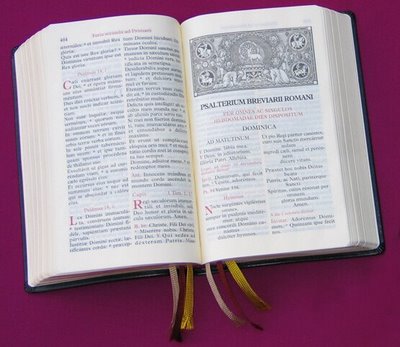
I have a love for the Breviarium Romanum because of the Psalter, the prayers, and its structure. That being said, it is difficult to juggle two different calendars and I am tempted to question whether or not I will have the time to pray it in pastoral life. That being said, I know that time is normally not the issue but rather discipline and desire are what allows one to pray the Breviary digne, attente ac devote, with God’s help.

I appreciate the Liturgia Horarum for the simple fact that the calendar is the same as the one used at Mass, the complimentary psalmody and the ability to pray Sunday Compline every night. However, I really dislike the four week psalter, the structure of the readings for the Office of Readings and the flattening of all hours to 3 psalms with a hymn at the beginning.

I would love to pray the Breviarium Romanun exclusively but need some advice/encouragement with respect to my concerns and hesitations.

First, priests in parishes long before the changes were made to the office were able to pray the office.  How well?  I am not sure… that depended on the priest and his life’s habits.  Therefore, establish your habits of prayer of the breviary now.

The older form of the office is longer.  It is also in Latin.  I think it is great that men want to pray the office in Latin, but I also think it is important to understand what you are praying.  If you don’t have a strong use of Latin, you might want to think about this again, as praiseworthy as your desires are to pray the Breviarium Romanum.

I sure do understand the problem of the conflict with the calendars.  The office form of Mass and the older form of the Office go hand and hand.  Some of my best private reflections have come from the interplay of the Mass and the Office.  That connection is, to my mind, less strong between the newer form of Mass and the Liturgia Horarum.  I do like the opportunity to read a longer selection of a reading in the Office of Readings.  However, there is a subtle genius to the way the readings were broken up in Matins.  It was perhaps easier to absorb something, with the help of the responsories.  This is especially true when they were sung… which isn’t happening in most places.  And probably won’t be either, unless you join some traditionalist monastery.

Perhaps at this point in your life, as a transitional deacon, you might try the following rather hard course.

Since you should be practicing Mass anyway, try practicing the older form of Mass.  On those days when you practice the older form, also try reading the older Office.  Of course you are probably going to have to be going to Holy Mass each day in the newer form wherever you are anyway.  But the recitation of the older Office will fulfill your obligation on those days when you are saying it.  I offer this suggestion so that you can get familiar with your options in this regard.  Also, you ought to be learning to say the older form of Mass!  This is our Roman Rite!

This will take more of your time during the day, but it will help you get your feet wet in this while still a deacon.

And say a prayer for me while you are at it.

Posted in "How To..." - Practical Notes, ASK FATHER Question Box, SESSIUNCULA | Tagged
20 Comments

PRAYERCAzT: Ascension of the Lord – Vespers (Breviarium Romanum)

No frills office of Vespers for the feast of the Ascension… Ascension Thursday that is.  Today.

Posted in SESSIUNCULA |
Comments Off on PRAYERCAzT: Ascension of the Lord – Vespers (Breviarium Romanum)

Benedict XVI’s Sermon in Fatima, references to “second secret”, “maternity of God”

The Holy Father’s sermon in Fatima.  The papal spokesman, Fr. Lombardi, had earlier said that the Holy Father would deliver an "intense" message in Fatima.

You may want to read the text of the "second secret" of Fatima before delving into the sermon:

You have seen hell where the souls of poor sinners go. To save them, God wishes to establish in the world devotion to my Immaculate Heart. If what I say to you is done, many souls will be saved and there will be peace. The war is going to end: but if people do not cease offending God, a worse one will break out during the Pontificate of Pius XI. When you see a night illumined by an unknown light*, know that this is the great sign given you by God that he is about to punish the world for its crimes, by means of war, famine, and persecutions of the Church and of the Holy Father. To prevent this, I shall come to ask for the consecration of Russia to my Immaculate Heart, and the Communion of reparation on the First Saturdays. If my requests are heeded, Russia will be converted, and there will be peace; if not, she will spread her errors throughout the world, causing wars and persecutions of the Church. The good will be martyred; the Holy Father will have much to suffer; various nations will be annihilated. In the end, my Immaculate Heart will triumph. The Holy Father will consecrate Russia to me, and she shall be converted, and a period of peace will be granted to the world.

And now the Holy Father’s sermon with my emphases and comments.

Benedict XVI's Sermon in Fatima, references to "second secret", "maternity of God"Dear Pilgrims,

"Their descendants shall be renowned among the nations […], they are a people whom the Lord has blessed" (Is 61:9). So the first reading of this Eucharist began, and its words are wonderfully fulfilled in this assembly devoutly gathered at the feet of Our Lady of Fatima.

Dearly beloved brothers and sisters, I too have come as a pilgrim to Fatima, to this "home" [tuck these words "pilgrim" and "home" away in the back of your head as you read] from which Mary chose to speak to us in modern times. I have come to Fatima to rejoice in Mary’s presence and maternal protection. I have come to Fatima, because today the pilgrim Church, willed by her Son as the instrument of evangelization and the sacrament of salvation, converges upon this place. I have come to Fatima to pray, in union with Mary and so many pilgrims, for our human family, afflicted as it is by various ills and sufferings. Finally, I have come to Fatima with the same sentiments as those of Blessed Francisco and Jacinta, and the Servant of God Lúcia, in order to entrust to Our Lady the intimate confession that "I love" Jesus, that the Church and priests "love" him and desire to keep their gaze fixed upon him as this Year for Priests comes to its end, and in order to entrust to Mary’s maternal protection priests, consecrated men and women, missionaries and all those who by their good works make the House of God a place of welcome and charitable outreach.  [The Holy Father is shaping this pilgrimage to Fatima around the intention of sanctification for and prayer for and support for priests.  Yesterday He entrusted priests to Mary’s Immaculate Heart.]

These are the "people whom the Lord has blessed". The people whom the Lord has blessed are you, the beloved Diocese of Leiria-Fatima, with your pastor, Bishop Antonio Marto. I thank him for his words of greeting at the beginning of Mass, and for the gracious hospitality shown particularly by his collaborators at this Shrine. I greet the President of the Republic and the other authorities who serve this glorious Nation. I spiritually embrace all the Dioceses of Portugal, represented here by their Bishops, and I entrust to Heaven all the nations and peoples of the earth. In God I embrace all their sons and daughters, particularly the afflicted or outcast, with the desire of bringing them that great hope which burns in my own heart, and which here, in Fatima, can be palpably felt. May our great hope sink roots in the lives of each of you, dear pilgrims, and of all those who join us through the communications media.

Yes! The Lord, our great hope, is with us. In his merciful love, he offers a future to his people: a future of communion with himself. After experiencing the mercy and consolation of God who did not forsake them along their wearisome return from the Babylonian Exile, the people of God cried out: "I greatly rejoice in the Lord, my whole being exults in my God" (Is 61:10). The resplendent daughter of this people is the Virgin Mary of Nazareth who, clothed with grace and sweetly marvelling at God’s presence in her womb, made this joy and hope her own in the canticle of the Magnificat: "My spirit rejoices in God my Saviour". She did not view herself as a fortunate individual in the midst of a barren people, but prophecied for them the sweet joys of a [NOTA BENE:] wondrous maternity of God, for "his mercy is for those who fear him from generation to generation" (Lk 1:47, 50). [He made an interesting segue here.  On one level he seems to be comparing what we have been going through as a Church to the Babylonian Exile… out of which we are moving, as "pilgrims" who are actually going "home", but a home which is a holy place.  Also, that phrase "maternity" of God, I suspect, aims less at applying a feminine image to God the Father than it aims at the Marian dimension of the Incarnation.  Mary is Mother of God.]

This holy place is the proof of it. In seven years you will return here [NB: He did not say "We" will return here.] to celebrate the centenary of the first visit made by the Lady "come from heaven", the Teacher who introduced the little seers to a deep knowledge of the Love of the Blessed Trinity and led them to savour God himself as the most beautiful reality of human existence. This experience of grace made them  fall in love with God in Jesus, so much so that Jacinta could cry out: "How much I delight in telling Jesus that I love him! When I tell him this often, I feel as if I have a fire in my breast, yet it does not burn me". [On this trip the Holy Father has spoken of the burning bush of Moses.] And Francisco could say: "What I liked most of all was seeing Our Lord in that light which Our Mother put into our hearts. I love God so much!" (Memoirs of Sister Lúcia, I, 42 and 126).

Brothers and sisters, in listening to these innocent and profound mystical confidences of the shepherd children, one might look at them with a touch of envy for what they were able to see, or with the disappointed resignation of someone who was not so fortunate, yet still demands to see. To such persons, the Pope says, as does Jesus: "Is not this the reason you are wrong, that you know neither the Scriptures nor the power of God?" (Mk 12:24). The Scriptures invite us to believe: "Blessed are those who have not seen and yet have come to believe" (Jn 20:29), but God, who is more deeply present to me than I am to myself (cf. Saint Augustine, Confessions, III, 6, 11) – has the power to come to us, particularly through our inner senses, so that the soul can receive the gentle touch of a reality which is beyond the senses and which enables us to reach what is not accessible or visible to the senses. For this to happen, we must cultivate an interior watchfulness of the heart which, for most of the time, we do not possess on account of the powerful pressure exerted by outside realities and the images and concerns which fill our soul (cf. Theological Commentary on The Message of Fatima, 2000). Yes! God can come to us, and show himself to the eyes of our heart. [I return now to a constant theme of this blog: We must have worship which fosters an encounter with mystery, the transcendent.]

Moreover, that Light deep within the shepherd children, which comes from the future of God, [A curious phrase.  It reminds me of that other curious and awkward phrase "maternity of God".  I suspect that this "future of God" (God doesn’t have a future… God has no past, present or future") aims not so much at describing God’s future as it aims at describing our future with God.] is the same Light which was manifested in the fullness of time and came for us all: the Son of God made man. He has the power to inflame the coldest and saddest of hearts, as we see in the case of the disciples on the way to Emmaus (cf. Lk 24:32). ["Were our hearts not on fire?"] Henceforth our hope has a real foundation, it is based on an event which belongs to history and at the same time transcends history: Jesus of Nazareth. The enthusiasm roused by his wisdom and his saving power among the people of that time was such that a woman in the midst of the crowd – as we heard in the Gospel – cried out: "Blessed is the womb that bore you, and the breasts that nursed you!". And Jesus said: "Blessed rather are those who hear the word of God and obey it!" (Lk 11:27-28). But who finds time to hear God’s word and to let themselves be attracted by his love? Who keeps watch, in the night of doubt and uncertainty, with a heart vigilant in prayer? Who awaits the dawn of the new day, fanning the flame of faith? Faith in God opens before us the horizon of a sure hope, one which does not disappoint; it indicates a solid foundation on which to base one’s life without fear; it demands a faith-filled surrender into the hands of the Love which sustains the world.

"Their descendants shall be known among the nations, […] they are a people whom the Lord has blessed" (Is 61:9) with an unshakable hope which bears fruit in a love which sacrifices for others, yet does not sacrifice others. Rather, as we heard in the second reading, this love "bears all things, believes all things, hopes all things, endures all things" (1 Cor 13:7). An example and encouragement is to be found in the shepherd children, who offered their whole lives to God and shared them fully with others for love of God. Our Lady helped them to open their hearts to universal love. Blessed Jacinta, in particular, proved tireless in sharing with the needy and in making sacrifices for the conversion of sinners. Only with this fraternal and generous love will we succeed in building the civilization of love and peace.

[People interested in the "third secret" can start paying attention here:] We would be mistaken to think that Fatima’s prophetic mission is complete. Here there takes on new life the plan of God which asks humanity from the beginning: "Where is your brother Abel […] Your brother’s blood is crying out to me from the ground!" (Gen 4:9). Mankind has succeeded in unleashing a cycle of death and terror, but failed in bringing it to an end… In sacred Scripture we often find that God seeks righteous men and women in order to save the city of man and he does the same here, in Fatima, when Our Lady asks: "Do you want to offer yourselves to God, to endure all the sufferings which he will send you, in an act of reparation for the sins by which he is offended and of supplication for the conversion of sinners?" (Memoirs of Sister Lúcia, I, 162). 

At a time when the human family was ready to sacrifice all that was most sacred on the altar of the petty and selfish interests of nations, races, ideologies, groups and individuals, our Blessed Mother came from heaven, offering to implant in the hearts of all those who trust in her the Love of God burning in her own heart. At that time it was only to three children, yet the example of their lives spread and multiplied, especially as a result of the travels of the Pilgrim Virgin, in countless groups throughout the world dedicated to the cause of fraternal solidarity. May the seven years which separate us from the centenary of the apparitions hasten the fulfilment of the prophecy of the triumph of the Immaculate Heart of Mary, to the glory of the Most Holy Trinity.  ["In the end my Immaculate Heart will triumph."  This is connected to the "second secret" in which the Blessed Virgin asks that Russia be consecrated to her Immaculate Heart.  Notice he refers again to the "seven years".]

Some points.

At the very beginning of his trip to Portugal, the Holy Father introduced in a very pointed way the theme of martyrdom.  In his first address at the airport in Lisbon, he spoke of martyrdom.

In the text of the "second secret" we read:


The good will be martyred; the Holy Father will have much to suffer; various nations will be annihilated. In the end, my Immaculate Heart will triumph. The Holy Father will consecrate Russia to me, and she shall be converted, and a period of peace will be granted to the world.


There is some discussion whether or not Russia has been consecrated in the way the Blessed Virgin asked.  It seems that Russia has not "converted".

However, at the end of his sermon, the Holy Father seems to be picking up on some of the language of the "second secret".

"Seven years".
 

Posted in Pope of Christian Unity, SESSIUNCULA, The future and our choices | Tagged
39 Comments

Pray for Pope Benedict

The Holy Father is clearly feeling the heavy burden of his office.

Let us all pray more frequently for the Holy Father and remind others to do the same.

From the the Enchiridion of Indulgences, #25:

A partial indulgence is granted to the Christian faithful who, in a spirit of filial devotion, devoutly recite any duly approved prayer for the Supreme Pontiff (e.g., the Oremus pro Pontifice):

V. Let us pray for our Pontiff, Pope Benedict.

R. May the Lord preserve him, and give him life, and bless him upon earth, and deliver him not to the will of his enemies.

Our Father.  Hail Mary.

Let us pray.

O God, Shepherd and Ruler of all Thy faithful people, look mercifully upon Thy servant Benedict, whom Thou hast chosen as shepherd to preside over Thy Church. Grant him, we beseech Thee, that by his word and example, he may edify those over whom he hath charge, so that together with the flock committed to him, may he attain everlasting life. Through Christ our Lord. Amen.

Here are some trinkets which you might consider in this cause, to help reminded people to pray for the Holy Father.

With the help of "Vincenzo", the official WDTPRS photoshopper, I made a cafepress store for buttons and the like.

Pray for Pope Benedict

If you are in the USA…

Get Pro Pontifice stuff here.Pray for Pope Benedict

If you are in the UK…

You can get the Pro Pontifice stuff here.Pray for Pope Benedict

If you are an Aussie …

You can get Pro Pontifice stuff here.Pray for Pope Benedict

If you are a Canadian …

You can get Pro Pontifice stuff here.Pray for Pope Benedict

There are also mugs and a hat and some shirts and the like.

There are as well packs of 100 buttons in different sizes which you could distribute to people.

Play video

Posted in Pope of Christian Unity | Tagged ,
8 Comments

“conscience truly so called”

His Hermeneuticalness as a great entry on the proper understanding and function of a person’s conscience in case of possible conflict with the, for example, teaching of a Pope or of the Church.

You will want to read the whole thing, which starts with a look at the most recent rubbish from John Cornwell.

Fr. Finigan’s post takes up the "toast quote" of Ven. John Henry Newman.

Here is an excerpt from the entry:

It is from this point that Newman discusses conscience since he has admitted that "there are extreme cases in which Conscience may come into collision with the word of a Pope." He says that conscience is the apprehension of the divine law which is the supreme rule of conduct. He points out that this Christian understanding of conscience is opposed to the subjective view of conscience which sees it as a creation of ourselves rather than the voice of God. Newman describes the popular understanding which is familiar to us today, though sadly now within the Church as well as outside of it:

When men advocate the rights of conscience, they in no sense mean the rights of the Creator, nor the duty to Him, in thought and deed, of the creature; but the right of thinking, speaking, writing, and acting, according to their judgment or their humour, without any thought of God at all. They do not even pretend to go by any moral rule, but they demand, what they think is an Englishman’s prerogative, for each to be his own master in all things, and to profess what he pleases, asking no one’s leave, and accounting priest or preacher, speaker or writer, unutterably impertinent, who dares to say a word against his going to perdition, if he like it, in his own way.

Go see the rest at Fr. Finigan’s place!

Posted in SESSIUNCULA | Tagged
2 Comments