National Catholic Fishwrap receives a response

Just for a moment I thought that perhaps that the temperature in Hell was dropping, that the Lord was about to return, the Cubs might have a shot at the Series.  

I saw a piece by Bill Donohue of the Catholic League on the site of the National Catholic Fishwrap‘s … er.. Reporter.

"Great Caesar’s Ghost!" quoth I, thinking that the Reporter might be trying to expand from one sensible writer to two.

National Catholic Fishwrap receives a responseThen I recalled the Fishwrap‘s attack on Bill Donohue – in the midst of their subscription drive.

This was Donohue’s reply to the Reporter’s attack.

Let’s have a look at the response with my emphases and comments:

Catholic League president responds to NCR column
May. 13, 2010
By Bill Donohue

Looks like Joe Feuerherd doesn’t like me ("Billy the bully is bad for the church," May 11). Let’s go through his gripes, one by one.

Like so many other left-wing Catholics, Feuerherd thinks I make too much money. My goal in life, actually, is to make as much money as Sr. Carol Keehan, who cleared $963,436 last year as president of the Catholic Health Association. In fact, I would settle for making as much as Sr. Patricia Talone, the VP for Mission Services: she makes $394,092.  [And Mr. Donohue is not a professed religious.]

Please note, too, that the latest figures show that the Catholic League has amassed over $26 million (not $22 million as reported). Not bad considering that when I took over as president 17 years ago we had $400,000 and were losing upwards of $20,000 a month.  [I don’t think these figures are going to impress the NCR, but they impress me.]

My board of directors and our members hold me accountable, [Conservatives don’t mind being held accountable.  Liberals do, however.] but I couldn’t help but notice that many of those who commented on Feuerherd’s online article wondered why I have not been reined in by the bishops. And I thought you guys were against such censorship.

Hollywood is not run by Chinese Taoists, nor does it make movies endearing to Catholics. As the Forward, a Jewish weekly, said a few years ago, it is merely a "sociological observation" to say that "Jews run Hollywood." Was it wrong?

In the 1990s, some seminarians from the Legionaries of Christ supposedly said that Father Marcial Maciel told them that he had gotten the green light from Pope Pius XII to have sex with them for the purpose of "relief." I mocked this absurd story. Feuerherd evidently believes it. I am delighted to know he does.

The story about the Republican operative who had to resign after Feuerherd broke the story about what happened when he was a Fordham professor is misleading. I put out a statement on the morning of August 19, 2004 based on a story that day in The New York Times. All the Times said was that the professor resigned after charges of sexual harassment were made by a co-ed who got drunk with him one night. The Times also said that it was believed that the source of this outing was the National Catholic Reporter.

The details of what happened, which were much more disturbing than what the Times said, were not published until 1:57 p.m. that day. In other words, Feuerherd is criticizing me for what I said before I learned the whole story. No matter, what was also disturbing was the graphic detail that Feuerherd went into describing the sex acts. He didn’t have to do that, but the fact that he did speaks volumes. [Exactly.  It is possible to report news without adding TMI.]

What is really driving Feuerherd’s anger are my comments to the media regarding the fact that most of the sexual abuse in the Catholic Church is the work of homosexual priests. It is. Kevin Cullen, who won a Pulitzer Prize for his reporting on the priestly sexual abuse scandal in The Boston Globe, summarized the findings of a study by the John Jay College of Criminal Justice: "Of the 10,667 reported victims [between 1950 and 2002], 81 percent were male, the report said, and more than three-quarters of the victims were post-pubescent, meaning the abuse did not meet the clinical definition of pedophilia." Which obviously means this was the work of homosexuals. By the way, the American Pediatric Association defines puberty as beginning at age 10 for boys.

Cullen also interviewed Robert S. Bennett, the Washington lawyer who headed the National Review Board that prepared a report on this issue. After saying that there were many fine homosexual priests, he said that "any evaluation of the causes and context of the current crisis must be cognizant of the fact that more than 80 percent of the abuse at issue was of a homosexual nature."

If we are to get to the bottom of this problem, we must stop the cover-up and start telling the truth: the link between homosexuality and the molestation of minors is real. In any event, it’s a moot point since practicing homosexuals have been barred from the priesthood, thus resolving the problem. [Perhaps a bit of irony there.  It is true that the the Holy See has directed that active homosexuals may not be enter programs of formation or continue in them.]

Feuerherd needs an editor. He says I have "strange company," citing my affiliation with the Catholic Citizens of Illinois, a group founded by Tom Roeser, a pundit who has roiled Cardinal George. My association is that of a letterhead advisor and my contacts with Mr. Roeser are zilch: I met him once several years ago. In any event, two paragraphs later, Feuerherd makes an unrelated comment deploring "Joe McCarthy’s guilt-by-association tactics." Does he even realize how hypocritical he appears?

These are tough times for struggling Catholic journalists on the left. But not for me. [And it looks like the NCR is sinking.] After four years in the U.S. Air Force, four more as a teacher in Spanish Harlem and 16 years as a professor (including a year as a scholar in residence), I found my dream job. But it is demanding.

I am busy writing daily news releases (often several a day), writing a monthly journal, contributing to an annual report, writing all the fund-raising letters (we don’t need a director of development), offering information and advice to our direct mail agents, preparing a budget, writing newspaper and magazine ads, penning essays and op-eds, granting interviews, teaching part-time at New York University, giving talks around the nation, doing non-stop radio and TV (we don’t need a publicist—they come to me), writing books (my fourth was published last year and I am now working on another), accepting awards, debating my adversaries, writing to the bishops, etc.  [Sounds like he works for a living!]

Finally, it is not true that I take a cab to the network and cable studios. They always send a limo.  [And in NYC that is nothing out of the ordinary, btw.  Furthermore, when I recently did a thing for Fox News they sent a car.  That is simply S.O.P.   They want to make sure the person gets there on time and in good shape.]

[William A. Donohue is president of the Catholic League for Religious and Civil Rights.]
Posted in SESSIUNCULA | Tagged ,
13 Comments

An anti-Catholic editorial in Hell’s Bible… again

From Hell’s Bible (aka The New York Times) comes this anti-Catholic blast.

Editorial
Justice for Child Abuse Victims
Published: May 14, 2010

The Catholic Church is working against the interests of child abuse victims in state legislatures around the country. [Absurd.] In recent weeks, lobbying by the church has blocked measures [Ummm… how does lobbying block anything?  Also, you are being asked to accept their premise, namely, that that is what is going on, that "the Catholic Church" is trying to do something bad.  Lobbying is bad (unless perhaps you are a lobbyist with a job in the present White House Administration).] in Wisconsin, Arizona and Connecticut intended to widen the legal window for victims to file lawsuits against hidden predators. [What is meant by "hidden predator"?]

We urge the New York State Legislature to rise above intense lobbying by the New York State Catholic Conference [But wait… there’s more…] and Orthodox Jewish officials [Sooooo…. it is not just the Catholic Church involved?  However, the one group the editors of Hell’s Bible hates nearly as much as Catholics, its practicing orthodox Jews.] and pass the overdue Child Victims Act. Like a similar measure enacted in 2003 by California, it would create a one-time, one-year suspension of the statute of limitations for bringing civil lawsuits over the sexual abuse of children.

Once that window closes, people alleging abuse would have until age 28 to bring a claim. Current law sets the limit at 23 in most circumstances.

The measure recognizes that it typically takes many years before victims are ready to come forward. [Get this…] The measure also recognizes the Catholic Church’s history of intimidating victims and burying abuses in church files, creating a shroud of secrecy that extended in many cases until victims were in their 30s or older, well beyond existing time limits for prosecutions or civil lawsuits.  [I wonder what the language of this "measure" is.]

An earlier version of the bill passed the Assembly in 2006, 2007 and 2008, but the Senate, then under Republican control, [eeeevil REPUBLICANS!  They are as bad as Catholics or even ORTHODOX Jews.  Incredible.] refused to consider it. Assembly Speaker Sheldon Silver expresses strong support for the latest bill, amended to cover abuses by both religious and non- religious entities. But he is insistent that the Senate act first before requiring his members to cast another politically sensitive vote on the issue.

The Senate Codes Committee is set to consider the measure by mid-June. The committee’s chairman, Eric Schneiderman, Democrat of Manhattan, should work to ensure passage of the bill, which has safeguards against the filing of bogus claims.

The Catholic Church fears a wave of costly settlements and damage awards like those that followed California’s temporary lifting of the statute of limitations several years ago. [But don’t worry, subscribers! We’ll tear at them until they BLEEEEEED.] Those concerns, and the difficulty of trying to judge decades-old accusations, are outweighed by the need to afford victims a measure of justice, the demands of public safety, [What a smear.  The Church has done more than any other organization in the USA to deal with the problem of abuse of children.] and the injustice of rewarding any group for covering up sexual abuse of children.

A version of this editorial appeared in print on May 16, 2010, on page WK9 of the New York edition.


If you needed a demonstration of their ability to hate, here it is, draped in the guise of self-righteousness.

Posted in Biased Media Coverage, Clerical Sexual Abuse, The Drill, The Last Acceptable Prejudice, Throwing a Nutty |
19 Comments

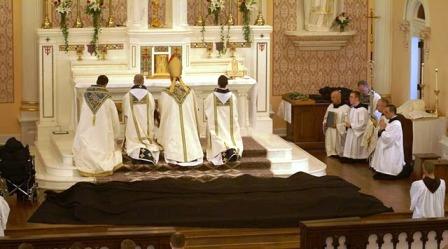
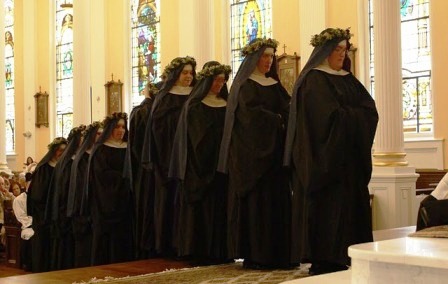
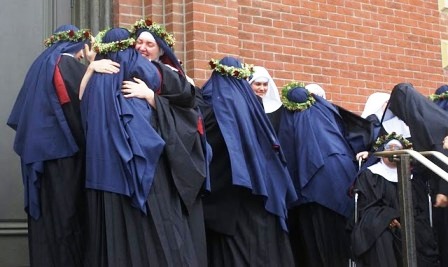
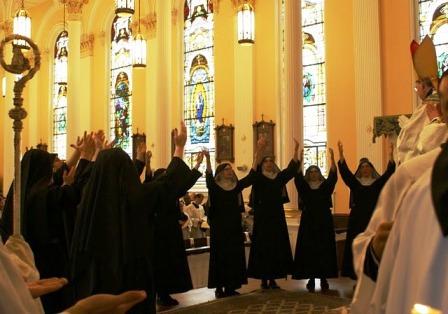
Solemn Profession of Benedictines: simply beautiful

Our friend R.J. Sciurus of Serviam has alerted us the splendid photos of the solemn professions of the wonderful sisters of the Benedictines of Mary, Queen of Apostles, in Kansas City.

Many of their sisters have been waiting many years for this moment.  On Saturday they were able to make their final, lifelong vows in the presence of His Excellency Bishop Robert Finn.

Here are a couple photos, but be sure to go to Kansas Catholic.

Solemn Profession of Benedictines: simply beautiful

Solemn Profession of Benedictines: simply beautiful

Solemn Profession of Benedictines: simply beautiful

Solemn Profession of Benedictines: simply beautiful

Solemn Profession of Benedictines: simply beautiful

Posted in SESSIUNCULA | Tagged ,
40 Comments

“The Priest and Pastoral Ministry in a Digital World”: World Communication Day:

Today is the 44th Day for World Communication.   The Holy Father released his Message for this day last January.  But since today is the day it is reasonable to look at the Message again.

First, may I direct you back to an editorial I wrote for the UK’s Catholic Herald?

My emphases and comments:

MESSAGE OF HIS HOLINESS
POPE BENEDICT XVI
FOR THE 44th WORLD COMMUNICATIONS DAY

"The Priest and Pastoral Ministry in a Digital World:
New Media at the Service of the Word"

[Sunday, 16 May 2010]

Dear Brothers and Sisters,

The theme of this year’s World Communications Day – The Priest and Pastoral Ministry in a Digital World: New Media at the Service of the Word – is meant to coincide with the Church’s celebration of the Year for Priests. It focuses attention on the important and sensitive pastoral area of digital communications, in which priests can discover new possibilities for carrying out their ministry to and for the Word of God. [Doin’ my best, Holy Father!] Church communities have always used the modern media for fostering communication, engagement with society, and, increasingly, for encouraging dialogue at a wider level. Yet the recent, explosive growth and greater social impact of these media make them all the more important for a fruitful priestly ministry.

All priests have as their primary duty the proclamation of Jesus Christ, the incarnate Word of God, and the communication of his saving grace in the sacraments. Gathered and called by the Word, the Church is the sign and instrument of the communion that God creates with all people, and every priest is called to build up this communion, in Christ and with Christ. Such is the lofty dignity and beauty of the mission of the priest, which responds in a special way to the challenge raised by the Apostle Paul: “The Scripture says, ‘No one who believes in him will be put to shame … everyone who calls on the name of the Lord will be saved.’ But how can they call on him in whom they have not believed? And how can they believe in him of whom they have not heard? And how can they hear without someone to preach? And how can people preach unless they are sent? (Rom 10:11, 13-15).

Responding adequately to this challenge amid today’s cultural shifts, to which young people are especially sensitive, necessarily involves using new communications technologies. [When you stand on a roof top, more people can see and hear.  When you are on water in a little boat at the end of a line, more people on the shore can hear and see you: online ministry!] The world of digital communication, with its almost limitless expressive capacity, makes us appreciate all the more Saint Paul’s exclamation: “Woe to me if I do not preach the Gospel” (1 Cor 9:16) The increased availability of the new technologies demands greater responsibility on the part of those called to proclaim the Word, but it also requires them to become become more focused, efficient and compelling in their efforts. Priests stand at the threshold of a new era: as new technologies create deeper forms of relationship across greater distances, they are called to respond pastorally by putting the media ever more effectively at the service of the Word. [Do I hear an "Amen!"?]

The spread of multimedia communications and its rich “menu of options” might make us think it sufficient simply to be present on the Web, or to see it only as a space to be filled. [NB:] Yet priests can rightly be expected to be present in the world of digital communications as faithful witnesses to the Gospel, exercising their proper role as leaders of communities which increasingly express themselves with the different “voices” provided by the digital marketplace. Priests are thus challenged to proclaim the Gospel by employing the latest generation of audiovisual resources (images, videos, animated features, blogs, websites) which, alongside traditional means, can open up broad new vistas for dialogue, evangelization and catechesis.

Using new communication technologies, priests can introduce people to the life of the Church and help our contemporaries to discover the face of Christ. They will best achieve this aim if they learn, from the time of their formation, how to use these technologies in a competent and appropriate way, shaped by sound theological insights and reflecting a strong priestly spirituality grounded in constant dialogue with the Lord. [Do I hear an "Amen!"?] Yet priests present in the world of digital communications should be less notable for their media savvy than for their priestly heart, their closeness to Christ. [sigh] This will not only enliven their pastoral outreach, but also will give a “soul” to the fabric of communications that makes up the “Web”.

God’s loving care for all people in Christ must be expressed in the digital world not simply as an artifact from the past, or a learned theory, but as something concrete, present and engaging. Our pastoral presence in that world must thus serve to show our contemporaries, especially the many people in our day who experience uncertainty and confusion, “that God is near; that in Christ we all belong to one another” (Benedict XVI, Address to the Roman Curia, 21 December 2009).

[Here it comes…]  Who better than a priest, as a man of God, can develop and put into practice, by his competence in current digital technology, a pastoral outreach capable of making God concretely present in today’s world and presenting the religious wisdom of the past as a treasure which can inspire our efforts to live in the present with dignity while building a better future? Consecrated men and women working in the media have a special responsibility for opening the door to new forms of encounter, maintaining the quality of human interaction, and showing concern for individuals and their genuine spiritual needs. They can thus help the men and women of our digital age to sense the Lord’s presence, to grow in expectation and hope, and to draw near to the Word of God which offers salvation and fosters an integral human development. In this way the Word can traverse the many crossroads created by the intersection of all the different “highways” that form “cyberspace”, and show that God has his rightful place in every age, including our own. Thanks to the new communications media, the Lord can walk the streets of our cities and, stopping before the threshold of our homes and our hearts, say once more: “Behold, I stand at the door and knock. If anyone hears my voice and opens the door, I will enter his house and dine with him, and he with me” (Rev 3:20).

In my Message last year, I encouraged leaders in the world of communications to promote a culture of respect for the dignity and value of the human person. This is one of the ways in which the Church is called to exercise a “diaconia of culture” on today’s “digital continent”. [I love that image.  It expands in a meaningful way the idea of the "public square".] With the Gospels in our hands and in our hearts, we must reaffirm the need to continue preparing ways that lead to the Word of God, while being at the same time constantly attentive to those who continue to seek; indeed, we should encourage their seeking as a first step of evangelization. [Keep in mind that Benedict has what I call a "Marshall Plan" for the Church. And he is talking now about a "new evangelization".]  A pastoral presence in the world of digital communications, precisely because it brings us into contact with the followers of other religions, non-believers and people of every culture, requires sensitivity to those who do not believe, the disheartened and those who have a deep, unarticulated desire for enduring truth and the absolute. Just as the prophet Isaiah envisioned a house of prayer for all peoples (cf. Is 56:7), can we not see the web as also offering a space – like the “Court of the Gentiles” of the Temple of Jerusalem – for those who have not yet come to know God? [Yes we can!]

The development of the new technologies and the larger digital world represents a great resource for humanity as a whole and for every individual, and it can act as a stimulus to encounter and dialogue. But this development likewise represents a great opportunity for believers. No door can or should be closed to those who, in the name of the risen Christ, are committed to drawing near to others. To priests in particular the new media offer ever new and far-reaching pastoral possibilities, encouraging them to embody the universality of the Church’s mission, to build a vast and real fellowship, and to testify in today’s world to the new life which comes from hearing the Gospel of Jesus, the eternal Son who came among us for our salvation. At the same time, priests must always bear in mind that the ultimate fruitfulness of their ministry comes from Christ himself, encountered and listened to in prayer; proclaimed in preaching and lived witness; and known, loved and celebrated in the sacraments, especially the Holy Eucharist and Reconciliation.

To my dear brother priests, then, I renew the invitation to make astute use of the unique possibilities offered by modern communications. May the Lord make all of you enthusiastic heralds of the Gospel in the new “agorà” which the current media are opening up.  [There is that "public square" idea again.]

With this confidence, I invoke upon you the protection of the Mother of God and of the Holy Curè of Ars and, with affection, I impart to each of you my Apostolic Blessing.

From the Vatican, 24 January 2010, Feast of Saint Francis de Sales.
 
BENEDICTUS XVI


Thoughts?

Posted in Pope of Christian Unity, SESSIUNCULA |
10 Comments

Using the new translation “ad experimentum”

From the great P.P. of St. Mary Magdalene in Brighton, Fr. Ray Blake:

Our bishop recently said that some parishes in the diocese were already using the new ICEL translations of the Missal, he said that he had no problem with them being used ad experimentum, as they were now an official text which had received the recognitio of the Holy See.

ICEL wants these texts to be used after appropriate catechesis next year. However, this morning I used new translation of the Roman Canon, as there are the four Eucharistic Prayers in the Missal, plus the two prayers for Reconciliation, the three (is it?) for children, and then those ghastly Swiss ones we can use, I thought that no-one would object, and from the reactions I heard people thought it was a vast improvement.
We had already intended to start introducing the Communion Rite in its sung form, just to get people used to the idea that their responses are going to change too.
Other people have suggested the translations are a bit lumpy, I found them immensely beautiful, so much so that I am going to use them tomorrow at the sung Mass.
The problem I have with then is that it seems so natural to use the rubrics, the signs of the cross, for example at phrases like, "… bless these gifts, these offerings, these holy and unblemished sacrifices, …"
I think it is going to be difficult to get people to change their responses, that is going to be the big problem, not what the priest says.PeoplesMassCard-NewTranslation

Interesting observation about the signs of the Cross during the Canon.  His remark reminds me of the argument that the more the newer form of Holy Mass is celebrated in the style of the old form of Mass the better it is.  Which of course begs a question.

Posted in Brick by Brick, WDTPRS | Tagged
61 Comments

REVIEW: Robin Hood

Not feeling well today, I opted for a movie.

I went to Robin Hood.

I wish I had stayed home.

This movie is really bad.

Just when you thought it couldn’t get worse… it did.

The credits are still rolling. Get me out of here.

If I had a gun to my head to find something positive… some of the music was okay. Of course modern effects can do amazing things.  Some characters were fine. There were some interesting animation effects in the credits… like paintings… interesting. But it was a long wait to get to this point.

UPDATE 15 May 1357 GMT:

The Catholic Herald’s review.

Posted in REVIEWS |
37 Comments

Benedict XVI in Oporto: “How much time we have lost…”

Benedict XVI in Oporto: "How much time we have lost..."I am incessantly going on about what I think Pope Benedict is trying to do in his pontificate: reinvigorate Catholic identity so that Catholics can fulfill their mission to shape the world around them.  If we don’t know know we are as Catholics, then as Catholics we will have nothing to contribute in the public square.  Why should people listen to us if we have nothing to say?

Of course this involves far more than being able to make good arguments.  It is also about living. Not just dicta but also facta.

In regard to what I call Pope Benedict’s "Marshall Plan" for the Church, our worship must play a vital role.

The Holy Father gave a sermon in Oporto, Portugal.  Let’s have a look with my emphases and comments.

Remember… he is not speaking only to the people of Oporto.  He is speaking to everyone who reads and listens.

Dear Brothers and Sisters,

"It is written in the book of Psalms, … ‘His office let another take’. One of these men, then […] must become a witness with us to his resurrection" (Acts 1:20-22). These were the words of Peter, as he read and interpreted the word of God in the midst of his brethren gathered in the Upper Room following Jesus’ ascension to heaven. [Pay attention: This is, once again, Peter reading and interpreting the Scriptures in the midst of the brethren gathered. Benedict is Peter.] The one who was chosen was Matthias, who had been a witness to the public life of Jesus and his victory over death, and had remained faithful to him to the end, despite the fact that many abandoned him. The "disproportion" between the forces on the field, which we find so alarming today, astounded those who saw and heard Christ two thousand years ago. It was only he, from the shore of the Lake of Galilee right up to the squares of Jerusalem, alone or almost alone at the decisive moments: he, in union with the Father; he, in the power of the Spirit. Yet it came about, in the end, that from the same love that created the world, the newness of the Kingdom sprang up like a small seed which rises from the ground, like a ray of light which breaks into the darkness, like the dawn of a unending day: it is Christ Risen. And he appeared to his friends, showing them the need for the Cross in order to attain the resurrection.  [The Holy Father is also trying to spur a "new evangelization".]

On that day Peter was looking for a witness to all this. Two were presented, and heaven chose "Matthias, and he was enrolled with the eleven apostles" (Acts 1:26). Today we celebrate his glorious memory in this "undefeated city", which festively welcomes the Successor of Peter. I give thanks to God that I have been able come here and meet you around the altar. I offer a cordial greeting to you, my brethren and friends of the city and the Diocese of Oporto, to those who have come from the ecclesiastical province of Northern Portugal and from nearby Spain, and to all those physically or spiritually present at this liturgical assembly. [That means you, dear reader.] […]

"One of these men must become with us a witness to his resurrection," said Peter. [Nota bene:] His Successor now repeats to each of you:[!]  My brothers and sisters, you need to become witnesses with me to the resurrection of Jesus. [NB:] In effect, if you do not become his witnesses in your daily lives, who will do so in your place? Christians are, in the Church and with the Church, missionaries of Christ sent into the world. [We must shape the world around us.] This is the indispensable mission of every ecclesial community: to receive from God and to offer to the world the Risen Christ, so that every situation of weakness and of death may be transformed, through the Holy Spirit, into an opportunity for growth and life. [And here is the dimension of worship:] To this end, in every Eucharistic celebration, we will listen more attentively to the word of Christ and devoutly taste the bread of his presence. [Notice that both of these involve activity receptivity.  True "active participation".] This will make us witnesses, and, even more, bearers of the Risen Jesus in the world, bringing him to the various sectors of society and to all those who live and work there, spreading that "life in abundance" (cf. Jn 10:10) which he has won for us by his cross and resurrection, and which satisfies the most authentic yearnings of the human heart.

[And now something from Peter, Benedict, about his own style…] We impose nothing, yet we propose ceaselessly, as Peter recommends in one of his Letters: [One of my favorite quotes from Scripture…] "In your hearts, reverence Christ as Lord. Always be prepared to make a defence to any one who calls you to account for the hope that is in you" (1 Pet 3:15). And everyone, in the end, asks this of us, even those who seem not to. From personal and communal experience, we know well that it is Jesus whom everyone awaits. In fact, the most profound expectations of the world and the great certainties of the Gospel meet in the ineluctable mission which is ours, for "without God man neither knows which way to go, nor even understands who he is. [!] In the face of the enormous problems surrounding the development of peoples, which almost make us yield to discouragement, we find solace in the sayings of our Lord Jesus Christ, who teaches us: ‘Apart from me you can do nothing’ (Jn 15:5) and who encourages us: ‘I am with you always, to the close of the age’ (Mt 28:20)" (Caritas in Veritate, 78).

Yet even though this certainty consoles and calms us, it does not exempt us from going forth to others. We must overcome the temptation to restrict ourselves to what we already have, or think we have, safely in our possession: [Here is strong language…] it would be sure death in terms of the Church’s presence in the world; [Get that?  "sure death"] the Church, for that matter, can only be missionary, in the outward movement of the Spirit. From its origins, the Christian people has clearly recognized the importance of communicating the Good News of Jesus to those who did not yet know him. In recent years the anthropological, cultural, social and religious framework of humanity has changed; today the Church is called to face new challenges and is ready to dialogue with different cultures and religions, in the search for ways of building, along with all people of good will, the peaceful coexistence of peoples. The field of the mission ad gentes appears much broader today, and no longer to be defined on the basis of geographic considerations alone; [Indeed.  There is a "digital continent" also.] in effect, not only non-Christian peoples and those who are far distant await us, but so do social and cultural milieux, and above all human hearts, which are the real goal of the missionary activity of the People of God.

This is the mandate whose faithful fulfilment "must follow the road Christ himself walked, a way of poverty and obedience, of service and of self-sacrifice even unto death, a death from which he emerged victorious by his resurrection" (Ad Gentes, 5). Yes! We are called to serve the humanity of our own time, trusting in Jesus alone, letting ourselves be enlightened by his word: "You did not choose me, but I chose you and appointed you that you should go and bear fruit and that your fruit should abide" (Jn 15:16). [Here it is.  A theme in his trip to Portugal.  How we have failed so often and in so many ways….] How much time we have lost, how must work has been set back, on account of our lack of attention to this point! Everything is to be defined starting with Christ, as far as the origins and effectiveness of mission is concerned: we receive mission always from Christ, who has made known to us what he has heard from his Father, and we are appointed to mission through the Spirit, in the Church. Like the Church herself, which is the work of Christ and his Spirit, it is a question of renewing the face of the earth starting from God, God always and alone.

Dear brothers and sisters of Oporto, lift up your eyes to the One whom you have chosen as the patroness of your city, the Immaculate Conception. The angel of the Annunciation greeted Mary as "full of grace", signifying with this expression that her heart and her life were totally open to God and, as such, completely permeated by his grace. May Our Lady help you to make yourselves a free and total "Yes" to the grace of God, so that you can be renewed and thus renew humanity by the light and the joy of the Holy Spirit.

Posted in Pope of Christian Unity, SESSIUNCULA | Tagged ,
33 Comments

MAN BITES DOG!

Many years ago I was walking along the river on an evening constitutional with a Chinese friend the topic of differences in food came up.

I asked him whether or not he had eaten dog very often. 

He said, "yes", and we paced for a while.

It occurred to me that if different types of chickens or cows taste different, then perhaps different types of dogs would also.

"What is your favorite type of dog?", I queried.

He thought about that for a while and returned with "Yellow Dog."

I was instantly amused at the idea of eating certain Democrats, but I didn’t think that is what he meant.

In any event, our walk continued with my suspicion confirmed: yes, different dogs do have different flavors after all!

If you don’t like surprises, it would probably be a good idea when you go to China to learn the characters and words for companion animals.

With that as a preamble, I tip my biretta to Sancte Pater o{]:¬) without whom I might never have learned of this story in the Daily Mail.

MAN BITES DOG!China’s first man in space reveals astronauts ate dog meat to keep up their strength
By Allan Hall

China’s first man in space has revealed that the menu on his spacecraft included dog meat – to keep the astronaut’s strength up.

Yang Liwei, who commanded the Shenzhou Five mission in 2003, revealed canine menu samples that were on-board his craft along with chicken and fish.  [Yes, that "canine menu samples" must be food from dogs, not food for dogs.]

In his autobiography ‘The Nine Levels between Heaven and Earth’ he said: ‘Many of my friends are curious about what we eat in space and think that the astronauts must have some expensive delicacies, like shark’s fin or abalone. [That was not my guess, though I too am curious about space menus.  I am toying right now with facetious comments about the old Space Food Sticks and playing "fetch".]

‘Actually we ate quite normal food, there is no need to keep it a secret,’ he added, listing chicken, steamed fish and dog meat from Huajiang county in Guangdong. [New meanings for the term "doggy bag".]

Chinese nutritional experts recommend dog meat, especially in winter months.

Finding dog meat, bones and even skulls – they are boiled to make broth – in Chinese supermarkets, particularly in the north of the country, is by no means unusual.  [Yes, there is a breed of Chinese dog called the "Chow".]

Germans and Swiss were recently horrified to find that St. Bernard dogs – traditionally associated with rescuing avalanche victims in the Alpine regions of both countries – are now bred in China on special farms for their flesh.  [OH… THE CANINITY!  But, think about it.  If you are going to eat a lot of dog, and therefore breed them for meat, wouldn’t you opt for da gou rather than xia gou, big dog rather than little dog, for your source of  xiangrou;  I mean… it stands to reason, no?]

The dogmeat menu was still in use last year, when Chinese astronauts conducted their first ever spacewalk.

If China has its way, it will be served when the country accomplishes its goal of a man-on-the-moon in 2030.  [And now I am thinking about moondogs.  Come to think of it, the Moon’s Mare Crisium is sometimes thought to be the "man in the moon’s" little dog.  Mare Crisium is, of course, where the Picard Crater is, named after, yes, Jean Picard, but not Jean-Luc Picard.  If memory serves, there were no dogs on Star Trek.  Though, come to think of it, Data did have a cat…. hmmm…. named "Spot"…. And so we come full circle at last.]

Animal rights campaigners in China were horrified at the revelations.

They believe dog consumption is the preserve of peasants and should not be promoted by people who are in effect the national elite. [What a curiously Chinese argument.  Asking people not to eat dogs just isn’t going to, excuse me, cur-tail their consumption.  At least get famous people not to eat them in public!]

‘Yang Liwei is a role model for so many young people and he is one of China’s greatest heroes,’ said Jill Robinson, the founder of Animals Asia.

‘We hope that he might recognise dogs as the heroes they are too: they found survivors after the Sichuan earthquake and protected people from potential terrorists during the Olympic games. Surely they deserve more.’  [Sorry.  Dogs are not heroes.  Dogs are dogs.  Most people labeled as "heroes" these days aren’t heroes either.]

European astronauts do not have to resort to snacking on man‘s best friend.  [I should think not!]

One of Germany’s Michelin-star chefs now cooks for the crew of the International Space Station (ISS).  [Just think about that.]

Harald Wohlfahrt, [A fitting name for a chef cooking for people who are decidedly going traveling.  Lord.. you just can’t make this up!] fifty-two year old chef of the prestigious Schwarzwaldstube Restaurant in Germany’s Black Forest, was recruited to spice up what was a down-to-earth menu. [And dog on the menu wouldn’t do that?]

Chef Wohlfahrt began revamping the tubed and tinned paste food about 18 months ago when he first learned that the astronauts were eating healthy but less tasty meals because of the special requirements of space.

Salt accelerates bone loss, vitamin D must be added due to lack of sunlight, and sauces can’t be used for fear of spills, [Okay… I wanted to go into space before… but…. ] which, in a weightless environment, could damage electrical equipment with potentially disastrous results. [Yahhhhhh…. that whole Bearnaise Sauce and Oxygen Distribution Circuit combo… not such a good idea.]
 
Foods also need to be highly seasoned, because astronauts’ sense of taste is diminished in outer space. [On airplanes too, btw.]

Astronaut Frank De Winne gave Wohlfahrt’s new menu a taste test prior to his launch into space and gave the food an enthusiastic thumbs up.

Admittedly there was plenty of room for improvement.  [I should think Chineeese cuisine might help.]

Wohlfahrt tasted some standard astronaut fare before beginning his space food project. ‘I felt sorry for the astronauts,’ he told the Süddeutsche Zeitung. ‘It tasted like cat food.’  [I’m sorry… but how does he know what cat food tastes like?  And are we dealing once again with food for cat or food from cat.  Data and I both want answers!]

He now offers Swabian potato soup, braised veal cheeks [OH! The BOVINITY!] with wild mushrooms and plum compote.

I’m must now go grocery shopping.  For hot dogs.

"But Father! But Father!", you are surely saying in frustration.  "You gave us that story about ‘Yellow Dog’ at the top and just left it!  Did you never find out what ‘Yellow Dog’ meant?"

Indeed I did, and thanks for reminding me.

We walked along, sometimes in silence, sometimes speaking of this or that.

All of a sudden, he tugged my sleeve.

Here came someone woking … sorry walking his dog on that beautiful evening.  A beautiful, happy, – yes – Golden Retriever.

As they passed he pointed back over his shoulder and said – what a wag he was – and said very quietly….

"Yellow Dog."

Posted in "But Father! But Father!", Fr. Z's Kitchen, Lighter fare, SESSIUNCULA |
62 Comments

Bp. Moran of Aberdeen, Scotland, blocks an Extraordinary form Mass

From the blog Damian Thompson on a sad piece of news:

A historic Latin Mass in the cathedral of the Orkney Isles… blocked by the Catholic bishop
By Damian Thompson

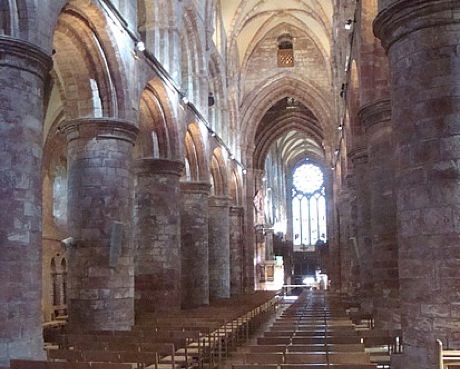
Bp. Moran of Aberdeen, Scotland, blocks an Extraordinary form MassHow sad to hear that plans to celebrate Mass in the Extraordinary Form in St Magnus Cathedral, Kirkwall – parts of which date back to 1137 – were recently blocked by the Catholic Bishop of Aberdeen, the Rt Rev Peter Moran. Sad but not surprising, since the Bishops of Scotland seem united in their determination to throw up as many obstacles as possible to the implementation of Summorum Pontificum.


The traditionalist group Una Voce Scotland had planned what would have been a historic and very beautiful celebration of the older form of the Roman Rite in the cathedral of the Orkneys (the most northerly in Britain), apparently with the permission of the Church of Scotland, which has occupied it for centuries. Una Voce has its own schola, so the plainchant would have been magnificent. [to be clear… the Church of Scotland now has the church, but they were willing to host this Catholic TLM.  Then the local Catholic bishop hears about it and blocks it.  Some time ago, if memory serves, there was a fine Solemn TLM in the Cathedral of Winchester which had the permission of the Catholic Bishop of Portsmouth.  So, it isn’t as if there isn’t a precedent.]

Enter Bishop Moran. “It has come to my attention,” he told Una Voce in a letter from last autumn that I’ve just been sent, “that … you have been making enquiries about the availability of St Magnus Cathedral for a possible celebration of Mass in the forma extraordinaria.”

Well, forget it. He didn’t approve of the choice of two priests from the traditionalist community of Papa Stronsay, now reunited with the Holy See after years of separation. Said the bishop: “While Fathers Michael Mary and Anthony Mary … are now, happily, in good standing with the Church, they have as yet only limited faculties to celebrate Mass in this diocese. (Like all priests of the Church they are at liberty to celebrate the forma extraordinaria privately without specific permission, and to have some people with them when they do, but for public celebration the local bishop’s permission is needed.)”  [And I say they CAN’T.  Nice, huh?  What possible harm could it have done to anyone?  Why are there still so many closed hearts when it comes to this perfectly legitimate and laudable desire for the use of the Extraordinary Form?]

Excuse me? Bishop Moran must have read a different edition of the Pope’s Apostolic Letter from the one published by the Holy See, because it says no such thing. Sadly, Archbishop Mario Conti of Glasgow labours under the same misapprehension. What is wrong with these Scottish prelates?  [Actually Summorum Pontificum addresses mainly the situation of pastors when it comes to public celebration. But it is clearly not the case that the bishop’s permission is needed for a public celebration of Holy Mass in the older form.  Other circumstances do matter, however.  For example, if that Mass is going to be in a church of another ecclesial community with whom we do not share Communion.]

That’s what really bugs me. I can understand why Bishop Moran might have had problems with the choice of Papa Stronsay priests; I am sure he’s telling the truth when he says in the letter that he has considered celebration of the EF elsewhere in Aberdeen diocese but “those priests whom I have approached have not been enthusiastic”;  and it is too much to expect, I suppose, that his imagination might be captured by the possibility of the Latin Mass being celebrated again in a building once renowned for its “treasures and rich vestments” before the so-called reformers destroyed them and whitewashed the walls.

But the claim (and I quote Bishop Moran again) that “the bishop’s permission is needed for any public celebration of the forma extraordinaria” is one with which the Congregation for Divine Worship would – and, I hope, will – take issue. [No.  The Pontifical Commission Ecclesia Dei has competence in this matter, not the CDW.]

Oh, and another thing that bugs me: not being told the truth. This morning I left a message with Bishop Moran’s secretary asking if I could talk to him about the plans for a Tridentine Mass at St Magnus. “We’ll get back to you,” she said, but no one did. So I rang again, the bishop picked up the phone and he said: “I’ve no knowledge at all of what you’re talking about. I’ll make inquiries and get back to you.” [HUH?]

No knowledge at all, he says, with his letter sitting in front of me.  Looking forward to your call, bishop.  [And I hope we hear more about this.]

It makes you think of the days just after the release of Summorum Pontificum when bishops finally started thinking about implementing Ecclesia Dei adflicta.

UPDATE: 16 May 1700 GMT:

Damian has more.  Be sure to read his update.


Posted in SUMMORUM PONTIFICUM | Tagged ,
51 Comments

QUAERITUR: Can I receive Communion at two Masses in one day?

From a reader, a question that pops up every once in a while.  Adhering to the adage repetita iuvant, here is the question and response:

It used to be the rule that you could could go to Communion only once a day, a rule that is in itself sensible.

But I heard that this is now permitted for a sufficient reason.

I sing in the schola for the Ordinary Form at 7:00 am.

But then twice a month we have the Extraordinary Form at 10:30 am, which I like to attend in addition with my family.

Can I go to Communion at both?


The quick answer is YES, you may receive Holy Communion at both those Masses.

The 1983 Code of Canon Law says:

Can. 917 – Qui sanctissimam Eucharistiam iam recepit, potest eam iterum eadem die suscipere solummodo intra eucharisticam celebrationem cui participat, salvo praescripto Can. 921, § 2. … Someone who has already received the Most Holy Eucharist can receive it again (iterum) on the same day only within the Eucharistic celebration [i.e. Mass] in which the person participates, with due regard for the prescription of can. 921 § 2.

Can. 921 § 2 says that if a person is in danger of death, he may receive Communion even it is not in the context of Mass.  That is Viaticum.

That iterum does not mean "again and again", but merely "again one more time".

Also, that "Eucharistic celebration" in the canon does not mean just any service involving Communion.  It means Mass. That was cleared up by the Holy See in an official response to a dubium.

So, say in the morning you were at a Novus Ordo Communion service wherein you received Communion, or a Mass in either Form.  Later in the day you stumble into a church where Mass was about to be celebrated and decided to stay for it.  At that Mass you could receive Communion again (iterum).  This would be even if you were, say, visiting a Maronite Catholic Church, or a Ukrainian Catholic Church and their Divine Liturgy was about to get under way. 

However, if you were at Holy Mass in the morning and then stumbled into a Communion service at a priest-less parish in the afternoon, you could NOT receive again because a Communion Service isn’t Mass.  If you were at Mass in the morning and then in the afternoon when you were visiting your auntie in the hospital when the chaplain came, you could not receive even if the priest invited you to do so (which in my opinion he should not).

Canon 917 tries to walk the line between promoting frequent reception of the Eucharist and a superstitious or excessive frequency, which I can assure you some people fall into.

The key here is that the second time must be during a Mass, unless it is as Viaticum and you may not enter the Mass at some late point merely in order to receive.

Posted in ASK FATHER Question Box | Tagged
8 Comments