The Tablet’s bizzare report on Medjugorje, Card. Schönborn

And now for one of the most absurd interpretations of news you will ever read.

This is either pure ignorance or deliberate misdirection.

Either way it is from RU-486 (aka The Bitter Pill aka The Tablet).

Church in the World
Schönborn says Pope might visit Medjugorje  [And I might become the next Archbishop of Southwark.]
Christa Pongratz-Lippitt9 January 2010

A cardinal close to Benedict XVI has signalled his support for the controversial Marian shrine of Medjugorje. [Does that sound even slightly plausible?]
Cardinal Christoph Schönborn of Vienna indicated that Pope Benedict himself might one day [might.one.day] visit the spot where the Virgin Mary is believed [by fewer and fewer] to have appeared to a group of local children. Speaking on his return from a three-day visit to the shrine in Bosnia at the turn of the year, he told journalists in Vienna that the time had come to integrate the “Medjugorje phenomenon” into the Church’s ordinary pastoral work.

Asked in an interview with the Bologna-based daily Il Resto di Carlino what he would tell Pope Benedict XVI about the trip, he said: “The Pope does not need my advice. [Therefore….?] He knows very well how important the Virgin Mary is for the Catholic Church and he is a fervent devotee. [My heavens… did Card. Schonborn really say that?  Was he addressing elementary schoolchildren at the time?] He has visited many Marian shrines and I think one day he might even come here.” [And I might one day visit Kinshasa.] He added that Medjugorje could “become something very important and profound”.

The cardinal’s support comes as a surprise to many who have observed the wrangling over the shrine. The local Franciscan community believes the visions are genuine while the local bishop of Mostar, Ratko Peric, has been highly critical.

Until Cardinal Schönborn’s visit, the Vatican itself had appeared sceptical [Which means Joseph Ratzinger…]  but his declaration of support could mark a turning point. [And I hereby declare that the Cubs will win the 2010 World Series… it could happen!]  Speaking in Vienna, the cardinal was cautious, [More cautious than this journalist.] saying that he does not want “to pre-empt a world church decision”. He acknowledged that the first impulse for pilgrimage had come from the apparitions but that he was more concerned with the devotion they had inspired. “Medjugorje is concerned with belief in Jesus Christ, with prayer, with the Eucharist, with practised charity, with what is essentially Christian and with strengthening Christian everyday life,” he said.  [And what if it is not approved by the Church?]

Cardinal Schönborn indicated that he stood by the guidelines issued in 1991 by the then Yugoslav bishops’ conference, which had twice been confirmed by the Congregation for the Doctrine of the Faith. These stated that it was not certain whether what was happening in Medjugorje was supernatural and that this question was being left open.

Among the “abundant fruit” from the shrine, the cardinal singled out priestly vocations, conversions and charities including Mary’s Meals, which provides daily meals for schoolchildren in a number of African countries.

Many aspects of Medjugorje conformed to the “grammar of Marian apparitions”, Cardinal Schönborn said, adding: “Perhaps we in the Church should let ourselves be more inspired by this Marian concept.”

Bishop Peric said that by going to Medjugorje, Cardinal Schönborn had only “added to the local Church’s suffering”.

Posted in SESSIUNCULA | Tagged ,
52 Comments

SCOTUS decision on free-speech and campaign contributions.

Did you see that SCOTUS ruled on campaign contributions?  Apparently, the Supreme Court says that the !st Amendment, free-speech rights, permit corporations and labor unions to spend money on political campaigns.

Justice Anthony Kennedy wrote the majority opinion, which reads in part that there is "no basis for allowing the government to limit corporate independent expenditures."

"There is no basis for the proposition that, in the political speech context, the government may impose restrictions on certain disfavored speakers," he wrote. "The government may regulate corporate speech through disclaimer and disclosure requirements, but it may not suppress that speech altogether."

The case was sparked by a movie made during the last presidential campaign: "Hillary: The Movie".

Dissenters – big surprise here –  included Justices John Paul Stevens, Ruth Bader Ginsburg, Stephen Breyer and Sonia Sotomayor.

Thus, McCain-Feingold has been eroded.

This has not been a good week for the White House or Congressional democrats.

Posted in SESSIUNCULA |
43 Comments

Catholic Herald editorial: “Benedict XVI is truly the Pope of Christian Unity”

The UK’s best Catholic weekly, The Catholic Herald, has an editorial with a title which may sound familiar to readers of WDTPRS.

My original post about a project.

This comes during the Week for Christian Unity.

My emphases and comments.

Benedict XVI is truly the Pope of Christian Unity

22 January 2010

When Jesus prayed that his followers may be one, He was praying for the unity of the Church whose leadership he entrusted to St Peter and his successors. He was not prophesying that this unity would be achieved by a particular model of ecumenism. In the 20th century, the Church mapped out a route towards unity which focused on ever closer links with other Christian communities, such as the Anglican Communion; the aim was to achieve a corporate reunion. Thus, the purpose of the Anglican-Roman Catholic International Commission, so far as the Church was concerned, was an agreement in which the Archbishop of Canterbury would once again become bishop of a historic see of the Church that Anglicans describe as "Roman Catholic". Unfortunately, participants on both sides of ARCIC glossed over the fact that doctrines of transubstantiation and infallibility are unchangeable: one can do no more than tinker with the language in which they are defined. [Ecumenical dialogue in which either party waters down their belief for the sake of continuing dialogue is no dialogue at all.]

Indeed, both sides implied that they could offer what were, in fact, impossible concessions. Many, if not most, Anglicans are Protestants: their objections to Catholic teaching on the Eucharist and papal primacy are fundamental. ARCIC established some genuine common ground between the two bodies; but some of the convergence was illusory. And this was the case even before Anglicans took irreversible decisions [Are they?] to ordain women priests and (in many provinces) women bishops, too.

As a result of these latter developments, a tremendous gloom settled over the Church’s official ecumenists. [In other words, those steeped in the art of watery ecumencial tea.  But go on… this is where it gets good… ] It has taken Pope Benedict XVI to show us that ecumenical dialogue can achieve the long-awaited goal of corporate reunion by another route. Let us take the example of the Society of St Pius X. Those of its members who accept the Magisterium can be welcomed back corporately into full communion; as a prelude to this, the Holy Father took the necessary but controversial step of lifting episcopal excommunications (though no one, including the Pontiff, would claim that the Vatican executed this manoeuvre skilfully).  [But it sure got things moving.  And the only serious dissidents objected to something that was not really germane to the question of why they had been excommunicated.  Some SSPXers said they weren’t ever excommunicated (dreamland).  Some objected because of one SSPX bishops bizzare views (irrelevant).  Some were liberals who "Don’t want their kind ’round these parts (ecclesiastical bigots).  The point is that Benedict XVI won’t shy from a tussle if that is the only way to get things going.  Thus, he has redefined not only the scope and issues of ecumenical dialogue, but also the methodology.]

The forthcoming group reception of former Anglicans is in some ways less controversial. Ever since the 1990s, the Holy Father has been convinced that orthodox Anglicans can be corporately received into the Church after detaching themselves from official bodies that have opted for the Protestant innovation of women’s ordination. This detachment need not be a source of long-term damage to Anglican-Catholic relations; from the Anglican point of view, it recognises an already existing ecclesial reality. For Catholics, however, it is more than that. As the Pope emphasised in his address to the CDF last week, his Apostolic Constitution is that rarest of developments: an ecumenical gesture that increases the visible unity and the liturgical riches of the Church. Those Anglicans who accept the papal offer will be doing a wonderful thing – not just for themselves, but for us, too.


Liberals want to be the sole arbiters of what may be involved with ecumenical dialogue, as well as who may be involved.  They are always happy to have "meaningful" (read = watery) discussions with groups who would be perfectly in sync with the Leadership Conference of Women Religious, but not with those who want to read, say, the Missale Romanum in continuity with our teachings and worship before 1963.

Do not let liberal ecumenists define ecumenism.  Do not accept their premises.

Instead, take heart and guidance from the Pope of Christian Unity… Pope Benedict XVI.

Posted in Pope of Christian Unity, SESSIUNCULA, The Drill | Tagged
6 Comments

Question for readers: Masses in honor of Martin Luther King, Jr.

A reader asked in an email what I thought about Masses celebrated in honor of the late civil rights figure Martin Luther King, Jr.

I was not paying attention to this or acutely aware that this was being done.

I can’t see any problem with praying for the repose of the soul of a person who is dead, Catholic or non-Catholic.  It is a work of mercy to pray for the dead.

I can’t see any problem with Masses for civil needs or concerns of society.  We should always ask god to help us strive for a more just and charitable society.

But as far as I understanding things, I thought that Masses in honor of someone were to be in honor of saints or blesseds according to the Roman calendar or the particular local calendars of those of religious institutes.

Question for you:

Where you live, were there Masses celebrated in honor of Martin Luther King, Jr?

Posted in SESSIUNCULA |
59 Comments

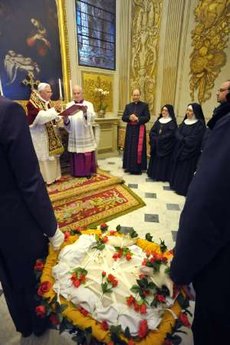
Agnes… lambs… Popes…. nuns… pallia

The Holy Father blessed lambs today, the feast of St. Agnes, as usual.
Agnes... lambs... Popes.... nuns... pallia
The lambs are associated with Agnes, because of the Latin similarity of their names, Agnes and agnus.  Get it?

Those sisters in the background are Benedictine nuns from the convent at St. Cecilia in Trastevere.  When I first lived in Rome, I would go there everyday, into the cloister, and serve Mass for the rector of the basilica.  I got to know them a bit.

In the morning the rather heavily drugged lambs are, tied down on a small litter, decorated with flowers, and brought to the Basilica of St. Agnes out on the Via Nomentana, where Mass is said.  You are thereby entertained by their bleating…. better than the Sistine Choir, actually.

Now that I think of it….it’s a good thing they don’t mix that agnus thing up with angus. That would make the litter harder to carry!  (Where is Vincenzo when you need him?)

Then they are taken to the Pope.

Then they are taken to St. Cecilia’s.

Later they will be shorn and, traditionally, their wool is used for the pallia distributed to new archbishops on the feast of Sts. Peter and Paul.  Of course there are so many archbishops these days that they would need a whole flock of lambs.

Then they are taken out to a beautiful farm, Timmy, where they can play with other lambs.

Well… honestly… I am not sure about the fate of the lambs. 

But I do know that Romans are neither overly sentimental about critters nor are they sparing in their appreciation of abbacchio scottaditto.

"But Father! But Father!", the fluffly lamb-lovers will blurt, as they recoil in horror from the screen.  "Would you… would you….?!?  You’re baaaaahd!"

I would.  When I see lambs, I think "Supper and sweater."

And for the record, in June the new archbishops get the better design of the pallium.   Just in case the Pope was going to ask.

Posted in "But Father! But Father!" | Tagged ,
17 Comments

QUAERITUR: Do you want all English Masses eliminated?

From a reader (emphasis in the original):

Do you want all English Masses eliminated, or a weekly Latin Mass at each parish, or what?  Our priest has said that everything that has happened in the last forty years has been  bad.  He has a Latin Mass in the chapel about every two months.  I assume he would have more, or say them in the main church,  if there was a request from enough people.


Do I want all English Masses eliminated?

Where is Mass celebrated in English?

Ask me again when Masses can be said in an English that both translates the original and doesn’t offend the intellect.

If people want Holy Mass in the Novus Ordo in the Latin language (the actual language of our Latin Church), I suggest they start asking for it.

If people want Holy Mass in the traditional, Extraordinary Form, I suggest they ask for it.

Don’t grouse if you have done nothing.

Posted in ASK FATHER Question Box |
42 Comments

21 January: St. Agnes of Rome, virgin and martyr

Here is something I have posted in the past… about St. Agnes of Rome.  Newcomers to WDTPRS may not have seen it.

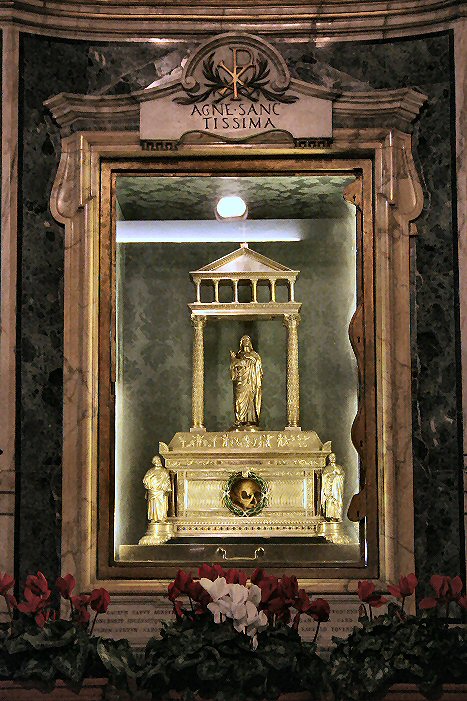
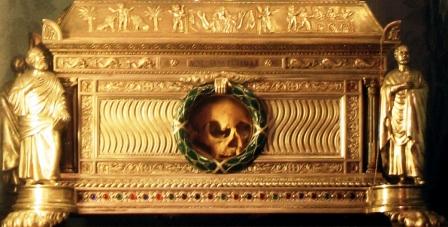
21 January: St. Agnes of Rome, virgin and martyrBehold the skull of Agnes.

21 January: St. Agnes of Rome, virgin and martyr

The dies natalis ("birthday into heaven") of Agnes was recorded in the register of the depositio martyrum as 21 January.

St. Agnes was slain probably during the reign of the Emperor Diocletian in 304. Some say she died during the time of the Emperor Valerian (+260).

The little girl was buried by her parents in praediolo suo, on their property along the Via Nomentana where there was already a cemetery.

This cemetery expanded rapidly after that, because many wanted to be buried near the grave of the famous martyr. The ancient cemetery grew in stages between the Basilica which Constantina, daughter of Constantine and Fausta began over her tomb from 337-350 and the small round Basilica of Constantia (Constantine’s daughter).

There was an acrostic inscription from that time in verses about the dedication of the temple to Agnes:

Constantina deum venerans Christoque dicata
Omnibus impensis devota mente paratis
Numine divino multum Christoque iuvante
Sacravit templum victricis virginis Agnes…

You get the idea.

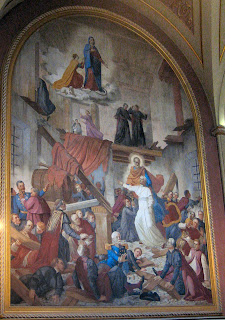
The Basilica of St. Agnes was reconstructed towards the end of the 5th c. by Pope Symmachus (+514). Honorius I (+638) rebuilt it as a basilica with three naves, adding a wonderful fresco of Agnes. It was worked on again in the 16th c. by St. Pius V and in the 19t21 January: St. Agnes of Rome, virgin and martyrh by Bl. Pope Pius IX.

Excavations in 1901 uncovered the silver sarcophagus made by Pius V for St. Agnes together with St. Emerentiana.

It contained the headless body of a young girl.

Zadock gave us a photo of the miraclous protection of Bl. Pius IX when once at the Basilica there was a near disastrous cave-in/collapse and no one was injured.

While Agnes’s body is in her tomb on the Via Nomentana, her skull is now at the place of her supposed martyrdom at the Piazza Navona in Rome’s heart. It is a fitting place to venerate a saint so much in the heart of the Roman people even today. It is not unusual for people to name their children Agnes in honor of this great virgin martyr, whose name is pronounced in the Roman Canon.

The skull was bequeathed to that church at the Piazza by Pope Leo XIII who took it from the treasury of the Sancta Sanctorum.

The Piazza itself was in ancient times the Stadium of Domitian (+96) a place of terror and blood for early Christians, far more than the Colloseum ever was. The Piazza is thus called also the "Circo Agonale" and the name of the saint’s church Sant’Agnese in Agone. "Navona" is a corruption of "Agonale", from Greek agon referring to the athletic contests of the ancient world. St. Paul used the athlete’s struggle as an image of the Christian life of suffering, perseverance, and final victory even through the shedding of blood. Early Christian tombs often have wavy lines carved im the front, representing an iron instrument called a strigil, used by athletes to scrape dirt and oil from the bodies after contests. Victory palm branches are still used in the iconography of saints, as well as wreathes of laurels.

We know about St. Agnes from St. Jerome, and especially St. Augustine’s Sermons 273, 286 and 354. St. Ambrose wrote about Agnes in de virginibus 1,2,5-9 written in 377 as did Prudentius in Hymn 14 of the Peristephanon written in 405.

Ambrose has a wonderful hymn about Agnes (no. 8), used now in the Roman Church for Lauds and Vespers of her feast. The Ambrosian account differs somewhat from others. For Ambrose, Agnes died from beheading. Prudentius has her first exposed to shame in a brothel and then beheaded.

Here is the text of the hymn from the Liturgia horarum for the "Office of Readings" with a brutally literal translation.

Igne divini radians amoris
corporis sexum superavit Agnes,
et super carnem potuere carnis
claustra pudicae.

Shining with the fire of divine love
Agnes overcame the gender of her body,
and the undefiled enclosures of the flesh
prevailed over flesh.

Spiritum celsae capiunt cohortes
candidum, caeli super astra tollunt;
iungitur Sponsi thalamis pudica
sponsa beatis.

The heavenly host took up her brilliant white spirit,
and the heavens lifted it above the stars;
the chaste bride is united to the
blessed bride chambers of the Spouse.

Virgo, nunc nostrae miserere sortis
et, tuum quisquis celebrat tropaeum,
impetret sibi veniam reatus
atque salutem.

O virgin, now have pity on our lot,
and, whoever celebrates your victory day,
let him earnestly pray for forgiveness of guilt
and salvation for himself.

Redde pacatum populo precanti
principem caeli dominumque terrae
donet ut pacem pius et quietae
tempora vitae.

Give back to this praying people
the Prince of heaven and Lord of the earth,
that he, merciful, may grant us peace
and times of tranquil living.

Laudibus mitem celebremus Agnum,
casta quem sponsum sibi legit Agnes,
astra qui caeli moderatur atque
cuncta gubernat. Amen.

Let us celebrate with praises the gentle Lamb,
whom chaste Agnes binds to herself as Spouse,
he who governs the stars of heaven
and guides all things. Amen.

We can note a couple things from this prayer. First, the reference to fire probably a description of Agnes’s death related in a metrical panegyric of Pope Damasus about how Agnes endured martyrdom by fire. On the other hand, St. Ambrose, when speaking of her death, speaks of martyrdom by the sword.

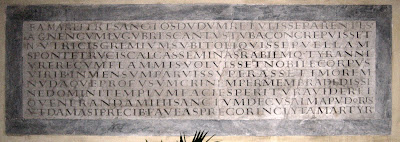
21 January: St. Agnes of Rome, virgin and martyrPope St. Damasus composed a panegyric, an elogia, inscribed in gorgeous letters on marble (designed and executed by Dionysius Philocalus) in honor of Roman saints, including Agnes.  This was the period when the Roman shifted from Greek to Latin.  Damasus was also trying to make a social statement with these great inscriptions, set up at various places about the City.   The panegyic of St. Agnes was placed in the cemetery near the saint’s tomb, but through the ages it was lost. Amazingly, it was at last rediscovered in 1728 inside the basilica, whole and complete: it had been used upside down, fortunately as a paving stone!

Now it is affixed to the wall in the corridor descending to the narthex. Its discovery was a find of vast importance (thanks to Zadok for the photo of the inscription).

FAMA REFERT SANCTOS DUDUM RETULISSE PARENTES
AGNEN CUM LUGUBRES CANTUS TUBA CONCREPUISSET
NUTRICIS GREMIUM SUBITO LIQUISSE PUELLAM
SPONTE TRUCIS CALCASSE MINAS RABIEMQUE TYRANNI
URERE CUM FLAMMIS VOLUISSET NOBILE CORPUS
VIRIBUS INMENSUM PARVIS SUPERASSE TIMOREM
NUDAQUE PROFUSUM CRINEM PER MEMBRA DEDISSE
NE DOMINI TEMPLUM FACIES PERITURA VIDERET
O VENERANDA MIHI SANCTUM DECUS ALMA PUDORIS
UT DAMASI PRECIBUS FAVEAS PRECOR INCLYTA MARTYR

21 January: St. Agnes of Rome, virgin and martyrIt is told that one day the holy parents recounted that Agnes, when the trumpet had sounded its sad tunes, suddenly left the lap of her nurse while still a little girl and willingly trod upon the rage and the threats of the cruel tyrant. Though he desired to burn the noble body in the flames, with her little forces she overcame immense fear and, gave her loosened hair to cover her naked limbs, lest mortal eye might see the temple of the Lord. O one worthy of my veneration, holy glory of modesty, I pray you, O illustrious martyr, deign to give ear to the prayers of Damasus.

Damasus used the sources available. There were the stories told by her parents, the 4th edict of Diocletian against Christians in 304 (lugubres cantus tuba concrepuisset). Agnes did what she did of her own free will (sponte). Note the reference to the body as temple of God (1 Cor 3:16 and 2 Cor 6:16).

St. Agnes of Rome, has two grand churches in Rome.  She has two feast days in the traditional Roman calendar.  Since the reform of the calendar, Agnes now has only one day, alas.
Posted in Saints: Stories & Symbols, SESSIUNCULA | Tagged
1 Comment

Irritated: flight diverted because a man was praying

Okay… I am a little steamed about this.

From FoxNews.

Plane Quarantined After Being Diverted to PhiladelphiaIrritated: flight diverted because a man was praying

Thursday, January 21, 2010

 A flight was diverted to Philadelphia from LaGuardia Airport after a passenger was reportedly mistaken for having a bomb.

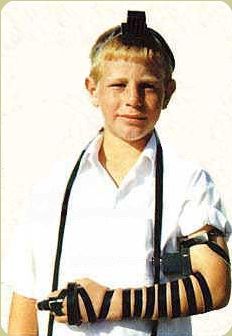
The U.S. Air flight from LaGuardia to Louisville was diverted after a man allegedly strapped on a "tefillin," a device mistaken as an "explosive device," CBS 3 reports. A tefillin has two small black boxes with straps. One box is placed on the head and the other is tied to the arm.

A law enforcement official says the man questioned is not a threat.

The plane was quarantined in Philadelphia after a number of firetrucks and police officers met them on the tarmac. [Because a man was praying.]

Passengers were all safely taken off the USAir flight, run by Chautequa Air.

The airport is reportedly staying open and flights are not affected.


In other words… the flight was diverted because the man, a Jew, was praying.

Are the flight crews of airlines so ignorant that they don’t know what tefillin are?   I find that hard to believe, especially on flights from New York.

TSA staff knew what they were, apparently.  And if TSA staff know…

You would think that airlines, in the present environment, would have some training for staff that might include recognizing religious differences.  I can see it now: conference room… powerpoint…. "This is a Jew….. this is a Sikh… this is a Catholic…", as the flight attendants stare open-mouthed.

Sometimes on airplanes I have said my breviary.  I have said a rosary.  Granted, those don’t involve strapping on tefillin and bowing repeatedly while praying.  Neither involve shouting allahu akbar and storming the cockpit. 

But is praying, in general, now to be held in suspicion on airplanes?

For those of you who don’t know what tefillin are, they are leather straps with small boxes which are bound around the arms and forehead.  They contain verses of Scripture.   Tefillin are the famous "phylacteries" which the Lord mentions in Matthew 23.  They are inspired by Deuteronomy 6, the famous Shema.

Perhaps the only proper behavior on a flight now is to go to sleep and hope you don’t wake up before you land.

"But Father! But Father!", some of you will object.  "Isn’t it better to be safe than sorry?  You should praise the flight staff for being careful in the face of something they didn’t understand! You might know about tefillin, but lots of people don’t.  They may have never heard of them, much less seen them."

We are talking here about a Jew, praying.  And flight crews need training.

There are dozens, nay rather, hundreds of more serious security problems and this is the sort of knuckle head stuff they are focused on.

Posted in SESSIUNCULA |
30 Comments

QUAERITUR: Pre-Conciliar Masses for the deaf

From a reader:

I have often wondered if there was any specially approved liturgy for profoundly/ severely  deaf people prior to the liturgical reforms of the ’60s? Surely, there must have been some adaptations of the Tridentine Mass to accomadate their needs? For instance, a Tridentine facing the people, or even it being said in sign langauge or something?


I have absolutely no idea.   We will need the help of others on this.

My first impulse is to say that there were no special provisions.

Posted in ASK FATHER Question Box |
27 Comments

A rescue from the rubble of the Cathedral of Port-au-Prince

A reader alerted me to this on the blog of Caritas.org.

A second woman was rescued by the Caritas team from the ruins of Port-au-Prince’s Cathedral.

Earlier, a Caritas organized Search and Rescue team has pulled a woman out from the rubble of Haiti’s quake. It took two hours to pull Enu Zizi from the rubble. She was in pain but ok.

Cancun Mexico Rescue Brigade and the South African Relief Team have been working with Caritas for the past week.

“The rescue of Zizi has been the best thing  in the team we have experienced. It is the first time we have saved somebody´s life after such a long time after the quake. The team has got an energy boost new and we are heading out to do more work as there is still hope,” said Ahmed Bham,leader of the South African Relief Team.

The identity of the second woman is not yet know. She was about 60 years old. Sadly, the team also found the body of the Vicar General Mons Charles Benoit. They found his body, with his hands around a reliquary with a wafer inside. [Hard to know what this meant.  It is either a reliquary with a relic in it, or it is a monstrance with a Host or a pyx with a lunette holding a Host.   You would think that a writer from a Catholic organization would want to get this one straight.  Or else… the person just didn’t know what it was?]

Mexican doctors with Caritas along with Cuban doctors are taking care of survivors at the Cathedral. People are arriving with serious wounds in advanced degrees of decomposition. The doctors have been carrying out amputations to save lives.

“The doctors, the Mexican and South African Search and Rescue teams, and the nuns who are working with Caritas deserve recognition for their bravery and generosity,” said Fr Antonio Sandoval, Regional Coordinator of Latin America, who is in Port-au-Prince. “The generosity continues and they show us how life can overcome death.”

Watch a slide show of the rescue.

The rescues have come as a huge morale boost for staff at Caritas as they work every hour in the day to meet the needs of the people in Haiti.

Solidarity and support from international members is flooding in. Caritas Congo, which works in one of the poorest countries in the world, sent $5000 for Haiti relief operations.

Posted in SESSIUNCULA | Tagged ,
6 Comments