Some things you couldn’t make up if you tried.
I am not making this up.
For Mary Daly: in memory of courage walking
by Joan Chittister on Jan. 13, 2010
I did not know Mary Daly personally. I never met her professionally. I never heard even one of her public speeches. My concern for women’s issues did not come from Daly. I got that from my mother.
My sense of Daly’s impact on history comes from every discussion of women’s issues in which I ever participated. The impact Daly’s ideas and courage was having on other women was palpable. [I believe certain maladies of the liver are also palpable.] In those living situations, [?] then, I learned a lot from Daly. Most of all, I learned how to look newly at things I’d looked at for so long that I was no longer really seeing any of them. [Boy oh boy, she sure did a number on you!]
Recently I heard a commentator remark on her role in the development of thought in our time that "when the theological history of the period is written, Mary Daly will, at most, be only a small footnote in the study." That depends, I would argue, on who is doing the history. Women, I think, will have a great deal more to say about Daly than any amount of footnotes can possibly hold. [Lemme guess… you are going to "share the story", right?]
Remote as my own associations had been, for instance, when the word of her death came I realized instantly that women in general, whether they knew it or not, had a great deal for which to thank her. [Okay, Joan, you are repeating yourself now. Get on with it.]
Women need to thank Daly for raising two of the most important theological questions of our time: one, whether the question of a male God was consistent with the teaching that God was pure spirit, and two, whether a church that is more patriarchal system than authentic church could possibly survive in its present form. These two questions have yet to be resolved and are yet rankling both thinkers and institutions. [Mainly because the answers people like this come up with are heresy.]
Women need to thank Daly for bearing the rejection that too often comes to those who say a new insight first and say it consistently and say it in the face of the very system in which they themselves have been raised. [More repetition.]
 For example, in later years, Daly refused to accept men in some of her classes, forcing men to experience the exclusion that women had endured for centuries. [Ohhhh…. I seeee…. is that what she was doing? Or… was she an androphobic zealot full of rage?] As a result, she lost her tenured position at a Catholic college for allegedly failing to offer equal service to all students, both men and women. [Allegedly? Let’s see… she actually did refuse to let men be in her course. Right?] But at the same time, no one else in Catholic colleges — or elsewhere — lost their jobs for excluding women from access to theology degrees or various medical specialties, among others, on the grounds that women, as women, were unfit for such programs. [Wait a minute. Where were women excluded from study of theology or medicine? I think everyone will acknowledge that it was hard for women in, say, med schools. But they were admitted. Am I wrong? Were there male only med schools? Yes, there were male only seminaries… which is reasonable. But that doesn’t mean there were no other theology programs out there.]
Nor did anyone — now that men had finally experienced what it felt like to be made invisible in the public arena [B as in B. S as in S. Daly hated men.] — officially apologize to women for having kept them out of schools, offices, work, leadership positions, discussions and decision-making in both church and state for two millennia. However much theology claimed we were all equal. [yawn]
Women need to thank Daly for modeling the adulthood, the psychological maturity, the strength it takes to accept the social isolation and loneliness that comes with refusing to agree that just because we have never questioned a thing that it is, therefore, unquestionable. Thanks to her relentless questioning of women’s social circumstances and theological exclusions everywhere, the woman’s question became a major and profound theological question. It is thanks to Daly and the myriad of women theologians [?] after her that "Because we say so" is no longer either a logical or an acceptable explanation for the exclusion of women anywhere.
Women need to thank Daly for exposing to us a whole new way of being alive. [Good heavens… make an end….] She freshened thought about the role and place of women by using language to show us what we could not see. [Put your coffee down before reading this part… and savor the irony…] She dug into history to trace the original meanings of words like hag and witch — once terms of reverence for the spiritual qualities and feminine wisdom of women, but now used to reduce them to the level of the malevolent.
She forced us to think newly, to think creatively. She called on women to Re-member themselves, [?] to put themselves together differently than they had been taught was right for a woman. She talked about Gyn/nocide [For the love of God, … ] to make us understand that the infamous centuries of witch burnings were really the genocide of women practiced long before this century’s Holocaust and under the guise of holiness. [How proud the editors of NCR must be of their weekly columnist.]
Indeed, Daly’s work is an icon to women. She was a groundbreaking thinker, a threat to any patriarchal institution, a creator of an entire new way of seeing life, of being alive, of celebrating life. She touched a culture deeply. Indeed, we owe her thanks. [How many times can she repeat herself?]
From where I stand, a person’s influence is measured, not so much by virtue of their effect on the institutions that bred them, but by their influence on those who never knew them at all. It is the women who never knew Daly but now know the things she knew that are the real evidence of her legacy, her impact, her meaning not only to this generation but to generations to come. [And here it is… ] As in "all generations shall call her blessed."
Sr. Joan Chittister just compare an apostate androphobic lesbian to the Mother of God.


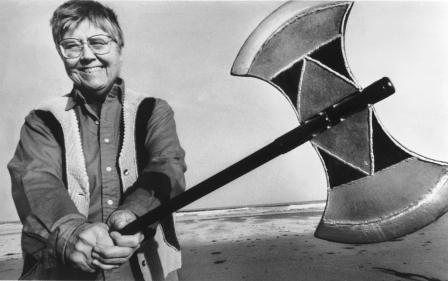 For example, in later years, Daly refused to accept men in some of her classes, forcing men to experience the exclusion that women had endured for centuries. [Ohhhh…. I seeee…. is that what she was doing? Or… was she an androphobic zealot full of rage?] As a result, she lost her tenured position at a Catholic college for allegedly failing to offer equal service to all students, both men and women. [Allegedly? Let’s see… she actually did refuse to let men be in her course. Right?] But at the same time, no one else in Catholic colleges — or elsewhere — lost their jobs for excluding women from access to theology degrees or various medical specialties, among others, on the grounds that women, as women, were unfit for such programs. [Wait a minute. Where were women excluded from study of theology or medicine? I think everyone will acknowledge that it was hard for women in, say, med schools. But they were admitted. Am I wrong? Were there male only med schools? Yes, there were male only seminaries… which is reasonable. But that doesn’t mean there were no other theology programs out there.]

 I have several e-mails right in my in-box this morning about a Coadjutor for Los Angeles.



 Fr. John Zuhlsdorf on Daily Rome Shot 1117 – A *POLL* about 2026-27: “Sorry… my bad. It is indeed SIX. 1. Rh8+! Kxh8 2. Qh2+ Kg8 3. Qh7+ Kf8 4. Qh8+ Ke7 5.…”




























