Your Sunday Sermon Notes – 13th Sunday after Pentecost (N.O.: 21st) 2023

Share the good stuff.

It’s the 13th Sunday after Pentecost in the Vetus Ordo and the 21st Sunday of the Novus Ordo.

Was there a GOOD point made in the sermon you heard at your Sunday Mass of obligation?

Tell about attendance especially for the Traditional Latin Mass. I hear that it is growing. Of COURSE.

Any local changes or (hopefully good) news?

I have some thoughts about the Sunday Epistle reading posted at One Peter Five.

A taste:

The part about “angels” needs explanation.  The promise given to Abraham was given directly to him by God, without an intermediary. The Law was given to the people indirectly through Moses. Indeed, the rabbis of Paul’s time thought that God was so overwhelming that the mediation of angels was necessary even in the giving of the Law. God gave it to angels who gave it to Moses. In Acts 7:53 we find: “you who have received the law that was given through angels but have not obeyed it.” In Hebrews 2:2: “since the message spoken through angels was binding, and every violation and disobedience received its just punishment”.


Posted in SESSIUNCULA | Tagged
2 Comments

Daily Rome Shot 775

Your use of my Amazon affiliate link is a major part of my income. It helps to pay for insurance, groceries, everything. Please remember me when shopping online. Thanks in advance.  US HERE – UK HERE

In Dusseldorf the World Rapid Team Championship 2023. Looking at the team rosters I opined that WR Chess was going to be hard to beat. In fact, that’s how it turned out. WR Chess is lead by my guy Wesley So and they were, after day 1, in 1st place. As I write, I haven’t caught up to today’s results. The World Rapid Team Championship – this is the first – features six nine-player teams each with blend of professional players, top women, and amateurs. The time control is 15 minutes per player, with a 10-second increment per move. The trend in chess is obviously going to faster and faster games. I don’t think that’s good for chess over all. However, people have shorter and shorter attention spans. And there’s money in watching the flash and fury of rapid and blitz.

There are five players from the world top-ten playing: Fabiano Caruana, Ian Nepomniachtchi, Anand, Rapport and Weslet So. The highest ranked woman is there, Hou Yifan. Prodigies are there, Gukesh, Pragg and Nodirbek.

WR Chess team is really powerful. Recent World Cup runner-up, Praggnanandhaa, is board five. Who else? Line up Ian Nepomniachtchi, Abdusattorov, Jan-Krzysztof Duda, Praggnanandhaa, and Vincent Keymer (who almost knocked Magnus out of the World Cup), with two women’s world champions, Hou and form champ Alexandra Kosteniuk.

Meanwhile,… white to move and mate in two. How long did it take you?

Use FATHERZ10 at checkout

NB: I’ll hold comments with solutions ’till the next day so there won’t be “spoilers” for others.

I’m really impressed with Chess House. They have a big “back to school” drive on. Usually you can get 10% with my link and code “FATHERZ10” but right now you can get 15% off with “B2S2023”. [UPDATE: US CHESS FEDERATION has a sale with 20% off for US Labor Day, code “LABOR”.  I don’t have an affiliate account with them, however, as I do with Chess House.]

I liked this blurb at Chess House:

A 5-year study of 7th and 8th graders showed test scores improved 173% for students regularly engaged in chess classes, compared with only 4.56% for children participating in other forms of “enrichment activities”

Not only have the reading and math skills of these children soared, their ability to socialize has increased substantially Educators at the Roberto Clemente School (C.I.S. 166) in New York report that chess has improved not only academic scores, but social performance as well. [Super important to consider after COVID and kids out of school.] In 1988, Joyce Brown, an assistant principal and supervisor of the school’s Special Education department, and teacher Florence Mirin began studying the effect of chess on their Special Education students. When the study began, they had 15 children enrolled in chess classes; two years later they had 398. “The effects have been remarkable,” Brown says. “Not only have the reading and math skills of these children soared, their ability to socialize has increased substantially, too. Our studies have shown that incidents of suspension. and outside altercations have decreased by at least 60% since these children became interested in chess.”

Here is a good option which is great for small spaces and is very portable. You can choose all sorts of color combos of board, pieces and bag. The Mini Marshall Chess Set and Bag Combo, on sale $46.

Just for fun, at least, go check out the color combos and let us know which combination you would choose? 

I do like that standard tourney green, but I also find the blue very pleasant.  I think blue with the black and natural pieces.   Otherwise, because of “Say The Black – Do The Red”, the black board with black and red could be fun.

Home altars and chess sets in every home, I say.

FATHERS!  PARISH CHESS CLUBS!

Posted in SESSIUNCULA |
3 Comments

We have a life we learn with, and a life we live with after

GO TO CONFESSION.

There is no sin so bad that you can commit that God can’t forgive, provided you ASK for forgiveness.

The way He wants you to do that is through the SACRAMENT he instituted precisely so that we would have the means of forgiveness and the certain knowledge of that forgiveness.

If we are complete and sincere, no doubts are necessary. Nothing you can do is so horrible that God cannot forgive it. Not ignore it. Not cover it over. TAKE IT AWAY. GONE. We may have memories. We may have, probably will have, additional penance, maybe restitution to do. But the sin… the stain… the guilt… GONE.

And the Sacrament of Penance strengthens you against future temptations. Oh yeah.. state of grace. You can receive Communion again, and not sacrilegiously, which is an additional sin.

While there is breath in our bodies, there is hope.

How hard can it be? Real hard.  Sometimes we screw up, even for long periods of time.  Keep breathing.  Make the turn.  Grace is ready for you.  You can do it.  Brick by brick rebuild.

GO TO CONFESSION!

Posted in GO TO CONFESSION |
5 Comments

WDTPRS – 21st Sunday of Ordinary Time: Vicissitudes and confusion, fog of the world, smoke of Satan, coming precisely whence there ought to be coming clarity.

Let’s have a look in advance of the Collect for Sunday in the Novus Ordo, which I assume most of you attend (perforce or not).

COLLECT – (2002MR):
Deus, qui fidelium mentes unius efficis voluntatis,
da populis tuis id amare quod praecipis,
id desiderare quod promittis,
ut, inter mundanas varietates,
ibi nostra fixa sint corda, ubi vera sunt gaudia
.

A master crafted this.

This same Collect is used for the Monday of the Fifth week of Easter and also in the 1962MR on the Fourth Sunday after Easter.  Therefore we have seen this prayer before. In the ancient Gelasian Sacramentary you find it on the Third Sunday after the close of Easter.  All those long eeee sounds produced by the Latin letter i are marvelous. Note the nice parallels: id amare quod praecipis, id desiderare quod promittis as well as ibi…sint corda and ubi…sunt gaudia.  In the first line the genitives unius…voluntatis are elegantly split by the verb efficis.  A master made this prayer.

The pages of our opportunely situated Lewis & Short Dictionary divulge that varietas means “difference, diversity, variety.”  It is commonly used to indicate “changeableness, fickleness, inconstancy.”  I like “vicissitude.”  The adjective mundanus, a, um, “of or belonging to the world”, must be teased out in a paraphrase.  Efficio (formed from facio) means, “to make out, work out; hence, to bring to pass, to effect, execute, complete, accomplish, make, form”.   Voluntas means basically “will” but it can also mean things like “freewill, wish, choice, desire, inclination” and even “disposition towards a thing or person”.

LITERAL TRANSLATION:
O God, You who make the minds of the faithful to be of one will,
grant unto Your people to love that thing which You command,
to desire that which You promise,
so that, amidst the vicissitudes of this world,
our hearts may there be fixed where true joys are
.

There are more things to say about the construction of the oration.  For example, look at these parallels.

Deus, qui fidelium mentes unius efficis voluntatis, da populis tuis
id amare quod praecipis,
id desiderare quod promittis,
ut, inter mundanas varietates,
ibi nostra fixa sint corda,
ubi vera sunt gaudia.

Deus, qui fidelium mentes unius efficis voluntatis, da populis tuis
id amare quod praecipis,
id desiderare quod promittis,
ut, inter mundanas varietates,
ibi nostra fixa sint corda,
ubi vera sunt gaudia.

Wonderful.

Let us revisit that id…quod construction. We could simply say “love that which you command,” or “love what you command”, but to me that seems vague and generic.  Of course, we must love everything God commands, but the feeling I get from that id…quod is closer to what the Anglican version expresses: “love the thing which you command… desire the thing which you promise.”  This seems more concrete.   We love and desire God’s will in the concrete situation, this concrete task.  A challenge of living as a good Christian in “the world” is to love God in the details of life, especially when those details little to our liking.  We must love him in this beggar, this annoying creep, not in beggars or creeps in general.  We must love him in this act of fasting, not in fasting in general.  This basket of laundry, this paperwork, this ICEL translation…. Hmmm…, didn’t I say it was a challenge?  God’s will must not be reduced to something abstract, as if it is merely a “heavenly” or “ideal” reality. “Thy will (voluntas) be done on earth as it is in heaven.”

The Association For English Worship in 1985 put out an examination of the Prayers of the Roman Missal comparing two different English versions, ICEL and their own.  Here is the AEW version of the Collect: “O God, by whom alone the faithful are made one in mind and heart, grant us to love what you command and to long for what you promise, that so, amid the changes and chances of this mortal life, our hearts may surely there be fixed where true joys are to be found.”  In the Anglican Church’s Book of Common Prayer of 1662 they hear on the Fifth Sunday in Lent: “O almighty God, who alone canst order the unruly wills and affections of sinful men: Grant unto thy people, that they may love the thing which thou commandest, and desire that which thou dost promise, that so, among the sundry and manifold changes of the world, our hearts may surely there be fixed, where true joys are to be found.”  You have to love that!

By contrast with what we usually hear now.

Benedict XVI spoke eloquently and more than once about the threats we in the Church face from religious/secular relativism, the reduction of the supernatural to the natural, caving in to “the world”.  “The world” has its Prince who still dominates it until Christ the King comes again.

St. Paul wrote to the Romans: “Do not be conformed to this world but be transformed by the renewal of your mind, that you may prove what is the will of God, what is good and acceptable and perfect” (12:2 – RSV).

Christ put His Apostles on guard about “the world”: “The world cannot hate you, but it hates me because I testify of it that its works are evil” (John 7:7).

When what “the world” has to give is given preeminence over what God has to give through His Church, we have the crisis Pope Paul VI described on the ninth anniversary of his coronation (29 June 1972):

“Da qualche fessura sia entrato il fumo di Satana nel tempio di Dio…

Through some crack the smoke of Satan has entered into the temple of God”.

Vicissitudes abound right now.  Vicissitudes and confusion, fog of the world, smoke of Satan, coming precisely whence there ought to be coming clarity.

Crux stat dum volvitur mundus, is I think, the motto of the Carthusians.  While the world is spinning the Cross stands still.  The Cross is the center.  It is the center of the universe in several ways, given that its geographical placement was probably the Garden, which was later Mt. Moriah, which was latter Jerusalem.   More on this, well expressed by Fr. Mawdsley.  What he offers isn’t original but it is very well written. Crucifixion to Creation: Roots of the Traditional Mass Traced back to Paradise – US HERE – UK HERE  I warmly recommend this.

The Cross must be our firm point in our lives right now, especially as we see major elements of the Church spinning out of control.   We can get through this, but we will do so by clinging to the Cross and the crosses we receive for our “full, conscious and active” participation in the Passion Holy Church is about to undergo.
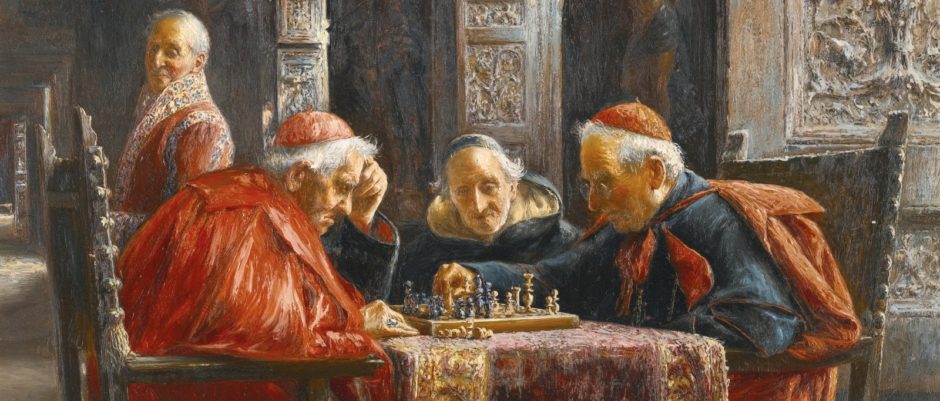
Posted in WDTPRS |
1 Comment

Daily Rome Shot 774


Meanwhile, in Dusseldorf there begins today the TEAM World Rapid Championship.  The teams include 6-9 members and must include a woman and an “amateur” who has at least a 2000 ELO (rating).  The winning team will get Euro 100K and the total prize purse is E 250K.   Big names there, young and seasoned.  Some team names: Helibronn Hustlers… Team MGD1 is back… another Indian team Six-pack. The Pensioners have Peter Svidler, Vladimir Kramnik and Dominguez Perez Leinier… strong.  Neustadt  Weinstraße! The FIDE Managrment Board has Nigel Short! The Prez of FIDE is playing!  My guy Wesley So is with WR Chess, … superpowers on this one Nodirbek Abdusattorov, Ian Nepomniachtchi, Jan-Krzysztof Duda, R Praggnanandhaa, Vincent Keymer, Hou Yifan, Alexandra Kosteniuk, and the amateur Wadim Rosenstein. If they don’t win the whole thing… well. Kompetenzakademie Allstars have Caruana, Levon Aronian, Gukesh, Keti Tsatsalashvili. Crazy. Three days of rapid. 15/10.

Meanwhile, my interest in things space and things chess come together in the news about India’s moon mission. As you might have heard, in the recent World Cup, the young Indians, Arjun, Gukesh and Pragg did amazing things. Young Gukesh and “old” Vishi are both in the world top 10. I suspect that, within a few years, there will be another Indian World Champ, especially of Magnus stays out.

Moving on, India has a young space program, too. They have a Moon mission underway, Chandrayaan-3 Mission soft-landing a rover, Vikram, on the surface near the southern pole. The Rover rolled out on 23 August.

However, we might have to take the positive news with a portion of green cheese.

Instead of a puzzle here’s a shot of OTB as I write.

Black to move on the close board. Yeah I know the board is backwards.

Posted in SESSIUNCULA |
Comments Off on Daily Rome Shot 774

Daily Rome Shot 773

Meanwhile, white to move and mate in 2.  win.  [Sorry, I mislabeled it or got the wrong puzzle or something.]

NB: I’ll hold comments with solutions ’till the next day so there won’t be “spoilers” for others.

Your use of my Amazon affiliate link is a major part of my income. It helps to pay for insurance, groceries, everything. Please remember me when shopping online. Thanks in advance.  US HERE – UK HERE

Posted in SESSIUNCULA |
4 Comments

ASK FATHER: What if an aardvark runs by and the priest goofs up the LATIN while baptizing?

From a reader…

QUAERITUR:

I’m going to entirely recast this question in my own words because I need to address the answer to priests, rather than to the laymen who sent the original query.

It seems that a priest recently baptized using Latin for the form.

Nothing wrong with that!   As a matter of fact, I often recommend the use of Latin so that people don’t have to wonder about the validity of translations, etc.

HOWEVER… FATHERS… If you are going to use Latin, GET IT RIGHT.

Fathers, you may have noticed that in Latin, the endings of words change, depending on their function in the sentence.  If you change those endings you change the meaning into a) something else that can be understood, b) something wrong but whose meaning we can guess at fairly confidently c) something incoherent which makes you look dumb as we stare at you without comprehension about what you were trying to say.

In the case brought to me, a priest goofed up on the endings of a couple of the names of the Trinity in form of baptism.

Serious?  YOU BET!

Did that invalidate the baptism?  Probably not, at least in this case.

Being an Unreconstructed Ossified Manualist I checked the manual by Prümmer about invalid forms (Tract II, Art II “De forma baptismi“).  I found something that put me at ease about the case presented to me.

According to Prümmer what is essential in the form is that there must be expressed the act of baptizing made by the minister (taken care of with the word(s) “(ego) … baptizo“), the subject of the baptism whom he intends to baptize (“you… te“), the unity of the divine nature (expressed in the phrase “in the name… in nomine“), and the distinction of the three persons of the Most Holy Trinity (“(of the) Father (and of the) Son (and of the) Holy Spirit… Patris (et) Filii (et) Spiritus Sancti).

If over in the Diocese of Black Duck at the SSPX Chapel St. Joseph Terror of Demons, Fr. Rocco Firm were perhaps to be momentarily distracted by, say, an aardvark running across the floor during the pronunciation of the baptismal form, prompting Father in his astonishment at the aardvarkial epiphany to say, “in nomine Patris et [ENTER AARDVARK] FiliO et Spiritus SanctOOO!” [EXIT AARDVARK] instead of “Patris et Filii et Spiritus Sancti”, nevertheless the form of baptism would be VALID.  He would have expressed his intent to baptize the person present in the name of the TRIUNE God.*

Fathers… make a review of the forms of the sacraments you administer, in whatever languages you may need to use.  REVIEW.  MEMORIZE and REVIEW.

GET IT RIGHT.  There’s NO EXCUSE.

*It is likely that Fr. Firm would, ad cautelam, repeat the form prefaced by “Si non es baptizatus (-a), ego te baptizo…” etc.  Of the things that could warrant such a repetition, I imagine an aardvark would be at the top of the list.

Posted in "How To..." - Practical Notes, ASK FATHER Question Box, Liturgy Science Theatre 3000, Mail from priests |
8 Comments

Daily Rome Shot 772

Meanwhile, BLACK to move and win.

NB: I’ll hold comments with solutions ’till the next day so there won’t be “spoilers” for others.

Interested in learning?  Try THIS.

Your use of my Amazon affiliate link is a major part of my income. It helps to pay for insurance, groceries, everything. Please remember me when shopping online. Thanks in advance.  US HERE – UK HERE

World Cup… Magnus.

Posted in SESSIUNCULA | Tagged
12 Comments

Bp. Strickland’s Pastoral Letter concerning the Synod (“walking together”) about Synodality (“walking together-ity”).

Bishop Joseph Strickland of Tyler has issued a pastoral letter to the faithful of the diocese entrusted to his care. It is about the Synod (“walking together”) about Synodality (“walking together-ity”).

The full text is at LifeSite:

[…]

I urge you, my sons and daughters in Christ, that now is the time to make sure you stand firmly upon the Catholic faith of the ages. We were all created to seek the Way, the Truth and the Life, and in this modern age of confusion, the true path is the one that is illuminated by the light of Jesus Christ, for Truth has a face and indeed it is His face. Be assured that He will not abandon His Bride.

[…]

Posted in SESSIUNCULA | Tagged , ,
10 Comments

24 Aug – St Bartholomew (Nathanael), Apostle – and a menu suggestion

I post this a day in advance in case you might want to do some shopping for tomorrow.

I have an affection for tomorrow’s (24 Aug) saint not only for the way in which he died (a way of being treated familiar to many priests of more traditional leaning) but also because my first ecclesiastical office was as rector of a small 700 year old church in Italy named for Sts. Peter and Bartholomew. Why it was named for that pair of saints is lost in time, I fear.

Here is the Roman Martyrology entry for today’s saint, the Apostle Bartholomew:

Festum sancti Bartholomaei, Apostoli, qui idem ac Nathanael plerumque creditus, Canae Galilaeae ortus, apud Iordanem a Philippo ad Christum Iesum ductus est; postea Dominus ad se sequendum eum vocavit et Duodecim aggregavit; post Ascensionem Domini Evangelium in India ipse praedicasse traditur ibique martyrio coronatus esse.

The feast of Saint Bartholomew, Apostle, who is commonly believed to the same person as Nathaniel, sprung from Cana in Galilee, he was led by Philip to Christ Jesus at the Jordan; later the Lord called him to follow Him and we was reckoned among the Apostles; after the Ascension of the Lord it is traditionally held that he preached the Gospel in India and there was crowned with martyrdom.

St. Bartholomew is also known as Nathanael.   One of the things that the Martyrology does not include is that Bart/Nate was the first person recorded to confess faith in Jesus as the Son of God.  Find verses about him at Matthew 10:3; Mark 3:18; Luke 6:14; John 1:45-49, 21:2; and Acts 1:13.

St. Bartholomew is depicted in art either being flayed (his skin being peeled off his body while still alive) or holding a knife and sometimes his own skin. In the Sistine Chapel in Michelangelo’s Last Judgement you see the artist’s self-portrait in the face part of the skin which the Apostle is holding.

St. Augustine speaks about today’s Gospel reading which concerns Bartholomew and the meaning of the fig tree under which the future Apostle was sitting.

This passage might be a good point of reflection for somewhat loftier ecclesiastics.

It also returns us to our often encountered theme of Christ as Physician of the soul.

This is from Augustine’s Tractate on the Gospel of John 7 (on John 1:34-51 – emphases and comments mine, but not the translation).

20. Jesus then saw this man [Nathaniel = Bartholomew?] in whom was no guile, and said, “Behold an Israelite indeed, in whom is no guile.” Nathanael saith unto Him, “Whence knowest Thou me?” Jesus answered and said, “Before that Philip called thee, when thou wast under the fig (that is, under the fig-tree), ….

21. We must inquire whether this fig-tree signifies anything. Listen, my brethren. We find the fig-tree cursed because it had leaves only, and not fruit. In the beginning of the human race, when Adam and Eve had sinned, they made themselves girdles of fig leaves. Fig leaves then signify sins. Nathanael then was under the fig-tree, as it were under the shadow of death. The Lord saw him, he concerning whom it was said, “They that sat under the shadow of death, unto them hath light arisen.” What then was said to Nathanael? Thou sayest to me, O Nathanael, “Whence knowest thou me?” Even now thou speakest to me, because Philip called thee. He whom an apostle had already called, He perceived to belong to His Church. O thou Church, O thou Israel, in whom is no guile! if thou art the people, Israel, in whom is no guile, thou hast even now known Christ by His apostles, as Nathanael knew Christ by Philip. But His compassion beheld thee before thou knewest Him, when thou wert lying under sin. For did we first seek Christ, and not He seek us? Did we come sick to the Physician, and not the Physician to the sick? Was not that sheep lost, and did not the shepherd, leaving the ninety and nine in the wilderness, seek and find it, and joyfully carry it back on his shoulders? Was not that piece of money lost, and the woman lighted the lamp, and searched in the whole house until she found it? And when she had found it, “Rejoice with me,” she said to her neighbors, “for I have found the piece of money which I lost.” In like manner were we lost as the sheep, lost as the piece of money; and our Shepherd found the sheep, but sought the sheep; the woman found the piece of money, but sought the piece of money. What is the woman? The flesh of Christ. What is the lamp? “I have prepared a lamp for my Christ.” Therefore were we sought that we might be found; having been found, we speak. Let us not be proud, for before we were found we were lost, if we had not been sought. Let them then not say to us whom we love, and whom we desire to gain to the peace of the Catholic Church, “What do you wish with us? Why seek you us if we are sinners?” We seek you for this reason that you perish not: we seek you because we were sought; we wish to find you because we have been found.

[I wonder what Augustine would have thought about the public embarrassment and timidity of some Catholics today?]

22. When, then, Nathanael had said “Whence knowest Thou me?” the Lord said to him, “Before that Philip called thee, when thou wast under the fig-tree, I saw thee.” O thou Israel without guile, whosoever thou art O people living by faith, before I called thee by my apostles, when thou wast under the shadow of death, and thou sawest not me, I saw thee. The Lord then says to him, “Because I said unto thee, I saw thee under the fig-tree, thou believest: thou shalt see a greater thing than these.” What is this, thou shalt see a greater thing than these? And He saith unto him, “Verily, verily, I say unto you, ye shall see heaven open, and angels ascending and descending upon the Son of man.” Brethren, this is something greater than “under the fig-tree I saw thee.” For it is more that the Lord justified us when called than that He saw us lying under the shadow of death. For what profit would it have been to us if we had remained where He saw us? Should we not be lying there? What is this greater thing? When have we seen angels ascending and descending upon the Son of man?


I can’t think of a better way to honor the saint than eating ficchi e prosciutto that is, figs with prosciutto, both for the image from the Gospel and also for the thinly sliced strips of raw meat, which is more than appropriate today, and wondrous to taste I must say.

Given that it is Friday, perhaps you can do this tomorrow.  I don’t think the saint would mind.

Here is the Church in Rome where the body of the Apostle is found.  San Bartolomeo is on the island in the Tiber River.

Posted in Saints: Stories & Symbols | Tagged ,
1 Comment






















