Working on the road to NYC

Working on the road requires light gizmos! I can usually work from my phone. Now I am trying an old netbook someone recently gave me loaded with Ubuntu… which I still don’t really know how to use.

Working on the road to NYC

UPDATE:

And after a hideous flight, into NYC.

Working on the road to NYC

Let’s hope all goes well for the ride into Manhattan at this time or day and after the snow.

Posted in SESSIUNCULA |
7 Comments

WDTPRS – 22 December COLLECT (2002MR)

We are closing in on our goal.   Let’s look at the Collect for 22 December in the 2002MR.  The Roman Station today is the Basilica of the Twelve Apostles.

COLLECT:
Deus, qui, hominem delapsum in mortem conspiciens,
Unigeniti tui adventu redimere voluisti,
praesta, quaesumus,
ut, qui humili eius incarnationem devotione fatentur,
ipsius etiam Redemptoris consortia mereantur.

Consortium is a compound of the preposition cvm and sors, which has to do with "lot", as in casting "lots" for determining something by chance. Thus it comes to mean "community of goods" and therefore "fellowship, participation, society", according to the mighty Lewis & Short. If we look in Blaise/Dumas we find plural consortia having a meaning of "union" almost as if it were conjugal union.

LITERAL VERSION:
O God, who, gazing upon man fallen into death,
desired to redeem him by the Coming of Your Only Begotten,
grant, we beseech You,
that, those who profess His incarnation in humble devotion,
may merit participation in Him also as Redeemer.

Once again we are seeing the "janus"-like backward/forward perspectives, looking back to the First Coming even as we look forward to the Second.

We look, simultaneously, back to the Fall and the First Adam, and forward to the summation of the cosmos by the Second Adam.

There is a development of thought from the fall, to death, to the Nativity, through humility and solidarity, to ultimate redemption.

The Lord came into the world at the fullness of time.  We often associate Christmas with stillness.  In these days before Christmas, it almost feels as if the Church, even as there is a sense of acceleration in the Coming, Christ to us, us toward Christ, there is at the same time a – how to put it – slowing of the pendulum.  It is like a perfect and mysterious anti-entropy, which is perfect stillness and yet is not static.

There is a balance point in the fullness of time.

There was a before for His Coming and there is the after. 

In that moment of His birth, all is still.

At the perfect point of stillness is His Mother. 

Closest to the point is Joseph.

The angels and humble shepherds draw close, and all the nations represented by the Magi… nearer and nearer, they will come until they are still, close to God With Us.

Where are you?

The Church’s year acknowledges the stillness with an Octave, when liturgical time stops, the pendulum will not swing as we rest in the mystery which embraces past, present and future.

Posted in SESSIUNCULA |
10 Comments

Michael O’Brien on “Twilight”: modern man’s futile flight from conscience

From a reader:

I think Michael O’Brien’s new piece (12/19/09) on "Twilight" and its popularity is a much better analysis than the one written by Sophie Caldecott.  I have both read and written a lot on Twilight and O’Brien’s piece is the most thought provoking, and, I fear, accurate analysis I have read yet. 

Here is an interesting segment from O’Brien’s article:

"E. Michael Jones has written that at the root of the phenomenal rise of horror culture [I would add dystopia especially in movies.] is suppressed conscience.

Michael O'Brien on "Twilight": modern man's futile flight from conscienceTracing the pattern from Mary Shelley’s novel Frankenstein (first published in 1818) through to Ridley Scott’s film Alien (1979) [The only that made me crawl the back of my chair.] and its sequels, Jones argues that the denial of moral law produces metaphorical monsters that arise from the subconscious of creative people and spread into society through their cultural works. The monster in the Alien films, for example, is a ghastly abomination of the feminine, and salvation is possible only through expulsion of the offspring it implants and incubates in humans—a subconscious eruption of internal conflicts (and guilt) over abortion. [!]

As Jones points out:

By following our illicit desires to their logical endpoint in death, [cf. John  Paul II’s discussion of a "culture of death".] we have created a nightmare culture, a horror-movie culture, one in which we are led back again and again to the source of our mysterious fears by forces over which we have no control.

Even though modern man denies the authority of moral conscience, he cannot escape it. He is created in the image and likeness of God, and deep within the natural law of his being the truth continues to speak to him, even as he adamantly denies the existence of God (in the case of atheists) or minimizes divine authority (in the case of nominally religious people, the practical atheists). In order to live with the inner fragmentation, which is the inevitable effect of violated conscience, he is driven to relieve his pain through three diverse ways:

a)     He makes open war against conscience and all its moral restraints, and pursues with radical willfulness an aggressive consumption of sensual rewards—generally a plunge into various kinds of addictions and a life of sexual promiscuity;

b)    More passively, he simply ignores the inner voice of conscience and distracts himself from it by sensual and emotional rewards—generally the search for love without responsibility and a restless striving for worldly success;

c)     He tries to rationalize a self-made form of conscience for himself, based in values such as “tolerance” and “non-dogmatism.” Generally this produces a new kind of perverse moralism, a self-righteousness which is, paradoxically, quite intolerant of genuine righteousness. Its anti-dogmatism is its dogma. Here there is no absolute rejection of morality, but rather a rewriting of it according to subjective feelings.

None of the foregoing coping mechanisms need be conscious. Indeed they tend to be largely subconscious processes through which a person feels that he is finding his personal identity, is living out the principle of freedom, discovering his path in life, and getting from it a portion of happiness. Though he is afflicted from time to time by a sense of the inner void, he presumes that the remedy for these dark moments will be found by increasing the dose of the very drug that is killing him.

The Twilight series, it would appear, follows the third coping mechanism mentioned above in c), the one which appeals to the broadest possible audience."

Grist for the mill.

Posted in The Drill | Tagged , ,
26 Comments

Dust up in Japan over new translation

In the UK’s weekly liberal fishwrap The Tablet (aka The Pill aka RU486) there is a note about a tussle over the new translation in Japan.

JAPAN

JAPAN’S BISHOPS have clashed with the Vatican in an effort to keep their version of the Mass culturally sensitive, writes William Grimm. The bishops are working on a re-translation of the liturgy in accordance with the 2001 instruction Liturgiam Authenticam, which mandates a more literal translation of the Latin text of the Mass into the vernacular. They are awaiting a response to a request to the Vatican’s Congregation for Divine Worship (CDW) that a new translation of the Mass not use the word “spirit” in the response to the greeting, “The Lord be with you.” The bishops want to use a Japanese equivalent of “And also with you”, as is presently the case in English translations (although the version due for introduction in 2011 returns to “and with your spirit”). The Japanese language does not have an equivalent to the Latin spiritus. The English word “spirit” is usually translated into a Japanese word for “ghost” used by groups that dabble in the occult. Bishop Masahiro Umemura of Yokohama, chairman of the bishops’ liturgy commission, said that in 2006 he warned the then-prefect of the CDW, Cardinal Francis Arinze, that non-Christians attending church weddings and funerals could conclude that Catholicism is a sort of cult.

In other news, the same issue has a story entitled… and I apologize in advance for the use of this haaard word:

Born with ineffable love


Hmmm… the appearance of this word in that weekly perhaps undermines the contention of a certain crowd that the new translation is tooo haaard.

Posted in WDTPRS | Tagged ,
67 Comments

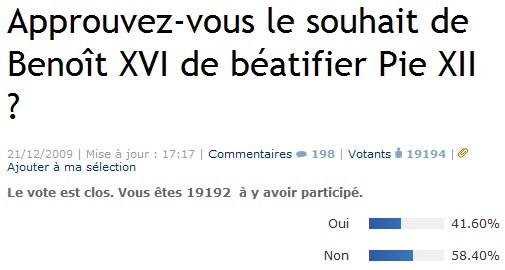
POLL ALERT: Le Figaro on Ven. Pius XII … AUX ARMES!

Aux armes, citoyens!

In another entry I asked you readers to keep your eyes peeled for online POLLS about the decision of Pope Benedict XVI to promulgate the decree regarding the heroic virtues of Ven. Pius XII.

A reader alerted us to a poll in the large national French daily Le Figaro.  Alas, the good guys are not doing so well. 

I voted "OUI". 

Go HERE to vote!

There are quite a few votes, 18K+, so I hope other bloggers will take up the gauntlet.

POLL ALERT: Le Figaro on Ven. Pius XII ... AUX ARMES!

UPDATE 1638 GMT:

Is anyone else getting a message that the voting is closed?  "Le vote est clos."

If so, I was the ante-penultimate vote.

POLL ALERT: Le Figaro on Ven. Pius XII ... AUX ARMES!

Posted in POLLS | Tagged ,
15 Comments

QUAERITUR: priest says not to lift the chasuble during TLM

From a reader:

Our TLM priest has asked the altar servers not to lift his chasuble during the elevations. Says it distracts him.
Anyway, I was wondering if the chasuble lifting is just a tradition or if it is such a tradition that it has become a ‘norm’ so to speak.

I don’t recall that this lifting of the chasuble is – for servers – an actual norm.  In the Ritus servandus in the 1962 Missale Romanum we are told that during a Solemn Mass the deacon is the lift the edge of the chasuble ("fimbrias planetae elevat").  Therefore, I assume that all others do this in imitation of the deacon at the solemn Mass.  That said, this is certainly a long-enduring custom, and a good one.

If this is really a problem for the priest, then it would be okay at a low Mass not to do it.   But… but… why should this be a big problem for the priest? 

Unless the server is yanking on the chasuble backward, I cannot fathom why this should be a problem.  If the server is being to intrusive in the way he handles the chasuble, then the server’s action should be corrected, not forbidden.

Thus, I would say in this case, it really should be done, from custom, and in imitation of the deacon, and from the expectations of the people, and from the desire of the servers (especially when young) to be able to do cool things.   I would say to the servers to be careful with the chasuble.  There is an old adage that "less is more".  Just raise the edge a little.  You don’t have to yank it backwards or raise it above your head.  A couple inches should suffice.

To the priest I would suggest "offer it up" if it bothers you.   This isn’t about you, after all.  Let the young men do what is expected and just deal with it.  In the meantime, be sure you train them to lift the chasuble in a way that is neither abrupt nor asphyxiating.

Posted in "How To..." - Practical Notes, ASK FATHER Question Box | Tagged
35 Comments

How wouldst thou vote in our “Thou v. You” poll?

Maybe we could have a petition…. "What if we just said ‘Thee’?" …  How wouldst thou vote?

n

{democracy:38}


Posted in SESSIUNCULA |
49 Comments

Avenging elephants in India didn’t forget

The great pastor of Blackfen, His Hermeneuticalness, has an interesting post:

Last July, as you may remember, Christians in the Indian state of Orissa were subjected to severe persecution. A 22 year old nun was burnt to death, an orphanage in Khuntpali village was burnt down by a mob, another nun was gang raped in Kandhamal, mobs attacked churches, torched vehicles, and destroyed the houses of Christians. Fr Thomas Chellen, director of the pastoral centre that was destroyed with a bomb, had a narrow escape after a Hindu mob nearly set him on fire. All together, more than 500 Christians were murdered, and thousands of others were injured.

In an extraordinary development, a herd of elephants has travelled some 300Km to attack villages that were the worst persecutors of the Christians, leaving Christian homes untouched. See: Elephants attack in Orissa exactly one year after persecutions [From the website of the Archdiocese of Colombo, where Archbp. Ranjith is now.  Some great detail in that article.]


Elephants never forget.

I wonder if they are available for a gig at Capitol Hill….

Posted in Just Too Cool, SESSIUNCULA | Tagged ,
35 Comments

Sen. Nelson sold himself

Sen. Nelson (D-NE) gets from Pres. Obama and Sen. Reid (D-NV) federal money for Medicaid … for Nebraska… pretty much forever?

Sen. Nelson is apparently okay with other states paying for Nebraska’s free ride.

Sen. Nelson must be okay with letting states opt out of receiving federal money for abortion. 

Sen. Nelson must therefore okay with tax payers everywhere paying for abortions somewhere.

Sen. Nelson sold himself.  

There is a another term for that, but let’s just say it that way.

I bet Sen. Nelson will run for reelection claiming that he is pro-life. 

Sen. Nelson has accepted a compromise that the USCCB should not willing to accept. 

It looks like the Hyde Amendment is irrelevant.

Did you notice that the conscience protection has been removed?

What will the USCCB do now?

Will they issue a statement that the Conference opposes the bill?

If they don’t, then the American bishop will have been rolled.

This seems to be the beginning of federally funded abortion in the USA.

Posted in Emanations from Penumbras, SESSIUNCULA | Tagged , , ,
66 Comments

WDTPRS: 4th Sunday of Advent – COLLECT (2002MR) – POLL!

WDTPRS: 4th Sunday of Advent - COLLECT (2002MR) - POLL!The Collect for this Sunday is the Post-communion of the Feast of the Annunciation (25 March) in the 1962MR. Most of you who recite the Angelus know this prayer. 

This time we also get the WDTPRS version since we want to know what the prayer really says. This is also the prayer said traditionally after the Alma Redemptoris Mater, sung following Compline during Advent.

COLLECT – LATIN TEXT (2002MR):

Gratiam tuam, quaesumus Domine,
mentibus nostris infunde,
ut qui, Angelo nuntiante,
Christi Filii tui incarnationem cognovimus,
per passionem eius et crucem
ad resurrectionis gloriam perducamur.

The last part, per passionem eius et crucem ad resurrectionis gloriam perducamur has a wonderful flow to it with its alliteration and snappy cadence, followed as it is by the rhythmically gear changing conclusion, Per Dominum nostrum Iesum Christum…. Collects are often little masterpieces. They deserve great care in rendering them into a liturgically smooth, yet accurate version. In WDTPRS we are purposely being rather “slavish” in translating so you can see the raw text. Imagine how hard it is to work up good liturgical versions.

We never have to brush dust from our frequently exploited Lewis & Short Latin Dictionary. Therein we find that cognosco is, generally, “to become thoroughly acquainted with (by the senses or mentally), to learn by inquiring…”, but in the perfect tenses (cognovimus) it is “to know” in all periods of Latin. The verb infundo basically is “to pour in, upon, or into” but in the construction (which we see today – infundere alicui aliquid) “to pour out for, to administer to, present to, lay before”. Simply, it can mean, “communicate, impart”. The verb perduco “to lead or bring through”, is “guide a person or thing to a certain goal, to a certain period”. Interestingly, both infundo and perduco can have the overtone of to anoint, or smear with something.

ICEL (1973 translation of the 1970MR):
Lord,
fill our hearts with your love,
and as you revealed to us by an angel
the coming of your Son as man,
so lead us through his suffering and death
to the glory of his resurrection
for he lives and reigns…

A TRADITIONAL VERSION:
Pour forth, we beseech Thee, O Lord, Thy grace into our hearts, that we, to whom the incarnation of Christ, Thy Son, was made known by the message of an angel, may by His Passion and Cross be brought to the glory of His resurrection, (through the same Christ our Lord).

Some people think that “Thee” and “Thou” are formal. Au contraire! These are familiar forms of pronouns for the second person singular used by a superior to an underling or between equals or friends. The “you” form (derived from “ye”) is the more formal! In traditional prayers (Our Father, who art in heaven, hallowed by Thy name…) we address God with a familiar, intimate form not so common today unless you are Amish or Quaker. You will raise an eyebrow or two at the bowling alley if you shift to “thou”: “Since it’s the tenth frame and thou hadst a strike, thrice canst thou bowl. Take up thy ball and bowl, already, ‘cause I gotta go home.”

Well… that last phrase shows some ICEL influence, but I think you get my drift.

I know the new translation is coming, and that it marks a huge improvement over the lame-duck massacre we are using now, but I often wish we could have had a version with all the "thees and thous".  A more archaic, stylized prayer could have cut across differences between, say, the English of Africa, Australia, and Asia. They say Americans and British are two peoples separated by a common language. But not when we read Shakespeare or we say the traditional Our Father!  The CDWDS document for the norms of translation, Liturgiam authenticam, says that the language of liturgy should be distinct from daily speech:

27. Even if expressions should be avoided which hinder comprehension because of their excessively unusual or awkward nature, the liturgical texts should be considered as the voice of the Church at prayer, rather than of only particular congregations or individuals; thus, they should be free of an overly servile adherence to prevailing modes of expression. If indeed, in the liturgical texts, words or expressions are sometimes employed which differ somewhat from usual and everyday speech, it is often enough by virtue of this very fact that the texts become truly memorable and capable of expressing heavenly realities. Indeed, it will be seen that the observance of the principles set forth in this Instruction will contribute to the gradual development, in each vernacular, of a sacred style that will come to be recognized as proper to liturgical language. Thus it may happen that a certain manner of speech which has come to be considered somewhat obsolete in daily usage may continue to be maintained in the liturgical context.

Anyway, it couldn’t have hurt.  But that is not going to happen… unless…. unless…

Maybe we could have a petition…. "What if we just said ‘Thee’?" …  How wouldst thou vote?

n

{democracy:38}


LITERAL TRANSLATION:
We beg You, O Lord,
pour Your grace into our minds and hearts,
so that we who came to know the incarnation of Christ Your Son
in the moment the Angel was heralding the news,
may be guided through His Passion and Cross
to the glory of the resurrection.

Angelo nuntiante is an ablative absolute, hard to render in English without using a paraphrase. The participle nuntiante is in the present tense, or better, in a tense “contemporary” with the time of the verb cognovimus having a past tense. Thus, in the very moment the Angel was heralding the good news, we (collectively in the shepherds) knew about how God the Son Eternal took our whole human nature perfectly into an indestructible bond with His divinity.

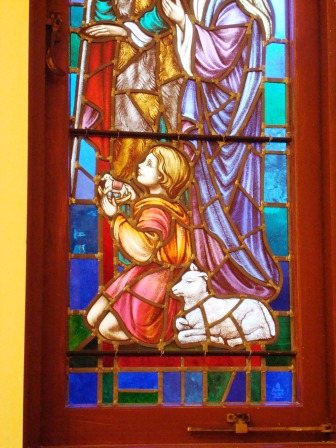
WDTPRS: 4th Sunday of Advent - COLLECT (2002MR) - POLL!Good Advent shepherds, they rushed to the Coming of the Lord, to see the Word made flesh lying in the wooden manger. “Seeing is believing”, they say, but believing makes us want to see! “Crede ut intellegas! Believe that you may understand!” is a common theme for St. Augustine (e.g., s. 43,4.7; 118,1; Io. eu. tr. 29,6).

Today many people automatically oppose faith against reason, authority versus intellect, as if they were mutually exclusive. In fact, faith and authority are indispensable for a deeper rational, intellectual apprehension of anything. In all the deeper questions of human existence, we need the illumination from grace, we must believe and receive. Faith is the foundation of our hope which leads to love and communion with God, as Augustine might say (trin. 8,6).


The Angel heralded with authority. The shepherds believed. They rushed to Bethlehem. They saw the Infant. They understood the message. Then they worshiped the Word made flesh Who opened for them a new life.


How often do we hear about something or learn a new thing and then rush to know more, to have personal experience, to see?

Think about this.   If you had been told in the night by angels to go somewhere, do you think you would roll over and say "It can wait"?  Would you, stroll?  Saunter? 

I think I would run until my lungs burst.

This is a paradigm for our life of faith. There is an interlocking cycle of hearing a proclamation (such as the Gospel at Mass, a homily, or a teaching of the Church) or observing the living testimony of a holy person’s life, and by this experience coming to know and then love the content of that proclamation or living testimony. The content is the Man God Jesus Christ. By knowing Him we come all the better to love Him and in loving Him we desire better to know Him.

An act of faith, acceptance of the authority of the content of what we receive, opens unto previously unknown territory, a vast depth otherwise closed to us. For the non-believer, on the other hand, a miracle is simply something inexplicable having nothing of the supernatural.
WDTPRS: 4th Sunday of Advent - COLLECT (2002MR) - POLL!
For a non-believer being nice or hard working can never ascend to true virtue or holiness. For him, the content of the Faith itself (both Jesus as well as what we learn and assent to) appears to be pleasant or interesting, but in the end remains naïve or foolish.

As we rush into Advent’s final days, that first candle we lit on our wreaths is now quite depleted.

From 17 December to Christmas Eve solemn days envelop us and the haunting “O Antiphons” of vespers one after another cloak us in our longing: “O come! O come!.. to teach us… redeem us… deliver us… ransom us… free us… enlighten us… save us… save us….”

We are deeply wrapped within our penitential holyday cheer because our celebration of the Lord in His First Coming is near to hand, but we do not forget that His Second Coming will bring our final judgment.
Posted in ADVENT, POLLS, SESSIUNCULA, WDTPRS | Tagged ,
20 Comments