The Feeder Feed

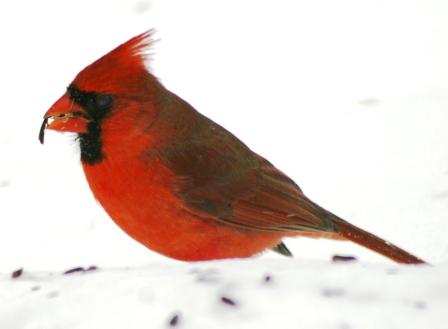
The Feeder FeedI have only a single male Cardinal coming around to the feeder.  There is a female lurking somewhere also, but I haven’t seen her for a while.

They are very alert and skittish.

The Feeder FeedThe Feeder Feed

He does go up on the feeder, an open feeder with a surface to stand on, but in general he prefers to eat on the ground.

The Feeder FeedThe Feeder Feed

One Cardinal does not a conclave make.

With my upcoming trips, I think I will have to find a somewhat larger feeder, requiring less frequent replenishment.  The last trip was … not successful, I think, at least as far as the birds were concerned.  It was very cold and my substitute did not refill, alas. 

I am missing some chickadees and finches. I haven’t seen a House Finch since I have returned.

Posted in The Feeder Feed |
7 Comments

Ineffabiliter sapiens, sapienter infans

Yesterday I wrote my column for the Christmas issue of The Wanderer.  Inter alia I delved into what St. Augustine said about the eternal Word becoming an infans, "incapable of speech", as the Lord’s way of teaching humility.  Augustine explores this mystery quite a few times in his sermons for Christmas.  I drill into some examples.

I did, however, want to share this one in particular.  A good example of this "speechless Word" images comes at the very beginning of s. 187, preached perhaps before 411.  We can get a sense of how Augustine sounded even in translation:

“He is the One through whom all things have been made and, on Christmas, Who has been made in the midst of all things. He is the Revealer of His Father and the Creator of His mother, the Son of God through His Father without a mother and the Son of Man through His mother without a father. He is great in the eternal day of the angels but small in the time-conditioned day of men. He is the Word of God before all time and the Word made Flesh in the fullness of time. Maker of the sun, He is made under the sun. Disposer of all ages in the bosom of His Father, He consecrates Christmas Day in the womb of His mother. In Him He remains while from her He goes forth. Creator of the heavens and the earth, He is born on earth under the heavens. Unspeakably wise, He is wisely speechless (Ineffabiliter sapiens, sapienter infans). Filling the universe, He lies in a manger. Ruler of the stars, He nurses at His mother’s bosom. He is both great in the nature of God and small in the form of a servant, but His greatness is not diminished by His smallness nor His smallness overwhelmed by His greatness.”

You might be interested to know that I did a search of Augustine’s works using one of my tools and found some 397 instances of a form of ineffabilis (ineffabil*).

I am not sure what that indicates about Augustine’s opinion of his congregation…. but there it is.

Posted in Patristiblogging | Tagged
7 Comments

They finally got around to it: Milingo dismissed from the clerical state

In the "It’s About Time" folder, comes this news from VIS about the dismissal of Emmanuel Milingo from the clerical state:

For a number of years the Church has followed with great concern the difficulties caused by the regrettable conduct of Archbishop Emmanuel Milingo. Many attempts have been made to bring Archbishop Milingo back into communion with the Catholic Church, including the consideration of suitable ways to enable him to exercise the episcopal ministry. Pope John Paul II and Pope Benedict XVI were directly involved in those efforts and both Popes personally followed the case of Archbishop Milingo in a spirit of paternal solicitude.

In the course of this unhappy series of events, Archbishop Milingo became irregular in 2001 as a result of his attempt to marry Mrs. Maria Sung, and incurred the medicinal penalty of suspension (cf. Canons 1044 § 1, n. 3; 1394 § 1 of the Code of Canon Law). Thereafter, he headed certain groups calling for the abolition of clerical celibacy and gave numerous interviews to the media in open disobedience to the repeated interventions of the Holy See, creating serious upset and scandal among the faithful. Then, on 24 September 2006 in Washington, Archbishop Milingo ordained four Bishops without pontifical mandate.

By so doing, he incurred the penalty of excommunication latae sententiae (Canon 1382) which was declared by the Holy See on 26 September 2006 and is still in force today. Sadly, Archbishop Milingo has shown no sign of the desired repentance with a view to returning to full communion with the Supreme Pontiff and the other members of the College of Bishops. Rather, he has persisted in the unlawful exercise of acts belonging to the episcopal office, committing new crimes against the unity of Holy Church. Specifically, in recent months Archbishop Milingo has proceeded to several other episcopal ordinations.

The commission of these grave crimes, which has recently been established, is to be considered as proof of the persistent contumacy of Archbishop Emmanuel Milingo. The Holy See has therefore been obliged to impose upon him the further penalty of dismissal from the clerical state.

According to Canon 292 of the Code of Canon Law, the penalty of dismissal from the clerical state, now added to the grave penalty of excommunication, has the following effects: loss of the rights and duties attached to the clerical state, except for the obligation of celibacy; prohibition of the exercise of any ministry, except as provided for by Canon 976 of the Code of Canon Law in those cases involving danger of death; loss of all offices and functions and of all delegated power, as well as prohibition of the use of clerical attire. Consequently, the participation of the faithful in any future celebrations organized by Archbishop Emmanuel Milingo is to be considered unlawful.

It must be pointed out that the dismissal of a Bishop from the clerical state is most extraordinary. The Holy See has felt obliged to act in this way due to the serious consequences for ecclesial communion resulting from repeated episcopal consecrations carried out without pontifical mandate; nevertheless, the Church hopes that Archbishop Milingo will see the error of his ways.

As for those recently ordained by Archbishop Milingo, the Church’s discipline in imposing the penalty of excommunication latae sententiae upon those who receive episcopal consecration without pontifical mandate is well-known. While expressing hope for their conversion, the Church reaffirms what was declared on 26 September 2006, namely that she does not recognize these ordinations, nor does she intend to recognize them, or any subsequent ordinations based on them, in the future. Hence the canonical status of the supposed bishops remains as it was prior to the ordination conferred by Archbishop Milingo.

At this moment, as the Church experiences profound sorrow for the grave acts perpetrated by Archbishop Milingo, she entrusts to the power of prayer the repentance of the guilty party and of all those who – be they priests or lay faithful – have in any way cooperated with him by acting against the unity of Christ’s Church.


You might remember the WDTPRS official parodohymnist gave us a song about Milingo some time ago:

It is to the tune of the famous song in The Sound of Music:

How do you solve a problem like Milingo

He sneaks around and can’t be found,
Until he’s on TV…
He takes a Moonie for a wife,
Embracing heresy;
And underneath his mitre,
Seems his lost his sanity.
I heard him once professing Docetism.

He’s always breaking canons
But his penitence is real
He’s always late for everything
Except for every meal
I hate to have to say it
But I very firmly feel
Milingo’s even worse than Charlie Curran!

I’d like to say a word in his behalf
(then say it, Sr. Margaretta)
Milingo makes me… laugh.

How do you solve a problem like Milingo?
How do you make a bishop keep in line?
How do you find a word that means Milingo?
A flibbertijibbet! A will-o’-the wisp! A clown!

If bishops are dogs, Emmanuel is a dingo Which even a German Shepherd couldn’t tame.
So how do you make him stay
And shut up for just one day?
How do you keep a crosier from his hand?

Oh, how do you solve a problem like Milingo?
How do you keep a Moonie’s feet on land?

When I’m with him I’m distressed
Things he blesses don’t seem blessed
And you never know what stunt he’s pulling next He’s defiant as M. Luther Wacky as Rosemary Reuther He’s a bishop! He’s a nutcase! He’s a wreck!

He’s a Gnostic without Gnoss
Like a crosier sans a cross
He could make a Trappist hermit scream out loud He is funny, he wild Pray his wife is not with child!
He’s a headache, he’s amusing
He’s a looooooon

How do you solve a problem like Milingo?
How do you make a bishop keep in line?
How do you find a word that means Milingo?
A flibbertijibbet! A will-o’-the wisp! A clown!

Many a thing you know you’d like to tell him:
Celibacy’s not just a papal whim
So how do you make him stay
And shut up for just one day?
How do you keep a crosier from his hand?

Oh, how do you solve a problem like Milingo?
How do you keep a Moonie’s feet on land?

Posted in SESSIUNCULA | Tagged
23 Comments

Card. Hummes: Without prayer, priests die of starvation.

From CNA:

Card. Hummes: Without prayer, priests die of starvation.Cardinal Hummes calls priests to strengthen ministry through prayer

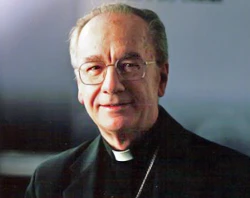
Vatican City, Dec 16, 2009 / 06:57 pm (CNA).- The prefect of the Congregation for the Clergy, Cardinal Claudio Hummes, encouraged priests this week not to neglect prayer because it strengthens their ministry by cultivating “the intimacy of the disciple with his Master, Jesus Christ.”

“Truly without the essential nourishment of prayer, the priest becomes ill.  The disciple cannot find the strength to follow the Master, and thus, he dies of starvation,” the cardinal warned in a letter.

Cardinal Hummes recalled that “prayer occupies a central place in the life of the priest,” and is a weapon for overcoming the devil, who seeks to weaken the shepherd in order to destroy the sheep.

“St. John Chrysostom warned that a decrease in shepherds always leads to a decline in the number of faithful in a community.  Without shepherds, our communities will be destroyed,” he explained.

The prelate added that a lack of prayer leads to “less joy and happiness in ministry each day.”  When a priest realizes “that his prayer life is weak, that is the time to address the Holy Spirit and pray.”

“The Spirit will reignite the passion and fervor for the Lord, who is always there…”

The cardinal encouraged priests to draw close to the manger in order to renew their friendship and discipleship, in order to be sent anew by Christ as his evangelizers.


I would add something.

Pray for priests.

Posted in Year of Priests | Tagged
16 Comments

Good news?

I think we could all use some of your good news.

Posted in SESSIUNCULA |
71 Comments

WDTPRS – Ember Wednesday “Missa Aurea” – Collect (1962MR)

WDTPRS - Ember Wednesday "Missa Aurea" - Collect (1962MR)Today, Ember Wednesday of Advent, those who have the use of the older, traditional Roman Missal, offer worship to God with the so-called Missa aurea, the "Golden Mass". 

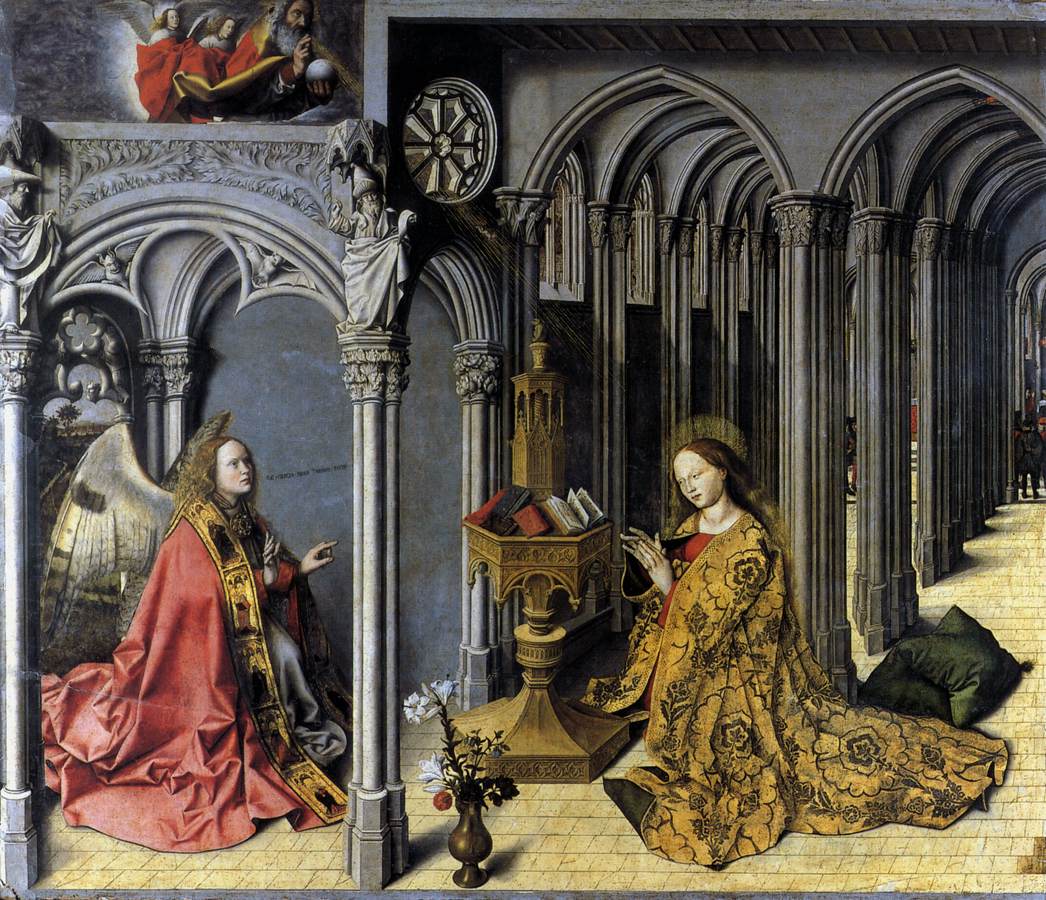
There is a strong Marian overtone to today’s Mass formulary.  The Roman Station for today is St. Mary Major.  the Gospel is the Annunciation.  The illuminated missals and sacramentary of centuries past presented the Gospel or at least its initial capital letters in gold, when our nickname Missa aurea.  And the Gospel pericope begins Missus est angelus Gabriel….  It was once celebrated with a solemnity nearly approaching a feast day.  Thus, Missa aurea also refers to little dramas in medieval times in which the Annunciation was acted out.  It is thus not just "golden Mass" but "the golden sending", which of course refers to the moment in which Our Lord becomes incarnate in the womb of the Virgin and His work for our salvation begins a new phase.  Missa aurea comes to be used in the terminology of art history also for paintings of the Annunciation, which often contain dramatic elements associated with the tableaux struck in the dramatic presentations of the mystery.  Doves would be lowered and an old man would be placed in a loft wearing an alb and cope.  Angels would come vested in dalmatics.  The Arena or Scrovegni Chapel in the 13th c.  Giotto’s frescoes echo this tradition as do many paintings of the Annunciation.

The Advent Ember Days were timed to follow St. Lucy’s feast (13 Dec.).  St. Lucy was an important saint for our forebears.  Her name, derived from the world for "light", is tied to our awareness in the northern climes of the deepening darkness of our December days and that those days will soon be getting longer again.  Listen for the urgency within the threefold "command" we are issuing to the Lord (festina… ne tardaveris… impende).

COLLECT:

Festina quaesumus, Domine, ne tardaveris,
et auxilium nobis supernae virtutis impende;
ut adventus tui consolationibus subleventur,
qui in tua pietate confidunt.

This Collect, an ancient prayer found in such manuscripts as the 8th c. Liber sacramentorum Gellonensis, survived the snipping and pasting experts of Fr. Bugnini’s Consilium in a somewhat truncated form, to be prayed on 24 December in the Novus Ordo: Festina, quaesumus, ne tardaveris, Domine Iesu, ut adventus tui consolationibus subleventur, qui in tua pietate confidunt.

That form tardaveris is a perfect subjunctive of tardo, "to tarry, loiter, linger, delay", paired here with ne to form a kind of imperative.  That ne tardaveris is found in the Latin version of the Psalms. 

Impendo is "to expend, devote, employ, apply".  Pietas, when it refers to man has to do with "duty", but when applied to God, it becomes "mercy… pity".  Remember that adventus here is a genitive with tui.   Sublevo means, basically, "to lift up from beneath, to raise up, hold up, support", but it comes to mean, "to sustain, support, assist, encourage, console any one in misfortune".  The perfect way to describe this vale of tears in which we journey.

LITERAL VERSION:
Hurry, we beseech You, O Lord, tarry not,
and expend upon us the help of heavenly power;
that those who rely upon Your mercy
may be sustained by the consolations of Your Coming.

You can feel in this prayer the growing Christian sense of urgency and longing.  Advent seems to pick up speed and become more anxious for resolution as we plunge headlong into physical darkness and cold, the reminders of our inevitable appointment with death.

This oration looks simultaneously back to the Nativity of the Eternal Word made man, but also forward to the Second Coming, which gives us consolation.  Christians in the state of grace can feel great consolation at the thought of the Coming of the Lord, in history and in the time to come.  We need not be afraid when we are in the state of grace.  Therefore, the Christian always eagerly says "Come, Lord Jesus.  Maranatha.   Come."

This prayers rings with consolation.

May the Lord’s coming and promise of return console any of you who are burdened with sorrow. Many people feel at times inconsolable.

This time of year can be a annual trial of despair and sadness for so many who are alone and suffering.

In gratitude for the Lord’s promises, console others. 

Think of this as a "golden rule".


Posted in ADVENT, WDTPRS | Tagged , ,
10 Comments

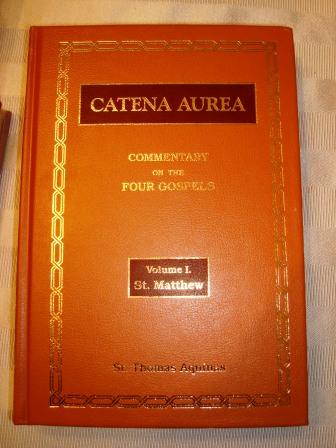
REVIEW: Catena Aurea of St. Thomas Aquinas (Baronius Press)

Latin catena means "chain".  Catena came to be the label for a work which involved "chaining" the commentaries of previous previous writers so as to create a verse by verse biblical commentary.

The best known of these catena was created by St. Thomas Aquinas (+1274) and it is called the Catena Aurea, covering the four Gospels.

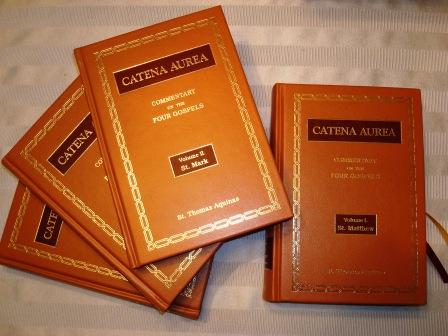
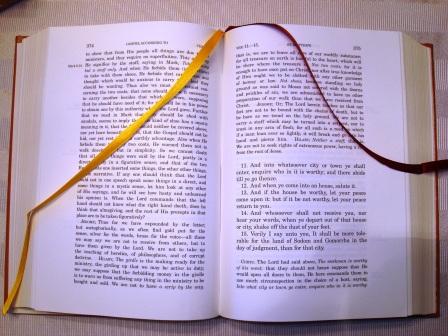
The nice folks at Baronius Press have produced a new, leather bound, four volume set of the Catena Aurea and I am happy to show some photos of the books on this day especially, when in the traditional Roman calendar we celebrate the so-called "Missa Aurea" for Ember Wednesday of Advent.

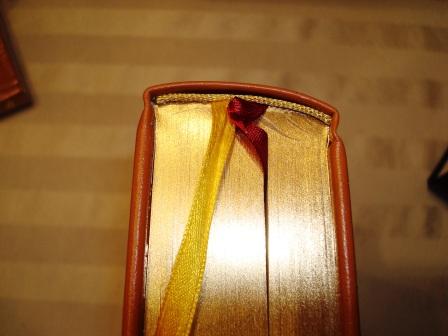
As I said there are four volumes, bound in leather with pages edged in, appropriately, gold.

They are being sold through the website of Baronius Press for US $140.

REVIEW: Catena Aurea of St. Thomas Aquinas (Baronius Press)

I noted that they were printed in India.

This is not just a photocopied set, reproducing the original pages of the 1841 edition.  This is entirely reset.  

There are handy ribbons for marking your place.

REVIEW: Catena Aurea of St. Thomas Aquinas (Baronius Press)

The binding feels good, and not too tight.  The books lie open.

REVIEW: Catena Aurea of St. Thomas Aquinas (Baronius Press)

REVIEW: Catena Aurea of St. Thomas Aquinas (Baronius Press)

The contents are as you might suspect.  No pictures.  Just text.  This is a reprint of an edition that was prepared in 1841.

The volumes have no indices, which is a bit of a draw back.  Since the books were actually reset with a new typeface, preseumably in electronic form, it is hard to understand why there couldn’t be an index.  But there it is.

Baronius Press is publishing very nice books.  Their hand missal for the older Mass is wonderful.  They have some good tools for Scripture.  I was very impressed also by their Divine Intimacy.

Posted in REVIEWS | Tagged ,
14 Comments

Catholic reporter fired because he disagrees with homosexual “marriage”

From CNA with my emphases:

Catholic reporter fired over comment on same-sex ‘marriage’ campaign

Portland, Maine, Dec 15, 2009 / 09:56 pm (CNA).- A localized media frenzy has ensued after a Catholic reporter was let go from his 19-year position at a Maine newspaper for voicing his opinion against same-sex “marriage” and the campaign to legalize it in Maine.

According to an article by the Maine Public Broadcasting Network, Larry Grard, a former employee of the Morning Sentinel, was sent a mass email from the pro-gay rights organization, Human Rights Campaign (HRC), following the repeal of the same-sex “marriage” law in Maine during the mid-term elections on Nov. 4.

In the email, Trevor Thomas, spokesman for the HRC, voiced his disappointment with the vote results and allegedly stated that opponents of same-sex ‘marriage’ built their arguments on “lies and hate.”

Thomas told CNA that Grard responded to the mass email from his personal email account and said “who are the venom-spewing ones? Hint: not the Yes on 1 crowd. You hateful people have been spreading nothing but vitriol since this campaign began. Good riddance!”

Although CNA asked Thomas for the original HRC statement that Grard responded to, Thomas did not provide it.

According to Thomas, he forwarded Grard’s email response to reporter’s boss and wrote, “it’s frankly, just not acceptable coming from a news organization the morning after our defeat.” Though Thomas insisted that he did not ask for Grard’s termination, Grard was fired on Nov. 10 and his wife’s bi-weekly cooking column for the paper was canceled.

The Maine Public Broadcasting Network stated that Grard has since apologized. “He had an emotional reaction to this email and sent off a reply and he recognizes that it was a mistake – that it wasn’t professional,” said Tom Bell, president of Grard’s union, the Portland Newspaper Guild.

Bell continued to say that workers for the paper have a union contract that calls for “progressive discipline” which means that if someone makes a mistake, they are given a chance to rectify the situation before drastic action, such as termination, is taken. “The issue here is that we feel the company overreacted,” said Bell.  “For someone like Larry, who’s 58, this is a one-way ticket into poverty.”

Bill Donohue of the Catholic League has also taken up Grard’s case and referred him to several pro-bono law firms that handle situations of Catholic workers who are victims of discrimination due to their beliefs.

Posted in The Drill, The Last Acceptable Prejudice |
20 Comments

A Gaudete Rose report

It is nice to see that His Hermeneuticalness had a Solemn Mass at Blackfen and used their new rose set.

The Mulier Fortis has photos.

A Gaudete Rose report

Posted in Brick by Brick | Tagged
9 Comments

Card. Murphy-O’Connor won’t be in the House of Lords

I picked up from Paolo Rodari’s blog, Palazzo Apostolico, that the Holy Father denied permission to His Eminence Cormac Murphy-O’Connor, Archbishop Emeritus of Westminster, to enter the House of Lords. 

Not only is the Cardinal still a member of the Congregation for Bishops, there is also a canon in the 1983 which prohibits priests from holding public office.

Posted in SESSIUNCULA |
25 Comments