PETITION PROJECT HELP REQUEST: We’ve Waited Long Enough

Here is an ALERT to all WDTPRS readers and a request to bloggers to help.

But first, a digression to whet your appetite.

Remember that whole business of a petition by those who are determined to resist the new translation of the Roman Missal?

A reader here sent me an interesting observation:

‘Anonymous’ Asks Bishops to Wait and See

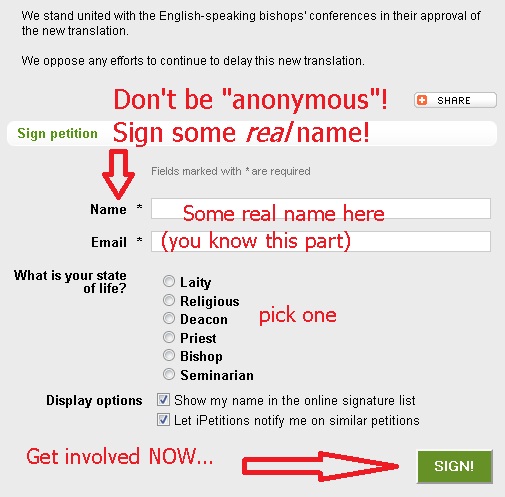
Friends, I scrolled down the list (well, the beginning of the list) of names of the signers of this petition [link]. I was frankly surprised to see the number of ‘signers’ listed there such as the following: "Anonymous — Religious — NY", "Anonymous — Lay Person — Washington". C’mon, get off it. Is this list really supposed to impress anyone, let alone a bishop? Anonymous Religious? Anonymous Lay Minister? Are they really afraid of some kind of unwelcome retribution from a Superior for saying something as radical as that they have reservations about the new translations and want an experiment? Is that so dangerous a sentiment? What are they afraid of, hate mail? (If so, they’d better not ever look into my in-box!) Or do they just lack the courage of their convictions? Or do they really exist at all? Is someone, maybe, just adding ‘Anonymous’ signers in an ACORN-like fraud to make it seem like there’s an issue here? ….. I’m just asking….

"But Father! But Father!", you are no doubt saying by now.  "What are you about?  What’s this got to do with your ALERT and that request to other bloggers?"

Perpend.

In reference to that dissident petition, a priest has started another petition in support of the new translation.  Had the priest in question alerted me to this earlier, I would have linked to it earlier.  But… here it is.PETITION PROJECT HELP REQUEST: We've Waited Long Enough

I hope you will give that petition some honest support.

There are not yet many signers.  I hope you will get on board.
PETITION PROJECT HELP REQUEST: We've Waited Long Enough

UPDATE 19 Dec 1649 GMT:

I see there are now over 1150+ signatures.  This is over 100% increase since I posted this.  Thanks! 

Also, I am glad to see that most of you are not signing as anonymous.  Signing a real name of some kind will help distinguish this petition from that other one.

Speaking of that other petition, an alert WDTPRS reader sent me the following note:

Fr. Z

These two ‘women priests’ want a trial period before they are required to introduce the new translation to their congregations?

Judith Heffernan, M.Div

Priest

Unofficially Philadelphia

USA

Rev. Suzanne Avison Thiel

Priest

RCWP Portland, Oregon

USA

The above are two signatories to the "Why don’t we just wait?" petition… hilarious.

Posted in Brick by Brick, Global Killer Asteroid Questions, PODCAzT, SESSIUNCULA |
36 Comments

Number of Cardinal electors drops to 112

From CNA:

Number of cardinals eligible to vote for Pope drops

Vatican City, Dec 18, 2009 / 04:05 pm (CNA).- Vatican Radio reported today that yet another cardinal has reached the age of retirement.  Cardinal Jozef Glemp, Archbishop-emeritus of Warsaw, turned 80 on Friday and is thus ineligible to vote for the next Pope as a member of the College of Cardinals.

When cardinals reach this ‘ceiling’ age their vote is no longer considered in the election of a new Pope by the College of Cardinals.  This decision was laid out in the Apostolic Constitution “Universi Dominici Gregis” of 1996, in which John Paul II reinforced the decision of Pope Paul VI to forbid the vote of a cardinal of 80 years of age or more.

"The reason for this provision is the desire not to add to the weight of such a venerable age the further burden of responsibility for choosing the one who will have to lead Christ’s flock in ways adapted to the needs of the times," the Apostolic Constitution reads.

At the same time, the document notes that "This does not however mean that the Cardinals over eighty years of age cannot take part in the preparatory meetings of the Conclave… ."

Cardinal Glemp’s retirement brings the total number of cardinals eligible to vote in elections to 112 and those ineligible for voting to the number 73. There are 185 living cardinals as of Dec. 18.

Vatican Radio also included the statistic that of the eight Polish cardinals, five of them are over 80 years old.

Posted in SESSIUNCULA |
15 Comments

USCCB statement: ‘Compromise’ would make citizens pay for others’ abortions

From the USCCB:

FOR IMMEDIATE RELEASE


‘ABORTION COMPROMISE’ DOES NOTADDRESS CORE PROBLEM IN SENATE HEALTH BILL, SAYS CARDINAL DINARDO, BISHOPS’ PRO-LIFE CHAIR


‘Compromise’ would make citizens pay for others’ abortions

Senate should mirror House of Representative’s Hyde amendment language

Bill doesn’t meet goals of affordability, fairness to legal immigrants, protection of life


WASHINGTON—Responding to reports of a new “compromise” proposal on abortion in the U.S. Senate’s health care reform bill, Cardinal Daniel DiNardo today reaffirmed the position of the U.S. Conference of Catholic Bishops that the legislation will be morally unacceptable “unless and until” it complies with longstanding current laws on abortion funding such as the Hyde amendment. Cardinal DiNardo is Archbishop of Galveston-Houston and Chairman of the Conference’s Committee on Pro-Life Activities. 

The Cardinal commented on efforts by Senator Robert Casey (D-PA) to improve the Senate bill’s treatment of abortion.

“Senator Casey’s good-faith effort to allow individuals to ‘opt out’ of abortion coverage actually underscores how radically the underlying Senate bill would change abortion policy. Excluding elective abortions from overall health plans is not a privilege that individuals should have to seek as the exception to the norm. In all other federal health programs, excluding abortion coverage is the norm. And numerous opinion polls show that the great majority of Americans do not want abortion coverage.”

“I welcome Senator Casey’s good-faith effort to improve this bill, said Cardinal Dinardo.” In particular he has sought to improve protection for conscience rights, and to include programs of support for pregnant women and adoptive parents that we favor in their own right. However, these improvements do not change the fundamental problem with the Senate bill: Despite repeated claims to the contrary, it does not comply with longstanding Hyde restrictions on federal funding of elective abortions and health plans that include them.”

Cardinal DiNardo had written to the Senate on December 14, saying that “the Catholic bishops of the United States strongly support authentic reform of our ailing health care system.” His letter cited “three moral criteria for reform: respect for life and conscience; affordability for the poor; and access to much-needed basic health care for immigrants,” noting that so far the Senate bill “has fallen short of the example set by the House version of this legislation in each of these areas.”

On abortion funding, the Cardinal urged the Senate to “incorporate into this bill the longstanding and widely supported policies of current law, acknowledged and reaffirmed by the Senate itself” when it approved the Consolidated Appropriations Act for the new fiscal year on December 13. This Act reaffirmed the Hyde amendment and other laws that exclude elective abortions from health plans receiving federal funds — including the plans that cover the Senators themselves and all other federal employees. The Senate so far has failed to reflect this same policy in its health care bill as the House has done, he said [see www.usccb.org/healthcare/DiNardo_1214_letter.pdf].

Cardinal DiNardo said December 18: “We continue to oppose and urge others to oppose the Senate bill unless and until this fundamental failure is remedied. And whatever the immediate outcome in the Senate, we will continue to work for health care reform which truly protects the life, dignity, conscience and health of all. As the bishops have said many times, ‘providing affordable and accessible health care that clearly reflects these fundamental principles is a public good, moral imperative and urgent national priority.’ In particular we will work vigorously to ensure that the substance of the House’s provision on abortion funding is included in final legislation. A special debt of gratitude is owed to House and Senate members, especially Rep. Bart Stupak (D-MI) and Sen. Ben Nelson (D-NE), who have placed their votes and reputation on the line to stand up for unborn children. Making this legislation consistent with longstanding federal law on abortion will not threaten needed authentic reform, but will help ensure its passage.”

Posted in Emanations from Penumbras, SESSIUNCULA | Tagged , , ,
3 Comments

Intriguing book by SSPX – “The Problem of the Liturgical Reform: A Theological and Liturgical Study

Intriguing book by SSPX - "The Problem of the Liturgical Reform: A Theological and Liturgical StudyThe kind folks at Angelus Press, the publishing arm of the SSPX, recently sent me a copy of The Problem of the Liturgical Reform: A Theological and Liturgical Study by the Society of Saint Pius X.

Intriguing book by SSPX - "The Problem of the Liturgical Reform: A Theological and Liturgical StudyI have no doubt that those of you who are followers of the SSPX have seen it. I ran into it in a footnote in  Reforming the Liturgy: A Response to the Critics by the liberal Jesuit liturgist at Boston College, John Baldovin, who has a very useful and fair-minded book which identifies the main arguments of critics of the Novus Ordo and then responds.

While I am just starting to dig into this short polemic against the Novus Ordo and the theology the writers believe was behind it, I found something interesting right away in the open letter by SSPX Bp. Bernard Fellay written in 2001 to His Holiness the late Pope John Paul II.  Felley wrote, with my emphasis:

The Liturgy has certainly evolved over the course of history, as is shown by the reforms made during the past century by St. Pius X, Pius XII and John XXIII. But the post-conciliar liturgical reform, by its extension and brutality, represents a disturbing upheaval, as a radical rupture from the traditional Roman Liturgy. Above all, this reform contains disconcerting elements, ambiguous and dangerous for the Faith.

What I find interesting here is that this, with the probable exception of "radical" and "dangerous", might have been written by Joseph Card. Ratzinger before his election.

The Forward states:

While this study goes to very root of the problem with the Liturgical Reforms, the analysis will focus for reasons of clarity on the Missal of Paul VI. The Mass is after all, the very jewel in the crown of the Catholic Liturgy.

The study comprises of three theses, each of which introduces a separate section. Firstly we will show how the publication of the New Mass of 1969 constituted a liturgical rupture. Secondly we will show how that rupture is explained principally by a new theology of Redemption, which we will call the "Theology of the Pascal Mystery". This complex second part forms the very heart of our study. Thirdly, we will seek to evaluate the new theology in the light of the infallible teachings of the Church, and to establish what attitude one should have towards this Novus Ordo Missae. In support of this attitude, an appendix treating the canonical status and rights of the Mass of St. Pius V is attached.

While by no means exhaustive, this work gets to the central issue at stake; the official texts show quite categorically that the "Pascal Mystery" is the key to interpreting the entire Liturgical Reform. 

I haven’t got much farther than this.

However, I was intrigued by the language used, in light of Pope Benedict’s identification of a "hermeneutic of discontinuity and rupture" that has plagued the interpretation and implementation of the Second Vatican Council.  It certainly plagued the implementation of the liturgical reform from the moment Sacrosanctum Concilium was promulgated.

We are so accustomed to making reference to "the Paschal mystery" in our post-Conciliar liturgical practice and preaching that we perhaps don’t consider more fully what may be involved in this theological category. 

This little book might prove to be interesting. 

There are a couple chapters which have especially interesting titles:

"From Christ, Priest and Victim, to the Lord of the Assembly"

and

"The Sacrament as Mystery"

At the end is a rather less relevant examination of the abrogation of the older, traditional form of Mass, now a moot point since Summorum Pontificum.

So, I am intrigued and will read this closely.

Posted in SESSIUNCULA, SUMMORUM PONTIFICUM, The Drill | Tagged , , ,
25 Comments

Catholic Herald Op-Ed: “We need a sharper divide between priests and laity”

Catholic Herald Op-Ed: "We need a sharper divide between priests and laity"From The Catholic Herald, the UK’s best Catholic weekly, comes this opinion piece, with my emphases and comments.     

We need a sharper divide between priests and laity

Dominic Scarborough presents a plan for recovering a true understanding of clergy and lay roles

11 December 2009

One of the most popular themes for Hollywood films over the years has been the so-called “body swap” film where parent and child exchange bodies and live the other’s life for a while, invariably “with hilarious consequences”. In the end both find that although each has learned a great deal about the other’s life, ultimately each is happier and more fulfilled as they were. A similar phenomenon can be found on our television screens with the familiar “life swap” genre.

Something similar seems to have been happening in the Catholic Church over the past few decades as many priests have started mimicking or even idolising the lay lifestyle while in many parishes it is the laity which increasingly populate the sanctuary. I know of one priest who decided he had to commission more Extraordinary Ministers of Holy Communion [Remember: they are not Ministers of the Eucharist.] to do his weekly sick calls because his time was being so taken up with the parish accounts (needless to say, one of these new Extraordinary Ministers was an accountant). The tragic element to all this (which outstrips even the comic element) is that there is more than an element of “role-play” escapism or flight from reality in this behaviour. The time may have come for the Church to realise that a clearer delineation of roles might be timely [Nay rather, long overdue.] and that the Church needs to be rooted in reality and not indulging the secular fantasies of its clergy.

Catholic Herald Op-Ed: "We need a sharper divide between priests and laity"As is so often the case, the Holy Father is only too aware of this situation. In a recent speech to the bishops of Brazil during their ad limina visit to Rome he made the following remarks: “Do not secularise the clergy and clericalise the laity … The truth is that the greater the faithful’s awareness of their own responsibilities within the Church, the clearer becomes the specific identity and inimitable role of the priest as pastor of the entire community.”  [I consider the purposeful clericalization of lay people by priests and bishops to be a particularly nasty type of "clericalism".  What lies at the bitter root of that weed is the false notion that lay people are not worthy unless they are doing things that priests or deacons do, that they are somehow not adequate unless they imitate priests.  We have to grant that most clerics who fall into this trap are well-motivated, but it is a trap nonetheless.]

Of course Vatican II sent out a rallying cry to the laity to recognise that they are the “People of God” and to be co-workers with the clergy and religious and not mere consumers of religion. The laity were called to discover a new sense of their sharing in the Priesthood of Christ by virtue of their baptism. But the primary task of the laity in sharing in the sacrifice of Christ was to be their emphasis on making a sacrifice of their own lives in how they lived them out in the world as a living witness and as a means of evangelisation. [We might see it this way: the clergy are to shape the lay people who shape the world around them.] How frequently, though, have these sentiments been interpreted by those with a very narrow and clerical view of the Church who seem to consider that one is not really doing something important in the life of the Church if it is not liturgical? This ideology, more than any decline in priest numbers, has led to the legions of Extraordinary Ministers and superfluous servers we now see crowding our sanctuaries.

One step towards sorting all this out might helpfully come from Rome. An important document, the significance of which even to this day is not fully understood in the wider Church, was Pope Paul VI’s Motu Proprio Ministeria Quaedam of 1972. This document abolished the clerical minor orders of porter and exorcist and re-designated the hitherto clerical orders of lector and acolyte as “instituted lay ministries”. It also abolished the tonsure and delayed the entry of the seminarian into the clerical state until diaconate (the sub-diaconate having already been suppressed). Sadly, the passage of time and the benefit of hindsight could both question the effectiveness of this previously untried system. While no seminarians are likely to feel particularly deprived at not being made a porter, [This could be an interesting point of discussion.  In the ancient Church there were many types of ministry to deal with concrete exigencies.] many seminiarians are required by their seminary staff (quite properly, according to the document) to continue to consider themselves laymen even after the reception of the lay ministries of lector and acolyte which they receive at the seminary, until the day of their diaconate when suddenly the clerical state hits them like a train. The old staged progress through tonsure, the reception of the cassock and collar, the saying of the Office and the milestones of the minor orders has given way to literally waking up the morning after diaconate as a celibate cleric.

Catholic Herald Op-Ed: "We need a sharper divide between priests and laity"Similarly, the appetite among the laity for these new “instituted lay ministries” has been entirely absent from the post-conciliar Church. As a policy initiative they have completely failed to take off in the western Church and I would be surprised if the total number of instituted lectors and acolytes in the entire Catholic Church (excluding the seminarians transiting through these lay ministries) would be enough to fill a village hall. Lay people happily fulfil the roles of lector and acolyte as lay people just as they sing or take up the collection but do not feel the need to be “clericalised” to do so. Indeed, according to the General Instruction of the Roman Missal 2002, where an instituted lector and acolyte are present at Mass they should always take precedence in that role. [Which could help with the problems we have in the distribution of Holy Communion as well as helping us to a more solemn liturgy.] The paradox of this is that if it were followed to the letter it would mean no lay person would ever read or serve at Mass again, given that the priest is likely to be the only person present who has been “instituted” in both of these lay ministries. Where the test of time has preserved these roles is in their proper place, in the seminaries, as steps to priesthood. In my view it is high time that the Church looked at this purely disciplinary issue again with the benefit of hindsight.

Where the laity can and should participate in the liturgy they should be proud to do so as lay people and in roles which respect the dignity of that state. Those aspects of the liturgy which pertain to the sanctuary and in a particular way to the ministerial priesthood should be reserved to clerics or to those lawfully deputising for clerics out of real necessity. [Do I hear an "Amen!"?] These “instituted lay ministries” should be quietly dropped, again, motu proprio and, at least in the case of acolyte, should be restored as an instituted role pertaining to the clerical state to which only clerics can be admitted. [Not sure about that… but this is worthy of discussion.] It would help to re-emphasise the different but complementary roles which clergy and laity have in the life of the Church and might result in more priests taking Communion to the sick and more laity helping with the accounts.

Dominic Scarborough is a lay Catholic from the south of England. A qualified barrister and former Civil Service Principal, he has a degree in Modern History from Magdalen College, Oxford. He is a regular commentator in the press and on the internet on Catholic affairs

Posted in The Drill |
54 Comments

College prof compares Cross to swastika

An alert reader found this story on the site of a Texas TV station:

College Crucifix Ban Prompts Lawsuit

Published : Tuesday, 15 Dec 2009, 3:00 PM CST

      Melissa Cutler
      FOX 4 News

MESQUITE, Texas – Joe Mitchell says all he wanted to do was make crosses as gifts for friends when he signed up for a ceramics class at Eastfield Community College in Mesquite.

Instead, he says, the ceramics instructor compared the crucifix to a swastika in trying to explain why crosses were not permitted.

“I felt humiliated and that my spirituality was being demeaned,” said Mitchell, a retired Dallas resident and student at the public college. “The whole point of art is to express who you are.”

Mitchell says he was told on several occasions by instructors and administrative staff that he could not make ceramic crosses, concluding with an ultimatum ban on crosses this fall.

“Unfortunately, not everyone has the Christmas spirit or even a basic understanding of religious freedom,” said Kelly Shackelford, chief counsel of Liberty Legal Institute. “The government cannot ban crosses and religious symbols.”

Shakelford says college officials are not only banning crosses, but menorahs and other religious items from the class.

In response, the institute sent a demand letter on Tuesday on behalf of Mitchell, alleging the school has committed an unconstitutional attack on religious expression in the classroom.

Eastfield Community College officials issued a statement saying it’s legal council will review the schools policy and language, quote:

"Eastfield College’s current ceramics policy tells students that they should not use symbols, icons or other "cookie cutter" images. The purpose of those references is to compel students to create original works that express their artistic perspectives through projects assigned by instructors. The college has never intended to circumvent expressions of religious or artistic freedom or violate any laws with regard to religious freedom. "

Posted in SESSIUNCULA |
22 Comments

Fr. Z pleads with readers

Fr. Z pleads with readersI get a lot of e-mail every day.  It is not unusual for me to get hundreds in the course of a single day.

May I plead with you about a few things?

  • Please don’t send e-mails with no subject in the subject line or vague subjects such as "Hey look at this!".  I delete them.
  • Please don’t send me just a link.  Could you tell me what it is, and what parts are important?
  • Please don’t send me articles without links if there are some?
  • Please don’t ask me to do your homework or translate long texts in Latin for you.
  • Please don’t expect me to answer.  I simply have too much mail.
  • Please attach photos rather than embed them.  That saves me a few steps.

Also, if you send me something, I assume that I can use it.  I will try to "anonymize" e-mails as much as possible, especially if you are clergy or seminarians.

Your e-mail is appreciated (well, mostly) and useful (well, mostly).  But you could be of greater help – please- by considering the aforementioned petitions.

Posted in SESSIUNCULA |
Comments Off on Fr. Z pleads with readers

Speaker Pelosi “thanks God” for tax-payer funded abortion language

About the new Senate Bill, from Lifesite:

[Pelosi said] the Senate bill "doesn’t have a public option, doesn’t expand Medicare for the (age) 55 to 64 group, and has abortion language that is completely different from the House – thank God."


God bless "Catholic" Speaker Pelosi, who invokes God in thanks for tax-payer funding of abortion.

Posted in SESSIUNCULA |
44 Comments

Save The Liturgy…. Say the Black…. WDTPRS…. stuff

Save The Liturgy.... Say the Black.... WDTPRS.... stuffI have had a few people send e-mails asking to repost the addresses to my shops for coffee mugs, etc., in different countries.

Glad to oblige!

I have been punishing these mugs, microwaving them for long periods and putting them in the bottom part of the dishwasher near the heating element.  They are holding up, though under this relentless hammering with heat, etc., they are showing some wear after a year or so.  If you don’t mistreat them as I purposely do, they should last for a long time!

If you are in the USA…

You can get the WDTPRS mug here.Save The Liturgy.... Say the Black.... WDTPRS.... stuff
You can get the Save The Liturgy mug here.
You can get the Say The Black mug here.

If you are in the UK…

You can get the WDTPRS mug here.Save The Liturgy.... Say the Black.... WDTPRS.... stuff
You can get the Save The Liturgy mug here.
You can get the Say The Black mug here.

If you are an Aussie …

You can get the WDTPRS mug here.Save The Liturgy.... Say the Black.... WDTPRS.... stuff
You can get the Save The Liturgy mug here.
You can get the Say The Black mug here.

Save The Liturgy.... Say the Black.... WDTPRS.... stuff

Posted in SESSIUNCULA |
10 Comments

Benedict XVI may approve John Paul II as “Venerable” on 19 Dec

From Rome Reports

Benedict XVI to declare John Paul II venerable at the Vatican

December 17, 2009. The late Pope John Paul II is one step closer at getting a spot on the altars, now that Benedict XVI will name him venerable.

Benedict XVI is expected to sign the decree Saturday December 19th.

When the Pope gives a candidate to the altars, the title "venerable" that means he recognizes that they lived the Christian virtues as heroes.

To beatify a candidate, the commission of cardinals and Vatican theologians must certify that God has performed a miracle through his intercession.

In the case of John Paul II, just two months after his death, several medical teams have classified the cure of a French nun with Parkinson’s, as “scientifically inexplicable”. The nun says, with much difficulty, she wrote John Paul II name on a piece of paper and a couple of hours later she was 100% cured.

To name venerable John Paul II, Pope Benedict XVI analyzed the documentation collected during the last 5 years by the postulator of the Cause of beatification, Father Slawomir Oder. Thousands of pages with specific facts and that show what many proclaimed the day of his funeral: that John Paul was a saint.

John Paul II road to sainthood, is perhaps one of the shortest on record. It started just one month after he died.

And lasted only 5 years. The traditional road to sainthood usually takes 10 times as long.

[wp_youtube]fIIDZkVDEEM[/wp_youtube]

Posted in SESSIUNCULA |
35 Comments