Wherein Fr. Z rants about our Catholic identity and dangerous times

In another entry, about the priest/penitent privilege and a state’s violation of the same we read:

I don’t believe it is likely that secret eavesdropping on conversations between priests and penitents is a growing trend in this country, but the revelation of truth and the limits that the law allows between civil authorities and clergy are being pushed to more narrow levels.

In my recent article in The Catholic Herald I mentioned that we, as Catholics, are in a fight for our lives. 

For our Catholic lives to be sure, but also for the sake of the life of society.  

This is an ad intra (Catholics considered as Catholics among themselves) and ad extra (Catholics considered in relation to the wider world).

I have mentioned too many times to count in this blog pages that I think Pope Benedict is implementing a kind of "Marshall Plan" for the Church.  Just as there was a plan to rebuild Europe after the devastation of WWII so as to create strong partners in trade, a healthy society and a bulwark against Communism, Pope Benedict is trying to revitalize our identity and the life of the Church in continuity with the past after the devastation of the last 40 years since the Council and the false hermeneutic of discontinuity and rupture which have so pervaded every facet of the Church’s life.  In doing so, he is trying to provide for a healthier, holier Church and create a breakwater against the rising tide of relativism.

Catholics, as Catholics, have been shoved out of the public square.  They are more often than not excluded from contributing to discussion of the burning questions of our day.  This is often because Catholics themselves, as Catholics, excluded themselves from contributing a Catholic voice because they are either dissenters or because they are weak or because they are tepid. 

But Catholic must contribute to the discussion in the public square, or as Pope Benedict called this phenomenon recently the "digital continent".  We have an obligation, each of us according to our vocations, to shape the world around us to the extent we can.  Holy Church has a God-given mission to teach both ad intra and – of course – ad extra.

The ad intra dimension entails Catholics knowing who they are and what they believe.  If we don’t know these things, if we are not firm in them, then we are vulnerable to every manner of marginalization and, don’t doubt it, persecution.   If we don’t know who we are as Catholics, we will never be able to articulate anything clearly about the burning questions of our day and make a contribution as Catholics according to our vocations.

There is an incremental erosion of human, common sense values taking place.  At a certain point, the erosion will pick up speed and, suddenly, we will wake up in a new kind of world.  Similarly, the process of revitalizing our identity and our Church will also take time.  Our gains will be slow and incremental.  Brick by brick. 

We must not be complacent or one day we will find we are living a nightmare.

I return to what I wrote in my liturgical-political manifesto after the Notre Dame Debacle.

I urge all priests and bishops who read this blog with any slight quaver of resonance or benevolence, to consider this with care:

If you sense that something quite serious and important is going on right now, for the love of God rethink your approach to how you foster Holy Church’s proper public worship.

Do all in your power and through your influence to foster a worship of God which conforms not to worldly goals – as praiseworthy as they may be in a world still dominated by its dire prince – but rather to the real point of religion: an encounter with mystery. 

Our worship must become more and more focused on the one who is Other.  Seek what is truly above in your rites and raise people to encounter mystery.

You will be challenged and reviled, blocked and attacked as you do.  You will be worn down and afraid under the weight of resistance.

But I think that to save the world we must save the liturgy.

[The Notre Dame Debacle] reaffirmed this for me. 

They can’t compete with the fullness of Catholic liturgy and sound preaching.

Reforming the liturgy along the lines Pope Benedict has proposed may be the most loving and effective option we have in these ever hotter times.

People will have to keep working very much in the sphere of the secular.  Of course!  Our inward Catholic Christian identity must find outward expression and bring concrete fruits.

But I think the real work now – where we will make some effective headway – must be done at the level of our public worship.

In the present circumstances, we are not going to argue most people out of danger or error.  But together we can draw them in and along and back through worship.

So long as we remain doctrinally faithful and active in works of mercy both spiritual and especially temporal, if we get our public worship together we will have a strong bastion against error. 

Holy Catholic worship will be an attractive force for conversion.

We need to foster worship which stuns, which leaves the newcomer, long-time practicing Catholic, above all the fallen-away simply thunder stuck.  Worship must at some point leave people speechless in awe.  We need language and music and gesture which in its beauty floods the mind with light even while it swells the heart to bursting.

The more people encounter mystery through liturgy, the more hollow will clang the false or incomplete messages of those who have strayed from the good path, either to the left or to the right.  

Our goal must be that which is good and beautiful because it is true, that which reflects what is of God, not man’s image merely.  Give us mystery, not fabrications smacking of the world, fallen and transitory.

Fathers, and you Reverend Bishops, if anything of alarm has sounded in your hearts and minds of late, rethink your approach to our worship.  Examine your approach with an eye on the signs of the times.  Take a new approach. 

The approach we have had least last few decades isn’t getting it done.  Really … it isn’t

Going neither left nor right along the road toward the Lord, even as He comes to us, take the flock now deeper, now higher on that path, but always to encounter the mystery which distinguishes truly Catholic liturgy… and therefore true Catholics.

Lines are being drawn, sides taken, choices made.

More than ever we need what Christ, the true Actor of our liturgy, desires to offer us through Holy Church’s worship.
Posted in Global Killer Asteroid Questions, Our Catholic Identity, SESSIUNCULA, The future and our choices, Wherein Fr. Z Rants | Tagged ,
28 Comments

Priest/penitent privilege and a state’s violation of the Seal

From ZENIT comes this about an attack on the Sacrament of Penance and the privilege of priests not to be forced by law to reveal confessions.

This is an interview.  My emphases and comments.

Seal of Confession Goes on Trial

Church and State Face Off in Court

By Annamarie Adkins

SALEM, Oregon, AUG. 26, 2009 (Zenit.org).- When Father Timothy Mockaitis heard inmate Conan Wayne Hale’s sacramental confession on April 22, 1996, he had no idea it was being recorded. [RECORDED!]

He also didn’t know that the event would spur an unprecedented legal case that attempted to demonstrate that a violation of the seal of the confessional was an infringement on the free exercise of religion guaranteed by the First Amendment to the U.S. Constitution.

Father Mockaitis details these pivotal events in his new book, “The Seal: A Priest’s Story.” The pastor of Queen of Peace Catholic Church shared with ZENIT how this case involved not only canon law versus civil law, but also a threat to the long term viability of our Constitutional freedoms.

ZENIT: You filed a lawsuit to prevent disclosure of the contents of the confession. What were your legal claims?

Father Mockaitis: Our legal position was based essentially on First and Fourth Amendment violations, which concern religious freedom and protections against illegal search and seizure.

We also claimed civil rights violations against privacy. This was an offense against not only the Church, but against the penitent himself. [Do I hear an "Amen!"?]

But we also raised moral and ethical objections that this particular and deliberate intrusion by the state was one incident that could never be justified for a greater good.

The integrity of both the Constitution and an unmistakable explanation of Canon Law, and the centuries-old tradition of the Church about the absolute secrecy of the seal in the sacrament of reconciliation, were all presented in this case.

[Get this…] It was the first time an attempt was made in court to define a violation of the seal of confession as a First Amendment violation.

The state consistently claimed the tape as among the body of evidence in its investigation.

A priest comes to the confessional in a parish church, a jail cell or a hospital bedside not as a judge and jury, but as a pastor of souls.

The actions of the state, and the response of the Archdiocese of Portland, set up a never-before-test of the American Constitution. [!] I felt state authorities had backed themselves into an untenable legal corner.

ZENIT: American law normally protects something called the priest-penitent privilege, like the attorney-client privilege. How did that figure into your case?

Father Mockaitis: [NB!] The priest-penitent privilege, like the attorney-client privilege, is granted in this country from the common law of the land. Civil authorities knew this was a sacrament of the Church and they secretly taped it because it was that sacrament; they had the audacity to cross this line between the values of Church and state.

In Oregon as of 1996, if one party — in such a relationship as priest-penitent — was willing to reveal information and wave the assumed confidence, then the other party could not object, despite his or her desire to maintain the privilege.

However, neither the penitent nor myself as confessor knew of the taping. By the time I got wind of this surreptitious act done with the approval of the local district attorney, a warrant had already been issued and signed by a local judge for law enforcement authorities to listen to the contents of the tape. [!]

As priest and confessor I was forbidden to grant any waiver of the confidence from the sacrament, so from the beginning there was no doubt the priest-penitent privilege had been violated. We demanded the immediate destruction of the tape and its written transcript.

One footnote to mark is that as a result of this case, about two years after litigation, Oregon revisited the priest-penitent privilege and granted protection for the priest (or member of any clergy) who could claim immunity from public testimony if he and his religious organization had an expectation of privacy.

The seal of the sacrament would certainly meet those criteria.

[Here is a good question…] ZENIT: Are there other stories like yours of the seal being broken? Is this a growing phenomenon? Do you see it as part of a trend about disrespect for religious freedom?

Father Mockaitis: No incident as is described in "The Seal" had ever come before a court of law in this country. The late William F. Buckley wrote, in his estimation, this action was “naked fascism, truly the end of the line.” [!]

I don’t believe it is likely that secret eavesdropping on conversations between priests and penitents is a growing trend in this country, but the revelation of truth and the limits that the law allows between civil authorities and clergy are being pushed to more narrow levels.  [More on this in another entry.]

For instance, just a few years ago Connecticut almost passed a law requiring priests to report certain crimes that are disclosed in the confessional.           
                      
The sad and painful saga of clergy sexual abuse in this country has indeed made professional confidence a more tenuous protection. Yet, it seems to me, the search for truth has in many cases gone well beyond professional respect and reasonable investigation to reach a far more intrusive and disrespectful level.

ZENIT: Why is there a seal of the confessional? Didn’t penitents once confess their sins publicly in church to the whole assembly?

Father Mockaitis: I believe the seal of the confessional finds its greatest justification in the protection of the integrity of the sacrament and for the safety and respect of the individual penitent.

Although, in the early centuries of Christian history, we do hear of the public acknowledgement of sins and the exercise of public penance, some sense of personal privacy was always a part of this sacrament.

The seal guarantees that whatever may be shared between priest and penitent will forever remain confidential.

To know this truth is to grant instant trust for the penitent to speak openly and honestly about whatever his or her struggle with sin may be. The seal creates an environment in which the penitent can be disposed to receive the grace of healing from a God of mercy.

ZENIT: Why shouldn’t the seal be broken when a great public good could come about? Don’t priests usually instruct those who committed a heinous crime to turn themselves in to the police as part of their penance anyway?

Father Mockaitis: What would be the greater good that might justify the revelation of a sacramental confession: the good of the soul of the penitent or some piece of so-called “evidence” that might lead to the conviction of guilt or innocence of an individual?

While the safety of citizens is crucial for the common good, is there no other ethical and legal way to search for evidence besides the invasion of the sacred trust established in the sacrament?

Law enforcement has developed myriad ways to seek evidence for the conviction or innocence of an individual that would make the eavesdropping of a conversation between priest and penitent a desperate method of investigation.       

The purpose of a penance is to seek justice, to repair the damage done by sin and to accept personal responsibility for one’s actions.

In the course of conversation between priest and penitent, in the case of a serious crime, the penitent may come to the realization that submission to authorities is the most appropriate way to be granted forgiveness.

But, if an individual has come to the sacrament properly disposed and sincerely seeking reconciliation, the priest is obliged to carry through as a pastor of souls, not as a police officer.

ZENIT: Your case received some attention in the media. What was the general public reaction to the recording of the sacrament? Do you believe the public’s response is a barometer of peoples’ views about the importance of religious freedom?

Father Mockaitis: This case received an enormous amount of media attention.

However,[get this…] the reaction of the mainstream population was far more visceral. Universal shock, outrage, insult and fear about a new disrespect for people of faith were not uncommon.

Good people knew this was neither about the Catholic Church alone, nor about this sacrament alone, but rather about our Constitutional protections in the long run. I was amazed and edified by the united voice of concern well beyond the Catholic Church.

ZENIT: What happened to the tape recording of Hale’s confession? Was it ever used in evidence or destroyed?

Father Mockaitis: Despite the state authorities’ and the District Attorney’s promise at that time that the tape would be destroyed after the murder trial of the inmate, the tape still exists to this very day.

The ultimate finding of the Ninth Circuit Court of Appeals [oh dear] that this action was a blatant violation of the First and Fourth Amendment made the action of this taping illegal.  [WOW!  That is a surprise from that court!]

Although it was never played during the trial of the inmate, the tape was not destroyed a year after the Appeals Court issued its opinion in January of 1997.

For what purpose does it remain more than 10 years since the inmate’s trial? 

It remains a red flag of warning for all those who treasure our First Amendment protections.

* * *

On the Net:

http://prieststory.com


Alarming.

WDTPRS kudos to Fr. Mockaitis!

Posted in Our Catholic Identity, SESSIUNCULA, The future and our choices, The Last Acceptable Prejudice | Tagged , ,
20 Comments

Series of columns on ZENIT: The Priest in the Eucharistic Celebration

From ZENIT with my emphases and comments:

The Priesthood and the Mass

Theologian Notes the Priest’s Privileged Role

By Father Mauro Gagliardi

VATICAN CITY, NOV. 20, 2009 (Zenit.org).- Benedict XVI proclaimed, as everyone knows, the Year for Priests (June 2009-June 2010), on the occasion of the 150th anniversary of the "dies natalis" of the holy Curé d’Ars. The purpose is "to deepen the commitment of all priests to interior renewal for the sake of a stronger and more incisive witness to the Gospel in today’s world"[1].

St. John Mary Vianney, besides concretely representing a supreme model of the priesthood, always proclaimed with clarity and incomparable emphasis the dignity of the priesthood and the centrality of the ordained ministry in the heart of the Church. Drawing from his teachings, the Holy Father re-proposed these words of the saint: "O, how great is the priest! If he realized what he is, he would die. [] God obeys him: He utters a few words and the Lord descends from heaven at his voice, to be contained within a small host."

And again: "Without the Sacrament of Holy Orders, we would not have the Lord. Who put him there in that tabernacle? The priest. Who welcomed your soul at the beginning of your life? The priest. Who feeds your soul and gives it strength for its journey? The priest. Who will prepare it to appear before God, bathing it one last time in the blood of Jesus Christ? The priest, always the priest. And if this soul should happen to die [as a result of sin], who will raise it up, who will restore its calm and peace? Again, the priest After God, the priest is everything! [] Only in heaven will he fully realize what he is."[2]

As we see, St. John Mary points to the greatness of the priest with the privileged reference to the power that he exercises in the sacraments in the name of the Person of Christ. Benedict XVI brought this light, citing still other words of the Curé d’Ars, which refer in particular to the office of celebrating the Holy Eucharist. The Pope writes that the saint "was convinced that the fervor of a priest’s life depended entirely upon the Mass: ‘The reason why a priest is lax is that he does not pay attention to the Mass! My God, how we ought to pity a priest who celebrates as if he were engaged in something routine!’"[3].

The Year for Priests proposes for our reflection the figure of the priest and, in a special way, his dignity of ordained minister who celebrates the sacraments, for the benefit of the whole Church, in the Person of Christ, high and eternal priest.[4]

In this Year for Priests, which will be celebrated between 2009 and 2010, there are nevertheless also other recurrences that merit attention because they are intimately connected with the Eucharistic nature of the priestly dignity. In 1969, Pope Paul VI proclaimed, with the apostolic constitution "Missale Romanum," the new missal prepared after the Second Vatican Council. In the present year, 2009, then, we celebrate 40 years since this promulgation. [The topic of my last two PODCAzTs here and here.]

Next year, 2010, we will celebrate two other anniversaries that are also directly linked to the celebration of the Eucharist. The first is the 40th anniversary (1970-2010) of the promulgation of the definitive "editio typica" (first) of the "Institutio Generalis Missalis Romani." The second is the 440th anniversary of the promulgation of the missal that we currently call "Vetus Ordo" or "Usus antiquor," promulgated by St. Pius V with the apostolic constitution "Quo primum" of July 14, 1570. [About which I spoke in another PODCAzT.] This constitution is recalled, together with Pius V’s missal, from the very first words of Paul VI’s above-mentioned apostolic constitution "Missale Romanum."[5]

The two missals, also united in the celebrations of the respective anniversaries, are two forms of the one "lex orandi" (law of prayer) of the Church of the Latin Rite. [Do I hear an "Amen!"?]  Benedict XVI has expressed himself in this manner, teaching that, in relation to the missal of Paul VI, "the Roman Missal promulgated by St. Pius V and reissued by Blessed John XXIII is to be considered as an extraordinary expression of that same ‘lex orandi,’ and must be given due honor for its venerable and ancient usage. These two expressions of the Church’s ‘lex orandi’ will in no any way lead to a division in the Church’s ‘lex credendi’ (law of belief). They are, in fact, two usages of the one Roman rite. It is, therefore, permissible to celebrate the Sacrifice of the Mass following the typical edition of the Roman Missal promulgated by Bl. John XXIII in 1962 and never abrogated, as an extraordinary form of the Liturgy of the Church."[6]

The possibility of a serene and harmonious coexistence of the two forms of the one Roman Rite also has been indirectly affirmed by the presence of both "Ordines Missae" (of Bl. John XXIII and Paul VI) within the very recent "Compendium Eucharisticum," published by the Congregation for Divine Worship and the Discipline of the Sacraments.[7]

The concurrence of these different anniversaries has likewise determined the theme that the Spirit of the Liturgy column proposes to explore this year: The Priest in the Eucharistic Celebration. [!]

Through these periodic articles by expert theologians, liturgists and canonists, we will try to present the role and the task of the priest in the various parts of the Mass in a clear and accessible way, with respect to both missals. The hope is that these articles will help priests take advantage of the opportunity for reflection and conversion offered by the Year for Priests and move them to a care that is always more attentive to the "ars celebrandi" (art of celebrating).

We hope, moreover, that the contributions will also help the other readers — men and women religious, seminarians, faithful lay people — to reconsider with greater attention, and venerate with profound religious respect, the grandeur of the Eucharistic mystery and the dignity of the sacerdotal office, and rediscover their centrality in the life and mission of the Church.

Notes

[1] Benedict XVI, "Letter Proclaiming a Year for Priests," June 16, 2009.
[2] Ibid.
[3] Ibid.

[4] Priests "exercise their sacred function especially in the Eucharistic worship or the celebration of the Mass by which acting in the person of Christ ["in persona Christi"] and proclaiming his mystery they unite the prayers of the faithful with the sacrifice of their Head and renew and apply in the sacrifice of the Mass until the coming of the Lord the only sacrifice of the New Testament namely that of Christ offering Himself once for all a spotless Victim to the Father." Vatican Council II, "Lumen Gentium," No. 28: AAS 57 (1965), p. 34. Cf. also "Presbyterorum Ordinis," Nos. 2; 12; 13.

[5] Cf. Paul VI, "Missale Romanum," April 3, 1969: AAS 61 (1969), p. 217.
[6] Benedict XVI, "Summorum Pontificum," July 07, 2007, art. 1.

[7] Cf. Congregation for Divine Worship and the Discipline of the Sacraments, "Compendium Eucharisticum," LEV, Vatican City, 2009. The preparation of this text was entrusted to the dicastery directly by the Holy Father, who mentioned it in the post-synodal apostolic exhortation "Sacramentum Caritatis," Feb. 22, 2007, No. 93.

* * *

Father Mauro Gagliardi is a consultor of the Office for the Liturgical Celebrations of the Supreme Pontiff .


Posted in Year of Priests |
3 Comments

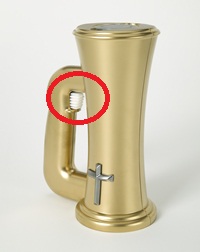
Ohhhhhh… no. That’s just… wrong!

Am I off base here or is this just… wrong?

Ohhhhhh... no. That's just... wrong!
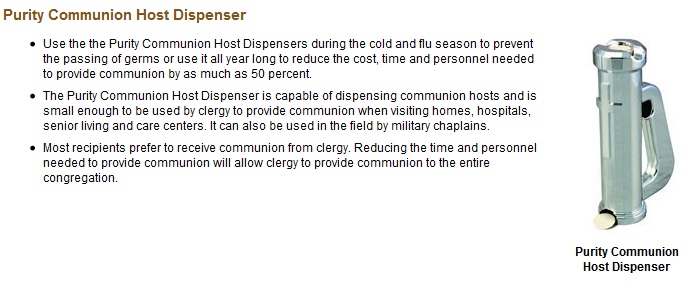
This comes to you from purity solutions: "artistic World-Class Churchware Proudly Mass in the USA for Over 60 Years".

D’ya s’pose they have a ShamWOW in liturgical colors for those pesky Precious Blood Dispenser accidents?

UPDATE:

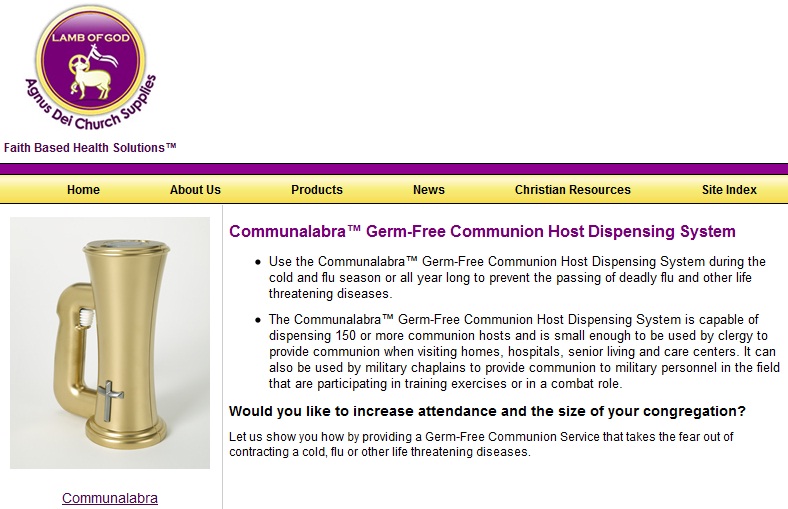
Okay… I thought at first…. this is a fluke… but now I see there is a regular industry around the idea.

Ohhhhhh... no. That's just... wrong!

A better look…

And look at that great button!

Ohhhhhh... no. That's just... wrong!

Posted in SESSIUNCULA | Tagged
84 Comments

CNN: Online churches draw believers and critics

Catholics have a very immediate and personal experience of sacraments.  We know we have to be there.

But there are different kinds of presence, aren’t there.  A person can be present at, say, Holy Mass, and yet have his mind a thousand miles any.  A person might with great longing desire to be present at Holy Mass, and yet physically be a a thousand miles away.  Through technology we are have a kind of presence with events which are taking place live.

We cannot receive Holy Communion unless we are physically present, but can make spiritual communions.  We cannot be confirmed unless we are physically present or receive absolution unless we are physically present where the sacraments are celebrated, but we can beg forgiveness and ask God for strength anywhere.  Not the same thing, but not nothing.  We must be physically present to be ordained or be anointed or be baptized: period.  There are possibilities about marriage at some distance, but this is very rare.

In this week’s issue of the UK’s Catholic Herald I have a piece about the need for dioceses to have a point man for ministry on the internet, a Vicar for Online Ministry. 

Then I read this.

This is from the site of CNN with my emphases and comments.

CNN: Online churches draw believers and criticsOnline churches draw believers, critics
By Anne Hammock, CNN
November 15, 2009 — Updated 1418 GMT (2218 HKT)

(CNN) — Hjalti á Lava was searching his iPhone for a Bible app when he stumbled across Church Online, a service of Web site LifeChurch.tv. Soon he was regularly logging into the Oklahoma-based cyber-church — some 4,100 miles away from á Lava’s home in the Faroe Islands, west of Norway.  [And it wasn’t a Catholic site, was it.]

"It allows me to connect with others and have conversations about the message," says á Lava, who shares his faith with other believers in the site’s live chat room. "Technology allows us today to have fellowship across borders and cultures."

In doing so, á Lava joined growing numbers of Christians worldwide who are migrating from the chapel to the computer. A map on the Church Online site showed users from 22 countries logged into a recent service.  [And let us not deceive ourselves: some of them are Catholic.  Some of them, looking for something, would resonate with a Catholic message.]

Online religious services offer convenience to those who are too isolated or infirm to attend a real-world church. But can worshipping via a computer offer true spiritual fulfillment?  ["Fulfillment"?  It depends on how you define that.  Something, sure.  Everything?  No.]

Internet pastors and parishioners cite their 24-hour access to interactive tools and social-networking platforms to show their online experiences are as meaningful as those that take place with face-to-face congregations.  [As meaningful?  I wonder.  Different, but "as meaningful"?]

"We were blown away at how people could actually worship along [online]," says Craig Groeschel, senior pastor at LifeChurch.tv. "The whole family will gather around the computer, and they’ll sing and they’ll worship together. Instead of trying to get people to come to a church, we feel like we can take a church to them."

But critics believe virtual worship separates followers from a trinity of spiritual essentials found in brick-and-mortar Christian churches: community, Communion and connection with Christ.

"Online church is close enough to the real thing to be dangerous," ["dangerous"] says Bob Hyatt, a pastor who leads the brick-and-mortar Evergreen Community Church in Portland, Oregon. In a blog post for ChristianityToday.com, he writes that calling it virtual church "gives people the idea that everything they need is available here."

The debate is an extension of a wider argument over social interaction in virtual environments versus the physical world. But because practices of faith are involved, both sides are deeply invested in the outcome, seeing it as a statement on the nature of the Christian person’s relationship with God.

Supporters of online churches have a common response to their skeptics: Try before you criticize. The virtual experience goes far beyond using live chat rooms to exchange emoticons instead of hugs and handshakes, they say.

Links allow congregants to "raise their hand" and publicly commit to Christ, [So, basically evangelical funamentalists are getting into this.  What are we doing as Catholics?] while prayer requests and one-on-one guidance are a click way. [Okay!] Sermon notes can be shared and discussed. And many online churches are aided by volunteers, allowing them to hold services several times each day.

The Internet campus [!] of the Flamingo Road Church in Cooper City, Florida, pulls in more than 2,000 congregants from around the world during its Sunday services. [!] Pastor Doug Gramling said his three children are part of the Internet generation that will eventually decide the future of worship. They use Web tools to stay in constant connection with friends over vast distances, which Gramling says "gives me confidence that it can happen in online church."

But the disconnect from physical closeness is what Hyatt said he’s "fighting hardest against." His own church offers online extensions such as podcasts and forums. But he believes "the computer screen is a supplement, not a replacement."

Hyatt and other critics are particularly distressed by the online offering of traditional sacraments, such as Communion and baptism. He believes it is "ridiculous" that someone can grab grape juice and a cracker from the fridge and watch a computer screen, thinking they are truly participating in a gathering of the faithful.  [Yah, and from a Catholic point of view, that is pretty crazy.  But try to explain why that isn’t okay from an evangelical point of view. ]

"Something about the physical presence, breaking the same bread, is what Communion is meant to be," he says.

But Church Online participant Donna Cole disagrees.

"Knowing that others are also celebrating Communion, regardless of location, [note how subjective this is] makes it an especially wonderful time," says Cole, who believes real-world Communion can ring hollow. "When I’ve taken Communion in live surroundings, I often got the sense that it was ritualistic and without meaning."  [Feelings drive a lot of this.]

Matthew Bailey, a parishioner in the Franktown United Methodist Church in Virginia, believes that the meaning of the ritual is what matters.

"If people are willing to go to the trouble of giving their own Communion, then it is quite probably ‘real’ for them," he says. While Bailey chooses to remain at his face-to-face church, he believes any person "faithfully attending an online church service, is being more proactive, and thus probably more attentive, than many longtime churchgoers."

Douglas Estes, lead pastor of Berryessa Valley Church in San Jose, California, and author of "SimChurch," a book about Internet church services, would like to see this debate go away.

"The Bible sees church not as a man-made building but as a people gathered to glorify God with their lives," he says. Estes believes the quality of a community should be judged by the spiritual fellowship it offers.

"There is only one substantive difference between an online church and a brick-and-mortar church: The place where they meet."


Discuss!

Posted in Our Catholic Identity, SESSIUNCULA, The Last Acceptable Prejudice | Tagged , , ,
26 Comments

PODCAzT 94: PART II – 40 years ago… Paul VI on the eve of the Novus Ordo

Since I killed the plugin: here is the file

Be careful if you have headphones or earphones… the beginning is a bit jarring.  I meant it to be jarring.


ORIGINALLY POSTED 20 Nov 2009:

Based on your response to PODCAzT 93, and my own desire to drill more deeply into the issue, we welcome back as our guest Pope Paul VI (+1978).

In the last PODCAzT we explored Paul’s General Audience of 26 November 1969, a few days before the Novus Ordo Missaewent into force.  This time we turn the clock back one more week to his General Audience of 19 Nov 1969 when he begins to address the changes people were about to experience.

We are coming up on the 40th Anniversary of the implementation of the Novus Ordo in the Latin Church.

That was Forty years ago on 30 Nov 1969 .  It was the 1st Sunday of Advent.PODCAzT 94: PART II - 40 years ago... Paul VI on the eve of the Novus Ordo

We are facing our own challenges today, with changes to the English translation and also the reintegration of the pre-Conciliar form of Mass in the life of the Church, thanks to Benedict XVI’s Summorum Pontificum.

The questions Pope Paul asked back in 1969 are valid for us as well.

You will hear Paul Paul’s General Audience text along with my commentary.

Be careful if you have headphones or earphones… the beginning is a bit jarring.  I meant it to be jarring.

Posted in New Translation, Our Catholic Identity, PODCAzT, The Drill | Tagged , , ,
56 Comments

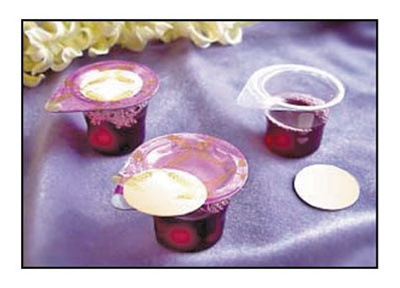
If you liked the communion host PEZ dispenser, your gonna flip over this!

I am not making this up.

A reader sent a note with the simple message…. "I’ll see your Communion Host dispenser… and raise you…."

If you liked the communion host PEZ dispenser, your gonna flip over this!

"… pre-filled Communion cups and wafers!"

Yes, folks, we can now beat that pesky Swine Flu with these.

Please note that this is NOT a Catholic company, okay? Don’t freak out or be giving them grief.   This is NOT intended for Catholic worship.

But I thought you would enjoy that anyway.

If you liked the communion host PEZ dispenser, your gonna flip over this!

Posted in Lighter fare |
26 Comments

10-14 December – Vancouver

I will be in Vancouver, BC to speak at a meeting of Una Voce and to celebrate Holy Mass for the occasion.

I look forward to seeing that famously beautiful city!

Posted in What Fr. Z is up to | Tagged ,
Comments Off on 10-14 December – Vancouver

Bosnian Card. Puljic denies claims of Vatican commission about Medjugorje

From CNA with my emphases and comments:

Bosnian Cardinal denies claims of Vatican commission for Medjugorje

Sarajevo, Bosnia and Herzegovina, Nov 20, 2009 / 11:45 am (CNA).- Cardinal Vinko Puljic, Archbishop of Sarajevo and President of the Bishops’ Conference of Bosnia and Herzegovina denied press reports yesterday which claim that the Vatican is creating a commission to investigate the alleged apparitions of Medjugorje. 

The cardinal, who is visiting Rome to attend the plenary session of the Congregation for the Evangelization of Peoples, of which he is a member, said that the Congregation for the Doctrine of the Faith is neither preparing a document nor establishing a special commission to study the Medjugorje apparitions.

Cardinal Puljic said that the official position of the bishops of Bosnia and Herzegovina is the one expressed by the then Bishops’ Conference of Yugoslavia in April 1991.

That statement not only expressed the episcopate’s support to then-Bishop Pavao Zanic of Mostar – where the town of Medjugorje is located – but explicitly said that,[pay attention…] “based on previous research, it cannot be affirmed that these events concerning apparitions and revelations are of supernatural nature.”  [That doesn’t say "it cannot be denied"….]

“The doctrinal issue of the Medjugorje phenomenon is resolved, but its pastoral significance must still be taken into account,” the cardinal continued.  [NB: "pastoral significance".  Many people report experiences of conversion because of this… phenomenon.]

“The Medjugorje phenomenon is not only gathering faithful from Bosnia, but from all over the world, and in places where people gather to pray, God gives his blessing. Therefore, we should carefully examine all sides of this phenomenon,” he added.

Nevertheless, he reiterated, “for the moment, everything is under the jurisdiction of the local bishops.”

“Still, at any given moment, the Congregation for the Doctrine of the Faith could establish an International Commission in order to study the case of Medjugorje,” the cardinal remarked.

Speaking at the 2004 assembly of the Synod of Bishops, Cardinal Puljic complained that the reported apparitions of Medjugorje were “becoming a source of division in the Church.” In 2006, the cardinal was involved in setting up a commission concluding that the alleged Marian apparitions were not supernatural.

Posted in SESSIUNCULA | Tagged ,
22 Comments

Anglican Archbp. Williams to Rome: set aside issue of female bishops

From the liberal daily The Guardian comes this with me emphases and comments:  

Rowan Williams urges Rome to rethink position on female bishops
 

    * Riazat Butt and John Hooper in Rome
    * guardian.co.uk, Thursday 19 November 2009 19.50 GMT

The archbishop of Canterbury insists there is more uniting Anglicans and Catholics than dividing them.

The archbishop of Canterbury today pleaded with Roman Catholics to set aside their differences with Anglicans over the issue of female bishops, [?] insisting there was more uniting the denominations than dividing them.

Rowan Williams was giving a lecture in Rome before Saturday’s meeting with the pope, their first encounter since the Vatican’s surprise announcement of a special institution for traditionalist Anglicans wanting to convert to Catholicism.

In his address at the Gregorian University, Williams said the Anglican communion was proof that churches could stay together in spite of their differences.  [And what a great job they have done of it!]

The communion has teetered on the edge of schism for nearly a decade over the issue of gay clergy but has retained a sliver of fellowship. Williams urged Roman Catholics to continue their 35-year dialogue with Anglicans in spite of theological and ideological divisions.  [I don’t think there was any question of that.]

He said: "The various agreed statements of the churches stress that the church is a community, in which human beings are made sons and daughters of God.

"When so much agreement has been established in first-order matters about the identity and mission of the church, is it justifiable to treat other issues as equally vital for its health and integrity?"  [So… what would those secondary issues be?]

Those issues included papal primacy, female clergy and the relations between the local and universal church in making decisions. "Is there a level of mutual recognition which allows a shared theological understanding of primacy alongside a diversity of canonical and juridical arrangements?" he wondered.   [In other words, forget about the Petrine dimension of the Church and accept women priests and bishops… for the sake of these other "first order" matters, which I assume would be something like belief in the Trinity, Incarnation, Resurrection, etc.]

Williams challenged Roman Catholic thinking on female bishops, saying there was no proof that their ordination damaged the church.  [You mean other than the fact it is it contrary to the God’s will, the Christian tradition, and the obvious rifts it has caused in the Anglican Church.  Hey!  Other than that, its fine!]

For his part the "ecumenical glass" was "genuinely half-full". [Why wouldn’t people want a fuller glass?] Catholics and Anglicans had achieved "striking" agreement on the broader questions. All that stood between them now were the "second order" issues of church organisation.  [If ordination is solely about "organization", then Williams has a point about female clergy.  In that case, anyone who is competent can do it.  But the nature of the clergy, the priesthood in particular, is of fundamental importance to who the Church is.]

In an explicit but fleeting reference to the pope’s move last month, Williams said it was an "imaginative pastoral response, but did not break any new ecclesiological ground." His speech was aimed at reviving dialogue between Anglicans and Catholics. But it also carried an implicit threat that there would be little point in continuing if the Catholic side continued to insist that the obstacles were insuperable.

Williams said: "The question is whether this unfinished business is quite as fundamental as our Roman Catholic friends believe."

He seemed tense, biting the sides of his fingers while he listened to the speaker who followed. His anxiety is understandable.

Bishop Brian Farrell, the secretary of the Vatican department that deals with ecumenical dialogue, told him: "You have certainly presented us with a challenge." [Which is pretty much a way of saying, politely, "Nice try."]

Posted in SESSIUNCULA | Tagged ,
47 Comments