QUAERITUR: When can I say a Requiem TLM?

From priest reader:

I just started praying the usus antiquior low mass after a year of preparation (of latin and the rubrics).

Question:  When may I opt to say a missae defunctorum?  When may I not?  In other words, may a missae defunctorm be chosen over a 3rd class feast, etc.?

First and foremost, thank you for learning the older form, traditional form of Mass.  I am always happy to learn that another priest is not ignorant of our common Latin Rite.  Kudos to you.  I am also hoping that you are young, so that you can say this form of Mass for many many years for many many people.

There are those special occasions as in, for example, when people die or it is the anniversary of their death.  However, I think what you are aiming at is really the daily Requiem Mass.

The rules for these daily Requiem Masses are along the lines of the rubrics for votive Masses.

A Requiem is of the 2nd class on the day of death (or getting news of the death) or on the day of burial.  That’s the Missa in die obitus seu depositionis defunctorum. It is of the 3rd class on the third, seventh, and thirtieth day after the death or burial.

A "daily" Requiem is 4th class and can be used on ferial days of the 4th class.

So… tomorrow 16 September is the Feast of Ss. Cornelius and Cyprian.  It is a 3rd class feast.  But the day after tomorrow, 17 September, is a "dies non", a 4th class feria.  You can say the "daily" Mass for the Dead, the Missa quotidiana defunctorum.

I hope that helps.

And remember that there are some differences in the Requiem Mass.  You exclude the Iudica me at the beginning, and do not bless the water.  Kiss the altar at the end, but don’t give the final blessing before the Last Gospel.  Leave off the gloria after washing your fingers and exclude the first of the three private prayers before your Communion.  The Agnus Dei is a little different and your say Requiescat in pace for the dismissal.

So, Father, put on those nice black vestments.  Put those unbleached candles on the altar and fire ’em up!

Posted in "How To..." - Practical Notes, ASK FATHER Question Box, Brick by Brick, Mail from priests, SUMMORUM PONTIFICUM | Tagged ,
25 Comments

QUAERITUR: may a permanent deacon be a deacon for a TLM?

From a reader:

As part of the changes recommended by the Second Vatican Council, Pope Paul VI brought back the permanent diaconate in 1967.  For centuries prior to this change, the role of deacon was a transitional period for those preparing to become priests.  Since TLM Masses and parishes are normally working according to the 1962 Missal, what role does the permanent diaconate have in a TLM?  Is this considered a reform-of-the-reform issue (ie. emphasizing the role of deacon as transitional period for aspiring priests), or is it a non-issue?


This is a non-issue.

A deacon is a deacon is a deacon.

Permanent deacons or transitional deacons, either way, may fulfill the role of deacon or subdeacon during a solemn TLM.

Some will say they can’t or shouldn’t.  They are simply wrong.

Posted in ASK FATHER Question Box | Tagged ,
51 Comments

Many registrations approved

I just approved a whole bunch of registrations for the blog… in case you were waiting or couldn’t get your log in to work.

You must register and log in to be able to post.  I must approve the registration before you can use it.

Also, it may be that some people have trouble logging in even after I approve the registration.  You might have to drop me a line with your username.  I will look to see if there is a problem and maybe give a new temporary password which you can change.

Posted in SESSIUNCULA |
Comments Off on Many registrations approved

QUAERITUR: Why give the liberals so much attention?

Quite a few have asked in e-mail, some in comments, why I should give so much attention to liberal dinosaurs such as Richard McBrien of Notre Dame, to dissident publications such as NCR, America, RU-468 (aka The Tablet).

I wonder about that too.  Even as I post about them, I wonder if I am not just propping them up a little longer by giving the impression more people read them with attention than actually do.

But no… some response must be made.

The way I figure, they are rather like the old Batman villains.

Batman villains are clearly ridiculous, but you still have to defeat them.  They hurt people.

Editors of the NCR, Tablet, America, Commonweal

Posted in SESSIUNCULA |
34 Comments

NCR instrumentalizes priest to attack his own bishop, Bp. Robert Finn

The editors of the ultra-lefty National Catholic Reporter once again show their spittle-flecked contempt for the diocesan bishop where their paper’s offices are located: Most Rev. Robert Finn, Bishop of Kansas City-St. Joseph.

NCR published a letter from a priest of the Kansas City, MO diocese, Fr. Michael Gillgannon to Bishop Finn. 

The letter reveals the thought processes and categories of the deeply entrenched left-leaning Catholic liberal democrat now evolving into a mean-spirited whiner in the face of a shifting American episcopate.

Fr. Gillgannon’s letter is far too long, and not always very interesting since it is pretty much a recitation of the left’s talking points.  I won’t do a full fisk here.  But there are a few passages to highlight.  First, however, let’s see NCR’s intro about who the writer is, before the text of Fr. Gillgannon’s letter which they (but not I) print in full.

My emphases and comments.

Kansas City-St. Joesph diocese priest criticizes his bishop’s leadership
By Thomas C. Fox
Created Sep 15, 2009

Michael GillgannonMichael GillgannonFather Michael J. Gillgannon, a widely respected missionary priest of the diocese of Kansas City-St. Joseph, has written an open letter to his bishop, Robert W. Finn, taking strong exception to his leadership.

…. 

Ordained in 1958, Gillgannon began his career in campus ministry in 1962 at Western Missouri State University. In 1966, he served on the advisory committee of the U.S. Catholic Bishops’ Conference for the post-Vatican II reorganization of Catholic Campus Ministry in the United States. [And wow! Has that been great!] Since 1974, he has worked as a missionary in La Paz, serving as pastor of San Antonio Parish, as episcopal vicar of the Eastern Deanery of La Paz, and as national chaplain for Bolivian Campus Ministry. He is the founder and director of campus ministry for the La Paz, Bolivia Archdiocese and and occasional writer for NCR.

    September 11, 2009
    Dear Bishop Finn,

    Greetings from Bolivia. …

…

   …  You have made many changes in the diocese since you came with a particular agenda. You appear to me and many priests of my generation who lived the Spirit filled days of Vatican II as one whose task is to reverse the changes of that great event. You have given the impression that your changes were for the sake of a narrow “orthodoxy” which seems to imply that the bishops and priests and laity before you were not orthodox.  [If the shoe fits, Father, if the shoe fits…  It is clear, however, that the writer is wholly convinced and entrenched in his position and that he belongs to the "rupture" crowd, not the "continuity" contingent.]

… You give the impression you are not working from a pastoral model of unity with respect for diversity, a more traditional Catholic practice, but from an ideological desire for a narrow uniformity and an even narrower spirituality.

    More recently, however, I have been deeply concerned by your pastoral document, co-authored with Archbishop Naumann, on health care in the United States. Many priests and laypeople have wondered about your applications of the principles of Subsidiarity and Personal Responsibility. [And here is a talking point straight from Pres. Obama’s stump speeches… which POTUS himself is now backing away from…] 47,000,000 citizens in the world’s richest country are without health care. The national arguments for change have been going on for years. We cannot leave those poor without care. Your document seems to say the poor must fend for themselves and take better care of themselves. [Nice way to talk to the bishop, right?] …

…

   Another problem of concern is the pastoral document on the 2008 elections you authored. You, Bishop, and many bishops of your generation,  [Remember McBrien’s whine about the change in the episcopate?  This is a serious nightmare for the editors of the NCR, it seems.  They are obsessed with this.] seem to be proposing [wait for the cliche…] a one-issue public dialogue on political candidates and platforms which deny the Catholic Tradition of social teaching on a wide range of issues expressed in the Seamless Garment social teachings of Cardinal Bernardin and his generation of prelates. [What a revealing phrase that was!] And which I was taught in the seminary of the ’50s and later in the documents of Vatican II.  [Note how the writer puts all these on pretty much the same level.]

    Later when some 60 or so Catholic Bishops of your generation condemned [gasp] the new president on pro-life issues you failed as teachers. [Nice, huh?  Remember, this is a priest writing to his own diocesan bishop in a "Catholic" newspaper published in that same diocese and then distributed in print and on the internet.  This is public.]  Your style and your strategy finds resonance with [cliche alert] only a small segment of the Church [I have written about this tactic several times.  Liberals of the McBrien and NCR stamp will always try to minimize the numbers of those who are conservative of traditional.  It is an attempt to trivialize the opposition and give more weight to their own positions.] and the wider American public you would like to influence. You may think of yourself and the others as defending human life by speaking the “truth” to power but you seem to most of us as pushing your own political agenda [You knew it had to happen.  The writer’s letter sounds as if it were written with talking points from ACORN and the DNC, but it is the bishop who is being political!] and not the wisdom of Catholic teaching. [Which he knows and the bishop obviously doesn’t.] And worse, you give the impression that those who disagree with you are opposed to the defense of life.  [Remember: this guy is a Bernardin/McBrien/Reese/Kmiec Catholic.]

 [Now, watch this….]   How pro-life have you been on Iraq and Afghanistan? Have you questioned the new American practice of hiring the poor and the marginalized without other job opportunities as mercenaries to fight and die in our wars? … Have you formed Catholic consciences on war and armaments and national defense budgets?  [blah blah]

…

    We have many wonderful values in our Church and in our country. But our civil and ecclesial divisions and the acerbic and accusatory tenor of our dialogues could end our acceptance of others and respect for difference. [Look who’s talking!] Particularly when ideologies replace reasoned pragmatic, but ethical, solutions. [Put down your coffee amd read this next part with amazement…] You do not have a coherent or compelling vision of Church teaching or of pastoral strategies that can convert people and change their attitudes and actions. That is why your leadership, and that of many other American Bishops, is questioned so deeply. Our church is more divided among leadership and faithful than at any time in my life of 76 years, and 51 years as a priest. We have to ask ourselves why so many Catholics are leaving the Church. Are they sinners? Or searchers? A search to which our in-house quarrels have not responded.  [Sounds like the same message NCR pushed through McBrien, right?]

…

   Sincerely yours in Christ,
    Rev. Michael J. Gillgannon


First, were I this priest’s bishop, I would be very tempted to suspend him if he did not issue a public apology in the same newspaper.  I would suspend him because of his public show of disrespect, amounting to an attack on the character of the bishop.  It is a clear attempt to undermine the bishop’s authority in his diocese, and harm his reputation in a contumacious way.  Had this letter been private, I would not go that far.  It is also possible that the priest in question wasn’t fully cognizant of what he was doing.  That would have to be assessed as well.

Second, I understand that Bishop Finn is a kind soul, but I wonder how much longer he will put up with the National Catholic Reporter before he does something about it using the word "Catholic" in its name.

Third, NCR is filled with boot-shaking, pants-wetting, blood-chilling terror at what is happening in the episcopate of the Church in the United States. 

Lastly, shame on the editors of the NCR for using this old priest, for their own hateful purposes.  Shame on them.  Even the the priest was a willing victim, shame on them.

Posted in SESSIUNCULA, The Drill | Tagged ,
42 Comments

QUAERITUR: isn’t it “inappropriate” to have the Extraordinary Form?

From a reader:

I’ve enjoyed reading your blog lately, although it has been somewhat frustrating as I tend to disagree with most of what you say.  My question, which is an honest one, is how people could genuinely either attend or preside, on a regular basis, the Extraordinary Form.  Doesn’t the mere classification of Extraordinary indicate that it should not be celebrated and/or led on a regular (i.e., ordinary) basis?  Therefore, wouldn’t the regular celebration of the EF be inappropriate?
 
Seriously, this is an honest question.


Anyone?

Posted in SESSIUNCULA |
43 Comments

Murder of Michigan pro-lifer a ‘non-story’ for Obama Catholics

Murder of Michigan pro-lifer a ‘non-story’ for Obama Catholics

From CNA.

Posted in SESSIUNCULA |
13 Comments

Cry Baby McBrien has better ideas for “Year for Priests”

Don’t be shocked.

I may actually agree with some points in the following article from the ultra-lefty NCR by the liberal Richard McBrien, dissident priest employed by Notre Dame to teach, mirabile dictu, theology.

Don’t be alarmed.  Broken clocks are also right once in a while. 

But … wait… the things I agree with below were not actually McBrien’s ideas at all!  

My emphases and comments.

Cry Baby McBrien has better ideas for "Year for Priests"Alternate thoughts for this Year for Priests
by Richard McBrien
on Sep. 14, 2009

Pope Benedict XVI declared this a Year for Priests, beginning on June 19, the feast of the Sacred Heart, and ending next June with an international gathering of priests in Rome. The pope named St. Jean Vianney, the Curé d’Ars, as universal patron of priests to mark the 150th anniversary of his death.

As part of the year-long observance there will be an international priests’ retreat in Ars, France, sponsored by the Vatican’s Congregation for the Clergy, from September 27 to October 3, and a symposium on the "faithfulness" of priests at The Catholic University of America Oct. 6-7.

Undoubtedly, [here we go…] the pious thing for most priests to do is to get fully into the spirit of this Year for Priests and for lay people to renew their appreciation for the good work that so many priests have done and continue to do in the life of the church.  [Remember: For McBrien, "pious" and "piety" are tantamount to dirty words.  Remember how McBrien denigrated piety and devotion in his attack on Eucharistic Adoration.]

But there is a more realistic dimension to this Year for Priests, [So, let’s get this straight.  Pope Benedict designates the parameters of the Year for Priests and its official celebrations but McBrien has better ideas.] and it is one that never sees the light of day in most of the diocesan papers in the United States and Canada because bishops will not permit any discordant opinions to be expressed.  [Two things.  I think it is not an exaggeration to suggest that most of the nation’s diocesan papers for the last few decades have entirely open to "discordant opinions", particularly with those out of harmony with the Church’s teachings.  Second, now that a new generation of bishops are cleaning up their diocesan newspapers, discordant Catholics are whining about unfair treatment.]

One such voice, that of a priest ordained almost 40 years, has expressed the views of fellow priests — not all, perhaps not even most, but definitely many.

Apart from this week’s column, his views and theirs have heretofore not been heard, much less taken into serious account by the Vatican or by many bishops in this "Year for Priests."

My priest-correspondent [unidentified.  Perhaps McBrien himself?  Nah….] has identified 10 issues that priests need help in facing — help that will not be forthcoming at symposia on the "faithfulness" of priests, nor at international retreats in France.

1. The shortage of diocesan priests cannot be addressed by band-aid solutions, like inviting priests from foreign countries to engage in sacramental ministry in dioceses with sharply declining numbers of domestic vocations. There needs to be a public discussion, involving priests themselves, concerning obligatory celibacy and its pastoral ramifications.  [Uh huh … that has worked for Anglicans and Protestants of all stripes.  But there is something to this: greater energy must be applied to future vocations.  Funny how, where the bishop is solid and traditional liturgy thrives, where catechism is good and where priests take this issue serious, there are many vocations.  Strange, no?]

2. Many priests do not perceive themselves to be close collaborators with their bishops, as Vatican II envisioned them to be (Decree on the Ministry and Life of Priests, n. 7). Too few bishops reach out to their priests to ask for their honest opinions about anything that seriously affects the life of the church and the priesthood.  [I am pretty sure many priests have this same opinion.  The "close collaborator" of the bishop has been pretty much a myth for a long time.  But then, I ask, now that the body of bishops is shifting, now that it reflects the "John Paul II priests" and bishops, now that the biological solution is shifting the liberals of past decades into the background, … I wonder if that will change?  I have found that liberals, dissidents, are far far more autocratic, cold and remote than more traditionally minded Catholic bishops.  The more conservative new bishops I have met and heard about in the last few years have presented themselves as warm and cordial.  Liberals prefer to dwell in light inaccessible.  They issue orders from on high with little regard for the opinion of priests in the field.  The same goes for pastors in regard to their assistants.  Is that unfair?  Inaccurate?  Perhaps priests might chime in with their own views on this.  Priests… since this is about bishops and priests…]

3. Many diocesan priests still feel betrayed by their bishops with the passage in 2002 of the Dallas Charter. Priests who have been accused by anyone of any sexual impropriety whatever with minors have been summarily removed from the active ministry. At the same time, no bishop, other than one cardinal-archbishop, has been forced to resign because of his mishandling of the sexual-abuse scandal.  [Again, I think this is an accurate statement.  Priests I know were outraged and demoralized when they realized that the bishops, at Dallas, exempted themselves from the norms they applied to priests and deacons.  I still hear priests talk about this very point.]

4. There is a growing rift between so-called "Vatican II priests" and so-called "John Paul II priests," which is painfully evident in some dioceses when priests gather for the Eucharist at retreats and other diocesan events.  [It is interesting to find on one side younger priests together with those priests, now much older, who were active for sometime before the Council and then, on the other hand, those who were formed especially during the late 60’s through around the late 80’s.]

Cry Baby McBrien has better ideas for "Year for Priests"5. There is a concomitant return to clericalism in the priesthood, involving not only a fascination with cassocks and birettas and a preference for antiquated vestments and devotions, [Remember: McBrien thinks that Eucharistic Adoration is an antiquated devotion which does harm to people.  And he has been teaching for a very long time at Notre Dame.  Think about that.] but also a negative, censorious tone to preaching and a cavalier dismissal of consultative structures that are supposed to be in place in every parish.  [This whole thing smacks of sour grapes and narrowness.  First, note the censorious tone the writer himself uses.  I will counter that no traditionally minded or conservative priest comes anywhere close to the sneering, domineering clericalism of the liberal.  Consider, for example, the corrosive clericalism, the condescension shown toward lay people especially by liturgical progressivists: by abdicating their own clerical role and improperly handing it over to lay people, they are effectively saying to lay people that laity are not of their own good enough.  They have to do things priests do in order to be involved or participate actively etc.  They strip lay people of their own dignity. Furthermore, I know a lot of young priests who are indeed fascinated by cassocks and birettas.  Wearing a cassock in church or around the parish is hardly odd.  Birettas are perfectly acceptable.  Very few of priests I know, however, are interested in these externals in an unhealthy way.  And they change as they get older.  But consider that these things and nearly their entire liturgical and theological heritage was robbed from them by liberal seminary faculties – men like McBrien –  and progressivist pastors and bishops.  If young priests are interested in these things, and liberals don’t like it, then liberals have also themselves to blame.  Moreover, the young priests I know, far from being uninterested in "consultative structures" are deeply grateful that they have such help!  Because of the destruction of priestly vocations inflicted for decades by liberals, these priests now are over worked and need the help.  I think the writer is talking about "consultative" structures which are really "congregationalist" structures, which would tell the priest what to do and keep him in the role of magic man for sacraments, smiling a lot, affirming whatever doctrinal and moral aberrations people might slide into because of the attacks of the world, the flesh and the Devil.]

6. At the same time, the Vatican and the bishops have failed to address concerns raised by the disproportionate number of gays in seminaries and the priesthood, including also the hierarchy. It is the elephant in the living room, as pointed out almost 10 years ago in Fr. Donald Cozzens’s The Changing Face of the Priesthood. Yet how many priests’ retreats and clergy conferences have used that book as a basis for discussion?  [In fairness, I have not read Cozzens’s book, and so cannot comment.  But I don’t think it is fair to say that the Vatican and bishops have failed to address the problem of openly or actively homosexual priests.  First, and no one can deny this, though the Dallas norms had their flaws, cracking down on pedophiles was also a way of dealing with homosexuality.  Second, the Holy See has in recent years made it pretty clear that men with homosexual tendencies don’t belong in seminary programs.  Did the writer forget the 2005 document, “Instruction Concerning the Criteria for the Discernment of Vocation with regard to Persons with Homosexual Tendencies in view of their Admission to the Seminary and to Holy Orders"?  Review it HERE.]

7. There has been a substantial attrition of Catholics — women, gays and lesbians, divorced people, critics of official teachings on sexuality and reproduction — from active membership in the church, to the point where fully one-tenth of the U.S. population now consists of ex-Catholics. What is being done about it?  [I suppose we are simply waving goodbye.  If people don’t like the teaching of the Church and won’t accept it, what are we supposed to do?  Change the teaching?  Soften the teaching?  People have always left because of hard teachings.  It has ever been so.  However, from another point of view… I believe that as a shrinking Church examines her ways and goals and revitalizes her own identity, eventually how she works will be more and more coherent with what she teaches.  Perhaps that will persuade some of those mentioned above not to abandon the one Church the LORD established.  Perhaps they will rather change their ways and form their consciences properly.  Remember: if all those people left, they left during the time of the ascendancy of liberals, not conservatives!  If the writer thinks they are just leaving now, when a few more conservative bishops and priests have come on the scene, then he is delusional.]

8. Resigned priests are treated like traitors. To be sure, some bishops welcome them back at clergy reunions, but others boycott such gatherings as a sign of their contempt. [This is a little too broad.  I think the writer really means that priests who left active ministry for one reason or another, with or without a dispensation, should simply be "reactivated" and allowed to function as priests again.  That is one point of view and it is up to the hierarchy to figure that out.  My guess here is, however, that if this isn’t McBrien’s own list, then it is the list of a priest who left active ministry.  That is why he is cagey about the identity of this priest.]

9. Appointments to the hierarchy since the pontificate of Paul VI have been of a certain type. [Hear the disapproval?] Those who do not fit the official profile are excluded from consideration or are harassed by Vatican officials if they are already bishops.  ["harassed"?  As in… "Your Excellency, this dicastery is in receipt of correspondence from members of the faithful within the bounds of the diocese entrusted to Your Excellency’s care.  The correspondence includes many documentary proofs of the claims made therein.  Concerns have been sent, together with proofs, about wide-spread liturgical abuses, poor catechetical practices, heresy taught in the diocesan seminary and in the theology department of the local Catholic university, sudden and unfounded removal of priests from mandates, and statements of questionable orthodoxy made by Your Excellency’s diocesan newspaper.  Please note that that aforementioned list is not to be considered exhaustive.  In light of these documents, Your Excellency, it is considered opportune that Your Excellency might, in a congruent period, present Your Excellency’s Reverend … Person, in the offices of this dicastery so that we may explain to Your Excellency the situation."  That sort of harassment?  Liberals often consider the presentation of facts, documents, and the Church’s laws to be harassment.]

10. So many senior priests say to their friends, "I can’t wait for retirement." Why this sense of discouragement over the present state of the Church, bordering sometimes on hopelessness?  [Oddly, the priests who tend to stay in the saddle and keep working are those who side with those younger, more conservative young priests. They are elderly priests who aren’t lugging around the baggage of post-Conciliar formation.  It is precisely the liberals, the aging liberals, who want to retire quickly.]

Alternate thoughts for this "Year for Priests."

So… my thoughts alternating with those alternate thoughts.

I don’t know… maybe I am wrong here… but…

I have the impression that McBrien isn’t happy as a priest.

He trashed Eucharist Adoration and all the people who venerate the Blessed Sacrament.

Now he trashes the Year for Priests… and by implication those who have embraced this special Year.

It must be very difficult, despite his present position, to watch everything he has worked towards for decades crumbling and slipping between his fingers.

Once so revered, so powerful….

He is now less and less relevant to… well.. any discussion. 
It must be very hard.

Cry Baby McBrien has better ideas for "Year for Priests"

Posted in SESSIUNCULA, The Drill |
78 Comments

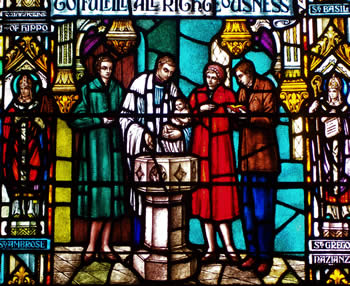
QUAERITUR: baptism during Sunday Mass… seemed incomplete

QUAERITUR: baptism during Sunday Mass... seemed incompleteA question from a reader:

I thank you for taking the time to read this.  I have been a loyal daily reader of your blog for a long time now.
 
My son was baptized in our parish church this morning during the 9 AM mass.  The priest conducted the ritual after the gospel and before his sermon.  I knew before that this priest was very liberal and has taken liberties before, but I was disheartened at what happened during the baptism.  We were invited up to the font and immediately Father began by lighting a candle and asking what name did we give to my son.  He then continued by saying some "off the cuff" commentary, crossed the sacred crism on the baby’s head then proceeded to pour the water "in the name of the Father, Son, and Holy Spirit." "Recieve the light of Christ" was then said and the candle was handed to us. No other rites were observed or administered and we were then told that he had finished and we were to go back to our pew.
 
Being an altar boy for many years during my childhood, I know that there are a few other rituals that accompany baptism and I was disappointed that they were not done.  I know that the baptism was still valid in its most basic form, but I wonder how much my son was deprived of.  Is this a common trend of many priests presently? Should I try to find another priest who will administer the other parts of the sacrament?  Did my son receive all of the grace that is intended my the Church for baptism?  If you have time, please advise.  Thank you in advance.

I know that baptisms are permitted during Sunday Masses, though I am  not especially a fan of that practice.  I have not been in a parish where baptisms are done that way, nor have I as a priest ever done this.  Therefore, I am not as familiar with the rite of baptism during Mass as some other priests may be.

That said, I do know that when baptism is integrated into Holy Mass on a Sunday, parts of the regular rite of baptism are distributed over different parts of Mass.  For example, the right of reception is integrated into the beginning of Mass.  The Creed can be substituted by the baptismal form of the profession of faith, and so forth.

I am not quite sure exactly what happened at the Mass and baptism for your child, but I think your reaction is telling.  You sensed that there should have been something more.  You said that there was the anointing with chrism.  That was supposed to be done.  There was to be an exorcism before hand.  You said something about an "off the cuff commentary".  Not sure what that might have been.

Some people will say that baptism during Mass is "so very meaningful".   I think that the rite of baptism itself is meaningful and that rite, as a matter of fact, is the norm for conferring baptism.

To the meat of your question: No, you don’t have to find another priest to supply the parts of the rite you might not have witnessed.  If the priest poured the water and said the words of baptism, then your child is baptized.  Those other elements of the rite wouldn’t cause the child to be more baptized.  They might cause all of you who participated in the rite to have experienced the rite more fully, but the child wouldn’t be more baptized.  While we must avoid a "minimalist" attitude about our rights (i.e., so long as the matter and form were valid, that’s enough), in this case where the moment is over and in the past, I wouldn’t say that you should want to do anything over.

I want to add another thing, since this is the anniversary of the Motu Proprio Summorum Pontificum.

The provisions of Summorum Pontificum make is clear that the older, traditional form of baptism can be used.  Priests can use the old Rituale Romanum.  My personal view is that the older form of baptism brings people to an encounter with mystery in a way that the newer form does not.  I regret that some elements of the older form of baptism were omitted from the revised post-Conciliar form.

Finally, priests need to SAY THE BLACK AND DO THE RED.  Whatever rite they use, traditional or revised, they should stick to it especially so that doubts are not raised in the minds of the people present.

People have the right not to doubt or wonder whether or not a sacrament was valid or licit or whether something that should have been there was changed or left out.

Posted in ASK FATHER Question Box, SESSIUNCULA, SUMMORUM PONTIFICUM |
55 Comments

QUAERITUR: Solemn Pontifical Mass… proper terminology

From a reader in Japan…

Dear Father Z,

[I am] from Japan (therefore, I am sorry for my poor English).
I thank God for your great blog. My faith grows up everyday by reading your blog.

I have a question regarding "Solemn Pontifical Mass"… in OF.

In my diocese, once a year a Cardinal celebrates OF in Latin and Gregorian Chant, and this Mass is entitled "Solemn Pontifical Mass in Latin".

But Wikipedia says that "Solemn Pontifical Mass/ Pontifical High Mass" is for the Tridentine Mass. After the liturgical reform, categories (Low Mass, High Mass, Pontifical High Mass) were abandoned.

If there is no more "Solemn Pontifical Mass" in the reformed liturgy(OF), is the title of this annual "Solemn Pontifical Mass" inaccurate?
Or can we still use the category "Solemn Pontifical Mass" for OF as a sort of custom?

Who wants to help our friend in Japan with the terminology?

Posted in "How To..." - Practical Notes, ASK FATHER Question Box |
10 Comments