Oakland, CA – 20 Sept: Bp. Cordileone, Pontifical TLM

From a reader:

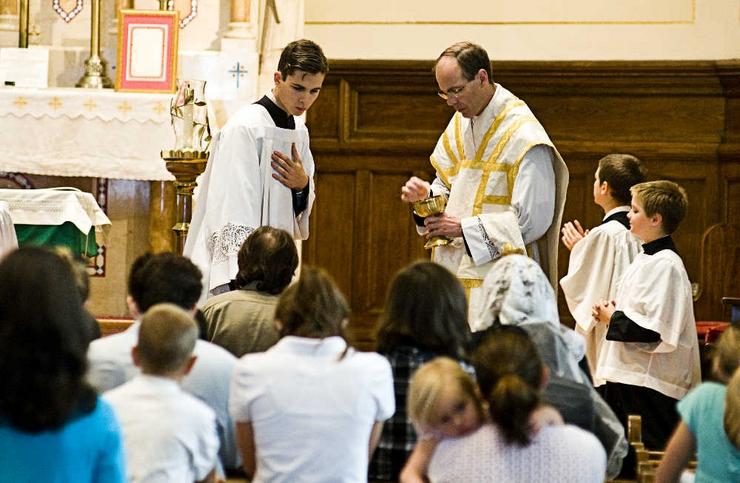
Next Sunday, September 20th, 2009, the Bishop of Oakland, California, His Excellency Salvatore Cordileone will celebrate a Solemn Pontifical Mass at Saint Margaret Mary to mark the 20th anniversary of the Traditional Latin Mass at the parish.  For the longest time, I believe it was the only parish in all of the East Bay and quite possibly the  entire San Francisco Bay Area, where the EF could be found.   The priest who first obtained the indult from then Bishop John Cummins, Fr. Vladimir Kozina, will be honored with the blessing and dedication of the parish hall in his name.  Of note, a second EF is now being celebrated in the diocese by one of the diocesan priests.  Hopefully my terminology for the Mass is correct, please correct any of my errors.

Posted in SESSIUNCULA |
7 Comments

Vulgar victory celebration

A blogger with Newsweek/WaPo, Anthony Stevens-Arroyo exults over the early retirement of Bp. Martino of Scranton with all the elegance of a face painted sportsfan on a car burning spree.

To give you some of his other accomplishments, Anthony Stevens-Arroyo agrees with Planned Parenthood.

The greatest irony about his vulgar writhe is that he is wrong about nearly everything.

Posted in SESSIUNCULA |
10 Comments

Episcopalians: old-style service drawing young crowd

Here is an interesting article from ljworld, the Lawrence Journal, about an Episcopalian church returning to a traditional… actually Roman… style liturgy and drawing in young people.  Big surprise!

My emphases and comments.

Archive for Saturday, August 29, 2009
Mass appeal: Old-style service drawing young crowd

By Sarah Henning

August 29, 2009

When introducing a new service these days, most churches seem to go the rock ‘n’ roll route — something new to bring in a younger crowd.

To say that Trinity Episcopal Church went in another direction might be a bit of an understatement.

When the church decided to add a new service in fall 2006, instead of looking forward, it looked back.

Way back. As in the fourth century.  [fourth?]

The result is a unique celebration of Christianity referred to as the Solemn High Mass.  [WOW! A "unique celebration"?  Where on earth did they get this thing!?]  A mystical [Okay… clearly the writer isn’t all that knowledgable about this Solemn High Mass thing, but the "mystical" hits it right on the head.] meeting of old traditions in a setting where blue jeans and T-shirts are appropriate, [QUAERITUR: Are jeans and T-shirts "appropriate" in this context?]  the Sunday night service features incense, music and what the church, 1011 Vt., refers to as all of the “major propers” including the Kyrie Eleison, the Gloria in Excelsis, the Credo, the Sanctus and Benedictus and the Agnus Dei, which are chanted. 

Performed only during the Kansas University school year, the service, which began its 2009-2010 season last Sunday evening, has snagged a crowd young and old, Episcopalian and not, says the Rev. Paul McLain, the church’s curate.

“You’ll see some students here tonight, of course, a lot students in the choir,” McLain says before the first service of the year, which drew about 50 people to Mass and the free dinner that follows it each week. “But then you’ll see members of the congregation in all age groups, who have been attracted to the service and many newcomers. And we have people who drive in from as far away as Kansas City because it is such a unique service.”  [I believe these "unique services"… the real thing… are available in KC.]

A tradition using tradition

Solemn High Mass was introduced to Trinity in 2006 by its former rector, the Rev. Jonathon Jensen. Before leaving in June for his current post at the Trinity Cathedral in Little Rock, Ark., Jensen described his thoughts behind the addition of the old-style service this way: “We wanted to create something new that was different from what other places could offer in Lawrence. Lots of churches in Lawrence do contemporary worship, and that’s wonderful, but this is a 150-year-old downtown church that looks like an old English church and we have a fantastic organ and a wonderful chorale tradition, and we know what we can do best. And it’s not contemporary. It’s that (old style). And, so, we wanted to have this distinct offering.”  [Want to revive a church where the demographics are shifting?]

Hooked right away was KU junior Ryan Hood, who, though raised in a different faith tradition, was quite enamored with the formal style of the service when he first attended as a freshman at the university.

“It is a totally different way for people like me who sort of enjoy the higher style of churching  [Maybe not an English major…] — this is the highest style,” says Hood, attending in a white T-shirt and jeans. “I’ve been to a lot of churches around, and almost no church in the area that I’ve been to does things with as high, sort of formal, style as this is done. It’s very rare. It’s uncommon. Even most Catholic churches don’t do it in high style.”  [Indeed, Ryan, that is the case.]

Impacting the senses

The formality and style come from the service’s substance. Much of the service is sung or chanted by the choir, celebrant or congregation, including the Nicene Creed and the Lord’s Prayer. Communion is given to the congregation in a kneel [Again… the writer is clearly interested in this story, but isn’t too familiar with the language, the ethos.] every Sunday night. The smell of incense is present throughout the ceremony with a thurifer swinging it down the aisle during specific portions of the Mass.

“I’ve heard a lot of people talk about the idea that it uses all your senses — it just sort of inundates you with things,” Hood says. “This thing encourages you to smell and to taste, to touch and to see and to hear and just sort of be flooded with … the presence of God and the presence of everything that we care about. Yeah, it really gets you involved on a totally different level than most services do.” [The same point can be made about most Catholic churches.]

That difference was felt immediately by the Rev. Ronald Pogue, the church’s interim rector. He was a novice at the execution of a Solemn High Mass, though he says he was excited at the opportunity to be at a church that offers such a service. He believes such a Mass is important to the future of the church — even though it’s such an old style.  [Especially because…]

“We have noticed a growing interest in ancient or meditative liturgies, particularly among the 18-30 year old age cohort. It’s one aspect of the emerging global cultural shift that is taking place,” Pogue says. “I am proud of Trinity Church in Lawrence and Father Jensen for taking this important step in opening the doors a bit wider to include those who are seeking a service like this.”

Some corners of the imploding Episcopalian world are sensing the right direction.

Why don’t more Catholics?

Posted in SESSIUNCULA | Tagged , ,
27 Comments

Pizza

I decided to make pizza.

"But Father! But Father!", you might be saying.  "Why pizza?  Are you watching a ball game?"

No ball game.  But I found a package of sliced pepperoni sausage in my freezer archive which a past guest must have brought… some time.

I couldn’t find my little camera for some reason so I used my phone. 

So… behold a floured wooden board.

Pizza

Sadly two of the photos of the dough stage, didn’t turn out.  Sorry.

Onto the round pan and the oven at 425F.

Pizza

After a few minutes to firm it up, I started with the sauce… American style today… lots of sauce.  I made this sauce a while back and froze it.  It has onions, lots of garlic, basil, oregano and lots of hot pepper, or the real pepperoncino.

Pizza

Some of the packaged food product which in American stores is risibly called "mozzarella" and laughably called "parmesan" cheese.

Pizza

Put on the sliced "pepperoni", which oddly are not red bell peppers, but ought to be.

I don’t know how many times in Italy I heard the tale of American tourists ordering "pepperoni" for their pizza and having the shock of red peppers and no sausage.

Pizza

Bake for a while.

Pizza

The next time I do something like this, I will make a different kind of sauce, a different range of flavors.  I think I will take it in the direction of fennel and more oregano.

The "pepperoni" was a little oily, coming from the onion, so I used some paper towel to dab it up.

Not bad.  The crust is very thin and very crisp.  It is not as good as a properly made wood-oven Roman style pizza, but it isn’t bad. 

I am not particularly good at anything involving dough, or resembling bread.  No… really.  Still, at no time did this pizza touch cardboard.

So… some frozen stuff, left over from who knows when, an oven, some beer, a little time… pizza.

There might be enough left over for breakfast.

Posted in SESSIUNCULA |
23 Comments

Thanks to readers

Thanks to readersFirst, WDTPRS went over 8 million visits recently, at least since I have been keeping stats.  Thanks!

Also, a long time ago a kind reader sent me an old but unused network power switch, I finally have it installed and functioning.  It is a twitchy but useful piece of equipment!  This critter allows me when I am on the road to use my laptop or even my phone to reach into my home network and turn the power on/off on certain pieces of equipment I access from afar or even switch lights on/off, etc.  This eliminates the need for someone to come in when I am gone and physically reboot things. Very useful!

Thanks to readersMore recently, WB of CA used my amazon wishlist to send me a small but extremely important Uninterruptible Power Source, which is a surge protector that is also a battery backup.  A storm swept through a couple months back when I was away.  It completely blew out one of my big UPS units.  Had I not had things plugged into the surge protection… well.. it could have been a lot worse.  If you don’t have even small UPS units on your important equipment, such as your computer, you are playing with lightning.  Seriously, this is something you should think about if you have a computer… and I assume you do if you are reading this, or a big flat panel TV – together with something that cleans Thanks to readersup your electric current and keeps it consistent.  I remember reading a story about a man who kept his vital medicine in a small fridge and it was preserved during that long blackout in NYC some years ago.  Consider, for example, plugging the base of your portable phone into a UPS.  Unless you have one of those old fashioned phones that run off the power in the telephone line itself (which is separate from the other power grid) you wouldn’t be able to call for help if there was an emergency during a power outage.  Frankly, any in in, say, Florida in storm season who doesn’t have at least one old phone and/or a couple UPS units should rethink their options.  But I digress.
Thanks to readers
WJ of MO, also using the amazon wishlist, sent the book by John Baldovin, SJ, Reforming the Liturgy: A Response to the Critics.  This book purports to assess the changes to the liturgy made subsequent to the Council’s mandate for reform.  I have not started to dig into this one yet, but look forward to what Baldovin has to say.  Given the publisher and the people acknowledged in the preface, I am not expecting an entirely friendly examination of critics of the post-Conciliar reform.  But… as I said, I haven’t yet read the book.

Many thanks to those of you who have visited, participated in discussion, downloaded and listened to PODCAzTs (I wish there were more, given the time it takes to make them… I must figure out a Thanks to readersbetter way to make these and save some time!) and, especially, who have used the donation button on the left side bar and on some posts.

I do not forget to pray for benefactors, which is my pleasure and duty.  I will during this upcoming week, as is my practice, bring a list of those who have sent things or donations along and say Mass for the intention of benefactors.

Posted in SESSIUNCULA |
2 Comments

Priests learning from the past: De Defectibus

As we come to the 2nd anniversary of Summorum Pontificum it is good to review some of the motives behind Pope Benedict’s Motu Proprio, his "emancipation proclamation" for the older, traditional forms of the Roman Rite.

Pope Benedict is concerned that there had been a break in the organic development of the Church’s worship.  This rupture in the Church’s worship life has affected every other aspect of the Church, how Catholic perceive themselves and how they act in the world.

One of the reasons why the Holy Father issued Summorum Pontificum was to effect a course correction in the way the newer, post-Conciliar forms of liturgy. 

He foresees that side by side celebrations of the older form will have a "gravitational effect" on the way the newer forms are celebrated. 

This is, in fact, what is taking place, especially as younger priests – free from the baggage of the 60’s-80’s – are learning about the older forms which they never experienced in their youth.  Through a familiarity with the older forms, they are learning more about what Holy Mass is, what they are doing at the altar and who they are as priests.

This is part of Pope Benedict’s "Marshall Plan" for the Church.Priests learning from the past: De Defectibus

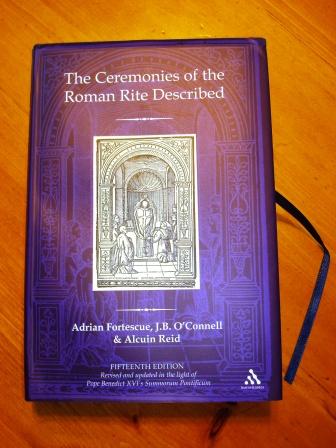
These younger priests, and lay people as well, are absorbing something of the wisdom of past centuries.  For example, say a person wants to learn about the older form of Holy Mass, the TLM.  He picks up some old books – maybe found in used bookstores (such at Loome’s) or maybe the seminary library or the basement of a rectory.  Maybe he orders the reprint of Fortescue-O’Connell, or Reid’s new verison of the same, or an older edition of the same and starts to read. He peruses a volume such as O’Connell’s The Celebration of Mass (1959).

Right away he discovers a very different attitude about the way Mass is celebrated. 

Once upon a time, the Missale Romanum itself contained directives, in the section called De defectibus, which indicated that some defects could be either venial or mortal sins.  That is, there was a moral judgment about some defects.  This section, still present in the 1962 Missale Romanum, was removed from the post-Conciliar editions of the Missale Romanum. That is to say, it is not in any edition of the Novus Ordo. 

The argument was, if I understand correctly, that since that was an issue of moral theology, the distinction did not belong in the Missale Romanum.  I think this is one of the reasons why experimentation began to deform the way the Novus Ordo was celebrated.  Once "changing the rite" was separated from "sin"… the floodgates opened.  This took place in an environment in which there may have been an overly rigid approach to liturgical rites, perhaps inculcated by instructors with jansenist tendencies.  There was, subsequently, a sharp backlash in the minds of some priests against any rubrics.

Back to my point….

If you look in pre-Conciliar editions of manuals designed to help seminarians and priests learn how to say Mass, to train seminarians and priests in the art and concrete crafts of the Church’s worship, you usually find a chapter on defects.  I maintain that a review of these old books can be very useful today.  Reading these old books especially through the lens of Pope Benedict’s Sacramentum caritatis (which presents us with a reflection on the priest’s ars celebrandi) could be of enormous practical use to seminarians and younger priests today.

Let’s have a look at a snippet of O’Connell’s The Celebration of Mass (1959) focusing on the section which concerns…

III. ARBITRARY CHANGES IN THE RITE OF MASS

10. Despite a custom to the contrary – which is expressly reprobated in the Code of Canon Law (Canon 818 [that is, the old Code, now superseded by the 1983 CIC]) – the Celebrant of Mass is "to observe accurately and devoutly the rubrics" of the Missal, "and take care not to add other ceremonies or prayers by his own authority".  Arbitrarily to change in any way – by addition, omission, or transposition – the rite of the Mass is unlawful.  So strict is the interpretation of this law that the S.R.C. [Sacred Congregation of Rites] refused to allow the Celebrant of Mass, for the purpose of gaining a rich indulgence, to pronounce, even in a low tone, the words "My Lord and my God," while looking on the Sacred Host at the Elevation, and cited Canon 818 to justify this refusal.

11. Whether the mutilation of the rite of Mass would be a grave sin, or a venial one, or no sin at all (for a sufficient cause) is discussed by the moral theologians.  Their reply is that this will depend on: (a) the motive for changing – is it due to contempt for the rubrics, to culpable ignorance of them, to gross indifference and carelessness, or from mere human frailty, like inculpable forgetfulness, or inattention, or from "devotion" of a wrong kind?  (b) The nature and extent of the change – is it one that seriously concerns the reverence due to the Blessed Eucharistic, does it occur in an important part of the Mass (important in itself or because of some extrinsic reason, such as the mystical meaning of the part), is the addition, or omission, serious because of its length?  It is regarded as grave to make even a comparatively small change in the Canon of the Mass, because of its intimate connexion with the sacrifice; and it is more serious to have omission in the ordinary parts of the Mass, the parts that occur in every, or almost every Mass, than in extraordinary parts which occur sometimes only.  Thus the omission of all the Prayers of Preparation at the foot of the altar, of the Gospel, of several of the Offertory prayers, would be regarded as a notable omission; to omit the purification of the paten (unless there were no visible participles on it) or chalice, would be a grave want of reverence for the Blessed Sacrament; to omit the addition of water to the wine in the chalice, or the Fraction of the Sacred Host, or the commingling of the two Sacred Species, would be a serious omission because of the mystical meaning of these rites.  But to omit the Gloria, or Creed, or prayers of commemoration, or the last Gospel would not, ordinarily, be regarded as a grave omission.

ADDITIONS TO THE RITE

12. Arbitrarily to add prayers or ceremonies, with the intention of introducing a new rite, or to a notable extent (especially prayers not found in the Missal), would be a grave violation of liturgical law. To add the Gloria (on days when it should be omitted), or collects not allowed by the rubrics, or ejaculatory prayers would not, ordinarily, be grave.  In general, private (vocal) prayers may not be introduced into the rite of Mass, except where the rubrics provide for it, e.g., at each memento, after the reception of the Sacred Hosts.

REMEDYING OMISSIONS IN THE RITE

13. The directives of De Defectibus do not, generally speaking, encourage the repairing of nonessential omissions (cf. e.g., V, 2). If the Celebrant should omit anything belonging to the validity, or the integrity (e.g., the Offertory), of the rite of Mass, he must, of course, repair the omission.  If an omission be trivial, it need not be supplied, and may not be, if it is not noticed at once.  If an omission be notable (though not concerned with the validity or integrity of the sacrifice) and can be easily made good – because, e.g., it is noticed almost at once – and without causing scandal, it should be.  Thus, if the Celebrant omitted, in error, the Gloria, or a commemoration, or the Creed, he must not interrupt the Mass to repair the omission; but he may, indeed should, repair it, if he adverts to it almost immediately.

The book goes on to describe defects in the matter for Mass, the bread and wine, what is necessary for validity, how to determine of the bread and wine are still good to use for Mass, what to do if there is some problem during Mass.  It describes defects of form, that is, in the words for consecration, and also defects in Priests learning from the past: De Defectibusintention.  There is a section on the defect of the state of soul for Mass and in bodily preparation.  What to do in the face of interruptions in the celebration of Mass such as if the celebrant is taken ill or even dies.  What to do if there are accidents with the Host or Precious Blood. … You get the idea.  I have written about some of these points in a humorous way here.

This is all very useful.  The point is not – as some claim – to make the celebrant nervous or scrupulous in an unhealthy way.  Rather, it conveys something of a deeper attitude about what Holy Mass is, about how important it is.  It reveals something as well of the intimate connections which exist between the Sacrifice, the rites, the matter, form and the priest himself.

Even though this section seems to have been dropped from post-Conciliar editions of these famous manuals, it strikes me as being important for every young priest and seminarian to have read this chapter at least once.  There are within some very practical pointers.

Posted in SESSIUNCULA |
18 Comments

Fitchburg, Mass., brick by brick with the TLM

A reader pointed out this article from telegram.com, of Fitchburg, Mass.


Sunday, September 13, 2009

In Fitchburg, Latin Mass ‘resonates with rhythm’
Fitchburg church celebrates traditional service

By Bronislaus B. Kush TELEGRAM & GAZETTE STAFF
bkush@telegram.com

Fitchburg, Mass., brick by brick with the TLMFITCHBURG —  The pews at Immaculate Conception Church contained a scattering of congregants as the solemn and somber chanting soothingly echoed through the cavernous nave of the Catholic house of worship.

The women, in a throwback to simpler times, ["simpler"?] wore veils or kerchiefs to cover their heads and many of the men, despite the oppressive summer heat, were conservatively attired in suits or sports jackets.

The worshippers — some struggling to follow the liturgy because of their unfamiliarity with the language — reverentially [note the juxtaposition of "struggling" and "reverentially"] focused their eyes on the altar where the Rev. David Phillipson, [CLICHE ALERT!] his back to the congregation, celebrated the 8 a.m. Sunday Mass in ancient Latin.

It seemed as if the veils of time had been peeled back.

Two years after the Vatican allowed for its wider use, the Latin, or, Tridentine Mass, [the writer seems not to have done much research before writing this] is being celebrated again on a regular basis at diocesan churches.

“The Latin Mass resonates with rhythm,” said Rev. Phillipson. “It’s a way in which individuals may deeply immerse themselves in faith.”

Pope Benedict XVI, in the summer of 2007, eased restrictions on the celebration of the millennial-old Latin rite, to the delight of many who believed the church had moved too far from its traditional spiritual moorings. [umm… including Pope Benedict XVI, right?]

In making the worship service more accessible, the pontiff acknowledged he was, to some degree, attempting to heal rifts with traditionalist groups within the church, including ultra-conservative followers of the late French Archbishop Marcel Lefebvre.

The Latin Mass was “codified” in 1570 and remained the standard Catholic liturgy for about 400 years.

After the sweeping reforms of the 1960s Second Vatican Council, however, the Latin Mass was mothballed [wrong] in favor of a worship service celebrated in vernacular languages encouraging more interactive participation by lay congregants.

Nonetheless, the Latin Mass could be conducted with permission of a local bishop. [Note the sloppy use of the term "Latin Mass".]

But church officials said, upon its introduction, the so-called “modern Mass” ["so-called"?] quickly caught on with Catholics and there were few calls for a return to the old rite.

Some, however, clung tightly to the Latin Mass.

Locally, many traditionalists have traveled for years to Still River in Harvard to attend services at St. Benedict Center, a non-diocesan facility operated by the Slaves of the Immaculate Heart of Mary, a religious congregation.

Many of those Catholics are now attending the Latin Mass in the Fitchburg church,. Other worshippers include families who send their children to the small Trivium School [great name!] in Lancaster, which provides students in Grades 7 to 12 “a Catholic perspective” of the liberal arts.

Raymond L. Delisle, diocesan spokesman and vice chancellor of operations, said despite all the hoopla generated internationally when the pope announced his intention to slacken restrictions, there’s been very little interest in the Latin rite among Central Massachusetts Catholics.

“There’s no question there’s a vocal minority that favors it and there is some curiosity among others,” he said. “But most Catholics have grown up with the current form and prefer it.”

The Latin Mass is a complex service replete with centuries-old trappings — harkening participants back to a time when the church served as the central authority of Western civilization.

With its stylized rituals, it conveys a sense of majesty and mystery. [BTW… any form of worship which doed not do this is a failure.] Imbued with formality, the old liturgy is precise and it can lull congregants with its cadence. [Does this writer really get what he is saying?  On the one hand it converys a sense of mystery, but it lulls?]

The service runs a bit longer than the modern Mass, and many parts of it are sung.

At Immaculate Conception, only the scripture readings and the homily are in English. Missals are available that provide English translations of the Latin text.

Even the Mass accoutrements are different. For example, the priestly vestments are more ornate than those used in the “modern” service. [Again, no sense of what is inherent in the two forms of Mass and what is accidental.  Okay, just read to the end… you get the idea.]

“Going to a Latin Mass is like enjoying a piece of classical music,” said Ted Turner, a Lunenburg resident who was instrumental in bringing the rite to Immaculate Conception. “It’s an enriching experience. It truly is an antidote to all the bad things in the world.”

Mr. Turner’s family was among those who had been attending the Latin Mass in Still River for years.

Though spiritually satisfied, those families yearned for a parish life, something they couldn’t get at St. Benedict Center.

Representatives approached the Rev. Thien X. Nguyen, the pastor of Immaculate Conception, about holding Sunday Latin Masses at his parish, which was founded by French Canadians in 1886.

Mr. Turner was familiar with the church because his daughter, Annie, was married there two years ago in a service using the Latin rite.

Rev. Nguyen agreed and, with the blessing of Worcester Bishop Robert J. McManus, Latin Masses began to be celebrated this summer.

The Masses are celebrated by Rev. Phillipson, who was born in Middletown, Conn., but raised in New Jersey.

Rev. Phillipson, who was ordained in 2003, is from the Archdiocese of Santa Fe in New Mexico and is associated with, though not a member of, the Fraternity of St. Peter. He has been celebrating the Latin Mass for three years.

Though the first, which was held on June 28, drew about 250 worshippers, subsequent services have attracted far fewer.

“We expected that,” said Mr. Turner, a former member of the Episcopal Church who converted to Catholicism in 1968. “It really takes awhile to appreciate the Latin Mass.”

Mr. Turner, who is originally from north Virginia and who works in the information-technology field, said he hopes the influx of Latin Mass worshippers will help the parish at Immaculate Conception grow. There’s some fear, among parishioners, the church might be closed by the diocese.

Since the introduction of the Latin rite, about a dozen families have joined Immaculate Conception.

Besides the Fitchburg parish, the Latin rite is conducted on Sunday mornings by the Rev. Daniel J. Becker at St. Paul Church in Warren.

Contact Bronislaus B. Kush by e-mail at bkush@telegram.com. 


I didn’t get any sense from this article that the writer had done much homework.  There wasn’t much evidence that he asked questions or did any reading so as to understand what the terms were, etc.

The upside is that something is growing in Fitchburg, despite certain attempts to downplay what is going on.

The writer did, however, pick up on the sense of "mystery" which is conveyed through the older form of Mass.  This is the single most important point people who are not used to the TLM have to deal with.  It often leaves them, at least at first, confused, disoriented.


Posted in Brick by Brick, SUMMORUM PONTIFICUM | Tagged
21 Comments

Documentary about Matteo Ricci screened at Venice Film Festival

Very cool… from CNA:

Documentary about Matteo Ricci screened at Venice Film FestivalDocumentary about Jesuit missionary to China screened at Venice Film Festival
Venice, Italy, Sep 12, 2009 / 06:13 pm (CNA).- A new documentary on the life of Fr. Matteo Ricci, a pioneering Jesuit missionary to China, was screened at the Venice Film Festival on Thursday.

The film is part of a revival of interest in Ricci, whom Pope Benedict XVI has called a model for a “fruitful meeting” between civilizations.

The movie, directed by Italian filmmaker Gjon Kolndrekaj, was shot in China and Italy.

Political and religious dignitaries from both countries attended the screening, ANSA reports. They included the Patriarch of Venice Cardinal Angelo Scola, China’s Ambassador to Italy Sun Yuxi and the Chinese Embassy’s cultural counselor Zhang Jianda. [But not, I note, the Chinese (Taiwan) Ambassador to the Holy See.]

Matteo Ricci was born in 1552 in the Marche town of Macerata. He became a Jesuit priest and a scholar of mathematics and astronomy before leaving for the Far East at the age of 26.

Audience members from Ricci’s hometown of Macerata included Bishop Claudio Giuliodori, Mayor Giorgio Meschini. The Governor of Marche Gian Maria Spacca was also in attendance.

Ricci spent four years in Goa on the west coast of India before traveling to China. There, he settled in Zhao Qing in the southernmost Guangdong Province and began studying Chinese. During his time there he produced his global Great Map of Ten Thousand Countries, which revolutionized the Chinese understanding of the rest of the world.

In 1589 he moved to Zhao Zhou and began sharing European mathematics discoveries with Chinese scholars. He became known as “Li Madou” and was renowned for his extraordinary memory and knowledge of astronomy. He eventually became a member of the court of Ming Emperor Wanli.

In 1601 he was allowed into the Forbidden City of Beijing, where he worked until his death in 1610.

Ricci’s work is familiar to Chinese schoolchildren of all ages but he was not well known in Italy until recently, ANSA says. Two successive exhibitions and a TV film have revived interest in his life.

Governor Spacca said that Father Ricci is one of his region’s “most important sons.”

“The fact this film is being shown on September 10 is also a special coincidence, as this was the very day in 1583 when Ricci left Macao and set out for inland China, the province of Canton,” he continued, according to ANSA.

Pope Benedict XVI recently sent a message to the Bishop of Marcerata which described the Jesuit missionary as a model for a “fruitful meeting” between European and Chinese civilizations.

“Matteo Ricci sets an example for our communities of people from different cultures and religions to bloom in the spirit of hospitality and mutual respect,” the Pontiff said.

Posted in Just Too Cool | Tagged , ,
2 Comments

Caritas in veritate

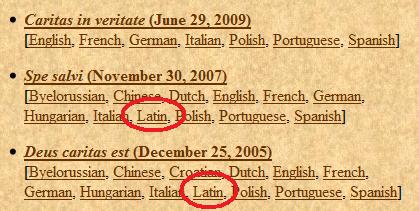
BTW… I understand that the Latin text for the Holy Father’s encyclical Caritas in veritate is ready.

Hopefully it will be made public soon.

Caritas in veritate

Posted in SESSIUNCULA |
9 Comments

hash #

When people use Twitter, they often use hash tags.

A bit confusing….

You might chime in with commonly used Catholic topic hash tags.

Of course hash tags are ephemeral as well, topical!

Wanna find Tweets with hashes?

Go to http://search.twitter.com, and search for, for example, the hash code ‘#tlm’ and you will find the tweets including that tag.

Posted in SESSIUNCULA |
7 Comments