NYT: New Nuns and Priests Seen Opting for Tradition

Hell’s Bible has an interesting article.

The following will resonate with the experience most of us have. 

The aging hippies are passing on and the young men and women coming up, without the 60-80’s baggage, want their Catholic heritage intact and they want to apply it to their vocations with continuity, not rupture.

This is from The New York Times with my emphases and comments.

NYT: New Nuns and Priests Seen Opting for TraditionAugust 11, 2009
New Nuns and Priests Seen Opting for Tradition
By LAURIE GOODSTEIN

A new study of Roman Catholic nuns and priests in the United States shows that an aging, predominantly white generation is being succeeded by a smaller group of more racially and ethnically diverse recruits who are attracted to the religious orders that practice traditional prayer rituals and wear habits.

The study found that the graying of American nuns and priests was even more pronounced than many Catholics had realized. Ninety-one percent of nuns and 75 percent of priests are 60 or older, and most of the rest are at least 50.

They are the generation defined by the Second Vatican Council, of the 1960s, which modernized the church and many of its religious orders. Many nuns gave up their habits, moved out of convents, earned higher educational degrees and went to work in the professions and in community service. The study confirms what has long been suspected: that these more modern religious orders are attracting the fewest new members.  [As we all know.]
 
The study was already well under way when the Vatican announced this year that it was conducting two investigations of American nuns. One, taking up many of the same questions as the new report, is an “apostolic visitation” of all women’s religious orders in the United States. The other is a doctrinal investigation of the umbrella group that represents a majority of American nuns, the Leadership Conference of Women Religious.

The new study, being released on Tuesday, was conducted by the Center for Applied Research in the Apostolate at Georgetown University, for the National Religious Vocation Conference, [I would like to see the results!] which is looking for ways for the church to attract and retain new nuns and priests. It was financed by an anonymous donor.

“We’ve heard anecdotally [and we all know that the plural of anecdote is not "data".  Therefore this was a good idea for a formal study.] that the youngest people coming to religious life are distinctive, and they really are,” said Sister Mary Bendyna, executive director of the Center for Applied Research in the Apostolate. “They’re more attracted to a traditional style of religious life, where there is community living, common prayer, having Mass together, praying the Liturgy of the Hours together. They are much more likely to say fidelity to the church is important to them. And they really are looking for communities where members wear habits.”  [Can I hear an "Amen!"?]

Of the new priests and nuns who recently joined religious orders, two-thirds chose orders that wear a habit all the time or regularly during prayer or ministry, the study found.

The study also showed that whites account for 94 percent of current nuns and priests but only 58 percent of those in the process of joining orders.

Asians and Pacific Islanders are disproportionately represented among the newcomers, [Philippines?] accounting for 14 percent, far above their 3 percent share of the Catholic population in the United States, Sister Bendyna said.

Hispanics are 21 percent of the newcomers, compared with only 3 percent of the current priests and nuns.

Of women who recently entered religious orders, the average age is 32; for men, it is 30. But retaining new recruits is a challenge. About half of those who have entered religious orders since 1990 have not stayed, and almost all who left did so before making their final vows.  [Also, not a surprise.  First, religious life is very counter-cultural and we remain people of our own age.  Second, perhaps they tried to join some group that still has a lot of squishy things going on.]

“People come to religious life because they feel they’re being called,”  [There is no lack of vocations, I think.] said Brother Paul Bednarczyk, executive director of the National Religious Vocation Conference, adding that the purpose of the church’s training process “is to discern that call before a commitment is made.” So “it’s not surprising,” he said, “that you would have people that would leave.” 

 Too bad the article left off there, on that sour note.   What was necessary was a line or two about the way some religious orders have so many applicants that they must be turned away.  Also, some dioceses have many vocations while others… not so many.  Usually this has something to do with a bishop who is also in favor of tradition.

Brick by brick, folks.
Posted in Brick by Brick |
14 Comments

QUAERITUR: consuming blessed salt

From a reader:

Is it a respectful and proper use of the sacramentals of Holy Water and Blessed Salt for a pious Catholic to either consume or cook with them, for the purpose of (without superstition) restoring and promoting health of mind and body for themselves and their loved ones?

I have heard differing opinions on the matter, both from priests and laity, and was wondering if Canon Law or other documents spoke to their proper usage. Your personal opinion would also be most appreciated.

I think it is proper to use blessed salt also for cooking.

The prayer for the blessing of salt refers to its consumption.

O you creature of salt, I purge you of all evil by the living + God, by the true + God, by the holy + God, who commanded by the Prophet Elisha that you be put into water in order that the sterility of the water would be healed: so that you might be rendered a purified salt for the salvation of believers, and so that you might be a healthiness of soul and body to all who consume you, and so that you may put to flight and drive out from a place in which you will have been scattered every phantom and wickedness, and cunning trap of diabolical deceit, and every unclean spirit be solemnly banished by command through Him Who shall come to judge the living and the dead, and the world by fire.  R. Amen.


As you can see, blessed salt is for the blessing of holy water, for sprinkling in places, and for consumption.

Using Holy Water?  I don’t see why not.  However, sometimes it is old.  If it wasn’t perfectly fresh I would hesitate to use it.

Posted in ASK FATHER Question Box |
20 Comments

Cardinal George Pell: Newman against the ‘errors of the age’

I received the following from the Oratorians at Birmingham.  It was under embargo until midnight, UK time:

August 11 2009

Cardinal George Pell: Newman against the ‘errors of the age’

On the anniversary of Newman’s death, Cardinal George Pell of Sydney has commented incisively on Newman’s significance and impending beatification. The full text of Cardinal Pell’s reflections will be published at www.newmancause.co.uk on August 12. Here is a summary of his key arguments.

Dictatorship of Relativism

Aligning Newman with Pope Benedict XVI’s analysis of ‘the dictatorship of relativism’, Pell emphasises that Newman’s understanding of conscience is in ‘the mainline of the Christian tradition, which upholds the view that we do not create truth but stand underneath it.’ Even conscience, therefore, must be ‘judged by conformity to the truth, and to the Word of God.’ As Newman’s Letter to the Duke of Norfolk declares, conscience is in fact fulfilled and completed only when it embraces the Faith and Morals taught by the Catholic Church.

Detached from this vocation to objective truth, Newman knows that conscience degenerates from discerning what is right into ‘the right of self will’. From this flows ‘the dictatorship of relativism’, according to which truth is sacrificed to human passions and opinion.

Contemporary emphasis on the primacy of conscience, which often appeals to Newman’s inspiration, systematically overlooks this aspect of his teaching, according to Pell. For Newman it is in fact ‘truth, specified as the word of God, that has primacy.’ Without this, what people call ‘conscience’ becomes in Newman’s account a ‘counterfeit’. Pell suggests that the relativism promoted by ‘counterfeit’ conscience leads inexorably to ‘the dictatorship of numbers, power and manipulation’. When everyone’s ‘conscience’ is supposed to be ‘equally valid’, it is unavoidably those most determined and best-placed to assert themselves whose opinions hold sway.

Truth and Politics

Drawing on another connection between Newman’s thought and Pope Benedict’s, Cardinal Pell argues that Christian Faith has from the beginning presented itself above all as true. In this it crucially separates itself from what Pell calls ‘mythical’ conceptions of religion. Such conceptions of religion are ‘used to justify political and social arrangements—as today religion is said to perform an important therapeutic function—but do not claim that religion belongs to the order of reality as such.’ For Newman, however, Christianity cannot be aligned with other religions and reduced to an instrument of social cohesion. Its claim to truth makes it permanently resistant to the State’s recurring efforts to subdue and control it.

In his ‘very specifically Christocentric and God-centred understanding of conscience’, so also in his insistence on Christianity’s claim to truth, Pell argues that Newman can refresh the Church’s opposition to the tyranny exercised by secular ’science’ and power. ‘Knowledge which radically excludes the transcendent dimension of life’, writes Pell, ‘has partly blinded itself. The diminishment of knowledge without faith is one reason why Newman insisted that although the value of knowledge is absolute, knowledge itself is “emphatically not the highest good”’. Pell reminds us that Newman’s witness to this truth has the most urgent significance for our own time, when ‘the humanity of the unborn child, the humanity of the old, disabled and sick, and the wrongness of unjust working conditions’ are threatened by the dictatorship of professional expertise divorced from the light of Faith.

For all these reasons, writes Cardinal Pell, Newman’s beatification provides ‘a powerful spiritual help as we strive to respond to some of the most important and damaging intellectual errors of our age.’

—

The official website for the Cause for Cardinal Newman’s Canonisation:

http://www.newmancause.co.uk/

Posted in SESSIUNCULA |
2 Comments

Catholic Sr. Campbell (NETWORK) endorses Planned Parenthood bailout bill

You might remember the story about the Catholic Dems in the House and their little bill to bailout Planned Parenthood.

Check out The Catholic Key blog on this.

Also, note that Sister Simone Campbell at NETWORK endorses Ryan-DeLauro bill.   NETWORK is supposed to be a "Social Justice" lobby. Sr. Campbell say that the bill must be passed now without getting bogged down by "insignificant details".

When did the killing of 47 million lose its qualifications as a "social justice" issue?  When did Planned Parenthood, rooted in the black race genecide eugenics of Margaret Sanger, merit the support of a "social justice" lobby?

Posted in SESSIUNCULA |
9 Comments

St. Lawrence and the Holy Grail

On the Feast of St. Lawrence, I thought you might want to see an old post I wrote some time ago, posted on 26 June 2006, on the chalice some people think might be the Holy Grail:

_____________
St. Lawrence and the Holy Grail

When His Holiness Pope Benedict visits Valencia in Spain, he will surely visit the Chapel where people venerate what well might be the actual Holy Grail.

I am quite interested in this topic, since I am more than hopeful that we will eventually get a good and accurate translation of pro multis in the consecration formula for the Precious Blood during Mass.  We all know it means "for many", but let’s move on.  [And…. we did!]

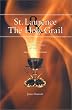
St. Lawrence and the Holy GrailAn interesting book by Janice Bennett entitled St. Laurence and the Holy Grail: the story of the Holy Chalice of Valencia (Ignatius, 2004) argues that the 1st century cup of agate, now mounted on a medieval base of gold and precious stones is the cup that Jesus used at the Last Supper for the consecration of His Most Precious Blood, “poured out for many for the forgiveness of sins.” 

Please understand that this book has big holes, uneven writing and research, and is open to serious skepticism on some aspects.  However, it also relates truly fascinating information about this amazing relic held in Valencia and gives the reader a glimpse into the story of St. Lawrence and translations of various manuscripts of interest.  Take this with a grain of salt, but it is a great read.

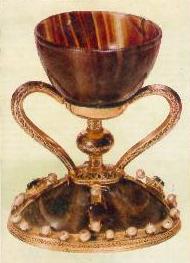
The cup itself is of a kind of agate, like chalcedony or sardonyx.  It is like other cups found in Egypt, Syria and Palestine at the time of Christ.  In the British Museum there are stone cups of the same style as that in Valencia dating to A.D. 1-50.  It is of an odd color, reddish, “like a live coal”, and it is hard to say exactly what the stone is.  The ancient naturalist Pliny describes that stone cups were submerged in oil until the stone absorbed some, and then boiled in acid which modified the organic material and changed the colors of the veins in the stone.  The cup was very finely and accurately crafted and lacks ornament other than a fine band around the lip.  It was broken through the middle on 3 April 1744, Good Friday, when it was dropped. [I’ll bet that guy was reassigned!]  The break was repaired and only a tiny chip is missing.  The cup can hold about 10 ounces.

You are asking, “But Father!  But Father! How can anyone claim that this cup in Valencia came from the hands of Jesus in Jerusalem?”

The cup has an interesting story, traced by Bennett in her book.  Here is the super brief version. 

Some scholars argue that Christ used two different cups at the Last Supper, one of metal and the other of agate, the latter used for the first consecration.  Some argue that the Upper Room used for the Last Supper belonged to the family of John Mark.  There is some confusion about the different “John”s and “Mark”s in the New Testament.  Suffice to say that it is possible that Mark the Evangelist was the son of the women who was a prominent member of the first Christians in Jerusalem.  Peter went to her house when he was released from prison. That house was a meeting-place for the brethren, “many” of whom were praying for Peter when he was in prison: (Acts 12:12-17).  This is possible the same place where the Last Supper took place, which establishes a connection with Mark and with Peter.  It is argued that Mark gave Peter the cup Jesus used at the Last Supper for the consecration of his Precious Blood.  This would be the second cup Jesus handled that night.  St. Peter consequently took the cup with his to Rome, where the Prince of the Apostles used it for Holy Mass until his martyrdom under the Emperor Nero.  Thus, this cup became a precious object within the Christian community in Rome. 

Martydom of LawreneSixtus II ordains Deacon Lawrence Bennett relates the argument that the presence of and even use of this cup in the ancient Roman Church is proposed as a possible reason why in the Latin Rite our consecration formula speaks of “hunc praeclarum calicem… this precious chalice” whereas the non Latin rites refer to the Greek “to poterion… the cup”.  Interestingly, in the New Testament the word used is poterion, “cup”, and in Latin it is calix.  However, in Spanish the word caliz (in Italian calice) is used to distinguish this important vessel for Mass from a simple cup, or copa (Italian coppa).  “Cup” is simply not worthy of the moment and the purpose.  Where do the words involved here come from? A Greek kylix was ceramic and had a wide base, was shallow, and had handles parallel to the table along the wide open lip.  This style also came to be made from precious metals.  The Romans called this cup a calyx.  The word “grail” probably derives from old Spanish gral, grail for a drinking vessel, perhaps coming from Latin gradale or grasale a wide dish.  In Provençal, the language of many of the troubadors who spread the grail legends, we have grazal.

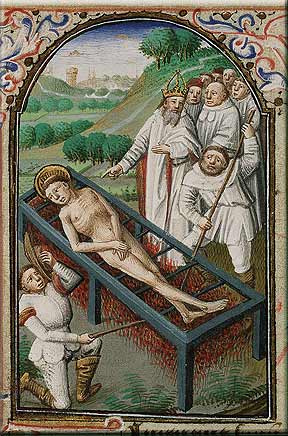
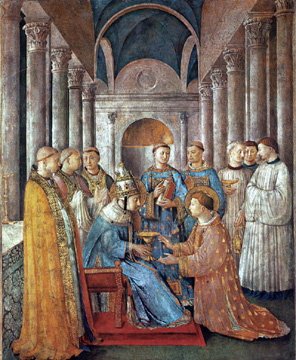
During the time of the Emperor Valerian there was a terrible persecution of Christians.  In A.D. 258 Pope Sixtus II was commanded to turn over the goods of the Church and, when he refused, was killed.  Sixtus, however, had entrusted to his deacon the goods of the Church for their administration.  This deacon was the famous St. Lawrence, a Spaniard from Huesca.  When the Emperor went after Lawrence and commanded that the goods of the Church be rendered up.  Lawrence asked for three days to get everything together.  But instead of giving it to the officials he gave everything away and then produced a group of poor people, saying “These are the true treasures of the Church”.  For that Lawrence was beaten and tortured horribly, even to being fried alive on an iron grate.  For his part, however, Lawrence had already given the precious stone cup to another Spaniard named Precelius, who took it to Spain.  The iron grid of Lawrence’s martydom is preserved in a Roman Church just a few minutes from where I am writing, in San Lorenzo in Lucina though he was martyred where there now stands San Lorenzo in Panisperna and buried at San Lorenzo fuori le mura, a Minor Patriarchal Basilica. 

Lawrence is obviously the patron saint of cooks as well as several other groups. [cooks!]

St. Lawrence and the Holy GrailThis is where the history firms up a bit.  Various manuscripts indicated that the stone cup was kept in several places.   By 533 it was in the Cathedral of Huesca, which was built in that year.  Huesca was where St. Lawrence was from and perhaps where the Spaniard Precelius took it.  After the 711 invasion by the Moslems it was hidden in the Pyrenees in various caves.  After Charlemagne’s journey to the area in 777, the location of the cup, which was hidden, roused up many of the “grail legends” that come down to us in many forms today.  In 830 the cup is at the Monastery of San Pedro de Siresa.  In 1071 it was taken to the monastery of San Juan de la Peña.  In 1190 Cretién de Troyes wrote a 9324 line poem Perceval about the “Holy Grail”.  In 1209 Wolfram von Eschenbach wrote Parcival, based on Spanish legends, which centuries later inspired Richard Wagner’s opera.  In 1322 a Sultan sells a gold cup from Jerusalem, which he claims is the cup of the Last Supper, to Jaime II, King of Valencia and Aragón.  This is perhaps the cup which is converted to become the base for the ancient stone cup. In 1399 the stone cup was given to King Martin the Humane and taken to Barcelona.  King Alfonso V of Aragón sends the cup to Valencia.  In 1744, the cup is broken, repaired and fixed to its base.  In 1936, to save it from the Marxists, a woman named María Sabina Suey smuggled the cup out of the Cathedral wrapped in newspaper.  She hid it in various places to keep it from desecration and destruction.  The cup returns to the Cathedral of Valencia in 1939 with the end of the war where it remains to this day.
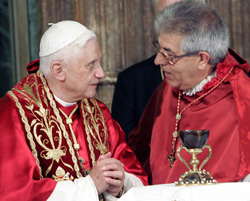

Even if this is not the very cup Jesus used at the Last Supper, and it might well be, it is hard to dismiss that this is the cup that inspired all the Holy Grail legends which branch into the stories of the Knights of the Round Table, an Indian Jones movie, and another recent piece of rubbish not worth our time to name.

The ancient stone cup, on its golden medieval base, is now in a beautiful chapel in Valencia.  When Pope John Paul II visited Valencia on 8 November 1982, he kissed the cup and then used it to celebrate Holy Mass.  It might have been the first time, 1724 after Pope Sixtus II, that “Peter” had held the cup again.

I will be watching Pope Benedict’s journey to Valencia carefully to see if he uses the “Holy Grail”.

It could really be it, after all.

__________________

The Pope did indeed visit Valencia.

St. Lawrence and the Holy Grail

Posted in SESSIUNCULA |
5 Comments

Caritas in Veritate — A Reader: by Acton Institute


Fr. Sirico of Acton Institute has something to say on the Acton blog:

Posted by Rev. Robert Sirico
on Monday, August 10, 2009

In response to the ongoing interest in Pope Benedict’s new encyclical, the Acton Institute is readying the publication of Caritas in Veritate — A Reader.

This encyclical, in all of its remarkable depth, will no doubt be the subject of thoughtful analysis for a long time to come. Later this summer, Acton will gather the best of its own commentary on Caritas and selected articles from other observers in a single volume that will be available in hard copy and in a digital format. We trust that this Reader will serve as a guide to understanding the encyclical and the thinking of Pope Benedict on important social questions. We’ll update you with information on how to purchase or download the Reader as we get closer to the publication date.

Posted in SESSIUNCULA |
Comments Off on Caritas in Veritate — A Reader: by Acton Institute

QUAERITUR: Canon aloud in the TLM

From a reader:

Is there any precendence for saying the Offertory and Canon audibly at a TLM?  I’ve heard a few people who are attached to a traditional group who say that the "silence" in the Mass pertaining to the Offertory and Canon is to be considered a "stage whisper" and it’s a good thing for at least those serving at the altar to be able to hear the Canon.


Precedent?  I suppose in very ancient times.  In more modern times, you could call the Novus Ordo a precedent.

Gravitational pull, remember?

It works both ways.

Right?

Seriously, I don’t think you should strive for this in celebrations of the TLM.   Leave the Canon silent.

One of the most important dimensions of the TLM is the lack of the constant talking found in the Novus Ordo.  Even Joseph Card. Ratzinger said we needed to explore a return to a silent Canon in one of his book on liturgy.

And yes, it is good that servers know where you are.  Thus, the voice should be just loud enough for the server to hear where you are.   However, even if the server can’t hear, he should be able to know where ‘the priest is are by his gestures.

In any event, the description of the level of voice for the priest in most manuals is that he should be just loud enough for the servers to hear.

I think the Canon out loud is overrated.  I the think the silent Canon has a great deal more to recommend.

Posted in ASK FATHER Question Box, SUMMORUM PONTIFICUM |
20 Comments

The Replacements

The ReplacementsThere was a bad lightning storm here at the Sabine Farm during my trip to England and two of my UPS (Uninterrupted Power Sources) were fried.   They protected my equipment, mostly.  I am still having problems with one computer, the main one I use, alas.  

I think the computer is partly screwed up because the power went out while I was on a remote log in and it screwed up the video card memory. 

In any event, I just got off the phone with APC which makes these UPS devices.

The customer service was very good.  One unit, a 900VA, will be replaced.  The other one is out of warranty, though it died in a good cause. 

The other UPS units I have to protect my other electronics all did their jobs, but now I need another.  And soon.

If you do NOT have UPS units… think about your sins and the results of the Fall of man.

Posted in SESSIUNCULA |
4 Comments

QUAERITUR: wedding processions

You would not believe the dopey things people want to do during weddings.

I had a question from a reader about marriage processions.

I had a (hopefully quick) question. I am getting married soon and just found out about entrance processional guidelines set by the USCCB HERE and HERE:

This appears to be a post-Vatican II development, and despite my google searches, I was unable to find how processionals worked pre-Vatican II. What were the Church’s guidelines? Also, what is your opinion on the new processionals, if they are in fact different?

Yes… they were very different.

Here is a good example.

Well… maybe that wasn’t the pre-Vatican II video.  Sorry.  Must have gotten mixed up with… well… I dunno….

I believe this sort of thing was handled by local custom more than by legislation. 

After all, it is before Mass or the wedding rite.  There are no clerics involved, so issues of precedence are not regulated.  There could be civil authorities, but that is not regulated by rubrics.

It would not surprise me were there no indications of any kind before the Council, since the silliness season didn’t begin until later.

In any event, here is what the Rite of Marriage says about the entrance procession:

If there is a procession to the altar, the ministers [e.g., lectors, altar servers] go first, followed by the priest, and then the bride and bridegroom. According to local custom, they may be escorted by at least their parents and the two witnesses. Meanwhile, the entrance song is sung. (#20)


This seems consistent with common sense.

Seasoned married Catholics might chime in with memories of their pre-Vatican II marriage processions.

Posted in ASK FATHER Question Box, Lighter fare |
26 Comments

More comments on The Tablet’s vulgar little scream

More comments on The Tablet's vulgar little screamIn the last issue of The Tablet (aka "The Bitter Pill") the editors had a little hissy fit.  I look at their piece here.

Subsequently, I have found comment by His Hermeneuticalness, Fr. Finigan as well as The Sensible Bond.

Here is an excerpt from the latter with my emphases and comments:


Indeed, I think The Tablet is right about the one thing which nobody seems to want to look at very carefully: Archbishop Nichols is less than enthusiastic about the Extraordinary Form. You only need to look at his priorities as expressed in the interview he gave a little time ago to The Catholic Herald. Instead of pointing out why it is that people might prefer the Extraordinary Form, [right] he instantly cites the dangers it poses to the Church:

One of the troubling things at the moment is that some people want to create too much of a tension between those two. And most troubling of all to my mind is the mindset that somebody might get caught into, because perhaps they don’t like some aspect of how the Mass is being celebrated or the music that’s been chosen or something, that they begin to turn their back on the Church’s ordinary pattern of prayer, the ordinary form of the Mass and say: "I can’t accept that." That’s really quite serious, because if they can’t accept that then they are inexorably distancing themselves from the Church. And as the Pope said in the documents which he issued at the time in which he opened up a wider use of the extraordinary form, this all depends on the person’s faithfulness to the Church. It’s our concentration on what’s essential. And what is essential is that I put myself there in the presence of the priest, whichever form the Mass is said in, and I recognise with wonder that this is the mystery of the Lord’s Body and Blood given for me.

What strikes me about this is that there is none of the wisdom which the pope has shown in his own writing on this subject. Pope Benedict understands perfectly why people flee the Ordinary Form and it is NOT, REPEAT, NOT SIMPLY because they ‘don’t like’ it. It is often because they have found something special in the EF which has come as a surprise to them: richly-worded prayers, inspiring music, awe and reverence, centuries-old beauty. [Exactly.  It may be that people flee the foolishness they find in their regular parish, but then discover more than they bargained for in the TLM.] And it is generally because they feel driven away by irreverence, the lack of a sacred atmosphere, the tosh music, the casual, smugger-than-thou atmosphere that can sometimes, though by no means always, characterize celebrations of the Ordinary Form. I suggest it is also because of the utterly irrational, stupid, dimwhit, mischievous, brainless hostility to the Extraordinary Form the very mention of which instantly puts the backs up of 75% of the clergy. It is sometimes because the traddies are filled with disgust at how they have been treated by clergy who can behave more like bullies than shepherds. I still wince when I think of the priest who, to provoke me, sarcastically described his colleague coming out to celebrate the Old Mass with his amice pulled over his head, concluding his description by spitting out the word ‘Bollocks!’

So, everyone is firing arrows at The Tablet for being naughty. But, in reality, the real problem is not The Tablet – we’ve known about them for a long time; it is the lukewarm, tottering understanding of Pope Benedict’s motu proprio which is the real story.


From Fr. Fingan:

Essentially, the Tablet is attempting to use Archbishop Nichols in support of its opposition to the usus antiquior which it persists in calling the "Tridentine Rite" – a dated and inaccurate expression now quite properly abandoned by other commentators on the subject, whatever side of the debate they take.

The editorial rightly notes that the Archdiocese of Westminster has sponsored the training course offered by the Latin Mass Society but instead of drawing the obvious conclusion that the usus antiquior is therefore entering the mainstream of ecclesiastical life in England, it presents this as a "control" issue; a claim that the Archdiocese of Westminster might find mildly insulting.

There is a note of that insecurity often found in the shrill opponents of the usus antiquior whereby they accuse its supporters of considering themselves "more Catholic than thou". In the case of the Tablet, one does not need to try hard to be more Catholic  [Amen.] – supporting Humanae Vitae and the papal magisterium generally would be enough to set you a good distance from it in that respect regardless of whether you like to attend the usus antiquior or not.

Posted in Linking Back, SESSIUNCULA, SUMMORUM PONTIFICUM |
12 Comments