Where you are!

Here is a brief snapshot of the some of the places people are when they visit the blog.  These are in many cases estimations, depending on where a person’s provider or server might be situated.  I cut out all the "unknowns" and vague "Canada" references, etc.

It is interesting to see how the who world and beyond is getting around in the internet!

Grosse Pointe, Michigan
Chelmsford, Essex
Shickshinny, Pennsylvania
Muncie, Indiana
Gurnee, Illinois
Atlanta, Georgia
Glasgow, Glasgow City
Baton Rouge, Louisiana
Powell, Ohio
Houston, Texas
Brantford, Ontario
Beijing
Biloxi, Mississippi
Edmonton, Alberta
Warsaw, Warszawa
Bayeux, Basse-Normandie
Silver Spring, Maryland
Sarasota, Florida
Gouderak, Zuid-Holland
Asheville, North Carolina
Capitola, California
Berkeley, California
Satellite Provider  <— Ooooo… the Mothership is watching
Ripon, Wisconsin
London, London, City of
Cortland, Ohio
Aizkraukle, Aizkraukles
Garwolin, Siedlce
York, Pennsylvania
Buffalo, New York
Coldwater, Michigan
Charlotte, North Carolina
Milford, Massachusetts
Peabody, Massachusetts
Brugge, West-Vlaanderen
Detroit, Michigan
Chillicothe, Illinois
Olfen, Nordrhein-Westfa…
Delaware, Ohio
Oceanside, California
Stafford, Staffordshire
Los Angeles, California
Washington, District of…
Lincoln, Nebraska
Atlanta, Georgia
Alpharetta, Georgia
Issaquah, Washington
Ft Mitchell, Kentucky <— Ooooo… the Mothership is watching
Chapel Hill, North Caro…
Brighton, Massachusetts
Ft Mitchell, Kentucky
Mlaga, Andalucia
Gresham, Oregon
San Francisco, California
Ljubljana, Bohinj
Saint Paul, Minnesota
Chilliwack, British Col…
Kalispell, Montana
Saint Paul, Minnesota
Washington, District of…
Notre Dame, Indiana  <— Is that you, Fr. Jenkins?
Letterkenny, Donegal
Huntington, West Virginia
Rome, Lazio
Columbus, Ohio
Philippines
Manchester, New Hampshire
Berkeley, California
Milan, Lombardia
Liverpool
Strasbourg, Alsace
Bloemfontein, Free State
Arlington, Virginia
Blacksburg, Virginia
Columbus, Ohio
Austin, Texas
Rome, Lazio
Groton, Massachusetts
Cincinnati, Ohio
Ann Arbor, Michigan
Ottawa, Ontario
Manila
Flossmoor, Illinois
Sumida, Tokyo
Portland, Oregon
Hemel Hempstead, Hertford
Denver, Colorado
Bowie, Maryland
Bloomington, Indiana
Saint Louis, Missouri
Portland, Oregon
Billericay, Essex
Alpharetta, Georgia
Passaic, New Jersey
Oakland, California
Oxford, Oxfordshire
Brooklyn, New York
Milpitas, California
Cleveland, Ohio
Southgate, Michigan
Cambridge, Cambridgeshire
Worcester, Massachusetts
Westbrook, Maine
Bonn, Nordrhein-Westfalen
Fairbanks, Alaska
Oakland, California
Crawfordsville, Indiana
Miamiville, Ohio
Inver Grove Heights, Mi…
Toronto, Ontario
Falkirk
Indio, California
Hayward, California
Gainesville, Florida
Galveston, Texas
London, London, City of
Slamannan, Falkirk
Mingo Junction, Ohio
San Diego, California

Posted in SESSIUNCULA |
75 Comments

QUAERITUR: Abstinence on Easter Friday

From a reader:

According to the Ordo of the Priestly Fraternity of St. Peter, Easter Friday "is not a day of abstinence or penitential observance".  Yet on their liturgical wall calendar, there is a fish symbol on April 17th, indicating a day of abstinence.  Obviously an error crept in somewhere.  Which is correct?


This is a bit after the fact, but my inclination is favor the strength of the Octave of Easter and say that on Friday of the Octave it would be okay not to abstain.  That is, it would be okay to eat meat.

An Octave is a period when time is stops.  We rest in the mystery of the great feast we celebrated, since one day simply isn’t enough.  We are continuing Easter through all the days of the Octave.  In the older rite we say Mass with the Gloria, Sequence and Creed.  In the Novus Ordo we use the Gloria, and can use the Sequence, though we are not obliged to use the Creed.  There are restrictions on votive Masses for the dead, etc.  We say in the Te Deum in the office every day during the Octave.

Still, Fridays are penitential days appropriate for abstinence and we should always keep that in mind.  Of course when a very important feast, a Solemnity in the newer calendar and a 1st class feast in the older, fall on a Friday our Friday penitential spirit is set aside.   (BTW… that is 1st Class Feast, for other days are 1st Class, such as Good Friday in the mighty Triduum when we obviously bound to fast and abstain.) 

A feast is a feast, after all!

I don’t think you sin if you maintain something of a penitential spirit, even when Friday is also a great feast or during the Octave.  We have that same tension on Sundays in Lent, which is a penitential season.  Every Sunday is an "Easter", but the season is penitential.  What to do?  Ignore our Lenten spirit?  I don’t think so.  We don’t have to rub gravel through our hair on a Lenten Sunday, but neither do I think we should simply ignore the season.  Maybe a Santa Cristina will grace your Sunday dinner table rather than your habitual 1988 Biondi Santi Brunello di Montalcino and you can have two courses instead of three.  I exagerate, of course, to make a point.

I think that on some calendars issued by traditional groups, as mentioned above, you will find an indication for abstinence on Easter Friday.  I think the calendar put out by the SSPX indicates "traditional abstinence" or such like.

All Catholics can make their own choices about what to eat and when, when to do penance and how, provided we do observe the law when we are truly bound by the law.  The 1983 Code is in force now, not the 1917 Code. 

All Catholics, even traditionalists, can with good conscience go by the indications of the present Code.  The law must be interpreted so that people are favored and not overly restricted.

If people decide they want a more rigorous approach, that is fine.  I applaud them.  But let us not forget to allow feasts to be feasts.  I think Easter Friday, within the mysterious Octave, is a feast.

Posted in ASK FATHER Question Box |
31 Comments

WDTPRS: Collect (Mercy Sunday)

In the post-Conciliar calendar this is the “Second Sunday of Easter.”  It is sometimes called “Thomas Sunday” because of the Gospel reading about the doubting Apostle.  It is called “Quasimodo Sunday” for the first word of the opening chant, the Introit (cf. 1 Peter 2:2-3). 

Now it is often called “Mercy Sunday” because of the emphasis on the merciful dimension of God’s redemptive act celebrated at Easter. 

The new Collect for this Sunday (based on a prayer in the Missale Gothicum) for the 1970 and subsequent editions of the Roman Missal begins by calling God merciful.  The newest, third edition of the Missale Romanum of 2002 specifically labels this Sunday: Dominica II Paschae seu de divina Misericordia. 

Since ancient times this Sunday is called “Dominica in albis” or also “in albis depositis”… the Sunday of the “white robes having been taken off.”  1 Peter 2:2-3 says: “Like (Sicut modo – Vulgate) newborn babes (infantes), long for the pure spiritual milk, that by it you may grow up to salvation; for you have tasted the kindness of the Lord.” Quasimodo and Sicut modo are interchangeable.  Quasimodo reflects a Latin Scripture version predating what became the Vulgate.  So, today’s Mass begins by exhorting the newly baptized. 

In the ancient Church the newly baptized were called infantes.  They wore their white baptismal robes for “octave” period after Easter during which they received special instruction from the bishop about the sacred mysteries and Christian life to which they were not admitted before the Vigil rites.  On this Sunday they removed their robes, which were deposited in the cathedral treasury as a perpetual witness to their vows.  They were then “out of the nest” of the bishop, as it were, on their own in living their Catholic lives daily.  St. Augustine of Hippo (+430) using the imagery of spring compares the newly baptized to little birds trying to fly from the nest while the parent birds flap around them and chirp noisily to encourage them (s. 376a).    

COLLECT – LATIN TEXT (2002MR):
Deus misericordiae sempiternae,
qui in ipso paschalis festi recursu
fidem sacratae tibi plebis accendis,
auge gratiam quam dedisti,
ut digna omnes intellegentia comprehendant,
quo lavacro abluti, quo spiritu regenerati,
quo sanguine sunt redempti.

The use of those clauses starting with quo, having no conjunctions (a trope called asyndeton) gives this prayer a very forceful feeling.  I very much like that sole sunt (that goes with abluti…regenerati…redempti) imbedded elegantly in the last phrase.

WDTPRS is not complete without a look at the actual words which are the building blocks of the Collect.  Recursus is “a running back, return, a returning path.”  In reference to sight it is something that has power to bring back an image.  Recursus harks to the cyclical, “recurring” nature of the Paschal observance. 

We have the opportunity to experience the Paschal mysteries each year.  This is more than a memorial or re-enactment.  By baptism we participate in mysterious events completed once and for all time, but for us in the liturgical year they sacramentally take place again. 

According to the hardly mysterious Lewis & Short Dictionary, accendo means “to kindle anything above so that it burns downward” (the opposite of succendo or sub-cendo – to kindle from “below”, like the English “burn up” and “burn down”).  You kindle a candle from above.  Accendo is also “to set on fire, to kindle, light to light up, illuminate, to inflame a person or thing, to incite, to round up.”  This word delivers the fiery liturgical imagery of the Vigil: when Christians are baptized the Holy Spirit (depicted as fire) comes to dwell in them.  Intellegentia is “the power of discerning or understanding, discernment.” The vast verb comprehendo is too complex to treat comprehensively.  Literally it involves, “to lay hold of something on all sides.”  Think of … well… “comprehensive”.  Comprehendo also means, “take hold, grasp, seize” or negatively “attack, arrest.”  It is also “to perceive with the senses, observe.”  Especially it is to grasp with the mind, but in a thorough way (on all sides).  In the Collect we want to “grasp with a worthy power of understanding.”  This is a profoundly interiorized “grasping” in the sense of true possession.  

A lavacrum is a bath.  In Titus 3:5 we have, “He saved us, not because of deeds done by us in righteousness, but in virtue of his own mercy (misericordiam), by the washing of regeneration (lavacrum regenerationis) and renewal in the Holy Spirit, which he poured out upon us rightly through Jesus Christ our Savior, so that we might be justified by his grace and become heirs in hope of eternal life (vv. 5-7, RSV).”  This refers to both the process and effects of baptism, worked in us by the mercy of God.

In our Collect is abluo, “to wash off, wash away, cleanse, purify.”  In classical Latin, abluo is used by Cicero (+43 BC) to describe a calming of the passions coming from a religious rite of washing away of sin (Tusc 4, 28, 60) and even by the poet philosopher Lucretius (+ AD 55) in De rerum natura to describe the removal of darkness by the bringing in of light (4, 378).  Early Latin speaking Christians lacked vocabulary to express their faith.  Abluo was ready made to be adapted to describe the effects of baptism.

ICEL (1973 translation of the 1970MR):
God of mercy,
you wash away our sins in water,
you give us new birth in the Spirit,
and redeem us in the blood of Christ.
As we celebrate Christ’s resurrection
increase our awareness of these blessings,
and renew your gift of life within us
.

Do you want to know what the Latin prayer really says?

A LITERAL TRANSLATION:
O God of eternal mercy,
who on this recurrence of the paschal feast
do kindle the faith of a people sanctified for Yourself,
increase the grace which You have given,
so that all may comprehend with worthy understanding
by what laver they were washed,
by what Spirit they were regenerated,
by what Blood they were redeemed
.

In today’s Collect we pray that by the recurring sacred mysteries we veteran Christians and neophytes together as a People will be continually renewed and that our grasp of how we have been redeemed and the effects of that redemption will continually deepen.  We who were once set on fire with the indwelling of the Spirit, should want each day for God to rekindle us, burn us up again from above.  We want an increase of grace, faith that seeks to grasp, comprehend, understand ever more fully who He is, who we have become in Him.  Grace and faith come first, of course.  As the ancient adage goes: Nisi credideritis non intellegetis… Unless you will have first believed, you will not understand.  We can only go so far on our own.  Faith then brings to completion what reason begins to explore.

In a sermon addressed to the catechumens before their baptism at the Easter Vigil, St. Augustine used the imagery of light to help them understand who they were to become (cf. s. 223 and s. 260c):

“Keep the night Vigil humbly.  Pray humbly with devoted faith, solid hope, brightly burning charity, pondering what kind of day our splendor will be if our humility can turn night into day.  Thus, may God who ordered the light to blaze out of the dark make our hearts blaze brightly, that we may do on the inside something akin to what we have done with the lamps kindled within this house of prayer.  Let us furnish the true dwelling place of God, our consciences, with lamps of justice”.

Augustine (and our Church) wants Christians truly to “possess” these mysteries in a way that made a concrete difference.  The newly baptized infantes eventually put off their white robes and get to the business of living as Catholics. 

We who have done this already, perhaps long ago, must continue to wear them in our hearts.
Posted in EASTER, WDTPRS |
29 Comments

D. of Raleigh, Confirmations in the Extraordinary Form

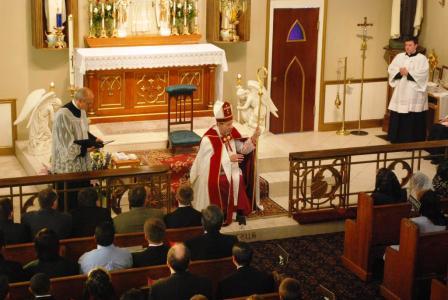
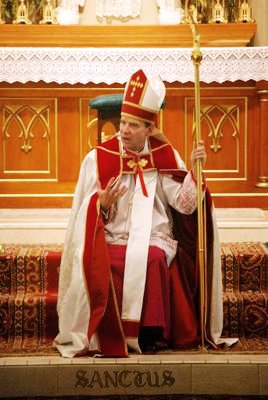
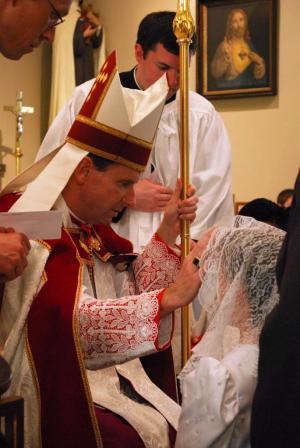
On April 17, 2009, His Excellency Most Rev. Michael F. Burbidge, Bishop of Raleigh, NC confirmed 21 people in the Extraordinary Form at Sacred Heart Catholic Church in Dunn, NC. 

This was his first ceremony in the Extraordinary Form.

Brick by brick!

D. of Raleigh, Confirmations in the Extraordinary Form

A great shot redolent of the ancient Church… the bishop teaching from his chair.

D. of Raleigh, Confirmations in the Extraordinary Form

I especially like this photo, with the Sacred Heart of Jesus in the background and the Crucifix.

D. of Raleigh, Confirmations in the Extraordinary Form

Of course bishops could do this at any time even before Summorum Pontificum, but now these wonderful events can become even more regular.

Congratulations to the newly confirmed!

Spiritus Sanctus superveniat in vos, et virtus Altissimi custodiat vos a peccatis.

Kudos and a biretta tip   o{]:¬)    to In Caritate Non Ficta for the photos.

Posted in Brick by Brick, SUMMORUM PONTIFICUM |
26 Comments

Happy Anniversary Holy Father!

On this day in 2005, Joseph Card. Ratzinger was elected as the 265th Successor of Peter, the Bishop of Rome.

May God grant Pope Benedict health and length of days!

Posted in SESSIUNCULA |
15 Comments

What were you up to?

It is sometimes possible to remember precisely where you were and what you were doing when historic events took place. People often cite examples like where they were when they heard that JFK was shot, or when Neil Armstrong stepped off the LEM and onto the surface of the Moon.

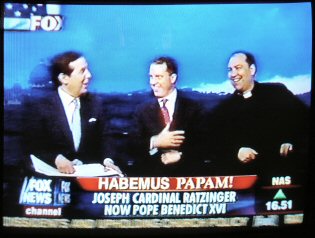
Where were you and what were you doing when you heard that Joseph Card. Ratzinger had been elected Pope?

Here is a shot of what I was doing. (Many thanks to the person who sent me the video tape I took this photo from.)

Chris Wallace, Greg Burke, Fr. Zuhlsdorf

Posted in SESSIUNCULA |
121 Comments

PODCAzT 83: St. Augustine on the challenge of remaining faithful

In this simple PODCAzT, we will pry open St. Augustine’s sermon to newly baptized Catholics.

He talks to them about the hardships they will face in remaining faithful under the onslaught of temptations presented by the unfaithful.

In s. 376A Augustine is preaching on this very Sunday, the Sunday after Easter – Dominica in albis – Low Sunday – Divine Mercy Sunday.

The newly baptized are gathered in the church in their white robes, which they will now put off as full members in the Church.
PODCAzT 83: St. Augustine on the challenge of remaining faithful
The old bishop explains that they will face challenges in remaining faithful.  Others, who say they are just as faithful as they are – but aren’t – will as tools of the devil try to lead them astray.  They must be on guard.

This sermon reminded me of the problem we face today with those who say they are Catholic and yet scandalously promote anti-Catholic policies.  I have in mind pro-abortion Catholic politicians and institutions such as the University of Notre Dame.

I read the sermon in English, and – because it isn’t too long – in Latin with my own comments and digressions before and after.http://www.wdtpr

s.com/podcazt/09_04_19.mp3


Posted in EASTER, Patristiblogging, PODCAzT | Tagged , , , ,
6 Comments

“doctrinal discussions” betwixt SSPX and the Holy See?

The formerly excommunicated SSPX Bishop Richard Williamson says on his blog Dinoscopus that some particulars of the necessary talks between the SSPX and the Holy See have been hammered out.

The Motu Proprio Summorum Pontificum, the terms that the Holy See issued to the leadership of the SSPX last year, and the lifting of the excommunications of the four bishops were necessary steps to reach the next step: theological discussions.

You can see the logic of associating the PCED more closely with the CDF.  That move, when it comes, will not be a punishment (as the liberal Catholics and their dour press wanted to paint it because they are full of fear-born hate for Catholic Tradition).  It is a necessary move to keep the process directed to a positive conclusion.

The SSPX has problems with the documents of the Second Vatican Council.  They have the right to present their concerns.  Holy See, in turn, has the right to present responses.

Let’s see what Bp. Williamson said with my emphases and comments.

From Bishop Tissier de Mallerais speaking in Paris we hear that terms have been fixed for the doctrinal discussions due to take place between the Society of St. Pius X and the Church authorities in Rome. The discussions are to be in writing, which is wise, insofar as there is less room for passion and more time for careful thinking. [It is also far safer for the SSPX since they have fewer resources.]  Also they will not be made public, a provision which at best eliminates "grand-standing" by either party, otherwise known as playing to the gallery, because there will be no gallery present.  [A good idea, since the SSPX does have a base to be worried about.]

From Rome we hear that the impetus towards a Rome-SSPX understanding which was generated by the Pope’s January "re-incommunication" [odd word play… figure it out…] of the four SSPX bishops, was seriously slowed down by the distrust generated by the media uproar  [is that what we are calling it?  Distrust?] of January-February, which is what that uproar was designed to achieve.  [probably] Yet subjectively speaking, there is certainly still good will on the part of the Pope towards the SSPX, [Good grief man!  Of COURSE there is!  And he took a huge hit for you guys.  Do you think for a moment he didn’t know he would have to take a hit?] and there is no lack of good will on the part of the SSPX towards the person of the Holy Father. [QED… good]

The problem for these discussions is that, objectively speaking, as on either side there may be some reluctance to admit, we are in the presence of an irreconcilable clash between the religion of God and the religion of man. [hmmmm] Vatican II mixed the two together, which was too much of the religion of man by half. Let us then say that Benedict XVI wishes to combine Vatican II with Catholic Tradition. That is still too much of the religion of man by a quarter. Let us now suppose that the SSPX and Benedict XVI were to agree to come half-way towards each other. That would still represent one eighth of the religion of man mixed with seven eighths of the religion of God, which for the purposes of Almighty God would still be one eighth too much.  [Sorry… but this is silly.  I am reminded of the futility expressed by Eliot’s coffee spoons.  But that is not how these things work.]

For just as it takes a disproportionately small amount of water mixed with a tank full of gasoline (or petrol) to stop a car engine dead, so it takes only a small admixture of idolatry to stop dead the true religion of God. [So… we can understand by that the Bp. Williamson thinks that .. well.. at least he is the arbiter of what is the True Catholic Faith.  Is this going to be the position of the leadership of the SSPX?  Thus, does this signal a break between Williamson and Fellay?] The Lord God Himself tells us that He is a jealous God (Exod. XX, 5; etc.), and will not endure any false gods beside Him. To anybody in the SSPX who might be tempted to worship with the neo-modernists, as to any neo-modernist who might wish to share worship with the Catholics, the Old Testament prophet Elias would say as he said to the hesitating Israelites, "How long do you halt between the two sides ? If the Lord be God, follow Him: but if Baal, then follow him." Scripture (III Kings, XVIII, 21) then says, "The people did not answer him a word".

Subjectively, the Israelites wanted to have it both ways. Objectively, that was impossible. For ourselves too. Kyrie Eleison.


This offering of the formerly excommunicated and now "re-incommincated" SSPX bishop –  who really ought to be living out a quiet retired life – raises a few questions.  I included a few of them above.

However… I think the way to sort this out is to remember that people of good will on both sides should be able to disagree about those things which are not able to be nailed down with clarity… and still remain in communion with each other.


Posted in Brick by Brick |
87 Comments

Orlando, FL: 3 May – Mass of Reparation for Notre Shame

From the website of the Diocese of Orlando with my emphases.

This isn’t just a group of concerned Catholics.  This is the Catholic diocese in the cathedral with a bishop.

All are Invited to the Mass of Reparation

As Catholics we are aware of the many shortcomings and transgressions committed against the dignity and sacredness of human life in our world. That is why it is inconceivable that Notre Dame University, a Catholic institution of higher learning, should receive and honor anyone who promotes policies that are contradictory to who we are as a people of faith.

As our Holy Father, Pope Benedict XVI stated in his visit to the U.S. last year in reference to Catholic university presidents, "to justify positions that contradict the faith and teaching of the church would obstruct or even betray the university’s identity and mission."

Mass of Reparation
May 3 at 6:00 p.m.
Cathedral of St. James
215 N. Orange Avenue
Downtown Orlando

Come and pray with Bishop Wenski for all of our transgressions against the Gospel of Life.

Reparation is the making amends for a wrong done or for an offense against God. By his death on the cross, the Son of God offered his life out of love for the Father to make reparation for our sinful disobedience (CCC #614).

We are obliged to make reparation for personal sins against justice and truth (CCC #2412 and #2487).

Posted in SESSIUNCULA |
32 Comments

Will Pres. Obama wear ND’s doctoral robe and its Marian motto?

From CNSNEWS with my emphases and comments.

Notre Dame Expects Obama to Wear Prayer to Virgin Mary on Chest When He Accepts Honorary Degree
Friday, April 17, 2009
By Edwin Mora

(CNSNews.com) – Notre Dame expects President Obama to wear the school’s traditional doctoral robe–which is emblazoned with a cross and a prayer to the Virgin Mary–when the president receives an honorary law degree from the university at its May 17 commencement ceremony.

“Yes,” replied Notre Dame Spokesman Dennis Brown, when CNSNews.com asked him if Obama would wear the robe that has been worn by previous graduation speakers at Notre Dame.

Another Notre Dame official confirmed that “everybody” wears Notre Dame’s traditional doctoral robe when they receive an honorary law degree from Notre Dame.

In 2001, when President Bush received an honorary law degree from Notre Dame, he wore the school’s traditional doctoral robe inscribed with the prayer to the Virgin Mary. In 2008, when actor Martin Sheen [How odd to mention those two, since neither of them would have an ideological problem with the BVM.] received the Laetare Award from Notre Dame at its commencement ceremony, he wore the same traditional Notre Dame robe.
 
CNSNews.com asked White House Spokesman Shin Inouye whether Obama will wear the same robe worn by Bush and Sheen.  Inouye said: “I’ve looked around, [wait for it…] but I don’t have an answer for you.”  [What do you want to bet this will now be a concern.]
 
The Notre Dame doctoral robe bears two images of the school’s coat of arms, one on both the right and left chest areas.
 
The coat of arms and its symbolic meaning are described in “The Spirit of Notre Dame: Its History, Legends and Lore” by Dorothy V. Corson, a publication that is posted on Notre Dame’s official website.
 
The publication includes a detailed illustration of the coat of arms and a quote from the February 1931 issue of The Notre Dame Alumnus magazine, explaining it.
 
The emblem features a cross and a book with a prayer inscribed in it, a star in the upper left-hand corner and two wavy lines at the bottom.
 
The official title of the university is “Universitas Dominae Nostrae a Lacu”—the University of Our Lady by the Lake–and thus the star is presented because it is “reminiscent  [ummm…. so it is not explicit?] of the beautiful epithet Star of the Sea” and “was chosen as Mary’s symbol in the new shield of arms.”
 
The two wavy lines are “poetically expressive of the dedication of the University to the Star of the Sea.”
 
Members of the Congregation of Holy Cross who founded Notre Dame are represented by the cross.
 
“The open book is always emblematic of an institution of learning,” says the publication on the Notre Dame website. “The phrase ‘Vita, Dulcedo, Spes,’ taken from the ancient prayer to the Virgin, the ‘Salve Regina,’ [So, that is explicit.] means ‘our life, our sweetness, our hope’ the combination of these phrases with the symbol for the university indicates the dedication of all Notre Dame’s activities, intellectual, spiritual, athletic, and so on, to Our Lady.”
 
When President Obama spoke at Georgetown University on Tuesday, the school covered over a cross and the monogram “IHS”—which is a symbol for the name of Jesus—where it was inscribed on a pediment embedded in the wall directly above and behind where Obama stood on a stage to speak.
 
In a written statement, Georgetown told CNSNews.com on Wednesday:  “In coordinating the logistical arrangements for yesterday’s event, Georgetown honored the White House staff’s request  [The fault lies more with Georgetown than the WH, obvously] to cover all of the Georgetown University signage and symbols behind Gaston Hall stage. The White House wanted a simple backdrop of flags and pipe and drape for the speech, consistent with what they’ve done for other policy speeches. Frankly, the pipe and drape wasn’t high enough by itself to fully cover the IHS and cross above the GU seal and it seemed most respectful to have them covered so as not to be seen out of context.”  ["out of context"… irony oozes…]
 
On Thursday, both Georgetown and the White House made statements indicating that covering over the “IHS” and cross behind the stage at Georgetown’s Gaston Hall was the unintended consequence of an effort to provide a backdrop for the flags that the White House wanted displayed behind the president.


I hope those pool photographers will bring their biggest lenses and take really crisp photos of the President with the phrase from the Salve Regina on his honorary doctoral garb.

Posted in SESSIUNCULA |
41 Comments