Feel free to send photos and accounts of your Roman Stations during Lent!
I’ll make sure you are anonymous if you wish to be.
Feel free to send photos and accounts of your Roman Stations during Lent!
I’ll make sure you are anonymous if you wish to be.
We are having a bit of a blizzard.
Supplies have been laid up.
I jarred some very spicy homemade mostarda last week for such an occasion. I made a batch of oranges and lemons, and a batch of carrots, celery and fennel. The second should be pretty aggressive!

Tonight a guest comes for a little beef roast and roasted veggies.
The birds are also laying up stores, despite the fierce wind and snow.
Here is a sturdy Chickadee.
Undaunted.



A reader read a piece on this blog about the washing of the feet of women on Holy Thursday and decided to approach the liturgy office of his local diocese.
He received this response.
For now I will edit out the location and the names of the people.
The Congregation for Divine Worship should receive a copy of the response for their opportune knowledge. They will I am sure be interested to have this clarified for them.
Pay attention to the issue of "reprobation".
"Reprobate" means to abolish something in a quite severe way so as to make it impossible to appeal to custom even after future violations of law over a long time (as was the case with altar girls, etc. etc.). But we are not talking about "reprobate" here, but "abrogate".
And so they appeal to "custom" so as to override anything Rome has legislated or clarified about the legislation.
My emphases.
February 23, 2009
XXXXXXXX
XXXXXXXX
XXXXXXXXDear XXXXXXXX:
Bishop XXXXXXXX has asked me to reply on his behalf to your recent e-mail.
In answer to your question ("Should not the May 2008 response from the CDWDS take precedence over the February 1987 article from the USCCB?), the answer is "no." The letter that you reference is a private correspondence, which in the system of Canon Law carries no juridical weight. Father Ward, from the Congregation for Divine Worship and the Discipline of the Sacraments, simply reiterated the content of the law and left its application to the diocesan bishop.
To understand the Congregation’s mind in this matter, it is important to recall that Seán Cardinal O’Malley, OFM Cap, did not wash the feet of women on Holy Thursday when he first arrived in Boston. Subsequent to a private exchange of letters with the Congregation, he changed his practice. In other words, the guidance offered by the United States Conference of Bishops that this is a pastoral issue best resolved by the bishop in his diocese stands as the norm in this country, a norm that has never been reprobated [it has to be reprobated before anyone will believe it should not be done?] by the Vatican (though the Congregation has had ample opportunities to do so). As the USCCB website states, "This is the latest statement of this Secretariat on the question. No subsequent legislation or instructions have necessitated a modification in the statement."
Most importantly, it must be remembered that in the system of Canon Law, the customs of dioceses and parishes must also be respected, as "Custom is the best interpreter of the law" (c. 23). [contra legem custom]
You also asked if reserving the mandatum to men would "present a teachable moment for those who mistakenly believe the Church could ordain women to the priesthood." Again, the answer is "no." [Really? Does he has a crystal ball?] As clearly stated in the 1988 Circular Letter from the Congregation for Divine Worship and the Discipline of the Sacraments, Paschale Solemnitatis, the washing of the feet "represents the service and charity of Christ, who came ‘not to be served, but to serve," (#51). [It has no other reason?] The same emphasis on charity and service, to which all the faithful are called, is found in the 1955 reform of the Holy Week rites promulgated by Pope Pius XII, when this practice was restored. Neither then, nor in any subsequent document, is there any mention of reading into the liturgical enactment of the footwashing a commentary on ordination. [Perhaps violation of the clear Holy Thursday rubrics might send a message too.]
I hope this relieves any anxiety [A weasel phrase. Do you think it did?] that parishes choosing to include women in the mandatum are in any way acting in a fashion contrary to what the Church allows.
Sincerely in Christ,
XXXXXXXX
Director of Liturgy and XXXXXXXX
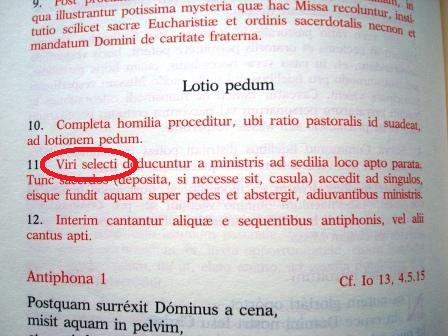
In the meantime, here is a photo of the rubric on p. 300 of the 2002 Missale Romanum.
From a reader:
I have a quick question if I may. Do you what the differences are, if any, between The New Missal for Every Day and The New Roman Missal by Fr. Lasance? I have the New Roman Missal, but know the other is out there as well. I was wondering if it is orth having both if the one I have currently is fine alone.
Quick to ask, not so quick to answer.
I will let the readers here chime in.
In the meantime, I am glad that you have your own hand missal. They are treasures.
Some discussion of hand missals could be helpful.
From The Catholic Spirit of the Archdiocese of St. Paul and Minneapolis comes this statement of the Chancellor of the Archdiocese about the SSPX.
My emphases and comments.
Lifting of bishops’ excommunication doesn’t mean they are in full communion with church
By Jennifer Haselberger For The Catholic Spirit
Wednesday, 25 February 2009Canon 1382 of the Code of Canon Law imposes the penalty of latae sententiae (automatic) excommunication on both the ordaining bishop and the ordinand when the consecration of a bishop occurs without a pontifical mandate. Only the Holy See can remove this penalty. On June 30, 1988, the penalty was incurred by Bernard Fellay, Bernard Tissier de Mallerais, Richard Williamson and Alfonso de Galarreta of the Fraternity of St. Pius X after they received illegitimate Episcopal consecration at the hands of Archbishop Marcel Lefebvre.
On Dec. 15, 2008, the four men requested that the excommunication be lifted, citing the suffering that it has caused them and affirming their belief in the primacy of the Holy Father and their willingness to accept the teachings of the Roman Catholic Church. Therefore, Pope Benedict XVI, taking into account the “spiritual distress of the parties” and “trusting in their commitment . . . to spare no effort in exploring as yet unresolved questions,” authorized the removal of the penalty of excommunication. This became effective on Jan. 21, 2009, with the Decree of the Congregation for Bishops.
The decree frees the four bishops from the penalty of excommunication, but it does not change the status of the Society of St. Pius X, which is not recognized by the Roman Catholic Church. [Indeed, this is the case.] While no longer excommunicated as a result of their illegitimate Episcopal consecration, the four bishops are not clergy of the Roman Catholic Church and may not exercise ministry on behalf of the church.
All baptized Roman Catholics are obliged to maintain communion with the Roman Catholic Church. This communion is expressed through the bonds of the Profession of Faith, the sacraments and union with the Roman Catholic hierarchy. When someone does not profess all of the faith, or rejects one or more of the sacraments, or rejects the ecclesiastical governance of the hierarchy, they are no longer in full communion. The remission of the excommunication of the four bishops, which was an act of charity on the part of the Holy Father, did not bring the individual bishops or the Society of St. Pius X into full communion with the Catholic Church. That will only happen when the society demonstrates its recognition of and fidelity to the Magisterium and the authority of the pope, and is visibly united to the Roman Catholic Church. [Right. They can state all they want about their fidelity to the Holy Father, but formal adherence is another.]
Subsequent to the lifting of the excommunication, the Holy Father further clarified that Bishop Williamson’s viewpoints on the Holocaust are unacceptable and firmly rejected by the Holy See. Moreover, while regrettably Bishop Williamson’s statements do not result in the imposition of additional penalties under canon law, the Holy Father has specified that Bishop Williamson must unmistakably distance himself from such viewpoints before he can be admitted to Episcopal functions in the Roman Catholic Church.
Jennifer Haselberger is archdiocesan chancellor for canonical affairs and director of the Office of Conciliation.
Accurate in its details. I like this because it doesn’t say more than it has to.
There is an SSPX presence in the Archdiocese and it was probably a good idea to say something.
The only thing I might want to quibble with is the idea that it might be in some way desirable for Bp. Williamson ever to have "functions" as a bishop in the Church. Even should he be fully reconciled with the Church, he should quietly retire.
I received the following e-mail:
Maybe this is a dumb question, but in a recent survey in our diocese, the priests stated that one of the most stressful problems for them were what the survey question called "expectations of the laity". Apparently, the stress is from either unreal expectations, or demands which seem impossible owing to a priest shortage.
However, one of the questions this raises is "Can the laity expect their priests to be holy, have courage and show leadership?" Are these unfair expectations? Just wondering what your opinion is of expectations from those of us in the pew.
People ought to have realistic expectations about their priests.
But think about the following:
There is an old adage that people get the priests they deserve.
Frankly, I hope we all get better than that!
People have the obligation to foster vocations and be positive about priests in their families with their children, and how the speak about priests and treat them.
Sometimes I get the impression that many people think everything they want from the Church can be expected or demanded without reciprocal cost.
Ministry of priests included.
If people want their priest to be courageous, they can help him be so by being courageous in their vocations. If they want him to be faithful, they must support faithfulness. If they want him to be priestly, treat him as if he is a priest.
Two things now pop into my head.
I am thinking of a sermon of Fr. Ronald Knox, I think for a first Mass, about expectations for priests and their own way of seeing their vocations as the years past. He talks about the priest being, for example, during Holy Mass, a worker, just a priest saying Mass. He gets about his work in a journeyman-like way.
Perhaps some people think that the priest is supposed to levitate or shoot light from their eyes. They should let him be a priest, not an angel.
Finally, I am reminded of an old chestnut about a chain letter:
The Perfect Priest
The results of a computerized survey indicate the perfect priest preaches exactly fifteen minutes. He condemns sins but never upsets anyone. He works from 8:00 AM until midnight and is also a janitor. He makes $50 a week, wears good clothes, buys good books, drives a good car, and gives about $50 weekly to the poor. He is 28 years old and has preached 30 years. He has a burning desire to work with teenagers and spends all of his time with senior citizens.
The perfect priest smiles all the time with a straight face because he has a sense of humor that keeps him seriously dedicated to his work. He makes 15 calls daily on parish families, shut-ins and the hospitalized, and is always in his office when needed.
If your priest does not measure up, simply send this letter to six other churches that are tired of their priest, too. Then bundle up your priest and send him to the church on the top of the list. In one week, you will receive 1,643 priests and one of them will be perfect. Have faith in this procedure.
One parish broke the chain and got its old priest back in less than three weeks.
This is in from The Catholic Herald.
Documents show Pius saved Jews from Nazis
By Ed West
27 February 2009Documents discovered in the Vatican Secret Archives prove that Pope Pius XII helped to save thousands of Jews during the Second World War and firmly opposed anti-Semitism before he became pope, it emerged this week.
The 300 pages of documentation, posted online last week, suggest that Pius saved 80,000 lives by persuading the Hungarian regent to prevent deportation of the Jews, and that he saved a further 12,000 by securing visas for them to leave Europe for the Caribbean.
The documents, discovered by Dr Michael Hesemann, a German historian, show that, as Archbishop Eugenio Pacelli, the future pope intervened with the German government to assure that their Turkish allies would not harm the Jews living in the Ottoman province of Palestine.
As nuncio to Bavaria, Pacelli personally helped World Zionist Organisation representative Nachum Sokolov to meet Pope Benedict XV in 1917 to discuss a Jewish homeland in Palestine. And in 1926 Cardinal Pacelli encouraged German Catholics to join the Committee Pro Palestina, which supported Jewish settlements in Palestine.
Other documents include an entry written by a nun detailing Pope Pius XII’s order of 1943 to hide the Jews of Rome in religious houses, and listing the names of Jews sheltered.
Furthermore, they show that Pius’s anti-Nazi tendencies went back to before the war. A 1939 US Foreign Service document in which the US Consul General to Cologne reports to Washington on the "new Pope", stating that he surprised him by his hatred of Hitler and the Nazi regime, and how Pope Pius supported the German hierarchy’s opposition to Nazism, even if it meant losing the support of German Catholics.
A 1938 document, signed by Cardinal Pacelli during his last months as Vatican Secretary of State, declare the Vatican’s opposition to a planned Polish law to make Kosher slaughtering illegal. The anti-Semitic bill was defeated. Other documents show that Pius XII convinced the Brazilian government to accept 3,000 Jews and helped to forge baptismal papers to allow Jews to pass as "Aryans".
The Pave the Way Foundation, invited by Yad Vashem to carry out research into the conducted of a man vilified as "Hitler’s Pope", has also posted several video interviews on its website (www.ptwf.org), including an interview with an elderly priest who describes how Pope Pius helped 12,000 Jews to escape to the Dominican Republic.
Pius XII died in 1958 but his wartime reputation became a source of controversy five years later, when German Communist Rolf Hochhuth wrote The Deputy, a fictional play that indicts Pius for his failure to speak out against the Holocaust.
Pave the Way now has testimony from Lt General Ion Mihai Pacepa, the highest-ranking KGB agent ever to defect to the West, that The Deputy was financed and edited by the Soviets, and sustained by doctored Vatican documents as part of a KGB plot to discredit the Vatican.
Gary Krupp, the president of Pave the Way Foundation said: "Personally, as a Jew, I find that correcting this revision of history according to documented proof has really nothing to do with the Catholic Church. In the interest of Jewish justice we must acknowledge the efforts of one man during a period when as a people we were abandoned by the rest of the world. It’s time to recognise Pope Pius XII for what he really did rather than what he didn’t say."
Some scholars, including Pinchas Lapide, the Jewish diplomat and historian, estimate that the Catholic Church under Pius saved between 700,000 and 850,000 Jews from the Nazis, mostly by either providing sanctuary or passage to safe countries but also by intervening, when practicable, to stop their round-up in occupied countries.
But John Cornwell, author of Hitler’s Pope, a critical biography of Pius, said: "If Pius is to take credit for non-Aryans given safe passage to Brazil via Rome during the war, then he should take responsibility, by the same token, for Nazis given safe passage via Rome after the war. It could well be that he was ultimately responsible for neither."
Quite often of late and by many we have had opportunity to discuss the "communications skills" of Holy Mother the Catholic Church in its "official" voice.
I found this interesting entry at ragan.com.
Some of the language is a little less than dignified, but it sure does communicate. I won’t edit it out.
I’ll pick it up in medias res.
My emphases and comments.
Six secrets of global communication
By Jim Ylisela
jimy@ragan.com…
We are humans dealing with horrific approval processes that destroy clarity and timeliness, and with executives who insist on abstract, jargon-filled “visions” rather than bold and direct leadership. Humans trying to connect with an audience through one good sentence, image or sound bite.
In our consulting work, we’re lucky enough to meet communicators from all over the world. And while every organization has its own distinct culture and peculiarities, the real secret is that they are all so very much the same.
Whether it’s an old-line American behemoth, a European startup or a new Middle East conglomerate, crap is the great uniter. Who’s got time to fight about politics when we’re so busy trying to keep the boss from going all mumble-mouth? [Sound about right?]
Here’s a sampling of the crap that binds us together:
1. All organizations have initiatives that no one can comprehend. They have strategic pillars, three-legged stools, key drivers and abstract concepts that never quite sink in with employee audiences.
In the western world, these initiatives come about when executives hold an “off-site meeting,” which most employees associate with golf, lots of booze and expensive dinners at exotic resorts.
In South Africa, they do the same thing, but they call it a bosberaad, an Afrikaans term that describes bearded men going off to a wine farm, drinking themselves silly and deciding how to continue oppressing the masses “for their own good.” Sounds very familiar.
2. Their intranets blow. Nearly every organization has an intranet these days, and with a few noteworthy exceptions, they are poorly organized, difficult to navigate and stunningly boring.
“We can’t get anyone to go there, and no one can find anything when they do,” was the lament I heard from more than one conference-goer in London. Boy, if I had nickel for every time I’ve heard that one. [Sounds like the Holy See’s website, how they deal with these modern tools of connectivity, and those of nearly every other diocese in the world.]
3. Their organizations are, dare I say it, “silo-ed.” Everyone gets caught up in their own work and their own departments, and nobody, but nobody, understands the big picture. This leads to confusion, wasted resources and, at times, people working at cross-purposes.
This is as true about communications as any other department. Despite all the good reasons to do so, internal and external communicators often never share information or tactics.
During a recent focus group with one of our clients, an engineer told me she didn’t realize she was working on the same project as a fellow employee until she talked to him—at home! They happen to be husband and wife.
That is some sexy pillow talk!
4. Executives are cut off. Employees want to hear from their leaders. They want to know the strategic direction of the company, but they also want to know that their ideas and suggestions are getting heard. [In the case of the Holy See, I suspect the top has been cut off from the rest by a few of the folks in between.]
But the executives can’t seem to get out of their offices and just walk around. They never ask for ideas, only impose decisions. And then they wonder why people aren’t fired up about that goofy initiative.
5. Managers are even worse. They do talk with the employees who report to them, but not very well. They do a lousy job of communicating the big picture from the chiefs (if they even understand it themselves), and they do an even worse job of letting executives know how the rank-and-file thinks.
Most managers say they don’t have the time to communicate. What they really mean is that they don’t have time to sift through all the crap to find something meaningful (and believable) to share with their folks.
6. Organizations have way too much communication, poorly applied. Once upon a time, employees complained they didn’t get enough information and didn’t know what was going on. No longer. Now people scream about getting buried in information, most of it irrelevant.
They’re incensed by e-mail, have given up on the intranet and find nothing relevant in print.
How much of this list applies to your organization? Congratulations. You are a true citizen of the world.
For your Lenten spiritual warfare, here are two version of the Via Crucis, the Way or Stations of the Cross, by St. Alphonsus Liguori.
If people a truly impeded from going to a church, chapel or place where the Stations have been formally set up (which is a requirement for the indulgence to be gained) you can still gain an indulgence by spending at least a half hour in meditation on the Cross and death of the Lord. This recording might be of help.
One version is plain, just my voice. The other is the same voice recording, but with the Gregorian chant Sequence Stabat Mater interlaced between the stations.
Listen & subscribe: Apple Podcasts Overcast Pocket Casts RSS feed
I appreciate the support you have given to me and to WDTPRS.
This is a token of my esteem.
UPDATE: The Way of the Cross – Joseph Ratzinger (Good Friday – 2005)
Stations of the Cross by St. Alphonsus Liguori
Stations of the Cross by St. Alphonsus Liguori (with chant)
REPOST:
Are you thinking about what you will do for this season of spiritual warfare?
Here is the Holy Father’s message for Lent 2009
My emphases and comments.
Dear Brothers and Sisters!
At the beginning of Lent, which constitutes an itinerary of more intense spiritual training, [Lent is a disciplina] the Liturgy sets before us again three penitential practices that are very dear to the biblical and Christian tradition – prayer, almsgiving, fasting – to prepare us to better celebrate Easter and thus experience God’s power that, as we shall hear in the Paschal Vigil, "dispels all evil, washes guilt away, restores lost innocence, brings mourners joy, casts out hatred, brings us peace and humbles earthly pride" (Paschal Præconium [the Exsultet] ). For this year’s Lenten Message, [NB] I wish to focus my reflections especially on the value and meaning of fasting. Indeed, Lent recalls the forty days of our Lord’s fasting in the desert, which He undertook before entering into His public ministry. We read in the Gospel: "Jesus was led up by the Spirit into the wilderness to be tempted by the devil. He fasted for forty days and forty nights, and afterwards he was hungry" (Mt 4,1-2). Like Moses, who fasted before receiving the tablets of the Law (cf. Ex 34,28) and Elijah’s fast before meeting the Lord on Mount Horeb (cf. 1 Kings 19,8), Jesus, too, through prayer and fasting, prepared Himself for the mission that lay before Him, marked at the start by a serious battle with
the tempter. [Remember that the Holy Father wrote about this battle in his book about Jesus]
We might wonder what value and meaning there is for us Christians in depriving ourselves of something that in itself is good and useful for our bodily sustenance. The Sacred Scriptures and the entire Christian tradition teach that fasting is a great help to avoid sin and all that leads to it. For this reason, the history of salvation is replete with occasions that invite fasting. In the very first pages of Sacred Scripture, the Lord commands man to abstain from partaking of the prohibited fruit: "You may freely eat of every tree of the garden; but of the tree of the knowledge of good and evil you shall not eat, for in the day that you eat of it you shall die" (Gn 2, 16-17). Commenting on the divine injunction, Saint Basil observes that "fasting was ordained in Paradise," and "the first commandment in this sense was delivered to Adam." He thus concludes: " ‘You shall not eat’ is a law of fasting and abstinence" (cf. Sermo de jejunio: PG 31, 163, 98). Since all of us are weighed down by sin and its consequences, fasting is proposed to us as an instrument to restore friendship with God. Such was the case with Ezra, who, in preparation for the journey from exile back to the Promised Land, calls upon the assembled people to fast so that "we might humble ourselves before our God" (8,21). The Almighty heard their prayer and assured them of His favor and protection. In the same way, the people of Nineveh, responding to Jonah’s call to repentance, proclaimed a fast, as a sign of their sincerity, saying: "Who knows, God may yet repent and turn from his fierce anger, so that we perish not?" (3,9). In this instance, too, God saw their works and spared them.
In the New Testament, Jesus brings to light the profound motive for fasting, condemning the attitude of the Pharisees, who scrupulously observed the prescriptions of the law, but whose hearts were far from God. True fasting, as the divine Master repeats elsewhere, is rather to do the will of the Heavenly Father, who "sees in secret, and will reward you" (Mt 6,18). He Himself sets the example, answering Satan, at the end of the forty days spent in the desert that "man shall not live by bread alone, but by every word that proceeds from the mouth of God" (Mt 4,4). The true fast is thus directed to eating the "true food," which is to do the Father’s will (cf. Jn 4,34). If, therefore, Adam disobeyed the Lord’s command "of the tree of the knowledge of good and evil you shall not eat," the believer, through fasting, intends to submit himself humbly to God, trusting in His goodness and mercy.
The practice of fasting is very present in the first Christian community (cf. Acts 13,3; 14,22; 27,21; 2 Cor 6,5). The Church Fathers, too, speak of the force of fasting to bridle sin, especially the lusts of the "old Adam," and open in the heart of the believer a path to God. Moreover, fasting is a practice that is encountered frequently and recommended by the saints of every age. Saint Peter Chrysologus writes: "Fasting is the soul of prayer, mercy is the lifeblood of fasting. So if you pray, fast; if you fast, show mercy; if you want your petition to be heard, hear the petition of others. If you do not close your ear to others, you open God’s ear to yourself" (Sermo 43: PL 52, 320. 322).
In our own day, fasting seems to have lost something of its spiritual meaning, and has taken on, in a culture characterized by the search for material well-being, a therapeutic value for the care of one’s body. Fasting certainly bring benefits to physical well-being, but for believers, it is, in the first place, a "therapy" to heal all that prevents them from conformity to the will of God. In the Apostolic Constitution Pænitemini of 1966, the Servant of God Paul VI saw the need to present fasting within the call of every Christian to "no longer live for himself, but for Him who loves him and gave himself for him … he will also have to live for his brethren" (cf. Ch. I). Lent could be a propitious time to present again the norms contained in the Apostolic Constitution, so that the authentic and perennial significance of this long held practice may be rediscovered, and thus assist us to mortify our egoism and open our heart to love of God and neighbor, the first and greatest Commandment of the new Law and compendium of the entire Gospel (cf. Mt 22, 34-40).
The faithful practice of fasting contributes, moreover, to conferring unity to the whole person, body and soul, helping to avoid sin and grow in intimacy with the Lord. Saint Augustine, who knew all too well his own negative impulses, defining them as "twisted and tangled knottiness" (Confessions, II, 10.18), writes: "I will certainly impose privation, but it is so that he will forgive me, to be pleasing in his eyes, that I may enjoy his delightfulness" (Sermo 400, 3, 3: PL 40, 708). Denying material food, which nourishes our body, nurtures an interior disposition to listen to Christ and be fed by His saving word. Through fasting and praying, we allow Him to come and satisfy the deepest hunger that we experience in the depths of our being: the hunger and thirst for God.
At the same time, fasting is an aid to open our eyes to the situation in which so many of our brothers and sisters live. In his First Letter, Saint John admonishes: "If anyone has the world’s goods, and sees his brother in need, yet shuts up his bowels of compassion from him – how does the love of God abide in him?" (3,17). Voluntary fasting enables us to grow in the spirit of the Good Samaritan, who bends low and goes to the help of his suffering brother (cf. Encyclical Deus caritas est, 15). By freely embracing an act of self-denial for the sake of another, we make a statement that our brother or sister in need is not a stranger. It is precisely to keep alive this welcoming and attentive attitude towards our brothers and sisters that I encourage the parishes and every other community to intensify in Lent the custom of private and communal fasts, joined to the reading of the Word of God, prayer and almsgiving. From the beginning, this has been the hallmark of the Christian community, in which special collections were taken up (cf. 2 Cor 8-9; Rm 15, 25-27), the faithful being invited to give to the poor what had been set aside from their fast (Didascalia Ap., V, 20,18). This practice needs to be rediscovered and encouraged again in our day, especially during the liturgical season of Lent. [This was an important dimension for St. Pope Leo I "the Great" (+461). In his preaching he always connects fasting directly to increased almsgiving.]
From what I have said thus far, it seems abundantly clear that fasting represents an important ascetical practice, a spiritual arm to do battle against every possible disordered attachment to ourselves. Freely chosen detachment from the pleasure of food and other material goods helps the disciple of Christ to control the appetites of nature, weakened by original sin, whose negative effects impact the entire human person. Quite opportunely, an ancient hymn of the Lenten liturgy exhorts: "Utamur ergo parcius, / verbis cibis et potibus, / somno, iocis et arctius / perstemus in custodia – Let us use sparingly words, food and drink, sleep and amusements. May we be more alert in the custody of our senses."
Dear brothers and sisters, it is good to see how the ultimate goal of fasting is to help each one of us, as the Servant of God Pope John Paul II wrote, to make the complete gift of self to God (cf. Encyclical Veritatis splendor, 21). May every family and Christian community use well this time of Lent, therefore, in order to cast aside all that distracts the spirit and grow in whatever nourishes the soul, moving it to love of God and neighbor. I am thinking especially of a greater commitment to prayer, lectio divina, recourse to the Sacrament of Reconciliation and active participation in the Eucharist, especially the Holy Sunday Mass. With this interior disposition, let us enter the penitential spirit of Lent. May the Blessed Virgin Mary, Causa nostrae laetitiae, accompany and support us in the effort to free our heart from slavery to sin, making it evermore a "living tabernacle of God." With these wishes, while assuring every believer and ecclesial community of my prayer for a fruitful Lenten journey, I cordially impart to all of you my Apostolic Blessing.
From the Vatican, 11 December 2008.
BENEDICTUS PP. XVI
[Originally posted on 3 Feb 2009]


Coat of Arms by D Burkart
 mibethda on Pope Leo XIV airplane interview: remarks about relaxing Traditional Latin Mass restrictions: “The prime rationale underlying Traditionis Custodes and the restriction of the Vetus Ordo Missae as declared by Pope Francis, Cardinal…”
 on Pope Leo XIV airplane interview: remarks about relaxing Traditional Latin Mass restrictions: “I’m not sure why people are hanging their hat on the “not now” preface. It’s the exact same formula he…”
 on CQ CQ CQ – EWTN shut down its shortwave radio service on 31 October. Understandable, but I have some reservations.: “When I was flying everywhere in the world 25 years ago I always took my Sony short wave radio with…”
 on Pope Leo XIV airplane interview: remarks about relaxing Traditional Latin Mass restrictions: “I agree, strongly, with Abp Lefebvre that there was something about the Missal as molded over the years by SRC…”
 on Pope Leo XIV airplane interview: remarks about relaxing Traditional Latin Mass restrictions: “It is important to digest the pope’s initial answer of “No, not right now.” That is not an answer one…”
 on Pope Leo XIV airplane interview: remarks about relaxing Traditional Latin Mass restrictions: “It’s really remarkable the extent to which the Holy Father has swallowed the “party line” about TLM folks being divisive…”
 on Pope Leo XIV airplane interview: remarks about relaxing Traditional Latin Mass restrictions: “Frosty, not frothy. There’s a remark to be made about beer there as well.”
 on Pope Leo XIV airplane interview: remarks about relaxing Traditional Latin Mass restrictions: “Father, I wonder why you are translating an answer from Italian that he gave in English? Because, having watched the…”

A Daily Prayer for Priests








They find you a pro-life agent in your area who commits to giving a portion of the fee to a pro-life group!

PLEASE subscribe via PayPal if it is useful. Zelle and Wise are better, but PayPal is convenient.
A monthly subscription donation means I have steady income I can plan on. I put you my list of benefactors for whom I pray and for whom I often say Holy Mass.
In view of the rapidly changing challenges I now face, I would like to add more $10/month subscribers. Will you please help?
For a one time donation...



Help Monks in Wyoming (coffee – UPDATED LINK) and Norcia (beer) and the wonderful "Soap Sisters" of Summit, NJ!


Please follow me on Twitter!










Visits tracked by Statcounter
since Sat., 25 Nov. 2006:

