QUAERITUR: starch and albs

On a lighter and more immediate note:QUAERITUR: starch and albs

Is it allowed or recommended  to starch an alb? The priest that says the EF Mass for us needs help with the cleaning, mending, etc. of his albs and other liturgical garments. I would like to do things properly and am not sure where to get information on the proper care of liturgical garments.

Thank you for any input, and thank you for your blog, I visit it every time I have time to access my computer.

You are welcome. 

I am only a reluctant commenter on anything having to do with laundry. 

I will direct you first of all to consult a useful little booklet put out by our friends at Angelus Press, which I reviewed here.

I can say that I appreciate some firmness to the fabric.  There are few things in life as since as a well starched shirt.  That goes for properly starched altar linens when you are at the altar.  And an alb that is well-prepared is part of how we give glory to God.

Fabrics for albs will differ and so how you use starch will differ.  I am not sure what to do about pure linen, for example.  And I suspect you ought to avoid lace and embroidery. 

I think I better defer to the ladies of the WDTPRS Altar Guild now, and back slowly, with a big grateful smile, out of the room….

backing….

smiling…

backing…

…closing the door.

click

Posted in "How To..." - Practical Notes, ASK FATHER Question Box, SESSIUNCULA |
15 Comments

In the matter of Bp. Williamson

Lots of people are talking now along these lines…

"Bishop Williamson must change his views or, if there is a reconciliation of the SSPX, he won’t be given an assignment."

Folks, inter alia, Williamson was born in 1940.  Do the math.

He won’t be getting an "assignment".

He maybe would get a titular see, but I imagine they could find a way around that too.

Posted in SESSIUNCULA |
31 Comments

Another problem bishop

Another problem bishopSome critics of the Pope are suggesting that the Vatican is open to the hard-liners on the right, but closed and cold to the warm-hearted forward-looking progressive thinkers on the left.

The Pope is willing to bend over backward for Bishop Williamson, while those over on the righteous long-suffering progressivist side are treated sternly.

How many times did Rome try to reconcile Bp. Milingo?

I forget.

I’m just askin’….

Posted in I'm just askin'... |
9 Comments

A diocesan paper makes distinctions: liturgical and devotional music

In the official newspaper of the Diocese of Columbus, OH, there is an interesting notice from the Office of Worship.

It is a brief piece, and therefore cannot drill to depth, but it is useful nonethess.

And the topic couldn’t be a better one.

LITURGICAL MUSIC VS. DEVOTIONAL MUSIC

Music in the Catholic Church can be divided into two categories.

Liturgical music is appropriate for a Mass or any other ritual action that is under the jurisdiction of the diocesan bishop. Devotional (worship) music is music that has been produced to be used in worshiping God, but not in a liturgical setting. 

The third edition of the General Instruction of the Roman Missal suggests [I think it does more than suggest…] that Gregorian chant is proper to the Roman Liturgy and should be regarded as the music that is proper to a liturgical setting. It also says that other types of music, such as polyphony, are appropriate if they “correspond to the spirit of the liturgical action” and “foster the participation of all the faithful.” [We have to understand what "participation" really means, when it comes to music.  Participation isn’t only through everyone singing everything.  That requires music which is simplistic.  A deeper participation is possible by some (well-trained) people singing (artistic sacred liturgical music) to which others carefully listen.]  Going hand in hand with the types of music used for liturgy is the types of instrumentation used. In a later paragraph, the Instruction states that the preferred instrument for liturgy is the organ. Other wind, stringed or percussion instruments may be used as long as they can be rendered “truly apt for sacred use.”  [Some instruments have connotations which shift only slowly.  Some cannot fill a large space without amplification.]

In other words, liturgical music should adhere to, and be used within, the context for which it was created. Liturgical music, traditionally, has been written for the organ or for the small ensemble of instruments it is designed to mimic. Many pieces have been written to include both the organ and the ensemble. Instruments that do not require amplification are preferred within the liturgy. This is so that we may complement the sacrifice of Jesus Christ with our own sacrifices. It takes more work to create music that can properly fill the church without amplification. Any instrument that requires amplification is a failure to live up to our prayer that this sacrifice of not only the bread and wine but our labor to give glory and praise is truly the work of our human hands.  [Still.. the bagpipe, which will fill a space, doesn’t have a liturgical connotation.]

Devotional music and authentic devotion is supposed to lead us back to the mystery of the Mass and to draw us deeper into the mystery of Christ. As we said last week, authentic devotion can be done anywhere.  [Except, musically, in the context of Mass, as the writer was explaining.]

Therefore, devotional music can exist anywhere. Whether we are caught in a traffic jam, shopping or participating in the parish charismatic praise and worship group, this music keeps Christ fresh in our minds. It also helps to lead us into a greater understanding of our participation in the gift of life. Like devotion in general, devotional music takes a free form and can be played with a variety of instruments. Amplification is not an issue with devotional music because the assembly is usually smaller, [hmmm… how about for rallies of young people?]  and the sense of sacrifice reserved for the Mass is replaced with the idea of giving praise and thanksgiving to God for his many gifts.

Since devotional music is intended for a smaller group, [hmmm] this community should have greater control over what types of music and instruments are played. The devotional setting is the proper place for instruments such as guitars and for groups that prefer to play “rock” style music.  [Exactly, though not so much because the group is smaller.]

Christian “praise bands”, and the songs that they play should be reserved for the devotions of the Church. This is so that the people attending may participate as they wish. A question that should be answered before devotional music is used, and before authentic devotion may take place is; “How does this activity lead us back to the life, death and resurrection of Christ that is present in the Mass?”

Next week, we will complete this series of articles by discussing the prayers of the Church when it comes to liturgy and devotion, and also the places where liturgy and devotion take place.

Well done!
 

Posted in Brick by Brick, Mail from priests |
39 Comments

A different “brick by brick” account

A friend sent me this.

I think it applies to many spheres of life.  It even applies to our "brick by brick" approach to rebuilding Catholic identity, one little move in obscurity at a time.

Mostly, this applies to moms, the real point of this piece.

My emphases

The Invisible Mom

It all began to make sense, the blank stares, the lack of response, the way one of the kids will walk into the room while I’m on the phone and ask to be taken to the store.

Inside I’m thinking, ‘Can’t you see I’m on the phone?’ Obviously not; no one can see if I’m on the phone, or cooking, or sweeping the floor, or even standing on my head in the corner, because no one can see me at all.

I’m invisible. The invisible Mom. Some days I am only a pair of hands, nothing more: Can you fix this? Can you tie this? Can you open this? Some days I’m not a pair of hands; I’m not even a human being. I’m a clock to ask, ‘What time is it?’ I’m a satellite guide to answer, ‘What number is the Disney Channel?’ I’m a car to order, ‘Right around 5:30, please.’

I was certain that these were the hands that once held books and the eyes that studied history and the mind that graduated summa cum laude – but now they had disappeared into the peanut butter, never to be seen again. She’s going, she’s going, she’s gone!

One night, a group of us were having dinner, celebrating the return of a friend from England .. Janice had just gotten back from a fabulous trip, and she was going on and on about the hotel she stayed in. I was sitting there, looking around at the others all put together so well. It was hard not to compare and feel sorry for myself. I was feeling pretty pathetic, when Janice turned to me with a beautifully wrapped package, and said, ‘I brought you this.’ It was a book on the great cathedrals of Europe .

I wasn’t exactly sure why she’d given it to me until I read her inscription: ‘To Charlotte , with admiration for the greatness of what you are building when no one sees.’

In the days ahead I would read – no, devour – the book. And I would discover what would become for me, four life-changing truths, after which I could pattern my work: No one can say who built the great cathedrals we have no record of their names.

[1] These builders gave their whole lives for a work they would never see finished. [2] They made great sacrifices and [3] expected no credit.  [4] The passion of their building was fueled by their faith that the eyes of God saw everything.

A legendary story in the book told of a rich man who came to visit the cathedral while it was being built, and he saw a workman carving a tiny bird on the inside of a beam. He was puzzled and asked the man, ‘Why are you spending so much time carving that bird into a beam that will be covered by the roof? No one will ever see it.’ And the workman replied, ‘Because God sees.’

I closed the book, feeling the missing piece fall into place. It was almost as if I heard God whispering to me, ‘I see you, Charlotte. I see the sacrifices you make everyday, even when no one around you does. No act of kindness you’ve done, no sequin you’ve sewn on, no cupcake you’ve baked, is too small for me to notice and smile over. You are building a great cathedral, but you can’t see right now what it will become.’

At times, my invisibility feels like an affliction But it is not a disease that is erasing my life. It is the cure for the disease of my own self-centeredness. It is the antidote to my strong, stubborn pride. I keep the right perspective when I see myself as a great builder. As one of the people who show up at a job that they will never see finished, to work on something that their name will never be on.

The writer of the book went so far as to say that no cathedrals could ever be built in our lifetime because there are so few people willing to sacrifice to that degree. [!]

When I really think about it, I don’t want my child to tell the friend he’s bringing home from college for Thanksgiving, ‘My Mom gets up at 4 in the morning and bakes homemade pies, and then she hand bastes a turkey for three hours and presses all the linens for the table.’ That would mean I’d built a shrine or a monument to myself. I just want him to want to come home. And then, if there is anything more to say to his friend, to add, ‘You’re gonna love it there.’

As mothers, we are building great cathedrals. We cannot be seen if we’re doing it right. And one day, it is very possible that the world will marvel, not only at what we have built, but at the beauty that has been added to the world by the sacrifices of invisible women.


In addition to the indispensable work of mothers, I am sure you could add many other vocations, sacred and temporal.

I have in mind also the lives of faithful women religious, not so much those who threw off their habits and said "look at me!" and tried to get ahead in the world, but those who fended off disaster in the world and enriched countless lives by spending time praying before the Blessed Sacrament, educating children and nursing the sick.  

Posted in SESSIUNCULA |
19 Comments

Archbp Burke: “They’re using the Eucharist as a political tool”

Archbp Burke: "They're using the Eucharist as a political tool"This from LifeSite.

Vatican Official: Bishops Have no Choice But to Refuse Communion to Pro-Abort Politicians
By Hilary White

ROME, January 30, 2009 (LifeSiteNews.com) – Archbishop Raymond Burke, in an exclusive interview last week, told LifeSiteNews.com that the issue of pro-abortion politicians continuing to receive Holy Communion is still one of major concern and that it is the duty of bishops to ensure that they are refused.

He told LifeSiteNews.com, "I don’t understand the continual debate that goes on about it. There’s not a question that a Catholic who publicly, and after admonition, supports pro-abortion legislation is not to receive Holy Communion and is not to be given Holy Communion."

"The Church’s law is very clear," said Archbishop Burke, who was appointed last year by Pope Benedict XVI as the head of the Church’s highest court, the Apostolic Signatura. "The person who persists publicly in grave sin is to be denied Holy Communion, and it [Canon Law] doesn’t say that the bishop shall decide this. It’s an absolute."

Among the US bishops directly to address the issue, Archbishop Burke was one of around a dozen who vigorously supported a directive of the Vatican that said pro-abortion Catholic politicians "must be refused" Holy Communion if they attempt to receive at Mass. Others have refused to abide by the Vatican instruction and the Church’s own Code of Canon Law, saying they would rather focus on "education" of such politicians.

Archbishop Burke called "nonsense" the accusation, regularly made by some bishops, that refusing Holy Communion "makes the Communion rail a [political] battle ground". In fact, he said, the precise opposite is true. The politician who insists on being seen receiving Holy Communion, despite his opposition to the Church’s central teachings, is using that reception for political leverage.

In 2004, when self-proclaimed Catholic and candidate for the Democrat party, Sen. John Kerry, was frequently photographed receiving Holy Communion despite his vigorous support of abortion, the US Bishops Conference issued a document which said only that it is up to individual bishops whether to implement the Church’s code of Canon Law and refuse Communion. The issue has remained prominent with the appointment of Joe Biden, another pro-abortion Catholic politician, as Vice President of the United States of America.

Archbishop Burke recalled previous experiences with Kerry, pointing to the several occasions when the senator was pictured in Time magazine receiving Communion from Papal representatives at various public events. Burke said that it is clear that Kerry was using his reception of Holy Communion to send a message.

"He wants to not only receive Holy Communion from a bishop but from the papal representative. I think that’s what his point was. Get it in Time magazine, so people read it and say to themselves, ‘He must be in good standing’."

"What are they doing? They’re using the Eucharist as a political tool."

In refusing, far from politicising the Eucharist, the Church is returning the matter to its religious reality. The most important reasons to refuse, he said, are pastoral and religious in nature.

"The Holy Eucharist, the most sacred reality of our life in the Church, has to be protected against sacrilege. At the same time, individuals have to be protected for the sake of their own salvation from committing one of the gravest sins, namely to receive Holy Communion unworthily."

Archbishop Burke also dismissed the commonly proffered excuse that such politicians need more "education". [RIGHT!] Speaking from his own direct experience, he said that Catholic politicians who are informed by their pastors or bishops that their positions in support of pro-abortion legislation makes it impossible for them to receive Holy Communion, "I’ve always found that they don’t come forward."

"When you talk to these people, they know," he said. "They know what they’re doing is very wrong. They have to answer to God for that, but why through our pastoral negligence add on to that, that they have to answer to God for who knows how many unworthy receptions of Holy Communion?"

Archbishop Burke said that the issue had been debated enough. He rejected the idea that the matter should be left to the US Conference of Catholic Bishops, saying the Conference has no authority in the matter. "This is a law of the universal Church and it should be applied."

"I think this argument too is being used by people who don’t want to confront the issue, this whole ‘wait ’til the Conference decides’…well the Conference has been discussing this since at least 2004. And nothing happens."

When asked what the solution was, he responded, "Individual bishops and priests simply have to do their duty. They have to confront politicians, Catholic politicians, who are sinning gravely and publicly in this regard. And that’s their duty.  [Thus, do not wait for direction from your local bishop?  Or bishops wait for the conference?]

"And if they carry it out, not only can they not be reproached for that, but they should be praised for confronting this situation."

Thank you, Archbishop Burke.

Posted in The future and our choices |
68 Comments

Reese piece

The WaPo’s On Faith has a note from Fr. Thomas J Reese, side-lined former editor of America.  For some reason he still in everyone’s Rolodex.  Reese has a comment on Pope Benedict.

I am sure you were waiting for it.

Benedict Undermining His Own Legacy

The lifting of the excommunication of Bishop Richard Williamson by Pope Benedict XVI caused a firestorm [ah… a fresh image] of protest from Jews and liberal Catholics. Jewish leaders expressed shock and hurt because Bishop Williamson had denied the reality of the Shoah (Holocaust) that exterminated millions of Jews. Catholic liberals complained that Williamson and the three other bishops of the St. Pius X Society have still not accepted the Second Vatican Council.

The complaints against Bishop Williamson are on target. He is a Shoah [he prefers the chic term] denier and does not accept Vatican II. [Watch this…] His views on women are also anachronistic. He disapproves of women in pants and says women should not go to universities. This is a man who would be happier living in the 19th century, like many members of the Lefebvre movement who have not recovered from the French revolution.  [Has Europe?] Oh yes, he also believes that the World Trade Center was destroyed by explosions, not by airplanes.

[Now that he has set you up…]

Three aspects of this debacle need to be separately examined: the decision to lift the excommunication, how it was made and how it was communicated to the world.

The Decision

The media has described the decision to lift the excommunication of Bishop Williamson as the pope "rehabilitating" him, "returning him to the fold," and "embracing" him. None of this is true.

The four bishops, along with Archbishop Marel Lefebvre, were excommunicated because Lefebvre ordained them as bishops without the approval of the pope. They were not excommunicated because of their beliefs about the Shoah or Vatican II. They were excommunicated because they were ordained bishops.

Lifting the excommunication says nothing about their beliefs. It is the ecclesia [sic] equivalent of a "cease fire" not a peace treaty. The bishops are still suspended from ministry, they are forbidden to act as bishops or even as priests. Long and difficult negotiations will be needed to bring about any reconciliation between the Vatican and the Society of St. Pius X. There is a very good chance that these negotiations will fail.  [Depend on him always to take to negative view… even the cowardly view, as he did in regard to the difficulties in introducing a new translation of the liturgy.]

As one who believes that the Catholic Church should be a big tent with room for different views, I do not criticize the pope’s attempt to reach out to the Lefebvrites. In my view, lifting the excommunications was a judgment call, and I would defend the pope’s right to make that decision. [This from a Jesuit.  How gracious.]  My disappointment is that while the Vatican is enthusiastic in wooing the right, it has no patience with the left. Only the right side of the cafeteria is open.  [This is simply silly.  Who is he trying to kid?  The Holy See has been nothing but patient with the left for decades!  This Pope, when he was Prefect of CDF, was notoriously patient with theologians with the screwiest ideas.  It has been over 20 years since those consecrations at Econe.  That is a rush to reconcile?  When someone goes this far to the left, even the center appears to be the extreme right.]

Why is the Vatican putting so much effort into reconciliation with the Society of St. Pius X? The real reason is because these men are bishops. If they were simple priests, the Vatican would not give them the time of day. [This is simply false.  Look at the acceptance of the FSSP, the recent reconciliation of the Institute of the Good Shepherd and the Sons of the Most Holy Redeemer… no bishops there.]  The Vatican is caught by it own theology that sees these men as validly if not licitly ordained. As a result, these bishops can ordain more bishops and the schism can go on forever.  [He didn’t get the memo on this term.]

If the bishops ordain more bishops, they will again suffer excommunication. If the bishops refrain from ordaining new bishops, the schism ends when these four bishops die [?] even if they are not reconciled with the pope. If lifting the excommunication is the price for keeping the bishops from ordaining more bishops, then in the view of the Vatican it is a cheap price to pay.  [I see.   So, the Holy Father didn’t tell us the real reason why he did this.  This couldn’t really have been actually to help heal a rift in the Church.]

The Decision-Making Process

This latest controversy and others that preceded it (like his Regensburg address) point to a fatal systemic flaw in the Benedict papacy that is destroying his effectiveness as pope: He does not consult experts who might challenge his views and inclinations.  [This is the second time Reese has gone in this direction.  He was quoted to this effect elsewhere.  The obvious question is, how does he know the consulting habits of this Pope?  Was he in the room?  Just because some people groused that they weren’t consulted, that doesn’t mean a) that they had to have been consulted or b) that Benedict therefore didn’t consult anyone.  The problem is that he doesn’t like the decision the Pope made and therefore the Pope didn’t consult.  Reese is shooting from the hip.]

No one disputes the fact that Benedict is a brilliant theologian, but he is surrounded by people who are not as smart as he is and who would never think of questioning him. [Reese is shooting from the hip.  He has no idea what happens in the Apostolic Palace.]  How do you challenge someone who you think is the smartest man in the world?  [Easy.  You just do it.  Respectfully.  Anyone who knows or has known Papa Ratzinger, knows that you can challenge and question, civilly and with a real desire to find the best conclusion.]

A smart person surrounded by less than smart people will always get in more trouble than an average person who consults smart people who are experts in their fields. The fact that Walter Kasper was not consulted on lifting the excommunication is just another in a long line of examples.  [See? The Pope didn’t consultm because he didn’t consult the people I think he should have consulted.  But there is a bit of misdirection here.  He juxtaposed Card. Kasper with those merely "average" people.  And what would Card. Kasper have said?  The Jews will be angry?  And that would be a reason not to lift the excommunications?]

The firestorm [there is it again] that followed the decision should have been foreseen and prepared for. Unnamed sources in the Vatican are saying that they did not know that Williamson was a Shoah denier. Haven’t they heard of Google?  [Well… they know, and we know they knew.]

In any other organization, heads would roll after so many disasters, but in the Vatican, loyalty still trumps competence.  [And the Church isn’t any other organziation.  Though I admit they have a lot to learn.] The pope needs a good chief of staff who would make sure this kind of thing does not happen.  [Now THIS I can agree with.  And we are getting closer to the solution.]

Communicating the Decision

Finally, the way in which this decision was communicated to the world was a disaster. Benedict still acts like a German professor who can demand the undivided attention of his students. [I don’t know about that.  I think this is unfair.] He has little PR sense. He needs people to protect him from himself.  [Yah… we’ve heard that from others too.  Nothing new.]

Special efforts should have been made to communicate the decision to Jewish leaders. For example, after explaining to them that the decision did not represent an endorsement of the bishops’ views, the Vatican could have argued that during its dialogue with the Society, it would try to change the Lefebvrites’ views on Jews. It could argue that it is better for the Jews if the church acts as a check on the Lefebvrites than if they are simply left to fester by themselves. [There’s charity for you.] This argument and other arguments might not have worked, but Jewish leaders would have known that the Vatican takes their feelings seriously.

The Vatican still believes that all it has to do is announce a decision by the pope and everyone will greet it with enthusiasm. One-page press releases will not do it. Most large American universities have more sophisticated media offices than does the Vatican, which is the headquarters for a 1.1-billion member organization. Simply setting up a YouTube channel will not do it either. The Vatican needs a sophisticated and modern communications strategy.  [yep]

The sad thing is that Pope Benedict is saying and doing many great things, but these media disasters are undermining his papacy. His words about peace, justice, refugees and the economic crisis are not being heard. Benedict wants to be a pastor and teacher, but he needs people who know how to run an organization and communicate in the 21st century, and he does not have them. The Vatican’s model for the papacy is still the absolute monarchies and royal courts of the past. That model simply will not work today.  [He could have gotten this point out more directly and far easier.  It seems he wanted also to blacken the Pope’s eye and bash the SSPX.]

Posted in SESSIUNCULA |
33 Comments

Clerical readers from San Antonio, TX?

Are any there any priest readers of WDTPRS from San Antonio, TX?

Drop me a line if you have a moment. Question for you.

Posted in SESSIUNCULA |
Comments Off on Clerical readers from San Antonio, TX?

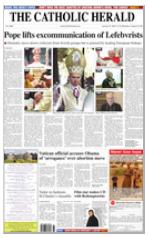
Some random notes on a scan of The Catholic Herald

Some random notes on a scan of The Catholic HeraldIn the latest number of The Catholic Herald, the best Catholic news weekly in the UK, there are some interesting stories. 

I see the online edition, which is really useful!

I’ll just do a stream of first impressions about things that catch my eye.

They have a nice format for this paper.

First, the engaging Anna Arco writes above the fold on the SSPX maelstrom.  I like the subtitle: "Dramatic move draws criticism from Jewish groups but is praised by leading European bishops".   Yes!  Let us not forget that some think that Church unity is a good thing!

Also, Mark Greaves reports (p. 1) that Tridentinum, which made the historic "St Charles" vestment for Pope Benedict, will also make one for you!  For 5000 euros.  I’ll take … four.

On page 2 I read that a new memorial to the Tyburn Martyrs is being planned, at the site of the infamous gallows, "Tyburn Tree", on Oxford Street in London.  What happened to the old one?  Ideas about the form are being debated.

Ironically on the same page is a story about a C of E theologian preaching at St. Chad’s Cathedral in Birmingham and it is noted that there will be a training day for priests to celebrate the TLM 20-23 at Ushaw College, Durham.

More on the SSPX thing on page 3, this time Mark Greaves focusing on Catholic Jewish relations.  There is a prominent photo of Rabbi David Rosen … gesticulating. You can move down the page to a story on Williamson and his opinions and then… my my… an excerpt of something I wrote for this blog, a little Q&A on the status of the SSPX now that the excomm’s are lifted.

I note with interest that they advertise that you can follow the Catholic Herald on Twitter: @catholicherald.  Do that right after you start following @fatherz

Page 4… I am starting to sound like Paul Harvey… Edward Pentin has a note on the Vatican’s "gamble".   There is also a comment on the economic pinch in clerical shops in Rome.

They picked up for page 5 a story by CNS’s Cindy Wooden on the use of modern tools of social communication to "spread the faith".  Okay.  Count me in.  Furthermore, they let people know about the Vatican’s new YouTube channel.

The new fine editor of L’Osservatore Romano, Gian Maria Vian, is featured on p. 7.

On page 8, in advance some a new appointment to the See of Westminster, which Fr. Tim Finigan would handle very well, thank you, there are profiles of past Archbishops of Westminster.

I learned on p. 10 that Archbishop Nichols plays the French Horn and that a medieval chapel in Wales has been restored.  Cool photo.  I should visit Glastonbury.  Never been to Wales.

Page 10 also writes of a Catholic Studies program at Hope University in Liverpool.  There are Catholic Studies programs being implemented in the USA too, sometimes, ironically, at Catholic schools.  Good trend.

Will Heaven’s Notebook on p. 12 talks about the Church waking up to Web 2.0.  Oh?  Evidence?
 
Also, Alcuin Reid’s piece on the SSPX is reprinted in full.  The blogosphere has had it for a while.

Page 14 sports a review of a new movie, Revolutionary Road. and on p. 15 I saw an ad for a book I don’t know about: Pius XII: The Hound of Hitler by Gerard Noel.

Since I am quite interested in Shakespeare, I noted on p. 16 the piece on

"Bringing the Shakespeare of architecture back to life" to discover that it was a review of a book about the St. John Vanbrugh.  Might be worth a glance.

Also there is a note on the BBC production out on DVD of Little Dorrit by Charles Dickens. I have been looking at their productions of the Jane Austin’s Sense and Sensibility as well as Bronte’s Wuthering Heights, which were good.

Page 17 has an interesting feature: Prayers of the Week.  This time it is Prayers to Jesus in the Blessed Sacrament.  They also give the liturgical calendar for both the Ordinary and Extraordinary Form!

Next, page 18, we find boxes on Magisterial Teaching (a bit by John Paul II) and a saing (St. Bridget).  At the bottom at the bishops’ engagments.  You might be interested to know that tomorrow, Feb 6, you can find Bishop Roche in Horsforth.

Stuart Reid, who has written about yours truly in the past, has a column on guess which SSPX Bishop.  He recounts having meet then Fr. Williamson in the 1970’s for a drink along with a friend.  Hijinx ensued.  Reid pretty much laughs off the kooks among traditionalists, mentioning in passing that his son has a workmate who thinks that the world is rule by lizards.  Then Mr. Reid suggest kindness and mercy.  

Just a few notes as I scan through the paper.
Posted in SESSIUNCULA |
10 Comments

POLL: What computer do you use?

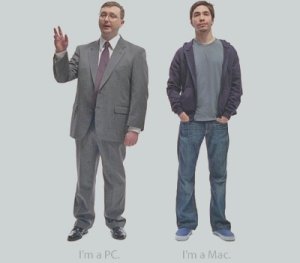
If you are in the USA, you have seen the "Hi, I’m a PC… and I’m a Mac" commercials. 
POLL: What computer do you use?
Amusing.

You have heard the smug superiority of Mac users.

(I guarantee you are going to hear more in the combox!)

You have heard PC users grouse about the Blue Screen of Death and its dire equivalent in the Macs OS when kernel panic results from something you should have – DARN IT – been able to do.

It wasn’t your fault!

You use your computer for … what? 

E-mail only?  Gaming?  Streaming the Z-Cam?  Graphics?  Doing your taxes?  Getting photos of your grandkids?  Writing that novel? 

If you are a PC user, you have lots of software options.  Fewer on Mac, but better in some spheres.
POLL: What computer do you use?
And now Mac can run PC stuff but not the other way around.

So… which do you use?  Mainly… that is.

Let’s leave aside the arcana of alternative operating systems, such as installing Ubuntu on your PC, etc.

We also know that some people use BOTH PC and Mac, for different purposes. In that case… just do your best.

POLL CLOSED

What sort of computer do you use mainly?

  • "Hi! I’m a PC…" (69%, 872 Votes)
  • "… and I’m a MAC" (29%, 362 Votes)
  • Other or none (e.g., phone or handheld only) (2%, 27 Votes)

Total Voters: 1,261

Posted in POLLS, SESSIUNCULA |
80 Comments