New from His Hermeneuticalness

My good friend His Hermeneuticalness, aka, Fr. Tim Finigan – mighty PP of Blackfen – has good news.

On Saturday 7 February, there will be a Missa Cantata at Blackfen (or Solemn High Mass if there are a couple of other clerics available) [I’ll come!] at 10.30am. Afterwards there will be a little party in the Hall to celebrate the million visits. All of you are most welcome. If you are coming, it would be helpful if you could send an email to rosary@freeuk.com with "Million party" in the subject line; but if you forget or are free at the last minute, come anyway.


Also, HH has hit his 1 millionth visitor since he has been keeping stats!  Well done!  We too will come up to a new mark in the next couple days.  But welcome to the millionaire blogger circle!

Posted in SESSIUNCULA |
4 Comments

Oh me-oh, oh my-oh, Toledo, Ohio!

From reader in Toledo:

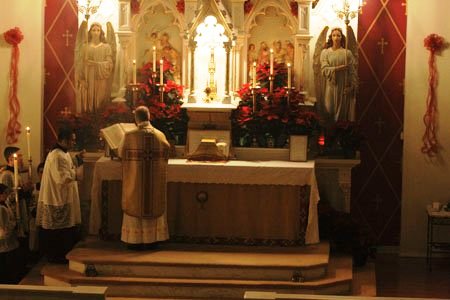
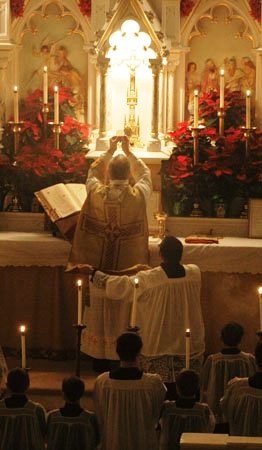
They are from the Midnight Mass a few weeks ago at St. Joseph’s Church, Toledo, Ohio.  The priest is the new pastor, Fr. Joseph Poggemeyer–he is a young and very impressive guy.  The 8:30am Sunday Mass at St. Joseph’s is the OF in English celebrated ad orientem, and the 10:30 Mass is the EF in Latin.

As you note, brick by brick.  When I was in (a Jesuit) high school 35 years ago, I never thought I’d see this happen.

Oh me-oh, oh my-oh, Toledo, Ohio!

Oh me-oh, oh my-oh, Toledo, Ohio!

Posted in Brick by Brick |
17 Comments

Thanks are due!

I am very grateful to M for the English Blue Stilton from the Amazon wish list. 

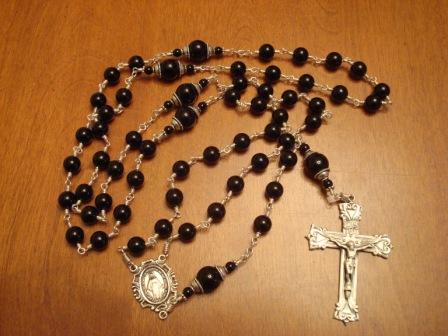
Also, thanks are due to Immaculata Rosaries for the rosary sent to me.

Thanks are due!

This is a very nice rosary, I can tell you. 

The best rosaries I have seen were from Queen of Peace Rosaries.  They were wire-wrapped and amazingly strong.  I received this rosaries with a note saying:

Mine are similar in style, as I learned the wire-wrapping technique from someone who’d learned it from G [of Queen of Peace Rosaries].


I am not too enthusiastic about the caps on the Pater noster beads, and this rosary is a little larger than my usual, but this is one fine rosary.  There are some regular links involved, which will weaken it over all, but it is very sturdy.

They would make wonderful gifts.

Immaculata Rosaries

Fine Wire-wrapped Rosaries
Handcrafted by Beth Small
BSmallDVM [AT] aol [dot] com

The Paraclete Catholic Books and Gifts
800-333-2097
 

Posted in SESSIUNCULA |
10 Comments

Released: Vatican’s report on 2005-06 Visitation of US Seminaries

The Vatican Seminary Report is out.

CNS has a story.  The whole report is here as a PDF from the USCCB.

The Vatican’s report says:

“[A]n Apostolic Visitation is a blunt instrument and by no means an infallible one.  It a seminary is visited on March 1-7, 2006, then the Visitation report will show the general state of the seminary only on those days [emphasis in the original].  It is a snapshot.  Indeed, we cannot claim that the Visitation will have unerathed all the problems that may be present.  What is more, we have repeatedly underscroed that the responsibility for your seminaries rests with you, the bishops and major superiors.

In what follows my emphases and comments.

Vatican report: Most U.S. seminaries are generally healthy

By Chaz Muth
Catholic News Service

WASHINGTON (CNS) — An apostolic visitation team concluded that U.S. Catholic seminaries and houses of priestly formation are generally healthy, but recommended a stronger focus on moral theology, increased oversight of seminarians and greater involvement of diocesan bishops in the formation process.

“This visitation has demonstrated that, since the 1990s, a greater sense of stability now prevails in the U.S. seminaries,” the report said. “The appointment, over time, of rectors who are wise and faithful to the church has meant a gradual improvement, at least in the diocesan seminaries.”

The report, sparked by the sexual abuse crisis that hit the U.S. church, concluded that seminaries appeared to have made improvements in the area of seminarian morality, most notably with regard to homosexual behavior.  [Hmmm…. a connection, perhaps, between sodomy in general and pedophilia in particular?  Hmmm….]

“Of course, here and there some case or other of immorality — again, usually homosexual behavior — continues to show up,” the report said. “However, in the main, the superiors now deal with these issues promptly and appropriately.”

The report was dated Dec. 15 and signed by Cardinal Zenon Grocholewski, head of the Congregation for Catholic Education, which deals with seminaries. It was published on the Web site of the U.S. Conference of Catholic Bishops to coincide with National Vocation Awareness Week, which began Jan. 12.  [Were you aware it was “Vocation Awareness Week”?  Most of us are pretty well connected.  So… Did you know that?  I didn’t.]

The report said some seminaries need to examine how educators can ensure the good behavior of their students when they are off-campus as well as their access to emerging technology.  [What… are they going to shut them in again in the evenings or other times?  That is the way it was in the Roman seminary I was in, though not in the USA.] 

“Seminaries face extra challenges today, as compared to recent years,” the report said. “Among these is how to monitor the students’ use of the Internet.” It recommended that seminaries and religious houses of priestly formation use Internet-filtering programs and restrict Internet use to public rooms within the seminary.  [There is a point here.  However, does this prepare men for what they will be doing in the “big world”?  I don’t know.  This is not 1908.  This is 2008.] 

Bishops sometimes delegate too much responsibility for the acceptance of diocesan candidates to their vocation directors and other subordinates, the report said.

“This is unfortunate, as it is the bishop who will ultimately have to call, or not call, the candidate to orders,” it said, recommending a more collaborative approach to the formation process.

Cardinal Sean P. O’Malley of Boston, chairman of the U.S. bishops’ Committee on Clergy, Consecrated Life and Vocations, said in a letter to U.S. bishops that it was “gratifying to read in the report that our seminaries are generally in a healthy condition that strongly promotes the formation of men for the sacred ministry in this country.”

“The general conclusions of the visitation are positive,” Cardinal O’Malley added. “I am sure that all bishops and religious superiors will take seriously the observations and recommendations of the congregation that will further strengthen our seminaries and houses of formation.”

The plan to hold apostolic visitations to assess the quality of formation in seminaries arose in Rome at an April 2002 special meeting of the U.S. cardinals and U.S. bishops’ officials with top Vatican officials.

Archbishop Edwin F. O’Brien, now head of the Baltimore Archdiocese, was chosen to coordinate the visitation team, which included 117 bishops and seminary personnel. Archbishop O’Brien was rector of the Pontifical North American College, the U.S. seminary in Rome, from 1990 to 1994. For five years before that and two years after, he headed the New York archdiocesan seminary, St. Joseph’s in Yonkers, N.Y.

Working in teams of three for smaller programs or four for the larger ones, the panels visited more than 200 U.S. seminaries and formation houses in 2005 and 2006. The visitations paid special attention to areas such as the quality of the seminarians’ human and spiritual formation for living chastely and of their intellectual formation for faithfulness to church teachings, especially in the area of moral theology.

Cardinal O’Malley noted that although the report generally praised the academic standards of most institutions for both philosophy and theology it reported gaps in some programs, particularly in the areas of the theological study of Mary and the study of early Christian writers, [AHHHH!  FINALLY!  TE DEUM!  TE DEUM!  AT LAST!]  as well as some lack of commitment to “sentire cum ecclesia” (to think with the church) in the area of moral theology.

In 1990 the Congregation for Catholic Education issued a document that required all seminaries to have training in Patristic Theology (not just an anthololgy of some snipets from the Fathers or Patrology) as a separate rubric from Church history, etc.

There are a few things to absorb in the report.

The Vatican’s report says:

“A seminary without a proper concept of the priesthood is starting off entirely on the wrong foot.”

The late Msgr. Richard Schuler, once pastor of St. Agnes in St. Paul, used to question whether the faculty of one seminary could correctly answer three questions: 1) Who is Jesus Christ? 2) Who is the Church? 3) Who is the priest?

Once upon a time, most of the seminaries in the US were confused on this point.

I am happy to say that in my experience of seminaries I have visited on my own, the environments were very good and clear and the seminarians were happy.  As a matter of fact, I think many of the positive changes in seminaries over the last 15 years came from the seminarians themselves, as the demographics shifted.

The report says that

“in the great majority of diocesan seminaries, the doctrine on the priesthood is well taught.  The faculty and seminarians follow the teaching of the Magisterium on the subject….”  “However, there is “an incomplete grasp”.

Service is stressed, but less so the priestly character.  The function of a priest is strong, less so who the priest is in a deeper theological sense.  Not all seminaries distinguish well enough between ministerial priesthood and common priesthood of the baptized.  Sometimes there is too much of a mix of training of seminarians with those not in formation for ordination.  The report was somewhat tougher on formation programs for religious.

Regarding the governance of the seminaries, it was found that some faculty had not made a profession of faith required before teaching.  Also, some faculty members suggested to students their disapproval of articles of Magisterial teaching.

Criteria for admission were examined.  There were concerns about the lack of a propeduetic period foreseen by Pastores dabo vobis 62.

Concern was raised about “compression” of studies.

I have no idea what they are going to do about this, since the entire structure of classical, liberal education has been nearly completely destroyed everywhere.

Otherwise, “Seminary rectors, in conscience, must always keep the barriers to ordination high.”

Candidates themselves are praised, but it is reasonably and correctly observed that they are men of their times, with the concommitant difficulties.

“Not infrequently, they come from broken families, or from backgrounds with little faith experience or knowledge of Catholic doctrine.  They may be weighed down by their past, which also complicates the work of formation.”

As far as their formation is concerned, a couple comments jumped at me. 

“It seems that most seminarians are in the practice of confessing at least monthly.  It should be asked whether twice monthly would not be better….”

Also,

“It is profoundly regrettable that many seminaries do not include traditional acts of piety in their horarium. … Some institutes even have an atmosphere that discourages traditional acts of Catholic piety – which begs the question as to whether the faculty’s ideas of spirituality are consonant with Church teaching and tradition.”

Also, “internal forum needs to be better safeguarded”.  My experience from seminary in the USA was complete violation in this regard.  I hope this is over for good.

Regarding intellectual formation, I think it is important to remember that seminaries are not really “grad schools”, and some seem to pretend to be.  Students are different ages and from different backgounds, so a seminary can’t be confused with a grad school.  Still, there is a concern that there isn’t enough training in philosophy.

Then, back to something spoken of elsewhere in the report, which suggests to me that it was a real concern:

“Even in the best seminaries, there can be some theology teachers who show reservations about areas of magisterial teaching.  This is particularly true in the field of moral theology.  Other points of Church teaching, such as ordination being restricted to men alone, are also questioned.  Such a lack of sentire cum Ecclesia is often not overt, but the students receive the message clearly nevertheless.  In a few seminaries, and particularly in some some schools of theology run by religious, dissent is widespread.”

Their big concerns is, of course, moral theology.

It is alarming that there was no mention at all of Latin.  It is clear that if a student does have any Latin coming into major seminary (and how sadly indicative of disaster in our education is that?) it is probably too late to turn him into a Latin machine.  But something must be done.  At the very least, even if the benefits are not obvious, Canon Law requires it.

However, the report says that generally the programs are well-thought out and well taught.  Some are excellent.

In the matter of being placed in parishes…. well…

There was an interesting and strong paragraph about evaluations.  In my time, this was the nightmare scenario.  I am told by seminarians that things have improved, but there are still problems.  The report says,


“In a very few seminaries, suspicions were voiced that the evaluations are sometimes used to ‘punish’ seminarians.”


Also, the process is often opaque.

Go and read the General Conclusions.

Posted in SESSIUNCULA |
80 Comments

Feeder report

It is cold.  When I got up this morning it was – 20°F – 29°C.

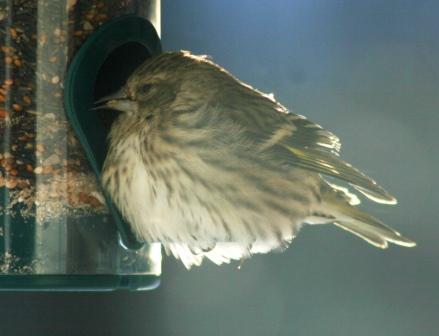
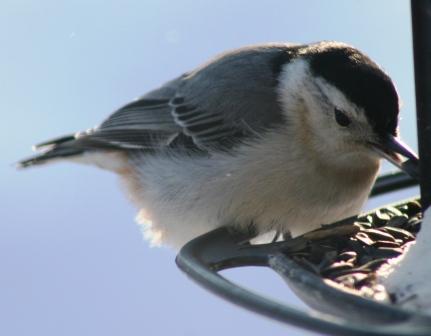
The birds are all puffed up, obviously to insulate themselves against the intense wind and wind.  With the wind chill it was about – 40°F.

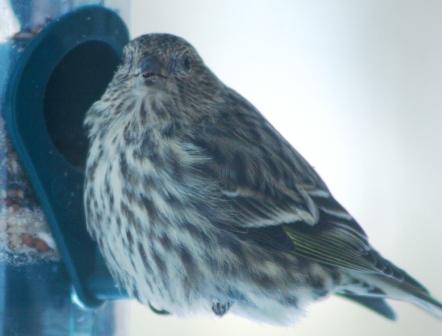
The Pine Siskin I wrote of yesterday isn’t doing so well.  He seems to be lame.  He is not hopping properly… limping, rather.  Though he isn’t at the perch constantly, as yesterday.  We’ll see how this goes.

Feeder report

The Nuthatch is doing the puff ball thing too, of course.

Feeder report

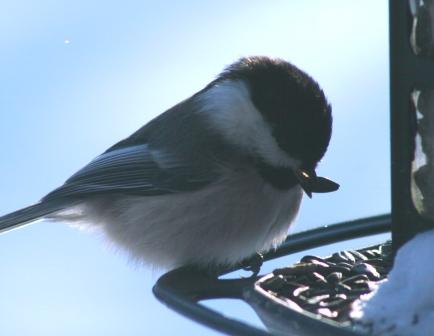
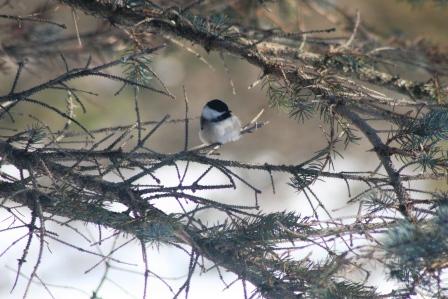
Chickadees as well.

Feeder report

Triumph.  In this case, life-saving.Feeder report

Feeder report

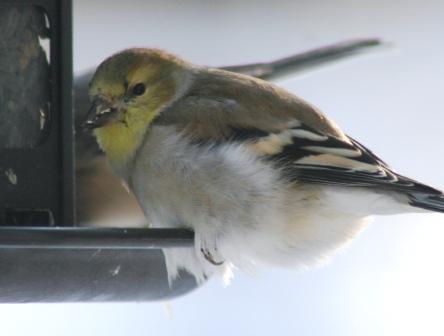
One of the American Goldfinch Eating Team.

Feeder report

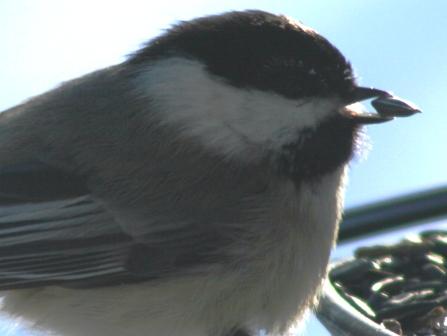
Chickadees, as do the others, constantly look for other food sources.

Feeder report

Waiting to zoom in for another snack.

Feeder report

UPDATE: 20:27 GMT

He is still there.

Feeder report

Posted in My View |
16 Comments

AP article on the Sacred Apostolic Penitentiary

Each year the Church’s special tribunal for matters of the internal forum and issues of indulgences, the Sacra Penitenzieria Apostolica, holds courses during Lent for seminarians and priests.  I have been through the course several times.  Repetita iuvant after all.

Now I read this from the AP:

Vatican secret confession tribunal opens up [A bit sensational, but… okay…]

By NICOLE WINFIELD – 9 hours ago

ROME (AP) — One of the Vatican’s most secrecy shrouded tribunals, which handles confessions of sins so grave only the pope can grant absolution, is giving the faithful a peek into its workings for the first time in its 830-year history.  [Problem: There are some sins that are so grave that they incur censures which not every priest can absolve.  Only the Holy See can absolve the censures that come from certain acts.  However, the SPA also handles any matter of conscience.  A Catholic always has recourse to the Holy See.]

The Vatican has long lamented that fewer and fewer Catholics are going to confession, the sacrament in which the faithful can receive forgiveness if they sincerely confess their sins to a priest.

To combat the decline, the so-called "tribunal of conscience" invited the public into the frescoed halls of its imposing 16th-century palazzo for a two-day conference that ended Wednesday.

The aim was to explain what the Apostolic Penitentiary actually does, and thereby encourage more of the faithful to go to confession, said Monsignor Gianfranco Girotti, the tribunal’s No. 2 official.

"Even though it’s the oldest department of the Holy See, it’s very little known — specifically because by its nature it deals with secret things," he said. "We want to relaunch the sacrament of penance."  [Excellent!]

By lifting the veil of secrecy surrounding the tribunal’s work, the Vatican hopes to emphasize the fundamental role the sacrament plays in saving souls, the Vatican’s No. 2, Cardinal Tarcisio Bertone, said in a paper delivered at the conference.

"Today it seems as though the sense of sin has been forgotten," he said.  [Not a new insight … but accurate all the same.]

Confessions of even the most heinous of crimes and sins — such as genocide or mass murder — are handled at the local level by priests and their bishops and are not heard by the tribunal.

Its work involves those sins that are reserved for the pope — considered so serious that a local priest or bishop is not qualified to grant absolution, [of the censure] said Cardinal James Francis Stafford, an American who heads the Apostolic Penitentiary.  [TRIVIA NOTE: When a Pope dies, all but a very few curial appointments automatically cease until a new Pope makes decisions about who will fill them.  One of those which does not cease is the Major Penitentiary, the head of this tribunal.  So important is the need for the exercise of the Church’s ministry of binding and loosing, of forgiveness, that this office continues even during the sede vacante period.]

These include defiling the Eucharist, [or selling, or stealing to be able to give it to someone to defile, as happened by that jerk at the University of Minnesota, etc…] which Catholics believe is the body and blood of Christ. Stafford said this offense is occurring with more and more frequency, not just in satanic rites but by ordinary faithful who receive Communion and then remove the host from their mouths and spit it out or otherwise desecrate it. [Remember: To incur a censure you have to commit a mortal sin.]

Others include a priest breaking the seal of the confessional by revealing the nature of the sin and the person who sought penance, or a priest who has sex with someone and then offered forgiveness for the act.

These sins bring automatic excommunication from the church. Once absolution is granted, the excommunication is lifted, Stafford said.  [But the one who does this must have faculties from the Holy See… from this office… to do it.]

A fourth type of case that comes to the tribunal involves a man who directly caused an abortion — such as by paying for it — who then seeks to become a priest or deacon, Stafford said.

"That is an irregularity and it means he should not receive the ordination without a dispensation from the pope," he said.  [In the moment of his ordination, he would be automatically suspended.  He is validly ordained, but under suspension, which has various consequences.]

Vatican officials frequently point to a study carried out by Italy’s Sacred Heart University that found that 47 percent of people in Italy — a majority Roman Catholic country — never went to confession or did so a long time ago.

"We cannot hide that the sacrament of penance is threatened in this time of secularization," Girotti said. But he stressed that it remained "fundamental for salvation and the sanctification of souls."

For the most part, clerical sex abuse cases are handled by another Vatican office, the Congregation for the Doctrine of the Faith, which deals with more public issues of discipline and orthodoxy.

What makes the Apostolic Penitentiary unusual by Vatican standards is the speed with which it dispenses decisions, Girotti said — very often within 24 hours, or two to three days maximum.

The palazzo where it operates, in the heart of Rome’s historic center, also houses two of the Vatican’s other main tribunals, the Roman Rota, which decides marriage annulments, and the Apostolic Segnatura, the Holy See’s highest court. [Where Archbishop Burke is Prefect.]

Taking up nearly an entire city block, it is just steps away from one of Rome’s most profane piazzas — Campo dei Fiori, filled with bars catering to tourists and college-age Americans studying abroad.

We need a revival of the sacrament of penance.

Raise awareness and use it yourselves!

Posted in SESSIUNCULA |
31 Comments

New altar edition of the 1962 Missale Romanum now available

New altar edition of the 1962 Missale Romanum now availableIt takes a short time to tear down a mighty, ancient and beautiful structure. 

It can take decades to rebuild it.

We will now have a new tool for the reconstruction which I believe His Holiness Pope Benedict desires in what I term his "Marshall Plan" for the Church.

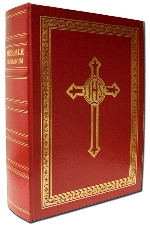
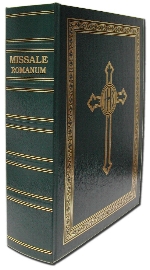
Preserving Christian Publications has produced a reprint of the 1962 Missale Romanum in the Benziger Brothers’ edition… a classic.

The price: US$ 450. 

If you are not in the USA…

NON-USA CUSTOMERS Please contact us by telephone, fax or e-mail to purchase a missal.  We will need to determine the shipping costs based upon your region.

I have used the old-time Benzinger editions many times and they are legible and well-planned. 

They bill this as:

…the ONLY reprinted missal available in complete conformity with the   final revisions made by the Holy See in 1962 to the traditional Roman Missal.

New altar edition of the 1962 Missale Romanum now availableI haven’t seen one yet, so I will believe that when I have a copy in my hands or I hear from other sources.
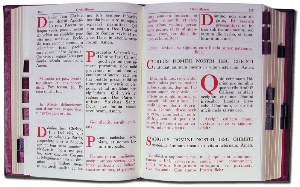
New altar edition of the 1962 Missale Romanum now availableThe volume is 1290 pages, and measures 83/8” x 11¼” (approximately 2¾” thick).
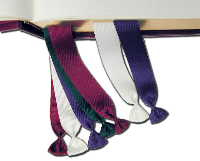
It seems to have good ribbons and page markers.

There are interesting photos of the printing process and assembly of the book here.

In case you are wondering what it has:

  • St. Joseph’s name in the Canon (added in November 1962)
  • ad libitum prefaces (added in April 1963 and which includes the restored Advent preface)
  • pro aliquibus locis (for some places) section specifically for the USA dioceses (added in December 1962)
  • imprimatur by Cardinal Spellman

The fastest way to see if your edition is really a 1962 edition is to check the Roman Canon to see if the name of St. Joseph is included.  This was a change made by Bl. Pope John XXIII for the 1962 edition.  St. Joseph’s name was not in the Canon before the 1962 edition. 

New altar edition of the 1962 Missale Romanum now available

To find out what edition you actually have, you can look at the "legal" documents at the beginning of any Missal.  A Missal always includes the texts of the documents which promulgate the edition.  Remember, "back in the day" publishing houses were given permission by the Holy See to print liturgical books.  So, the publication date of an edition printed in the USA might actually be after the year of the edition.

Nevertheless, there ought to be also the addition of a letter from ecclesiastical authority that this volume conforms to the original.  We recently had a question addressing that elsewhere.

In any event, they are taking great pains to differentiate their volume from another book published at the "1962" Missale,…

So unlike the other “1962” missal being offered in the USA…

It is offered in both a red binding and green.  I have seen both colors of the original editions and the older timers are both handsome.  It remains to be seen what hues of red and green this new volume has.  I suppose the photos of the construction process on their site are to show us also how sturdy the binding is, which is a critical point for an altar missal.

It comes with a slip cover.

I am delighted that this new tool for the "Marshall Plan" exists.

In order to help revitalize our Catholic identity in every sphere of our lives, we must revitalize our worship.  Celebrations of the older form of Mass will exert a powerful "gravitational pull" on the way the newer forms of worship are conducted. 

Younger priests and laypeople especially will be on the forefront of this great undertaking.

But they need mentors.

They need training.

And they need books.


Posted in Brick by Brick |
31 Comments

Fluffly winged tennis balls

When the temperatures dip and the wind picks up (it was around -25F with windchill today) birds tend to eat constantly and puff up like little tennis balls.

Fluffly winged tennis balls

This little Pine Siskin has been snarfing the seed nearly without a break for the better part of the afternoon, not leaving the perch at all. 

I don’t know what gives, but he isn’t hangin’ with the rest of the flock today.

Perhaps like the Kung Fu Panda, he has a big showdown coming up later and eats when he is nervous?

Posted in My View |
22 Comments

Cork, Ireland: 4-5 Feb – TLM course for priests

From a reader:

The Latin Mass Society of Ireland will run a second course for priests wishing to learn to say the Latin Mass (Extraordinary Form) in Cork in February. The course will take place between Wednesday, February 4 and Thursday, February 5 at St Dominic’s Retreat Centre, Ennismore, Cork.

The course director will be Father John Emerson FSSP. For further details, see www.latinmassireland.org or e-mail Maurice O’Brien at mauriceandjaneobrien@g mail.com or Vicky Nestor at vickynestor@gmail.com

Posted in SESSIUNCULA |
16 Comments

A reminder about e-mail

I am deeply grateful when people take the time to write e-mail with news items.

However… I have plenty to do during the day hours.  

Please… please… don’t just send a link and leave it to me to dig up the information, figure out what is relevant, format it, and post it.  

It doesn’t take a little time to put together an entry for the blog, you know.

If you can do some of that ahead of time, it is more likely that I will post it. 

When I get e-mail with merely a link, my heart falls.

Posted in SESSIUNCULA |
Comments Off on A reminder about e-mail