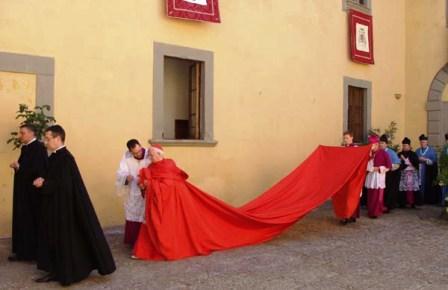
I note on this photo, posted over at the Papist‘s place….
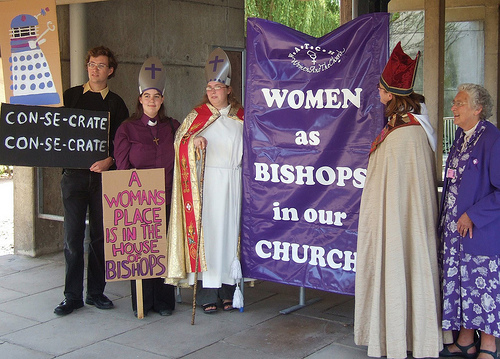
As if they weren’t already a sad punch line,…
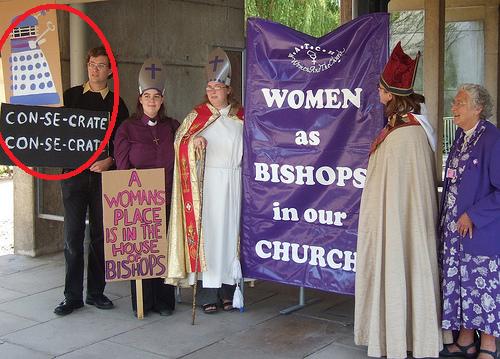
I note on this photo, posted over at the Papist‘s place….
As if they weren’t already a sad punch line,…
There is some discussion going on in the Catholic blogosphere about the obligation, or lack thereof, for women to cover their heads in church with a mantilla or hat, etc.
On St. Louis Catholic there was stark statement about my position:
The first author, Rev. Zuhlsdorf, summarily dismisses the obligation of head-covering for women in church, stating, “[A]ccording to Church law you are not obliged.” He bases his conclusion on an apparent reductionist equating of the Code of Canon Law of 1983 with any other Church law.
Reductionist? Summarily?
Well… as my late pastor, Msgr. Richard Schuler used to say: "When you’re right you can’t be wrong."
I’m right.
What bugs me about St. Louis Catholic blog entry is the way the entirety of position was ignored.
In fairness, they ought to have clarified that whenever I state that there is no obligation under the Church’s law at this time, I nevertheless think this is a very good tradition. I think woman and girls should use mantillas. I have always made sure to include that when stating that there is no obligation.
I have written about the head covering issue many times, here and elsewhere. I also dealt with it in PODCAzT 45 in response to a question.
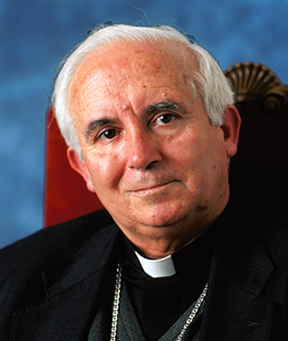 More about Card. Cañizares Llovera, the new Prefect of the Congregation for Divine Worship
From Palazzo Apostolico of Paolo Rodari:
The nickname "little Ratzinger" was born in the Roman Curia. From 1985 to 1992 Canizares played the same role in the Spanish bishops conference that Ratzinger played in the Vatican: he took care of the "doctrine of the faith" sector for the bishops conference. It was this role, together with the special friendship he had with Ratzinger, that prompted the men of the former Holy Office good-naturely to start nicknaming him that way.
The friendship with the present Pope had not secondary role in his arrival in Rome. Benedict XVI trusts him. It is known that liturgy is a determining domain at the heart of his pontificate, and he wants to be certain that, in the face of the future farewell of Malcolm Ranjith, the present secretary of the same Congregation (who will become the Archbishop of Colombo and later cardinal), there will be in the dicastery a man who will guarantee the continuation of a very clear liturgical line: the liturgy is at the apex of the life of faith and, at the same time, it lives from continuity. And so: the Church, in the name of a illuminated progress, proceeds renews herself without losing sight of her own roots and her own living tradition.
And so the fact that there arrives at Liturgy a man who in the past has thoroughly digested theology is not irrelevant. Theological understand is useful and "Little Ratzinger" has it. A great scholar of Teresa of Avila, having been bishop of Avila from 1992-96 (it was his first, and for him unforgettable, bishop’s see), he demonstrated love for the study of theology founding, at Avila, the Catholic University "Saint Teresa of Jesus". In the balance, in his curriculum there is only one fault: he speaks only Spanish.
Immediately after the arrival of Canizares Benedict XVI will touch up other crucial sectors of the Roman Curia: Cardinal Walter Kasper, after the funeral of Alexis II (today) and the octve of prayer for unity of Christians (starting in 2009) will leave his dicastery which deals with ecumenism. Farther down the line the prefects of other dicasteries will also leave, all near to 75 years of age, Claudi Hummes, Giovanni Battista Re, Ivan Dias, Dario Castrillon Hoyos, Javier Lozano Barragan e Franc Rodé. The example could be given with Re: next January he turns 75 and he could do what in the past his predecessor Lucas Neves Moreira did. He could step down exactly on the day of 75th birthday: it was 16 September 2000.
There’s more, but that’s what I have the energy to do right now.
Apparently, and sadly, Fr. Richard John Neuhaus editor of First Things, has been diagnosed with cancer.
He put this on his site:
Fr. Neuhaus wrote this note on First Things:
I cannot begin to respond to the deluge of assurances of prayer and concern about my health. Please be assured that I am grateful and count mightily on being remembered by you before the Throne of Grace. Or, as Catholics are wont to say, on your storming the gates of heaven. The nature of the cancer is beginning to come into clearer focus, and I hope to have more details in short order. Meanwhile, I will, please God, continue to be as engaged as possible in the work of First Things and other apostolates, even as I am compelled by grace to know more deeply our solidarity within the Body of Christ.
May I ask you all to say a prayer, right now, for Fr. Neuhaus?
From a reader:
Can you explain the construction, "Benedicite Deus"? First, is it actually the equivalent for "God bless," as several websites suggest? If so, how does the grammar work there — is "benedicite" some sort of majestic plural, with "Deus" in the nominative?
As you know, near the end of Prime is also found "V./ Benedicite. R./ Deus," and there is a similar construction in the EF Mass, I think when incense is used, when a Priest is addressed, "Benedicite, reverende Pater."
This has been bugging me, and now several friends, for a while now.
Interesting. I haven’t thought about this.
Benedicite is a 2nd person plural imperative. And Deus is obviously a singular form. Pater Reverende is also a singular.
Benedicite is also common in the liturgy in the recitation of the Canticle in Morning Prayer, "Benedicite, omnia opera Domini, Domino; laudate et superexaltate eum in saecula." But the plural form is clear in that context.
In Prime I am not entirely sure that this is Benedicite, Deus. Notice the comma. I think this is more along the lines of two separate concepts, Benedicite, being a complete sentence, "Let you all speak [i.e. "ask for"] a blessing!" and the response everyone says is "God!", in other words, "May God bless us!" And then in Prime there is a blessing spoken by the one who says Benedicite.
In the case of the blessing of incense, I suppose the same thing is going on. The Benedicite is mainly spoken to everyone present, and the priest blesses. It could therefore be the echo of courtly forms, the courtesy and greater formality of earlier epochs.
I found that Jungmann has a note on Benedicite. In The Mass of the Roman Rite, Vol. I, p. 309, n. 75 we find a discussion of a custom of saying "Adiutorium nostrum in nomine Domini" as the priest leaves the sacristy.
"In some churches the servers offer the priest the holy water for a blessing as he pronounces these words. In some places (e.g., in Tyrol) the servers use the formula for asking a blessing: Benedicite! and receive the answer: Deus [sc. benedicat]."
Anyway… there’s my shot at it.
Don’t forget these recent PODCAzTs on the Advent hymns in the Church’s official prayer, the Liturgia Horarum.
076 08-12-07 An Advent hymn dissected "Verbum supernum prodiens", with digressions
075 08-12-04 An Advent hymn dissected "Conditor alme siderum"; Fr. Z digresses far afield
From a reader:
Seven Days of Musical Heaven”
June 22-28, 2009 (Monday noon through Sunday morning)
Loyola University, Chicago, Illinois
Sponsored by the Church Music Association of AmericaYou are invited to sing with and experience the Sacred Music Colloquium, the largest and most in-depth teaching conference and retreat on sacred music in the world.
Gregorian Chant has been called the most beautiful music this side of Heaven. But as Pope Benedict XVI and the Second Vatican Council have emphasized, it is also integral to Catholic liturgical life and should be heard and experienced with wide participation in every parish. The Church Music Association of America is working to bring about this ideal with its Sacred Music Colloquium.
The primary focus of the Colloquium is instruction and experience in chant and the Catholic sacred music tradition, participation in chant and polyphonic choirs, nightly lectures and performances and daily celebrations of liturgies in both English and Latin. You are there not merely as an attendee but as a singer in some of the greatest choirs you will ever experience, singing music that will touch your heart and thrill your artistic imagination — music that is integral to the Catholic faith.
Attendance is open to anyone interested in improving the quality of music in Catholic worship. Professional musicians will appreciate the rigor, while enthusiastic volunteer singers and beginners new to the chant tradition will enjoy the opportunity to study under an expert faculty.
On the blog Rinascimento Sacro there is an story I didn’t expect to be reading.
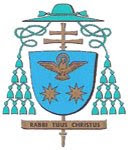 Following the precepts of Summorum Pontificum in the Archdiocese of Ferrara-Comacchio and the Abbey of Pomposa, the archbishop, His Excellency Most Rev. Paolo Rabitti on 8 December, happy day that it always is and now happier still, released a notification about the introduction of Holy Mass in the Extraordinary Form in Ferrara. He has designated a church of the Theatines, Santa Maria della Pietà e san Gaetano, and its rector Fr. Riccardo Linares, to have Mass in the older form every Sunday and Holy Day of Obligation at 5 pm.
The bishop also issued a fine letter for the diocese.
Mattone su mattone, amici!
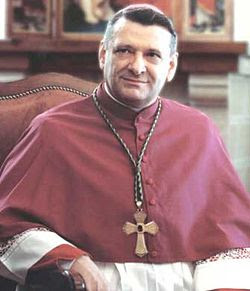
# RINUNCIA DEL PREFETTO DELLA CONGREGAZIONE PER IL CULTO DIVINO E LA DISCIPLINA DEI SACRAMENTI E NOMINA DEL SUCCESSORE
Il Santo Padre ha accolto la rinunzia presentata dall’Em.mo Card. Francis Arinze, per raggiunti limiti di età, all’incarico di Prefetto della Congregazione per il Culto Divino e la Disciplina dei Sacramenti ed ha chiamato a succedergli nel medesimo incarico l’Em.mo Card. Antonio Cañizares Llovera, finora Arcivescovo di Toledo (Spagna).
TRANSLATION:
The Holy Father has accepted the resignation presented by His Eminence Francis Card. Arinze, for having reached the age limit, as Prefect of the Congregation for Divine Worship and Discipline of the Sacraments and has called to suceed him in this same role His Eminence Antonio Card. Cañizares Llovera, who has been until now Archbishop of Toledo, Spain.
Card. Cañizares Llovera is member of the Commission Ecclesia Dei.
This means that His Excellency the Secretary, Archbishop Ranjith will be staying a while longer.
This is a happy development, all in all.


Coat of Arms by D Burkart
 WVC on Pope Leo XIV airplane interview: remarks about relaxing Traditional Latin Mass restrictions: “@Rod Intentional or not. With malice or without. I suspect that many within the Vatican, especially among the Curia, consider…”
 on NB: Desktop and Posting – Zuhlsdorf’s Law kicks in – UPDATE: “AI does have its uses. Both good and bad. I’ve been using extensively to help me configure some servers I…”
 on Pope Leo XIV airplane interview: remarks about relaxing Traditional Latin Mass restrictions: “I do wonder to what extent a certain set of Episcopal Consecrations on July 1st created the impression of a…”
 on Pope Leo XIV airplane interview: remarks about relaxing Traditional Latin Mass restrictions: “! TC was Francis’s decision and we will continue that. ! SP was Benedict’s decision and we will not continue…”
 on Pope Leo XIV airplane interview: remarks about relaxing Traditional Latin Mass restrictions: “~mibethda You are assuming that there isn’t a contingent among the powers that be that has just as much of…”
 on NB: Desktop and Posting – Zuhlsdorf’s Law kicks in – UPDATE: “We have all tried to enter thru that “narrow gate”. Just last night I installed new computer drafting software for…”
 on Pope Leo XIV airplane interview: remarks about relaxing Traditional Latin Mass restrictions: “WVC: You are exactly correct. The problem is that under TC we the faithful who have a desire to attend…”

A Daily Prayer for Priests








They find you a pro-life agent in your area who commits to giving a portion of the fee to a pro-life group!

PLEASE subscribe via PayPal if it is useful. Zelle and Wise are better, but PayPal is convenient.
A monthly subscription donation means I have steady income I can plan on. I put you my list of benefactors for whom I pray and for whom I often say Holy Mass.
In view of the rapidly changing challenges I now face, I would like to add more $10/month subscribers. Will you please help?
For a one time donation...



Help Monks in Wyoming (coffee – UPDATED LINK) and Norcia (beer) and the wonderful "Soap Sisters" of Summit, NJ!


Please follow me on Twitter!










Visits tracked by Statcounter
since Sat., 25 Nov. 2006:

