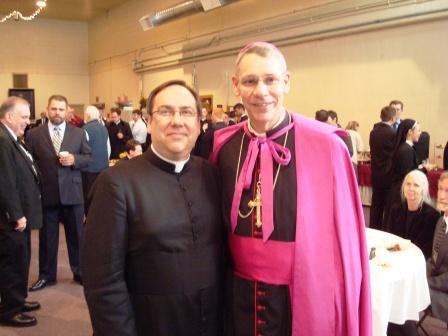
KC: local media coverage of Old St Patrick

Today I see in the KC STAR on B5 a black and white photo and box on the consecration of Old St Patrick.

I wonder if the KC based National Catholic *Reporter* covered the event.

After all… this is their own back yard, very close to their HQ.

NCRep made a special effort to cover dissident Fr. Richard McBrien’s recent visit to KC.

McBrien criticized Pope John Paul and Pope Benedict and tried to confuse the faithful about the fundamental importance of life in this election cycle.

The Reporter sure covered that!

Was NCRep not interested? Will they have no coverage positive or negative?

I’m just askin’….


Posted in I'm just askin'..., SESSIUNCULA |
5 Comments

Ave Maria Univ.: TLM Cantata

From a reader:

Dear Fr. Z,

Here’s an email we received at Ave Maria University:

"Dear AMU Community,
 
The AMU Chamber Choir will sing a Missa Cantata tomorrow at 12:30pm in the Oratory. 
 
In Extraordinary Form of the Roman Rite, tomorrow is the feast of Christ the King, instituted in 1925 by Pope Pius XI with the encyclical Quas Primas.  In the calendar of the Extraordinary Use, the feast of Christ’s Kingship occurs in proximity to that of His holy court, All Saints.
 
Music will include:
•    Missa Brevis by 16th-century Italian composer, G. da Palestrina
•    Coenantibus autem illis by 17th-century indigenous Mexican composer Juan de Lienas
•    Gregorian propers of the feast
Vivat Christus Rex."

Posted in SESSIUNCULA |
7 Comments

Synod on Scripture proposes making women Lectors… er… Lectrices

Here is a story from CNS by my friend in Rome and fellow Minnesotan Mr. John Thavis:

Remember that once upon a time, Holy Church had the minor order of Lector.  Paul VI suppressed the minor orders in favor of "ministries" of Lector and Acolyte.  These are open only to males.  However, an interpretation of the 1983 Code of Canon Law (a mistaken one, I think) allowed that women could substitute for officially installed Acolytes.  This introduced a theological confusion into our praxis as a Church, a violation of continuity in our tradition.

Now, we read that not all the discontinuity embracing aging-hippies stayed home when they were invited to the Synod this year:

An opening on women lectors?
Posted on October 25, 2008 by John Thavis

VATICAN CITY — Probably the most newsy — and somewhat unexpected — item in the final propositions of the Synod of Bishops on the Bible was a proposal to allow women to be officially installed in the ministry of lector. [Quod Deus avertat.]

The issue was raised in Proposition 17 on “The ministry of the word and women,” and on Saturday morning it passed with 191 votes in favor, 45 opposed and three abstentions, according to our sources.

“It is hoped that the ministry of lector be opened also to women, so that their role as proclaimers of the word may be recognized in the Christian community,” the proposition states in its final sentence.

What Pope Benedict XVI will do with that proposal is unclear, according to Vatican people I spoke with shortly after the synod vote.

The issue, of course, is not whether women can act as lectors, or Scripture readers, in Catholic liturgies. They already do so all over the world, including at papal Masses.

The question is whether women can be officially installed in such a ministry. Until now, the Vatican has said no: canon law states that only qualified lay men can be “installed on a stable basis in the ministries of lector and acolyte.” At the same time, canon law does allow for “temporary deputation” as lector to both men and women, which is why women routinely appear as lectors.

The reasoning behind church law’s exclusion of women from these official ministries has long been questioned. For centuries, the office of lector was one of the ”minor orders,” generally reserved to seminarians approaching ordination. While seminarians still are installed formally as “acolyte” and then as “lector”  before being ordained deacons, since the 1970s service at the altar and proclaiming the readings at Mass have been seen primarily as ministries stemming from baptism and not specifically as steps toward ordination.

“It’s important to emphasize that any proposition for women lectors would simply arive from their baptism and not from any presumptive opening for orders,” said one Vatican source.  [I disagree.  I think reading in liturgy is tied closely also to Holy Orders, and not just baptism.  I wonder if this proposition doesn’t come from a confusion of the two modes of priesthood.]

The synod took up the question because some have suggested that in promoting greater scriptural preparation and presentation, the church designate “ministers of the word.” Lectors were seen as natural candidates.

It’s interesting that this proposal, while passing overwhemlingly, drew the greatest number of “no” votes than any of the other 54 propositions, most of which passed with fewer than five opposing votes.

Posted in SESSIUNCULA |
137 Comments

TLM in York, England: aftermath

You might remember that I posted news of a solemn TLM in York, England.

Here is a debriefing:

Dear Fr Z
Many thanks for posting the information about the Solemn Mass in Honour of Our Lady, which was celebrated yesterday at English Martyr’s Parish in York, England. Here are some reflections on the Mass that might be of some interest to your readers.
 
1/ Master of Ceremonies: A very kind young gentleman came in from outside of the city to act as MC and what a difference it made! A calm and assured MC instantly put our regular servers at ease, knew how to keep out of the way, but also knew how to reduce the duties of the priest so that he could concentrate on prayer. It made all the difference to the celebration of the Mass and the synchronicity of all the servers was incredible. For communities just starting the EF Mass, the training and encouragement of a head server should be a top priority.
 
2/ Young vs. Old: It was apparent that many of the newcomers were of an older generation while some of the regulars were younger. It was quite interesting that it was the younger crowd who knew when to stand/sit/kneel/respond while the older worshippers came to follow their lead. I thought this particularly interesting because so many of liturgical battles in the Church seem to divide along generational lines. I do not doubt, based on some of the stories that I heard, that many older people rejoiced at VII because of abuses and lack of reverence that crept into the celebration of the EF. Now that it is celebrated by priests and people who are genuinely interested in it, perhaps it becomes the role of the young to humbly re-introduce it to the old. Rather than rail against them for an attachment to the OF or look at them in perplexity when thinking how they could abandon the EF, perhaps we should, with joy and humility, re-evangelise the older generation who came to dislike the EF so much. In this regard, one of the most inspiring comments I heard afterwards from an older worshipper was "Well, that wasn’t as bad as I thought it would be."
 
3/ Music: The Rudgate Singers provided a full schola with beautiful polyphonic chant, which made the sense of holiness all the more apparent. I won’t comment on this too much as I know our friends at NLM discuss it regularly. I will only say that we think we made history at this Mass. A Solemn Salve, composed for the Benedictine Abbey of St Mary’s York, was sung – which the schola leader thinks is the first time it has been sung in York after a Mass for Our Lady since the Reformation!
 
We continue to thank you for your many encouragements and work, and pray for your safety on your many travels.

Posted in SESSIUNCULA |
1 Comment

WDTPRS: Christ the King (1962MR)

Here is some of my article for The Wanderer for this Sunday, which in the older, traditional calendar, is the Feast of Christ the King, always celebrated on the last Sunday of October.

What Does the Prayer Really Say?   Last Sunday of October – Christ the King (1962 Missale Romanum)

In the post-Conciliar, Novus Ordo calendar, the Solemnity of Christ the King is the last Sunday of the liturgical year, just before Advent begins.  In the older calendar Christ the King fell on the last Sunday of October.  The feast was established by Pope Pius XI in 1925, as Pius Parsch says I in The Church’s Year of Grace, to “renew in the minds and hearts of the faithful the ancient concept of Christ as divine King who, enthroned at the right hand of the Father, will return at the end of time in might and majesty.”  It also falls in October, a month of celebration for Communists, who embraced a radical atheistic materialism. 

Each year Holy Church presents to us the history of salvation, from Creation to the Lord’s Coming (His First and also His Final Coming).  At this time of year, as we move in the Northern Hemisphere into the darkness of autumn and winter, as we head toward the end of the liturgical year, we more and more in the Church’s liturgy consider the Four Last Things: death, judgment, heaven and hell.   This feast reminds us that the Lord is indeed coming and that He will come not so much as “friend” or “brother” or “gentle shepherd” with a fuzzy lamb on His shoulders, but rather as King and our Judge.  The Dies Irae prayed at Requiem Masses identifies Christ as “King of Fearful Majesty” and “Just Judge”.  He is of course a King and Judge of mercy to those who submit themselves to His rule.  What will His coming be like?  Will it just be all trumpets and angels with harps and banners?  Consider the description of His Coming in 2 Peter 3: 10-12 (Douay-Rheims):

“But the day of the Lord shall come as a thief, in which the heavens shall pass away with great violence and the elements shall be melted with heat and the earth and the works which are in it shall be burnt up. Seeing then that all these things are to be dissolved, what manner of people ought you to be in holy conversation and godliness? Looking for and hasting unto the coming of the day of the Lord, by which the heavens being on fire shall be dissolved, and the elements shall melt with the burning heat?”

Christ Jesus will judge us all, dear friends, and submit all things to the Father (cf. 1 Cor 15:28).  Having excluded some from His presence, our King, Christ Jesus, will reign in majestic glory with the many who accepted His gifts and thereby merited eternal bliss.

COLLECT (1962MR):
Omnipotens sempiterne Deus,
qui in dilecto Filio tuo, universorum Rege,
omnia instaurare voluisti:
concede propitius;
ut cunctae familiae gentium,
peccati vulnere disgregatae,
eius suavissimo subdantur imperio.

That final line is clearly a reference to Matthew 11:27-30:

“All things are delivered to me by my Father. And no one knoweth the Son but the Father: neither doth any one know the Father, but the Son, and he to whom it shall please the Son to reveal him. Come to me all you that labor and are burdened, and I will refresh you. Take up my yoke upon you, and learn of me, because I am meek, and humble of heart: And you shall find rest to your souls. For my yoke is sweet and my burden light.” 

The image of the yoke is substituted by imperium.  The ancient Romans would force vanquished foes to pass under a yoke, iugum, as a sign of their subjugation, as if the people passing under it were being transformed into slaves or even beasts of burden.  Christ reverses the humiliation of the worldly yoke, making it into a sign of our freedom from the slavery of sin and the burden of this world.  In the prayer, however, the victorious might of Christ to free us is expressed not by the yoke, but by its opposite, that is imperium, which was the power granted by the Senate and People of Rome to men so that they could legally command armies.  Here, this “imperious” power of command, the power of life and death over the troops and the vanquished alike, is surprisingly paired with suavissimum, “most/exceedingly sweet”. 

We have looked closely at sempiterne in a previous column.  This is the vocative form of sempiternus, a, um.  In philosophy and theology (indistinguishable in ancient times through late antiquity) there has been constant effort to figure out time and God’s relationship to time. Thinkers developed terms such as “sempiternity” to identify a nuance about unendingness or everlastingness.  In this prayer sempiternus is simply the equivalent of aeternus, “eternal”.  Be aware that sempiterne can sometimes say something subtly different from aeterne though in our prayers I suspect that it is often used for the beautiful rhythm it brings to the opening line.

That kingly Latin lexicon, the Lewis & Short Dictionary, shows that disgrego is “to separate, divide”.  In its roots it means to split someone off from the grex, “the herd”.  Dis– is a prefix indicating some sort of separation or opposition.  Think of the English pairs “similar” and “dissimilar”, “facile” and “difficult”, “concord” and “discord”.

This prayer is clearly of more modern composition.  Your first clue to this is that it is wordy.  Ancient Roman Collects are distinguished by their crisp brevity.  It was clearly written by good students of Latin and of rhetoric, since the author uses what we call copia verborum, that is, a variety of words for the same idea instead of simply repeating the same word.  Note the use of three different words for “all”:  universus, omnis, cunctus.  Universus, a, um is an adjective and universorum a neuter plural, “all things.”  Since we have another “all things” in omnia, neuter plural of omnis, I will make universorum into “the whole universe.” Cunctus, a, um, is “all in a body, all together, the whole, all, entire”.  It comes from “con-iunctus” indicating that the things involved are connected, “conjoined”.

Instauro is a wonderful word.  It means “to renew, repeat, celebrate anew; to repair, restore; to erect, make”.  It is synonymous with renovo.  Etymologically instauro is related to Greek stauros.  Turning to a different L&S, the immensely valuable Liddell & Scott Greek Dictionary, we find that stauros is “an upright pale or stake.”   Stauros is the word used in the Greek New Testament for the Cross of Jesus.  The word immediately makes us think not only of the motto on the coat-of-arms of Pope St. Pius X, “Instaurare omnia in Christo”, but also the origin of that motto, Ephesians 1:10:

“For he has made known to us in all wisdom and insight the mystery of his will, according to his purpose which he set forth in Christ as a plan for the fullness of time, to unite all things in him, things in heaven and things on earth.” (Eph 1:9-10 RSV). 

There have been changes in the Latin texts of this passage, by the way: the older Vulgate of St. Jerome, the so-called “Sixto-Clementine” says “instaurare omnia in Christo” while the New Vulgate says “recapitulare omnia in Christo”.  Recapitulare is related to Latin caput (“head”).  This was considered by the scholars behind the New Vulgate to be a more accurate translation of the Greek anakephalaioô, “to sum up the argument.”  This harks to the headship of Christ over the Body of the Church.  It expresses that He is the Final Statement, the Conclusion of All Things.  At any rate, in 1925 when the Collect was composed, and in the 1962 Missale Romanum when the older version of Vulgate was in use, we prayed instaurare, not recapitulare.

The older Vulgate, going mainly back to St. Jerome’s translation, is named after Popes Sixtus V (1585–90) and Clement VIII (1592–1605), who issued editions of the Latin Vulgate Bible so that the Church would have a unified text in the face of the confusion resulting from the theological revolt of the Protestants.  The Neo-Vulgate, completed in 1979 and issued by Pope Paul VI, was based on a critical edition of Jerome’s Vulgate initiated by St. Pius X in 1907.  A second edition of the Neo-Vulgate was issued in 1986 by Pope John Paul II.  Thus, the Nova Vulgata is the Catholic Church’s official Latin version of the Bible. 

Many “conservatives” have not readily accepted the New Vulgate.  They see it as a “retranslation” rather than a “revision”.  They probably balk at some changes to familiar verses, such as the one I pointed out, above.  However, the New Vulgate is important our consideration of the preparation of a new translation of the Missale Romanum with its lectionary, or book of readings for Mass. Liturgiam authenticam states that the New Vulgate is reference source for biblical translations used in our liturgies.

You might remember that the chief opponent of the Holy See’s guidelines for translation, His Excellency Donald W. Trautman the Erie bishop in Pennsylvania, former head of the U.S. Bishops’ Committee for Liturgy, once claimed that Liturgiam authenticam was a bad document because (as he claimed) the New Vulgate was a flawed translation and that translators of the liturgy should instead refer to texts in the original languages. When His Excellency raised this during a meeting of the USCCB, I believe it was Bishop Arthur Serratelli, now in Paterson, NJ, who made it clear that Liturgiam authenticam really says that the New Vulgate must be used when determining which verses of Scripture are to be translated for the liturgy, since chapter and verse markings differ among ancient manuscripts.   Some reference point is needed.

LITERAL TRANSLATION:
Almighty eternal God,
who in Your beloved Son, the King of the whole universe,
desired to reestablish all things:
propitiously grant;
that all the families of the nations,
separated by the wound of sin,
may be brought under His most sweet sovereignty.

The Daily Missal and Liturgical Manual (Baronius Press – 2007):
Almighty and everlasting God,
who in Thy beloved Son,
the King of the whole world,
hast willed to restore all things,
mercifully grant that all the families of nations
now kept apart by the wound of sin,
may be brought under the sweet yoke of His rule.

In everything Jesus said or did in His earthly life He was actively drawing all things and peoples to Himself.  In the time to come, when His Majesty the King returns in glory, His act of drawing-to-Himself (cf. John 12:32) will culminate in the exaltation of all creation in a perfect unending paean of praise. 

By virtue of baptism and our integration into Christ’s Mystical Body we all share something of His three-fold office of priest, prophet, and also king.  We have the duty to proclaim His Kingship by all that we say and do.  We are to offer all our good works back to Him for the sake of His glory and the expectation of His Coming.  He must be the King of all that we are and all that we do.  Through total submission to His rule, we mysteriously become kings ourselves even in our lowliness.  We are restored, in a sense, not just to what we lost on the fall of the First Adam.  The Second Adam restores to us even more than we originally rejected.

This glorious restoration (instaurare) is possible only through the Lord’s Cross (Greek stauros).  The Cross is found subtly in the midst of this Collect, where it is revealed as the pivot point of all creation.

WDTPRS aims to help you explore and love more deeply the true content of the prayers of Holy Mass. 
Posted in WDTPRS |
4 Comments

FSSP celebrates in Rome

Our friend John Sonnen over at Orbis Catholicus has posted some great photos of the FSSP’s celebration in Rome.  Here and here and here and here and many other places.  Go explore.

Here is a teaser.

FSSP celebrates in Rome

My my… that looks like the Via dei Pettinari, doesn’t it?

Posted in SESSIUNCULA |
3 Comments

KC: Bp. Finn’s sermon for the consecration of Old St. Patrick

Here is the sermon of His Excellency Most Rev. Robert Finn, Bishop of Kansas City for the consecration of Old St. Patrick and a Pontifical Mass.

It is slightly edited, and with my emphases and comments.

Sermon for the Consecration of Old St. Patrick Church

October 25, 2008

Most Reverend Robert W. Finn

Bishop of Kansas City-St. Joseph

Then came a loud voice from the heavenly throne, “Behold the dwelling place of God with men. … Behold, I make all things new.”

Dear friends, I greet you with great joy on this day of Solemn Consecration. This is the dwelling place of God with men. This is the place where heaven meets earth, where the mystery of salvation touches the human heart. Here, even sadness and death are given flight – so full of hope, so full of grace and light are the truths and supernatural actions that unfold in this place, where God dwells with man.  [Indeed!  Well said.  This is a sacred space wherein people are to have a transforming encounter with mystery.  The introit for the Mass is "This place demands reverence… Terribilis est locus iste…"  William James calls this sense of mystery, this feeling of holy reverential dread at the fearful, almost terrifying experience, "awe at transcendence".   The bishop got it in one.  And he starts with this!]

In the Gospel account of the meeting between the Lord Jesus Christ and the tax collector, Zachaeus, we see the power of conversion in the encounter with God. When the human heart receives the Lord, a saving change can transform us. Here in this magnificent church such miracles have been occurring for more than 130 years. Now, again we have set it apart as the House of God. What a happy and historic day this is in our Diocese.  [It is "set apart".  It is sacred.  And within the sacred precinct there is an even more sacred place, leading to a place most sacred of all.   Our places of worship should not look like seafood restaurants or municipal airport terminals.]

It was on August 14, 2005, that I had the privilege of being able to announce to our little Latin Mass community the impending arrival of the Institute of Christ the King Sovereign Priest, the establishment of the Oratory of Old St. Patrick, and the beginning of a plan to provide a fitting home for the faithful in this historic church – the oldest Catholic church building in Kansas City. At that meeting in the hall at Our Lady of Sorrows, I told those gathered about this place. I called it “a diamond in the rough,” and acknowledged that the work of restoration “would be demanding and costly.” With enthusiasm and hope they accepted the challenge.

KC: Bp. Finn's sermon for the consecration of Old St. PatrickOut of a motive of true love for God and dedication to the Church you have done something great in the history of the Diocese. You have renewed this holy temple in a way that is equal to the sacrifice and commitment of those who first built it, and which may indeed surpass its original beauty. Deo Gratias!
…

Now, dear friends, what will God accomplish in this place? His love and grace, alive in the Church, will be a source of supernatural aid to many individuals and, we pray, He will kindle something blessed in this neighborhood and throughout the Diocese. [This is very good.  This is a spark for the whole diocese!]

I pray that this church will be a center of reverent and obedient worship in spirit and truth for all who come here. Here you will bring your babies to be baptized. Here your sins will be forgiven. Here holy matrimony will be solemnly ratified. All the sacraments will give God glory, perhaps none more than the re-presentation of Calvary at this altar.

Dear friends, may this place also be a home of reconciliation for Catholics who, within the praxis of these venerable rites, still long for a more perfect communion with the Vicar of Christ and me his unworthy servant. I welcome you. Jesus Christ the Eternal High Priest Himself seeks you out. [Excellent.] He who came to seek and save the lost looks, searches, to see us. “Make haste and come down, Zachaeus.” And we must humbly invite him to the house of our soul as did the tax collector in whom already the transformation was beginning to take place.   [Notice how the theme of "transformation" threads itself through the whole sermon.]

Today, Dear friends, Let salvation come to this house! Let salvation be found here in the ineffable mysteries of which the Church is the one faithful and prudent steward.

[Watch this…]

There is one more precious intercession I wish to lift today. In collaboration with the Catholic bishops of Missouri, and in anticipation of a significant election, [the election…] I ask all to pray; to pray and sacrifice, so that our country will be renewed in the love of human life, and that we may be spared the continuing spiral and decline of our moral sense. Let us take advantage of the singular grace of this Solemn Consecration to beg the Merciful God; to implore Mary the Lady of the Rosary, St. Patrick and St. Bridget, St. Joseph and all our heavenly patrons, to keep our country from evil and sustain on a new path of life.  [This was a point I made to people during Forty Hours Prayer at Mater Ecclesiae in New Jersey a few days ago.   The point of Forty Hours was to beg God to avert disaster and to protect us in time of need.  The bishop ties this consecration of this church together with this theme of transformation for the diocese and now change of hearts and minds for the country.]

In this month of Angels I ask you to join me in calling upon the Guardian Angels of 47 million babies lost to the crime of abortion in our country, to carry the cry of these Holy Innocents before the throne of Mercy: not to condemn us, but to fortify and inspire us to be the Guardians of life.

On this happy day Lord, let us not forget the responsibility that is forever ours to give back to you the obedience of our faith, to seek holiness with a pure heart, and to spend ourselves in apostolic charity. Let the faith and good will of the many find a new start here. “For this is the dwelling place of God with men.” Let the voice from heaven resound in our joyful and thankful hearts, “Behold, I make all things new.”

Well done!


Posted in SESSIUNCULA |
11 Comments

KC: post Consecration celebrations

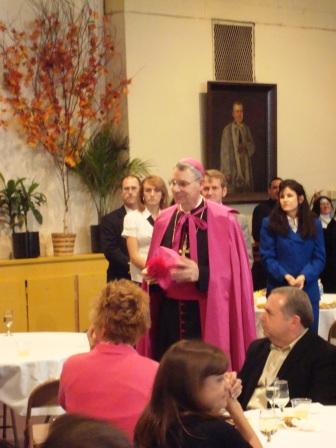
After the consecration of Old St. Patrick in Kansas City, MO, and the Pontifical Mass, many people headed to a hall near the Cathedral for an elegant reception.  His Excellency Most Rev. Bishop Finn came also. 

KC: post Consecration celebrations

He made some comments at the beginning and then spent time speaking with most of the people there.

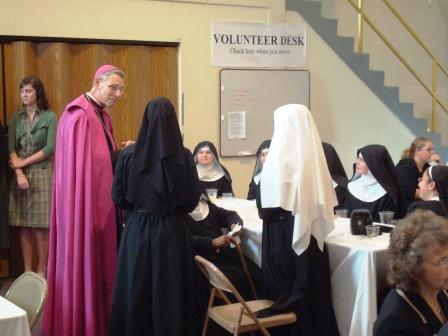
Some of the folks he spent time with were the wonderful Benedictines of Mary, Queen of Apostles.   Do not be alarmed.  I saw His Excellency tell the sisters to remain seated as they scrambled to rise at his approach.

KC: post Consecration celebrations

Indeed this is the "volunteer desk" in the best sense.

These are joyous women, by the way.   I was very impressed.  They pray for priests and vocations.  They make vestments.   They are young and focused and have a strong identity.

I had a chance to chat with Bishop Finn for a while.   He is, as always, very gracious.

KC: post Consecration celebrations

The celebration continued at the house of a long-time friend and fellow early internet warrior.

We were happy to have Fr. Totten join us.   He posts on here on the blog from time to time.

KC: post Consecration celebrations

"But Father! But Father!" you might be saying.   "What is that in your glass?"

This is something I am not used to at all: bourbon. 

Frankly I am not a great fan of this stuff.   But I could get used to what I had tonight.   I had heard about it from a friend in Rome.  Now I have tried it.  He was right.

KC: post Consecration celebrations

For supper, which involved a wonderful celery soup with onion and gruyere cheese, a roasted pork loin and a sautee of Brussels sprouts and radichio, we had a fine Zin.

KC: post Consecration celebrations

All in all, a successful day.

Posted in SESSIUNCULA |
7 Comments

More of the Consecration of Old St. Patrick in KC

Here are a few photos of some of the more interesting moments in the rite of consecration and a couple from the Pontifical Mass and its aftermath.

I’ll post and maybe add notes later. 

More of the Consecration of Old St. Patrick in KC

More of the Consecration of Old St. Patrick in KC

More of the Consecration of Old St. Patrick in KC

More of the Consecration of Old St. Patrick in KC

More of the Consecration of Old St. Patrick in KC

More of the Consecration of Old St. Patrick in KC

More of the Consecration of Old St. Patrick in KC

More of the Consecration of Old St. Patrick in KC

More of the Consecration of Old St. Patrick in KC

More of the Consecration of Old St. Patrick in KC

More of the Consecration of Old St. Patrick in KC

More of the Consecration of Old St. Patrick in KC

More of the Consecration of Old St. Patrick in KC

More of the Consecration of Old St. Patrick in KC

More of the Consecration of Old St. Patrick in KC

More of the Consecration of Old St. Patrick in KC

More of the Consecration of Old St. Patrick in KC

More of the Consecration of Old St. Patrick in KC

More of the Consecration of Old St. Patrick in KC

More of the Consecration of Old St. Patrick in KC

More of the Consecration of Old St. Patrick in KC

Posted in My View, SESSIUNCULA |
31 Comments

Consecration and Pontifical Mass

We have consecrated the church.

Pontifical Mass will soon begin.

Consecration and Pontifical Mass

The consecration and Mass are over and we have spilled outside!

What a ceremony and day.

Consecration and Pontifical Mass

At the reception.

Consecration and Pontifical Mass

Posted in SESSIUNCULA |
7 Comments