INTERNET PRAYER UPDATE: DANISH

Another happy announcement.  We have now a Danish rendering of the Internet Prayer.

DANISH:

Bøn før du logger på internettet:
Almægtige evige Gud
Du som har skabt os i dit billede,
og opfordret os til at søge det som er godt, sandt og skønt,
specielt i din enbårne søn,
vor Herres Jesu Kristi, guddommelige person.
Vi beder at du,
gennem den hellige biskop og kirkelærer Isidors forbøn,
vil gøre det sikkert at vi på vores rejser gennem internettet
retter hænder og øjne mod det du finder behageligt,
og at vi behandler alle vi møder med kærlighed og tålmodighed.
Ved Kristus vor Herre. Amen.

I am always happy to receive new translations.  Check the Internet Prayer Page to see what has already been provided.

Also, I always pleased when native speakers of languages also provide an audio file of the prayers read in their tongue.
INTERNET PRAYER UPDATE: DANISH

Posted in SESSIUNCULA |
1 Comment

QUAERITUR: Assistant priest puts an amice over the surplice

This comes via Facebook from a priest reader:

What can you tell me about the use of the amice over the surplice for deacon chaplains and Assisting Priests? The AP at my first Mass wore the amice that way.

There isn’t really too much to say.

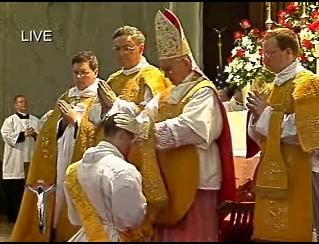
There are a few occasions wherein there may be an assistant priest, such as when a bishop pontificates or for the first three solemn Masses of a newly ordained priest.  The assistant does certain things with, for example, the book and especially in the case of the newly ordained, makes sure he doesn’t make a grave mistake.

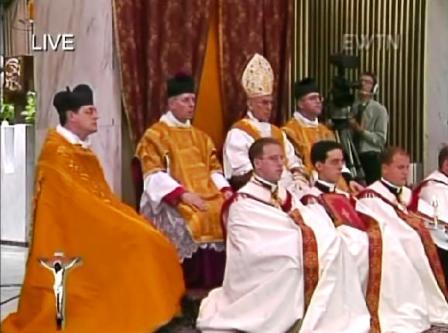
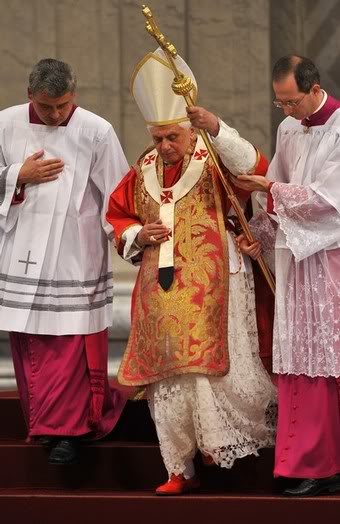
In this screen capture you can see an assistant priest to the left, in the cope.

QUAERITUR: Assistant priest puts an amice over the surplice

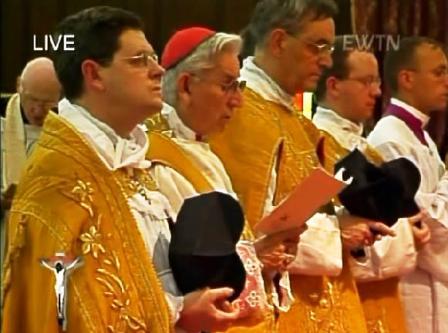
Again… the AP is on the left, though he has his cope properly closed over his knees so that you cannot see the cassock.  The deacon "chaplains" sitting with the Cardinal in this shot have their surplices.

QUAERITUR: Assistant priest puts an amice over the surplice

QUAERITUR: Assistant priest puts an amice over the surplice

He dresses in his cassock, with a surplice (or rochette if can wear one).  He put on the amice over the surplice and then the cope.  I think the idea is that it is he not quite a sacred minister in the sense that the celebrant and deacon and subdeacon are.  He is sort of in between being an MC and a sacred minister.  The amice?  Dunno… that’s just the way it is.

You might be interested to know that in olden times, in processions, priests and deacons used to wear the vestment of their rank, chasuble or dalmatic, but over the surplice, not over an alb, also with the amice over the surplice.

Posted in "How To..." - Practical Notes, ASK FATHER Question Box, Mail from priests |
11 Comments

TULSA: Vocation of spiritual motherhood for priests

I was alerted to this very good item on the website of the Diocese of Tulsa. 

Bishop Slattery continues to impress. 

You will remember his statement after pro-abortion Catholics Speaker Pelosi (D-CA) and VP candidate Sen. Biden (D-DE) made their scandalous gafs about the Church’s teaching on life.

You will remember his strong instruction about sacred music.

Now there is this spiritual approach to give support to priests of the diocese.

Potential Spiritual Mothers Join to Pray, Learn About Roles
Diocese of Tulsa News
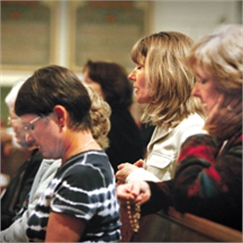
Sheila Michie, at center, joins in praying the rosary with other women who are discerning whether to become spiritual mothers to the priests of the Diocese of Tulsa.

10/10/2008 – EOC Staff

Nearly three dozen women of all ages will spend the next three months discerning whether God might be calling them to the vocation of spiritual motherhood to the priests of the Diocese of Tulsa. If they believe He has given them this vocation, they will spend the month of January in spiritual formation, deepening their prayer lives in preparation for their blessing by Bishop Edward J. Slattery on Sunday, Feb. 1.

The women who will begin their discernment traveled from across the Diocese on Oct. 7 for a Night of Reflection at Holy Family Cathedral offered by Father Mark Kirby, o.Cist. The focus of the evening’s prayer and reflection was the relationship that exists between Our Lord and his Blessed Mother, who was privileged to share in a unique way in her Son’s paschal Mystery. Father Kirby explained that from the cross, Our Lord, the Eternal High Priest, entrusted his disciple John into Our Lady’s maternal care, even as St. John assumed his new role of priest of the new covenant.

The vocation of a spiritual mother, Father Kirby said, is to sustain and support the Church’s priests in the same way Our Lady loved and supported her divine Son and her adopted sons like St. John. Spiritual motherhood “has nothing to do with doting on or mothering a priest,” Father Kirby said. Rather, a priest’s spiritual mother would offer herself to God, praying in intercession and reparation for him, spending time in Eucharistic Adoration and becoming “a point though which an abundance of God’s graces might flow to bless the priest and sanctify his work.

“This is the vocation being offered to you this evening. It’s not something that should be taken on lightly or without solid preparation.”

The program of spiritual motherhood is part of a Vatican effort proposed by Cardinal Claudio Hummes of the Congregation for the Clergy to draw on the link between the Eucharist and the priesthood – first, by establishing diocesan centers of Eucharistic Adoration and – secondly, by fostering the vocation of spiritual motherhood, in the example of Our Lady. Cistercian Father Mark Kirby gave two notable examples of consecrated feminine souls who lived out the vocation of spiritual motherhood. The first is the most popular saint of the 20th century, St. Therese of Lisieux. The second is the relatively obscure Margaret Mary Mathers, a widow, who offered herself as a spiritual mother for Padre Pio.

In discussing the program’s practical details, Father Kirby said that the women might never know the identity of the priest or seminarian they adopt, but emphasized that the hidden nature of the women’s commitment adds to its power. “Most likely, you will never lay eyes on the priests you are praying into holiness, but I promise you that you will see their faces in Heaven.”

In discerning the question of whether God has given them this vocation, the women will meet with Father Kirby on each of the four Tuesday nights of January to pray and reflect on the meaning of this life of prayer, penance and loving reparation. Thereafter, the spiritual mothers of the diocese would likely meet “ no more than three or four times a year.”

Among the women present Oct. 7 were Sister Christine Ereiser, O.S.B., prioress of St. Joseph Monastery with Sister Eugenia Brown and Sister Veronica Sokolosky, from St. Joseph’s Monastery, Tulsa.

“A couple of the sisters are interested, and so I came along,” Sister Christine said. “I’m very open to it; we’ll see what God has in store.”

Father Kirby stressed that any mature woman could become a spiritual mother, including single women, married women with children, widows and consecrated religious. For information on the nights of formation to be offered in January, please call 307-4955 or divine.worship@dioceseoftulsa.org


This is the first I have heard of this type of program in a diocese in the USA.   Perhaps there are others, but I have not come across them.

I must say I am grateful for such a powerful initiative.

Posted in SESSIUNCULA |
13 Comments

wonderful

wonderful

Posted in SESSIUNCULA |
Comments Off on wonderful

QUAERITUR: Can the TLM be offered ‘versus populum’?

From Facebook:

Dear Fr. Z,

The priest that celebrates de EF in Buenos Aires, has decided today to do it versus populum quoting a work of Card. Ratzinger that says that the cross must be the focal point or liturgical east. He also says that the rubrics of JXXIII’s missal doesn’t prescribe to celebrate the mass "ad orientem". Is this all right? What can we say to him?
Please, forgive my poor english and thank you very much!

No, there is nothing that requires the TLM (EF) to be celebrated ad orientem.  In Roman Basilicas it was celebrated versus populum because of the way the altar was situated in the sanctuary: on the model of San Pietro, where the celebrant stood at the main altar so as to face the East.  In the ancient Basilica of St. Peter, the people would be directed to turn around also to face the East during the action of the Mass.  So… celebration of Holy Mass to the liturgical East is important in the Roman way of seeing things.

However, nothing specifically prescribes ad orientem worship… though in my opinion it is superior. 

The other thing to consider, and this is important, the sensibilities of the people in the congregation should be considered.  If the people would be upset by an versus populum Mass with the EF, then it probably wouldn’t be a good idea.   There is no sense in doing that merely as a novelty or for shock value, or even because of the priest’s own preference.   The TLM and ad orientem are closely connected.

Posted in ASK FATHER Question Box |
39 Comments

Pray.

Pray.

Posted in SESSIUNCULA |
16 Comments

INTERNET PRAYER UPDATE: NORWEGIAN!

A kind reader has sent me the second update of the day!  Feast or famine, it seems.

I am pleased to share with you the Internet Prayer in Norwegian.  I am hoping to audio files of these prayers as well.

Bønn før en logger seg på internett:

Allmektige evige Gud,
Du som har skapt oss i ditt bilde,
og oppfordret oss til å søke det som er godt, sant og vakkert,
spesielt i din enbårne Sønns,
vår Herres Jesu Kristi, gudommelige person.
Vi ber at du,
gjennom den hellige biskop og kirkelærer Isidors forbønn,
vil gjøre det slik at vi på våre reiser gjennom internettet
retter hender og øyne mot det du finner velbehagelig,
og at vi behandler alle vi møter med kjærlighet og tålmodighet.
Ved Kristus vår Herre. AmenINTERNET PRAYER UPDATE: NORWEGIAN!

Posted in SESSIUNCULA |
3 Comments

Our Yellow Sun’s role in the economic recovery

I was clued to this from Dealbreaker by a friend.  Very funny:

Paulson To Use Superpowers Sooner Than Expected

In a raft of measures, that aren’t desperate (no really, we swear) Hank Paulson is set to issue what looks to be a general "term sheet" in the next few days for all financial institutions needing an thick injection of syrupy cash, or three.

Our Yellow Sun's role in the economic recoveryApparently, the power and flexibility Paulson possesses to complete these transactions has taken some by surprise. (People, we went over this once already. The Emergency Economic Stabilization Act of 2008 renames Paulson "Kal-El" and, because of his proximity to our yellow sun, grants him powers mortals could only dream of. Especially when it comes to syrupy capital injections). There is concern among many legislators that there was far too little opportunity for hand-wringing and grandstanding with lots of cameras and microphone thingies pointing before Paulson stole the show. Damn that Paulson and his financial crisis!

There is some grumbling (read: preparatory leaks) that Paulson might go so far as to nationalize crumbling banks as well, which should silence all the snickering that has been going on since Northern Rock was smothered in the ample bosom of the crown earlier this year.

Then there is the discussion of backing all bank deposits in the United States. It’s all the rage, you know.

No word yet on the use of X-Ray vision to see into balance sheets from afar.

Posted in SESSIUNCULA |
2 Comments

Bp. Fisichella at the Synod

I am interested in the intervention of H.E. Rino Fisichella whose background is in fundamental theology.  (Rene Latourelle)

–  H.E. Most. Rev. Salvatore FISICHELLA, Titular Bishop of Voghenza, President of the Pontifical Academy for Life; Rector of the Pontifical Lateran University (VATICAN CITY)

The Dei Verbum had still not been discovered and developed in its great intuition that constituted an authentic dogmatic progress; the Council fathers in fact had recovered the Biblical concept of the uniqueness of the source. This allowed Sacred Scripture to be understood within the life of the Church which does not just live by it but is responsible for its being alive, complete and fruitful. Many believers when asked what they mean by “Word of God” reply: the Bible. This is not a wrong answer, but it is incomplete or at least it shows an incomplete perception of the richness present in the expression and leads, as a consequence, to identifying Christianity as the “religion of the book”. It is necessary that in our language we do not fall into the uncertain expression “the three religions of the book”. Christianity is the religion of the “word”. It is important to strive for the construction of a culture that sees sacred Scripture as a living word, dynamically open to the truth of the revelation it contains. If we do not present this teaching in its totality in the various instruments we possess for the training of our people, we risk humiliating the Word of God because we reduce it exclusively to a written text without the provocative force to bring meaning to life any longer. As the Apostle reminds us: “God’s message cannot be chained up” (2 Tm 2:9).

What we are always faced with is the inexhaustibility of the Word of God; it is like the bush that burns without going out. We are called to exercise a ministry that permits this Word of Life to spread so that everyone in every part of the world can grasp its profound meaning in such a way as to obtain salvation. In a time like ours filled with attempts to marginalize the sacred texts as bearers of meaning only insofar as they are myths , with no historical character and destined only for the naïve, it is important that they find the necessary forms to restore historical value and provocativeness about the sense of existence. We really are faced with a teaching emergency that brings back to the center of our life of faith the theme of salvation. Again Dei Verbum reminds us how much has been transmitted and written on the “salvation announcement” (DV 7). The various cultural tendencies present in the modern world have not only perverted the meaning of salvation but they have marginalized it as useless and illusionary. Representing the Word of God in its totality means pointing the scope of its teaching towards the theme of our salvation.


Posted in SESSIUNCULA |
12 Comments

Pittsburgh: Bp. Zubik’s Letter on Catholics and Voting

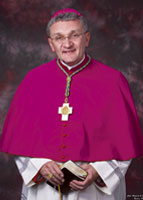
His Excellency Most Rev. David A. Zubik, Bishop of Pittsburgh, has issued a letter to his flock on VOTING.

Here it is with my emphases and comments.

Letter from Bishop David A. Zubik
on Catholics and Voting

Pittsburgh: Bp. Zubik's Letter on Catholics and VotingMy dear family of the Church of Pittsburgh,
 
There is an important matter that falls under my responsibilities as bishop which has taken front and center stage – the upcoming elections. One of the things I treasure most about you, the faithful of the Church of Pittsburgh, is the open way in which you offer suggestions to me and make requests of me. Sometimes those requests conflict. The election issue is one such example. Some of you have asked me to speak out publicly about the presidential candidates. That I can not do. [The bishop does not want directly to endorse a specific candidate.]  The important document written by the Bishops of our country entitled Forming Consciences for Faithful Citizenship: A Call to Political Responsibility from the Catholic Bishops of the United States (available at www.faithfulcitizenship.org) [But this is NOT a teaching document in the sense that the Church has a Magisterium.  Bishops conferences do not have a munus docendi in the same way that the Holy Father or individual bishops have.] underscores the important point that the Church cannot, I repeat, cannot tell people for whom they must vote. However, the document is very clear about highlighting two things about our voting privilege: (1) the right that we have to vote as American citizens is precious. (2) the obligation that we have to bring our faith to our voting is sacred.
 
As we approach the coming elections, I implore you to consider both: your right to vote; and your obligation to bring your faith to the voting booth.  [YES]

To assist you in both might I suggest four important steps. [This is good] (1) Familiarize yourself with the issues of the campaign; (2) Learn what the teachings of the Catholic Church are regarding those issues; (3) reflect on both in a spirit of prayer, and (4) Vote.  [Don’t opt out.]
 
To assist you in understanding what the teachings of the Church are regarding the various campaign issues, I would recommend that you consult with the Catechism of the Catholic Church, the United States Catholic Catechism for Adults or the Compendium of the Social Doctrine of the Church. Moreover, you might also want to secure a copy of Faithful Citizenship.  [The USCCB does not have a teaching office, a munus docendi by which they can issue teaching documents that can be placed together with, e.g., the CCC.  Faithful Citizenship is not a document of the Magisterium.  It cannot be treated as such.  Evangelium vitae, however, is a document of the Magisterium.  It is as if Apostolos suos wasn’t issued.] Since the presidential election of 1976 and every four years, we the Bishops have offered updated versions of this important document to assist voters as they exercise their voting rights coupled with the responsibility of an understanding of the issues from the perspective of faith. [I would have preferred also that H.E. spell out the main points to review.]
 
Now there is a second issue which I need to address with you as well. Over the course of the last several weeks, several people who are recognized as Catholic leaders in our diocese have espoused a public rationale for why they personally are choosing to vote for a particular candidate for the presidency. [Apparently, some prominent Catholics are saying that you can vote for a pro-abortion candidate.  Perhaps readers in Pittsburgh can fill us in on the background.] These reflections have appeared in either local newspapers or in national periodicals. A number of you have raised questions with me about their statements.

Over the course of the past week especially, I have reflected long and hard about how I might be able to respond to the many questions that you have placed on my desk about such statements.

I wish to clarify the confusion that has been caused by these public statements with the hope that any division that has been caused by such remarks and worse any scandal [We are back to this ugly reality: scandal.] that may have resulted from such comments is addressed. It is important to say once again that no one has a right to tell anyone how to vote. Moreover those who have offered their personal interpretation of the Church’s teaching do not speak for the Church and in some part do not reflect the teaching of the Church.  [It would be good to have local background here.]

Pittsburgh: Bp. Zubik's Letter on Catholics and VotingWhile Faithful Citizenship speaks about the moral choice which we each must make when we enter the voting booth, the manner in which we vote must weigh all the issues with a clear reflection on the teachings of the Church. The primary theme of Faithful Citizenship is the right to life and the dignity of every human person. [EMPHASES IN THE ORIGINAL] As the United States Bishops made clear, this is the foundation of a moral vision for society. We cannot dismiss this foundational principle as secondary in our thinking. As the bishops insist, we cannot consider abortion or euthanasia as merely two issues among many to be weighed or dismissed with a shrug. Nor can we exclude other issues that also are pro-life: concerns about the poor and immigrants, concerns about peace and war, concerns about bigotry and prejudice, concerns about capital punishment, and other social justice issues. [He is saying that the issue of right to life cannot be set aside in favor of these other important issues.]

Having offered these few thoughts on the upcoming electoral process, it is my sincere hope that I have clarified some of the questions which you have raised, [I think he did, when you read this closely.] especially in light of some well-known Catholics who advocate for your vote for a particular candidate from their own personal perspective.

As we are prepare for this year’s elections, remember to know the issues, know the Church’s teachings, pray about both and vote. To do so as a woman or a man of faith highlights the right we have as American citizens and the responsibility we have as members of the Church.

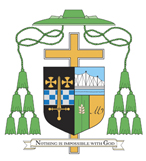
Grateful for our belief that "Nothing is Impossible with God," I am
Your brother in Christ,

Most Reverend David A. Zubik
Bishop of Pittsburgh

This is NOT a bad letter.  It comes down on the right side of things. 

However, there is a methodological flaw, in my humble opinion.  We must not fall into the trap of treating some document of the USCCB as if it were a magisterial document.

It is perfectly okay for a priest or bishop to embrace the concepts elucidated in a conference document (provided that they are correct, of course).  But we mustn’t raise these documents to a level of authority that they simply don’t have.

Again, Bp. Zubik is exercising his role as teacher of his flock in an important time and issue.  If you read this closely, you know what he is saying.  That is warmly to be applauded.

Posted in SESSIUNCULA |
30 Comments