NEWARK: TLM implemented

From a reader:

Our Lady of Mount Carmel Church (259 Oliver St., Newark, NJ) has recently instituted a Latin Mass according to the More Ancient Use Monday-Friday at 7:30 A.M. We are planning to start a Sunday Mass at 5:00 P.M. on the First Sunday of Advent. I would appreciate it if you could announce this on your website. We are also looking for men and boys who are interested in serving or forming a schola. Those interested should contact Fr. Forte at 973-589-2090. I would also appreciate it if you could recommend any other websites that I should contact.

Keep up the good work.

In Christ,
Fr. Anthony Forte

Posted in SESSIUNCULA |
15 Comments

TLM Seminary news

I got this from a reader:

Here at Kenrick-Glennon Seminary, the theologate is having a workshop on the Extraordinary Form of the Roman Rite.  I have attached a copy of the schedule.
 
This morning we assisted at a Solemn High Mass at the St. Vincent De Paul Chapel of the Cardinarl Rigali Center (the former Kenrick Seminary chapel).  It is a beautiful Tudor gothic chapel with side altars and choir stalls, etc.  It was absolutely beautiful. 
 
The celebrant of the Mass was Fr. Lienhardt of the Institute of Christ the King.  The deacon and sub-deacon were recently ordained priests of the Archdiocese of St. Louis.  The MC and servers are seminarian of Kenrick-Glennon Seminary.


Brick by brick, folks!  One on top of the other.  Slowly but surely.

And…

Posted in SESSIUNCULA |
11 Comments

QUAERITUR: Communion rails – Fr. Z rants

A question from a reader:

I am wondering if there was once a "law" about the Altar Rail in a Catholic Church.  Did, or does, Canon Law, GIRM, or The Ritus Servandus speak to this piece of Church architecture?


I am away from my library at the moment, but I am not sure there was a specific law on the books.  Spaces and architecture vary so much. Maybe someone can chime in on that.  Trimeloni might speak to this.

But the important thing is that there is no law that says that Communion rails were to be torn out!

The mania of eliminating the distinction between the priesthood of the ordained and the priesthood of the baptized, the obsession with "empowering" the laity by bringing them into the sanctuary, the insanity of thinking that modern man is all grown up now and doesn’t have to kneel as if before a feudal lord, resulted in architectural devastation.  It also undermined our identity as Catholics and our faith in the Real Presence.

Communion rails were among the things torn out, but the hearts of Catholic people were the real victims.

The altar rail serves to delineate the place of the the congregation in a church. 

Lay people and the ordained have different roles in the liturgy.  They have their own particular places.   When you blur those places by making them less distinct, you undermine something important in the hearts and minds of the clergy and congregation. 

When you constantly tell people that they are being empowered by being given things to do and places to sit or stand that cannot be distinguished from what the clergy do, you are really telling them that on their own they aren’t good enough.  They are really not good enough unless they do things priests do, or sit where they sit. 

Within the Hebrew temple, a sacred space, there was the Holy of Holies into which the High Priest would enter.  In our churches there must also be such a space marked off as the proper place of expiation and sacrifice, the priestly place.  This takes nothing away from lay people.

Some will say that Communion rails and kneeling and all that was just a later, Medieval accretion.  For those of that ilk, "Medieval" is always "bad".   On the other hand, these things developed as our understanding of what the Eucharist is deepened.

Things like altar rails are not just "encrustations" to be scraped off our churches.  They are concrete signs that we came to understand the Blessed Sacrament more and more over time and that that understanding drove people more and more humbly to their knees.

Also, there is a practical use of the Communion rail.  It helps those who are old or injured to kneel and rise again.  Sure conferences have said they prefer people to stand for Communion, but Holy Church guarantees that they can kneel.  Furthermore, mark my words that kneeling for Communion will make a come back.  It remains, after all, the norm.

I suppose a priest could say that he must put the rails in to help keep his insurance costs down.

I heard recently that Dominus Est, by Anthanasius Schneider and with a forward by Archbp. Ranjith is coming out in English.  This little book contains a strong argument for a return to kneeling for Communion on the tongue.  The Holy Father now only gives Communion on the tongue to those kneeling.

We must have a return to kneeling, people.  That means that we will need Communion rails.

There is nothing, as far as I know, directing us against them, other than wacko liturgists and those who have been duped by them over the years.

More Kneeling Now!

Posted in ASK FATHER Question Box |
70 Comments

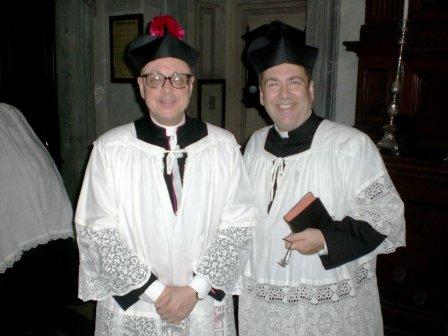
A shot in the sacristy

Our friend John Sonnen of Orbis Catholicus shot a photo in the sacristy of Ss. Trinita dei Pelegrini of me with an old friend in Rome, Msgr. Ignacio Barreiro, who runs the Rome office of HLI. 

This was last week at the end of the conference on Summorum Pontificum.

Thanks John!  Keep up the good work!

A shot in the sacristy


Posted in SESSIUNCULA |
26 Comments

A Seven Dials break

If any of you are near Seven Dials, I’ll spend a few minutes at The Crown. There is good Internet access here and Chinese food close at hand.

A Seven Dials break

A Seven Dials break

A Seven Dials break

A Seven Dials break

A Seven Dials break

Posted in SESSIUNCULA |
22 Comments

Glorious hours

I have just emerged from the National Gallery! Glorious hours! What a place. I learned a great deal and saw many paintings well known to me over the years.

These visits have been wonderful reminders of the passage of years. The first time, and last, I visited this gallery was over a quarter century ago … when I knew very little indeed. My appreciation of what I am seeing now has grown from those seeds and sparks.

In contrast to yesterday today I used an audio guide since I had more time. Yesteday I saw the pieces I simply could not miss. Today I took my time and really drilled into the experience going back to spend time in front of partcular paintings, listen to the guide, look some more with my own thoughts and watch others taking them in … or not.

Time well spent.

And the admission is free. Amazing.

Now I think I will find go by the Portrait Gallery again and find something to eat before seeking the tube.

Oh… I had a call from a friend in the USA while I was in the gallery. Sorry. Couldn’t talk on a mobile in there. I’ll find you later!

Glorious hours

Glorious hours

Posted in SESSIUNCULA |
6 Comments

The Lamb and Flag

The names of pubs often reveal England’s particularly Catholic roots. Today I met the splendid Anna Arco for lunch at the Lamb and Flag near Leicester Square. I was tempted to go to Chinatown again… but it was time for pub food: lamb hotpot seemed appropriate.

Conversation was wide ranging but eventually she told me about a article she is working on which will include a bit about an old sister I knew in Rome. But I won’t say any more about that!

Here are a couple views of the Lamb and Flag and then it is back to the National Gallery!

Maybe later I can wanderer back to Chinatown for some if that hot and sour soup I had the other day… Hmmm…

The Lamb and Flag

The Lamb and Flag

The Lamb and Flag

Posted in My View |
12 Comments

How St. Padre Pio received the stigmata

Here is a fascinating story posted on ZENIT.

Everyone should read it closely.

The Secret Story of Padre Pio’s Stigmata

Volume Reveals Report of Vatican Investigator

By Mirko Testa

ROME, SEPT. 22, 2008 (Zenit.org).- A volume detailing the report of a Vatican investigator into Padre Pio gives new information on the wounds of the Passion that the friar suffered.

Padre Pio da Pietrelcina received the stigmata from the crucified Christ, who in an apparition invited the Capuchin friar to unite himself to his passion so as to participate in the salvation of others, particularly consecrated persons: This is what we can know with certainty thanks to the recent opening — at the request of Benedict XVI — of the archives of the former Holy Office up to 1939, which contain information on revelations to Padre Pio that were not previously published.

These revelations have been released in a book titled "Padre Pio Sotto Inchiesta: l”Autobiografia Segreta’" ("Padre Pio Under Investigation: The ‘Secret Autobiography’"). The volume is prefaced by Vittorio Messori and edited by Father Franceso Castelli, historian for the beatification cause of Pope John Paul II and professor of modern and contemporary history of the Church at the Romano Guardini Institute for Religious Sciences in Taranto, Italy.

Until the publication of this book, many assumed that Padre Pio — whether for reasons of modesty or because he thought himself unworthy of the charisms he had received — had never disclosed to anyone what happened on the day he received the stigmata.

The only known reference to these events was in a letter Padre Pio sent to his spiritual director, Father Benedetto da San Marco in Lamis, in which he speaks of the appearance of a "mysterious person" but does not offer any details.

The new book, which contains the first complete version of the report penned by Bishop Raffaele Rossi of Volterra, (later cardinal), apostolic visitor sent by the Holy See to secretly investigate Padre Pio, clarifies that on the occasion of the reception of the stigmata the saint had a conversation with the crucified Christ.

The book also contains a number of statements that Padre Pio made under oath, which provide an interpretive key to Bishop Rossi’s report.

Asked to swear on the Gospel, Padre Pio for the first time revealed the identity of the one from whom he received the wounds.

It was June 15, 1921, and in answer to a question posed by Bishop Rossi, Padre Pio said: "On Sept. 20, 1918, I was in the choir of the church after celebrating Mass, making the thanksgiving when I was suddenly overtaken by powerful trembling and then there came calm and I saw Our Lord in his crucified form.

"He was lamenting the ingratitude of men, especially those consecrated to him and favored by him."

"Then," Padre Pio continued, "his suffering was apparent as was his desire to join souls to his Passion. He invited me to let his pains enter into me and to meditate on them and at the same time concern myself with the salvation of others. Following this, I felt full of compassion for the Lord’s pains and I asked him what I could do.

"I heard this voice: ‘I will unite you with my Passion.’ And after this the vision disappeared, I came back to myself, my reason returned and I saw these signs here from which blood flowed. Before this I did not have these."

Padre Pio then said that the stigmata were not the result of a personal request of his own but came from an invitation of the Lord, who, lamenting the ingratitude of men, and consecrated persons in particular, conferred on Padre Pio a mission as the culmination of an interior mystical journey of preparation.

Common theme

Father Castelli, the book’s editor, noted that the theme of the ingratitude of men and especially those favored by God is not something new in the Capuchin friar’s private revelations.

He told ZENIT: "What is decisive is that Padre Pio made no request for the stigmata. This helps us to understand the freedom and the humility of the Capuchin who is clearly completely uninterested in making a show of the wounds.

"Padre Pio’s humility also manifests itself in his reaction to seeing the signs of the Passion traced in his flesh once he had come back to himself. In fact, in the conversation with the bishop, once the mystical scene has finished, it is not elaborated on further."

From the conversation with Padre Pio, from the letters, from the witnesses questioned by Bishop Rossi and finally from his own report, it is plain that the friar was unhappy about the signs of the Passion, that he tried to hide them and that he was uneasy in showing them at the request of the apostolic visitor, the editor explained.

A 6th wound?

The book conveys Bishop Rossi’s conclusions about the stigmata, of which there had only been partial information, and so provides new information, especially about the form of the wound in the side and a rumored sixth wound on the friar’s back.

In his report the apostolic visitor says that there was no festering in Padre Pio’s wounds, they did not close and did not heal. The remained inexplicably open and bloody, despite the fact that the friar had tried to stop the bleeding by treating them with iodine.

"Bishop Rossi’s description of the wound in the side," Father Castelli told ZENIT, "is decisively different from those before and after him. He did not see it as an upside down or slanted cross, but as having a ‘triangular form’ and so therefore with definite edges."

Contrary to what certain doctors have said, Bishop Rossi concluded that the wounds did not appear to be externally inflicted.

"This speaks in favor of the authenticity of the stigmata," Father Castelli explained, "because carbolic acid — which according to some was what Padre Pio might have used to cause the wounds — after it has been applied, consumes the tissue and inflames the surrounding area. It is impossible to think that for 60 years Padre Pio could have caused himself these wounds of the same definite shape.

"Further, the wounds emitted the intense odor of violets rather than the fetid stench that degenerative processes, tissue necrosis or infections usually cause."

According to the report, Padre Pio said that apart from the stigmata in his hands, feet and side, there were no other wounds, and therefore no wound on his back as Jesus might have had from carrying the cross. Some have suggested that Padre Pio might have had this wound.

Father Castelli maintains that it is not possible to speculate beyond the information gathered in Bishop Rossi’s 1921 investigation and attribute to Padre Pio any other sign of the Passion.

Posted in SESSIUNCULA |
9 Comments

EMBER DAY AWARENESS … DAY

From a reader:

Dear Fr. Z,
 
[Wednesday] is the beginning of the September Ember Days, and I am helping spread the word that this year, on the heels of the first anniversary of the motu proprio, we traditional Catholics should unite to pray and fast for the following intentions (see below). Not only will this be a sign of solidarity and a devotion that will, Deo volente, go some good, but it will "raise Ember awareness," so to speak, retrieving a beautiful but neglected facet of the traditional calendar.
 
FYI, I have an article on the Ember Days in the Fall issue of The Latin Mass Magazine that explains the history and meaning of this observance. I am attaching it for your perusal.
 
In any event, it would be great if you could post this "call to pray and fasting" on your website.
 
God’s blessings in all your wonderful work!
 
Best,
Mike

If memory serves, I think the newer Ordo mentions something about the custom of Ember Days, but it does so in such a vague way that no one might be prompted to do anything with it.

Let’s have a look at the article he sent me.   I removed some formatting to make it easier to post, but the content is clear enough.

My emphases and comments.
 

Call to Prayer and Fasting

This year, the Autumn Ember days are on September 24, 26, and 27. They follow the Feast of the Holy Cross (Sept. 14), the first anniversary that the motu proprio took effect. Let all traditional Catholics unite to observe the traditional Ember fast on these three days: 1) to pray for the Holy Father?s welfare, 2) to thank Almighty God for the motu proprio Summorum Pontificum, and 3) to pray for its full implementation in every parish around the world.

The Glow of the Ember Days

By Michael P. Foley

A potential danger of traditionalism is the stubborn defense of something about which one knows little. I once asked a priest who had just finished beautifully celebrating an Ember Saturday Mass about the meaning of the Ember days. He replied (with an impish twinkle in his eye) that he hadn’t a clue, but he was furious they had been suppressed.  [Yah… that sounds about right.]

    Traditionalists, however, are not entirely to blame for their unfamiliarity with this important part of their patrimony. Most only have the privilege of assisting at a Sunday Tridentine Mass, and hence the Ember days—which occur on a weekday or Saturday—slip by unnoticed. And long before the opening session of the Second Vatican Council, the popularity of these observances had atrophied.

    So why care about them now? To answer this question, we must first determine what they are. [I have written about this in my columns for The Wanderer.]

The Four Seasons

The Ember days, which fall on a Wednesday, Friday, and Saturday of the same week, occur in conjunction with the four natural seasons of the year. Autumn brings the September Embertide, also called the Michaelmas Embertide because of their proximity to the Feast of St. Michael on September 29.  Winter, on the other hand, brings the December Embertide during the third week of Advent, and spring brings the Lenten Embertide after the first Sunday of Lent. Finally, summer heralds the Whitsun Embertide, which takes place within the Octave of Pentecost.

In the 1962 Missal the Ember days are ranked as ferias of the second class, weekdays of special importance that even supersede certain saints’ feasts. Each day has its own proper Mass, all of which are quite old. One proof of their antiquity is that they are one of the few days in the Gregorian rite (as the ’62 Missal is now being called) which has as many as five lessons from the Old Testament in addition to the Epistle reading, an ancient arrangement indeed.
Fasting and partial abstinence during the Ember days were also enjoined on the faithful from time immemorial until the 1960s. It is the association of fasting and penance with the Embertides that led some to think that their peculiar name has something to do with smoldering ash, or embers. But the English name is probably derived from their Latin title, the Quatuor Tempora or “Four Seasons.” 

Apostolic and Universal

The history of the Ember days brings us to the very origins of Christianity. The Old Testament prescribes a fourfold fast as part of its ongoing consecration of the year to God (Zech. 8:19). In addition to these seasonal observances, pious Jews in Palestine at the time of Jesus fasted every Monday and Thursday—hence the Pharisee’s boast about fasting twice weekly in the parable involving him and the publican (Lk. 18:12).

Early Christians amended both of these customs. The Didache, a work so old that it may actually predate some books of the New Testament, tells us that Palestinian Christians in the first century A.D. fasted every Wednesday and Friday: Wednesday because it is the day that Christ was betrayed and Friday because it is the day He was crucified.  The Wednesday and Friday fast were so much a part of Christian life that in Gaelic one word for Thursday, Didaoirn, literally means “the day between the fasts.”

In the third century, Christians in Rome began to designate some of these days for seasonal prayer, partly in imitation of the Hebrew custom and partly in response to pagan festivals occurring around the same time.  Thus, the Ember days were born. And after the weekly fast became less prevalent, it was the Ember days which remained as a conspicuous testimony to a custom stretching back to the Apostles themselves.  Moreover, by modifying the two Jewish fasts, the Ember days embody Christ’s statement that He came not to abolish the Law but fulfill it (Mt. 5:17).

Usefully Natural

This fulfillment of the Law is crucial because it teaches us something fundamental about God, His redemptive plan for us, and the nature of the universe. In the case of both the Hebrew seasonal fasts and the Christian Ember days, we are invited to consider the wonder of the natural seasons and their relation to their Creator. The four seasons, for example, can be said to intimate individually the bliss of Heaven, where there is “the beauty of spring, the brightness of summer, the plenty of autumn, the rest of winter.”
This is significant, for the Ember days are the only time in the Church calendar where nature qua nature is singled out and acknowledged. Certainly the liturgical year as a whole presupposes nature’s annual rhythm (Easter coincides with the vernal equinox, Christmas with the winter solstice, etc.), yet here we celebrate not the natural phenomena per se but the supernatural mysteries which they evoke. The Rogation days commemorate nature, but mostly in light of its agricultural significance (that is, vis-à-vis its cultivation by man), not on its own terms, so to speak. 

The Ember days, then, stand out as the only days in the supernatural seasons of the Church that commemorate the natural seasons of the earth. This is appropriate, for since the liturgical year annually renews our initiation into the mystery of redemption, it should have some special mention of the very thing which grace perfects.
 
Uniquely Roman

But what about Saturday? The Roman appropriation of the weekly fast involved adding Saturday as an extension of the Friday fast. And during Embertide, a special Mass and procession to St. Peter’s was held, with the congregation being invited to “keep vigil with Peter.” Saturday is an appropriate day not only for a vigil, but as a day of penance, when our Lord “lay in the sepulchre, and the Apostles were sore of heart and in great sorrow.”  It is this Roman custom, incidentally, which gave rise to the proverb, “When in Rome, do as the Romans do.” According to the story, when Sts. Augustine and Monica asked St. Ambrose of Milan whether they should follow the weekly fasts of either Rome or of Milan (which did not include Saturdays), Ambrose replied: “When I am here, I do not fast on Saturday; when I am in Rome, I do.”

Solidarity of Laity and Clergy

Another Roman custom, instituted by Pope Gelasius I in 494, is to use Ember Saturdays as the day to confer Holy Orders. Apostolic tradition prescribed that ordinations be preceded by fast and prayer (see Acts 13:3), and so it was quite reasonable to place ordinations at the end of this fast period. This allows the entire community to join the candidates in fasting and in praying for God’s blessing upon their vocation, and not just the community in this or that diocese, but all over the world.

Personally Prayerful

In addition to commemorating the seasons of nature, each of the four Embertides takes on the character of the liturgical season in which it is located. The Advent Ember days, for example, celebrate the Annunciation and the Visitation, the only times during Advent in the 1962 Missal when this is explicitly done. The Lenten Embertide allows us to link the season of spring, when the seed must die to produce new life, to the Lenten mortification of our flesh. The Whitsun Embertides, curiously, have us fasting within the octave of Pentecost, teaching us that there is such a thing as a “joyful fast.”  The Fall Embertide is the only time that the Roman calendar echoes the Jewish Feast of the Tabernacles and the Day of Atonement, the two holidays that teach us so much about our earthly pilgrimage and about Christ’s high priesthood.  
The Ember days also afford the occasion for a quarterly check-up of the soul. Blessed Jacopo de Voragine (d. 1298) lists eight reasons why we should fast during the Ember days, most of them concerning our personal war against vice. Summer, for example, which is hot and dry, is analogous to “the burning and ardour of avarice,” while autumn is cold and dry, like pride. Jacopo also does a delightful job coordinating the Embertides with the four temperaments: springtime is sanguine, summer is choleric, autumn is melancholic, and winter is phlegmatic.  It is little wonder that the Ember days became times of spiritual exercises (not unlike our modern retreats), and that folklore in Europe grew up around them affirming their special character. 

    Even the Far East was affected by the Ember days. In the sixteenth century, when Spanish and Portuguese missionaries settled in Nagasaki, Japan, they sought ways of making tasty meatless meals for Embertide and started deep-frying shrimp. The idea caught on with the Japanese, who applied the process to a number of different sea foods and vegetables. They called this delicious food—have you guessed it yet?—“tempura,” again from Quatuor Tempora.  [Very cool!]

Dying Embers

    While the Ember days remained fixed in the universal calendar as obligatory (along with the injunction to fast), their radiating influence on other areas of life eventually waned. By the twentieth century, ordinations were no longer exclusively scheduled on Ember Saturdays and their role as “spiritual checkups” was gradually forgotten. The writings of Vatican II could have done much to rejuvenate the Ember days. The Constitution on the Sacred Liturgy decrees that liturgical elements “which have suffered injury through accidents of history are now to be restored to the vigor which they had in the days of the holy Fathers” (50).

    But what came instead was the Sacred Congregation of Divine Worship’s 1969 General Norms for the Liturgical Year and the Calendar, where we read:
On rogation and ember days the practice of the Church is to offer prayers to the Lord for the needs of all people, especially for the productivity of the earth and for human labor, and to give him public thanks (45).

In order to adapt the rogation and ember days to various regions…the conferences of bishops should arrange the time and plan for their celebration (46).  [Yah… that happened…. right?]

    Happily, the Ember days were not to be removed from the calendar but tweaked by national bishops’ conferences. There were, however, several shortcomings with this arrangement. First, the SCDW treats Rogation and Ember days as synonymous, which—as we saw in a previous article —they are not. The Ember days do not, for example, pray for “the productivity of the earth and for human labor” in the dead of winter.

Second, by calling for an adaptation to various regions, the SCDW allowed the Ember days to take on an indeterminate number of meanings that have nothing to do with nature, such as “peace, the unity of the Church, the spread of the faith, etc.”  Unlike the organic development of the Ember days, which preserved its basic meaning while taking on others, the 1969 directive has no safeguards to keep newly assigned meanings from displacing the Embertides’ more fundamental purpose.

Third, the national bishops’ conferences were supposed to fix the dates of the Ember days, but none, as far as I can tell, ever did.

Dead Embers & Lively Debates

In the wake of this ambiguity and indirection, the Ember days disappeared from the celebration of the Novus Ordo, and at one of the worst possible times. For just as the Church was letting its liturgical celebration of the natural slip into oblivion, the West was going berserk over nature.  [Good point.  The Ember Days could fulfill a function in a developing theology of ecology/environment.]

Ever since the publication of Machiavelli’s Prince in the sixteenth century, modern society has been predicated on a technological war against nature in order to increase man’s dominion and power. Nature was no longer a lady to be wooed (as she had been for the Greeks, Romans, and medieval Christians); she was now to be raped, beaten into submission through evermore impressive technological advances  that would render mankind, in Freud’s chilling words, “a prosthetic god.”

While there were some strong reactions against this new attitude, the modern hostility to the God-given only expanded as time went on, growing from a war on nature to a war on human nature. Our current preoccupations with genetic engineering, sex “changes,” and same-sex “marriage”—all of which are attempts to redefine or reconfigure the natural—are examples of this ongoing escalation.

The environmental movement that began in the 1960s has helped bring to light the wages of ruthlessly exploiting nature, and thus today we have a renewed appreciation for the virtues of responsible stewardship and for the marvels of God’s green but fragile earth. Yet this same movement, which has served in many ways as a healthy reawakening, is peppered with absurdities. Often the same activists who defend endangered tadpoles go on to champion the annihilation of unborn babies. Recently, after liberalizing their abortion laws, Spain’s socialist government introduced legislation to grant chimpanzees legal rights in order “to preserve the species from extinction”—this in a land with no native ape population.

Contemporary environmentalism is also sometimes pantheistic in its assumptions, the result being that for many it has become a religion unto itself. This new religion comes complete with its own priests (climatologists), its own gospels (sacrosanct data about rising temperatures and shrinking glaciers), its own prophets (Al Gore, who unfortunately remains welcome in his own country), and, most of all, its own apocalypticism, with the four horsemen of deforestation, global warming, ozone depletion, and fossil fuels all leading us to an ecological Doomsday more terrifying to the secular mind than the Four Last Things.

Conclusion

My point is not to deny the validity of these anxieties, but to lament the neo-pagan framework into which they are more often than not put. Modern man is such a mess that when he finally recovers a love of nature, he does so in a most unnatural manner. Both the early modern antipathy to nature and the late modern idolatry of it stand in dire need of correction, a correction that the Church is well poised to provide. As Chesterton quipped, Christians can truly love nature because they will not worship her. The Church proclaims nature’s goodness because it was created by a good and loving God and because it sacramentally reflects the grandeur of God’s goodness and love
The Church does this liturgically with its observance of the “Four Seasons,” the Embertides. Celebrating the Ember days does not, of course, provide ready solutions to the world’s complicated ecological difficulties, but it is a good refresher course in basic first principles. The Ember days offer an intelligent alternative to pantheist environmentalism, and they do so without being contrived or pandering, as a new Catholic “Earth Day” or some such thing would undoubtedly be.

It is a shame that the Church unwittingly let the glow of Embertide die at the precise moment in history when their witness was needed the most, but it is a great boon that Summorum Pontificum makes their celebration universally accessible once again. What remains is for a new generation to take up their practice with a reinvigorated appreciation of what they mean. At least then we’ll know why we are so furious.

Call to Prayer and Fasting

This year, the Autumn Ember days are on September 24, 26, and 27. They follow the Feast of the Holy Cross (Sept. 14), the first anniversary that the motu proprio took effect. Let all traditional Catholics unite to observe the traditional Ember fast on these three days: 1) to pray for the Holy Father’s welfare, 2) to thank Almighty God for the motu proprio Summorum Pontificum, and 3) to pray for its full implementation in every parish around the world.

Michael P. Foley is an associate professor of patristics at Baylor University. He is the author of Wedding Rites: A Complete Guide to Traditional Music, Vows, Ceremonies, Blessings, and Interfaith Services (Eerdmans) and Why Do Catholics Eat Fish on Friday? The Catholic Origin to Just About Everything (Palgrave Macmillan).

A good article in many respects.

We need a revival of these observances.  This is definitely a way in which the older form of Mass, with its calendar, can influence the post-Conciliar calendar.

Posted in SESSIUNCULA |
15 Comments

QUAERITUR: “biretiquette” for the Novus Ordo

From a reader:

Thank you for the wonderful blog, I check it several times a day.  I have a question about the use of the Biretta in the Novus Ordo.  When can it be worn at Mass?  I wear it in procession at the moment. I’m especially curious of it’s possible use at Funeral Masses with the greeting of the body at the door of the church and at the end of the Mass at the commendation and procession out of the church.  My basic question is when should it be on and when should it be off.  I assume the answer is based on it’s use in the EF since there are no instructions for it in the NO.

The biretta can be used anytime!  And it should be!

I think your inclination is correct.  I would simply follow the rules laid down … what I call “biretiquette” … as they were in the old days, with the pre-Novus rites.  You can find all these rules in O’Connell and similar.

Remember too that during Mass you should put on your biretta, “cover”, after you sit down and “uncover” before you stand.  This is a common error… men uncover as they are standing or after… quod Deus avertat… they have already stood up!

The horror!

And do your best to avoid sitting on it if you are not used to using it.   There is nothing so disheartening as that crunching sound coming from a confused cleric on the other side of the sanctuary.

Lastly, with your right use the right hand point to cover and uncover.  Don’t use the front point.  Diocesan priests generally wear a biretta with three points, so the be sure to put the “empty” side to your left.  And… for the love of God… don’t cover with both hands.  I saw that not too long ago..

Posted in ASK FATHER Question Box |
4 Comments























