I received an audio of the Internet Prayer in Brasilian Portugese!
Thanks!
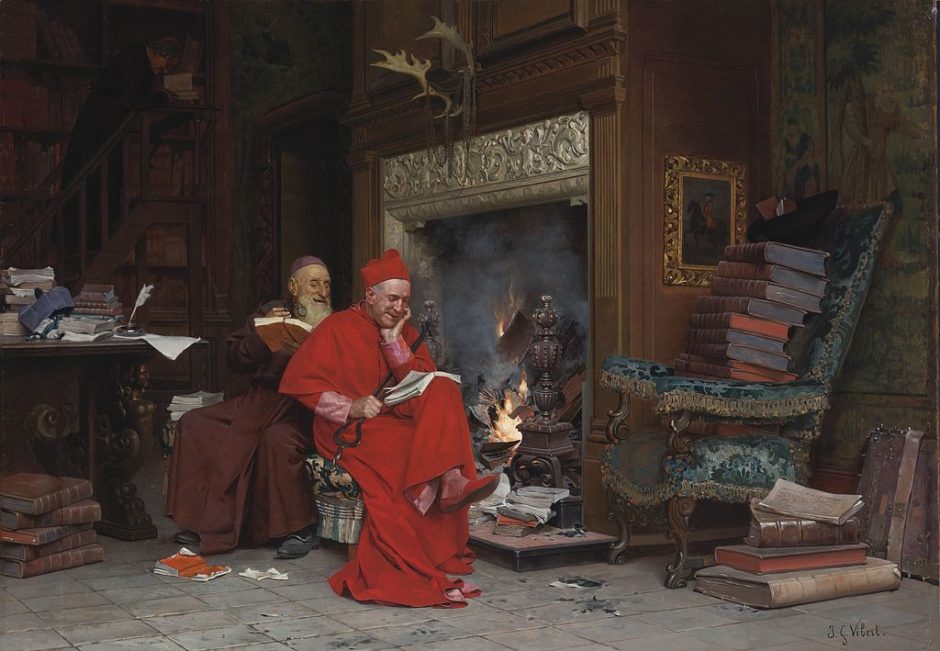
I often check in at Engrish, which site digs up some fun "translations" into a sort of English perhaps more appreciated by the authors of the lame-duck ICEL prayers.
Here is a sample that amused me:
Wonderfurry fravorfur sandrich, no doubt. Yum!
Orthometer strikes again.
Some bishops are fighting the Holy See’s norms for liturgical translation and the most recent draft prepared by the reconstructed ICEL. They essentially think that the language is too hard, which implies that they think people are not very smart.
Thus, words like "ineffable" are "unspeakable" in the Mass. They are tooo haaard!
This applies also to "gibbet". No one could ever understand what "gibbet" means!
So, visual aids are often helpful for liturgical catechesis … and basic English vocabulary.
This question came in via e-mail:
Father, a brief question.
In the TLM, there is a clear distinction between the Low Mass, the High Mass, the Pontifical Mass, etc. Is there such a distinction in the Novus Ordo? I mean, what do we call the Mass usually celebrated on weekdays, without incense and a full complement of servers? On the other hand, how should we call the Mass celebrated with incense, perhaps a Book of the Gospels, a full complement of servers, etc.?
In our parish, we are discouraged to call the former "Low Mass" and the latter a "High Mass." Is it more proper to call the latter a "Solemn Mass"–but shouldn’t all Masses be solemn?
It is true that when we use the older form of Mass, call it TLM or "Gregorian" or what you will, we make distinctions. A Low Mass is spoken only, with one or two servers. A Sung Mass, sometimes called High Mass, is mostly sung and there can be more servers. A Solemn Mass is sung and there are deacon and subdeacon, perhaps also an archpriest. The terms High Mass and Solemn Mass sometimes get mixed up. Pontifical Masses have a bishop or abbot as celebrant. You also get picky and distinguish Pontifical Masses at the throne or at the faldstool, etc.
It often happens that people get all riled up about Low Mass and High Mass distinctions. Some folks think that the Low Mass is actually the Shangri-la, the El Dorado, of Masses. It may be that some of this comes from older people who were from parishes with an Irish background. For so very long, Catholics were oppressed in Ireland. Thus, they didn’t develop a deep tradition of sacred choral music and choirs, or church architecture with large choir lofts such as German had. Also, some people just don’t want to be bothered with a Mass that is longer than, say, 45 minutes on a Sunday and 3O minutes on a weekday. Therefore, the Low Mass becomes their favorite and, subsequently, it is promoted to their personal norm for the Universal Church.
But getting back to your question:
In the Novus Ordo there is no official distinction between Masses celebrated with different levels of solemnity. That said, I don’t see any reason why we couldn’t use the same terminology in a parish setting along the lines you suggest. The terms seem very useful to me.
Should all Masses be solemn?
Well, yes and no.
The standard or paradigmatic Mass for every rite is its higher level of solemn celebration. Many people think that the Low Mass is the norm or standard for the Roman Rite. It is not. Or rather, it may be the norm or standard when considering merely the frequency of celebration. Low Mass is admittedly more common (in both senses of the word). However, Low Mass is not the norm, where norm means the measuring stick by which Masses are considered. The Solemn Mass, even Pontifical Mass is really the standard. The Low Mass and the Sung Mass are scaled down from the Solemn Mass. That is to say that things were taken away from Low Mass and Sung Mass rather than things added to the Solemn Mass. See?
Now we get into the psychology of our worship, which is something I believe the post-Conciliar reforms never considered.
Lo those many years ago when I worked in theater, we had a phrase: Everything is nothing. That is to say, if a set is entirely red it rapidly becomes uninteresting. If the lights are also bright, the lighting is boring. If an actor’s volume is always loud or never varies from a high pitch, he is extremely dull. There must be variation. You can’t keep going at a fevered pitch forever and expect that people will keep you tuned it. There must be highs and lows, contrasts, ups and downs.
The Church’s calendar does this perfectly. Our level of solemnity should match the psychology of the calendar.
So, that is the "no" part of the question. Not every Mass should have all the stops pulled out, to use a term applicable to the Church’s favored musical instrument.
But, at the same time, I can say "yes", Mass should always be solemn. That is to say, solemn in proportion to the occasion you are observing. What is solemn on Easter is not the same as what is solemn on the 6th Sunday after Pentecost, which is not the same as a ferial day during the week after the 6th Sunday of Pentecost. Mass should be solemnly, that is reverently and carefully, with great attention from all those involved, at whatever level of liturgical solemnity the occasion requires. So, using the world "solemnly" equivocally, a garden variety Low Mass can be celebrated with the solemnity appropriate to it.
What’s up with the term "Gregorian Mass"? Or "Gregorian Rite"?
The other day in London Dario Castrillon Hoyos spoke of the Gregorian Rite saying "this is the just [correct] name for the Extraordinary Form,".
I think we can call the older form of Mass many different things. However, surely will be seeing more of the label "Gregorian".
Some people called the Mass in the form we find in the various editions of the Missale Romanum from before the changes in the 1960’s, "Gregorian", rather than "Pian" (after St. Pope Pius V), because its essential structure and many of the prayers go back to the time at least of Pope Gregory I (+604). Gregory did a great deal to codify liturgical law and practice for the Church of Rome. His influence endures today, in an even greater measure again, now that Summorum Pontificum is in force.
However, hard on the heels of this Card. Castrillon’s statement, I received a question today by e-mail:
I had a call referred to me by the diocese of "x" in regard to a request for Gregorian Masses. I told the woman who inquired about the matter that I would look into some possibilities. She had a couple of questions. First, what is the usual stipend for such a request? Second, is it possible to have the Masses said for two deceased individuals who were husband and wife in one series of Masses, or must the intention of the 33 consecutive Masses be only for one person? The questions I have in regard to Gregorian Masses include: Is it 30 or 33 consecutive Masses? Must they all be requiem Masses? (That would not seem possible given the liturgical calendar). Must Gregorian Masses be said consecutively by the same priest? Given the nature of Gregorian Masses where might I be able to direct this woman to have these Gregorian Masses said? Thanks for any assistance rendered.
Let’s get to the bottom of this.
What are "Gregorian Masses"?
When you hear "Gregorian Masses" you are usually talking about the celebration of thirty Masses for thirty consecutive days for the soul of someone who has died. It is thought that St. Pope Gregory I (+604) spread this practice, which was already a tradition by his day. Pope Gregory had these Masses said for, at least, a fellow Roman monk named Justus (Dialogorum 4,57: Vade itaque, et ab hodierna die diebus triginta continuis offerre pro eo sacrificium stude, ut nullus omnino praetermittatur dies, quo pro absolutione illius salutaris hostia non immoletur.) At the end of the thirty days the dead monk appeared to his brother to let him know he was free from Purgatory. In any event, this became a widespread practice after Pope Gregory. I believe that the Dominican’s even had special Mass prayers in their Rite for this practice.
In any event, there are some basic guidelines.
First, thirty Masses must be said on thirty consecutive days for the same intention. If the priest can’t say one the Masses himself, for any reason, he must arrange for another priest to say the Mass for that same intention on that same day so that the series is not broken. They are said only for the dead.
The Masses can be said anywhere, and they need not be Requiem Masses.
Because this is a heavy commitment, the stipend offered should usually be pretty generous. Given that very few priests are able to take their own chosen intention every day for 30 days, that is fitting. The stipend can be whatever is agreed on, of course. How much should it be? That can’t really be fixed down. I have done Gregorian series three times. On one occasion I was offered 450 euros, and the person who offered the stipend was very pleased to have found a priest who could do it. On another occasion I took far less, because it was requested by an elderly woman on a limited income for her dead husband. So, it depends on the circumstances. Whatever is decided, if the stipend is accepted, in justice the priest is strictly bound to fulfill his part of the commitment.
So, there is one way "Gregorian Masses" can be understood.
Another way also relates to the dead, though these are less commonly called "Gregorian Masses".
There is a custom in the Roman Church for Requiem Masses to be said on the third, seventh and thirtieth days after the death of a person. In this case, these are indeed Requiems. The third, seventh, and thirtieth days can be counted either from the day of death or from the day of burial, exclusive.
Yet another type of "Gregorian Mass" is a Mass said at a "Gregorian altar".
A Gregorian altar is a privileged altar, that is, an altar to which certain added benefits or indulgences were attached such that when priests said Mass there the indulgence was gained. A Gregorian altar was therefore an altar that had the same privileges as the altar of the Roman basilica of San Gregorio in the Caelian Hill, where St. Gregory the Great had his monastery. That original Gregorian altar had a plenary indulgence for a soul in Purgatory. No Gregorian altars, called Gregorian altars ad instar, were so blessed after 1912. Naturally such an indulgence, a mighty application of the power of the keys indeed!, depends entirely on God’s will.
So, there are various uses of "Gregorian".
Every once in a while the nice folks at Angelus Press send me something to review. For example, we have looked at their daily hand missal (which I see is on sale right now) and a spiffy little inexpensive intro booklet for people who want to know more about the pre-Conciliar form of Mass.
This time I get to preview something for you.
They sent me a pdf of something they haven’t printed yet. I hope they get to it soon, because it is very useful and well done.
"But Father! But Father! Are you ever going to tell us what it is? C’mon! Spit it out!
Patience.
You know, life at the Sabine Farm has its positives and its negatives.
One of the positives is the chapel. One of the negatives is the chapel.
That is, one of the negatives is that I am pretty much the only one who cleans it and keep everything in order.
That means doing all the linens.
I really hate ironing. No… really… I do.
As a matter of fact I detest ironing.
Therefore, I am highly in favor of anything that will help other people learn how properly to iron purificators, corporals, amices… all that stuff.
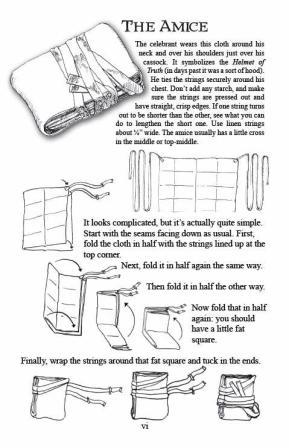
Here is where I rapidly become a fan of the Angelus Press and their forthcoming (sound the trumpet):
 So what if they are the publishing arm of the SSPX.
They just might have expanded my pool of potential ironers!
Seriously, this is going to be a very useful booklet in parishes far and wide, old Mass, new Mass, in union with Rome or not. Very useful.
All the various common linens are presented with descriptions of what they are for and what they might mean, for example in the case of the symbolic meaning of the amice, a vestment the priest uses during Mass.
There are clear directions and also step by step drawings for how to fold the linens, which is very important, especially in the case of a corporal, which has the function of capturing particles of the Host which might have been missed.
Here is what we find on the contents page:
i Quick Reference Chart
ii The Purificator
iii The Corporal
iv The Pall
v The Lavabo Towel
vi The Amice
vii A Few Guidelines and Tips
viii Altar Linens
ix Glossary
ix Notes pageThis little book provides a bit of direction for those ladies who are so generous
helping Holy Mother Church (and her sacristans) with laundering,
ironing, and mending.
What sort of thing might you find in "A Few Guidelines and Tips"? Let’s see what they say about the hated ironing.
Ironing
? There is a linen setting on most irons. If you have tough creases to remove, you
might try squirting a little water onto the crease or try the iron’s steam setting.
? The corporals call for heavy starch, but be careful with the spray-on starch.
If you saturate the cloth, the starch will flake when it dries (during Mass, the
celebrant scrapes the corporal with the paten; if the starch is flaky, it will mix in
with the Particles of the Sacred Host). To prevent this flaking, apply the starch
in thin layers and iron it in before the next layer is sprayed on.
? Keep all edges nice and square and crisp. Any strings such as those on the
amice should be pressed out flat. Lace also needs to be ironed out flat.
? If you find that your linens look “rumpled” or “wumpled” or kind of wrinkly no
matter how much you iron, you might try using a thinner ironing pad.
I will also give you a tip. When washing Father’s amices, do not – I repeat – DO NOT just thrown them into the machine and start the cycle. You must first tie up the long ties attached to the corners or YOU – WILL – BE – SORRY. Another solution might be small mesh bags to wash them in. Whatever your solution might be… be careful with the treacherous amice.
I have sent them a couple suggestions before they go to press. For example, it might be helpful to talk about the wonderful custom of the priest first washing linens that come into contact with the Sacred Species and then pouring the water down the sacrarium before they go to be laundered.
There is a very good glossary toward the back. Here are a few examples:
antemensium a “Greek corporal” which is used as a “portable altar stone”
gremial the cloth a bishop uses over his lap during confirmations
predella the top platform of the altar steps
At the end there is a good fervorino:
Be sure that any work you do for the chapel will redound to your
merit. We are meant to love the altar and everything that pertains to
it, and remember that even the smallest work or smallest detail does
not go unnoticed nor unrewarded by our beloved Master.
I think the word "chapel" in this reflects the SSPX origin. A better way would be "chapel or church".
This should be available in July!
I can hardly wait!
I plan on giving out copies.
The site of Newsweek has an article by George Weigel about Pope Benedict’s "revival" of the "Latin Mass".
As you begin, keep in mind what WDTPRS has been saying since Summorum Pontificum was released. This incredibly important document, perhaps the most important thing Pope Benedict has done so far, is a key part of what I term as his "Marshall Plan" to reinvigorate Catholic identity. We we Catholics don’t know who we are within our own Church (the ad intra dimension of Pope Benedict’s project) then we will have nothing useful to say to the rest of the world, in the public square (the ad extra dimension). Pope Benedict knows that our liturgical practice must change for our identity to be strengthened. Thus, liturgy is, as I term it, "the tip of the spear". Widespread celebration of Holy Mass and the sacraments in the older, pre-Conciliar form will exert a gravitational pull on every other aspect of the Church, especially because it will change priests’ perception of who they are and what Holy Mass is. Once they learn something about the older form, they will never say Mass the same way again. That will affect a whole parish and thus a community.
That said…
Shall we have a look with my emphases and comments?
Latin Days Are Here Again?
Pope Benedict wants to revive the Latin mass in Roman Catholic worship. But what exactly does that mean?
George Weigel
Newsweek Web Exclusive
Updated: 11:19 AM ET Jun 19, 2008Is Pope Benedict XVI determined to restore the Latin mass that many Roman Catholics thought had been consigned to the dustbin of history? The answer, in short, is both yes and no. But neither the "yes" nor the "no" quite fits the conventional speculations in several recent media reports [He is proabably talking about Damian Thompson’s reports and the parsing on WDTPRS and other blogs.] following off-the-cuff remarks to a small Catholic association in Great Britain by a Vatican official. In unraveling this, it helps to begin at the beginning.
As he reminds us in his memoir, "Salt of the Earth," the young Joseph Ratzinger was deeply influenced, both spiritually and intellectually, by the mid-20th-century movement to reform the Roman Catholic Church’s public worship–a movement that helped pave the way for the Second Vatican Council (1962-1965). Father Ratzinger was a peritus, a theological expert, at the council, and like many others, he welcomed the council’s Constitution on the Sacred Liturgy: here was a ratification of the liturgical reform movement he had long supported and a blueprint for further organic development [The key word here is "organic"] of the celebration of mass. In the immediate aftermath of Vatican II, however, Ratzinger became convinced that organic development had been jettisoned for revolution, the liturgical Jacobins being a cadre of academics determined to impose their view of a populist liturgy on the entire Catholic Church. [That is a pretty good description. It also jives with the account in Bugini’s and Marini’s books.]
In the decades between Vatican II and his election as Benedict XVI, Ratzinger became a leader in what became known as "the reform of the reform": a loosely knit international network of laity, bishops, priests and scholars, committed to returning the process of liturgical development in the Catholic Church to what they understood to be the authentic blueprint of Vatican II. Seeing a Gregorian chant CD from an obscure Spanish monastery rise to the top of the pop charts in the 1990s, they wondered why much of the church had abandoned one of Catholicism’s classic musical forms. Finding congregations that seemed more interested in self-affirmation than worship, [Nicely said.] and priests given to making their personalities the center of the liturgical action, [Exactly!] they asked whether the rush to create a kind of sacred circle in which the priest faces the people over the eucharistic "table" might have something to do with the problem. [Precisely.]
And they reminded the entire church that Vatican II had not mandated many of the things most Catholics thought it had decreed: for example, the elimination of Latin (and chant) from the liturgy and the free-standing altar behind which the priest faced the congregation. [Thanks, Mr. Weigel, thank you, thank you, thank you for getting this right.]
Over the past 40 years, the Catholic liturgical wars have tended to be fought among specialists and activists. The largest post-Vatican II splinter group, associated with the excommunicated French archbishop Marcel Lefebvre, certainly had its problems with the new liturgy; but the deeper cause of the Lefebvrists’ march into schism was primarily their rejection of Vatican II’s teaching on religious freedom, [As I have been saying for years, this is going to be the toughest problem. And notice that Weigel says "schism".] which they deemed heresy. The overwhelming majority of Catholics throughout the world have welcomed [I wonder if it wasn’t more a matter of "shrugging and accepting" and then getting used to it? Dunno.] the new form of the mass that became normative in 1970, a mass celebrated entirely in English (or Spanish or French or Polish, or whatever language the congregation speaks). Over time, the silly season in Catholic liturgy that peaked in the 1970s – [He didn’t go to my seminary, obviously.] "clown" masses (with the priest vested as Bozo or somesuch), free-for-all prayers that ignored the prescribed rite, dreadful pop music, inept "liturgical dance," a general lack of decorum – began to recede. A re-sacralization of Catholic worship became evident in many parishes. What Ratzinger and other specialists had called "the reform of the reform" was underway at the grass roots, and under its own steam. [And under the influence of younger priests.]
It was to accelerate that "reform of the reform" that Benedict XVI issued a decree last summer permitting the widespread use of the 1962 Roman rite, known technically as the Missal of John XXIII. [Among other terms.] Amidst the recent, fevered speculations that Latin days are here again, it’s important to note what the Missal of John XXIII is not. It is not the "Tridentine Rite," [Thank you!] because it includes modifications of the missal mandated by the Council of Trent in the 16th century; it is not the "mass of Pius V," which some Catholic megatraditionalists [Hmmm… a new label. Interesting.] argue is the only valid form of Catholic worship. It is, in fact, the mass as celebrated every day at every session of the Second Vatican Council. (The 1962 missal did contain a Good Friday prayer for the conversion of the Jews, which some, but certainly not all, Jews found offensive. After a brief flurry of criticism, Benedict XVI modified the prayer; conversations about its further alteration continue. The modified prayer was used in the minuscule number of Catholic congregations that celebrated Holy Week 2008 according to the Missal of John XXIII; no pogroms resulted, [LOL!] and indeed the argument seems to have died out.) [Wait till next year!]
Some may find it ironic that the "old Latin mass" that Benedict XVI has permitted is precisely the mass as known by Pope John XXIII, hero of Catholic progressivism. But there is in fact something "progressive," in the sense of reformist, about Benedict’s strategy here.
Yes, the mass of John XXIII is celebrated in Latin, and yes, it is often celebrated (although it need not be) with the priest and the congregation facing the same direction as they pray – looking together, as classic liturgical theology teaches, toward the return of Christ and the inauguration of the heavenly Jerusalem. But the pope’s point in making this form of liturgy more widely available is neither nostalgic nor retrogade. Rather, by encouraging the more widespread celebration of this classic form of the always-evolving Roman rite, Benedict XVI intends to create a kind of liturgical magnet, drawing the "reform of the reform" in the direction of greater reverence in the Catholic Church’s public worship. [Okay… does "liturgical magnet" sound like "gravitational pull"? He gets it!] In doing so, the pope is also reminding the church that, as Vatican II put it, the mass is a moment of privileged participation in "that heavenly liturgy which is celebrated in the Holy City of Jerusalem toward which we journey as pilgrims, where Christ is sitting at the right hand of God, minister of the sanctuary and of the true tabernacle." "Going to mass," in other words, is not something we do for ourselves, or something we make up ourselves; liturgical worship is our participation in something God is doing for us. [YES! As we are constantly stressing here at WDTPRS the true actor in Holy Mass is Jesus Christ. Active participation is really all about interiorly active receptivity to all Christ is doing for us and through our agency.]
Will this Benedictine reform-of-the-reform mean that every Catholic parish will soon have at least one Sunday celebration of mass in Latin, using the Missal of John XXIII? It seems unlikely, not least because very few priests today are competent Latinists. But in those places where the Latin mass of 1962 is celebrated reverently and without nostalgic accretions (lace-bedecked older vestments, for example), it will be a source of spiritual nourishment for the minority that prefers this way of worship, even as it introduces a new generation to what will be, for them, a new form of liturgy. [A couple things here. I am not sure that I read him right, but he seems to think that the use of lace is a "nostalgic accretion" which somehow interferes with the older form of Mass being spiritually nourishing. Also, while he speaks about a "minority" he is also stating that a new generation will be learning about this form of Mass. That implies the potential to grow.] In international settings, the use of this rite in Latin may help revive that ancient tongue as a common Catholic language for common worship – no small matter in an increasingly diverse and pluralistic church. Among scholars and parish clergy alike, the more widespread celebration of mass according to the Missal of John XXIII may prove to be the reformist magnet that Benedict XVI wants it to be, encouraging those who are already at work re-sacralizing the liturgy.
And the net result, over time? Almost certainly not "Latin days are here again" in every Catholic parish but rather a more reverent, more prayerful celebration of mass according to a reformed missal of 1970–and according to what the Second Vatican Council actually prescribed.
Mr. Weigel has clearly grasped correctly the core of the issue.
After the Big Mass at Westminster, I got on the horn and called across the pond to His Hermeneuticalness to get his take on what happened. Fr. Finigan was one of the deacons of honor for Card. Castrillon Hoyos’ Pontifical Mass.
One of the things he pointed out was that not a single bishop of the Diocese of Westminster was present in any capacity.
I suspect that was not because they didn’t want to make the rubrics more complicated.
Sometimes local prelates will stay away out of courtesy, so that their conspicous presence doesn’t detract from the guest prelate.
In this case, however, they were even more conspicuous by their absence.
Now I find this from Damian Thompson, who has been all over this story from soup to nuts.
Look at it here, but be sure to go over to Damian’s place and check the comments which will surely pile up.
Benedict ‘annoyed’ at bishops’ boycott
Posted by Damian Thompson on 19 Jun 2008 at 15:22I don’t like passing on rumours, [And in fairness that is what this is, and he has clearly acknowledged it from the start.] as you know, but there are reports that Pope Benedict XVI is annoyed by the absence of a single bishop at the big Mass celebrated by Cardinal Dario Castrillon Hoyos at Westminster Cathedral on Saturday.
Consider the facts. At the end of last year, Cardinal Cormac Murphy-O’Connor opened up the throne room of Archbishop’s House so that the liberal Archbishop Piero Marini could launch a book containing a coded attack on the Pope’s liturgical reforms. The party was packed with “magic circle” bishops, monsignori and Tabletistas, all gushing away like crazy.
But when Cardinal Castrillon – head of Ecclesia Dei and a former Prefect of the Congregation for the Clergy – celebrated a Pontifical High Mass in the cathedral, there were no other bishops present in the sanctuary and the Westminster Cathedral website has still made no mention of the event. [Can you say damnatio memoriae?]
Could this display of studied indifference have anything to do with the fact that Cardinal Castrillon was celebrating in the ancient Extraordinary Form of the Latin Mass?
Earlier in the day, the Cardinal had announced that the Pope wants to see the old liturgy made available in every parish in England and Wales. That’s a big story, don’t you think? [Yep. Pretty big.]
The Catholic Herald has led on it this week. The Tablet isn’t out yet, [It is now. Go here.] but I can’t wait to see how it reports the latest development. Normally, the Bitter Pill plays down news that it doesn’t like – and boy, you should have seen the thunderous features of its deputy editor Elena Curti at the press conference! She practically performed a (liturgical) dance of rage. If only I had thought to capture it on my mobile…
You might remember that recently His Eminence Dario Card. Castrillon Hoyos celebrated a Pontifical Mass in Westminster Cathedral, London, in the Extraordinary Form, or Gregorian Rite, as some call it.
There was a small press conference with His Eminence, and Damian Thompson of The Catholic Herald gave an account on his blog on The Telegraph‘s site.
During that press conference, Mr. Thompson slapped down the writer for The Tablet. So did Card. Castrillon, but rather gently.
Now The Tablet’s slapped-down Elena Curti has her say:
My emphases and comments.
21 June 2008
Ringing in the old
Elena Curti
A Pontifical High Mass in the Tridentine Rite was said in Westminster Cathedral last weekend for the first time in four decades. Its celebrant, a close ally of the Pope and an ambassador for the old liturgy, promised that further changes will be afoot
Imagine for a moment a vibrant and confident Catholic church, the pews filled every Sunday with parishioners of all ages, eager to celebrate a distinctive liturgy that will impart a sense of reverence and awe and the mystery of Christ’s redeeming sacrifice.
That is the vision of the Church presented last weekend by a senior member of the Curia, Cardinal Darío Castrillón Hoyos. And the means of achieving it, he claims, is the revival of the Tridentine Rite. [We know the problems with this term "Tridentine", but let them pass.]
It was last July when Pope Benedict issued an instruction, or motu proprio, encouraging the rite’s much wider celebration if a "stable group" requests it from a parish priest. He designated the Tridentine Mass the "extraordinary form" and the new the "ordinary form" of the one Roman rite. But, Cardinal Castrillón, who is close to the Pope, has now gone much further, suggesting it should be made a far more frequent liturgical experience. [Indeed, a priest need not wait for a request. He can celebrate the older form publicly even without requests.]
The cardinal, who in his present role as president of the Pontifical Commission, Ecclesia Dei, has responsibility for ensuring that traditionalists have access to the old Mass as set out in Pope John XXIII’s 1962 missal, was in London last weekend where he celebrated a Pontifical High Mass in the old rite at Westminster Cathedral – the first celebrated by a cardinal in England for nearly 40 years. Before the Mass, he gave a group interview to four journalists arranged by the Latin Mass Society at a hotel in Westminster. And during it, he made clear his vision, saying that it was his hope that eventually Catholics in every parish in England and Wales would have the opportunity to attend Sunday Mass in the Tridentine Rite.
Those unfamiliar with the pre-Conciliar Mass will be offered catechesis to help them understand and appreciate it. Men training for the priesthood will be taught not just Latin but the complex ritual and gestures they must learn in order to equip them to meet the expected demand [A touch of sarcasm, perhaps? Dunno.] for the old Mass. At the moment, bishops are required to facilitate Masses using the rite if appropriately trained priests are available.
Celebration of the Tridentine Rite was discouraged ["Discouraged"? People who wanted to have the pre-Conciliar form of Mass were actively and diligently PERSECUTED for decades! "Discouraged"?] after the introduction of Paul VI’s missal in 1970 following the Second Vatican Council. From that time Mass was to be celebrated in a new rite with the priest facing the congregation. [Notice how time and again writers simply slide into the mistake of connecting the Novus Ordo with versus populum celebration of Mass as if the versus populum was required with the Novus Ordo.] The new rite led to the widespread introduction of lay readers and Extraordinary Ministers of the Eucharist. For the first time women were permitted on to the sanctuary [I don’t know, but is "on to the sanctuary" a typically British way of saying "into the sanctuary"?] to fulfil these new roles and girls were also allowed to be altar servers. [Actually, this started as an abuse, which went purposely unchecked until the Holy See caved in and extended permission. So, what the writer is bringing up here was really the result of disobedience.] The biggest change in the new rite was that Mass was celebrated in the vernacular for the first time although Latin was still permitted. [Again, note the reversal of reality: "Latin was still permitted"? On the contrary, Latin was still required and the vernacular was permitted, at least according to the Church’s documents. But, again, disobendience brought about the wide-spread impression that the vernacular is the norm for the Novus Ordo. ]
Small numbers of traditionalists [Now I think we get a better glimpse of the writer’s real thoughts.] continued to celebrate Mass in the old rite down the years with some encouragement in the later part of Pope John Paul II’s pontificate. But it is under Pope Benedict that the old Mass has acquired new prominence following the motu proprio. There have been loud complaints from traditionalists that some bishops ["some"] in England and Wales have been uncooperative [That’s one way to put it.] in implementing the motu proprio but Cardinal Castrillón declared that he and the Pope felt the bishops’ response had been good, given the time needed to prepare for the change. [Yes, that is because curial Cardinals don’t go to dioceses and then beat up the bishops publicly. It’s called Romanità.]
Cardinal Castrillón, now 79, has spent a lifetime as a curial cardinal. [I think the implication is that he is not "pastoral".] He is a former prefect of the Congregation of the Clergy and currently heads negotiations to bring the ultra-traditionalist Society of St Pius X with its four excommunicated bishops back into the Catholic fold.
He was eager to explain why he considered the revival of the old rite – which he called the Gregorian Rite – so important. He had a forthright response to those who complain that its reintroduction violates the teaching of the Second Vatican Council, calling such a view "absolute ignorance". ["forthright", nice!] Pope Benedict, he added, was a theologian with deep understanding of Vatican II and was acting exactly in accordance with "the way of the council" that the freedom of different kinds of celebration is to be offered. Similarly, he judged complaints about the priest in the old rite celebrating Mass with his back to the congregation to be "ridiculous". [And he is right! I would also have added "adlepated", but I defer to the Cardinal.] The priest represented the person of Christ and in facing east – that is, towards God – he was reviving the sacrifice [?] of the Son to the Father.
Asked whether he hoped to see provision for the Tridentine Rite made in "many" parishes in England and Wales, the cardinal said he wanted "all" parishes to experience this "treasure". As for men training for the priesthood, he disclosed that the Vatican is writing to all seminaries, asking them to ensure they will be taught Latin not just for liturgical purposes but also to prepare them for their studies in theology and philosophy. [And this would merely repeat what Holy Church already requires.]
But what of the confusion felt by many Catholics who had seen the transition from the Tridentine to the new rite in 1970 and had welcomed it, seeing it as real progress? I suggested that for some this new emphasis on old rite might feel like a step backwards.
"Progress is important, but what does it mean?" said the cardinal. "Today, for me, progress is discovering the meaning of contemplation. This is progress. A person who has no time for silence is a poor person. A person who has no time for contemplation is poor also. The holy Mass is sacrifice. We have to look at Golgotha, at Calvary, the Cross of Christ. When we have sacrifice in Christ we feel free from sin, we are redeemed, then we are happy and when we celebrate the Resurrection of Christ we are happy to gather together and to celebrate, but first the sacrifice, second the community aspect of the meal."
Is it not possible to express all this in the new rite?
"Yes, but the experience of these 40 years is not always so good," said Cardinal Castrillón. "Many people abandon the sense of adoration of God. Yes, we are brothers but we are not saved as brothers. We are saved by the sacrifice. We need to be in front of the mystery. We sing because we are brothers. We sing because we are celebrating, but we keep silent because we are in front of the mystery. The new rite can express it but there have been brought out so many abuses all over the Church that many people abandon it [sic]. Many children do not know how to be in the presence of God, how they have to be adoring."
To a conservative journalist who insisted vehemently [Notice that "traditionalists" are those who "complain" and "conservatives" are "vehement"?] that some bishops in England were denying permission for the old Mass to be celebrated in their dioceses, the cardinal said such cases were few and he did not want to make the Eucharist a cause of confrontation for priests, lay people, bishops and the Holy See. He explained that the new rite was a response to a new era of world communication and conceded that it too contained riches. The Pope had decided that the time had come to celebrate the new rite alongside the old.
"It is not a matter of confrontation but of dialogue, fraternal dialogue, and making efforts to understand the precious things contained in the new and in the old rite," he said.
But what exactly were the abuses he had alluded to earlier that had crept in with the advent of the new rite? The answer was surprising.
He explained that he had received letters complaining that a priest had celebrated Mass made up as a clown: "The parish priest with the lips painted and the wig and mirrors here," he said, pointing to his temples. "A travesty." Other examples including that of a priest who had allegedly presided at Sunday Mass dressed in a miniskirt, and a priest who had invited his Protestant "brother" to celebrate the Eucharist. Yet another had introduced his wife and sons before celebrating Mass. [Those are extreme examples. However, I remind you all that for a very long time having altar girls and Communion in the hand were contrary to law and were abuses. And there are countless others we could all recite.]
"There is an atmosphere that makes possible those abuses [That’s the real point.] and that atmosphere must be changed, and in my poor opinion the new presence of the Gregorian Rite will help us to take seriously the identity of our faith, [Does that sound familiar? This is what WDTPRS has been hammering at all along: this is part of Pope Benedict’s Marshall Plan, his project to revitalize Catholic identity.] respecting all the other ways of thinking but keeping strongly our identity with Christ, with Christ in Calvary, with Christ in Golgotha, with Christ offering his blood for our salvation."
With that the cardinal was off to change into his red robes ["robes", it’s always "robes"… how tiresome.] in readiness for his address to the Latin Mass Society’s annual general meeting, followed by a private session with Cardinal Cormac Murphy-O’Connor. According to a statement issued by Archbishop’s House, Cardinal Castrillón expressed his gratitude to his fellow cardinal for the generous way which the bishops of England and Wales had responded to an indult from Pope Paul VI allowing traditionalists to celebrate the old rite and for their reception of Pope Benedict’s motu proprio. [Again, curial Cardinals don’t go to dioceses and then beat up the bishops publicly. It’s called Romanità].
Here is an interesting event for those of you in Ireland.
St. Colman’s Society for Catholic Liturgy
St. Colman’s Society for Catholic Liturgy is pleased to announce that Holy Mass will be celebrated in the Extraordinary Form on Saturday, 28 June 2008 at St. Patrick’s Pro- Cathedral Church, Fermoy, Co. Cork, at 11 am.
The Mass is that of Vigilia Sanctorum Apostolorum Petri et Pauli as prescribed in Missale Romanum of 1962, approved by the Blessed John XXIII.
This Holy Mass is specifically offered for the intentions and well-being of Our Holy Father, Pope Benedict XVI. Members of the Society are encouraged to participate and to pray for the Holy Father’s intentions. All are welcome to attend.
The Society for Catholic Liturgy wishes to express its profound gratitude to His Lordship, Bishop John Magee, Bishop of Cloyne and titular Parish Priest of Fermoy, for his kindness in facilitating the celebration of this Holy Mass in the Extraordinary Form.
The Society would also wish to thank the Very Reverend Fr. Aquin Casey for making St. Patrick’s Church available for the Mass; to Deirdre Foley, chorimistress; to the members of the choir who will be present, and to Mrs. Howard, the organist.


Coat of Arms by D Burkart
 waalaw on Daily Rome Shot 1119: “In 1st variation, 2. . . . . . Q-g1# also works. As does 4. . . . . .…”
 on Daily Rome Shot 1119: “The folks in Charlotte need to test this by kneeling for Holy Communion right in front of the priest in…”
 on NB: Desktop and Posting – Zuhlsdorf’s Law kicks in – UPDATE: “I understood Windows 7, and stayed with that a long time, because it was such a stable and reliable system.…”
 on Daily Rome Shot 1119: “If the hoary old men of the Vatican wanted to instill a deep and abiding disgust of all things Vatican…”
 on Daily Rome Shot 1119: “Black mates in 4: 1. . . . Qe3+ 2. Ke1 Rg1+ (if 2. Kf1, Qg1++) 3. Rf1 RxR+ 4.…”
 on Pope Leo XIV airplane interview: remarks about relaxing Traditional Latin Mass restrictions: “@ProfessorCover: he did have a ready answer: no. That you disagree with the Roman Pontiff’s response does not make him…”

A Daily Prayer for Priests








They find you a pro-life agent in your area who commits to giving a portion of the fee to a pro-life group!

PLEASE subscribe via PayPal if it is useful. Zelle and Wise are better, but PayPal is convenient.
A monthly subscription donation means I have steady income I can plan on. I put you my list of benefactors for whom I pray and for whom I often say Holy Mass.
In view of the rapidly changing challenges I now face, I would like to add more $10/month subscribers. Will you please help?
For a one time donation...



Help Monks in Wyoming (coffee – UPDATED LINK) and Norcia (beer) and the wonderful "Soap Sisters" of Summit, NJ!


Please follow me on Twitter!










Visits tracked by Statcounter
since Sat., 25 Nov. 2006:


