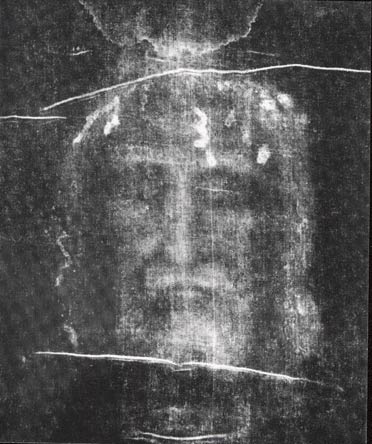
 A while ago, I ran into a claim that in the near future devotion to the Holy Face of Jesus would be more and more important.
Think about how our ecclesial shepherds have, through neglect and even expressions of contempt, downplayed and eroded the pious devotional practices of the faithful. Hence, I am inclined to think that any good, traditional Catholic devotion would be better than the wide-spread near-zero we’ve got going now.
That said, we cannot go wrong with contemplation of the Holy Face of the Lord, held up before us sometimes as a portrait, sometimes as a lens, sometimes as a mirror.
In our 1980’s seminary we were inflicted with the deadly musings of Edward Schillebeeckx in his then-recent The Church With a Human Face: A New and Expanded Theology of Ministry. The heretic priest – he eventually quit – who taught the course which was supposed to be on Holy Orders and Eucharist (but was instead about “ministry and symbol”) used this trash. While most of us seminarians… well, some… yearned for a formation about a Church resplendent with the face of Christ for her people, we were being told to obscure, nay rather, efface that transcendent face with the merely earthly.
There’s nothing wrong with stressing the real needs of breathing and living human beings in the Church and the care she has for them. That’s not what this seminary agenda was about. It was a total, systematic disfigurement of the Church’s teaching on the priesthood and Eucharist. We could say it was a radical “defacing”. À la Rahner, sacraments only celebrate pre-existing realities. There’s no “transubstantiation”. When an “ordained minister” says the words of “institution” (not consecration) bread and wine become a symbol of the unity of the community gathered in that place at that moment. À la Schillebeeckx, priests – sorry, scratch that, ministers are called forth from the community. When the community’s “face” changes, they fade back into the community for another to emerge.
My apologies. We were instructed back then not to use the “p-word”, and instead refer to ordained and non-ordained ministers. We are all ministers, you see.
And now we are all “walking together”. See how this progresses?
Sadly, as these heretics in the seminary crucified Christ daily in the classroom and in the chapel and in their very quarters, I often had in mind the passage in Isaiah 52:
“His appearance was so marred, beyond human semblance, and his form beyond that of the sons of men”.
This, dear reader, is the pattern we see again and again in the Church. If Christ suffered His defacing, so must Holy Mother Church and, with Christ, many of her priests.
It isn’t a coincidence that, today, priests of a certain type are being de-faced, cancelled.
We need now to have before our eyes even painful images of the Holy Face of Christ, not only in our both beautiful and battered neighbor, but especially in the Church in the world.
Perhaps the Gospel for this Sunday can help us face up to this need.
Today’s Gospel comes from Matthew 22, which describes the Lord’s final days in Jerusalem. The previous chapter saw His triumphant Palm Sunday entrance. Holy Week follows, during which hostility from the high and mighty mounted and mounted against our Lord.
At this point in Matthew, we’ve just heard the parable of the Wedding Banquet, which Holy Church presented during Mass a few weeks ago. Hard on the heels of that eschatological lesson, a group of Pharisees and Herodians oiled their way up to Jesus with flattering words to lay a trap for Him. They asked, “Is it lawful to pay taxes to Caesar, or not?” (v. 17). Keep in mind that at his “trial” a few days later Christ would be falsely accused of forbidding people from paying the tribute (Luke 21:2).
It is helpful to know that, in those times, the Jews had to pay two tributes, or taxes, one to the Romans and another to the Temple. Taxation, tribute, was a sensitive issue. Should the Lord have responded affirmatively, the Jews could have seen Him as a Roman collaborator, much as they would the hated Jewish tax collectors. Had he answered in the negative, they could have accused him of sowing sedition against Rome. Either way, a “yes” or a “no”, meant trouble. Christ saw past their unctuous flattery and knew their wicked motive for asking. He requested to see the “nomisma tou censou”, the tribute coin, a denarius, the famous standard “day wage”, sometimes translated as “a penny” as in the KJV. There’s been some inflation since the KJV.
The Lord doesn’t deliver a parable here so much as a riddle (vv. 20-22).
Jesus said to them, “Whose likeness and inscription is this?” They said, “Caesar’s.” Then he said to them, “Render therefore to Caesar the things that are Caesar’s, and to God the things that are God’s.” When they heard it, they marveled; and they left him and went away.
Again, context helps us to break open this nourishing bread of the Word. The Gospel says Christ underscored not only the image on the coin, but the inscription. His enemies responded “Caesar’s” and not some other great figure whose coins were in circulation. It is most likely that the coin in question was a silver denarius of the adoptive son of Augustus, the Emperor Tiberius (+AD 37), which bore the image of Tiberius on the obverse with the inscription “Ti[berivs] Caesar Divi Avg[vsti] F[ilivs] Avgvstvs … “Caesar Augustus Tiberius, son of the Divine Augustus”. In essence, “Tiberius, son of god”, for Augustus had been declared to be “divine”, like his adoptive father Julius before him.
It was a faceoff between the Son of God and the son of god, the ultimate worldly glorification of a mere mortal and the acknowledgement of the one true and living God.
Christ asked the Pharisees, “Whose likeness… is this?” In the Greek he asks about the eikon which gives us the English “icon”. Our Biblically oriented minds direct us back to the ancient Greek of the Old Testament, the Septuagint, and Genesis 1:27 where the same word eikon describes the creation of man in God’s image.
Putting aside controversy over Christian cooperation with or resistance to secular authority, “the state”, which over the centuries has been rooted in part in this encounter of Christ and the Pharisees, we are presented with what Paul later frames in terms of putting off the earthly man and putting on Christ, in whose image we are. The more we are like Him in word and deed and inner orientation, the more we are good images of Him.
St. Ambrose of Milan (+397) wrote in his Commentary on Luke (9.34):
“Questioned concerning the penny, [Christ] asks about the image, for there is one image of God, another image of the world. Therefore, the Apostle, also, admonishes us, ‘As we have borne the image of the earthly, let us bear also the image of the heavenly.’ Christ does not have the image of Caesar, because He is the image of God.”
In other words, the coin and its image of the Emperor with the false “son of god” stands for the world and its allurements. We must detach ourselves from that image to see after the truer image. In De officiis, the great Bishop of Milan says of the incident of the coin:
“You are laying aside the image of the eternal Emperor and setting up within yourself the image of death. Instead, cast out the image of the devil from the kingdom of your soul, and raise up the image of Christ. This is the image that should shine in you, that should be resplendent in your kingdom, or your soul, the one which effaces all the images of evil vices.”
The Second Vatican Council’s document Gaudium et spes is not without its puzzles and its legitimate critics. However, in the Christological section 22, we find, and please have patience with the extended quote:
The truth is that only in the mystery of the incarnate Word does the mystery of man take on light. For Adam, the first man, was a figure of Him Who was to come, namely Christ the Lord. Christ, the final Adam, by the revelation of the mystery of the Father and His love, fully reveals man to man himself and makes his supreme calling clear. …
He Who is “the image of the invisible God” (Col. 1:15), is Himself the perfect man. To the sons of Adam He restores the divine likeness which had been disfigured from the first sin onward. …
As an innocent lamb He merited for us life by the free shedding of His own blood. In Him God reconciled us to Himself and among ourselves; from bondage to the devil and sin He delivered us, so that each one of us can say with the Apostle: The Son of God “loved me and gave Himself up for me” (Gal. 2:20). By suffering for us He not only provided us with an example for our imitation, He blazed a trail, and if we follow it, life and death are made holy and take on a new meaning.
Christ, in whose image we are made, reveals man more fully to himself. By gazing at Christ, risen and glorious, battered and defaced beyond recognition of man, we find ourselves revealed.
Jesus paid the tax for our sins with the coin of His face.
Shall we, in this time of dreadful and anxious need for our clearly struggling Church, turn away our faces? We must look our challenges square in the face, remembering that concealed within them are the perennial enemies of our soul: the world, the flesh and the Devil.
Now is the time to pay tribute to the King, whom a week ago we celebrated as such in our traditionally oriented churches and chapels.
If not in churches, if it gets to that point, then on rocks in the forest and in people’s homes.

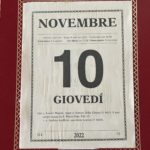 6:51 was the sunrise in Rome and 16:56 will be sunset. The Ave Maria bell should ring at 17:30.




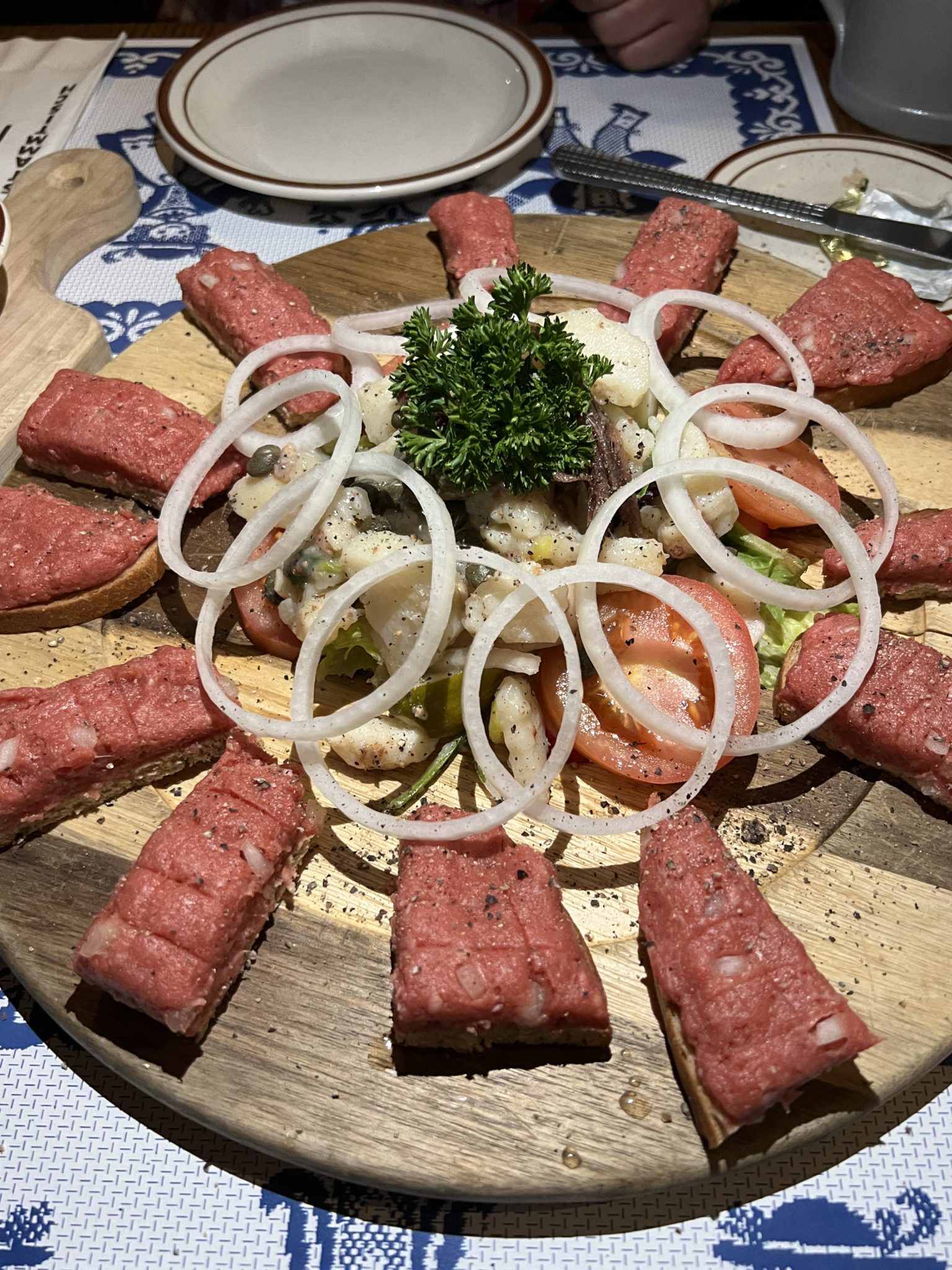 … and then schlepped some Sülze.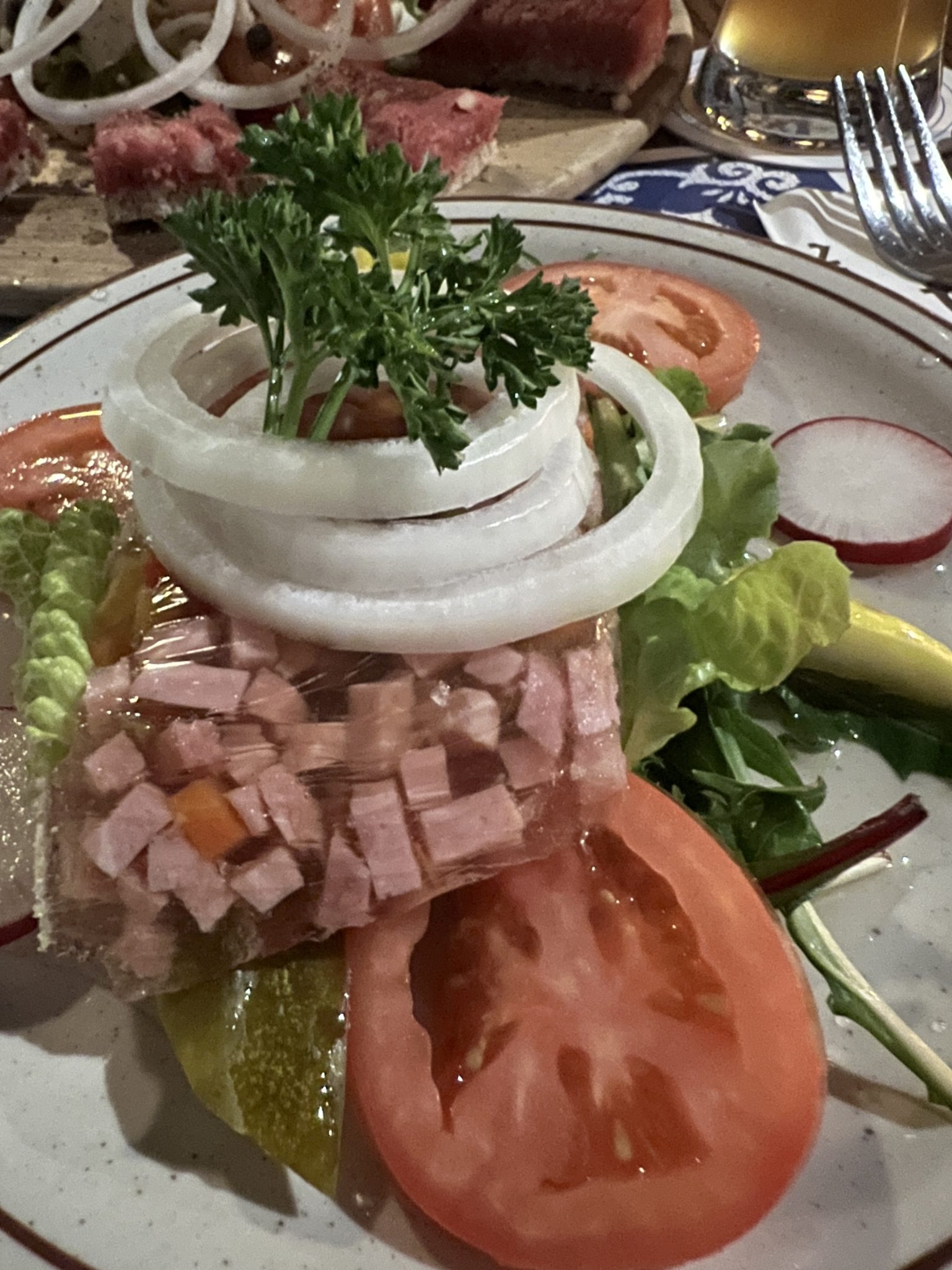
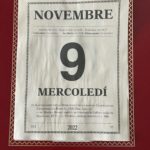 In Rome, the sun rose at 6:50 and will set at 16:57. The Ave Maria is still in the 17:30 time slot. The Moon is full and there are 53 days until the end of the calendar year. It is the Feast of the Dedication of St. John Lateran. Also, we venerate, St. Theodore a soldier martyr in c. 306 and Maria and Neon in the 3rd c.









 Back in Rome sunrise was at 6:49. Sunset should be at 16:59.


 Today the sun dawned upon Rome at 6:48 and it will slip below the horizon at 16:59. Shorter. Ever shorter. The Ave Maria is at 17:30. Today is a dies non on the Roman calendar, and so priests do well to celebrate a Requiem Mass.


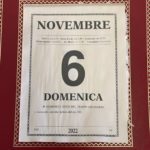 The Roman sunrise was at 6:46 and the sunset is due at 17:01. The Ave Maria is still slated for 17:30. It is the 22nd Sunday after Pentecost and the Feast of St. Felix, of happy memory, about whom St. Augustine wrote in his Expositions of the Psalms.
 ™
™
 A while ago, I ran into a claim that in the near future devotion to the Holy Face of Jesus would be more and more important.

 Vir Qui Timet Dominum on From “The Private Diary of Bishop F. Atticus McButterpants” – 26-10-06 – Chester And Bp. Dozer: “Plot twist: “observations about that thing” is referring to Chester taking the cathedra in the last entry.”




























