Here’s something to chew on for this Ember Saturday.
 Earlier, I posted a video about the Traditional Latin Mass in a parish setting. The presence of that Mass in the schedule has exerted a huge influence on the worship of the whole parish. The older, traditional forms have a knock-on effect on many levels.
On a related note, there is a Carmel in Pennsylvania which has spun off from a previous Carmel, where there were too many nuns, too many vocations. Well… “too many” is a good problem. Vocations are rising in traditional monasteries. In ten years their mother house has made FIVE new foundations. They use the Traditional Roman Rite and women are knocking on the door.
This new Carmel community is building. The video shows what they are building.
One of the intriguing points that comes up in the video is the comment by the superior that were these communities of traditional nuns, contemplatives, to collapse, so to the Faith in the Church and in the world would collapse. I have long written here on this blog about this point using the slogan Save The Liturgy – Save The World.
Can we doubt this? I think we are teetering on the brink of this now, which is one reason why certain powers that be attack, specifically, newly forming traditional communities.
More on this, below.
PREFACE: I need to ramble a little. Think aloud, as it were. There is a line of thought here, which I am developing.
St. Paul writes in 2 Thessalonians 2 about an eschatological concept, “the restrainer”.
According to Paul, before the “Day of the Lord” comes the “Son of Perdition” or “Antichrist” must show up. Hence, if we haven’t seen the Son of Perdition, then the end is not upon us. Therefore, we must conduct ourselves not as if the world is about to end, but rather as if we are in it for the long haul.
But wait, there’s more. Paul says that before the Son of Perdition comes, that which restrains him must be removed. The word Paul uses for this “restrainer” is katechon. Paul uses this in two forms, masculine and neuter.
Alas, Paul doesn’t describe the katechon. We are left to speculate. What is “that which restrains” or “the restrainer”?
Through history some have thought the Restrainer to be a person and others some kind of force or world power. Various theories have been forwarded.
For my part, in harmony with what I have written in the past and also with the comments of the nun in the video, above, it seems to me that The Restrainer might not be a person, but rather a force or activity in the Church. Traditional liturgical worship.
I wrote, inter alia…
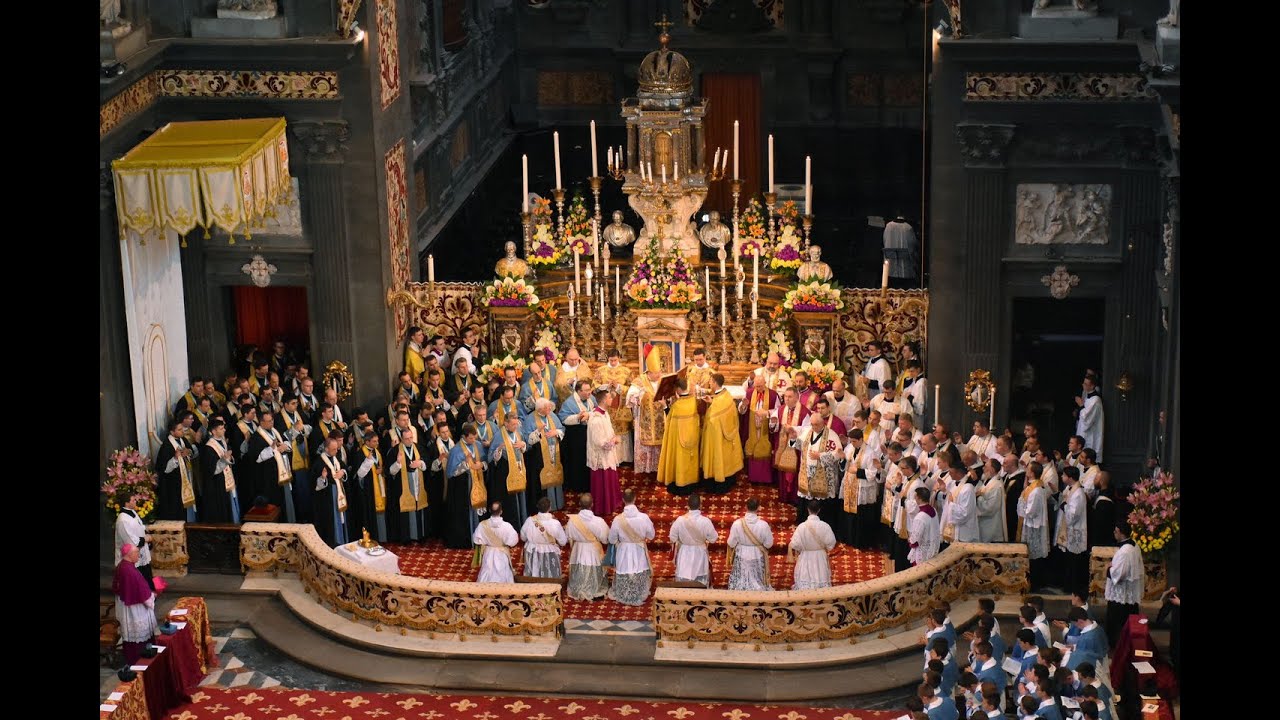
Do we believe the consecration [during Holy Mass] really does something? Or, do we believe what is said and how, what the gestures are and the attitude in which they made are entirely indifferent? For example, will a choice not to kneel before Christ the King and Judge truly present in each sacred Host, produce a wider effect?
If you throw a stone, even a pebble, into a pool it produces ripples which expand to its edge. The way we celebrate Mass must create spiritual ripples in the Church and the world.
Think of how, once, there were far more celebrations of Mass and far more contemplative religious praying, praying, doing reparation for sins, asking for intercession according to God’s will. No more. The numbers of Masses – reverent or otherwise – has fallen off dramatically since the Council. The numbers of religious in general have declined massively, not to point specifically to numbers of contemplatives. However, where Tradition is applied, vocations seem to flourish, thus drawing fire from the present powers that be. Think, for example, of that recent case in France where women religious formed to take care of the infirm. They wanted to wear traditional habits and pray in a traditional way and the local bishop crushed them. Think of the Franciscan Friars of the Immaculate. Think of the last round of legislation from the Congregation in Rome about religious life, which, while having some positive points, really could be a new hammer with which to smite traditional efforts.
Paul writes to the Thessalonians surely because someone was saying that “the day of the Lord” has come, or they are misrepresenting his teaching. Paul wants to get them back on track. He explains, as in Matthew 24, first, “rebellion” must come, Greek apostasia. Not just any apostasia but an eschatological apostasia, THE apostasia. The rebellion will come and the Son of Perdition will appear. He will seat himself in the temple (the Second Temple is no more!) and proclaim himself as divine, teaching falsehoods and working wonders. Paul says, “Hey! Remember? I told you this.” Would that we had Paul’s fuller description! We only have the hints at what he more fully told them in another venue.
Question: How many Catholics are well catechized in the Four Last Things and Eschatology? We have to have our eyes on the eschatological realities of our Faith. In the Creed we say that we believe that Christ will return to judge the quick and the dead. Shouldn’t we drill into that?
Think about this. If we don’t know where we are headed… then we are wandering around in the dark. Why bother? One of the things I say that alarms some people – especially those are new to, or don’t know, traditional worship – is that the End of Mass that over-arches and gives shape to the classic Four Ends (adoration, thanksgiving, atonement, petition) is the fact that we are all going to die and go before our Judge. There isn’t really any other over-arching reason to go to Mass: we are going to die. It is a mystery that even though Christ defeated death once and for all time, we still must pass through death to come to the perfection of what has already been completed. This is all tied into my writing about the importance of the Virtue of Religion and how we actively and intentionally fulfill it.
So, the Enemy, the Lawless one, is working working working. And there is a “restraint/restrainer”. There must be a great “falling away” from the Faith and the removal of the restraint that holds back the coming of the Antichrist, Son of Perdition, who will make claims about divinity in the “temple”. Ultimately, Christ will slay him “with the breath of His mouth” when He comes again, at the parousia. Let’s read Paul:
And you know what is restraining [to katechon – τὸ κατέχον] him now so that he may be revealed in his time. 7 For the mystery of lawlessness is already at work; only he who now restrains [ho katechonὁ κατέχων] it will do so until he is out of the way. 8 And then the lawless one will be revealed, and the Lord Jesus will slay him with the breath of his mouth [cf Isaiah 11 – the word of judgment] and destroy him by his appearing and his coming. 9 The coming of the lawless one by the activity of Satan will be with all power and with pretended signs and wonders, 10 and with all wicked deception for those who are to perish, because they refused to love the truth and so be saved. 11 Therefore God sends upon them a strong delusion, to make them believe what is false, 12 so that all may be condemned who did not believe the truth but had pleasure in unrighteousness. (2 Thess 2)
That doesn’t at all sound like our times, does it.
Before the Second Coming the Church herself must pass through a kind of Passion, a time of trial, during which many will fall away from the Faith. If Christ had His Passion, the Church and we members must have our Passion. True iniquity will be unveiled in that time in the form of religious deception, as the CCC puts it, which leads to apostasia from the Truth. There will be a pseudo-messianic movement born of the Antichrist which is anthropocentric, glorifying man, reducing the supernatural to the natural, the transcendent to the immanent (modernism). A political utopianism might be a manifestation of that, such as a “one world government” which would supplant the Church’s claims about Christ as King over all, even this earthly realm.
- The apostasia (cf. Matthew 24), which leads to a final period of tribulation (cf. Daniel 12 – cf. CCC 675-7).
- The “Restraint/Restrainer” is removed.
- The coming of the “man of Lawlessness”, “Son of Perdition” (cf 1 John 2:18 – BTW… Judas was described as “son of perdition”.)
It will be an HONOR to be in that time.
God could have called any one of us into existence at any point. But he chose this time for us. This time and not another is where God wants us to be, with all its attendant cares, according to His providential plan for salvation. If we are true to our Faith and our vocations, God will give us every actual grace that we need to fulfill our part in His plan. If we are in the End Times, or approaching, God is showing us a great honor and offering us great graces. More will be given, because more will be expected.
There are lots of theories about The Restrainer. Some thought that it was the Roman Emperor. Some think it is “the Church” in general. Some think that it is the hand of God, the Holy Spirit. Luther thought the Pope was the Antichrist and that the Church is the Whore of Babylon. This became an article of faith for Protestants. Hence, the mystery of iniquity unleashed was the Jesuits… maybe they were onto something. Remember that Protestantism is founded on attacks on the priesthood and the Mass. Remember that Protestants thought the Pope was the Antichrist because he arrogated to himself nearly divine authority over souls, commanding them to worship bread in idolatry. Interestingly enough, some Jesuits today diminish transubstantiation and say that there is no Hell and promote homosexualism. Where is the ecclesiastical “restrainer” who restrains them?
A great Pauline theologian, Prat, suggests that the Restrainer is St. Michael the Archangel. Look at Daniel 12 on the time of distress or tribulation followed by resurrection. Michael figures big time. In Revelation Michael fights the ancient serpent.
Ponder, please, the fact that at a pivotal moment, on the cusp of societal upheaval, 1964, the obligation to recite after Mass the Leonine Prayers, with the Prayer of St. Michael the Archangel, was removed. Removed? Nay, they were, rather, suppressed! Coincidence? 1965, first new Missal. Whether the Leonine Prayers were, at different moments, prayed for different intentions (for the Papal States or prerogatives of the Church v state, for conversion of Russia) is not really that important. From 1884 onward, St. Michael was invoked. Exactly 100 years later, Quattuor abhinc annos was issued.
For a key century, from about the time of the apparition of Our Lady at Fatima, we had, in conjunction with Low Mass, the Prayer to St. Michael, concerning restraint of the Enemy.
In the medieval period there were speculations that the “False Prophet” of the End Times, was Mohammed, and therefore, Islam. Since I’ve gone this far, note that big problems started in places like Lebanon in about 1975, a few years after the imposition of the Novus Ordo (yes, that’s Maronite region).
I’m making some thin connections. I know. But lots of leaves in the wind make patterns. Lots of birds on the wing make murmurations. Both reveal patterns. Liturgy Science Theatre 3000, indeed!
What sorts of things have risen since the brutal imposition of an artificially created rite of Mass in the name (not the mandate) of the Council? In the West, lawlessness and perversity, the exaltation of man at the expense of the divine, a massive falling away of the faithful. In the East, the rise of radical Islam. I’m just sayin’.
So… what about the NEW Evangelization? What about carrying on, in our time and place, the mission Christ imposed on the whole Church, clerical and lay vocations alike?
If there is going to be a SUCCESSFUL new evangelization, it will be founded on what it was founded on in the first place.
Sacred liturgical worship.
The Blood of Martyrs.
Regarding martyrdom, there are different forms, as described by great saints and doctors, such as Gregory the Great, red, blue/green, white.
Regarding worship, as St. Padre Pio put it, “It would be easier for the world to survive without the sun than to do without Holy Mass.”
As I reflect on these eschatological notes and the present state of affairs, I wonder if The Restraint/The Restrainer is not our sacred liturgical worship, by which we, first and foremost, fulfill the duties of the virtue of religion, which leads to a radical renewal of personal lives of faith in specific vocations.
Traditional worship is fueling the very thing that I suggested, above, and sends great spiritual ripples through the Church and the world. How much woe and perhaps the End Time have been held in check by prayer according to the Ends of Mass, with greater appreciation of the Four Last Things, and contemplative vocations who commit, inter alia, to propitiatory prayer and penance in reparation for sins. Is our sacred worship the Restraint/Restrainer of 2 Thessalonians 2?
While we might not now be in THE apostasia that leads to the lifting of the Restraint and the coming of the Antichrist, the Lawless one, the Son of Perdition, the opposite of Christ who will work “wonders” but teach falshood, we are surely in AN apostasia, and, as John wrote, there have been many antichrists. There will eventually be THE Antichrist. If that is the case, then perhaps there are different “restraints”. Worship need not exclude, for example, St. Michael as possibly being THE Restrainer.
It might not be a bad strategy, friends, to embrace traditional sacred worship and return to the recitation of the Prayer to St. Michael. Called the Restrainer’s Wager. Just a thought. Meanwhile, it seems to be working in those communities where it is active.
Anticipating questions, let me spin that out. Pascal proposed that we are making a wager about our eternal destiny by accepted or rejecting the existance of God. If you bet on God, and God doesn’t exist, you haven’t lost a thing. You will have lived a virtuous life, had finite rewards, etc. If you bet against God, and God does exist, then you lose, and lose huge, including eternal rewards. What you wager is finite versus infinite. It is, therefore, probably better to go with God than against.
Similarly, why not go with traditional worship rather than modern? First, the Usus Antiquior has a track record and is clearly something that the Church maintained and bore fruits in the form God’s subcreation with man, namely, saints (animate beauty) and art (inanimate beauty). It worked and it works. The Novus Ordo has no such track record. So far the fruits we have seen since its imposition are… well… are there any? Statistics suggest the opposite of fruits, by which trees are known. The visible Church is imploding.
Is it necessary to chose between the two? Perhaps not at this very minute. And yet that are indications that time is pressing. I foresee a time when, as the apostasia continues, there is an amazing merging of tradition with some charismatic verve. The beige middle won’t be in the picture any longer.
There is nothing to be lost in embracing sacred worship in the traditional Roman Rite and there is a lot to be lost. Is there something to be lost by rejecting traditional worship in favor of the Novus Ordo? Yes, I think there is. You still have benefits and rewards, but not what you could have otherwise. Is there something to be gained in the Novus Ordo that can’t be provided for in the traditional Rite? Not really, no, once you get past the canards about “active participation” and “understanding what’s being said”, etc. A preacher can bring in, and should bring in, riches of Scripture no matter which form is used. Moreover, the Church’s Divine Office ought to be cultivated, which had, of course, deep Scripture pericopes.
We have to have serious conversations about these matters founded on both …
1) a deeper liturgical catechesis and
2) a deeper eschatological catechesis.
The two are strictly interconnected because…
a) we are our rites, and
b) the best reason for participating at Mass is that we are going to die.




 Bp. Donald J. Hying of the Diocese of Madison is issuing nearly daily brief videos, just a couple minutes each, on varying topics.
 Was there a
 From a reader…
 The other day I posted –
  Earlier, I posted a video about the Traditional Latin Mass in a parish setting. The presence of that Mass in the schedule has exerted a huge influence on the worship of the whole parish. The older, traditional forms have a knock-on effect on many levels.
 One of the intriguing points that comes up in the video is the comment by the superior that were these communities of traditional nuns, contemplatives, to collapse, so to the Faith in the Church and in the world would collapse. I have long written here on this blog about this point using the slogan