Tall Poppy Syndrome and two American Bishops

A couple of bishops have raised their heads in defiance of contemporary Tall Poppy Syndrome.

First, Most Rev. Daniel R. Jenky issued a letter to his subjects in the Diocese of Peoria.  He kindly allows us to eavesdrop by putting it on the interwebs.  HERE

Without mentioning by name the Pew Research Center, he talks about their findings concerning plummeting belief and/or acceptance of the Church’s teachings on the Real Presence and Transubstantiation Bp. Jenky writes about the Eucharist.  He works from Scripture, the Church Fathers, dogma defined by Councils.  He talks about how to “enhance” faith and reverence through “regular instruction, Benediction, processions, visits, holy hours, and quiet times of personal prayer before the Tabernacle.”  Bp. Jenky rightly emphasizes that Holy Mass is the privileged place of encounter with Christ in the Eucharist.  He touches, barely, on the “greatest possible care” that should be given to “public worship”, which he puts together with preparation of homilies and “training of servers, readers, ushers and musicians”.   I won’t go along with him at this point about increasing Communion under both kinds.  Frankly, in the present context that multiplies by forces of magnitude the risk of profanation.  Let’s get people back on track with understanding that Christ, Body, Blood, Soul and Divinity, is in – IS – each Host and fraction therefore equally, is in each drop of the Precious Blood.  One species is the best approach until we have gotten the basics shored up.

He points to our ars celebrandi.  I grant that in a letter to the diocese a bishop cannot elaborate and embroider each and every point.  He had to make the points and move along, ne longius.  And, to his credit, he mentions different levels of liturgical solemnity and also ritual Masses.  

That said, we need for bishops to be increasingly and visibly liturgical.   Over all other initiatives, sacred worship must become our primary tool for EVANGELIZATION.   That’s what this is about, the “new evangelization” in territories where the Faith has eroded or caved in.

A bishop is, yes, the Grand Administrator, “Martha” with many unavoidable cares.  But “Mary” remains the better part for bishops and priests.   The Sacristy must be cultivated with the Sanctuary, to create the knock-on effect we need in the minds and hearts of the faithful and the not-so-faithful.  Augustine of Hippo lamented the obligation of hauling around his administrative and more worldly tasks in lieu of being able to devote himself to the study, prayer and contemplation he longed for.  He had originally returned to N. Africa to form a monastic community for this, but he was dragooned into clerical life.  He called his active duties his sárcina, the enormously heavy backpack of the Roman solider.  He wrote eloquently of the tension of the busy life and the life freer for the heart and mind, trying to find otium in negotio, “unburdened time within time for business”.

Bottom line: bishops and priests must become more and more liturgical.  Of all the things we have to do in and for the Church, sacred worship is the most important.  Only we can do it in the way that only we can do it.  Sounds tautological, but think about it.

Next in our Tall Poppy post, Archbishop Chaput raised his head up and wrote in his newspaper and online to the people of Philly about Jesuit homosexualist activist James Martin’s divisive and destructive antics.  HERE

This has bought about some whining on Twitter about how mean Chaput is and how they can hardly wait till he has to submit his resignation (soon).  Context: Martin spoke earlier in the week at St. Joseph’s University in that Archdiocese about his homosexualist agenda.   After the fact, Chaput wrote this statement to instruct the people committed to his pastoral care.  After the fact.  Perhaps he didn’t want to make assumptions about what Martin would say within the boundaries of the archdiocese.  But, still… c’mon.  Martin has spoken often enough without veering to merit what Chaput wrote after the fact of Martin’s talk in Philly.

That aside, Chaput made some good points, clearly.   Here’s one:

[…]

[A] pattern of ambiguity in his teachings tends to undermine his stated aims, alienating people from the very support they need for authentic human flourishing. Due to the confusion caused by his statements and activities regarding same-sex related (LGBT) issues, I find it necessary to emphasize that Father Martin does not speak with authority on behalf of the Church, and to caution the faithful about some of his claims.

[…]

He lays out succinctly and kindly what the Church teaches about all the things that Martin obscures or undermines, namely, that homosexual inclinations are “objectively disordered” and that all people are called to chastity and continence.  Since people of the same sex can never be married, they are not exonerated from chastity and continence.

Chaput makes a good point.  First, he acknowledges Martin’s claim that he has “never challenged [the Church’s] teachings”.  I’m not so sure about that: asking that the language of the Catechism and other documents be changed is a kind of challenge without being an open denial of the teaching.   However, Chaput says, rightly, that:

Catholic teaching always requires more than polite affirmation or pro forma agreement, particularly from those who comment publicly on matters of doctrine.

Priests and bishops can’t dance around or rope-a-dope.  They can’t rely merely on qui tacet consentire videtur.  No.  We have the obligation to teach as Paul wrote in 2 Tim 4:

Praedica verbum, insta opportune, importune: argue, obsecra, increpa in omni patientia, et doctrina…. Preach the word, be urgent in season and out of season, convince, rebuke, and exhort, be unfailing in patience and in teaching.

Let us not be ambiguous about important matters such as the Church’s teachings on these important moral issues which, in our day, are burning issues.

A bishop can’t let one issue dominate all his access to his people.  You can’t preach about abortion or homosexuality or care of the poor every single time you have their attention.  However, I still think Archbp. Chaput – given Martin’s visibility and his relentlessly corrosive work – would have done well to write this both before Martin’s talk in Philly, as well as to have reacted to it afterward.  He is a fine writer and, when he engages, he delivers.

Who knows what bodes for Philadelphia in the weeks and month to follow the Archbishop’s 75th birthday.

Finally, perhaps bishops around the country could make use of Archbp. Chaput’s column as a model for their own teaching in the dioceses entrusted to their care, especially when certain speakers are scheduled.

Posted in Si vis pacem para bellum!, Sin That Cries To Heaven, The Drill | Tagged , , , , , , ,
11 Comments

The priest’s voice and the “priest voice” during Holy Mass. Wherein Fr. Z rants.

My kind of concelebration.

At NLM, Peter Kwasniewski dedicated a post to: “The Parish Low Mass Is Not a “Silent” Mass: The Rubrics on Clara Voce”. Note well that he specified “parish Mass”, in contrast to a “monastic Mass”.

In a monastic setting, or else a clerical house where in the chapel there are multiple altars for priests to say individual Masses, or for another example, in St. Peter’s Basilica (where I said morning Mass for many years daily) where priests are at altars sort of near each other, you keep your voice down, so that you don’t disturb other priests or people with them.

In a parish it might also be – though this is pretty rare now – TLMs talking place at side altars of the church while a scheduled Mass for the parish is being celebrated at the main altar. This is the case in Rome at, for example, Ss. Trinità dei Pelegrini, where I say Mass when I am in Urbe. If other men are at side altars, I keep my voice down. If Mass is at the main altar and I am at a side altar, I keep my voice down.

If, however, I am saying a scheduled parish Mass, I follow the rubrics laid out in the Missal for the level of voice to be used at different times.

This is more pronounced in Masses that are sung, but it is still a contrasting and meaningful feature of the Low Mass, not sung.

The point is this: even in the Low Mass, the priest is directed to use all his speaking voices, at different levels for different prayers.

Sometimes he speaks so quietly that only he can hear, or the “secret” voice, the submissa vox.  Let me stress this: he must say the words, pronounced them, not just sort of look at the page and think them.  Yes, there is some sub-vocalization involved even in doing that, but it is clear that the words are intended to be spoken, lips and breath moving, etc., but not so loud that they reasonably can be heard by others nearby.

Sometimes he speaks with the vox conveniens, that is, “appropriate”, “useful”, which is just loud enough for the servers to hear when they are to make responses, but not so loud as the fill the entire space, as it were.  For example, at the beginning of Holy Mass when I say the Prayers at the Foot of the Altar, if the sanctuary has more servers or clerics in choro, I say them a little louder than if there are only one or two servers kneeling next to me at the steps.  Loud enough for them, but not so loud as to be heard in the back pews (depending on the size of the place).

Then there is the vox clara, or intelligibilis. This level of voice is used for prayers that are to be heard by everyone (depending, of course, on the size of the church). This means distinct and audible, but not shouted or hollered. The priest should always speak with gravitas, in a tone nor more or less suited to the circumstances (e.g., the number of people present, how close they are, the size of the space, outside noise, dead or lively acoustics, Dem thugs hunting for you, etc.). More on this point, below, where I shall rant.

At the reading of Peter’s aforementioned article some people jumped up and down with their hair on fire suggesting that he was advocating what they – falsely – perceived as a Bugninian camel nose under the tent of all that’s good, true and beautiful.  They thought he was advocating the “dialogue Mass”, which they think was the beginning of the end.

In fact, in a subsequent piece, responding, Peter showed that the rubrics of a 1920 Missal described the different levels of voice in the rubrics precisely for the Low Mass.  This wasn’t made up by Bugnini and company to destroy the Roman Rite as we know it.

Back in the day our forebears weren’t stupid.  They understood what ars celebrandi, of which Benedict XVI wrote in Sacramentum caritatis, meant in the dynamic exchange (admirabile commercium?) which develops between the ordained priest at the altar, mediator, father, brother, and the baptized in the pews who share in their way in Christ’s priesthood.

Yes, our forebears got this long before it became all the rage later on.  That’s why they enshrined their understanding in the rubrics: precisely so that people could, as they chose and willed, actually and even outwardly to participate in moments such as obvious dialogues during Mass, local customs, etc., being observed.  They polished the rubrics and handed them down as gifts.

One of the disastrous things that was perpetrated in the name of the Council was, in the newer, post-Conciliar books to remove the moral dimension of rubrics.  Rubrics are, in a sense, a matter of moral theology.

It was ever understood, and rightly, that willful violation of rubrics was at least venial sin and often, depending on the defect, mortal sin.  That was right in the front part of the Missale Romanum!   If, among some who had “Jansenist” proclivities, that lead to the occasional overly scrupulous celebrant, the removal of that moral dimension of rubrics from the Missal itself opened the floodgate of illicit creativity and abuses.   

This matter of rubrics and their moral implications is serious business.

Back in the day, moral theologians agreed that it would be grave sin to recite the whole of the Canon, or just the words of consecration, aloud, that is in the clara or conveniens vox, rather than secrete, with the submissa vox.  The Council of Trent went so far as to say that if a priest didn’t use the submissa vox, then anathema sit and that act was “damnandum”.  On the other hand, were the priest not to pronounce the words at all, physically, with breath and movement of the lips, etc., that too would be a grave sin, for he would be risking sacramental nullity, an invalid, ineffective consecration due to lack of proper form.  Knowledge of rubrics and obedience to them relieves the priest from worries.   Think of this analogy.  Think of those who allow children to approach their First Confession without proper preparation, with a form to follow, what to do and say.  The kids are genuinely frightened and rightly so!  They know this is important, for children are inherently liturgical and sensitive.  Those parents and teachers are to be blamed and roundly for being so cruel to those children through neglect.  So too, the celebrant of Holy Mass must be taught how to say Mass, so he is at ease and can act as a normal man, but one doing something of grave, of supernatural significance, with gravitas, but not abnormally.

Priestly, not prissily.

So, in short, the priest should follow the rubrics for the Low Mass and obey the rubrics for the level of voice to be used.

If Father is at the main altar celebrating a regularly scheduled public Mass and if – seated reasonably close and not in the 60th pew in the back corner – you can’t hear anything … that’s a serious problem.  NB: SERIOUS PROBLEM.

I don’t have to argue that.  It’s manifestly clear from the rubrics.  SAY – in the appropriate voice – the Black and Do the Red.

However, I must bring up what I really wanted to stress in this post. 

And this is directly to seminarians, and to my brother priests and to bishops.

Fathers, use your normal voice when saying Mass.  Don’t use a “priest voice”, different from your normal voice.

As Fortescue O’Connell (1962) says,

“The celebrant, while eschewing affection or any suggestion of formal declamation, [think of Hamlet’s admonition to the players] should so read the prayers and other parts of the Mass formulary, with such attention to punctuation, accentuation, pauses and voice inflections, as to make clear that he understands what he is saying and desires to render it as intelligible as possible to others, and that he recites the text with the reverence due to words so sacred… and in a tone which gives a lead to and encourages the people to talk out.”

By 1962, what Popes of the 20th century desired, more vocal participation founded in interior drive to respond, is being advanced.  Fine.  But the main point here, Fathers, is to use a natural, and not affected, voice.

What I find appalling, and surely this is what Fortescue O’Connell is describing and inveighing against, is the “priest voice”, which is often pitched higher – not to be better heard but rather for… damn, I dunno why!   I think it is a subtle affectation.  And sometimes it’s not so subtle.  It out-Herods Herod.

This “priest voice” is often higher, sing-song, cloying, such that you feel like someone is dripping Karo Syrup on you.  You hear this all the time, to one degree or another.  This is the vocal equivalent of slouching around, shoulders hunched as if the weight of your amazing piety is too much to be bourne, or flitting and nearly pirouetting about with slips and slides leading with the head, or, just as bad, robotic angularity like an mannequin dancer or mime.  Blech.  Get over yourself!

BTW… pitching your voice higher is an old technique of the orator before the time of microphones and artificial amplification.  The higher voice carries farther.  That’s a different matter.  That’s not what I am talking about.  You can still speak with your normal voice at a slightly higher pitch to be heard, just as you can force your voice downward a bit so as not to be heard, like “golf announcer voice”.  Moreover, I warmly agree with McLuhan about the damn microphone doing untold damage to sacred worship and, therefore, to people’s identity and faith.

Fathers…

Stand up straight.  Move normally and with comfort without being rigid.  Use your normal voice.  Read with comprehension and for comprehension.  Don’t know Latin?  Then STUDY Latin! And at least review the prayers for their meaning, not just pronunciation before Mass begins.

In the Roman Rite, when the priest sits down, he sits sideways to the congregation.  It isn’t about him.  When the priest enters, turns to the people, exits, he is to keep his eyes lowered.  The lowering of the eyes is described in the same terms as the low, or “secret” voice of Mass (demissis… submissa).  Remember that there are distinctions to be made about gestures.  There are three levels of bows, three levels of voice, three levels of eye position (cast down, or lowered, looking at the texts, and raised heavenward ad Deum).  The old adage is “qui bene distinguit bene docet… he who makes distinctions well, teaches well.  Teach with your ars celebrandi. Every word and gesture teaches.  Think about how 7 of 10 Catholics don’t believe in the Real Presence and Transubstantiation.  The way we priests say Mass has a lot to do with that.

If the occasion – Holy Mass – is special, then let the text shine by getting yourself out of the way.  People in the pews will thank you.

Fathers, please, get rid of the “priest voice”.


Posted in "How To..." - Practical Notes, Hard-Identity Catholicism, Liturgy Science Theatre 3000, Priests and Priesthood, Seminarians and Seminaries, The Drill, Wherein Fr. Z Rants | Tagged , , , , ,
13 Comments

The true “pseudo-schismatic” Church in Germany

Team Francis and the New catholic Red Guards who march and sloganeer for them have been hurling, as anxious chimps do their poo, the word “schism” at Catholics who are worried that Catholic doctrine is being made obscure or even being watered down, thus, threatened.

For the most part the epithet “schism” has been used against anglophone writers and also those who write with or often associate with them by the very people who – as “pseudo-schismatics” – did nothing by bitch at and about John Paul II and Benedict XVI for some three decades.

Today there is a good piece at Crisis – everyday more valuable – about the antics of the present day caput malorum omnium.  No, not the Society of Jesus, though they are hard upon the heels of the front-runner.  The Church in Germany.

The German bishops announced they were going to have a “binding synod” to which they would invite prominent lay people, mostly liberals, progressivists (“pseudo-schismatics”).

What could go wrong?

Francis, the guy the Team is named after, said, “Don’t.”  They, stomping their feetsies, said, “We wanna!”.  The Congregation for Bishops said, “Don’t.  It won’t be an ecclesial act.”  Card. Marx responded.  “Up yours.”

Let’s pull some gold from the Crisis piece, which lines up the issues clearly.  My emphases and comments.

[…]

Reinhard Cardinal Marx, head of the German bishops’ conference, is planning to convene a two-year-long “binding synod,” in which certain influential laymen will be invited to participate. Its stated topics are a laundry list of progressive euphemisms: [1] the “authority and separation of powers” (Gallicanism), [2] “sexual morality” (legitimizing adultery and homosexuality), [3] “the priestly mode of life” (abolishing clerical celibacy), [4] and “women at the service of ecclesiastical offices” (female deacons, priests and bishops).

In June, Pope Francis sent a letter rebuking his ally Marx and all the participating bishops, ordering them not to go ahead with the sham synod. Marx ignored the pontiff. Then, last week, the Vatican’s Congregation for Bishops sent a letter to Marx informing him that the synod was “not ecclesiologically valid,” and that he was not to proceed in defiance of the Pope.

In his reply to the Congregation’s head, Cardinal Marx absolutely refused to comply with the Holy See’s orders, saying:

We hope that the results of forming an opinion [on these matters] in our country will also be helpful for the guidance of the Universal Church and for other episcopal conferences on a case-by-case basis. In any case, I cannot see why questions about which the Magisterium has made determinations should be withdrawn from any debate, as your writings suggest… Countless believers in Germany consider [these issues] to be in need of discussion.

[…]

That, dear friends, is how you say, “Up yours!” in Germano-Churchese.

Irony alert.  As writer at Crisis also pointed out, Francis even went so far as to issue a stamp in honor of Martin Luther.  How’s that stamp looking now?

“For they sow the wind, and they shall reap the whirlwind.”

Later in the Crisis piece..

Having said that, Francis’s papacy has been full of encouragement for liberal firebrands like Cardinal Marx. [1] Authority and separation of powers? Anyone who prefers a decentralized Church structure would welcome the concordat with China’s brutal communist regime. [2] Sexual morality? Francis’s steadfast refusal to clarify certain passages in Amoris Laetitia has led to widespread uncertainty as to the Holy See’s line on welcoming the divorced-and-“remarried” to receive Holy Communion. [3] Priestly mode of life? The upcoming Amazon Synod will ask whether clerical celibacy should be suspended in countries with low recruitment to the priesthood; only one man entered the seminary in Cardinal Marx’s diocese in 2016. Women at the service of ecclesiastical offices? [4] Francis has said there’s “no certainty” whether or not women can receive sacramental ordination to the diaconate.

Here’s where suspicion sector of my cerebellum starts jumping up and down and waving its hands.  Other than the fact that the German Church is modernist nut house right now, and that nut houses produce nutty results, one also has to wonder if this is some longer term ploy.  This business of a “binding synod” in Germany and the back and forth with Rome makes me think of a pantomime horse: the two parts obviously, hence comically, don’t function in sync with each other. Then the charade is over and it comes apart.  Meanwhile, over in the main ring, the real show is taking place.

Is this a distraction from the problems of the upcoming Synod on the Amazon?  Germans are fueling that goat rodeo, too.

Posted in Francis, Liberals, Pò sì jiù, Synod, The Coming Storm, The Drill | Tagged , , , ,
12 Comments

Idea for the Pan-Amazonian #Synod2019

This, from the Twitter feed of Union Seminary in NYC (non-denominational at Columbia U).

This is a GREAT idea for the upcoming Synod! They could bring in all sorts of trees and plants, maybe with some snakes and frogs still in them and then collectively confess our sins against them.

We have a lot to apologize for.

Think of all the plants being abused because of climate change!

We are making those poor plants work harder than ever before to save us from ourselves.  They are sacrificing their own well-being to keep us from destroying creation with our closed-minded, blinkered, selfish materialist rape of the Amazon forests.

As Ed Pentin reported HERE:

From an ecological point of view, the Instrumentum laboris represents the Church’s acceptance of the deification of nature promoted by the UN conferences on the environment.

In fact, official UN documents, already in 1972, claimed that man has mismanaged natural resources mainly due to “a certain philosophical conception of the world.” While “pantheistic theories … attributed part of the divinity to living beings … scientific discoveries led to … a kind of desacralization of natural beings,” the best justification of which is reaffirmed “in the Judeo-Christian conceptions according to which God created man in his image and gave him the earth to subdue.” Conversely, the UN said, practicing the cult of ancestors “constituted a bulwark for the environment, since trees or water courses were protected and revered as a reincarnation of ancestors” (Aspects éducatifs, sociaux et culturels des problèmes de l’environnement et questions de l’information, UN General Assembly, Stockholm, June 5-6 1972, A/CONF.48.9, p. 8 & 9).

In the closing speech of Rio 92 in Rio de Janeiro, the then-UN Secretary General, Boutros Boutros-Ghali declared that “for the ancients, the Nile was a god that was worshiped, as was the Rhine, an infinite source of European myths, or the Amazon rainforest, mother of all forests. Everywhere, nature was the home of gods. They gave the forest, the desert, the mountain, a personality that imposed adoration and respect. The Earth had a soul. Finding it, resurrecting it: this is the essence [of the Intergovernmental Conference] in Rio.” (A / CONF.151 / 26, vol. IV, p. 76).

And this neo-pagan UN agenda is now proposed by a Synodal Assembly of the Catholic Church!

Citing a document from Bolivia, the Instrumentum laboris states that, “the forest is not a resource to be exploited, it is a being or more beings with which to relate” (n ° 23); it continues by stating that “The life of the Amazon communities still unaffected by the influence of Western civilization [sic], is reflected in the beliefs and rituals regarding the action of spirits, of the divinity – called in so many names – with and in the territory, with and in relation to nature. This cosmovision [I learned a new word!] is summarized in the “mantra” of Francis: ‘everything is connected’” (n ° 25).

We have no time to lose!

Apologize to your houseplants today!

Posted in Lighter fare, Synod | Tagged , , ,
42 Comments

Initiative of Prayer and Fasting from now through October 2019 (and the Synod)

A call has been issued by Card. Burke and Bp. Schneider to fast one day a week and, daily, to recite one decade of the Holy Rosary in the lead up to, the prosecution of, and the immediate aftermath of the upcoming Synod of Bishop which will deal with the Amazon.

The Instrumentum Laboris or “working document” for the Synod is deeply troubling.  A proof that it is troubling is the division that it is causing.   Some are questioning certain elements are veering into heresy.  Others defend … well, not sure… perhaps the document but surely the intention behind the document at those who produced it by launching accusations of “schism”.

The whole thing smacks of the sort of diabolical plot that calls precisely for prayer and fasting.

If you are not used to prayer and fasting, this is a good time to get used to it.  Start small if need be.  One decade isn’t hard.  Just set a time and do it.  Especially in the family home.   Fasting?  We get good at things by doing those things.   Start small and see what happens.   One day, one meal.  Cut down.  Offer it for the working of the Synod and God’s guiding hand.

And GO TO CONFESSION!

Posted in GO TO CONFESSION, Synod, The Coming Storm, The future and our choices | Tagged , ,
13 Comments

St. Robert Bellarmine – Pray for us! Help us with your teaching and example!

Today I greet readers and friends who are blessed with the name “Robert”.  Happy Novus Ordo Name Day.

You get two Name Days, since the traditional day is 13 May.

In particular I remember in prayer His Excellency Most Reverend Robert C. Morlino, the Extraordinary Ordinary, Bishop of Madison.  I am, sincerely, not worried about the state of his soul, but God knows what to do with prayers, which are never in vain.

I have a couple other Roberts to pray for and to congratulate.

Let’s have a look at St. Robert’s entry in the post-Conciliar Martyrologium Romanum of 2005.

Sancti Roberti Bellarmino, episcopi et Ecclesiae doctoris, e Societate Iesu, qui praeclare de theologicis temporis sui controversiis peculiari ac subtili habitu disputavit; cardinalis renuntiatus, ad ministerium pastorale in Ecclesiae Capuana magnopere sese impendit et tandem Romae ad Apostolicae Sedis et fidei doctrinae defensionem plurimos suscepit labores.

Would you all like to stretch your Latin muscles?  I’ll turn on the moderation queue so that you can’t copy from each other’s papers.  Other comments (without translations) about St. Robert I’ll let through as I find them.

St. Robert’s body may be venerated in Rome at the Church of St. Ignatius, Sant’Ignazio, which is a must visit for many reasons.

St. Robert was a Jesuit (a good one), a Cardinal, theology and profession and rector at the Roman College, archbishop of Capua, He was a major figure in the implementation of the Council of Trent and in the Counter-Reformation. He also took a major role in the matters of Giordano Bruno and Galileo Galilei.  He was a splendid teacher in difficult times who refuted errors much like those we see cropping up in the Church today.  Stories of his great humility can be multiplied.

Not long ago, I was privileged to see a letter with a signature of St. Robert Bellarmine.  HERE

St. Robert Bellarmine was a prolific writer, but a great deal of his work has not yet been translated into English. In recent years there have been good efforts to do just that. One of those efforts has left me a bit in awe.

Behold Controversies of the Christian Faith translated by the erst-while of Homiletic and Pastoral Review Fr. Kenneth Baker, SJ.  US HERE probably unavailable– UK [nope]

It’s hardcover only, I believe.  But… look at the size of this thing!

The pages, from fairly subtle paper, are jammed with text.

“But Father! But Father!”, you terrified liberals are quaking, “Ho… ho… how long is this book?!?  How many pages of so-called ‘sound teaching’ are there?  If you are happy about this book, it must be rigid and ossified and … and… AGAINST VATICAN II!  JUST LIKE YOU!”

To which I respond: Tremble, heretics, women’s ordination fans, and Fishwrap schismatics.

Seriously, I am in awe of the discipline it took to translate this opus magnum.

It begins with a Forward and a brief life of the saint.  Fr. Baker says that he did it in a year.  Holy cow.

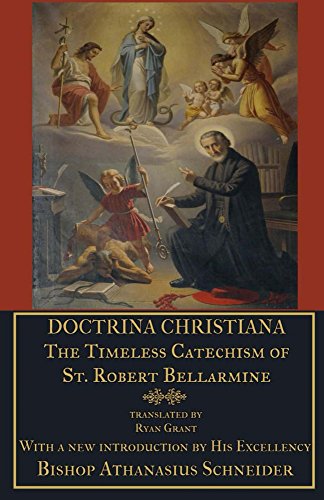
Next, available also on Kindle (don’t have a Kindle yet? US HERE – UK HERE), Doctrina Christiana: The Timeless Catechism of St. Robert Bellarmine translated by Ryan Grant with an introduction by the great Bp. Athanasius Schneider. US HERE – UK HERE

A while back I posted an entry with suggestions for different catechisms.  I think this should be on the list.  This takes the form of a dialogue, rather than simply prose explications of bullet points.

In the forward we read:

In our time of an enormous and general confusion in matters of Catholic faith we do need urgently a crystal-clear, absolute reliable and at the same time simple catechetical text. Such a text represents the famous catechism of St. Robert Bellarmine, which notwithstanding being written 400 years ago, remains nevertheless up to date. This catechism had until the 20th century about 400 editions and has been translated into 60 languages. It was a favorite catechetical tool for the missionaries in the past centuries.

The countries of the so-called Western civilization became today almost neopagan societies and there are even people who named themselves Catholics but are living like pagans. It is therefore obvious that we are living in a missionary. Both inside and outside the church.

The translator adds these interesting notes, which make reference to the first work by Bellarmine with which I started this entry, above:

St. Robert Bellarmine composed two catechisms under the title of Doctrina Christiana(Christian Doctrine), one called his “Small Catechism” which he had written for children and simple souls. This second one, written as a dialogue, called his “Long Catechism,” was intended for teachers and for the well instructed to deepen their understanding of the truths of the faith. The Shorter Catechism was translated in 1614, but the Long, at least to our knowledge, had never been rendered into English until now.

The translation was made from the Latin edition published in Prague in 1732. It seemed to be the most accurate, and it was compiled and edited into a text version book by Anton Repko, whom I especially thank as many of the copies available in electronic form have defects, missing pages etc. Still, as sometimes the Latin edition used complicated phrases from 16th century vernacular Latin that simply would not render into English well, it was necessary to consult Bellarmine’s original Italian to simplify.

This Catechism was written at the express command of Pope Clement VIII, and approved by him in 1598. It quickly became more popular than the Saint’s Controversies, which he is principally known for today. It was also specifically approved by Pope Benedict XIV, and its importance was so great that Pius XI, in his bull of canonization for the Saint, declared of this Catechism:

“Nor may we pass over in silence his sacred sermons and also his catechetical works, especially that catechism, which the use of the ages as well as the judgment of a great many bishops and doctors of the church has approved. Indeed, in that same catechism, composed at the command of Clement eight, the illustrious holy theologian expounded for the use of the Christian people and especially of children, the Catholic truth in a plain style, so brilliantly, exactly and orderly that for nearly three centuries in many regions of Europe and the world, it most fruitfully provided the fodder of Christian doctrine to the faithful.”

In his introduction, the great Bp. Schneider penned, and we cannot but agree:

The corruption of morals and depravity of life is already so great, and ever increasingly greater, not only among uncivilized peoples but even in those very nations that are called Christian. The Apostle Paul, writing to the Ephesians, repeatedly admonished them in these words: “But immorality and every uncleanness or covetousness, let it not even be named among you, as become saints; or obscenity or foolish talk” (Eph. 5:34). He also places the foundation of holiness and sound morals upon a knowledge of divine things—which holds in check evil desires: “See to it therefore, brethren, that you walk with care: not as unwise but as wise. . . Therefore, do not become foolish, but understand what the will of the Lord is” (Eph. 5:15-16).” (Encyclical Acerbo nimis from April 15, 1905).

A good and solid knowledge of the Catholic faith has as its aim a virtuous life through which alone with the help of God’s grace one can achieve eternal salvation. Saint Pius X teaches therefore: “Christian teaching not only bestows on the intellect the light by which attains truth, but from it our will draws that ardor by which we are raised up to God and joined with Him in the practice of virtue” (Encyclical Acerbo nimis from April 15, 1905).

The true knowledge of the Catholic faith fills the human mind with a light and this light, in spite of being sometimes obfuscated by a bad will, is usually the effective means of salvation.

The content of our Catholic Faith is not just words and formulae to be memorized.  The true, interior content of the Faith is a Person, the divine Person of the Eternal Word made Flesh, Christ Jesus.  We can have a relationship with a Person.  Coming to know the Faith leads to knowledge of Christ and, in turn, hope and love.  Furthermore, as the bishop pointed out, even if one loses love, that is charity, and loses hope, faith remains long after.  That faith can help to bring you back to hope and to charity.

Speaking of Bp. Schneider, he, with Card. Burke, are calling for Catholics to pray a decade of the Rosary and to fast at least one day a week from NOW, the Feast of St. Robert Bellarmine, through October (to cover the time of the Synod on the Amazon).


Posted in "How To..." - Practical Notes, Saints: Stories & Symbols, Synod, The Coming Storm | Tagged
7 Comments

ASK FATHER: Did Francis say something heretical about God and our sins?

From a reader…

QUAERITUR:

You always [write] about going to confession and that’s great!  But I read in a Catholic Herald article that in a speech about confession Pope Francis said that God ‘forgets’ our sins.   How can that be?  Is this heresy?

What’s up with that?   In a Catholic Herald article we read what Francis said during the Sunday Angelus address (15 Sept 2019).  Here’s the text (no English) HERE. Also, I went to see the video.  He says this at about 10:20 – HERE.  Let’s see the Catholic Herald [my emphases and comments].

‘God, when He forgives, loses His memory,’ the Pope said  [Ummm…]

Pope Francis said on Sunday that God forgets sins absolved within the confessional.

“How do you defeat evil? Accepting God’s forgiveness … It happens every time we go to confession; there we receive the love of the Father who overcomes our sin. It is no longer there, God forgets it,” Pope Francis said in his Angelus message on September 15.

“God, when He forgives, loses His memory. He forgets our sins, forgets. God is so good with us,” he added in a departure from his prepared remarks.  [NB that the account says he went off script.  Indeed, that’s why I posted the video link.  He is speaking off the cuff.  Whenever he does that… well… results vary.]

In the sacrament of confession, God completely erases the evil confessed, making one new inside, reborn in joy, Pope Francis explained.  [YAY!]

“Brothers and sisters, have courage. With God, no sin has the last word,” the pope said.  [It does with us if we don’t ask for forgiveness and amend our lives!]

Pope Francis reflected upon Sunday’s Gospel from Luke in which the Pharisees complain that Jesus “welcomes sinners and eats with them.” [And tells us, as he did the adulteress, to sin no more.]

“Jesus ‘welcomes sinners and eats with them.’ This is what happens to us, in every Mass, in every church: Jesus is happy to welcome us to his table, where he offers Himself for us,” Pope Francis said.  [So let’s do our part and be properly disposed to receive Him.]

“It is a phrase that we could write on the doors of our churches: ‘Here Jesus welcomes sinners and invites them to his table,’” he added.  [GO TO CONFESSION!]

[…]

God forgets.   God loses His memory.

No and No.

God cannot forget, just as God cannot learn or be surprised.  God’s being and His knowledge are the same.  He doesn’t “forget” in the strict sense.

However, speaking off the cuff like this, I think we can chalk up to well… him, speaking off the cuff.  I don’t think that he is trying to teach something that’s false.

There are times when people do awful things to us, then apologize and we say, “Fuggedaboutit. I have.” We haven’t forgotten, but we intend to put the person at ease. We are not going to hold it against him, or harbor a grudge. I think Francis was just being avuncular and folksy (probably not a great idea very often, if you think about it).  “God forgets your sins” means he won’t hold your sins against you.

He got it right on when he said, “It is no longer there”.  That’s just before he goes off script.

When we confess our sins, with sincerity and intention of amendment, and the priest gives us absolution, we are not just unbound from the guilt of that sin, we are washed clean of it.  It is washed clean in the Blood of the Lamb, in the river of mercy from Christ’s side, the sacramental laver of baptism and of the sacrament of penance.  By Christ’s own authority and with His own power, the priest takes that sin away so completely from your soul that, though the memory of it remains, it is no longer that dark blotch, as it were, on your soul.  God does not cover up or white wash that sin, so that it is still there, but he’s just going to “forget about it” and not hold it against you.  He “forgets” in the sense of “forgives” with a mending, healing forgiveness.  Sin is an evil and evil is a deprivation, a diminishing of being.  God doesn’t leave the wound and ignore it.  He heals it and completes you again so that the sin no longer removes you from Him.   It is gone.  In that sense you might say that God forgets.

But God does not forget.  Remember that, in justice, there is still something owed after sin has been forgiven.  We must make amends.  We make “amends, amendments”, in our life to set it straight, and in our relations with those whom we harmed by our sin, principally God, but also others  – we are in this together and even private sin hurts everyone – and ourselves.   That’s why the sacrament of penance reconciles us also with the Church.  Our sin hurt all the members of the Church.   We, in justice and in religion, owe reparation to neighbor and to God.   If we don’t do reparation here, we will have to do it in Purgatory, provided we die in God’s favor.

BTW… the profundity of how sin breaks us and our relationships is reflected in the deep and ancient forms of absolution that come from the genius of the Roman Rite.   Think of the subtleties of meaning, nuances in “indulgentiam, absolutionem et remissionnem peccatorum” that the priest pronounces.  Each term has a nuance of meaning for logical phases and, with each term, we are reconciled with the Church, ourselves and God in a different way – those different ways being all one way.

In trying to say something that average people can get, using human analogies to describe God or anything God does can go off the rails pretty easily if we want to pick on it.  Anthropomorphic language for God goes only so far.

So, just forget about what Francis said about “God losing His memory”.

And GO TO CONFESSION!

Oh… and another thing…

Whenever Church figures say something that doesn’t sound right or that it, in fact, wrong, use the opportunity.  That is one of the good things about this chaotic time: people who haven’t cracked a good book of Catholic doctrine or a catechism for looooong time have started to ask questions and to look things up.  “THAT didn’t sound right.  I wonder what the Catechism says about it.”  A good thing that will come from this chaos is that the smaller, leaner Church will be better educated and formed in the Faith.

Posted in Francis, GO TO CONFESSION, Liturgy Science Theatre 3000, What are they REALLY saying? | Tagged , ,
24 Comments

ASK FATHER: Should I “poison” by Facebook account?

From a reader…

QUAERITUR:

Will I be guilty of causing scandal if I “poison” my Facebook data in order to protect myself from them?

I just read an article how it is better to run a script to make your
account unusable by liking random posts (posting things I may not agree with) before deleting your account. I worry about the
implementation of a “social score” in the USA like the Chinese have started.

Wow.  I haven’t heard about this “poisoning” of Facebook data before.

Frankly, I dislike Facebook, always have.  I use it sparingly and question why others use it so much.  I feel my IQ drop several points a minute while it is open on my screen.

Facebook, it seems, is getting dangerous, in a wide way, and intrusive, it seems.  Their powers-that-be are political and they are engaging in social engineering, and not in a good way.  It is serious player now.  Not good.

How does one fight back?

You can stop using it.

However, once you are really into it, what do do?

The sort of tactic you bring up looks like a misdirection similar to “disinformation”.

I ask myself what I might do were I under the heel of the Soviet Bloc.

I also remind myself that Augustine said that lying for any reason was wrong.

This seems to be a good topic for discussion for several reasons.  Perhaps you readers have some thoughts about Facebook and the potential of the “social scoring” that is already underway in China and, if the Dems take over, will soon be in these USA as well.

Posted in "How To..." - Practical Notes, ASK FATHER Question Box, The Coming Storm, The Drill, The future and our choices | Tagged ,
18 Comments

Of “schism” and the abolition of the USCCB

A couple of reading assignments for this morning.

Check out Ross Douthat on the Left’s “schism” hysteria.  HERE

Also, at Crisis there is a piece which suggests the abolition of the USCCB.  HERE

This passage summed up a lot of what I think about bishops:

Generating activity is the bread and butter of any bureaucracy. The further the bishops drift away from their spiritual goals towards worldly affairs, the more control these staffers can exercise.

The professional mode is hard to resist. The USCCB’s biannual meetings in posh hotel venues (with bare-bones Masses that demonstrate the priorities of the participants) display the vacuity of the proceedings, with no man daring to break ranks over the decisions—which run the gamut of banal to destructive—of others.

At their last convocation in Baltimore, in the wake of revelations of episcopal cover-ups, one bishop stood up to offer a timorous semblance of rebuke to his confreres when one of their endless statements proved too much for him. “No mention of Jesus,” he half-whispered. Resorting to mild sarcasm—the room seemed to get uncomfortable—he weakly offered his opinion that “it might be a good idea.”

The ghost of Bernardin haunts us to this day.

Posted in The Drill | Tagged ,
16 Comments

Our Lady of Sorrows Project: 7th Sorrow – The Burial of Jesus

Today is the Feast of Our Lady of Sorrows.  So, on this day, after the Feast of the Exaltation of the Cross, we conclude our brief work.

So far…

1st Sorrow – The Prophecy of Simeon
2nd Sorrow – The Flight into Egypt
3rd Sorrow – The loss of the Child Jesus in Jerusalem
4th Sorrow – Mary meets Jesus on the way to Calvary
5th Sorrow – The Crucifixion of Jesus
6th Sorrow – The Piercing of the Side of Jesus, and His Deposition

Now we turn to and to conclude with…

The Burial of Jesus (Matthew 27:57–61, Mark 15:43–47, Luke 23:50–53, John 19:40–42)

It was necessary to work swiftly. It was time for Mary to feel the particular pain of Christ’s piercing sword through His burial.

The Romans and the people had committed what she knew was homicidal deicide: they had, all had, collectively killed the God made Man.  Darkness fell and the earth shook at the Creator’s demise.  Rocks cracked and the earth gave up the dead.  It is time for the New Eve – theotokos – to take the New Adam from the Death Tree and plant in the earth as the new Life Tree, soon to bear first fruit – prototokos – for a New Eden.

Romans usually left corpses on crosses to be picked over by the crows and vultures and insects.  But this was a special day and they had orders from Pilate.  There would be hell to pay if these guys were still visible after sunset.   One can image the gentle words of the soldiers of the occupying Roman force: “Please, if you don’t mind, just try to speed things up a little?”   In fact, they probably urged them along with the help of their pila, at least when the Centurion wasn’t looking.  Thus, all of the well-wishers and followers of the Lord who had made it to this point, the Gospel talks of the women who came from Galilee, leapt into action.

They had to take care of the Body of the Lord at least by wrapping it in linen cloths and getting it into a tomb.

Here is an image to take with you to Holy Mass.  Bede was careful to point out that we consecrate the Lord’s Body not on silk or gold cloth, but on a clean linen cloth. (Harmony of the Gospels 3.23).  In the traditional Roman Rite, the priest lays the Host to be consecrated directly upon the linen “corporal” and he hides away the golden paten under the cloth until the “resurrection moment” of the recombination of the Body and Blood.

Be clean at Holy Mass, and contemplate the richness of the symbols in your still hearts, like Mary who saw, heard and pondered.  Origen says that if anyone wants to be buried with Jesus in baptism cannot be an old, used tomb or a dirty cloth. He must be a clean cloth. (Comm. Rom. 5.8).

In no way would Mary have excluded herself from wrapping her boy in cloths, she who had wrapped Him countless times in his infancy.  He was still her baby.

Joseph of Arimethea -“secret disciple” who was “looking for the Kingdom of God” – had come out of hiding and provided a new, a virginal, tomb, in which no body had yet been placed. Both Jerome and Augustine underscore the importance of a tomb that had never been occupied, its connection with virginity.

Because of the controversy of the situation, Pilate sent guards, probably nervous because of the task and because there had been an earthquake and, I suspect based on some calculations, there was a total lunar eclipse producing a portentous “blood Moon”.  Twilight was fast approaching which would mark the point at which work must cease for the sabbath.  The future evangelist and author of apocalyptic visions, newly ordained Fr John, is there, young and healthy, helping with the heavy work.  He wrote that Nicodemus (Greek “victory of the people”) provided 100 pounds of myrrh and aloes, a spectacular quantity. Fit for a King. Gifts from the Greek and Jewish Joseph.

I envision the “beloved” Apostle, John, carrying in the spices for the Galilean women to use, marveling at their quantity.  What might he have been thinking?  The casting of lots on Christ’s garment revealed Him as High Priest.  The quantity of burial spices reveal Him as High King.

Cyril of Jerusalem in his Catechetical Lectures points to the planting of Christ in the garden. “I am the vine”, said Christ. Christ will transform the earth, choked with thorns after the Fall, with new life.  Thus, Cyril:

“And what will he that is buried in the garden say? ‘I have gathered my myrrh with my spices’ and again, “myrrh and aloes, with all chief spices” (Song of Songs 5:1; 4:14). Now these are the symbols of burial.”

It was necessary to work swiftly in the virginal tomb. They could return after the sabbath and complete their ministrations with the necessary anointing.

What was going on around them as they worked in the tomb, for surely nearby there were other tombs?   Matthew 27:51-52 says that when Jesus died, “the tombs also were opened, and many bodies of the saints who had fallen asleep were raised”.  It was immediately after this that the Centurion acknowledge Christ as God.  The dead would, after the resurrection, walk among the living in Jerusalem.

In ancient writings time accounts are sometimes tidal, ebbing backward and forward.  But it seems that at the death of the Lord, the dead started to rise and tombs started to open.  If they didn’t leave their tombs until the after the resurrection – Christ must be the prototokos, the first of Creation and the first to rise – maybe at this point ‘dem dry bones’ were stirring, knitting up.  Maybe at this point there were sounds.  That could have been be somewhat disconcerting to those gathered about Christ’s virginal tomb.  If these people had faith and were bolstered by their time with Christ, the soldiers would have been rather freaked out under the “blood Moon”.

Meanwhile, while they scramble to beat the appearance of the sabbath stars, the soul of Christ has gone to harrow Hell.   Things are stirring up there, for sure.

At the same time Mary, theotokos, with the new Fr John and the disciples work hurriedly in the earthy tomb, carved out from the rock, the Lord is comforting holy souls who died before the “fullness of time”.  Perennial masters of paint show in their devotion a triumphant New Adam, also before a tomb-like opening, door and demons both gaping in the shadows, as with His recently spiked hand He draws out the dead from darkness to light, the old Adam first along with the old Eve still at his side.  New Adam with a New Eden.  New Noah with a New World.  New Moses with a New Jerusalem.  New… New… New…

“Behold, I make all things NEW.”

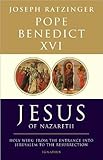
Benedict XVI, in his  Jesus of Nazareth Part Two, Holy Week: From the Entrance Into Jerusalem To The Resurrection writes [US HERE – UK HERE] writes about Mary as the “the Woman” of the New Adam of the Book of Revelation.  John – again, John, eyewitness to the burial – describes the Woman appearing in heaven, a sign of the entire Church throughout time until the end of things.  Mother/Bride she is continually, in the vision granted to John, giving birth to Christ, to the Church.  Mary, at the tomb of her Son, with the “beloved” Apostle John, are living icons of discipleship and the ministry of the Church.   They are historical figures doing, now, historical things, but through Christ they are the Church already in action, still wet from the Blood and water of the Lord’s side, birthing the sacramental life.

But right now all Mary can see in the close and murky, shadow-flickering tomb of the old Earth is the work to be done.

Were the tears flowing down all of their cheeks from sorrow or from the stinging smoke of the torches or oil lamps?  The presence of all those spices?

On the matter of the tears of the Mother, in The World’s First Love Fulton Sheen writes, about the Lord’s burial:

At such moments, there is not loneliness but desolation—not the outward desolation such as came through the three days’ loss but an inner desolation that is probably so deep as to be beyond the expression of tears. Some joys are so intense that they provoke not even a smile; so there are some griefs that never create a tear. Mary’s dolor at the burial of Our Lord was probably of that kind. If she could have wept, it would have been a release from the tension; but here the only tears were red, in the hidden garden of her heart! One cannot think of any dolor after this; it was the last of the sacraments of grief. The Divine Sword could will no other thrusts beyond this, either for Himself or for her. It had run into two hearts up to the very hilt; and when that happens, one is beyond all human consolations. In the former dolor, at least there was the consolation of the body; now even that is gone. Calvary was like the bleak silence of a church on Good Friday when the Blessed Sacrament has been removed. One can merely stand guard at a tomb.

On Good Friday, the Blessed Sacrament is removed.   There is no Mass, though Communion is possible.

Through Holy Saturday there is neither Mass nor Communion.  The Church is silent, still as a dark tomb.

Mary stands outside the closed tomb.  Still and silent.

Mothers will say that they feel that their children are still part of them, even into their old age.

In fact, during pregnancy, the cells of babies cross into their mother’s bodies and become part of them. For the rest of their lives, mothers carry with them, as part of themselves, the genetic material of their children. It is possible to find fetal DNA in a mother’s blood. In fact, mothers therefore have encoded within them, the DNA of both children and her husband.

Mary, who was with Child by the Holy Spirit, carries within her flesh and blood the DNA of Christ.  She is at this moment the sole living Tabernacle of Christ on Earth. Dead in the tomb, He lives in her.  She is the Ark of the Covenant. By the tomb, she is the “singular vessel of devotion”, the living “house of gold”, “tower of ivory” and “of David”.

As she stood by Christ’s tomb as it was being officially sealed, did Mary have inklings of the seals of the tomb of sheol shattering at the comforting coming of Christ?  Might not the Comforter Himself have provided a comforting vision for the one who would be sung to with litanies through the centuries as “comforter of the afflicted”?

Her piercings have made her Holy Church’s greatest minister of comfort.

The very first time I was in Rome, before I was even Catholic, I stayed at a place next to the tiny church that houses the body of St. Vincent Pallotti. It is across the street from the flanks of the church where I now always say Mass, Ss. Trinita dei Pellegrini, where I said my 3rd Mass, which has a lovely altar of our Sorrowful Mother.  I feel, therefore, a kind of spiritual thrum between these churches, and a friendship with St. Vincent, as if he has been watching out for me all these years. St. Vincent was deeply attached to the devotion of Our Lady of Sorrows. He often said that he heard a demon through a possessed person admit that no one who had prayed the devotions of Our Lady of Sorrows had ever been taken by the fallen angels and that God restrained demons from attacking dying souls with temptations who prayed these devotions.

St. Vincent preached that the Mother of God will assist at the hour of their death anyone who shared with compassion a devotion to her Sorrows.  St. Alphonsus Liguori wrote that anyone who loves God and says of name of Mary while dying cannot be lost.  St. Bridget said that Mary became the Mother of all the dying through her own Sorrows.  Devotion to Our Lady of Sorrows changed the life of the young St. Gabriel Possenti who entered the Passionists with her very title.

St. Bridget of Sweden (+1373) wrote that Our Lady of Sorrows grants seven graces to the souls who honor her daily by saying seven Hail Marys as they meditate on her tears and sorrows:

  1. “I will grant peace to their families.”
  2. “They will be enlightened about the divine Mysteries.”
  3. “I will console them in their pains and I will accompany them in their work.”
  4. “I will give them as much as they ask for as long as it does not oppose the adorable will of my divine Son or the sanctification of their souls.”
  5. “I will defend them in their spiritual battles with the infernal enemy and I will protect them at every instant of their lives.”
  6. “I will visibly help them at the moment of their death—they will see the face of their mother.”
  7. “I have obtained this grace from my divine Son, that those who propagate this devotion to my tears and dolors will be taken directly from this earthly life to eternal happiness, since all their sins will be forgiven and my Son will be their eternal consolation and joy.”

St. Alphonsus in his Via Crucis penned the dolorous phrase, “And they closed the tomb, and all withdrew”.

To where did they withdraw?  My heart yearns after the image of John taking Mary and the others to a safe place, perhaps back to the upper room.  They would talk, as people do, after burials, exhausted, remembering the good and the bad.  I hear John relate to the Apostles who were not there what happened on Golgotha.  I hear him then relate to Mary what happened at the Last Supper.  He wants to make sure that everyone knows the whole story.  The events are connected and the blanks filled in.  Matthew listens carefully.

John was the Apostle Jesus loved most, but Peter loved Jesus more than the others.  If my heart wants that image of John telling the story to be true, no less do I picture Peter, after the intertwined stories of the Last Supper and of Calvary were related and connected in their minds, saying decisively, “He told us to do something in His memory.”

Peter, the one who had betrayed the Lord three times, looks at Mary for comfort and affirmation.  After pondering all these things, pondering Peter for a moment, she who is the living Tabernacle of Christ, says,

“Do whatever He tells you.”

Newly ordained, young Fr. John, future evangelist and the youngest of that first ordination class, rises to pray.

וְאָבֹואָה אֶל־מִזְבַּח אֱלֹהִים אֶל־אֵל שִׂמְחַת גִּילִי וְאֹודְךָ בְכִנֹּור אֱלֹהִים אֱלֹהָֽי׃

And everyone responding…

מַה־תִּשְׁתֹּוחֲחִי נַפְשִׁי וּֽמַה־תֶּהֱמִי עָלָי הֹוחִילִי לֵֽאלֹהִים כִּי־עֹוד אֹודֶנּוּ יְשׁוּעֹת פָּנַי וֵֽאלֹהָֽי׃

Mary ponders these things in her heart as they pray Psalm 42/43 together and the new priests set a table.

I will go in to the altar of God: to God who giveth joy to my youth. To thee, O God my God, I will give praise upon the harp: why art thou sad, O my soul? and why dost thou disquiet me? Hope in God, for I will still give praise to him: the salvation of my countenance, and my God.

FINIS


Let us pray:

O Mother of Sorrows, thou, who beneath the Cross of Jesus were given to us as our Mother, look down with pity on us, thy children, who weep and mourn in this valley of tears. By that sword of sorrow which pierced thy Heart when thou looked upon the Face of thy dead Son, obtain for us that comfort we so sorely need in our sufferings.

Thou were given to us our Mother in the hour of thy greatest grief that thou might be mindful of our frailty and the evils that press upon us. Without thy aid, O Sorrowful Mother, we cannot gain the victory in this struggle against flesh and blood. Therefore, we seek thy help, O Queen of Sorrows, lest we fall prey to the wiles of the enemy. We are orphans in need of the guiding hand of our Mother amid the dangers that threaten our destruction. Thou whose grief was boundless as the sea, grant us by the memory of those sorrows the strength to be victorious.

Intercede further, O Mother of Sorrows, for us and all who are near and dear to us, that we may ever do the Will of thy Son, and may direct all our actions to His honor, and to the furtherance of devotion to thy sorrows.

Amen.

Virgin Most Sorrowful, pray for us.

Our Father, …
Hail Mary, …
Glory Be …

PRAYER FOR A HAPPY DEATH

O Mother of Sorrows, by the anguish and love with which thou didst stand beside the Cross of Jesus, stand by me in my last agony. To thy maternal heart I commend the three last hours of my life. Offer these hours to the Eternal Father in union with the agony of our dearest Lord. Offer frequently to the Eternal Father, in atonement for my sins, the Precious Blood of Jesus, mingled with thy tears on Calvary, to obtain for me the grace to receive Holy Communion with most perfect love and contrition before my death, and to breathe forth my soul in the actual presence of Jesus.

Dearest Mother, when the moment of my death has come, present me as thy child to Jesus; say to Him in my behalf: “Son, forgive him, for he knew not what he did. Receive him this day into Thy kingdom.”

Amen.

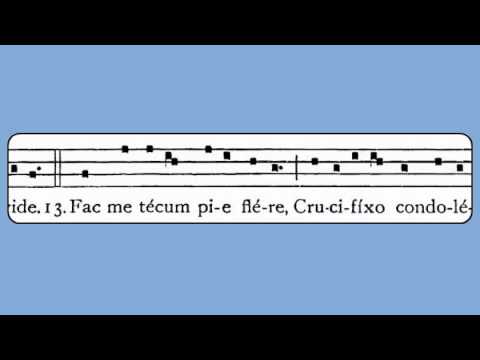
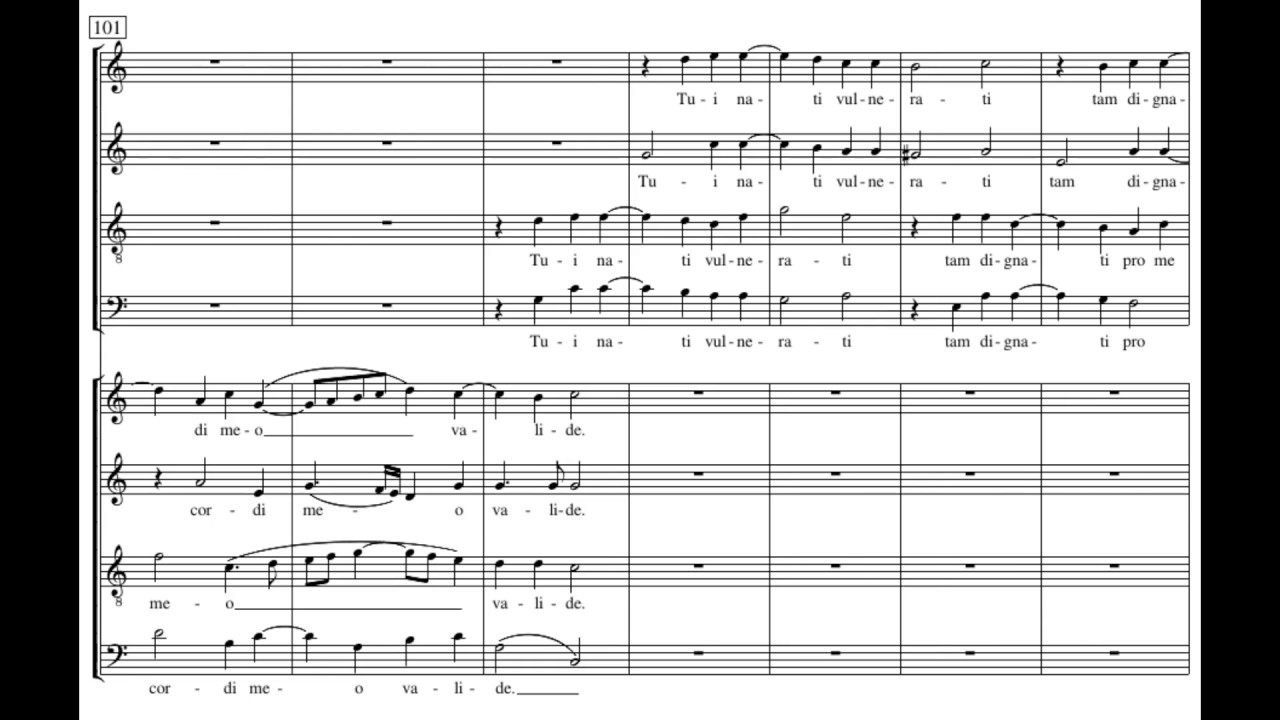
YouTube thumbnailYouTube icon

YouTube thumbnailYouTube icon

YouTube thumbnailYouTube icon

YouTube thumbnailYouTube icon

And from the great Benedictines of Mary, Queen of Apostles, whose apostolate is to pray for bishops and priests:
YouTube thumbnailYouTube icon

Posted in Four Last Things, Liturgy Science Theatre 3000, Our Solitary Boast | Tagged , ,
10 Comments