Francis on ice hockey… yes, ice hockey

As a Minnesota kid I skated and played hockey.  Hockey is in the family.

Hence, when I saw that Francis addressed himself to the International Ice Hockey Federation (they gave him a uniform sweater with a Roman numeral – you know… Latin), I checked out the text.  HERE

I was amazed at what I read!

Today’s culture may sometimes steer sporting activities down the wrong path, but we must keep in mind that rules are there to serve a specific purpose and to avoid a descent into chaos. Athletes honor fair play when they not only obey the formal rules but also observe justice with respect to their opponents so that all competitors can freely engage in the game.

… to avoid descent into chaos.

I wonder how the upcoming Synod will go this time?

I wonder if we could swap some terms out in that quip, above, and see how it might apply to the Church.

Posted in Lighter fare | Tagged
13 Comments

ASK FATHER: Are permanent deacons necessary?

From a permanent deacon…

QUAERITUR:

What is your take on the state of the permanent diaconate? Permanent deacons don’t seem to have a “home” in the Church. Many in the traditional community bemoan permanent deacons as a Vatican II oddity, while many in the liberal community reject the permanent diaconate as an unnecessary form of clericalism. In my own diocese, permanent deacons seem to be only tolerated, and not utilized or appreciated. I write this as a newly ordained permanent deacon. Do we need permanent deacons? Are they necessary? What is your take on the state of the permanent diaconate today?

A couple things as an introduction.

A deacon is a deacon is a deacon.  Whether the intention is that diaconate be a step to priestly ordination or not, diaconate is the diaconate. A man is not more of a deacon because he is a transitional deacon.

Also, keep in mind that, in the traditional sphere, priests function as deacons all the time.  All deacons are permanent deacons, even if later they are ordained to the priesthood.  Bishops quite properly wear dalmatics beneath their chasubles.  They didn’t stop being deacons with priesthood.

My entrance into the Catholic Church was facilitated in part by a terrific permanent deacon, an Englishman who had immigrated and had a distinguished career teaching and as an executive is a world-famous, Minnesota-based company.  He was in the Westminster school, in London, and he formed all the altar boys at the great St. Agnes in St. Paul, back in the day of Msgr. Schuler, according to the liturgical style of Westminster Cathedral of the 1930’s.   He knew everything about liturgy, gave great help to the pastor by way of sick calls and catechesis, and was a man of parts.   He is missed.

Therefore, my default position is to be favorable toward permanent deacons.

That said, I have encountered over the years super competent permanent deacons, edifying and praiseworthy, and also cringe worthy incompetents.  More of the later, alas, than the former.   Not that a lot of priests are great shakes.

The problem is terribly uneven formation.   I don’t question in the least the good motives or piety of the men involved.  I only hope that programs can sniff out the guys who just want to be “up there” on Sunday.

Do we need a permanent diaconate?   Are they necessary?  This feels like the third rail.

We didn’t have them for a loooong time and we got along just fine.  However, that also was in the day when convents were jammed and there were several priests in every rectory.   Work got done.

I’ll leave aside the issue of mission countries as being too complicated.

With the shortage of priests in these USA at least, one can see how having deacons who can help with Communion calls and so forth, sacramental prep, service at the altar for solemn worship is desirable.  Frankly, I wish I had a couple of permanent deacons around whom I could train up for Solemn Masses.  That would make my life a lot easier.

It seem to me that, while priests are existentially necessary for the life of the Church (e.g. Mass, confessions, anointing), and permanent deacons are not in the same way necessary (e.g. they do none of those), having them in service depends a great deal on both the urgency of the need and the quality of formation.   That isn’t very definite, I know.  First, every cleric ought to be well-formed.

We can’t do without priests, and so we can get on with priests who aren’t so sharp.  But we can get along very well without deacons who aren’t so sharp.

Are they necessary?   Well… it depends.  It depends on if you want to work priests into their early graves and it depends on the level of formation.

Lastly, reception of Holy Orders means that there was a vocation from God to be ordained.   We humans can and do get in the middle of that through formation programs, etc.  However, God’s involvement means that if permanent deacons are necessary, then they are going, somehow, to be ordained, just as a flower finds purchase and manages to spring up in the crack of a sidewalk.  I cannot pass any sort of judgment on God’s role in this matter of the permanent diaconate.

One of the first things that the Apostles did was choose men for the diaconate.  That tells us something.

If the same conditions pertain in our day, deacons will be necessary for us just as for the Apostles.   Circumstances play a role, and we can discern something of God’s will in the circumstances, as the Apostles did.

What we read after the choosing of the seven deacons is:

And the word of God increased; and the number of the disciples multiplied greatly in Jerusalem, and a great many of the priests were obedient to the faith.

Pretty good.

In the ancient Church there were deacons with understood roles.  Then that order faded out (sort of).  There were reasons for that, too.  So, the fruits of the Church’s mission and previous practice both tell us something.

Diaconate is a vocation.  We should treat diaconate with the seriousness it deserves and give men excellent formation if we are going to go down that road at all.  Otherwise, let’s stop pretending.  If we aren’t willing to make them great, then shut the programs down.


Posted in "How To..." - Practical Notes, ASK FATHER Question Box | Tagged ,
19 Comments

A young priest learns he was lied to about the Traditional Mass

Invariably, priests who learn the Extraordinary (because it’s great, not because supposed to be rare) experience a shift in their understanding of Holy Mass and their position as priest/victim at the altar.

Here is a blurb I picked up from Messa in Latino, in turn from Fakebook.  A priest learns that what what he was told in seminary about the Usus Antiquior was false.  My translation.

Many among priests and laity in no way have enough knowledge about the ancient liturgy to make a judgment.   I don’t really blame them (especially with regard to the clergy), since in the theological faculties professors do not teach about it at all, rather, they run it down it and ridicule it: I know it because I attended those liturgical courses and they did it in the classes that I heard.

But once coursework was completed, I studied on my own, thanks also to the prompting and example of the people I met and to the readings I did.  I took an old missal directly into my hands and started to read it and study it, without making the mistake of my professors: I didn’t stop to say things, like, “Look what they were doing here! How many useless signs of the Cross!”. I went beyond, trying to understand the reason for so many things.  Tackling the chore of understanding, I further deepened my readings and discovered symbolism and meanings of an extraordinary richness that the innovators decimated with a disconcerting ease.

Challenged by this, I had to change my point of view, I had to change my mind about the ancient liturgy and the aberrations of the new, which are its logical and inevitable consequences. The modern liturgy gives ample space to personal customization, the rubrics are often summary, and this more easily opens the way to aberrations, while in the ancient rite everything is well defined (the so-called “rubricism”, a word invented to denigrate and ridicule) and it leaves no room for creativity and improvisation of the celebrant, thus leaving the liturgy to speak for itself, and compels both the faithful and the priest towards eternal realities.

Posted in Liturgy Science Theatre 3000, Mail from priests, Priests and Priesthood, Seminarians and Seminaries, SUMMORUM PONTIFICUM | Tagged
10 Comments

ACTION ITEM! SATURNOS FOR CLERICS!

action-item-buttonBy now most of you know about the Biretta for Seminarians Project.

You – seminarians and lay people –

contact John Hastreiter in church goods at Leaflet Missal in St. Paul – 651-209-1951 Ext-331.

Seminarians: give name, address, HAT SIZE and John will put you on the list. Lay people or clergy: Contact John and pay for one or more birettas and John takes care of the shipping, etc.

In light of recent events, and in consultation with Mr. Hastreiter, here is a new project for your consideration.

saturno 02

SATURNOS FOR CLERICS PROJECT

The Project will work along the same lines as the Biretta Project.

Clerics (priests and deacons – bishops buy your own!), contact Mr. Hastreiter with your information – check your hat size before you call.

Here is a video about how to measure for your HAT SIZE: HERE.  It is important to double-check especially if you have gained or lost a lot of weight or hair.

“Saturno” is, of course, an Italian nickname for the broad-rimmed Roman clerical hat.  Romans also call the hat a “padella… frying pan”.  Otherwise it is a “cappello Romano”.  “Saturno” is fun and pretty much everyone knows it.

Some people in the high realms of power are really triggered by the saturno.  It’s a curious phenomenon.

Mr. Hastreiter informs me that there are a couple options for your saturno.  There are different kinds of Roman hats: woven straw for hot weather (they come in white for when you wear your white cassock), felt (like most normal hats, and pressed fur (often rabbit – warmer – rather shiny as in the photo, above).

The Project should be mainly for deacons and priests rather than for seminarians.  I don’t think that seminarians should be excluded.  That said, it could be that getting a saturno and having it around at the sem is NOT going to do you a lot of good… depending on the faculty and what you do with it.  Be prudent, men, and deny yourself some good things for the sake of the greater goal: ordination.  That said, seminarians aren’t excluded.

¡Hagan lío!  Let the New Evangelization Thrive!

PS: We also need a Spanish Biretta and a Jijin For Fr. Z Project.

Posted in ACTION ITEM!, Lighter fare, Priests and Priesthood | Tagged ,
11 Comments

Francis on priests in private Jesuit meeting: psych problems = rigidity = fixation on sex = clericalism = demonic

The ubiquitous Jesuit Antonio Spadaro is perhaps Francis’ closest adviser and gopher.  He is, among other, editor of La Civilta Cattolica and the administrator on his personal website, antoniospadaro.net, of a page dedicated to the homoerotic writer Pier Vittorio Tondelli.

Spadaro gave to historically anti-Catholic La Repubblica an excerpt of a transcript of a private, closed door meeting that Francis had with Jesuits during his trip to Maputo, Mozambique.   HERE

Since Spadaro chose to include this section in the brief excerpt given to the Communist founded La Repubblica, it must be so important that Spadaro thinks no one should miss it.

Since it is so very important, I feel the need to share it with you, especially, my brother priests who read here.  My translation and emphases and comments.

Q: How can we avoid falling into clericalism during the formation of priestly ministry?

Francis: “Clericalism is a true perversion in the Church. It demands that the pastor be always at the fore, establish a course, and punish with excommunication those who move away from the flock. In sum: it is precisely opposed to what Jesus did. Clericalism condemns , separates, beats, despises the people of God. Clericalism confuses priestly [presbiterale] ‘service’ with the priestly ‘power’. Clericalism is climbing and supremacy. In Italian it is called ‘arrampicamento’ [that’s not standard Italian, but it is clearly from arrampicare, which pertains to climbing, like in mountain climbing or cycling]. Clericalism is a direct consequence rigidity. [!] Have you ever seen young priests all rigid in a black cassock and hats in the shape of the planet Saturn on their heads? [One nickname for the Roman clerical hat in Rome is “il saturno”, along with “padella… frying pan”] There are serious problems behind all this rigid clericalism. One of the dimensions of clericalism is the exclusive [?] moral fixation on the Sixth Commandment. A Jesuit once told me to be careful in giving absolution, [?] because the most serious sins are those that have a greater ‘angelic’ character: pride, arrogance, dominion. [actually fallen angel, hence, demonic!]  Those which are less angelic, such as gluttony and lust. We focus on sex and then we don’t give weight to social injustice, to slander, to gossip, to lies .”

A few comments.

First, since angels have no bodies, they do not have appetites as we do and their fall didn’t result from carnal sins.  The sins of the fallen angels would have been of a higher (and therefore graver) order, such as pride.  Among the sins that humans can commit, there are grave sins which are more of the lower, fleshy, order and those of a higher, spiritual, order.  Pride, vicious thoughts about others, lying, are in general worse than gluttony or lust.  However, whether they are more spiritual or more carnal, both can be MORTAL.  There isn’t partly or sort of mortal sin.   A lesser grave sin is, by definition, still a grave sin.

Also, as any priest knows who has heard confessions for a long time, true sins of that higher order, such as true pride and true malice, deeply rooted propensity to deceive, are by comparison rarer.  Sure, people can commit sins of the graver spiritual order occasionally.  Sins of the flesh are more common.  And they are dangerous.  While sins of the more angelic/demonic character are graver, those of the lower order, provided that they are of full consent, etc., are nevertheless enough to merit separation from God.  They are still mortal sins.

Moreover, as spiritual writers are consistent in warning, one sin leads to another, one kind of sin can weaken one so that it is easier to sin more gravely.  For example, there is a classic connection leading from gluttony to lust, not just acts of lust with the body, but objectifying people in the mind and imagination.  If you don’t say no to one basic appetite, you won’t say no to another. Those carnal sins can lead to dire spiritual sins, such despair, presumption, deceit, etc.

Above, we read: “We focus on sex and then we don’t give weight to social injustice, to slander, to gossip, to lies.” And earlier: “…exclusive moral fixation on the Sixth Commandment.”

Exclusive? I don’t know where he has been spending his time, but that’s not anything I’ve seen.

Still, of course we focus on sex!  We don’t focus only on sex. We focus on sexual sins because they are a) common, b) gateway sins, and c) enough to get you damned.

People tend to die the way they lived.  If we strongly habituate ourselves in this life to goods that are less than God, goods which take us away from the ultimate and highest good which is God (which is what we do in a mortal sin), then we will lock on to those goods.  That will result in separation from God and hell.

So, of course the diligent priest is going to focus on the Sixth Commandment.  It is, after all, not a Commandment with an asterisk… as if God said, “Here are 10 Commandments, but … wink wink … this one… well, you know.”

I don’t want to go to Hell for not attending also to preaching on sins against the Sixth Commandment.  False mercy will get you to Hell just as efficiently as true mercy, founded in charity.

Also, I want to underscore the line of thought.

Francis went from judging an outward appearance, cassock and hats, to an assertion that, someone who looks unusual to him, must be psychologically ill.  But then he brings in demons and their sin.  People like this are crazy and maybe like demons.

Does that seem right to you? That’s strike me as smacking of the very things that Francis mentions negatively at the end of the excerpt: it is unjust, calumnious, and – since it was in a small private meeting and not in front of microphones and camera – it smacks of gossip.

And this is what Jesuit Antonio (2+2=5) Spadaro urgently wanted everyone to know, via the historically anti-Catholic La Repubblica.

I am sure that my brother priests have been deeply moved by these remarks. I trust they will take action.
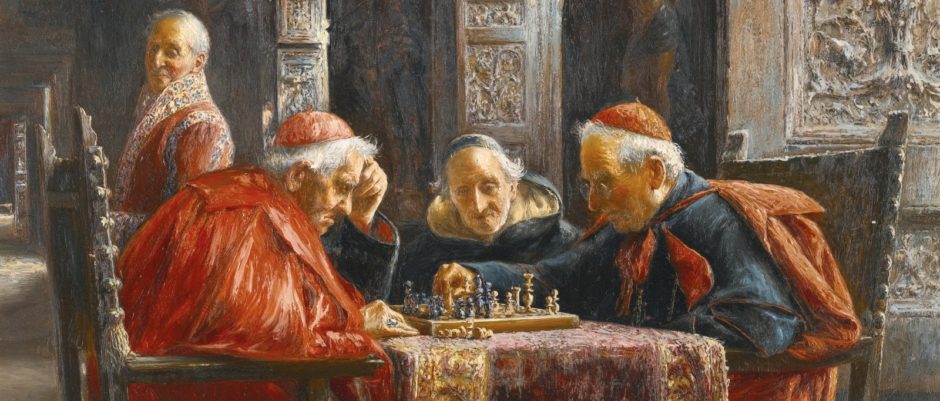
Posted in Mail from priests, Priests and Priesthood, The Drill | Tagged , , , , ,
22 Comments

Francis’ circle of ardent defenders uses “diabolical cancer” against all whom they wish to silence

During the Wednesday General Audience, Francis strongly rebuked those who, in an organized way, as accusing people of being schismatic simply because they are exercising parrhesia.

Here is something of his address (my translation):

And the Apostles create seven deacons, and among the seven “deacons”Stephen and Philip are distinguished in a special way. Stephen evangelizes with strength and parresia, but his word meets the most obstinate resistance. Finding no other way to get him to stop, what do his opponents do? They choose the basest solution to annihilate a human being: that is, calumny [calunnia – slander, libel, detraction] or false testimony. And we know that calumny always kills. This “diabolical cancer”, which comes from the desire to destroy a person’s reputation, also assaults the rest of the ecclesial body and seriously damages it when, due to petty interests or to cover up one’s own inadequacies, a coalition forms to smear someone[For example, a coordinated effort to label critics of Francis as “schismatic”.]

Conducted in the Sanhedrin and accused by false witnesses – the same thing they had done with Jesus and the same thing they will do with all the martyrs through false witnesses and calumnies – to defend himself Stephen proclaims a reinterpretation of sacred history centered on Christ. And the Easter of Jesus, dead and risen, is the key to the whole history of the covenant. In the face of this superabundance of the divine gift, Stephen bravely denounces the hypocrisy with which the prophets and Christ himself were treated. And he remind them of history, saying: “Which of the prophets did your fathers not persecute? They killed those who foretold the coming of the Just One, whose traitors and murderers you have now become”(Acts 7.52). He doesn’t use half words, but he speaks clearly, he tells the truth.

This provoked a violent reaction from his listeners, and Stephen was condemned to death, condemned to stoning.

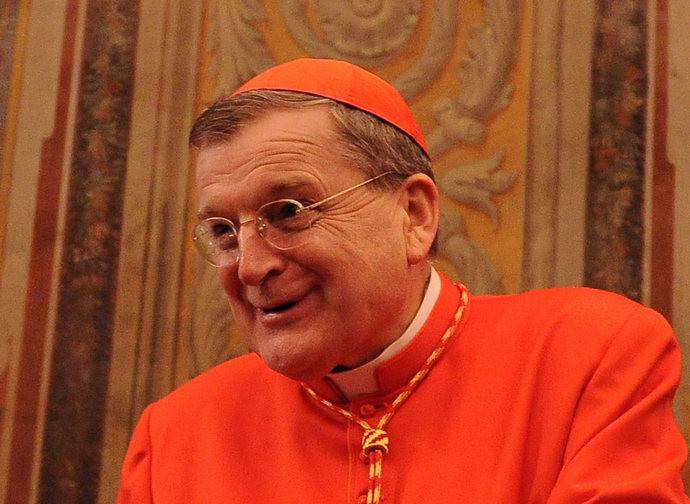
This sounds very much like, in Francis’ telling, what the coalition who have put themselves forward to defend his every off the cuff remark as if it were an oracle of the Fifth Apparition of Vishnu, are doing to people like Card. Burke… who, in the College, is a Cardinal Deacon.  He is a Cardinal Deacon not afraid to wear the red cappa which recalls the blood of martyrdom.

Team Francis are flinging stones of calumny.   I hope they will take Francis’s words to heart.


Posted in Francis, Liberals | Tagged , , ,
10 Comments

“Sometimes you can benefit the Church just by ceasing to do something stupid.”

Eloquent Anthony Esolen uses the sharpie of his brain to underscore with slashing priority a point that would solve a lot of problems.  HERE

The issue he addresses is the appalling English translation used at Mass in the Novus Ordo.  His preamble, however, stands by itself.

Here is an excerpt, but I want to preface this with an observation.

As we face many of the problems stirred up by the present chaos in the Church, don’t immediately leap to conclude that they are rooted in someone’s malice.

In many instances incompetence and even stupidity suffice to explain the origin of the challenges that are now rising up not single spies but in battalions.

Our “Sophisticated” Bible Translators

“Stupidity,” says Jacques Maritain, “is always a vice.” So are bad taste and slovenly work.

Maritain should have been the editor of the New American Bible, copyrighted by the U.S. Conference of Catholic Bishops, and of the lectionary in use in America – a tenebrous mystery if ever there was one. Please, your excellencies, put these ugly and dispiriting creatures to death.

Sometimes you can benefit the Church just by ceasing to do something stupid. Many of us have known such addition by subtraction. You rip out the dingy plush carpet and the plywood, and you find a beautiful floor of white ash beneath. You strip away the whitewash to reveal again the colorful folk paintings of your ancestors long ago. You convert bad children’s readers to fuel for wood stoves, and you pick up Kipling and Austen and Stevenson again.

[…]

When you have made a mistake or done something stupid, its rarely a good idea to keep at it.

If you take a wrong turn, and you are heading away from your desired destination, its rarely helpful to keep going.

No, you stop what you are doing. You turn around, retrace your steps, and get it right.

Our Catholic identity has been eroded to the point that 7 of 10 Catholics don’t believe what the Church teaches about transubstantiation and the Real Presence of Christ in the Eucharist. The major reason for this is the way the Eucharist has been celebrated for decades. Yes, preaching and catechesis have also been strongly corrosive, but banal, worldly, self-referential and stupid liturgy has broadly wiped faith out of the former faithful and left confusion and fog in those who cling to belief.

We could start to recover a lot of lost terrain and get back on the right path by doing a few things, with catechesis of course.

Let’s move now to walk back really bad ideas.

  • Communion in the hand.
  • Standing for Communion.
  • Versus populum altars.
  • Excessive use of Extraordinary Ministers of Communion.
  • Hostility to the traditional Roman Rite.
  • Banal music.
  • Ugly architecture.
  • Cheap and unworthy vestments and vessels.

The list can be lengthened, but we can start with these.

Bottom line:

Let’s stop infantalizing people.

Posted in "How To..." - Practical Notes, Our Catholic Identity, The Coming Storm, The future and our choices | Tagged
23 Comments

Happy Feast of Our Lady of Walsingham to members of the Ordinariate

Happy Feast of Our Lady of Walsingham to members of the Ordinariate across the Pond.

I heard that the Ordinariates will be meeting in Rome during October.  Hopefully, some of the members who go to Rome will reach out to me. I’d enjoy meeting you.

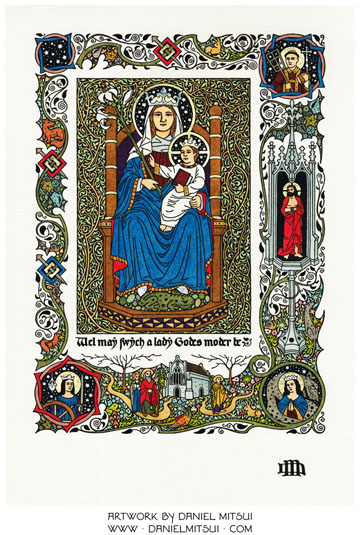
I’ll take this occasion to remind you of the image of Our Lady by the Catholic sacred artist Daniel Mitsui. The 7″ x 10″ print is ready for ordering HERE.

20140127-113221.jpg

Those saints in the corners are Catherine of Alexandria, Margaret of Antioch and Lawrence of Rome.

From his website:

The print was made on a Heidelberg Windmill press at Rohner Letterpress (Chicago, IL). The printing method involves pressing a piece of paper against a hard plate whose raised surfaces are inked; this is essentially the method invented by Gutenberg that remained dominant until the 20th century. Graphic Chemical & Ink (Villa Park, IL) supplied a traditional printing ink made from linseed oil & furnace black. The paper was handmade from cotton rag pulp at Twinrocker Handmade Papers (Brookston, IN). It is a laid paper, which means that it has a slight ribbed texture, from the wires in the papermaking mould. Laid paper was the only type of paper manufactured in Europe until the mid-18th century.

A few details.

20140127-113246.jpg

A squirrel!  I hate squirrels, but there it is.

20140127-113338.jpg

A nice reminder that her shrine is a pilgrimage place.

20140127-113410.jpg

The Middle English at the bottom is from a 15th c. poem in honor of Our Lady.  You have to go to his site to read that…. yes… just go there.

I have an earlier version of this, on vellum, but he has a reworked it.  The printing is crisp.  It jumps out at you.  Very nice.


Lot’s of stuff to consider… go have a look!

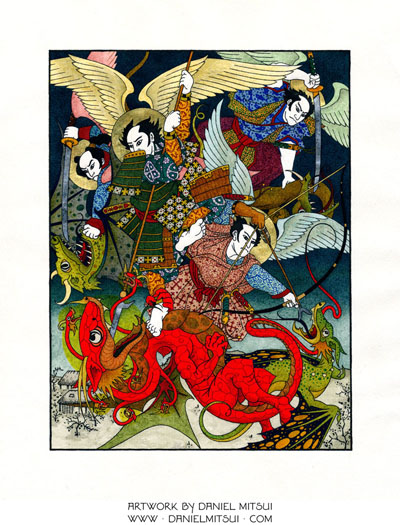
And, because the Feast of the Dedication of the Shrine of St. Michael (Feast of Michael, Gabriel and Raphael) is around the corner, 29 September, I’ll remind you of a great version of the Battle of Heaven with the Archangels as Japanese samurai opening a can of whoopass on Ol’ Scratch.  Very cool.

Daniel has some terrific pieces.  Check out his altar cards for the Usus Antiquior.  Check out his Sacred Heart. We had that framed for the new bishop here in Madison, who has a great devotion to the Sacred Heart.

Posted in Liturgy Science Theatre 3000 | Tagged ,
2 Comments

Card. Burke on the Synod’s Instrumentum Laboris, proselytizing, accusations

At La Nuova Bussola there is an interview with Card. Burke in English.  HERE

Highlights…

[…]

Proselytism means to impose your doctrine on others or to make becoming a member of the Church the condition for receiving material aid. This is certainly not correct. But we cannot neglect to announce Christ to those who do not know him and we cannot fail to demonstrate the beauty of the Church. This leaves the interlocutor perfectly free, but he receives the testimony.

[…]

If a missionary starts with the sole intention of appreciating whatever culture he finds, then we can be sure there will be no evangelisation, it’s more likely that these missionaries will end up losing their faith.

[… about the Instrumentum Laboris of the upcoming Synod on the Amazon…]

We must pray and fast for the Church because we are in a moment of profound crisis. We must do everything we can to defend the integrity of the Catholic faith. This document cannot be accepted. The truth of Christ is being challenged, when it is stated that these pagan cultures are in anyway sources of revelation that warrant respect in themselves even though they are outside the context of God’s plan which is only fulfilled by Christ’s Incarnation. According to the profoundly mistaken view of the Instrumentum Laboris, Christ and the cosmos are one and God also reveals himself in other circumstances. This view is closely connected to pantheism. Therefore it is a cult of the natural world. But the only cult for us is divine worship and it is through this worship offered to God, that God teaches us and we can understand what is the correct relationship with nature and with ourselves.

[…]

Those who are promoting a “new Church” do not want vocations, they discourage them in order to justify their own position which attacks celibacy. It is no coincidence that the religious institutes, perhaps with young congregations and many vocations, are the ones being particularly targeted at the moment.

[…]

The Synod is presented as being for the pastoral care of the people to be evangelised in the Amazon, but the German bishops state clearly that the goal is to revolutionise the whole Church, which is certainly not God’s plan but a kind of ideology.

[…]

He goes on to talk about accusations of being an “enemy” of Francis, plotting with “capitalists”, and L’Affaire McCarrick.

Take a moment to read it.


Posted in Synod, The Coming Storm, The Drill, The future and our choices | Tagged
5 Comments

AMAZING INTERVIEW with @Card_R_Sarah “I believe that we are at a turning point in the history of the Church.”

Cri de coeur is the Word of the Day, it seems.


At the National Catholic Register, there is an interview with Robert Card. Sarah, Prefect of the Congregation for Divine Worship.

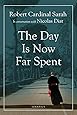
His newest book The Day Is Now Far Spent is available in English. HERE

In the interview the great Cardinal offered points that have been much on my mind of late.

Let’s see some quotes:

[…]

This book is the cry from my heart as a priest and a pastor.

I suffer so much from seeing the Church torn apart and in great confusion. I suffer so much from seeing the Gospel and Catholic doctrine disregarded, the Eucharist ignored or profaned. I suffer so much from seeing the priests abandoned, discouraged, and [witnessing those] whose faith has become tepid.

The decline of faith in the Real Presence of Jesus the Eucharist is at the heart of the current crisis of the Church and its decline, especially in the West.

[…]

The profound crisis that the Church is experiencing in the world and especially in the West is the fruit of the forgetting of God. If our first concern is not God, then everything else collapses. At the root of all crises, anthropological, political, social, cultural, geopolitical, there is the forgetting of the primacy of God.

[…]

In the conclusion of my book, I speak of this poison of which we are all victims: liquid atheism. It infiltrates everything, even our speeches as clergymen. It consists in admitting, alongside faith, radically pagan and worldly ways of thinking or living. And we satisfy ourselves with this unnatural cohabitation! This shows that our faith has become liquid and inconsistent! The first reform to be made is in our hearts. It consists in no longer making a pact with lies. Faith is both the treasure we want to defend and the strength that allows us to defend it.

[…]

I believe that we are at a turning point in the history of the Church. Yes, the Church needs a profound and radical reform that must begin with a reform of the way of being and the way of life of priests. The Church is holy in herself. But we prevent this holiness from shining through our sins and worldly concerns.

[…]

[B]enedict XVI’s teaching is luminous. He dared to write just recently that the crisis of the liturgy is at the heart of the crisis of the Church. If in the liturgy we no longer put God at the center, then neither do we put him at the center of the Church. In celebrating the liturgy, the Church goes back to its source. All its raison d’être is to turn to God, to direct all eyes towards the cross. If it does not, it puts itself at the center; it becomes useless. I believe that the loss of orientation, of this gaze directed towards the cross, is symbolic of the root of the Church’s crisis. Yet the Council had taught that “the liturgy is mainly and above all the worship of the divine majesty.” We have made it a flatly human and self-centered celebration, a friendly assembly that is self-aggrandizing.

It is therefore not the Council that must be challenged, but the ideology that invaded the dioceses, parishes, pastors and seminaries in the years that followed.

We thought the sacred was an outdated value. Yet it is an absolute necessity in our journey towards God. I would like to quote Romano Guardini: “Trust in God; nearness to him and security in him remain thin and feeble when personal knowledge of God’s exclusive majesty and awful sanctity do not counterbalance them” (Meditations Before Mass, 1936).

In this sense, the trivialization of the altar, of the sacred space that surrounds it, have been spiritual disasters. If the altar is no longer the sacred threshold beyond which God resides, how would we find the joy of approaching it? A world that ignores the sacred is a uniform, flat and sad world. By ransacking our liturgy we have disenchanted the world and reduced souls to a dull sadness.

[…]

We had to get out of a certain rubricism. Unfortunately, it has been replaced by a bad creativity that transforms a divine work into a human reality. The contemporary technical mentality would like to reduce the liturgy to an effective work of pedagogy. To this end, we seek to make the ceremonies convivial, attractive and friendly. But the liturgy has no pedagogical value except to the extent that it is entirely ordained to the glorification of God and to the divine worship and sanctification of men.

Active participation implies in this perspective to find in us that sacred stupor, that joyful fear that silences us before the divine majesty. We must refuse the temptation to remain in the human to enter the divine.

In this sense, it is regrettable that the sanctuary of our churches are not a place reserved for divine worship, that we enter them in secular clothing, that the passage from human to divine is not signified by an architectural boundary.

[…]

Q: Why do you think more and more young people are attracted to traditional liturgy / the extraordinary form?

I do not think so. I see it; I am a witness to it. And young people have entrusted me with their absolute preference for the extraordinary form, more educative and more insistent on the primacy and centrality of God, silence and on the meaning of the sacred and divine transcendence. But, above all, how can we understand, how can we not be surprised and deeply shocked that what was the rule yesterday is prohibited today? Is it not true that prohibiting or suspecting the extraordinary form can only be inspired by the demon who desires our suffocation and spiritual death?

[…]

Wow.

He goes on to talk about Africa and the Amazon Synod.


Posted in The Coming Storm, The Drill, The future and our choices | Tagged
13 Comments