A well-funded lay watchdog group to investigate all the Cardinals. All of them.


UPDATE 2 Oct:

I received an email from the operations director of this new group.  His corrections to the CRUX piece are worth noting:

Dear Fr Z,

My name is Jacob Imam and I’m the operations director of Better Church Governance. I’m thankful for your attention to your cause. If you’d like a more accurate acccount, could I recommend Dan Hitchen’s article in the Catholic Herald?

http://catholicherald.co.uk/news/2018/10/01/ex-fbi-agents-to-help-investigate-cardinals-on-abuse-and-corruption/

The Crux article proved inaccurate in a number of fronts.

First, we are not at all well-endowed. We are in debt! We are Catholics in love with Jesus and His Church willing to risk a lot for the visible purity of the Church.

Second, we are not against homosexuals and will not note cardinals who are. Where the ellipsis is in the quotation is me clarifying that they have to be sexually activate (which, of course, goes for those heterosexually involved as well).

Third, our attempt is to be above reproach. That means that we do not favor or negatively target any one prince. We hope to find an immaculate record for every single cardinal!

Fourth, we do not intend to change a conclave. I stated that we will not publish the report if a conclave is already called so as not to risk that appearance. The goal of Better Church Governance is to help the hierarchy help itself. By dispassionately scrutinizing the records of spiritual leaders, we hope to vindicate those unjustly accused on one hand and, on the other, draw attention to those who have credible accusations made against them. It is then the job of the hierarchy to do what it wills with the information.

Fifth, I converted from Islam a decade ago(!)

There are a number of other critiques but I won’t take more of your time.

We are compelled by love and by hate: love of Christ and of His children; hate of sin and abuse.


Originally Published on: Oct 1, 2018

If bishops – God’s chosen successors of the Apostles – won’t clean up the Church, then someone else will. It’s necessary that this be so, if this is not the end of the world, because the Church is indefectible.

Of course the Lord didn’t promise that the Church would be a great shape when he returns.

So, a group of the faithful is taking matters into their own hands.

From Crux:

ROME – As U.S. bishops work to formulate an official response to clerical sexual abuse and cover-up, a new watchdog group backed by wealthy Catholics is seeking to take matters into their own hands.

A new organization, which held an RSVP-only event on Sunday evening, plans to spend more than $1 million in the next year investigating every member of the College of Cardinals “to name those credibly accused in scandal, abuse, or cover-ups.”

The Better Church Governance Group” held its launch on the campus of the Catholic University of America (CUA) with the stated intention of producing its “Red Hat Report” by April 2020.

[…]

In an audio recording obtained by Crux of the event’s launch, Better Church Governance’s Operations Director, Jacob Imam, said the organization was not meant as an attack on Pope Francis, though he asked the crowd of nearly forty attendees: “What if we would have had someone else in 2013 who would have been more proactive in protecting the innocent and the young?”

“Had we had the Red Hat Report, we may not have had Pope Francis,” stated one of the slide presentations accompanying his remarks.

Imam, who is currently a Marshall Scholar of the University of Oxford and converted to Catholicism from Islam three years ago, alleged that following the 2013 conclave that elected Francis, many major news outlets based their knowledge of the newly elected pope on what they could find on Wikipedia.

[…]

“Many of us who were raised in a liberal democratic society don’t always know how a hierarchy can be reformed,” Imam told attendees. “But there are many tips and tricks that history gives us, and we at Better Church Governance started to systematize some of these strategies. We are here to help create transparency in the Church and we’re here to help support integrity.”

[…]

Imam said that report revealed that local individuals were aware of ongoing abuse and cover-up, hence the Red Project Report will seek to, whenever possible, carry out its research where each cardinal is based.

He went on to describe the two-fold purpose of their report: to provide information to every cardinal in hopes of better informing them about their fellow papal-electors, as well as to make the information available publicly so that lay Catholics can have access to it.

“Cardinals need to be held accountable publicly, so there has to be some sort of culture of shame,” he said. “They know if they vote for this person…the people that they shepherd, and their pastors, will know about it.”

“This is difficult. There is a dark side to this decision. We recognize that,” he added. “We are willing to take this on with prayer and fasting…because we can’t allow people to continue to allow our kids, the innocent, the young, seminarians to be devoured the ways that they are.”

Imam also said that 10 former FBI agents are involved in the investigation, with two individuals being the agency’s former lead investigators on ecclesiastic matters.

[…]

There is a lot more.

You should read it for yourself.

These are complicated times.

Posted in Hard-Identity Catholicism, The Coming Storm, The future and our choices | Tagged
24 Comments

Fr. Z’s Voice Mail: Catholic psychiatrist with an offer for PRIESTS; an Austin conference on angels

I’ve been a little behind in checking voice mail, but today I pulled it up.

I very much appreciate your voicemail.  I always listen to it carefully.  If you have prayer requests I note them.

One voice mail I can pass along has some good news, about a “Fullness of Truth Conference” in Austin.  And a great topic, especially in The Present Crisis.

I am late in posting about this, and I hope to hear how it went.

Another voicemail was important.

A Catholic psychiatrist left a message to say that she would – free of charge – help any Catholic priest in need of consultation.  She left this message having read about the problems that some priests face when they are essentially forced into psychiatric treatment by bishops or superiors.  I don’t want to put her name and phone on the blog, for obvious reasons.  However, if a priest wanted to contact me, I would pass it along.

Think about it.  Priests can be forced into all sorts of “treatment” if they have an assessment that is somewhat tilted in one direction.   For example, a couple days ago I was contacted by a Catholic lawyer who does a lot of work with priests who are accused of a,b or c and they need help to defend themselves.  He told me that, because insurance companies pay for a priest’s time in one of these psychiatric places, like St. Luke’s, it is in their interest a) to find something wrong with the priest and b) extend his time in the clinic for a long time.  Hence, while the priest might be told at first that he would be there for 3 months, once they get him in there, it turns into 6… or more.   Having another opinion about your condition could change the way that you are dealt with.

Wanna leave me voice mail?  You have three options:

 WDTPRS

 020 8133 4535

 651-447-6265

Since I pay a fee for the two phone numbers, USA and UK, I am glad when they get some use.

TIPS for leaving voice mail.

  1. Don’t shout.  If you shout, your voice will be distorted and I won’t be able to understand you.
  2. Don’t whisper.  C’mon.  If you have to whisper, maybe you should be calling the police, instead.
  3. Come to your point right away.  That helps.
  4. I don’t call you back.  I do listen to every message.
  5. Say from the onset if I can use your message in a post.

Send snail mail to:
Fr. John Zuhlsdorf
733 Struck St.
PO BOX 44603
Madison, WI 53744-4603

Posted in Voice Mail | Tagged , ,
1 Comment

Salesians promote morally offensive homosexual pederasty movie

Until the real problem at the core of The Present Crisis is acknowledged, it will not be dealt with properly.

I read at La Nuova Bussola, in Italian, a horrifying bit of news.

In the Italian town of Rivoli, near Turin, there is a movie theater owned by the religious order The Salesians. founded by St. John Bosco.  They are to show at that movie theater a highly morally offensive movie, “Chiamami col tuo nome… Call Me By Your Name”.  It is, basically, about pederasty and involves a “sex story between a 24-year-old and a 15-year-old, with a lot of masturbation and other obscenities”.

In a movie theater owned by the Salesians.

What would St. John Bosco say about this situation?  The mind reels.

I wonder what Salesian Card. Rodriguez Maradiaga thinks about this movie.

CNS has a review of the movie, but the page would not open for me at the time of this writing.  Bottom line: morally offensive. HERE

According to an Italian Catholic cinema organization, the film is “poetic”.  HERE

Italian bishops, you ask?  HA!

Posted in Sin That Cries To Heaven | Tagged ,
14 Comments

Splendid Gregorian chant of Litany of Loreto

In my surfing about this morning, I found a stupendous recording of the Gregorian chant  version of the Litany of Loreto sung by all women.

The chant is easy.  This could be done in parishes.

First, I think that Gregorian chant sung well by women is ethereal.  For some years Rome I directed a schola of all women.  They sang like angels and we became pretty well known.   I have a great affinity of this sound.

This recording of the Litania Lauretana is just about perfect.  They could soften the ends of phrases a touch.  Note the confident pace of the litany.   There is a rhythm to litanies. So often Litanies are slowed to the point of near brain death.  One forgets what one is praying for in the first place.

The Choeur Grégorien de Paris is about as good as it gets when it comes to Gregorian chant recordings. I am delighted that there is now a female team as well.

Posted in "How To..." - Practical Notes, Liturgy Science Theatre 3000, Our Solitary Boast, The future and our choices | Tagged , ,
10 Comments

October, The Rosary, St. Joseph and YOU – ACTION ITEM!

Tomorrow, 1 October, begins a month which traditionally calls for daily recitation of the Most Holy Rosary.

Dear readers… please consider, if you don’t already, daily recitation of the Rosary during October.  How wonderful it would be if you took this up in your family homes, your little domestic churches.  The home, as a church, should be filled with prayer.

Has there ever been a time when this mighty prayer of intercession and consolation was needed more?

In many places it is customary to recite the Litany of Loreto as a kind of conclusion to the Rosary.

Back in 1889 Pope Leo XIII asked that a prayer to St. Joseph be added after the Rosary during the month of October.  He did this in his encyclical Quam pluries.    Recitation of the prayer “Ad te, beate Ioseph” can now obtain, under the usual conditions, a partial indulgence.

LATIN ENGLISH
Ad te beate Ioseph, in tribulatione nostra confugimus, atque, implorato Sponsae tuae sanctissimae auxilio, patrocinium quoque tuum fidenter exposcimus. Per eam, quaesumus quae te cum immaculata Virgine Dei Genetrice coniunxit, caritatem, perque paternum, quo Puerum Iesum amplexus es, amorem, supplices deprecamur, ut ad hereditatem, quam Iesus Christus acquisivit Sanguine suo, benignus respicias, ac necessitatibus nostris tua virtute et ope succurras.   To thee, O blessed Joseph, do we come in our tribulation, and having implored the help of thy most holy Spouse, we confidently invoke thy patronage also. Through that charity which bound thee to the immaculate Virgin Mother of God and through the paternal love with which thou embraced the Child Jesus, we humbly beg thee to graciously regard the inheritance which Jesus Christ has purchased by his Blood, and with thy power and strength to aid us in our necessities.
Tuere, o Custos providentissime divinae Familiae, Iesu Christi subolem electam; prohibe a nobis, amantissime Pater, omnem errorum ac corruptelarum luem; propitius nobis, sospitator noster fortissime, in hoc cum potestate tenebrarum certamine e caelo adesto; et sicut olim Puerum Iesum e summo eripuisti vitae discrimine, ita nunc Ecclesiam sanctam Dei ab hostilibus insidiis atque ab omni adversitate defende: nosque singulos perpetuo tege patrocinio, ut ad tui exemplar et ope tua suffulti, sancte vivere, pie emori, sempiternamque in caelis beatitudinem assequi possimus. Amen. O most watchful Guardian of the Holy Family, defend the chosen children of Jesus Christ; O most loving father, ward off from us every contagion of error and corrupting influence; O our most mighty protector, be propitious to us and from heaven assist us in our struggle with the power of darkness; and, as once thou rescued the Child Jesus from deadly peril, so now protect God’s Holy Church from the snares of the enemy and from all adversity; shield, too, each one of us by thy constant protection, so that, supported by thy example and thy aid, we may be able to live piously, to die holy, and to obtain eternal happiness in heaven. Amen.

Need a beautiful rosary?

>>HERE<<

UPDATE 1 October:

Francis has asked people to pray the Rosary daily during October and also to pray the ancient Sub tuum praesidium and the Prayer to St Michael the Archangel.   The press release is HERE.

Posted in "How To..." - Practical Notes, ACTION ITEM!, Our Solitary Boast, PRAYER REQUEST, Si vis pacem para bellum! | Tagged , , ,
22 Comments

WDTPRS – 26th Ordinary Sunday: “man cannot live without love”

Our Collect for the 26th Ordinary Sunday, slightly different from its ancestor in the ancient Gelasian Sacramentary, is also in the 1962 Missale Romanum for the 10th Sunday after Pentecost.

Deus, qui omnipotentiam tuam parcendo maxime et miserando manifestas, gratiam tuam super nos indesinenter infunde, ut, ad tua promissa currentes, caelestium bonorum facias esse consortes.

A consors is someone with whom you share a common destiny (cum, “with” + sors “lot, fate, destiny”).  Parco means, “to spare, have mercy, forbear to injure; forgive.”  We see this verb often in our prayers.  Think of the responses during the litanies: “Parce nobis, Domine… Spare us, O Lord!”

LITERAL VERSION:

O God, who manifest Your omnipotence especially by sparing and by being merciful, pour Your grace upon us unceasingly, so that You may make us, rushing to the things You have promised, to be coheirs of heavenly benefits.

OBSOLETE ICEL (1973):

Father, you show your almighty power, in your mercy and forgiveness. Continue to fill us with your gifts of love. Help us to hurry toward the eternal life you promise and come to share in the joys of your kingdom.

CURRENT ICEL (2011):

O God, who manifest your almighty power above all by pardoning and showing mercy, bestow, we pray, your grace abundantly upon us and make those hastening to attain your promises heirs to the treasures of heaven.

We can slip into the trap of associating justice only with the exercise of power.

Today we affirm the other side of power’s coin: mercy.

Nevertheless, the affirmation of God’s mercy does not diminish God’s justice.

One of the ways God reveals Himself as “almighty” is by being forgiving and sparing.

God knows all things which ever were, are or will be, as well as how each human action impacts every other throughout history.

For God, balancing mercy and justice is no problem at all.

For us, however, this balancing act is exceedingly difficult.  Our will and our limited intellect are wounded.  We struggle with passions. It is hard to see what is good and right and true and then rein in our emotions. We oscillate between being just and then being merciful. Bringing the two streams of mercy and justice together in just the right way is a tremendous challenge.  When we encounter a person who does this well, we are deeply impressed by him and hold him up as an example of wisdom because he seems to act more clearly as an image of God.  His example moves us because we know that we too must conform to God’s image.

One way in which we act the most according to God’s image, behaving as Christ’s good consortes, is precisely when we act with compassion.

In biblical language, such as the Hebrew racham, compassion is often interchangeable with mercy.  The Latin word compassio comes from Latin cum+patior, “to suffer/endure with” someone.  We are moved when we witness suffering and attendant compassion because they reveal in a mysterious way who we are as human beings and how we ought to act.

In a famous passage from the Council’s Gaudium et spes, we are taught that Christ came into the world to reveal man more fully to himself (GS 22).  Christ did this in His every word and deed during His earthly life.  His supreme moment of revelation to us about who we are was His Passion and death on the Cross and subsequent rising from the tomb.  When we imitate His Passion, in sacrificial love and in the genuine “with suffering” which is compassion, we act as we were made by God to act.   In sincere and concrete acts of compassion we, in our own turn, reveal man more fully to himself!  We in turn show God’s image to our neighbor.  Only the stony, cold and dead are not to be moved by examples of genuine compassion rooted in the sacrificial love which is charity.

Pope John Paul II wrote in his first encyclical, Redemptor hominis 9, that “man cannot live without love”.  By this he meant both the love we give and the love we receive.

Unmerited acts of charity, mercy, and compassion make visible to our neighbor the God after whose likeness we ourselves are fashioned.

In sincere and concrete acts of compassion, in our biblical “bowels of mercy” (Colossians 3:12), we in our turn reveal man more fully to himself.

Individuals can by their example effect great changes in a society.

If one person can do much, how much more could be done by armies of men and women thirsting for holiness and righteousness (i.e., a Church), striving to act in compassion, justice and mercy?

By His justice, God will give us what we deserve.

By His mercy, He will not give us certain elements of what we deserve.

By His pouring forth graces upon us, God gives us what we do not deserve.

God’s justice must be received with joyful trepidation, whether we want it or not.

God’s mercy we must beg for with humble confidence.

God’s grace, unmerited by us, we embrace with exultant gratitude.

Posted in Liturgy Science Theatre 3000, WDTPRS |
3 Comments

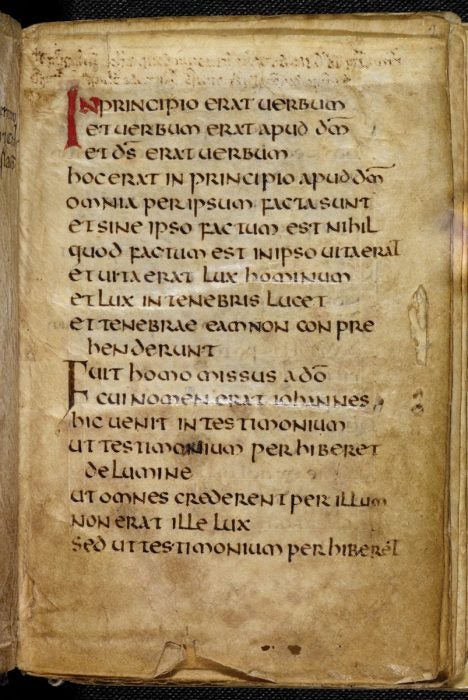
Europe’s Oldest Intact Book Was Found in a St. Cuthbert’s Coffin

Here is a super cool story from JSTOR (which I’m sure you all follow):

Why Europe’s Oldest Intact Book Was Found in a Saint’s Coffin
The St. Cuthbert Gospel is the earliest surviving intact European book. Some time around 698, it was slipped into the coffin of a saint.

Saint Cuthbert’s fame grew following his death in 687. The hermit monk’s body, so the story goes, was found to be incorrupt over a decade after his passing in Northumbria (today’s border between England and Scotland). The miracle led to a cult around his remains. Offerings were placed at his tomb. Some time around 698, a small red book was slipped into his coffin.

This manuscript — known as the St. Cuthbert Gospel, or Stonyhurst Gospel (for Stonyhurst College where it was once held) — is the earliest surviving intact European book. It was removed from Cuthbert’s coffin in 1104, during a transfer of the saint’s remains to a new shrine in Durham Cathedral. “In an eyewitness account of the events surrounding the ceremony of Translation, which took place on Monday, August 29, 1104, [an] anonymous writer describes an investigatory opening of the coffin on the night of Thursday, August 25,” writes historian Calvin B. Kendall in The Journal of English and Germanic Philology. “After examining Cuthbert’s body for evidence of incorruption, the monks reclothed it with costly garments and restored it to the coffin, and ‘As soon as the body of the blessed Father was shut up in the coffin, they covered the coffin itself with linen cloth of a coarse texture, dipped in wax.’”


The book, however, was kept as a separate relic. Today the 1,300-year-old manuscript retains its original pages and binding. It was acquired by the British Library in 2012, and will be on view in the London institution’s Anglo-Saxon Kingdoms: Art, Word, War, opening October 19th.  [That settles it.  I have to go to London.  And there are two exhibits at the National Gallery that I want to see.]

“Its excellent state of preservation can be traced at the outset to the significance it held — a carefully prepared gospel text, which was transferred with the relics of St. Cuthbert to Durham in 1104,” writes scholar Robert D. Stevick in Artibus et Historiae. Because of this remarkable condition, it’s an important example of Insular art, which was created on the British Isles and Ireland between 600 and 900 CE. “There is interlace pattern in two panels on the front cover, step-pattern implying two crosses on the lower cover, a prominent double vine scroll at the center of the front cover—elements of this early art that have been well catalogued for their individual features as well as for their affinities to similar decorative elements in other artifacts,” notes Stevick.

Posted in Just Too Cool, Saints: Stories & Symbols | Tagged ,
10 Comments

Court case, Seal of Confession, and requiring priests to break the Seal

From Lexology:

A note about the Seal of Confession and requiring priests to break the Seal:

State Could Not Require Priest to Breach Confessional Without Satisfying RFRA

In Ronchi v. State, No. 5D18-194, 2018 WL 2988975 (Fla. 5th DCA June 15, 2018), the court of appeal held that a circuit court order granting a Catholic priest’s motion for protective order, in part, and denying the motion in part, after the priest was served with a witness subpoena requiring him to testify in a criminal case regarding certain communications that took place during confession contravened the Florida Religious Freedom Restoration Act (FRFRA). The trial court found that the communications between the priest and alleged victim of sexual abuse occurred within confession. It focused almost exclusively on the Florida Evidence Code in determining that the communications were privileged under section 90.505, the privilege could be asserted by both the priest and the victim, and the priest had partially waived the privilege during his conversation with the victim’s mother and her friend. As to whether the priest disclosed the abuse, the mother testified, “[N]ot directly, but it could be understood from the conversation.” The court of appeal ruled that FRFRA should control the case, rather than section 90.505, meaning that the state must establish that coercing the priest’s testimony furthers a compelling governmental interest and is the least restrictive means to further that interest. The court ruled that it is undisputed that the state has a compelling governmental interest in prosecuting sex offenses perpetrated against children, but disagreed that the state met the second test because: (1) the priest’s testimony would, at most, be corroborative evidence; (2) the case does not involve a child victim who, because of his or her age, might be unable to adequately testify about the alleged sexual abuse; and (3) the state could seek to have the alleged victim testify about her purported prior disclosure of sexual abuse to the priest. The court quashed the trial court order. Concurring, Judge Richard Orfinger argued that the trial court also misinterpreted section 90.505 because while the clergy can assert the privilege, only the penitent can waive it.

There are a few troubling elements in this, as well as positive.  Positive: the privilege of the Seal is upheld.

However, the priest put himself and the Seal in danger by intimating to others what could have involved the content of a confession.

Also, even if a penitent says it’s okay to talk, you should keep your mouths shut.

Fathers… keep your mouths shut.

Keep your mouths shut.

Keep your mouths shut.


Posted in GO TO CONFESSION, Liturgy Science Theatre 3000, Priests and Priesthood, The Coming Storm | Tagged
13 Comments

ASK FATHER: Sacraments and time travel

From a reader…

QUAERITUR:

I remember your posts about Space travel and Catholicism, but I’ve been wondering: what about time travel and our obligations? Specifically, what if someone were to be transported to a time before Christ and outside of Judaic influence? If the time-traveller were a priest, would he be able to administer the sacraments and say Mass? Would he have an obligation to preach the risen Christ, or act more like a prophet?

Finally, something important to write about!

Sure the priest time traveller has received the indelible mark of priesthood.  An ontological change has taken place.  He is a priest forever.  This forever suggests that, when he goes back in time, he is still just as much a priest of the new covenant as he was in his own time period.

Moreover, Christ the High Priest is the Alpha and Omega, He is eternal God.  For Him, yesterday, today and tomorrow are hardly to be distinguished as a Divine Person.   He was always High Priest and always will be.  He is High Priest even in the time to which Father travelled.

Preaching: I think that Father should be careful while in the past, that he not initiate one of those pesky chronoconundra that we find so tedious to clean up.   Sheesh!  Can’t people be more careful when they are in the past?!?   It’s just not fair to run about, la la la, creating temporal paradoxes.

And just who was Melchizedek anyway?

I’d better stop before I get worked up.


Posted in "How To..." - Practical Notes, ASK FATHER Question Box |
29 Comments

Watching the #KavanaughHearings

Yesterday I watched the Kavanaugh Senate hearing.  There were some important moments, including the fact that Kavanaugh arrived wearing his game face and Sen. Graham gave the Dems a piece of his mind.   Turning points, both.

Amusing moments: Sen. Whitehouse walking into the “year book” sawblade.  Sen. Blumenthal, having fibbed about Vietnam, having the temerity to invoke (poorly): “Falsus in uno, falsus in omnibus“.  Sen. DiFi’s bluster at the end about who leaked Ford’s letter.

What was particularly interesting was watching the testimony of Prof. Ford, as well as Kavanaugh’s, in the company of someone who would by all accounts considered an expert on sexual assault and related crimes and how they are investigated.

I am visiting my mother in Florida.  She was the 1st woman on the Minneapolis Police Department.  For 12 years of her time on the job, as a detective, she investigated “sex crimes”, which included rape and all the other disgusting things that happen.  She had some pointed insights during the proceedings, particularly about Prof. Ford’s time in the hearing and about how she was questioned.

In any event, a major step will be taken today.  We are moving to toward the end of this painful process.   I think Judge Kavanaugh will wind up as a SCOTUS Justice, but I will wait to believe it firmly when they have the group photo in the robes.  Even then, I suspect some ideological hacks will try to have him impeached.

I am genuinely worried about the state of political and cultural division in this country right now.   But, as Kavanaugh mentioned, we are reeping what has been sown over years and years.

Sadly, because of the long-term effects of dreadful declining quality and standards in education, the general public is more and more ignorant and distracted and incapable of grasping the basics of the issues today and the processes by which with work through them.   Hence, I am not strongly optimistic that we can turn this boat around any time soon.

Posted in The Coming Storm, The Drill, The future and our choices | Tagged
43 Comments