An idea for All Saints next year

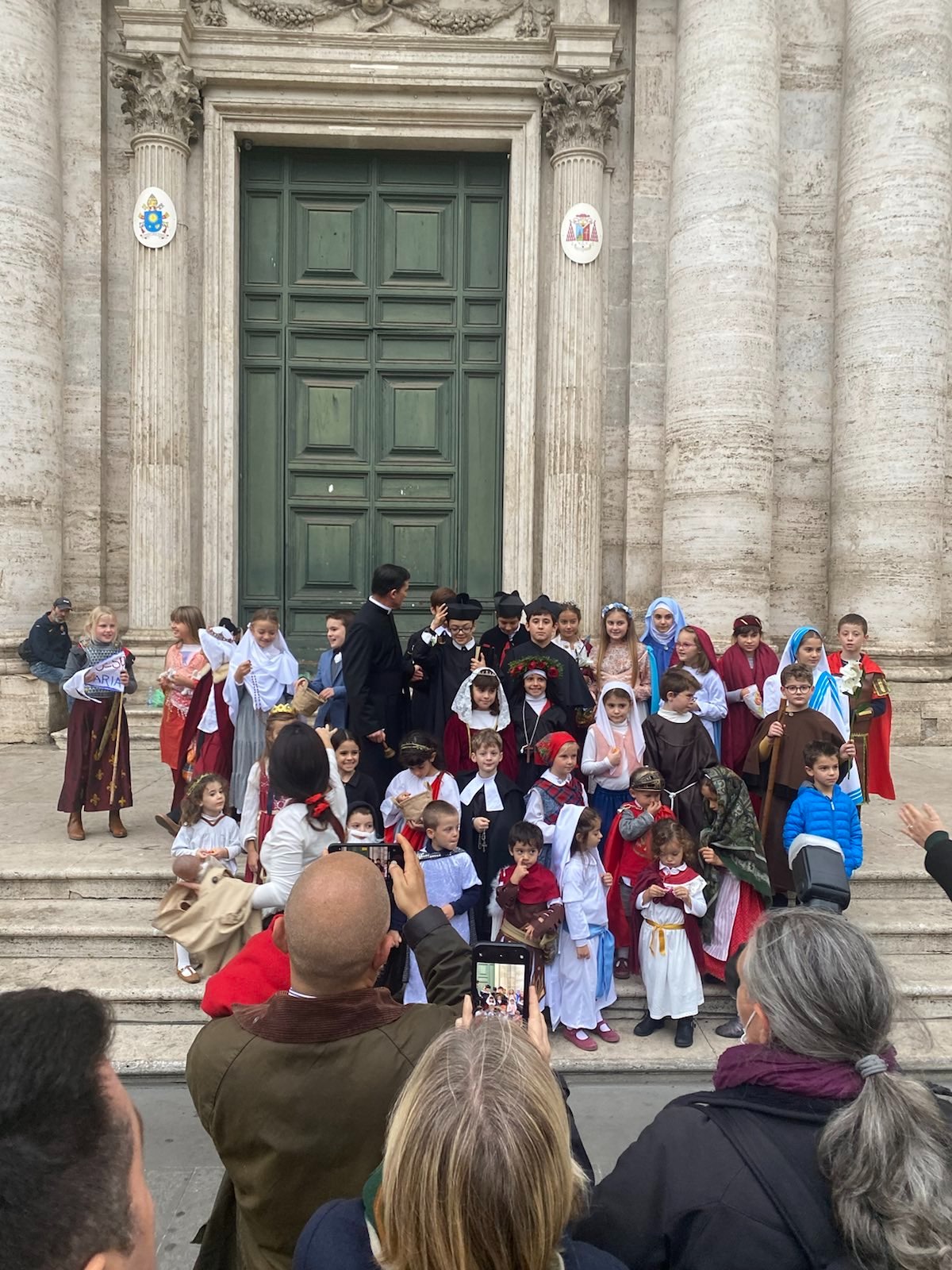
At the traditional parish in Rome, Santissima Trinità dei Pellegrini, there was a nice ceremony in honor of all the saints.

This could also be done on the Feast of Holy Relics, on 1o December in the 1962 calendar.  Before 1962, Holy Relics was on 30 October.

Relics are remains of saints after their death, flesh, bone, hair, ashes and, by association, clothing and possessions.   Christians have venerated the graves and relics of saints since the earliest years of the Church.

Consider how people carried the sick into the streets so that Peter’s shadow would fall on them and they would be healed.   How much more relics of saints.

Countless miracles have been worked by God through contact with the relics of saints.

Back to Santissima Trinità dei Pellegrini.  They brought out all the relics they have, brought them one by one to the parish priest who showed them to the people while their names were proclaimed to the people.  Then they were placed on the main altar.  However, they had so many that they had to use a side altar in the transcept.  Then they sang 2nd Vespers of all Saints.

Something like this could be done at a parish or chapel where there are some relics.  Or perhaps several parishes could combine forces so that there would be more relics on hand.

A lovely way to honor the saints, who do so much for us.

There is an interesting poem (19) by St. Paulinus of Nola, beautiful Latin, inspiring saint, about St. Felix and relics of saints, their translation, etc.  We read this fascinating passage (its all in Latin poetry.  Here’s a taste with English prose version:

Sed Deus ut cunctorum hominum sator, omnibus istam 307
De sanctis indulsit opem procedere terris:
Ut jam de tumulis agerent pia dona beati
Martyres, et vivos possent curare sepulti. 310
Nec satis hoc donum Domino fuit, ut sua tantum
Nomine, sive opibus loca martyres illustrarent:
Ex iisdem tumulis etiam monumenta piorum
Multiplicans multis tribuit miserator eosdem
Gentibus. Et referam varias ab origine causas, 315
Ex quibus haec orta est variis benedictio terris
Nam quia non totum pariter diffusa per orbem
Prima fides ierat, multis regionibus orbis
Martyres abfuerant, et ob hoc, puto, munere magno
Id placitum Christo nunc inspirante potentes, 320
Ut Constantino primum sub Caesare factum est,
Nunc famulis retegente suis, ut sede priori
Martyras accitos transferrent in nova terrae
Hospitia: ut sancto non olim antistite factum
Novimus Ambrosio, qui fultus munere tali, 325
Postquam ignoratos prius, et tunc indice Christo
Detectos sibimet mutata transtulit aula,
Reginam prompta confudit voce furentem. ….

The lifespan of one mortal man could not suffice to dissolve the pollution which had gathered over a long period; the few years in which Felix lived in the flesh as confessor and priest, his words as teacher, his record as martyr, his deserving deeds and duties as presiding priest were not enough. So the Almighty Lord caused Felix’s mortal span in the body to continue in a higher way, for he extended the healing activities of our busy martyr so that after burial he would exercise the powers which he had wielded whilst still in the flesh through the strength of Christ. In this way he could after death abide physically in the city he had espoused. Though only the spirit of the martyr laid to rest showed its healing presence (since the physical appearance of their dear patron lay concealed from the longing hearts of his beloved people, withdrawn temporarily from their eyes) is ready healing could always be at hand for the curing of the sick. So undying distinction and fame halo Felix, and his efficacious power flourishes without cease. True, he was buried in a mound long ago, and being mortal lies hidden in the covering earth; yet a living grace quickened by God outlives his limbs, and brings fame to the martyrs bones which exhale divinity. He is buried, but the power of his merit lives on among his folk, so that dense crowds from different regions constantly venerate the tiny tomb of the great confessor.

But since God is father of all men, he allowed this helped to pass from his Saints to all lands, so that the blessed martyrs could now provide kindly presents from their tombs, and the buried could attend the living. But the Lord did not content himself with allowing the martyrs to bring Radiance with their names or assistance only to their own regions. He multiplied the memorials of the saints from these tombs, and in his pity conferred the same martyrs on many regions. I shall state from the beginning the various occasions from which this blessing has originated in various countries.

Since the faith had initially not been spread through the whole world alike, many areas of the earth were without martyrs. This I think is why Christ has both inspired princes (in the first place when Constantine was Caesar) and acquainted his servants with his most generous decision to summon martyrs from their earlier homes and translate them to fresh lodgings on earth. So, for example, we know of the recent action of the holy Bishop Ambrose; relying on this gift, he translated and set in a different church saints who were earlier unknown but whom he later identified on the information of Christ, and thus he has confounded the raging queen with the light he has uncovered.

When Constantine was founding the city named after himself, and was the first of the Roman kings to proclaim himself a Christian, the godsent idea came to him that since he was then embarking on that splendid enterprise of building a city which would rival Rome, he should likewise emulate Romulus’ city with a further endowment – he would eagerly defend his walls with the bodies of apostles. He then removed Andrew from the Greeks and Timothy from Asia; and so Constantinople now stands with twin towers, vying to match the hegemony of great role, and more genuinely rivaling the walls of Rome through the evidence that God bestowed on her, for he counterbalanced Peter and Paul with a protection as great, since Constantinople gained the disciple of Paul and the brother of Peter.

In widely separated regions along that road greatly increased help was afforded by these Saints to the tasks of human living, and those regions demonstrate this even today. Where ever the carriage, equal to its holy burden, halted at an established post station, wherever the holy bodies lodged and the bearers of their consecrated ashes rested, the evidences of miracles cry out in each and every place. God’s hand is at work with healing strength along all the roads where the holy bodies imprinted their living traces on that sacred journey.

This, then, was the means by which the faithful and zealous escorts of the relics were afforded a chance at promoting of faith to break off some keepsakes from the holy bones as their deserved reward, so that they could individually bear back home for their personal protection the reward for their service and the payment for their toil. As a result, the sacred ashes have been scattered over different areas like life-giving seeds. Wherever a drop of view has fallen on men in the shape of a particle of bone the tiny gift from a consecrated body holy grace has brought forth fountains in that place, and the drops of ashes have begotten rivers of life.

From this source Christ’s abundance, so rich in its tiniest forms, has fallen on us also; for we, too, have received, in the form of a fragment of dust, the sacred tokens of the apostles’ flesh. St. Felix, Lord and father of our lodging, guardian of our soul, protector of our salvation, has accepted these in the neighboring shrine close by.

I warmly recommend an apostolate run by a friend of mine, Fr. Carlos Martins, called Treasures of the Church.

BTW… in that same poem of Paulinus, he describes the reaction of demons who possessed people to the presence of holy relics.  There had been pagan worship and people were affected.  REMEMBER: Every pagan god and idol is a demon (e.g., Pachamama = demon).  The relics of St. Felix put demons into agony, and the ergumens manifested the same symptoms that exocists see today.  More from Paulinus:

The demons who were worshiped as deities in all the shrines are disarmed and tormented throughout God’s temples, and those who presumed to accept honors appropriate to the gods are now beaten and subjected to the laws of men. These demons whom we observe in the crowded church of Felix being tormented, crying out, and being pulled along in the bodies they have captured, are kept in prison in those very bodies into which they trusted themselves; thus their own decision devised for them human torments. So now they play the part of the guilty, and hollow at their punishment, whereas before they had been gods of spurious divinity. Before God was worshiped, they had with their counterfeit godhead devoted to their own the service living men who saw no sign from heaven; but now that true faith has been exposed by Christ’s light, they cannot withstand even men enclosed in the tomb.

The nature of the demons voices makes it more manifest that they who are tortured before the thresholds of tombs of the saints are the same as those to whom the enslaved human race once sacrificed and insanely offered sacred reference; for they quite often groan with the same voices, so that one can recognize from the shouting their habitual madness. Usually their mouths appear to hang open quite loosely, they gnash their teeth, foam at the lips, cause their hair to stand on end. Their hands pull at their hair and shake it heavenward; they stand on tiptoe, feet and hair erect. From time to time they remember those ancient rights in which they used to lick the entrails of slain cows, to feed on the sacrificial offering, to lead wanton bands in ivy-clad processions. Even now they attest that theirs was the ritual at which the drunken mob uttered the crazed shout “Euhoe”; they gaspingly ape this cry of Bacchus with effeminate voices and swivel there necks with slow circular movements.

As I read this, I recalled a post of some years ago.  Jesuits like homosexualist activist James Martin were promoting Jesuit yoga – no, really.  Fr. Gabriel Amorth, long-time late exorcist of Rome, said that yoga opens people up to demons.  The CDF commented on yoga.  And yet the homosexualist activist promoted their “Ignatian Yoga Retreat”… Jesuit Yoga, I guess, with its appropriately and “downward facing dog”.

Brrrr.   My exoricst friends tell me about how demons react to relics, and certain demons to relics of particular saints.
 

Posted in Just Too Cool, Our Catholic Identity, Patristiblogging, Saints: Stories & Symbols | Tagged ,
4 Comments

All Souls Masses – Rubrics change when a priest says three Masses without interruption

I am getting ready to say my three Masses today. A note from a priest reader prompts to post.

On two days of the year, from the calendar and law itself a priest has the privilege of saying three Masses: Christmas and All Souls.  On Christmas, he can keep three stipends for the Masses.  That’s the only day of the year when he can do that.  On All Souls he can keep one stipend and if he celebrates the other Masses they must be for the Poor Souls in Purgatory and, traditionally, for the Intentions designated by the Roman Pontiff.  More on that Intentions thing, which also impacts on the gaining of indulgences, such as those for the dead this November HERE.

When the priest says his Masses back to back, the rubrics change a little in the Traditional Mass – which every priest really ought to know.

Pace Francis and the anti-Tradition machine, if a doesn’t know how to say the Traditional Latin Mass, then, if he is a Latin Rite priest, he doesn’t know his own rite.  He is incomplete and ignorant in a culpable way.

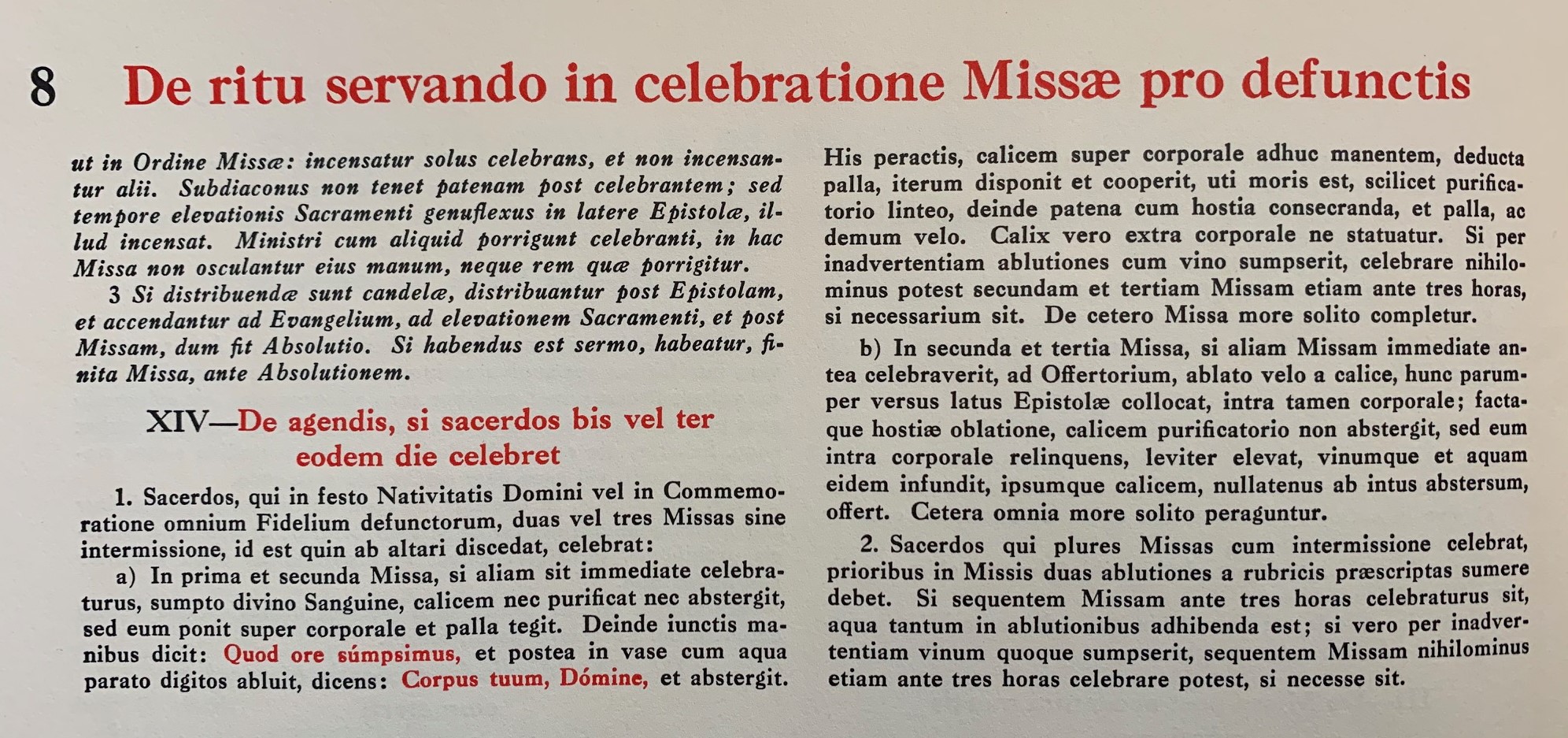
Here are some rubrical changes for saying three Requiem Masses back to back.  Click for larger.

After Communion of the 1st and 2nd Masses, the priest does NOT purify the chalice as usual, but rather places it on the corporal and covers it with the pall.  He says the Quod ore sumpsimus and then purifies his fingers, saying the Corpus tuum while drying them.  He removes the pall from the chalice, replaces the purificator and paten with a new host to be consecrated, covers with the pall and veil and places as for Mass.  He must not remove the chalice from the corporal.

If he slips and purifies the chalice as habitual, he can still celebrate the other Masses.

At the second and third Masses, if celebrated right away, after removing the veil he sets the chalice still on the corporal toward the Epistle side.  It helps to have a larger corporal today (as I do).  He does not wipe the inside of the chalice with the purificator before putting in wine and water and he does not use the purificator on the inside of the cup.

If his Masses are not in a row, he purifies as usual, but should use only water in purifying the chalice (so he doesn’t break his Eucharistic fast).  But if he slips and uses both wine and water, he can still celebrate Mass even within the three hours (that was prescribed at the time of the 1962 Missal).


Posted in "How To..." - Practical Notes, ASK FATHER Question Box, Liturgy Science Theatre 3000, Mail from priests, Save The Liturgy - Save The World | Tagged , ,
5 Comments

On chess and gratitude and a dig at the loony Left

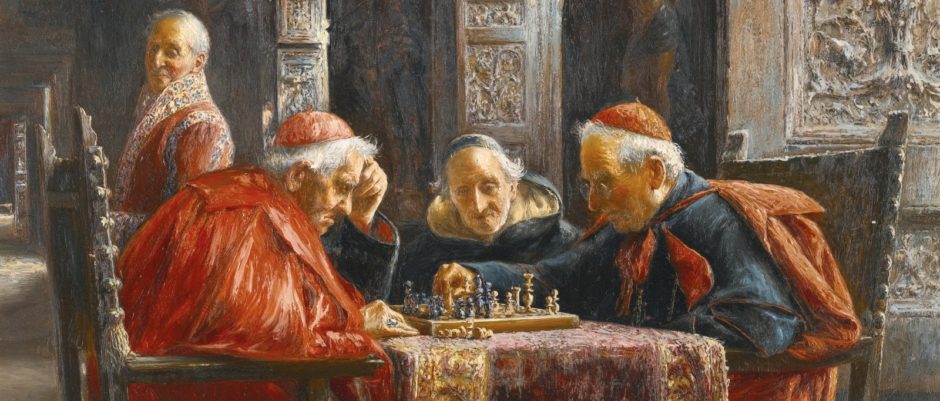
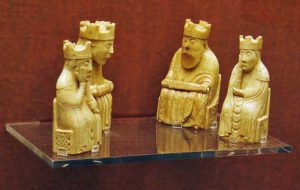
First and foremost, thank you to the reader who sent from my wishlist (‘happy birthday to me’) the wonderful “Lewis” chessmen, found on Lewis Island in the Outer Hebrides of Scotland, not at Lewes in Sussex where friends of mine labor in the Lord’s vineyard and whence came Thomas Paine, a man for our own time now.  Some years back I saw the 12th c. Lewis chessmen in the British Museum, which has most of them, and found them striking.   In general I prefer to play with Staunton pieces, or very similar.  These special chessmen, however, are wonderful.   They were discovered in 1831.

After that, their history would be the stuff of a great thriller, if someone creative could work it out.

A while back I posted an invitation to Catholic clerics who might play chess to drop me a line.  I had a few nibbles.  I’m patient.

I also want to send thanks out to people whom I don’t know, but who sent practical things in large and heavy boxes.  You know who you are, if I don’t, and God knows you as well.  May God reward you.

Thank you to all who have sent monthly donations and ad hoc contributions.  Thank you to you special “200” project givers.  Some have dropped by the way side, perhap others will take up the baton and keep it going.

Thank you for your prayers and notes.

I have been regularly saying Mass for the intention of my benefactors, as I did today.  Today, ALL benefactors seemed appropriate for “All Saints”.

Meanwhile, in other chess news, one of you sent this amusing bit from The People’s Cube which I haven’t seen for some time.

Buy Now: Anti-racist Chess!

In traditional chess, white gets to go first. A shocking and racist beginning to anything, but pretty much what you’d expect from a game invented by white people.*

Anti-racist Chess is an updated, more equitable version of this ancient but problematic pastime.

How to Play

The rules are similar to traditional chess with these modifications to make it more fair for the Pieces of Color (PoC):

    1. Before playing, the skin color of both players is determined. The players are to be assigned their pieces based on skin color if at all possible: black players get the black pieces, racist white people get the racist white pieces, etc. If both players are the same skin color, the player with the fewest grievances must play as white.
    2. Before the game starts, the black player gets to draw two ‘race cards’ from the Diverstity, Equity, and Inclusion (DEI) deck.
    3. Black gets to move first.
    4. All the black pieces can move anywhere on the board during their turn. Only one piece can be moved per turn.
    5. The white pieces can only move forward one square. Only one piece can be moved per turn.
    6. Players are permitted to play a race card at any time, which allows them to remove any one of their opponent’s pieces from the board. After the race card has been played, another can be drawn from the deck.
    7. Just like traditional chess, the first player to place the other player’s king in checkmate wins. Stalemates are also possible, in which case the black player automatically wins to make up for past injustices.

History of the game

Critical Race Theory (CRT) Professor Kincade X. Charletien noticed a disturbing trend in the game of chess in 2016. He analyzed 632 chess matches going back to 1948 and discovered this shocking fact: white wins 54.6% of the time. While most people would make this obvious example of systemic racism known by the usual methods – publication of a book, writing an expose for the New York Times, or burning down a city – Dr. Charletien decided to go a different route. Like the inventor of Monopoly, he would seek to educate the toiling masses by harnessing mankind’s natural attraction to games and puzzles.

He invented Anti-Racist Chess in 2019 and it became an instant classic, replacing ‘racist chess’ nearly everywhere in the US and selling over 87 million copies in the first year.

Makes an excellent Kwanzaa gift!
_______________
* Some people still believe chess was invented in India 1,300 years ago, but that has been shown to be an elaborate hoax: Chess was actually invented by white slave traders in 1619.

Speaking of racism and prejudice, I suppose my friends in Lewes are preparing for the annual Catholic bashing coming up on 5 November.

Posted in Chess, SESSIUNCULA, The Last Acceptable Prejudice | Tagged
6 Comments

ASK FATHER: 1 Nov this year is on a Monday, so Mass is not obligatory. But do we still have to refrain from work? – UPDATE and CORRECTED

UPDATE: 2 Nov 2021

The official decree, not as it’s posted on the USCCB website, but in the book, has clearer wording.

When 1 January, 15 August, or 1 November fall on a Saturday or Monday,

“they will not be observed as holy days of obligation,”

The simple reading of this is that there is no obligation to refrain from “work or business that would inhibit the worship to be given to God, the joy proper to the Lord’s Day, or the due relaxation of mind and body.”

Also, pastors would not be obliged to offer a Missa pro populo on those days.

Sorry about the confusion.  I got it wrong, at first.


Originally Published on: Nov 1, 2021 
From a reader…

QUAERITUR:

Regarding this coming Monday, and the U.S. Bishops’ decision that “Whenever January 1, the solemnity of Mary, Mother of God, or August 15, the solemnity of the Assumption, or November 1, the solemnity of All Saints, falls on a Saturday or on a Monday, the precept to attend Mass is abrogated.”

Does this merely mean that one does not have the obligation to attend Holy Mass this coming Monday 01 NOV, or does the ‘abrogation of the precept to attend Mass’ also mean one does not have to rest from servile labor on that day?  I ask, as I am scheduled to work that day, and normally take such days off.

From the wording of the decree as it is posted on the USCCB website, the only abrogation is of the precept to attend Mass.  The obligation to abstain from servile labor is still in force.  [NB: The UPDATE above]

“Yeah, right!”, you will have already said.  “All anyone hears is that ‘since it’s on a Monday, it isn’t a holy day of obligation…’ or “If even bishops don’t think it’s serious to miss Mass anymore, why bother on Sundays?”

To which I might respond, were someone to say that, “You mean the bishops that locked up our churches?”

Don’t worry everyone, it’s a New Springtime! New Evangelization is blossoming! Everything in every way is getting better and better every day!  Traditionis custodes! Young families are being denigrated with accusations of divisivness!  We are building back better!

To the point:

All Saints’ Day is still a Holy Day, though attending Mass is not obligatory this year.  It is a Holy Day, but this year not of obligation for hearing Mass.

Holy Days are like Sundays, the Lord’s Day.

If people must work on a Sunday or on a Holy Day, then they should “devote themselves to prayers for a suitable time alone, as a family, or, as the occasion permits, in groups of families.”

Can. 1247 On Sundays and other holy days of obligation, the faithful are obliged to participate in the Mass. Moreover, they are to abstain from those works and affairs which hinder the worship to be rendered to God, the joy proper to the Lord’s day, or the suitable relaxation of mind and body.

And…

Can. 1248 §1. A person who assists at a Mass celebrated anywhere in a Catholic rite either on the feast day itself or in the evening of the preceding day satisfies the obligation of participating in the Mass. §2. If participation in the Eucharistic celebration becomes impossible because of the absence of a sacred minister or for another grave cause, it is strongly recommended that the faithful take part in a liturgy of the word if such a liturgy is celebrated in a parish church or other sacred place according to the prescripts of the diocesan bishop or that they devote themselves to prayer for a suitable time alone, as a family, or, as the occasion permits, in groups of families.

Posted in "How To..." - Practical Notes, ASK FATHER Question Box, Canon Law, Our Catholic Identity | Tagged , ,
7 Comments

Daily Rome Shot 320

Photo by The Great Roman™

Posted in SESSIUNCULA | Tagged
1 Comment

ASK FATHER: Does an Apostolic Administrator of a diocese have the authority to force priests to receive the “jab”?

From a reader…

QUAERITUR:

Fr Z, does the Apostolic Administrator of a diocese have authority to require all priests in the diocese (including religious priests) to receive the covid jab, as well as to require the priests to tell him whether or not they have done so? Such request has recently been received by the priests. Thank you.

The bishop doesn’t have that authority, so the Apostolic Administrator definitely doesn’t have it.

Anyone who attempts to impose this is a tyrant.


Posted in "How To..." - Practical Notes, ASK FATHER Question Box | Tagged
10 Comments

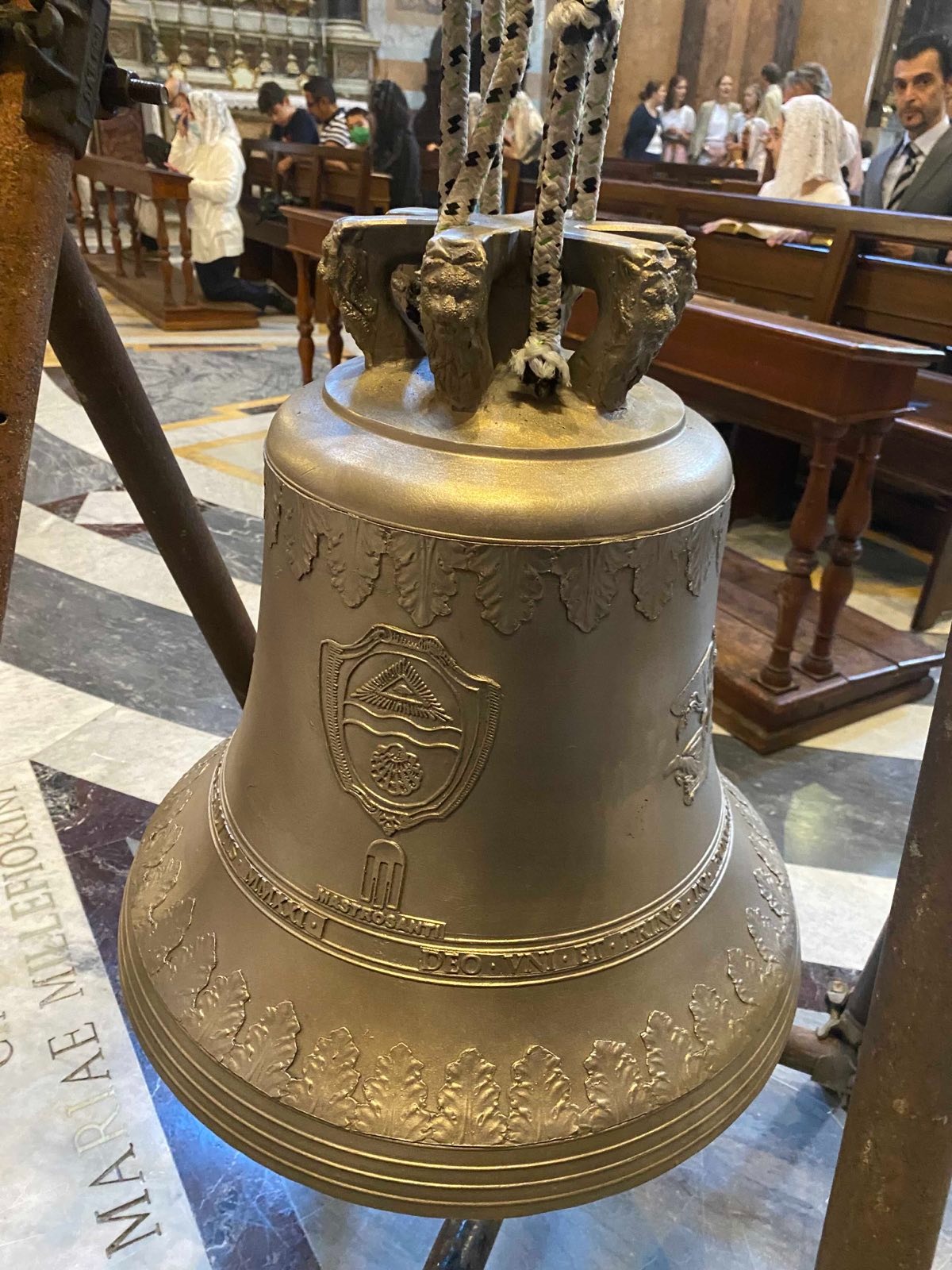
Just Too Cool: Traditional consecration or “baptism” of a new bell

At Messa in Latino we see images of the Vetus Ordo consecration of a new bell at Rome’s traditional parish Ss. Trinità dei Pelegrini.   Very cool.

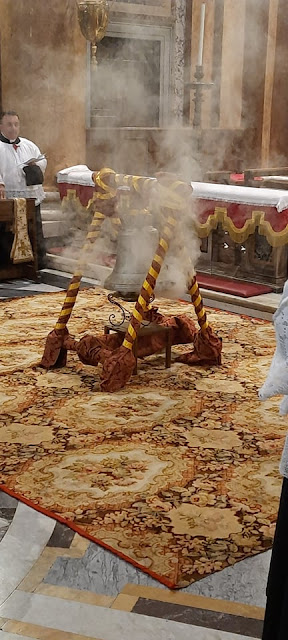
The consecration of a bell in the old rite, often called a “Baptism” is magnificent, long and complex.  As in the rites of baptism, the bells is washed with holy water, anointed with (oddly) the Oil of the Sick and Sacred Chrism, filled with smoke from burning thyme (or really thymiama, the recipe for which – equal parts of galbanum, stacte, frankincense and onycha) is, given by God to Moses, is a little hard to make now… but that’s another story), frankincense and myrrh, and then solemnly given a name.

Bells move and speak to us.

They call us to joy, prayer and action.

They mark the passing of time.

They warn us when there is danger.

They cry to the heavens when we suffer.

They mourn when we mourn.

Their silence can be deafening.

The rite of the consecration or “baptism” of a bell speaks to their use.  They are intended to thwart the snares of enemies, increase our devotion, avert hail and storm and mitigate the wind, and “lay low the powers of the air”.

“Lay low the powers of the air lay low the powers of the air, so that hearing this bell they may tremble and flee before the standard of the holy cross of Thy Son depicted upon it.”

Let all our churches ring their bells proudly and without fear of intimidating complaints… the tell-tale sign of a guilty conscience.

The new bell, close up, named “Lúcia… Lucy”.

One of several photos at Messa in Latino:


Posted in SESSIUNCULA | Tagged
12 Comments

Daily Rome Shot 319

Video by The Great Roman™

The children of the Traditional Parish in Rome had their “All Saints” recital today, each one dressed as a saint and explaining to all who they were.  Then there was a procession with them through the streets of Rome to P.za Navona where they entered the church of St. Agnes “in agone” and sang an Ave Maria in Latin.  These are just the children singing.


Posted in SESSIUNCULA | Tagged
1 Comment

Your Sunday Sermon Notes: Christ the King (31st Ordinary – N.O.)

Too many people today are without good, strong preaching, to the detriment of all. Share the good stuff.

Was there a GOOD point made in the sermon you heard at the Mass for your Sunday obligation (or, maybe still none), either live or on the internet? Let us know what it was.

What was attendance like?

Tell about attendance especially for the Traditional Latin Mass.  I was getting reports that it is way up.

Any local changes or news?

For those of you who regularly viewed my live-streamed daily Masses – with their fervorini – for over a year, you might drop me a line.  There are developments.

I have some remarks about the TLM – HERE

Posted in Liturgy Science Theatre 3000, Save The Liturgy - Save The World | Tagged
6 Comments

Concerning Traditionis custodes – VIDEO

Posted in Lighter fare, Traditionis custodes | Tagged
3 Comments