POLLS: 2018 Holy Thursday Foot Washing – What happened where you are?

A couple years ago what was clearly a severe abuse was given official recognition so that women’s feet could be washed during the entirely optional “Mandatum” in the Mass of the Lord’s Supper, Holy Thursday.

NB: Before 2016, those who did this, violated the law.

What happened where you went to Holy Thursday’s Mass, assuming, of course, that you went?

Otherwise, if you did not go, perhaps you know what happened by word of mouth or by reading the bulletin, etc.

Chose your best answer – depending on the Form of Mass you attended – and add a comment in the combox, below.

The 2018 Holy Thursday EXTRAORDINARY Form Mass I attended ...

View Results

[I suspect that the above has been messed with a bit, or that people aren’t paying attention to that EXTRAORDINARY which I tried to make unmissable.]

The 2018 Holy Thursday ORDINARY FORM (NOVUS ORDO) Mass I attended ...

View Results

Posted in Liturgy Science Theatre 3000, POLLS | Tagged , ,
40 Comments

Pope Francis’ alleged remarks about Hell. Fr. Z says, “Let not your heart be troubled.”

Today is Holy Thursday, which I had hoped might be a little quiet, giving me some time in silence.  It was not to be.

His Holiness Pope Francis inexplicably met once again with Eugenio Scalfari, the 90+ year old atheist Communist of the Italian daily La Repubblica.  Unless Scalfari simply made it up (which I don’t rule out), Pope Francis said something confusing about the existence of Hell and that unrepentant souls go into nothingness, a kind of annihilation.

Citing Dorothy Parker, “What fresh hell is this?”, quoth I.

The papal spokesman put out a statement that doesn’t necessarily deny what Scarfari said the Pope said.  However, the statement did say:

“Nessun virgolettato del succitato articolo deve essere considerato quindi come una fedele trascrizione delle parole del Santo Padre. … Not a single quoted word of the above-mentioned article should, therefore, be considered as a faithful transcription of the words of the Holy Father.” HERE

We have that to go on.  It ain’t much, but it’s not nothing.

Because I am getting lots of email, and because my phone sounds like a pinball machine with texts coming in from every corner of the globe and from people of all Christian vocations (including some media people), I’ll say this:

First, try to keep in perspective some of the confusing things the Holy Father says and go immediately to your catechisms and review.  We have multiple catechisms at our disposal.   Chief among them are these.

The Catechism of the Catholic Church.
US HERE – UK HERE (There are many editions.  Look around.)

 The Catechism of the Council of Trent for Parish Priests.
US HERE – UK HERE (There are many editions.  Look around.)

Also, the Baltimore Catechism, which has different volumes for different ages (US HERE – UK HERE).  It’s so useful, in its Q&A format.   And the Catechism of Pius X is also great.  (US HERE – UK HERE).  There are many good resources available.

Second, the Pope and the Church do not and cannot change the Church’s doctrine through unrecorded chats with Communist newspapermen.

Third, I think there is no person on Earth more beset by the Enemy of the Soul and the Enemy’s many earthly agents than the Vicar of Christ.  Think about the timing of this… HOLY THURSDAY?   Old Scratch and his bootlicking Communist journalist pawn chose well.  Look at the confusion they caused.  Hence, as a Catholic, understand that the Devil and Hell really exist, and that people really can go to Hell – which is eternal and not nothingness – we must – again, as believing Catholics – get down on our knees and pray for the Pope, especially with the time honored Pro Pontifice prayer.

Fourth, if news from Rome upsets you all the time, stop reading news from Rome all the time.  Cui bono?  Not everyone has the stomach for this trench warfare that we are in with the forces of evil and their journalist collaborators.  So, pay attention to your vocations and dedicate yourselves to what is good, true and beautiful in them.

Fifth, keep the Devil at bay with all available means.  Avail yourselves of (truly) blessed objects and sacramentals.  Ask your angel guardian to help you.  Also, say short exclamatory prayers all during the day as you work or when you read the confusing stuff.  Perhaps the prayer of Job could be useful.  When he was beset he cried out what we must cry out:

Then Job rose up, and rent his garments, and having shaven his head fell down upon the ground and worshipped, and said: Naked came I out of my mother’s womb, and naked shall I return thither: the Lord gave, and the Lord hath taken away: as it hath pleased the Lord so is it done: blessed be the name of the Lord. In all these things Job sinned not by his lips, nor spoke he any foolish thing against God.

You read the confusing headline.  You peruse the article.  You get mad.  Shake it off and say “Blessed be the name of the Lord!” and then get back to the duties of your vocation.

Friends, here is the straight stuff.

Your soul, once created by God, as an image of God, is eternal.  Once created, it cannot cease to be.  Eh-vur.  The Lord Himself opined about the Lord’s betrayer: “It would be better for him if he had not been born.”  Why would He say that?  His betrayer was indeed born and his soul is not ever going to be nothing.  His fate will be eternal, and not just for a time.

At the end of your life (or if the Lord returns) you will face judgment.

Once your soul separates from your body, you will not be able to change your mind or repent in a salvific way.  You will be “baked in” and “locked on” to your life choices without any appetites to pull you onto another choice vector.  That’s it.

Then you will be assigned as you have chosen.

If you have died in God’s friendship, you will go to Heaven, either immediately or after a time of purification in Purgatory.

If you don’t die in God’s friendship, you will be immediately separated from God and all that is good, true and beautiful to spend the rest of eternity in Hell.

Hell will involve the horrific pain of loss of what you could have had.  It will also, after the bodily resurrection, necessarily involve the pain of sense.  Just as spiritual sins are worse than carnal sins, so too the pain of loss will be worse than the pain of sense.  However, that doesn’t mean that the pain of sense will be painless.   Carnal sins may be less serious than spiritual sins, but they are still enough to damn you.  Sin is death and pain is bad.

Throughout the centuries the pains of Hell have been described as “fire”.  The other day I took something out of a toaster oven and my finger tip contacted the metal rack.  Not good.  I’ve also experienced, as you have, loss and betrayal and abandonment in life.  Those are worse than physical suffering and, in fact, they can cause physical suffering.

But these earthly pains and losses are nothing compared to the unending, hopeless agony of eternal Hell.

Heaven will be more amazing than Hell is hideous.  We will see God.  In seeing God we will eternally be drawn to the Trinity in a glorious spiral of joy that involves also learning more about ourselves as His images and seeking ever more His transforming glory, which He will share.  It will never be anything less than ecstatic and filled with amazement and joy.

We can make choices in this life.  We must practice dying, so that when we do die – and we will – we will be locked on to the right choice.  Barring extraordinary graces and circumstances, people tend to die as they lived.

How are YOU living?

Hell is REAL.  

Don’t give even 5 seconds of thought to the absurd notion that there is no Hell.

Instead, try to imagine the first 5 seconds of realization that strikes the soul just consigned to Hell.

It is not a bad thing to review this on such a day as Holy Thursday.  After all, this day sacramentally makes the mystery of Christ’s Passion present to us and we to it.  Christ underwent the Passion so that we could be saved from … WHAT?   An eternity in HELL which our sins merit.

In instituting the priesthood and giving us the Eucharist in the context of His Passion, He saves us for Himself in Heaven.

In John 14 the Lord said:

Let not your heart be troubled. You believe in God, believe also in me. In my Father’s house there are many mansions. If not, I would have told you: because I go to prepare a place for you. And if I shall go, and prepare a place for you, I will come again, and will take you to myself; that where I am, you also may be. And whither I go you know, and the way you know.  Thomas saith to him: Lord, we know not whither thou goest; and how can we know the way? Jesus saith to him: I am the way, and the truth, and the life. No man cometh to the Father, but by me.
Posted in Four Last Things | Tagged ,
63 Comments

Jesuits, the College of the Holy Cross, cowardice and blasphemy

UPDATE 29 March:

A friend at Holy Cross wrote:

Thanks for posting on the Holy Cross blasphemy. A clarification: Elinor Reilly, the courageous student who exposed Liew’s publications in a “Fenwick Review” article (the paper was founded by Fr. Paul Scalia) is in no way a supporter of Liew’s work. On the contrary, she is the whistle blower. Her goal was to put the material into the open but without commentary, just let the insanity speak for itself.

___ Originally Published on: Mar 28, 2018

A while back the Jesuit-run (who else?) Holy Cross College, in an entirely-predictable and yet still astonishing act of ankle-grabbing before the world’s ways, dropped their team moniker: The Crusaders.   More on that HERE.

Now we read HERE that at the same Jesuit-run (who else?) Holy Cross,…

Holy Cross Theology Professor Says Jesus Was a ‘Drag King’ with ‘Queer Desires’

The theology program at the Jesuit-run College of the Holy Cross has taken on a new tone ever since the school appointed a gender-obsessed Chair of New Testament Studies who claims Jesus was a “drag king,” a new article contends.

Writing for The Fenwick Review, Elinor Reilly of the Holy Cross class of 2018 argues in a March 26 article that Professor Tat-Siong Benny Liew’s “unconventional readings of Scripture” have brought “a new theological perspective to Holy Cross.”

Letting the facts speak for themselves, Ms. Reilly suggests that “the centrality of sex and gender to his way of thinking about the New Testament” significantly colors the way that Professor Liew presents Jesus Christ to students at the Catholic College.  [He’s not just writing this crap in journals, he’s teaching it in classrooms.  What do parents pay in tuition there?]

In a remarkable re-reading of the Bible, Professor Liew has argued that Jesus is not only “king of Israel” and “king of the Jews,” but “also a drag king,” as presented in the New Testament Gospel of John.

Saint John’s constant references to Jesus wanting water, giving water, and leaking water “speak to Jesus’ gender indeterminacy and hence his cross-dressing and other queer desires,” Liew contends.   [Sick.]

Reading everything through the lens of gender, Professor Liew finds sex in the most unlikely places in the life of Jesus. The episode of Jesus washing the apostles’ feet at the Last Supper, for example, is “suggestive,” like “a literary striptease,” and “even seductive,” because it “shows and withholds at the same time,” he claims.

Liew’s sexualization of the sacred Christian texts goes beyond the reinterpretation of actions and extends to gender identity as well. For instance, Liew stated that in his Gospel, Saint John makes very clear that Jesus is a Jew but he is less clear about “whether Jesus is a biological male.”

[…]

I can’t include the next part.

I wonder what Jesuit homosexualist activist James Martin has to say about Jesuit-run Holy Cross and this blasphemy.

Posted in Sin That Cries To Heaven, You must be joking! | Tagged ,
44 Comments

Peter Hünermann’s errors about marriage and their influence today

One of the figures who emerged from the shadows through the Lettergate scandal, is German liberal (wrong) theologian Peter Hünermann.   Benedict XVI had a strong negative reaction to finding him among the writers of the series that was intended to bolster Pope Francis’ theological cred.  Benedict declined having anything to do with the project.  His letter was twisted and weaponized and the rest is ongoing history.

Of course it had to happen that libs would immediately defend Hünermann and his greatness against the cold intractability of Ratzinger.  Some young and self-promoting theological enthusiasts happily sit at Hünermann’s feet.  Hünermann writings on marriage seem to have influenced Pope Francis’ document Amoris laetitia.    Therefore, he needs attention.

At Crisis, he got some attention.  There find a piece which pulls Hünermann – on marriage – apart at the seams.  The writer shows how Hünermann misread Papa Ratti‘s 1930 Casti connubii and, hence, goes down a wrong track and into a theological dead end.   I can’t help but think that people as smart as Hünermann know they are going the wrong way, but they want the wrong way to be the right way so badly that they throw what they know to be true overboard for the sake of their own desires and, ultimately, self-promotion.

Hünermann’s “Way Forward” is a Dead End
E. CHRISTIAN BRUGGER

[…]

Since the theological ideas of Hünermann have exercised considerable influence over Pope Francis, it is worth looking at what the German theologian thinks about the doctrine of the indissolubility of marriage, on which he claims to have advised the pope.

In an interview in 2016 published in Commonweal, Hünermann replied to the following question related to the indissolubility of marriage: “Can you say something about how you understand the theology of marriage, as you conveyed it to the pope?”

By way of answer, Hünermann turns his sights on the great papal encyclical of Pope Pius IX, On Christian Marriage (Casti Connubii, 1930). He says the encyclical’s account of marriage was “not informed by systematic theology” and so “could not deal satisfactorily with the complexities of the situation we face today.” And then responding to those “complexities” he proposes as “a way forward” a rejection of the doctrine of the absolute indissolubility of a consummated Christian marriage.

Hünermann’s account, however, is problematic in three ways: (1) it misconstrues Catholic tradition on marriage and the sacrament; (2) it badly misreads and so misrepresents Casti Connubii; and (3) it proposes a false (indeed a heretical) “pastoral solution.

A mature sacramental understanding of marriage, as Hünermann rightly notes, did not develop until the Middle Ages. But (pace Hünermann) this had little influence on the Church’s ancient understanding of marriage’s indissolubility. The Catholic Church taught from apostolic times that all marriages, natural and sacramental, are indissoluble. The Fathers of East and West affirmed this unanimously, as the great patristic historian Henri Crouzel showed. And Trent infallibly defined the absolute indissolubility of sacramental marriage as an irreformable dogma of faith, as I show in my book on the The Indissolubility of Marriage and the Council of Trent. The Eastern Church formally denied the doctrine of indissolubility in the ninth century; and Luther and Calvin denied it for Protestant Christianity in the sixteenth century. But the Catholic Church has maintained its teaching uninterrupted till today. [But we don’t change our teachings to match those of the Orthodox or of Protestants.  Or we shouldn’t.]

Hünermann claims that the author of Casti Connubii did not know that the indissolubility of marriage comes from its nature, that marriage, as Jesus teaches, was indissoluble “from the beginning” (Matt. 19:8-9). Hünermann says Casti teaches that marriage is made indissoluble by the sacrament: “marriage is transformed in sacramental reality in that it becomes indissoluble.” This is a misrepresentation. Casti does no more than affirm the correlation between marriage’s sacramentality and its indissolubility. Casti nowhere denies that the natural covenant is indissoluble, and even suggests it in paragraph numbers 8-10. Indeed, how could it deny it? Jesus explicitly taught the indissolubility of natural marriage in the Gospels, and the Church authoritatively affirmed it for twenty centuries.   [This is why I think that these lib theologians, especially the self-mesmerizing Germans, are so duplicitous.]

But it is true that Pius reaffirms only the absolute indissolubility of consummated sacramental marriages. (After all, his encyclical was on Christian marriage.) The pope was no doubt aware of the fact that at Trent, some fathers, although a minority, believed that natural, non-sacramental marriage was only indissoluble to the couple themselves, but that the Church could dissolve their marriages. In order not to definitively resolve this question, the Council chose only to resolve the question of whether consummated Christian marriages were absolutely indissoluble; and in Canons 5 and 7 of its teaching on the Sacrament of Matrimony, Trent did precisely this.

The text of Casti Connubii illustrates that Pius knew well the theology of the sacrament of marriage; and that he knew too that the early Church’s use of the term “sacrament” was as yet undeveloped. In Casti’s discussion of Augustine’s three “boni”—three goods—of marriage (CC, no. 31-36), Pius carefully avoids implying that Augustine’s use of the term “sacramentum” is coextensive with the Church’s later developed understanding of the same term. In fact, when Pius refers to Augustine’s use of the term “sacramentum” (e.g., CC, no. 31), Pius uses capitals (“SACRAMENTUM”) to indicate it is Augustine’s and not the Church’s developed sense by which the term should be construed at that point in his text. Unfortunately, the English translation confusingly drops the capitals.  [For more, check out the voice “SACRAMENTUM” in Augustinus Lexicon.]

The upshot of Hünermann’s account is to say that because Pius misunderstood the history and nature of the sacrament of marriage, the Church can now finally acknowledge that marriage is dissoluble. Hünermann writes:

So there is a way forward… If indissolubility refers to the nature of marriage, it is quite clear that [due to a failure of human cooperation] it can break down. Situations can arise where it is impossible to continue in marriage. If there are children and so on, one has to deal with the individual situation and attempt to find a pastoral solution. [Of course, you are asking how those situations are any different from the situations people have experienced all through the history of the human race.  Just because we have lived in the 20th and 21st centuries doesn’t mean that our conditions of life are so qualitatively different that we merit some special dispensation that results in a change in the Church’s – Christ’s – perennial teaching.]

But Hünermann’s “way forward” is a dead end. Because although it is true that the society of a marriage (i.e., the community of married life) can and often does break down, the Catholic Church at Trent infallibly rejected the claim that the bond (the “vinculum”) of a consummated sacramental marriage can break down. So what is “quite clear” is quite the opposite of what Hünermann claims. Nothing but the death of one of the spouses can dissolve (“break down”) a consummated sacramental marriage.

Posted in One Man & One Woman, Our Catholic Identity, The Drill | Tagged , , , ,
12 Comments

Help wanted. Traditional Gregorian Mass and also Traditional Church Musician

First, I am looking for a priest who could – soon – take a Gregorian Mass set using exclusively the Usus Antiquior.   Please drop me a line.   This is concrete.

Second, I wonder if there are any young musicians out there who have skills in singing and directing Gregorian chant, directing Renaissance Polyphony, and can play the organ (in other words qualifications emphasized by the Second Vatican Council’s Sacrosanctum Concilium) and who might be willing to relocate were there to be a job opening.  Such a person would need to be able to handle both the Usus Antiquior as well as the Novus Ordo, but with a strong stress on our Latin, Roman heritage.  Please drop me a line.  This is a more theoretical, but not wholly unreal.

Posted in "How To..." - Practical Notes, Liturgy Science Theatre 3000 |
Comments Off on Help wanted. Traditional Gregorian Mass and also Traditional Church Musician

“What young Catholics want.  What old Catholics want young Catholics to want.”

A couple of related stories.

Consider this against the background of some clever tweets that are going around.  Some wags post side by side images of something traditional and something liberal with the caption, “What young people want… What old people want young people to want.”

Now, forward! (Which is the traditional way, after all.)

First, our friend Fr. Dwight Longenecker has a piece giving 10 reasons why liberal catholicism is doomed to fade away.  Let’s see the first, part. Take note that the image heading the piece is an old, and I mean old, photo of the LCWR on the march! Slowly.

Ten Reasons Why Liberal Catholicism Will Fade Away

The late Cardinal George of Chicago [of happy memory] said, “Liberal Christianity is a failed experiment.” At this time in the church there seems to be a rise in the liberal or progressive wing of Catholicism. However, those who are concerned about this should keep several big picture aspects in mind.

First of all, our dear old Catholic Church, when it tries to keep up with the times, is invariably about twenty or thirty years behind the times. That is to say, when the Catholic Church started bringing in folk hymns and round churches and groovy priests, the trend had already pretty much reach a peak and was fading out.

The liberalism we are seeing in the Catholic Church at this time is not new. It is not fresh. It is not young. It is not innovative. It is old. It is passe. It is derivative. It is uninspiring.

It is a bunch of old folks who are either trying with one last gasp to resurrect the glory days of the sixties and seventies, or it is a few well meaning intellectuals who really do feel that climate change, neo-Marxism and the adaption of current sexual ideologies are the way to bring the church into the modern age.

Secondly, liberalism is always a protest movement. It always has to have something to campaign against. But now it has become the establishment default setting it has rather had the wind knocked out of its sails. Liberalism is driven by anger[That’s for sure!   This is one of the reasons why libs are so humorless.] and if there is nothing to rage about you run out of gas.

Thirdly, liberal Christianity is, by definition an adaptive ideology. [It does precisely what Paul warns against: it seeks to conform to the world and the world’s ways.] It believes that to survive, Christianity has to adapt to every age and culture in which it finds itself. If the culture and age in which it finds itself is still residually Christian there’s no problem, but if the culture and age in which it finds itself is radically anti-Christian, then to adapt to the culture is to cease to be Christian. Thus we have liberal Catholics who, incredibly, support same sex marriage, abortion, remarriage after divorce and who knows what else that isn’t really part of the Christian religion

Fourth, liberal Christianity focusses more on this world than the next. It is concerned more with making this world a better place than preparing for a better place. People aren’t dumb. They soon realize that you don’t need to be religious to make the world a better place, so they sleep in on Sundays. Liberal Christianity is therefore self defeating.  [Libs, as modernists, reduce the supernatural to the nature at every turn.]

With this in mind, here are ten reasons why, despite the present appearances, Catholic liberalism will shudder, fade out, flicker and die.

[…]

Check out the 10 reasons over there.

Next, at First Things there is a piece by Matthew Schmitz about the tone and spirit of the document from “young people” issues shortly ago as a lead up to the 2018 Synod.

Here’s a taste…

The document is supposed to have been written by young Catholics for the benefit of bishops, but it eerily repeats what certain bishops have long been saying. For instance, the “youths” declare: “Sometimes, in the Church, it is hard to overcome the logic of ‘it has always been done this way.’” But at the opening of the meeting, Francis had said the same thing: “You provoke us to break free of the logic of ‘it has always been done this way.” This is not a dialogue; it is an echo.

This makes the document significant—and unsettling. The document manifests an aversion to whatever is sacred, holy, divine. It laments that “sometimes we feel that the sacred appears to be something separated from our daily lives.” But that is the precisely the meaning of the word “sacred”—that which is set apart.

[…]

Remember the tweets?   “What young Catholics want.  What old Catholics want young Catholics to want.”

Reduction of the supernatural to the natural.

Conforming to the world.

On the other hand, we see demographic studies which suggest that in a few years, the number of Catholics attending Mass will plummet.

Solution?

It’s not liberalism.

Several things are staring us in the face, however.

Alas.  As I have written before and I will have to write again, there are those in the Church who would rather tear churches and institutions down, burn the wreckage and then sow the ground with salt rather than try reconnecting to our roots.

Posted in Liberals, New Evangelization, Our Catholic Identity, Pò sì jiù, The Coming Storm, The Drill, The future and our choices | Tagged , , ,
29 Comments

WDTPRS – Monday in Holy Week: “Are we there yet?”

COLLECT

Da, quaesumus, omnipotens Deus, ut, qui ex nostra infirmitate deficimus, intercedente Unigeniti Filii tui passione, respiremus.

Today’s prayer was in the 1962 Missale Romanum and its predecessors. It was in the ancient Gregorian Sacramentary in both the Hadrianum and Paduense manuscripts as well as in the Tridentinum. However, the used to read: Da, quaesumus, omnipotens Deus: ut, qui in tot adversis ex nostra infirmitate deficimus; intercedente unigeniti Filii tui passione respiremus.

In their ineffable wisdom The Redactors of the Novus Ordo excised the reference to the obstacles we face because of our fallen nature and the pressures of unrestrained appetites and habits.

There are calamities and adversities which put us off our purposes. And then there are the diabolical adversaries, the enemies of our soul. *tisk tisk* These things should not be deleted from prayers. We need to be reminded of them constantly, lest we forget what our true state is in this earthly vale.

In Christian contexts respiro is “to revive”, as if to bring about a resurrection. It can also be taken in a moral sense.  And it suggests even something along the lines of “revive, get a second wind, re-breathe”.

The mighty Lewis & Short has an interesting explanation of deficio:

“to loosen, set free, remove from; but it passed over at a very early period into the middle sense, to loosen from one’s self, to remove one’s self, to break loose from; and then gradually assumed the character of a new verbal action, with the meaning to leave, desert, depart from something, or absolutely, to depart, cease, fail. (For synonyms cf.: desum, absum, descisco, negligo.)”

Think of the hymn written by St. Thomas Aquinas (+1274) in honor of the Blessed Sacrament, the Pange Lingua. In the third to the last verse we will sing on Holy Thursday during the procession to repose the Eucharistic Christ:

Verbum caro, panem verum
Verbo carnem efficit:
Fitque sanguis Christi merum,
Et si sensus deficit,
Ad firmandum cor sincerum
Sola fides sufficit.

The Word/Flesh, by a word,
made flesh into true bread,
and wine became the Blood of Christ
and even if sensory perception fails,
only faith suffices
in the strengthening of the pure heart.

We have today an ablative absolute. Many students of Latin fall into the trap of rendering this into English with a phrase like, “with A,B, C happening”, the offending word being “with”. “With” in an ablative absolute gives the impression of accompaniment. We have to twist Latin ablative absolutes around a bit in order to get at the force of establishing circumstances or conditions for the actions of the verbs. In my version today, I render the ablative absolute as literally as I can, even though I sacrifice English elegance to do so. It is more important that students of Latin see what is going on in the prayer. You can work up your own version as you choose.

SLAVISHLY LITERAL METAPHRASE:

Grant, we beg You, O God Almighty, that we who are flagging from our weakness, may be revived, the Passion of Your Only-Begotten Son interceding.

What I take away from this is the image of a very weary man who is struggling in the last stages of his journey.

Sometimes the old adage in finem citius or motus in finem velocior (“things go faster the closer they get to the end”) just doesn’t hold true.

I think you have all had the experience of having something seem like it takes forever to end. When you have been seriously ill for a while, it seems like forever since you have felt halfway decent. On the other hand, every week I prepare articles for the paper. It seems like that deadline approaches at mach speed. Our perception of time and events makes a huge difference.

The passage of our days is as swift as a shuttle of a loom.

Back to it.

Do not exclude from your reckoning (as the Redactors of the Novus Ordo did) that the Devil is real. The might of his powers and those of his fallen lot are angelic and by far surpass our own. They hate you and want to see you damned to an eternity of suffering and despair in flames and lonely torment of hell.

NEW CORRECTED ICEL VERSION:

Grant, we pray, almighty God,
that, though in our weakness we fail,
we may be revived through the Passion of your Only Begotten Son
.

OBSOLETE ICEL:

All-powerful God,
by the suffering and death of your Son,
strengthen and protect us in our weakness
.

Some people want us to return to prayers like this.

Have a nice day!

Posted in LENT, LENTCAzT, Liturgy Science Theatre 3000, PODCAzT, WDTPRS | Tagged ,
4 Comments

#PreSynod #Synod2018 Young People document rigged against requests for traditional worship?

The Chant Cafe has a fascinating note from the “preparatory” young people pre-Synod confab.

Is the Vatican listening to young people?
by Kathleen Pluth

A member of the preparatory commission reflects:

On the journey, I checked in with the online community in the Pre-Synod English group and discovered a very different dialogue going on to the one present to us. [NB] There was a huge online community asking for the Extraordinary Form to be represented in the document, and I realised going through these comments that we as a writing team had not been shown the wealth of online commenting. [NB] We were given only a summary of these comments, and so I was saddened to see that many in this group felt disheartened or not listened to. I had turned to my Lebanese and Latin American editing colleagues and had asked them if the phrases ‘Extraordinary Form’ or even ‘Latin mass’ translated for them. They both said that they did not know what I meant, so I included the phrase, ‘reverential liturgies’ hoping to express those things, but looking online, I really saw that the document would have been different had the online world been represented properly.

¡Hagan lío!

The document … HERE

Posted in ¡Hagan lío!, Synod, The Coming Storm, The future and our choices | Tagged , ,
38 Comments

Your Palm Sunday 2018 Sermon Notes

In some places it might not have been possible to preach for any length because of the extent of the rites. However, I also suppose that in some places Father (or His Excellency, His Grace, His Lordship, His Eminence) did, in fact, discourse.

Was there a good point made in the sermon you heard at your Mass of Sunday obligation? Let us know.  A GOOD point!  This isn’t open for griping.

For my part, I reminded people briefly after the first Gospel that we are our rites. Participating in these sacred mysteries makes them present to us, us to them.  We reviewed some of the historical events of the day, the 1st Palm Sunday procession into the city, and then the short period before the Day of Preparation for Passover.  They were packed with action.

Posted in Liturgy Science Theatre 3000 |
16 Comments

25 March – Feast of the Thief who “stole heaven”: St. Dismas

Titian_Christ_Good_Thief_Dismas_smToday is Lady Day, the Feast of the Annunciation, the instant of the Incarnation… and we would be celebrating it if it were not for the vagaries of the Moon.  Palm Sunday and Holy Week have pushed our observance to another day.
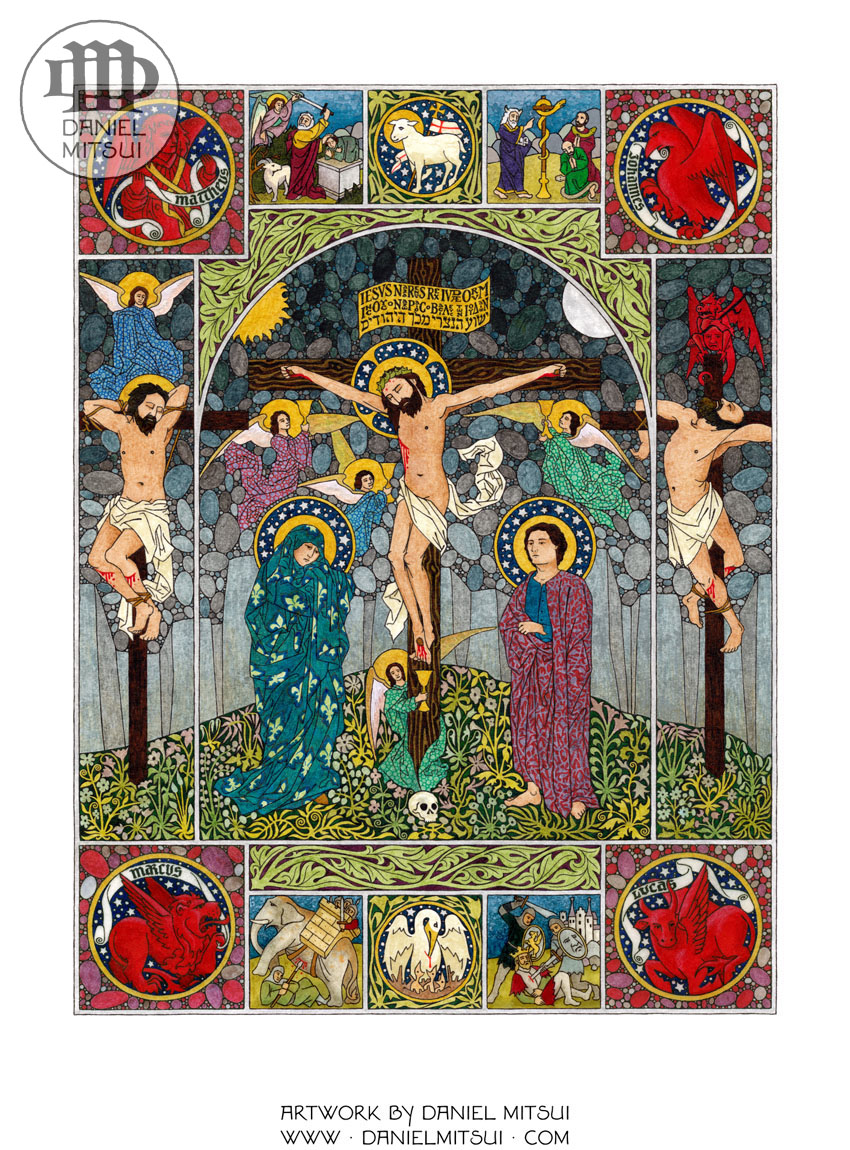

However, 25 March is also the Feast of the Good Thief, St. Dismas!

There is a legend that, during the Holy Family’s flight from Herod to Egypt, they ran into Dismas, who was exercising his trade of thievery.  Dismas was going to rob them, but seeing the Infant Jesus, he instead gave them shelter in his lair and let them go on their way without harming them.  Dismas would continue to be a nefarious ne’er-do-well.  His intellect still darkened by sin on Calvary kept him from recognizing Christ’s Mother.

Sin makes you stupid.

If true – and I don’t think we should immediately dismiss legends – I wonder if Mary recognized him and prayed for him in that horrible glorious moment.

Somehow, Dismas got another chance.  Christ is merciful and He listens to his mother.

Luke 23:39-43:

And one of those robbers who were hanged, [Gesmas] blasphemed him, saying: If thou be Christ, save thyself and us. But the other [Dismas] answering, rebuked him, saying: Neither dost thou fear God, seeing thou art condemned under the same condemnation? And we indeed justly, for we receive the due reward of our deeds; but this man hath done no evil. And he said to Jesus: Lord, remember me when thou shalt come into thy kingdom. And Jesus said to him: Amen I say to thee, this day thou shalt be with me in paradise.

It makes the heart ache, to read these words addressed to that penitent sinner.

Would that they were address to each one of us.

But wait!  They can be.

Holy Church has the Lord’s own authority to forgive sins, to loose and to bind!

It is exercised by His bishops and priests!

GO TO CONFESSION!

Daniel Mitsui – Crucifixion


Posted in Saints: Stories & Symbols | Tagged , ,
1 Comment























