For your Brick by Brick File.
There is now available an edition of the older, traditional Breviarium Romanum in Latin and SPANISH.
So far it looks like VOLUME I.


For your Brick by Brick File.
There is now available an edition of the older, traditional Breviarium Romanum in Latin and SPANISH.
So far it looks like VOLUME I.
My friends at St. John Cantius sent this:
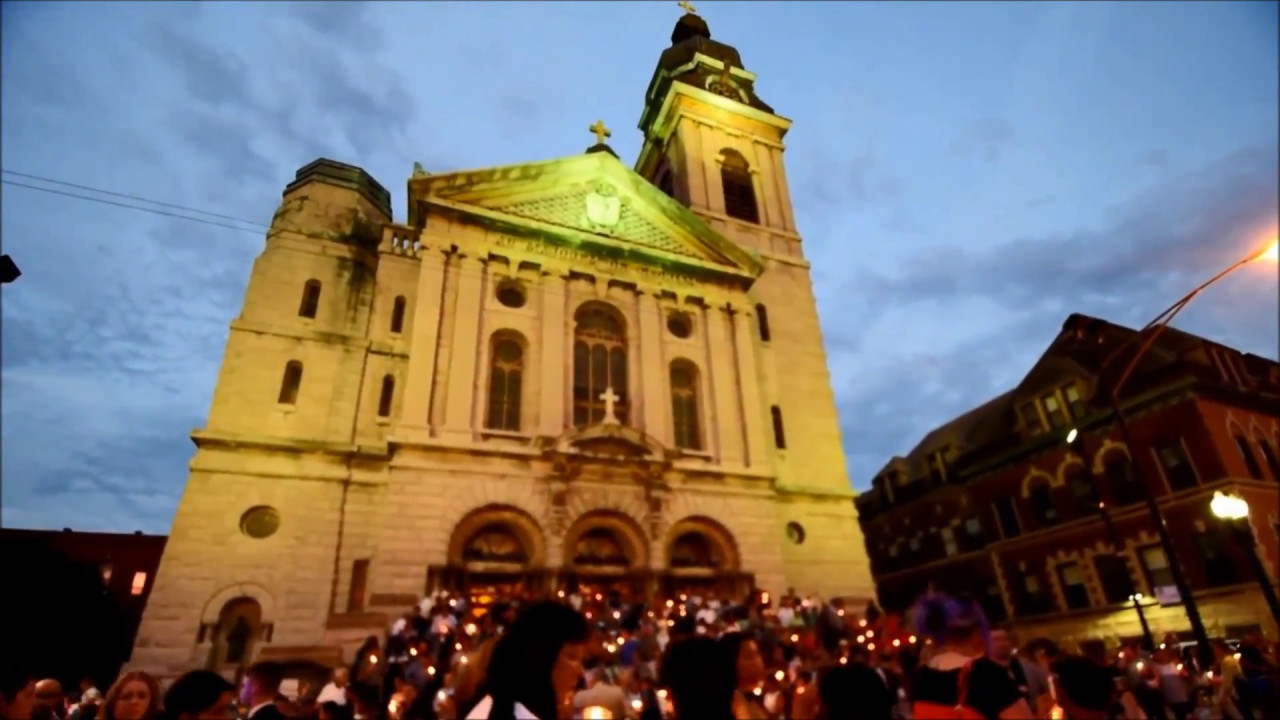
This Saturday, May 13th, in the streets of Chicago, thousands will peacefully walk one mile praying for an end to violence—following Mary’s request to pray for peace, forgiveness, and conversion.
Beginning at St. John Cantius at 7 pm, this Saturday, May 13th, there will be a presentation followed by a candlelight procession to St. Stanislaus Kostka Church.

I had an interesting email today.
I got an e-mail today from Fr. Joshua, at St. John Cantius Church, who was good enough to share a group photo of several priests at their TLM workshop.
Facebook tells me that this is embedded code.
As you may recall, you helped make this happen.
I asked Fr. Joshua, and my editor, Beverly Stevens to pass along this information. I think I’ll send it to Fr. Heilman as well.
Thank you so much Father. I hope you post it for justified bragging rights.
Frankly, I was a little confused about this (I get lots of half-explained email and hard to use or absent links), so I asked what it was all about. I got the response:
This, refers to a post you wrote. Specifically, this one HERE.
That post has turned into this.
The photo is helpfully included as well.
Thank you so much, Fr. Z. I just thought you might want to pass along these results.

Anyway, brick by brick.
Friends, it can be done. But YOU need to step up and make it happen!
UPDATE:
More coherent information…
This week 12 priests from across the USA and Canada are with the Canons Regular learning the ceremonies of the Latin Mass.
The priests participated in Solemn High Mass for the feast of Mary, Queen of Poland (May 3rd) at Saint John Cantius Church.
Since being asked by Cardinal Francis George in 2007 the Canons Regular have hosted 65 workshops in the Latin Mass in Chicago and locations around the world, helping over 1,000 priests to learn the Extraordinary Form of the Mass.
 Allow me to preface this with the reminder that I hate squirrels.
That said, I promise you I am not making this up.
I was alerted to this from the – no… really… Journal of Feminist Geography.
No… really.
Here is an abstract of a contribution to the – I just marvel at this – Journal of Feminist Geography.
If you are more comfortable by… no, wait… less triggered by reading it in either Spanish or Chinese, the abstracts are available in those languages. Not that I’m judging you.
Abstract
Eastern fox squirrels (Sciurus niger), reddish-brown tree squirrels native to the eastern and southeastern United States, were introduced to and now thrive in suburban/urban California. As a result, many residents in the greater Los Angeles region are grappling with living amongst tree squirrels, particularly because the state’s native western gray squirrel (Sciurus griseus) is less tolerant of human beings and, as a result, has historically been absent from most sections of the greater Los Angeles area. ‘Easties,’ as they are colloquially referred to in the popular press, are willing to feed on trash and have an ‘appetite for everything.’ Given that the shift in tree squirrel demographics is a relatively recent phenomenon, this case presents a unique opportunity to question and re-theorize the ontological given of ‘otherness’ that manifests, in part, through a politics whereby animal food choices ‘[come] to stand in for both compliance and resistance to the dominant forces in [human] culture’. I, therefore, juxtapose feminist posthumanist theories and feminist food studies scholarship to demonstrate how eastern fox squirrels are subjected to gendered, racialized, and speciesist thinking in the popular news media as a result of their feeding/eating practices, their unique and unfixed spatial arrangements in the greater Los Angeles region, and the western, modernist human frame through which humans interpret these actions. I conclude by drawing out the implications of this research for the fields of animal geography and feminist geography.
I think a blind squirrel wouldn’t have to look too hard, if you get my drift.
It was a full day yesterday. After Mass yesterday we broke the fast and then headed off the the Palazzo Braschi for the Artemesia exhibit.
Artemesia Gentileschi was the daughter of Orazio Gentileschi and a fine painter in her own right, a rare female painter in the 17th century. It was the time of Caravaggio and Galileo, whom she knew. Marino writing poems about new art works as they appeared in salons. Painters were swaggering, sword toting rockstars. Artemesia had a tough time of things, as a woman in that business, including being raped by a painting tutor whom her father had hired. There was a humiliating prosecution of her attacker afterward.
Perhaps it is just a coincidence, but some of Artemesia’s best work involved the theme of women killing men. I say “coincidence” because other painters of the period were often depicted the popular themes of, for example, Judith beheading Holofernes. She also has great versions of Jael serenely hammering a spike through Sisera’s head as he slept.

She has such a calm expression, focused and unhurried with her hammer raised for the blow.
Her Judiths are similarly calm, but focused. Holofernes is focused too, but not in a calm way.
A couple versions side by side, which was a treat.


Another moment in the process, Judith and faithful Abra are on their way out when they hear something. Alas, not a great shot from this angle. You can find better online. This is closer to the version in Detroit.

David with the head of Goliath was popular in the period, as were penitent Magdalen, dying Lucretia, and Cleopatra.
Later in the day, we had the great pleasure of attending the annual swearing in ceremony for the new recruits of the Pontifical Swiss Guard.
Some of you will recall that we of this blog had a wonderful project of having custom armor made for one the Corporals. Engraved on his breastplate are St. Joseph and St. Joan of Arc. It does get cooler than that.
Here is a close up of our guy and his armor.


I have a few videos to give you a taste:
How they swear…
And… see how windy it was. They can barely hold the flag and swords.
After the Giuramento, we headed off to supper with a stop at the famous Castroni for some coffee.

Fending off death by starvation…

Lamb… perfect.

And life without puntarelle… is… well… is it really life?

 At The Catholic Herald, the UK’s best Catholic weekly, there is a thought provoking piece by Damien Thompson. Read the whole thing over there, but here are a few snips:
It’s 1978 all over again
I’ve been thinking about that surreal period because my cousin has kindly given me three copies of Time magazine from 1978. The cover stories are: “In Search of a Pope” (August 21); “The New Pope, John Paul I” (September 4); and “John Paul II” (October 30). Reading them has been quite a culture shock, especially for a magazine journalist. So many lucrative full-page ads – eight of them for cigarettes in one issue alone. Dozens of exquisitely written colour pieces, published without bylines: Time’s hacks were so spectacularly well paid that they didn’t care if their names were missing.
[…]
When Paul VI died, the Church was still going through the identity crisis provoked by the Second Vatican Council. Paul was the pope who initiated drastic and increasingly ugly liturgical changes; he was also the author of Humanae Vitae, which dismayed Catholic liberals. By the time St John Paul died, the factionalism had subsided. It was a slow process – in his first few years, he was careful not to upset liberal dioceses – and of course there were still conservatives and progressives. But they had to operate within parameters set by John Paul. So, too, did his successor, whose supposedly hardline traditionalism evaporated once he became Benedict XVI.
Now, in contrast, the factions are again flexing their muscles. The Church, disturbed by Amoris Laetitia and several other small wars initiated by the Vatican, is dividing along geographical lines. The articles from 1978 talked about the Dutch, Latin American and Polish churches as if they were rival denominations. That way of thinking is creeping back.
The direction of the Church is once again negotiable, even if John Paul II managed to cross women priests off the agenda (and can we even be certain of that?). Like Paul VI, Francis is out of step with committed lay Catholics, the difference being that he is theologically to the left of his critics.
But an even bigger difference is that secular society takes no more than a polite interest in the Church. It’s fair to say, as it was 39 years ago, that everything hangs on the choice of the next pope. When the moment comes, Catholics will be able to draw on unimaginable amounts of information compared to 1978. But they will look in vain for the meticulous, expensive and even-handed coverage squeezed between the ads for bourbon and Buicks in my vintage magazines. Time, like the rest of the world, has moved on.
Yesterday I mentioned the set of vestments we are having made for the Pontifical Masses. I received the following few photos before the fabric was cut and sent for sewing. The photos are not great, but they give a sense of the project.
You can see that the arms are embroidered directly into the fabric, rather than onto a patch. More on the patch, below.


With some of the trim. Apparently, the trim held back the project. They thought they had enough, but when they opened a package of it, it was mismarked. So, they had to look high and low to get enough while more is being made. We are getting lots of vestments, as it turns out, including several copes and an antependium.

Okay… I’ll get back to the vestments. Meanwhile, some morning shopping revealed baccala ready to be cut and taken home for Friday preparation. If it’s Friday, it’s baccala.


At lunch I was presented with a new cardinalatial wrist band.

An old building, just because.

Back to vestments. These are finished pieces from the pontifical set.
The humeral veil.

The gremial.


With a new pair of gloves.

Patches. Originally they had the arms embroidered onto these which was UNACCEPTABLE. Hence, another delay in the production of the project.
In any event, now we have these too.

You would be surprised at how many people think that I should wear shoes with buckles when I say Mass. Available here.

Lunch having been consumed, and business errands concluded, it was off to Ss. Trinità for Mass. The vestments were laid out in this manner.

I was recognized by someone as I was reading Mass, a long-time reader here and a former Swiss Guard in town for the Giuramento. We had an aperativo afterward and a good chat.
So far so good.
UPDATE:
Not much of an appetite to go out. Hence…
Fave and peccorino and cold Frascati. Classic.

Pizza bianca, olives, anchovies, tomini.

Tomorrow will bring prosciutto, with cantaloupe melon, nearly oozing with juicy flavor.
 Over at Catholic World Report there is a piece by Fr. Peter Stravinskas, who reflects on 40 years of priesthood… his own. His 40th anniversary of ordination comes up on 27 May.
This bit got my attention and sympathy.
The college seminary experience was not too bad; indeed, the academic formation was stellar, while the overall environment in the Church was harrowing, especially as defections from the priesthood reached epidemic proportions; I often say it is surprising that the suction didn’t take the rest of us with them. The theology years were a nightmare at every level: outright heresy taught as Gospel truth; rife liturgical abuses on a daily basis; persecution of “retrograde” seminarians – with Yours Truly being told that he was “unsuited for ministry in the post-conciliar Church” and forced to find a benevolent bishop three months before diaconate. My seven years of supposed priestly formation were, bar none, the most unhappy years of my life, characterized by intense polarization and draconian imposition of aberrant viewpoints by those in authority. It must be noted that there were, to be sure, some good and faithful priests on the seminary faculty, but they were a distinct minority and largely reduced to window dressing. In short, my generation of priests had been robbed of our Catholic and priestly patrimony by a generation of angry rebels.
At any rate, by nothing short of a miracle of God’s grace, I was ordained a priest on May 27, 1977.
A lot has happened since 1977, including the passing of Paul VI and the election of John Paul II… etc.
With a few variations, what Father wrote, above, can be echoed by so many priests of a certain era and age, including the undersigned. For my part, I can say that my seminary years were sincerely dreadful. In fact, it was a nasty diabolical war for part of it. “Living hell” over states it, but not by much.
For those of you who are considering priesthood: Do NOT let the experiences of those who went through those bad years slow you down for a moment. Conditions have improved enormously, so much so that my not-in-the-least “alma” mater is unrecognizable today.
He goes on to offer his view of the present state of things along with his aspirations for the time to come. Go have a look.
Congratulations in advance to Fr. Stravinskas for 40 years. Stop and say a prayer for him today and on 27 May.
We hit the ground running, as one must do in Rome… first: stay awake… eat… get sun… stay awake.
This is a good way to do it.


Later, I said Mass at Ss. Trinita.

They are having a novena to Our Lady and will consecrated the parish!
Well done.

This is how they have displayed Our Lady of Fatima.

A trip to Gammarelli began with a glimpse of this beautiful hand embroidered vestment. Someone: feel free to send $10K.


Wow. Right?
The vestments we ordered will have the coats of arms embroidered directly on the fabric. However, we have a few others. Here is one for the Extraordinary Ordinary.

The scene of Act I of Tosca.

Because today, in the traditional calendar (and that of the Augustinians) is St. Monica, we went to venerate her bone in the church names after her son.


I enjoy the street shrines. After all these years they are like old friends.


Orata at a tiny, family owned place I’ve known and trusted for years.
Artichokes.


Zucchini flowers.


Scallopine.

One of the most beautiful squares in the world.

 My friend Fr. Martin Fox, at his blog Bonfire Of The Vanities, writes today about a Catholic college for the Holy Cross, hence, College of the Holy Cross. He picked it up from NRO.
They are wringing their hands over maybe changing their college team’s name: The Crusaders.
Goodness gracious! Imagine a Catholic college named for the Holy Cross with the team name The Crusaders. By the way, “crusader” comes ultimately from Latin crux, “cross” and maybe cruciatus, in Medieval Latin, “marked with a cross”.
Fr. Fox says:
[T]here is one reason to be embarrassed by the name “Crusader”….
I’ll bet they are spending pointless hours trying to come up with something PC neutral, like the idiotic Minnesota “Wild”. Perhaps they should chose: “Yellow”.
Holy Cross should drop the “Holy” right away, while they’re working on not offending anyone. Let’s not clue anyone in about what we think of the Lord’s Sacrifice on Calvary.

Coat of Arms by D Burkart









A Daily Prayer for Priests


They find you a pro-life agent in your area who commits to giving a portion of the fee to a pro-life group!

PLEASE subscribe via PayPal if it is useful. Zelle and Wise are better, but PayPal is convenient.
A monthly subscription donation means I have steady income I can plan on. I put you my list of benefactors for whom I pray and for whom I often say Holy Mass.
In view of the rapidly changing challenges I now face, I would like to add more $10/month subscribers. Will you please help?
For a one time donation...



Help Monks in Wyoming (coffee – UPDATED LINK) and Norcia (beer) and the wonderful "Soap Sisters" of Summit, NJ!


Please follow me on Twitter!










Visits tracked by Statcounter
since Sat., 25 Nov. 2006:

