
 In 1986 the English edition of Joseph Ratzinger’s Feast of Faith was published by Ignatius Press. At the time, it was a bombshell of enormous importance. It is still extremely helpful in understanding the state of the Church in the world and is foundational in Ratzinger’s faith. US HERE – UK HERE
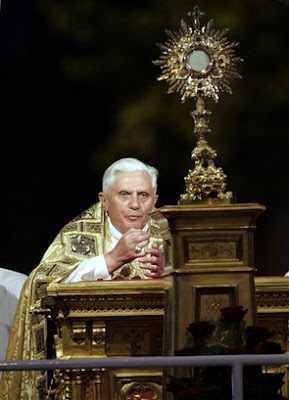
In that volume the future Benedict XVI reflected on the feast of Corpus Christi, which held profound significance for him from his youth onward.
His Holiness juxtaposed the sad decline of Eucharistic devotions after the Second Vatican Council with what the Council of Trent taught. Although the anti-triumphalism of some post-Conciliar liturgists had repressed Eucharistic exposition, adoration and processions,
the Council of Trent had been far less inhibited. It said that the purpose of Corpus Christi was to arouse gratitude in the hearts of men and to remind them of their common Lord. (cf. Decr. desc. Euch., c. 5; DS 1644). Here in a nutshell, we have in fact three purposes: Corpus Christi is to counter man’s forgetfulness, to elicit his thankfulness, and it has something to do with fellowship, with that unifying power which is at work where people are looking for the one Lord. A great deal could be said about this; for with our computers, meetings and appointments we have become appallingly thoughtless and forgetful (pp. 128-9).
Let us consider Trent again for a moment. There we find the unqualified statement that Corpus Christi celebrates Christ’s triumph, his victory over death. Just as, according to our Bavarian custom, Christ was honored in the terms of a great state visit, Trent harks back to the practice of the ancient Romans who honored their victorious generals by holding triumphal processions on their return. The purpose of Christ’s campaign was to eliminate death, that death which devours time and makes us cultivate the lie in order to forget or “kill” time. … Far from detracting from the primacy of reception which is expressed in the gifts of bread and wine, it actually reveals fully and for the first time what “receiving” really means, namely, giving the Lord the reception due to the Victor. To receive him means to worship him; to receive him means precisely, Quantum potes tantum aude – dare to do as much as you can. (p. 130).
Quantum potes tantum aude… from the Sequence Lauda Sion.
What strikes me in this today – I’ve read it many times over the years – is the stress on reception in connection with doing. There is a logical priority to reception. This is precisely the dynamic present in all of our properly understood “full, conscious and active participation” in our sacred liturgy.
Receptivity is not necessarily passive. Our liturgical receptivity is decidedly active. We participate – ideally – with active receptivity. That means engaging the will in a disciplined way to connect our attention, focus, heart, mind on the gestures and the texts, which are by and from Christ, the true Actor in the Church’s worship.
This is not easy for us to do, in this distracting world. It also isn’t easy if we are not habituated to face our true selves in the brutally honest mirror of self-examination.
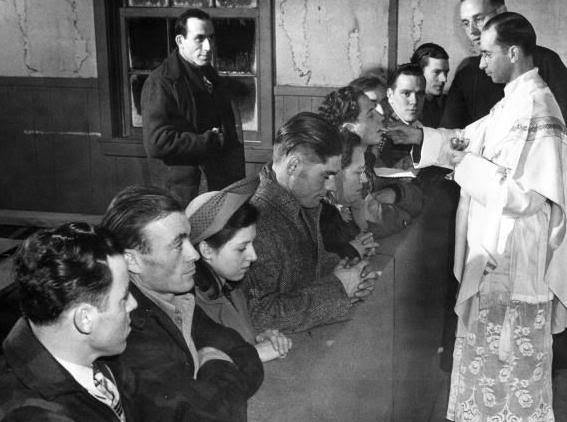
In the still and silent moments of encounter with the Eucharist such as those in Holy Mass before Communion or in the quiet of a church, we can be at times compelled to face the reality of our state at the moment and the fact of inevitable accounting for the life that is God’s gift.
Everything Christ offers is transformative.
The Eucharist is the very giver of the gift who, as “true food” (John 6:55 – alethes brosis) transforms us into what it is.









 maternalView on ROME 26/10– Day 21: fountain: “I don’t think discernment means what she thinks it means. These people always use that word as a justification for…”




























