Jill Stanek’s house vandalized by pro-aborts. She’s not about to quit.

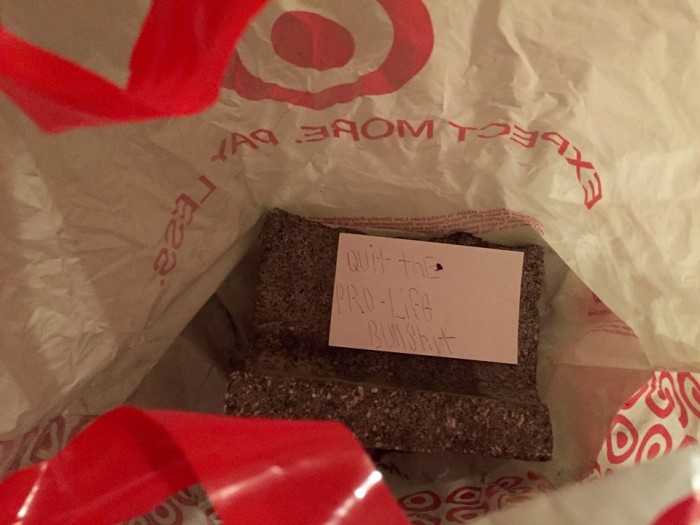
Pro-life activist Jill Stanek’s house was vandalized by pro-abortion cowards.  The story is HERE. One of them threw a brick through her window with the note: “Quit the pro-life bulls**t.”

It’s in a Target sack.   I’ll take Irony for $1000, Alex.

Stanek’s reaction?  She is more convinced than ever.  Also, she asked for the brick.

Police are filing a report, calling this “biased” vandalism. [Doesn’t hate crime apply?] Just before they took the brick away for evidence, Jill asked if she could have it back. One policeman was rather surprised, asking, “For what, a trophy?” Ever the dedicated go-getter, Jill replied, “Yes, actually.

Fr. Z kudos to Jill.

I say, si vis pacem para bellum.

Posted in Emanations from Penumbras, Fr. Z KUDOS, Si vis pacem para bellum!, The Coming Storm, The future and our choices | Tagged ,
15 Comments

WDTPRS: Presentation – “the substance of our flesh”

Forty days (there’s that number again) out from the Feast of the Nativity we come to the Feast of the Presentation of the Lord, called also the Purification of Mary as well as the Feast of Meeting by some of our Eastern brethren.

Today is also called “Candlemas”, for we bless candles and light them against the darkness.  And today is and even called YPOPANTI AD SANCTAM MARIAM!

As I wrote quite a while ago, we discern in the Gospels an interesting pattern.

The Second Person empties Himself of glory and becomes incarnate of the Virgin Mary. The eternal Word becomes a speechless child. He is lain upon the wood of the crib. He is pierced with metal and He sheds His Blood for our sake. The Incarnate Word Jesus Christ empties Himself of glory and enters His Passion. He stands mute before Pilate and the soldiers. He is lain upon the wood of the Cross. He is pieced with metal and sheds His Blood for our sake. In each case He is bound to the Temple, first in His Presentation, finally when the lambs (which foreshadow Him) are being slaughtered in the Temple. All of this is for our sake.

Today’s Collect was in the 1962 Missal and is based on one in the ancient Gelasian Sacramentary amidst the prayers “in purificatione sanctae Mariae” on the date iiii Nonas Februarias (read 2 February).

In the Gelasian it goes like this:

Deus, qui in hodierna die unigenitus tuus in nostra carne quam adsumpsit pro nobis in templo est praesentatus, praesta, ut quem redemptorem nostrum laeti suscipimus, uenientem quoque iudicem securi videamus: …

When you go to your church for Candlemas, you might be privileged to hear this:

COLLECT:

Omnipotens sempiterne Deus,
maiestatem tuam supplices exoramus,
ut, sicut unigenitus Filius tuus
hodierna die cum nostrae carnis substantia
in templo est praesentatus,
ita nos facias purificatis tibi mentibus praesentari.

SLAVISHLY LITERAL TRANSLATION:

Almighty and everlasting God,
we humbly beseech Your majesty,
that, just as Your only-begotten Son
was on this day in the substance of our flesh,
presented in the temple,
so too You may cause us, once our minds have been purified,
to be presented unto You.

Here is a great version from the …

1559 Book of Common Prayer 
(the first version ever brought to North American by the settlers at Jamestown):

Almyghtye and everlastyng God,
we humbly beseche thy Majestie,
that as thy onelye begotten sonne
was this day presented in the Temple
in the substaunce of our fleshe;
so graunte that we maie bee presented unto thee with pure and cleare myndes;

How does the version in Latin compare with what you usually hear in churches these days?

OBSOLETE ICEL:

All-powerful Father,
Christ your Son became man for us
and was presented in the temple.
May he free our hearts from sin
and bring us into your presence
.

Really?

CURRENT ICEL (2011):

Almighty ever-living God,
we humbly implore your majesty
that, just as your Only Begotten Son
was presented on this day in the Temple
in the substance of our flesh,
so, by your grace,
we may be presented to you with minds made pure
.

You decide.

Posted in Liturgy Science Theatre 3000, WDTPRS | Tagged , ,
2 Comments

“Ministry is not about…”

A friend sent this.

From the composer David Haas… from HERE

821-David-Haas-Bizarre-Creed

What do you, dear readers, think ministry is not about?

Ministry is not about [FILL IN BLANK] – 
it is about [FILL IN BLANK].

Posted in Liberals | Tagged
78 Comments

Prefect of Cong. for Bishops says more priests now decline becoming bishop

I have a priest friend who has 30+ reasons on his list for why he doesn’t want to be a bishop.

[UPDATE: I was informed that the list is presently at 42 reasons for why he doesn’t want to be a bishop.  It’s inclusive and brutally honest.]

My list isn’t quite as long as his, but it is pretty long and pretty similar.

From CNS via CathNews:

Although the number is not high, it is no longer “exceptional” to have priests turn down an appointment as bishop, according to Canadian Cardinal Marc Ouellet, prefect of the Congregation for Bishops.

Speaking yesterday about the annual course his office sponsors for new bishops, the Cardinal was asked about rumours that more and more priests are saying they do not want to be a bishop and declining an appointment even when the Pope, on the recommendation of Cardinal Ouellet’s office, has chosen them.

Yes, that’s true. Nowadays you have people who do not accept the appointment,” he said, adding that he would not provide statistics on how often it happens, although he insisted the number was not huge. [So… it is “big”?  “substantial”? “hefty”?]

Priests decline for a variety of reasons, Cardinal Ouellet said, pointing to the example of a priest who was chosen, but then informed the congregation that he had cancer and had not told others of his illness. “It was a sign of responsibility not to accept the appointment,” he said.

Others decline because of something in their past or because they think they cannot handle the responsibility, he said. In the latter case, he said, “normally we insist” because often people are not the best judges of their own abilities. But when a person makes “a decision in conscience,” the Vatican respects that.

As for the type of priests Pope Francis and the congregation are looking for as candidates, Cardinal Ouellet said the Pope “has insisted on the pastoral quality of the bishops. That’s very clear. It does not mean that they do not have to be masters of the faith because a bishop is, first and foremost, the first teacher of the faith in his diocese.”


[…]

Read the whole thing there.

Happily, I will never be a bishop.

But about that Monsignor thing….

Posted in Mail from priests, Priests and Priesthood | Tagged ,
23 Comments

Pope Francis to play himself in a movie… uh huh. POLL

UPDATE 2 Feb:

See below…

____ ORIGINAL  Published on: Feb 1, 2016

From Variety (not The Onion… not Eye of the Tiber):

Pope Francis will play himself in the new religious movie “Beyond the Sun,” marking his acting debut and the first time that a pope has appeared in a feature film.

“Beyond the Sun” — from Ambi Pictures — is a family adventure based on the Gospels. Pope Francis asked the filmmakers to make a movie that communicated Jesus’ message to children.

AMBI co-founders Andrea Iervolino and Lady Monika Bacardi will finance and produce the film. Graciela Rodriguez wrote the screenplay and will co-produce with Gabriel Leybu. Monsignor Eduardo Garcia will be Pope Francis’ advisor.

All profits from the film will be donated to Argentinean charities El Alemendro and Los Hogares de Cristo, which aid at-risk children and young adults.

Iervolino made his first film in his hometown of Cassino, Italy, at age 15.

“Our excitement and gratitude toward His Holiness, Pope Francis participating in this film is beyond words,” he said. “This is not just a movie for us, it’s a message, and who better to have on your side to deliver an important societal and spiritual message than the Pope.”

Bacardi said, “It is a great honor for Andrea and I to have the opportunity to work with His Holiness, Pope Francis, to spread the awareness of his message, through this film. We will make a movie everyone involved with can be proud of. Not only will families from around globe enjoy this film and be entertained, but they will be moved.”

Principal photography is slated to begin early this year in Italy. Ambi will oversee worldwide distribution for “Beyond the Sun” through its Los Angeles-based international sales division.

[…]

Okay… let’s poll this one.

Choose your best answer and, if you are registered to comment, give an pith and well-considered explanation in the combox.

Should Popes be actors in movies even to play themselves?

View Results

Moderation queue is ON.

UPDATE 2 Feb:

From AP via ABC:

Vatican Disputes Pope Film Claim, Says Pontiff Not an Actor

The Vatican is disputing a U.S. film studio’s claim that the pope is making his movie debut, saying no scenes were shot for the venture and that the pope isn’t an actor.

Los Angeles-based AMBI Pictures headlined its press release: “Film Will Mark First Ever Big Screen Participation Role for the Leader of the Worldwide Catholic Church.”

Monsignor Dario Vigano, the head of the Vatican’s communications operation, acknowledged that he couldn’t exclude that the filmmakers got hold of some clips of the pope. But in comments broadcast on Vatican Radio on Tuesday, Vigano disputed the press release claiming that Francis would “play himself” in the film “Beyond the Sun.”

He said: “The pope is not an actor.”

AMBI described the film as “a family adventure story where children from different cultures emulate the apostles while searching for Jesus in the world around them.”

[…]

The company said “Beyond the Sun” initiated with Francis asking the filmmakers to make a movie for children that communicates Jesus’s message. The press release was accompanied by photos of the pope with the filmmakers.

The Vatican works hard to control the pope’s image, enforcing tough copyright restrictions on all visual media, and Vigano’s reaction to the announcement was a clear sign that the Vatican didn’t appreciate the hype. But Francis has been known to go his own way on several occasions, allowing friends to shoot video of him to convey messages to private gatherings: He delivered such a message to the Argentine Jewish community and to a gathering of American Pentecostals.

Vigano’s comment that he couldn’t exclude that the filmmakers had some footage of the pope suggested that they might have secured some video of him in the privacy of his hotel reception rooms.

The organizers said all profits from the film will go to two Argentina-based charities that help at-risk children and young adults.

A spokesman for AMBI declined to comment Tuesday.

Posted in Francis, POLLS | Tagged , ,
53 Comments

New NBC (anti-Catholic) Show Takes Shot at Priests

From the Catholic League

New NBC Show Takes Shot at Priests

February 1, 2016

Bill Donohue comments on a slur against priests in NBC’s new show, “You, Me and the Apocalypse”:

“My job’s to prove they felt up kids …”

That’s how “Father Jude,” the foul-mouthed priest character in NBC’s new show, “You, Me and the Apocalypse,” describes his role as “Devil’s Advocate,” or Promoter Fidei, in the Church’s sainthood investigation process.

This bigoted “laugh line” about Catholic priests merited barely a mention in reviews of the show’s very first episode, which aired last Thursday night. Anti-Catholic stereotypes are so accepted by our cultural elite that they are either defended or simply ignored—never condemned!

It’s too soon to judge whether this show will join the list of anti-Catholic “entertainment” fare that has emanated from Hollywood in recent decades. We’ll withhold judgment for now. But it’s not off to a good start.

Contact Nikki Lichterman, Senior Press Manager: nikki.lichterman@nbcuni.com
Phone: 212-371-3191
E-mail: pr@catholicleague.org

Posted in Si vis pacem para bellum!, The Last Acceptable Prejudice | Tagged ,
7 Comments

St. Ignatius and Bl. Ludovica – Beauty differently manifested

My Roman Curia calendar today shows that it is the Feast of Bl. Ludovica Albertoni (+31 Jan 1553).  My (Novus Ordo – 2005) Martyrologium Romanum listed her yesterday, the day of her death, otherwise known as her dies natalis, her birthday into heaven.

Either way, here is her entry in the Martryologium:

Romae, beatae Ludovicae Albertoni, quae, filiis christianis moribus pie institutis, post viri obitum, Tertio Ordini Sancti Francisci adscripta, pauperibus auxilium attulit, ex divite pauperrima facta.

Let’s see your own flawless and yet smooth renderings of the Latin.

Bl. Ludovica wanted to remain a virgin but at the behest of her family, married.  She was widowed at 33 and became a Franciscan Tertiary. She often had spiritual ecstasies and levitated.

Ludovica is rather like St. Francesca of Rome, who as a widow became Benedictine Oblate in the house that she had earlier established.  As a married woman, she used her family’s wealth to help the poor.  When was first in Rome, I lived in her family house in Trastevere, the Palazzo Ponziani, then a quasi-religious residence for young men, now converted into a rather nice hotel.  In that palazzo there is a chapel and the room where she died.

Bl. Ludovica is someone you should visit when you are in Rome, in her tomb of the church in Trastevere San Francesco a Ripa.  It isn’t too far from Santa Cecilia.  The great sculptor Gian Lorenzo Bernini made her monument, and it is one of the great sculptures in Rome, reminiscent of his St. Theresa in Ecstasy in S. Maria della Victoria across town.  He made this late in his life.

Here are a couple pics.  The statue depicts her in extremis, in her death throes, simultaneously her last breaths and a spiritual ecstasy.

Bernini Ludovica Albertoni full

Before someone asks, the painting is of St. Ann and the Virgin by Giovanni Battista Gaulli.

Bernini Ludovica Albertoni det01

I remember the first time I saw this.  It was in my earliest days studying Latin with Fr. Foster in the 80’s.  I wandered into the church not knowing that this was within.

st-ignatius-of-antiochOf course in the older, traditional calendar, today is the Feast of St. Ignatius of Antioch, bishop and martyr.  His body is also in Rome, in the stupendous San Clemente.

His death was gruesomely beautiful.  Gruesome in its method, beautiful in its holiness.

In Matins in the Breviarium Romanum, we read:

Ignatius, chosen to be the second successor of Peter as bishop of Antioch, was accused of being a Christian during Trajan’s reign and condemned to be sent to the beasts in Rome. As he was being brought from Syria in chains, he kept teaching all the cities of Asia which he went through, exhorting them as a messenger of the Gospel and instructing the more distant ones by his letters. In one of these letters, which he wrote to the Romans from Smyrna while he was enjoying Polycarp’s companionship, among other matters he said this about his own death sentence: “O helpful beasts that are being made ready for me! when will they come? When will they be sent out? When will they be allowed to devour my flesh And I hope that they will be made the more fierce, lest by chance, as has happened in the case of others, they may fear to touch my body. Now I am beginning to be Christ’s disciple. Let fire, crosses, beasts, the tearing apart of my limbs, the torment of my whole body and all the sufferings prepared by the devil’s art be heaped upon me all at once, if only I may attain Jesus Christ. When he had arrived in Rome, he heard the lions roaring and, burning with desire for martyrdom, he burst out, “I am the wheat of Christ; let me be ground by the teeth of the beasts so that I may be found pure bread.” He suffered in the eleventh year of Trajan’s reign.

And from his Letter to the Romans, 3:

“Only request in my behalf both inward and outward strength, that I may not only speak, but [truly] will, so that I may not merely be called a Christian, but really found to be one. For if I be truly found [a Christian], I may also be called one, and be then deemed faithful, when I shall no longer appear to the world. Nothing visible is eternal. ‘For the things which are seen are temporal, but the things which are not seen are eternal’ [2 Cor 4:18]. The Christian is not the result of persuasion, but of power. When he is hated by the world, he is beloved of God. For says [the Scripture], ‘If ye were of this world, the world would love its own; but now ye are not of the world, but I have chosen you out of it: continue in fellowship with me’ [John 15:19].”

Posted in Saints: Stories & Symbols | Tagged , ,
5 Comments

Peters on Allen on Francis’s silence on abortion, etc.

You heard, I’me sure, about the huge lay-run “Family Day” event in Rome that drew vast crowds from all over the peninsula to the City.

Pope Francis and the Italian bishops were un-involved and even silent about this big and important manifestation of family values in the public square.

At the blog of the distinguished canonist Ed Peters, In The Light Of The Law, there a great piece of analysis of some comments made by John L. Allen, formerly of the Fishwrap now of Crux, about the absence of involvement by and silence from Pope Francis and the Italian bishops.   Allen argues that Francis and Co. are doing all sorts of other things to support the family and so they didn’t have to do anything for Family Day… or for the March for Life in these USA.  Avoiding the public square but doing smaller, less flashy things are, in a way, support.  ?!?  Allen:

Perhaps that’s where Francis is an innovator — not in rethinking whether Catholicism should still oppose abortion or same-sex marriage, but in pioneering a more compassionate, and thus at least potentially more convincing, way of doing it.

Peters has a different view.  Peters:

Allen, associate editor of the on-line news site Crux, recently arguedthat “Francis pioneers a merciful way to oppose abortion, gay marriage”. Setting aside questions as to what the ubiquitous and apparently infinitely malleable adjective “merciful” means here, I take from his headline Allen’s claim that Francis recently did or said some things to “pioneer” new ways to oppose abortion and so-called gay marriage. That claim gets my attention, naturally, but should it not be proven by what Allen includes in his article? Allen offers four points. [I provide only two, below.]

[…]

Francis need not, of course, have attended the March for Life (no pope has); he need not have sent it a supportive message (though other popes have); he need not even mention the March for Life if he does not wish to. But, if he did not attend, did not greet, and did not even mention the March, how exactly is this series of non-actions evidence that the pope is ‘pioneering’ a new way to oppose abortion? If eisegesis is reading one’s opinions into another’s words, what is it when there literally are no words to read one’s opinions into, but a message is divined from them anyway?

Italy’s Family Day. Per Allen, “With regard to Italy’s Family Day, Francis used an address to judges of the main Vatican [sic] court on Friday to insist that ‘there can be no confusion between the family willed by God and any other type of union,’ which was taken locally as a green light for resistance to the civil unions measure.” Sorry, but, as above, Francis did not mention Family Day, he did not mention Italian parliament members or its proposed legislation, and he said nothing about marriage or family that any Catholic could not have said in casual conversation. How, then, do Francis’ remarks to the Roman Rota ‘pioneer’ a new way to oppose ‘gay-marriage’ in Italy or anywhere else?

[…]

I conclude as I began. These remarks are not a criticism of Francis—there is no doubt whatsoever where he stands on the gravity of abortion and on the impossibility of ‘gay-marriage’ (even if his manner sometimes muffs his message) [A good way to put it.] and he is not obligated to engage in any specific acts of opposition to either. But my remarks are a criticism of reporters who, with some proclivity these days, seem to offer the pope’s silence on various matters as evidence for what they think he means on various matters. May I suggest, instead, that silence is usually, pretty much, just silence.

These are excerpts.  Read the rest there.

Peters has a point.

Posted in Emanations from Penumbras, Francis, One Man & One Woman, Our Catholic Identity, Sin That Cries To Heaven, The Coming Storm, The Drill, The future and our choices, What are they REALLY saying? | Tagged , , ,
25 Comments

ASK FATHER: Father said say Act of Contrition afterwards. Fr. Z rants… at priests.

12_03_31_confessionFrom a reader… who recently went to confession!

Everyone… GO TO CONFESSION!

QUAERITUR:

I just went. Yay! After confessing my sins I had a question about a friend who fell away from church. It took 2 minutes, 3 tops. I don’t usually get into asking for advice in the confessional. Then he gave me my penance including an act of contrition to be said right there in the church– find a quiet place. Then – ‘Now I will say a prayer granting you absolution’. I was a bit confused and started to say the act of contrition but he was praying kinda loud so I waited. Then I asked -‘Don’t I say the act of contrition now? Right? He said ‘no- I told you to say it after you leave here…’ I said ‘Really? That’s okay?’ I was confused and it didn’t feel right- maybe because I always follow the formula. He says again -‘Yes it’s okay’…so I responded -‘if you say so’. He told me to tell the next person they could come in. (?) I went out into a pew & said my penance & my act of contrition. I’m asking you just because it wasn’t feeling right…I thought I had to say it in the confessional in the presence the priest and then he gives absolution.

I general, yes, the Act of Contrition should be spoken after you confess your sins and before the priest gives absolution.

There are good reasons to say the Act of Contrition when it is classically assigned.  First, it helps you truly to be sorry for your sins and to deepen your resolve to amend your life.  Also, the priest has to be reasonably certain that the penitent is sorry for her sins.

One could argue that the fact of the confession itself is the minimum adequate to convince him of the sorrow.   That, however, has to be the exception rather than the rule.  Hearing at least attrition during the Act of Contrition is the normal way that Father comes to reasonable certainty that you are sorry and have a firm purpose of amendment.  The Act of Contrition says, first, that you are sorry for your sins because you fear punishment.  That kind of sorrow is called attrition.  A more perfect sorrow for sins comes from love of God.  This is contrition.  Both attrition and contrition are sufficient for receiving absolution validly.  Once the priest knows you have at least sufficient sorrow, and a purpose of amendment, he should give absolution.

However, there are times when the line of penitents is quite long and the confessor is up against a scheduled event, such as the beginning of Mass at the top of the hour for a church full of people.  In that case Father might try to move things along so that more penitents can be heard.  That is usually why a confessor might occasionally ask penitents to say the Act of Contrition afterward.  Again, that is not the optimal practice, but, if you are sorry for your sins and made your good confession, it would not invalidate the absolution.  And during “high volume” times, that can get a few more people in.  That’s a good thing, right?

This situation prompts me to remind everyone reading this not to “ramble” when there is a line of people behind you.  Be thoughtful!

Please, friends, be clear, be concise, be blunt, and be gone.   Get in there and confess those sins in number and kind, and include just the details that might aggravate or attenuate the sins.  Under the normal circumstances of regular confession times, priests don’t need the story of your life or account of your week.  It isn’t chat time.  Nor is it a psychotherapy session.  You don’t have to speed talk, like the disclaimers at the end of a radio commercial.  Just be clear, be concise, be blunt, and be gone.

To this end, examine your conscience beforehand.  Pretty please?  You should know what you are going to confess before entering the confessional.  Before, right?

And, please, pay attention to that request for “bluntness”, above.  Be blunt.  Don’t beat around the bush.  Use the clearest words, even if embarrassing.  “Father, I did ___ X times, ___’d X times, I failed to ___ although I must add that the house was on fire at the time, I ___’d my ___ X times….” etc.

There is very little that a priest hasn’t heard before.  He usually has no idea who you are, especially if you whisper.  He can’t reveal anything to anyone.  He usually – and this is something just about every priest you will ever meet can verify – he usually forgets what you told him even as he goes to the next penitent on the other side of the box.  It’s weird, but true… at least for me and priests I know.

Making a good confession regularly will help you with being clear, concise, blunt and gone.

In the meantime, if you are really nervous or haven’t gone to confession often for a long time, Father can help you out, but ask him to help you out so that he doesn’t wonder about intervening.  Be direct.

If you are reasonably sure that a) there isn’t anyone in line behind you and b) you can truly be concise with a question and c) Father isn’t up against a schedule and d) your question doesn’t pertain to your own confession, then you might ask that question after making your confession and receiving absolution and after asking if it is okay to ask a question.

And please be patient and understanding with priest who tries to get a few more penitents in before being forced to get out of the box?  Be brief.

AND FATHERS!  LISTEN UP!

Don’t ramble!  Some of you guys go on and on and on and on and we penitents have to just kneel there and take it.  And, often, you are not… how to say this… terribly inspiring.

If we want our penitents to be brief, then we should do unto them as we would like them to do unto us.  Right?  RIGHT?

There we are… kneeling there… and we know there are people in the line.  Of course, we are imagining that everyone out there thinks that we are the ones keeping the line from moving.  Until, of course, the next penitents get into box and you get your garrulous clutches on them, too.

Just… please… do us all a favor.  Keep it brief.

We penitents thank you in advance.
Posted in "How To..." - Practical Notes, ASK FATHER Question Box, Liturgy Science Theatre 3000, Wherein Fr. Z Rants | Tagged , , ,
10 Comments

ASK FATHER: Reciting the Office or reading silently

From a seminarian…

QUAERITUR:

I am a seminarian and I pray the EF Office faithfully. I know I have read somewhere that even when praying alone the words should actually be pronounced (however quiet) and not read as completely silent. What prompts my question is that I see so many guys just reading the Liturgy of the Hours and their lips aren’t even moving. Do you know of any reference that would enlighten me on this issue?

Those of us Latins who are bound to say the Office fulfill the obligation by reciting either the Roman Breviary as it was during the Second Vatican Council (that is to say with the Breviarium Romanum of Saint John XXIII, the actual Vatican II Office) or with the Liturgia Horarum of Paul VI revised by St. John Paul II in 1985 with the New Vulgate.  And were I to participate in the singing of monastic office, any of the hours at, say, the wonderful Benedictine Monastery at Norcia or at Le Barroux, I would fulfill my obligation.

The General Instruction of the Liturgy of the Hours says

103. The psalms are not readings or prose prayers, but poems of praise. They can on occasion be recited as readings, but from their literary genre they are properly called Tehillim (“songs of praise”) in Hebrew and psalmoi (“songs to be sung to the lyre”) in Greek. In fact, all the psalms have a musical quality that determines their correct style of delivery. Thus even when a psalm is recited and not sung or is said silently in private, its musical character should govern its use. A psalm does present a text to the minds of the people, but its aim is to move the heart of those singing it or listening to it and also of those accompanying it “on the lyre and harp.”

There is some recognition of silent recitation.

Recitation of the Office should be aloud, since it is official and mainly vocal prayer. This is why of yore and even now priests move their lips when saying their Office.  However, even when you don’t read aloud, there is a measure of subvocalization going on when reading.

That said, I am of the opinion that a priest fulfills his obligation even when not moving his lips, only reading silently.

And before someone asks, yes, priests and deacons can use mobile phone apps and websites for the Office.  They don’t have to be holding a book in their hands.  The Office is the text, not the book.

Posted in "How To..." - Practical Notes, ASK FATHER Question Box, Liturgy Science Theatre 3000, Seminarians and Seminaries | Tagged , , ,
14 Comments