Outstanding analysis from Prof. Royal and Fr. Murray on the eve of the conclusion of this Synod (“walking together”).



Outstanding analysis from Prof. Royal and Fr. Murray on the eve of the conclusion of this Synod (“walking together”).

November is the month when we Catholics pray in a special way for the repose of the dead and, by God’s will, for the rapid entrance into heaven of the Poor Souls.
On All Souls Day, Friday, 2 November, at 7 PM at the chapel of Holy Name Heights, His Excellency Most Reverend Robert C. Morlino, with the help of many clerical and lay ministers, will celebrate a Solemn Pontifical Requiem Mass at the Throne.
The Mass is for the intention of all the deceased priests and bishops of the Diocese of Madison.
All are invited to participate.
It is a work of mercy to remember in prayer the many priests who have served us in the past and who have gone to their Creator. Especially to be remembered are those who died during the last year.
The music for the Mass, under the direction of Mr. Aristotle Esguerra, will be Gregorian Chant and the Missa pro defunctis a 4 by Steffano Bernardi (+1636), with other motets.
Where: Bishop O’Conner Pastoral Center / Holy Name Heights – 702 S. High Point Road, Madison 608-821-3000
When: 7:00 PM
Why: All Souls Day Intention for Deceased Priests and Bishops of the Diocese of Madison
The Mass is sponsored by the Tridentine Mass Society of the Diocese of Madison www.latinmassmadison.org
This book has been terrific. The publisher, Regnery (really good) sent it and, at the last moment before I headed out the door to begin this trip, I slid it into the outside pocket of my suitcase. It isn’t released yet (30 October). Over the last few days, I have been reading and savoring subsections of chapters. This is one of those books that you have to read a bit at a time. Then you put the book down, think about it, and walk away for a while.
I am probably so struck at the moment because, as I write, I’m in the heart of Rome in an area where I lived for many years. It occurred to me that I spent more years here, than I did in my native place before I moved away. In a sense, I am there, to where I tend. I am alive here in a way that I am not when I go back to my present locale. Perhaps I hang my hat there, but its real hook is here. That’s what Esolen is on to.
Do not hesitate. Just order it. It is available for PRE-ORDER at a 24% discount at the time of this writing. There is a KINDLE version, too.
Nostalgia: Going Home in a Homeless World by Anthony Esolen
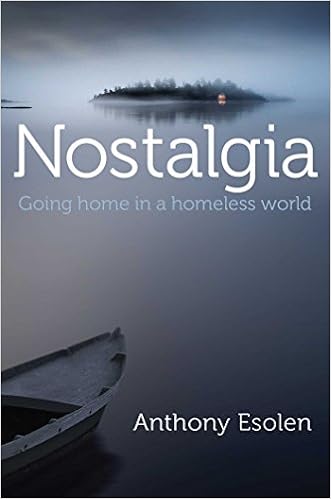
This isn’t an overtly Catholic book, but it is deeply Catholic in its worldview.
While Esolen uses little in the way of overtly churchy material, he – consciously or unconsciously – provides an argument for what I’ve been talking about for many years now: the revitalization of our Catholic identity, especially through a restoration of our sacred liturgical worship.
How often is the charge of “nostalgia” flung as a cliché into the teeth of those who desire, with their legitimate aspirations, the liturgical forms of their forebears?
Nostalgia, however, is, as the Greek indicates, a pain (algea) we feel for our “return home” (nostron): “pain for the return, ache for the homecoming.” It is an essential longing.
False nostalgia might be thought of as a desire for some “golden age” that is no more, and probably never was. A desire for something better. Augustine, drawing on the science of the day, describes the heart as restless because, according to ancient thought, gravity was a tendency within the thing itself which compelled it to go to where it belonged. The object tries to get where it is supposed to be. Thus, with the heart and God. Augustine says, “amor meus, pondus meum… my love is my weight”.
This is at the heart of what Esolen explores in Nostalgia.
He opens the book with Odysseus, sitting by the sea on Calypso’s island. He pines for Ithaca, for home, not because it is better than this enthralling captivity, but because, simply put, Ithaca is his home and this dreamy place isn’t. Everything with Calypso might be “better”, but it isn’t where he is supposed to be.
The small and even poor house in a humble neighborhood might not compare to the far more splendid starter-castle which through sweat and ingenuity you’ve worked up to, but it won’t be the same thing as what that old home was. And Esolen is not saying that nostalgia is nailed to a place and time. After all, God told Abraham to leave the place of his fathers and go to a new land, which would become the new place for new fathers. Of course, God can do that sort of thing, and even change your name, and make it right.
With every page, I cannot help but find a parallel with the devastation to our Catholic identity caused over the last decades, especially through devastation of our sacred liturgical worship. We are our rites. Change and tinker and make “progress with our rites” and you alter our identity as Catholics. The damage has been nearly catastrophic.
Esolen ranges all over, from the Odyssey to Shakespeare to Thomas Wolfe to Hilaire Beloc. Thank you, Professor, also for providing an INDEX! He draws on a short story by Flannery O’Connor about a “progressive” who, hating his own family, sells off parcels of their property for the sake of “progress”, like building a gas station that would blot their view of the woods. “Progress here,” writes Esolen, “is not the destruction of beauty. There is no great beauty. It is the destruction of a place”.
How’s that “springtime” of the Church thing going?
How the tinkerers and snipper pasters of the Novus Ordo got it wrong.
Those technocrats, for the sake of progress, damaged not something that was technically perfect, every bit accounted for somehow and having a utilitarian purpose to justify its continuance in our rites. They damaged our place, our home, our patria, where we start from and toward which we tend.
No wonder we are so damn screwed up as a Church.
Today I have read about such a (seemingly) important moment as a Synod of Bishops being run by – and I note the full irony in what I am about to write – not our Anthony Blanches, but by our Hoopers. By Hoopers with Anthony’s affliction but with none of his substance.
Many of you have been misunderstood and mistreated for your desire to go home, to be a Roman in the Roman thing, your rite, your patria which you ache for because it is yours. I sure have my stripes to show for it and the long tracks of my tears.
Time after time I have spoken with people, especially with priests, who at some point woke up from Calypso’s arms, who opened their eyes within the sty far from home, and realized that they had both squandered the patrimony they had or had been cheated out of the patrimony they didn’t know that they ought to have been given.
In his introduction, Esolen ends one section with the reaction of the progressive to those who feel deeply their sense of belonging, their desire to be placed and rooted.
“[P]eople who object to nostalgia are afraid that their achievements, such as they are, will not stand scrutiny. “No, you don’t want to go home!” they cry. They must cry, they must make the noise they can, because if they cease for a moment, we hear the calls of sanity and sweetness again, and we may just shake our heads as if awaking from bad and feverish dream. Coming to ourselves, we may resolve, like the prodigal, to “arise and go to my father’s house.”
I’ll probably write more on Esolen’s book along the way.
Since I am a pilgrim in this world, today I walked up Pilgrim Street, Via del Pellegrino, for to seek some good old fashioned Roman street fare. At the end of the Via del Pellegrino you find an ancient stone and inscription in the side of a building housing a hardware store. Across the way on the next corner was my destination, but I had to admire the inscription for the thousandth time.

Here you see the very stone and a supplì, which might surprise you.
First, the food. I picked up a couple supplì – rice balls filled with something and deep fried to crunchiness. The classic supplì “al telefono” has cheese inside, which makes each bite sort of stretchy, like telephone wires. The little shop, nearby, where I bought these surprisingly good little balls of joy, is called Supplizio, which is from Latin supplicium, which means “death sentence”. Perhaps they think their supplì are to die for? That wouldn’t be a surprise, because they are really good. Supplicium by the way, comes from supplex, which we see in our Latin prayers, as in “Supplices TE rogamus…” the beginning of the canon, and in many orations. Supplex is complicated, since it involves an etymological tension between plico and plecto. But, supplicanti parce, Lector. Oro supplex. I digress. The Italian word for the little, friendly rice ball, supplì, comes from French, surprise, because, like these posts, you never know what you are going to find inside. Hence, the Romans had the gumption to be way ahead of Forrest. And speaking of Surprise, “Which its a fried rice ball!”, Killick would shout to the Captain after they exercised the great guns.
What’s going on here on this chiseled rock?
This is an ancient pomerium marker for Rome’s sacred city limits. Tradition has it that Romulus defined the first sacred perimeter with oxen and a plough. The furrow was sacred as all furrows tend to be when there is a sense of the sacred. The pomerium was pushed outward by various Emperors. By law, no one holding imperium, the command of troops, could pass that boundary without losing his command, which was a way to prevent generals with pietas from marching on Rome. If they passed the boundary, everything they did would be illegal and sacrilegious.
Pompey the Great, for example, stayed outside when he returned to Rome and built the great stone theater (the first in stone in Rome) which had his residence and a meeting place for the Senate. He made the Senators come to him. Where I sit, writing, I can nearly peer out the window to see a place where some of the remains of Pompey’s buildings are found. I ate at a place where you can see part of the foundation. My seminary, on the other side of the buildings, including Sant’Andrea, is where the colonnade was where Julius Caesar was killed. Not the sort of supplicium he would have wanted.
Here’s the stone. Doesn’t that look like… “I, CLAUDIUS”?

[t]I CLAVDIVS
[d]RVSI FILIVS CAISAR
[a]VG GERMANICVS
[po]NT MAX TRIB POT
[v]IIII IMP XVI COS IIII
CENSOR P P
[au]CTIS POPVLI ROMANI
[fi]NIBVS POMERIVM
[a]MPLIAℲIT TERMINAℲITQ
Which is:
Tiberius Claudius Caesar Augustus Germanicus, son of Drusus, Supreme Pontiff, having Tribunician power for the ninth time, having imperium for the sixteenth time and being Consul for the fourth time, Censor, Father of the Fatherland, once the border of the Roman people grew, enlarged and defined the pomerium.
There are a few of these stones still around. One is at Santa Cecilia in Trastevere, my original stomping ground in Rome in whose streets I began to drink in all my bad words in my adopted language.
What is interesting here, on this stone, is an example of poor stuttering Claudius’ interest in linguistics. First, speaking of Caesar, Claudius used an archaic spelling in “CAISAR” which proves to us how it was pronounced at the time. Also, you see here one of the three letters he invented for the Roman alphabet. This is for your super nerdy Just Too Cool file.
Keeping in mind that at the time the “v” was not the voiced labiodental fricative “v” but more like its mysterious bilabial approximant “w”, so that vinum was “weenum”, “v” filled the function of both “v/w” and the vowel “u”, thus VINVM for vinum. Claudius created a letter for the “v/w” consonant: Ⅎ which is in this inscription in the last line [a]MPLIAℲIT TERMINAℲITQ (i.e., ampliavit terminavitq[ue]). That is so cool. (This was one of my foci in grad school.)
It never really caught on. BUT! … There it is! Is that not COOL?!?

If you haven’t seen I, Claudius… ohhhh are you in for a treat. This is an old series, but one of the best things ever done, IMHO. The book(s) by Robert Graves are good, but the TV series is amazing. US HERE – UK HERE Even now the theme runs in my mind. And a hilariously terrifying moment with Caligula comes to mind… because the Synod is going on and I imagine this to be happening in the Sala Nervi… or perhaps somewhere in the Casa Santa Marta, given some of the characters around that place these days. The video, if you don’t remember: HERE It’s … ludicrously ghastly. Performed, surely, by certain Jesuits. They’ve been summoned to Caligula and they think they are going to die … another analogy for the mercy of the moment.
#Synod2018 = “Let all the poisons that lurk in the mud hatch out.”
And, since it is October, here is another inscription, but from 1775. This is not one of the famous “no littering” signs from His Excellency the Monsignor of the Streets. This one says that Pius VI graciously gives (he is at the moment happily reigning) permission to carts that hauled eggs and chicken to vendors at the P.za Pollarola and P.za Paradiso not to pay taxes.

From a reader…
QUAERITUR:
Is there any church law which prevents sacramental records from being made public? I have seen church records used for online family trees that show living family members illegitimacy.
Interesting question.
The law says that parishes must keep sacramental records, for obvious reasons. They must be kept up to date, with accurate information. The law says that they are to be carefully preserved (can. 535§1). I think that in that “carefully preserved” we should include “confidential”. Most dioceses now have policies, particular law even, about allowing outside parties to view sacramental registers, especially Mormons, etc., doing genealogical research. Mormons want to “baptize” your ancestors, etc. Hey! They get planets! But we don’t cooperate with those things.
Look, I know the Latin/Italian scene. This applies to the older records in US parishes, too.
Parish records used to have indications of, say, whether a person received the Last Sacraments. They might include, back in the say, that a child who was baptized was actually left at the convent door and was therefore named “Esposito… es-POS-ee-tow”, that is, “exposed”. There might be an indication in short hand about “unknown mother… Mater Ignota” which came into Italian as “mignotta”, now a derogatory word for a woman assumed to be of loose morals. Other words could be added to records for abandoned (or, mercifully left in the care of others rather than killed, etc.). These words became last names of families passed down. For example, there are the Italian names of “Trovato… found”, “degli’Innocenti or Innocenti… innocents”, even “Amato… beloved” is a euphemism that became a common family name. So, “De Santis… from the saints” or “De Angelis… from the angels”, “Adeodato… given by God”. So too, if you find a really odd name, such as “Tulipano… tulip”, that might be a made up name.
While some might not like the idea, at the core, someone chose life, not death.
Anyone with such a name should pray for the soul of the, probably, woman who set the family name in motion in that city or village long ago.
Sacramental registers had all sorts of information in them that people might not want to be known.
I suppose today any number of parish records might show a lot of technical “pater ignotus” records. But back in the day, and in some circles, that means a great deal.
Of course, these days, if records are kept digitally, they should be protected. For my part, I would have a machine that was NOT connected to the internet in any way. Furthermore, it would be important never to destroy physical registers that had been digitalized: they could be preserved, perhaps in the diocesan chancery archive, as in the case of parishes that are closed.
Sacramental records concern sacred matters. They aren’t public, as when you apply for a marriage license (yes, marriage is a PUBLIC matter, which is why issues of scandal come in when those applying apply with the same address or members of the same sex do their scandalous thing) from the state or a building permit to add that new man cave or storage shed for the gear.
I am in Rome while the 2018 Synod (“walking together”) is slouching towards its predicted, rigged conclusion. I think we all knew that there would be shenanigans before the end. They’ve come now not single spies, but in battalions.
Tweets from Ed Pentin, the best English language Vaticanista around:
#Synod18 sources: “Synodality” as a new model of the Church (i.e. permanent revolution) is now being imposed on the assembly, despite it not figuring highly in working document nor synod discussions. It dominates 3rd part of final doc. draft, has no connection with synod theme
— Edward Pentin (@EdwardPentin) October 25, 2018
Note that phrase “permanent revolution”, which is a byword of Marxism.
Two chapters in draft final document devoted to synodality (Anglican model of Church governance), despite the subject being hardly raised at #Synod18: Part III: Chapter 1: Synodality – Missionary Synodality in the Church; Chapter 2: Synodality in Our Daily Relationships
— Edward Pentin (@EdwardPentin) October 25, 2018
You might also read Ed Pentin’s piece HERE.
If I had wanted to be an Anglican, I would have converted to Anglicanism.
I don’t want to be an Anglican.
How to rig a Synod? There are so many ways. They all involve, however, raw imposition of will.
How to react to all this?
Get organized. Network.
Get our your Catechisms and form “base communities”.
Get the TLM introduced.
Get yourself TO CONFESSION!
UPDATE:
Lest I violate the beauty of my day and mood, I will not multiply dire posts about the Synod (“walking together”) right now. Now I will sequester a few things here, under one heading.
I saw a piece at Public Discourse which merits attention, speaking of becoming Protestant (as the Synod (“walking together”) organizers seem to desire:
A Protestant Look at the Dogmatic Timidity of the Current Roman Catholic Synod
One does not have to be a Roman Catholic to appreciate the underlying concerns of the synod on youth that is currently ongoing in Rome, nor that of the document that was prepared as a basis for the discussion. That the church—any church—is only ever one generation from extinction may be a cliché, but it is nonetheless true. And so I have spent some time looking at the document upon which the synod is based—Instrumentum Laboris (IL)—to see if there is anything that a Protestant might find useful in its analysis and its proposals.
Sadly, IL is a missed opportunity. It suffers from two basic flaws: it takes young people far too seriously, and it does not take young people seriously enough. That might seem like a somewhat paradoxical complaint, but it captures neatly the problem faced in a document which listens too much and says too little.[…]
The fear of losing customers, votes, students, or members can become an overriding concern for organizations that depend in practice upon a loyalty that can be as easily withdrawn as given. But the problem for the Catholic Church is that it has certain standards that are part of who she is. They are not negotiable, [You wouldn’t know that these days. This Protestant writer gets it.] however unattractive they might be to young people. So, the fact that some young people find the church’s teaching on contraception, abortion, and sexuality unattractive is interesting but, with the exception of explaining her position more clearly, there seems little the church can really do in response. Catholicism is defined by dogma, not by focus groups. Those who dislike her dogma but still want to belong to her face a hard but unavoidable choice. And failure to make this point—that Catholicism is dogmatic and therefore by definition exclusive—is emblematic of the timidity of the document as a whole. [“timidity”… right. And what young person wants to follow “Timidity”?]
[…]
Whatever side one chooses in the Reformation of the sixteenth century—be it Bellarmine or Calvin—one thing is for sure: the Tridentine Catholics and the Magisterial Protestants were debating matters of real, ultimate significance. I am a Protestant by conviction and have very serious disagreements with Rome, but I regard traditional Catholicism as asking the right questions and providing substantial answers about the nature of sin, redemption, grace, faith, the sacraments, and eternal destiny. Christianity is a religion with a holy God and a tragic vision of a magnificent but fallen humanity at its core, so tragic that only a bloody sacrifice—the sacrifice of God Incarnate—can atone. I may reject the Mass but I can at least see that it marks the centerpiece of a serious theology and ecclesiology and is attempting to address the complexity of the human condition. By contrast Instrumentum Laboris points to a church which seems to be losing sight of those central issues. The Catholic Church could well be exchanging her theological birthright for a Mass of sociological potage.
The Protestant writer gets what the Synod organizers do not.
Or do they get it and simply not care? What’s their agenda?
This came via a reader.
Netherlands: religious belonging and attendance still decreasing. Only 6% of those who say they are Catholic attend Sunday Mass
51% of Dutch people over 15 years of age do not belong to any Church or to any religion whatsoever. Just released by the National Statistics Bureau (Centraal Bureau voor de Statistiek) as part of a survey of “social cohesion and welfare”, this figure shows a further decrease in the religious belonging of the Dutch: in 2016, 49% of them stated they did not belong to any religion, in 2012 they were 46%. The believing minority is composed of 24% Catholics, 6% belonging to the reformed Church and as many to the Protestant Church, 6% to other confessions, 5% to Islam. 78% of Dutch people have never or hardly ever attended a religious service, 10% of them attend once a week (6% for Catholics), 3% go 2 to 3 times a month, and the same proportion attends one religious celebration/meeting a month; 7% go less than once a month. The figures change depending on the age range and sex: 71% of Dutch people over 75 years of age stated they are religious, 34% that they regularly attend a celebration in a place of worship. The less religious ones are young people aged 18 to 25: 32% of them are somehow connected to a religious group, and 13% of them regularly see their group. As to men, 46% of them belong to a religious group, while 52% of women do.
6% Mass attendance.
Today I ran lots of little errands.
Included in the errands was a stop at Barbiconi to order up a new thurible and boat for the TMSM, especially for my use and for the bishop’s Masses. I’ve been having terrible shoulder problems, so lifting the thurible up properly for incensation has been difficult. The thurible we have is very nice to look at, was cheap, and weighs as much as a bowling ball with chains. That doesn’t work for me.
So, this one is light and more traditional.
While I was waiting at Barbiconi for something I did a little dig through the special palls they make. All of those on the right are Crosses or Marian initials. In the center, papal arms. However, in the back left are all the pall with Francis’s arms. They aren’t selling. I got the last B16.

Over to Gammarelli. Today I ordered up a Solemn set in violet for Advent and Lent. I really don’t like using pieces from the Pontifical set, since they wear unevenly.
Also, I am having an estimate readied for a Solemn set in THIS.


The red is the lining, obviously. This set would match one that a newly ordained priest had made for his First Solemn Mass which I wrote about. Here’s a glance:

Spiffy, no? Here’s the idea. He has a Solemn set. I order a Solemn Set, but also with antependium and gremial. That way, it can be used on its own, but with the supplement of his dalmatics, we can also trick out a Pontifical Mass at the Throne.
This will be expensive, I’m thinking. I’ll get the estimate tomorrow. However, I may come to all of you begging donations to the TMSM.
Meanwhile, light lunch out with a friend. Mass at Ss. Trinità, where at the request of the pastor I heard in English a spectacular confession. Dear readers, if nothing else good happened on this trip, that 15 minutes made it all worth it. One your your fellow Catholics tonight is treading the ground far more lightly than just a few hours ago and a long time before that. God is good. God is good. His promises to the Church and to hearts are TRUE and He will not be forsworn.
Back to the apartment for some grub… and some flowers for the table. It is still called Campo de’ Fiori for a reason.

In more ancient times, the once Via Florea came through here. More on that later.
I get lots of my supplies at Ruggieri.


Tonight for dessert.

Some pre-prandial snacks.

A little veal roll and some squash stuffed with meaty and cheesy goodness.
There’s no true stove here and no oven and no microwave. But… HEY!… when I was in the Steam Pipe Trunk Distribution Venue I didn’t have those things either (I had a microwave), and for several years. Hence, I learned how to make complicated things with great efficiency and limited space, heat, and tools. There is an induction hot plate. That’s what I used in the SPTDV.

I did not starve. And I left some for tomorrow.
Alas, beneath my window at a restaurant, the worst accordion player in the world is attempting “Brucia la terra”. My heavens, this is awful. Worst in world… and that’s saying something. Time to close the window and then my jet lagged eyes. Not even this guy can keep me awake.
UPDATE:
Now that it is after compline and a think back through the day, I can say that, many times today I caught myself walking around smiling. I have turned out of most churchy news for about 48 hours and I am in the City, which I know so well. My brain is waking up again from months of slumber and… I’ve just been going around smiling.
I’ll turn my attention to news again, soon, I suppose. But not tonight.
This is definitely for your Just Too Cool file.
It hit the spot this morning in particular, because Anthony Esolen’s new book begins with the figure of Odysseus, trapped by Calypso, longing to go home.
Read on.
From BBC:
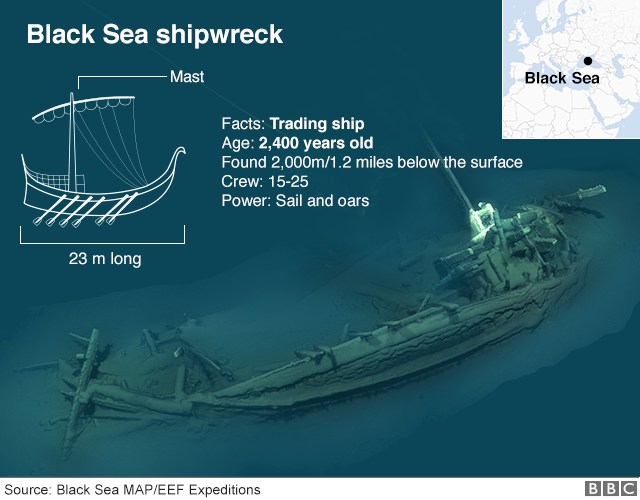
Shipwreck found in Black Sea is ‘world’s oldest intact’
A Greek merchant ship dating back more than 2,400 years has been found lying on its side off the Bulgarian coast.
The 23m (75ft) wreck, found in the Black Sea by an Anglo-Bulgarian team, is being hailed as officially the world’s oldest known intact shipwreck.
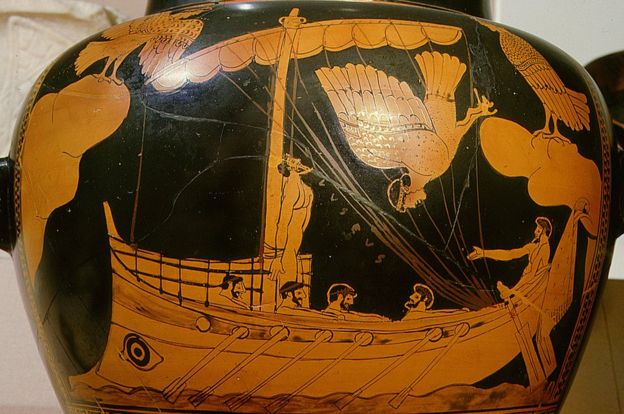
The researchers were stunned to find the merchant vessel closely resembled in design a ship that decorated ancient Greek wine vases.
The rudder, rowing benches and even the contents of its hold remain intact.
“It’s like another world,” Helen Farr from the expedition told the BBC.
“It’s when the ROV [remote operated vehicle] drops down through the water column and you see this ship appear in the light at the bottom so perfectly preserved it feels like you step back in time.” [How cool would that have been?]
The reason the trading vessel, dating back to around 400 BC, has remained in such good condition for so long is that the water is anoxic, or free of oxygen. Lying more than 2,000m below the surface, it is also beyond the reach of modern divers.
“It’s preserved, it’s safe,” she added. “It’s not deteriorating and it’s unlikely to attract hunters.”
The vessel was one of many tracking between the Mediterranean and Greek colonies on the Black Sea coast. It was discovered more than 80km off the Bulgarian city of Burgas.
The team used two underwater robotic explorers to map out a 3-D image of the ship and they took a sample to carbon-date its age.
The vessel is similar in style to that depicted by the so-called Siren Painter on the Siren Vase in the British Museum. Dating back to around 480 BC, the vase shows Odysseus strapped to the mast as his ship sails past three mythical sea nymphs whose tune was thought to drive sailors to their deaths.
As yet the ship’s cargo remains unknown and the team say they need more funding if they are to return to the site. “Normally we find amphorae (wine vases) and can guess where it’s come from, but with this it’s still in the hold,” said Dr Farr.
“As archaeologists we’re interested in what it can tell us about technology, trade and movements in the area.”
Over the course of three years the academic expedition found 67 wrecks including Roman trading ships and a 17th Century Cossack trading fleet.
Boring flight… mostly. For a half hour or so we weren’t sure about a woman who wasn’t doing well south of the tip of Greenland. A couple doctors were on the plane and I stuck my head in to make sure. Eventually she returned to her seat, drama ended,

Coming into Rome I always like catching sight of what I call the Temple of the Chinese Hat.

One of these churches was built in honor of Our Lady of Loreto (closer) and Holy Name of Mary. And that’s Trajan’s column. Dante was creative with Trajan!

A glimpse of the dome of one of the great Counter Reformation churches, Sant’Andrea della Valle, where recently liturgical turpitude was perpetrated. May the Teatini convert or regret it!

While I was waiting for the lady to come with the keys for the apartment, a nice young man at the nearby restaurant saw me, chatted a bit and offered a coffee. Genteel. I have to give the place some of my custom. The menu looked good! New place. Food is changing in Rome. FAST.

When I come here, I come armed with ice trays. You never know what ice horrors await.

Off for supplies. The first thing I did, even before cleaning myself up, was to get some pizza bianca and mortadella. Some things can’t wait.

Terrific – especially where I get it – and Rome is in every bite.

Next, veggies. La Signora doesn’t look overly joyful in this but I can assure you that an instant before she was beaming. I received an email from a reader who said that she went to this stand during her time in Rome and one of her little kids stuck his tongue out at her, but he apologized and they all got on well. Kids. Sheesh.

One of the things I pine for when not in Rome is the garlic you get here. It’s none of your weak-kneed stuff that we get in the States. No. This tastes like garlic. Hence, you have to remember not to compensate, if you get my drift.

Tomatoes peeled for sauce. This type really needs to be seeded.

Later in the afternoon, to church for Mass. A few things have changed in the sacristy since last June, so I’ll probably wind up with fixed times in the late afternoons.

Snack.

UPDATE
Supper.
Behold … beautiful… toothsome… fresh egg fettuccine.

I finished it in the sauce.

Tomorrow… errands and stuff.
Meanwhile, enjoy the evening bells of Sant’Andrea della Valle.
Podcast: Play in new window | Download
Subscribe: RSS

Coat of Arms by D Burkart
 revueltos67 on Daily Rome Shot 1646: Restoration and BOGO SALE: “White to move and mate in 4 1. Rxf7+ Kg8 (forced) 2. Rf8+ Kh7 (or KxRf8) 3. Bg8+ Kh8 (forced)…”
 on Daily Rome Shot 1646: Restoration and BOGO SALE: “Well, I guess there will be some excommunications then … https://x.com/LifeSite/status/2067005611468796412”
 on From “The Private Diary of Bishop F. Atticus McButterpants” – 26-06-15 – Ordination?: “A few years ago I went to daily Mass mostly because I was off work that day. There was a…”
 on ASK FATHER: Priest says the consecration of the chalice over the host: “Father, I understand what you have written, but we also believe that we receive the Lord- body, blood, soul, and…”
 on ASK FATHER: Priest says the consecration of the chalice over the host: “It’s been so many years at this point that my memory is fuzzy, but I do remember once being at…” on From “The Private Diary of Bishop F. Atticus McButterpants” – 26-06-15 – Ordination?: “Thank you, Fr. Z, I haven’t laughed like this in a while.”
 on ASK FATHER: Priest says the consecration of the chalice over the host: “Father, 1. Am I correct in saying that the sacrifice of the mass was not effected since only the wine…”
A Daily Prayer for Priests










They find you a pro-life agent in your area who commits to giving a portion of the fee to a pro-life group!

PLEASE subscribe via PayPal if it is useful. Zelle and Wise are better, but PayPal is convenient.
A monthly subscription donation means I have steady income I can plan on. I put you my list of benefactors for whom I pray and for whom I often say Holy Mass.
In view of the rapidly changing challenges I now face, I would like to add more $10/month subscribers. Will you please help?
For a one time donation...



Help Monks in Wyoming (coffee – UPDATED LINK) and Norcia (beer) and the wonderful "Soap Sisters" of Summit, NJ!


Please follow me on Twitter!










Visits tracked by Statcounter
since Sat., 25 Nov. 2006:


