
Distressing.
BREAKING: Pope Leo XIV on the upcoming SSPX Consecrations:
“I am considering making another appeal saying don’t do this, let’s try to live the communion of the Church.
But it’s their choice. One must realize what it means for them and for the Church.
Certainly, the division… pic.twitter.com/wXvaSeldVC
— LifeSiteNews (@LifeSite) June 16, 2026
There are a lot of holes in this slice of Swiss cheese.
“I am considering…”.
Okay, you are running out of shopping days.
“Let’s try to live the communion of the Church.”
What does it mean “to live the communion”? And just what does that look like? Meeting with a lay woman dressed like a bishop? How does one “live the communion”? I sense here a rather nebulous notion of a word we hear a lot these days which doesn’t seem to have a clear definition: unity. What is “unity” in 2026?
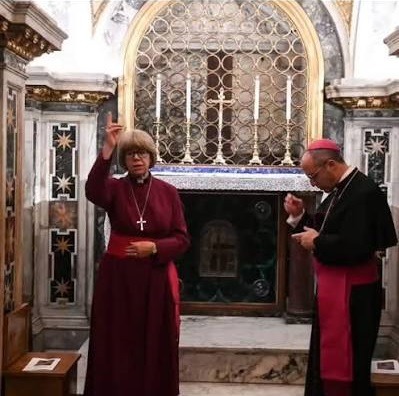
“what it means for them and for the Church.”
On the one hand, the antics that take place in German churches and in S. America are given a pass, but the faithful celebration of the Church’s liturgical rites is marginalized. What does that mean for the Church? Lex orandi.
“division among Christians is a painful point.”
Then don’t punch the bruised part.
“they refuse to accept some fundamental elements of the Church, starting with several points from the Second Vatican Council.”
Let me get this straight… the SSPX refuses “to accept some fundamental elements of the Church” and the starting point is “several points” Vatican II? When did “points” from Vatican II become the “fundamental elements of the Church”? And, please, which points are those again?
If I am not mistaken, the SSPX accepts everything in the Council documents which has been dogmatically defined. However, there are “several points” in the documents – which aren’t intended to define anything – which seem to contradict things which have been promulgated by Popes in the past. That makes those points matters for deeper discussion. Otherwise, you are merely forcing people to say that they accept something they don’t understand or which they disagree with.
“How many fingers am I holding up, Winston?’
‘Four.’
‘And if the party says that it is not four but five—then how many?’
‘Four.”
Is this what we are about now? What happened to John XXIII’s “In necessary things unity, in doubtful things liberty, in all things charity?”
This is a formula for moral injury.
“I’m sorry but we have to move on.”
Move on to… what? What does “moving on” involve and towards what?
3 So he told them this parable: 4 “What man of you, having a hundred sheep, if he has lost one of them,
does not leave the ninety-nine in the wilderness, and go after the one which is lost, until he finds itsays “Well… I still have 99, so that’s just too bad – gotta keep moving”? 5 And when he hasfound it, he lays it on his shoulders, rejoicingmoved on with his 99 sheep, he says, “¡Qué lástima, pero adiós!”. 6 And when he comes home, he calls together his friends and his neighbors, saying to them, ‘Rejoice with me, for I have found my sheep which was lost.I’ve walked together with an increasingly smaller flock, but that’s how things are because there are fundamental points which emerged in the 1960’s so important in 2026 that it’s time to move on’.
Nope. Sorry it’s time to move on. That sheep, well… too bad. Because,… points.
This is so confusing.
Meanwhile, I could point out that no matter what the high and mighty in the Church have since the Council done to the Church and her identity for the sake of “unity” with the Orthodox or Anglicans or Lutherans has resulted in true unity. They are still doing whatever they do, even though we’ve done backflips while juggling umbrellas to signal that we aren’t rigid and scary and, gosh, we don’t want to offend them. Fact: they’re not going to join up if we try to be like them.
I urge people to watch the second part of the SSPX video series about their missionary work.































SSPX needs to do what they need to do if only to point out the absurdity, blasphemy, and sacrilege rampant throughout the Church from those who ARE “obedient”, whatever that means, while holding on to and defending the evil they are doing in their confusing and misleading so many Catholics who take their words and actions as Truth. Hypocrisy at its worth allowing a Cupich or a McElroy or a Tobin or a Martin for a …. etc. to go on unchallenged by the Pope as if what THEY preach were… our faith, the Truth. It is neither.
Pope Leo will not talk with SSPX, but he is willing to talk with Islamic leaders. Jesus told his disciples to go and convert all nations, but Pope Leo cannot ask for prayers, rosaries, or novenas for the conversion of Islam because it would anger them and would end his peaceful dialogue with them.
Pope Leo is wisely returning to the approach of Ss. John Paul II and Paul VI towards the SSPX away from the Francis approach, which only sowed confusion in the Church. Blessed be God that we have a pope who does not tolerate open schism.
As one podcaster noted, there is no place for Tradition in the ‘synodal church’, that ‘ape of the church’.
Moving on seems the most sensible course. We should commit resources to ongoing negotiation to what end? Is there any rational basis to believe the SSPX will abandon their obstinance? When a defense of “necessity” is not coherently arguable, yet that is the one they put forward, is it possible to believe they are acting in good faith? What good will come of continuing? Let them go in peace and pray that the Good Lord has enough mercy left for them when He is done with us.
I don’t think it’s particularly helpful to complain about why the Holy Father might treat his different children differently. Why he treats the German children one way and the SSPX children another way.
Every good father I know understands that every child is different and tries to apply the medicine appropriate to that child. When it comes to questions of a child’s misbehavior the response must take into account the nature, character and temperament of the child.
For Catholics to complain about the unfairness of how the Pope is treating SSPX versus how he treats the German Church is akin to a child complaining “that it’s not fair to his parents” when seeing how they may have reacted to another childs misbehavior. That the response is different does not mean that it’s unfair or unjust.
That the german church misbehaves does not excuse the misbehavior of SSPX.
https://onepeterfive.com/the-sspx-oath-a-diocesan-priests-view/
It’s pretty sad, but it seems to strongly indicate exactly what direction Pope Leo wants to take the Church and explain why TC has not (and likely will not) be revoked, why bishops like Bishop Martin will not be reigned in, and why liturgy will continue to not be a topic at the Consistories. So far as Pope Leo is concerned, Vatican II is the Church and the Church is Vatican II. Nothing that came before matters. Nothing ill can ever be said of Vatican II. And if has been done in the name of Vatican II, it IS the new Tradition.
And I’m at the point where I couldn’t possibly care less about what the anti-SSPX critics have to say. I’ve yet to read anything from them that in any way contributes to the topic. The heart on that side seems to have been thoroughly hardened. Sacraments, souls, Tradition . . . none of it matters. Nothing can be considered except “Obedience uber alles.” I simply cannot understand such a mentality, and can no longer be bothered to try.
Four parishes in the Archdiocese of New York are advertising a full slate of Pride Month events. Some of them:
-“Gay Catholics Ministry will host a talk by Anwar Ogrm, a young Muslim trans man and a global advocate for trans people rights – about his journey of faith.”
-“Hot Dykes Melt ICE”
This Pride Month, Catholic Lesbians will host a drag show, featuring Alyssa See-Tho. The performance is rooted in the early days of LGBT herstory. We also will participate in Dyke March.”
-“Out at St Paul Pride Mass”
https://sfxavier.org/2026/05/pride-month-newletter/
This is 100% A-OK with the Archdiocese of New York and with the Holy See. Think of that whenever they brownbeat us about “accepting the Council”
We’re getting to the stage where people are addicted to being distressed and feeling hard done by. The Holy Father said some pretty vague and nondescript words intended to mean not much. Would be better for all concerned to take then in the spirit in which they were meant.
And not consecrate any bishops, obviously.
@ML
That analogy doesn’t quite fly. Paternal judgment does not supersede justice itself. If one child secretly got a job against a father’s wishes in order to earn money to help pay the family bills while the other child was busy physically abusing the mother and selling off the household possessions in order to buy drugs . . . if the father came down hard to punish the child with the secret job while ignoring or even rewarding the abusive drug addict, it would be grossly unjust and both the child and any decent outside observer would be justified in decrying the behavior of the father.
ALL: A point to consider.
Although it seems like a done deal and that SSPX will consecrate bishops will ye nill ye, they haven’t done it yet.
This is still hypothetical.
I hope and pray that something amazing will happen in the hearts and minds of those who make the decision and that an agreed and beneficial course forward can be executed. How amazing would that be?
Have you, dear reader, prayed for such a thing? That both sides will bend just enough so that this need not end up with excommunicated bishops and yet more talk about schism or non-schism?
The discipline with which the SSPX is threatened is without credence since the lash is spared on those promoting a host of moral and liturgical abuses.
I write as one who has not attended a Vetus Ordo Mass since the late sixties. I write as one who has observed over a lifetime the abuse of authority by the episcopate in countless situations — moral, theological and simply practical.
The only facet of Catholic doctrine, dogma and praxis exempt from alteration is the mighty stick of a bishop…ironically even the synodal operation which threatens their legitimate authority is a conivance to evicerate the very nature of the the Catholic Church.
Pope Leo serves us and his legacay, historical and eternal, very poorly if he does not sit down with the SSPX and fix this scandalous situation in accord with some uncomfortable truths. Declining to do so simple gives the upper hand to the SSPX.
I’m not in the habit of nitpicking the word choices of an off the cuff remark. That said, yes, what Pope Leo said is sad. I also think Fr. Pagliarani’s answer is distressing as well, because it leaves Rome with very few options. You cannot answer to someone asking you what would be your minimums to start a conversation with “I won’t propose minimums because that is your job, and also we can never agree so there’s no point in trying”, and then pretend that the other party is the one stonewalling your earnest attempts at communication and reconciliation.
Edit: also, I don’t think it’s wise, fair, or productive to identify the cause of tradition in general with the cause of the SSPX in particular.
In reply to Fr Zuhlsdorf: I could not agree with you more and a miracle of controlled sanity would be most welcome, but…. we are left with the fact, even if it happens, that so many prelates and clergy are blatantly disobedient to the Natural Law and to the long professed moral truths of the Church by their tolerance, even support of evil, not to mention the radical overhaul of our ancient liturgical practices.
If Pope Leo took 1/2 of the strong stand with the heretics among his bishops and priests, not to mention that of many in his Vatican offices, I don’t thunk anybody wood argue with his censuring SSPX; except that first part aint happenin’. The relative injustice of his stances– or rather failure to take one kind of stand while enforcing another– cannot but be disorienting.
I’d almost expect to see Pope Leo stamp his foot at SSPX over “thou shalt not disobey” (and we shouldn’t) while still saying nothing about Catholic(?) LGBTQ- and seamless-garment-promoting others. Terrible image of our lack of unity esp. because it is real.
Father, like you, I pray that both sides can bend enough to reach an agreement. Do you think the Vatican would accept a deal along the lines of the deal Lefebvre signed on 1988? One of things I’ve always found strange about the SSPX is that they refuse to try and interpret Vatican II in a way that’s more traditional and instead insist that modernist interpretations are accurate.
I’m sorry, the jig is up. I believed the lie for a long time that only the superficial aspects of the Church were being changed. But it is incredibly clear to me now not just superficial aspects have been changed, but the very essence of our Faith has been nullified. I see a rejection of the practice of the Apostolic Faith by Rome, with a pretense of still believing it. Believing is not just paying lip service to a truth. Believing is practicing that truth, and demanding that followers also practice that truth.
If a city has a law that says persons parking in certain spaces will be ticketed, but the leaders prevent issuing of tickets for parking there, then what is the use of the law?
The question is, has Rome apostatized? I’m thinking yes. And if it has, then what meaning does excommunication have?
“One of things I’ve always found strange about the SSPX is that they refuse to try and interpret Vatican II in a way that’s more traditional and instead insist that modernist interpretations are accurate.”
Why do you find it strange? It’s the hierarchy itself that has promoted and implemented the modernist interpretations over the past half century, with the only partial respite being the Ratzinger era.
The hermeneutic of continuity is dead and the hierarchy (and the papal magisterium, particularly since Bergoglio) killed it.
@thomistking – to be fair, there are 60 years of vague, confusing, and sometimes very modernist teaching coming from the Vatican and even from some popes that would very much give the average person the idea that the modernist interpretation of Vatican II is very accurate. Couple that with an almost obsessive refusal to curtail or silence the most fringe and most modernist voices in the Church, and it gives even more weight to the idea that Vatican II warrants a modernist interpretation. Heck, even the notion that one must pledge allegiance to, specifically, Vatican II in order to be in “full communion” is itself an implication that Vatican II must teach or promote something unique that cannot be found in the traditional and historical teaching of the Church. Given how little modern popes ever bother to reference any teaching or document from before Vatican II is another indicator.
If Vatican II requires copious amounts of research, study, footnotes, and caveats in order to make the interpretation obviously fit in line with the traditional teaching of the Church . . . then the absolute best that can be said is that the documents of Vatican II are almost criminally negligent, ought to be amended by the proper authorities to make the correct teaching unmistakably obvious, and that the experiment of phrasing the language of an ecumenical council in order to make it primarily “pastoral” in nature is a complete and utter failure.
I also pray deeply for mercy from the Holy Father. To ask himself why would there be a matter of necessity in this case? There are many who feel there is. I feel like there is.
Can the pope be fallible in matters of law?Peter was. Can he be fallible in matters of bishop selection? The apostles cast lots. Can he be fallible in lack of action? Peter denied Christ 3 times.
Sometimes drastic times call for drastic measures. The TLM largely survives to this day because the SSPX preserved it. They trained priests after sumorum pontificum. The society of St. Peter was born from them.
We all say we are willing to die for Christ but how many of us are willing to risk everything for Him and His church? St Paul was when he corrected Peter. The SSPX is.
I am not a member of SSPX but know many who are. Their devotion to the Church cannot be challenged. How many Saint’s had been excommunicated at one time?
ML-
But when it’s the same child getting the belt, doesn’t it become a matter of Justice ?
I am really confused why people think this issue is such a big deal. The world did not fall apart in 1988, nor did the Church. If anything, the 1988 consecrations helped the Church because it forced Pope JPII to have to accept agreements with a few groups who were willing to accept the terms offered to FSSPX in 1988, although it is my understanding that the Church has not completely fulfilled its side of the bargain with FSSP and ICKSP. What I am saying is the 1988 consecrations got the Latin Mass back in the Church to a much larger extent than otherwise would have happened. (Yes, I am aware that Aslan told Lucy that it is not given to anyone to know what would have happened.)
I am also troubled by what seems to me to be a sort of voluntarism regarding these consecrations: if the Pope says yes they are good, if he says no they are bad. This does not make any sense to me. Several of the clearly anti-FSSPX commenters here seem to understand this because they think the Pope saying Yes to consecrations is bad and a mistake. But not any Bishop or Pope is able to make an intrinsically evil action good by declaring it good, nor can he make an action intrinsically good bad. The only argument that seems be raised against the FSSPX is that they don’t obey the Pope, but if they for good reason—in this case the salvation of souls—disobey the Pope their action is not intrinsically bad.
By the way, I have only been to one FSSPX mass, a low Mass way back in 2005.
I find the complaints about those on the left here a bit disingenuous— since everyone’s favorite topic seems to be gay issues, the Holy Father has made clear that he is not currently willing to go beyond FS and Tucho has been actively reigning in the Germans, both by sending them letters reminding them of the law and by talking to them… so exactly the approach that’s being taken with the SSPX.
The big difference here is that no one on the left is committing a delict that carries with it the penalty of latae sententiae excommunication. The closest would be those who attempt to ordain female priests, and they are promptly excommunicated. Even with all the pride things people are raising — theological speculation around that is not the same as formal heresy.
There is currently only one group within the Church that is broadcasting for the entire world that they refuse to accept the supremacy of the Roman pontiff in matters of governance, and that is taking active steps to enter into formal schism. That shakes at the foundations of Catholicism like none of the whataboutism does.
God rest his soul, Pope Francis made it his pet cause to constantly rail against trads as backward-looking, mentally ill troglodytes. With the incomparable zeal of a true believer, he routinely denounced trads and all our works and all our pomps. Franciscus, Pontifex, Malleus Traditionalistarum… What’s my point? Well, perhaps Pope Leo isn’t the trad-friendly pope of our hopes and prayers… the pontiff who’s going to treat the SSPX fairly… the man who will restore the TLM to its proper place in the life of the Church. BUT am I really alone in welcoming him as a pope who to a great extent seems to leave us alone and at least does not seem to consider one of his primary roles as to be our scourge?
The Novus Ordo is the Ape of the Church. You MUST believe it is valid! You MUST believe in Vatican II!
As in The Emperor’s New Clothes, the Church doesn’t believe it is naked.
Father and all here – I am a faithful Catholic and Third Order Franciscan who has always belonged to a Novus Ordo parish, where the Mass, devotions, Sacraments, and everything else is celebrated and honored in accord with the teaching and reverence of the Church. I do sympathize with those of you who prefer the TLM, just as I do with those of the Eastern Rites.
As I see it in, in my admittedly outsider’s view, the SSPX crowd is blatantly defying Pope Leo and the efforts of past popes to bring them into full communion with the Church. Pope Leo and the past several popes have, in considerable humility, done their best to come to an agreement with the SSPX, to give them a full and dignified place with us.
The leadership of the SSPX, however, seems to place themselves on a pedestal, speaking with condescension and a real lack of Catholic humility in dealing with all these popes, and continuing in their obstinate, divisive efforts to ordain their “own” priests and bishops – and maintaining a wall of disobedience and rancor between themselves and the rest of the Catholic Church and all its Rites.
Please understand that when I say this, I do not include my fellow Catholics who prefer and love the TLM so much, and who place themselves under the leadership of the local Catholic bishops. In fact, my sister parish is designated as the site of a TLM every week and we welcome them warmly. They are under the jurisdiction and spiritual protection of our good Bishop, just as the rest of us are, and they are indeed our beloved family.
The SSPX, IMO, has done this to themselves. It could have all gone forward and come to a happy conclusion if they had humbled themselves and followed the direction of Pope Leo and past popes.
I don’t think either the Vatican or the SSPX is handling the issue particularly well. That said, I don’t have a direct link with the latter but I do indeed share some questions and concerns, hesitations if you will, about Vatican II.
Unfortunately, Pope Leo seems willing, like others, to make it a non-dogmatic-yet-ultra-dogmatic Uber-Council (TM). What elements of Vatican II are “fundamental” to the Church? Are they novations not found before, such that the SSPX is hesitant about them? Or is it simply rupturous interpretations thereof? Answering “yes” to either of those questions could lead one to some very awkward conclusions indeed.
Recalling that Abp. Lefebvre signed on to every document of the Council itself, but not what followed… where is the divergence? Unless we are to take the emanations and penumbras of the post-conciliar interpretations of the Council as just as definitive and unquestionable as the non-dogmatic Council itself. This also seems to be a read that some of the post-conciliar popes have held, such as insisting that the Consilium’s fabrication of the Novus Ordo is inextricably linked with, and completely implements, Sacrosanctum Concilium, which it is easy to see… it doesn’t.
Well, I didn’t mean to get so rambly. But Pope Leo’s statement here raises more questions for me than it answers.
I believe Sspx makes a strong case for the crisis in the Church. However I agree with Fr, Gerald Murray that the consecration of new bishops without papal mandate is not a remedy for the crisis. They seem destined to appear as a separate magisterium. If the fraternity of St Peter can honor and maintain the tradition, then it would be possible for sspx
Charity? Mercy? Pastoral concern? Unfortunately, these concepts in the Church only apply in one direction, just as in politics many on the left believe in the rule of “no enemies on the left”. Although many bishops are quite willing to tolerate all sort of abuses on the”left”, on what they perceive as the “right” there is nothing but strict by the book enforcement. Our parish has been blessed for 10 years by a pastor who, in addition to offering a very reverent Novus Ordo, is authorized to also offer the Traditional Latin Mass and we usually have a Missa Cantata every Sunday and also on special occasions. Unfortunately, our pastor is retiring and although he previously trained or new pastor, our new bishop refuses to request a dispensation from Rome to allow the TLM to continue. The TLM, is well attended, has a large group of dedicated altar servers, and an excellent trained choir. Interestingly, the TLM is attended by several large families with small children and some of them are Spanish speaking who prefer the TLM over our Spanish Mass. We have begged the bishop for charity to no effect. Letters, petitions, all to no effect. He has even refused an invitation to simply attend our TLM and talk to us before shutting us down. Charity? No where to be found.
The Vatican has gotten so good at apologizing to actual heretics and schismatics… perhaps that is proof that they consider SSPX to be neither ;-)
I really expected better than “don’t do that” from Pope Leo, frankly “I’m sorry but we have to move on” sounds too much like something
the ClintonsArchbishop Roche might have written! “[Let’s] get on with it without licking one’s wounds”… “Better put a little ice on that”… “I’m sorry but we have to move on”… yup, same ring! One can only hope H.H. is getting some informed info and advice, i.e. other than from +Roche, +Fernandez, et al!(There has to be a better way… it’s very likely that one overstuffed German cardinal will do more harm to the church than four illicit SSPX bishops!)
Could someone who is angry that this is a one-sided call for obedience please provide an example of where a left-leaning group publicly committed formally and materially a delict that carried with it the penalty of latae sententiae excommunication and did not have an excommunication proclaimed by the Holy See.
I am not aware of any, but I’ll happily write the Holy See asking that said excommunication be proclaimed. The examples people are giving in comments aren’t proscribed as such in the 1983 CIC. Consecrating bishops without a mandate from the Roman pontiff is.
I have sadly and reluctantly come to the conclusion that Pope Leo is a nicer version of Pope Francis. So he prays in Latin now and then and sings some traditional hymns and chants, his actions declare he will further the aims of his predecessor. He does little to nothing to protect the Church from the scourge of modernism.
While we are promised that the Gates of Hell will not prevail against the Church, it remains an open question whether we ourselves will survive unscathed.
@R2D – Can 1364 applies, but if folks provide you a boat load of examples of heretics not being punished, you’ll simply poo-poo it away with a “but they must be okay because they didn’t consecrate their own bishops” logic.
There is more in heaven and earth than the consecration of bishops. For you to attempt to reduce the reality of the Church, the complexities of papal authority, and the rich and nuanced history of the Sacred Tradition, the Faith, and the ecclesiology of the Church into your strict, binary, and quite absurd rubric doesn’t win any arguments and convinces nobody.
Claiming that, “the guys praising and giving awards to pro-abortionists” are okay and “the pro-LGBTQ+ activists” are okay and “the ones pushing for women priests” are okay and “the ones promoting the grossest and most inappropriate forms of liturgical abuse” are okay because they haven’t consecrated a bishop without papal approval is not only silly, it misses the point that the most liberal and progressive of folks have been allowed to get their own folks consecrated as bishops and cardinals WITH papal approval, so they’ve never even had to consider any other option.
@R2D
Sure, various consecrations of the Chinese bishops were done without papal mandate, then backdated after the fact. Let’s Google it:
Key Unapproved Consecrations
Over the decades, Beijing has unilaterally installed numerous bishops. Some notable episodes include:
The 2006 Ordinations: The CPCA consecrated Ma Yinglin (Kunming) and Liu Xinhong (Anhui) without a papal mandate, prompting intense protests and threats of excommunication from Rome.
The Shanghai Incident (2023): Authorities unilaterally transferred Bishop Joseph Shen Bin to head the high-profile Diocese of Shanghai. Three months later, Pope Francis approved the appointment after the fact to preserve the “greater good” of the local diocese.
The Shanghai Interregnum (2025): Following the death of Pope Francis, and during the papal vacancy (interregnum), the state-controlled church proceeded with the illicit consecration of Father Joseph Wu Jianlin as auxiliary bishop of Shanghai, representing a severe breach of canonical protocol.
In My life I have seen some Good Bishops consecrated. I have also seen some consecrated Bishops and wondered what were they thinking?
The SSPX has been around a long time and has been very successful. Are they perfect? No, but who is.
When I read these discussions from the recent Pope’s I see fear. They fear truth, tradition, devotion and growth. For many years and Popes we have seen with the N O declining numbers, churches closed and sold and scandal
The Vatican is dealing with the SSPX and the Germans in pretty much the same way. Letters, warnings… patience and mercy. Even Francis extended faculties for absolving sin to the SSPX.
The Germans drive me nuts. They are heretics or at least flirting with heresy (I have no authority to declare someone a heretic)…. But there is a key difference. The SSPX cross THE line: illicit consecrations. So far, the Germans have stopped short of their line (IMO that would be the permanent synodal council, which strips bishops of their divine authority… the Vatican said NO and so far they haven’t crossed the line).
@R2D (and maybe others) – the way you put it is as if “obedience” is *the* principal virtue. What about Faith? The problems on the “left” (as some here identify it) concern their willingness to deviate in matters of Faith, whereas the SSPX problems with Vatican II are all about how (as demanded of them) to “accept” Vatican II and its apparent doctrinal innovations without compromising the Faith in the process. IOW the SSPX dilemma is about what they see as a conflict between Faith and obedience, whereas the other side doesn’t *seem* troubled too much by either (NB “seem” because I am shy of judging others).
Moreover “Consecrating bishops without a mandate from the Roman pontiff”, while not to be done lightly, is hardly a matter foundational to the Faith … hasn’t it only been an excommunicable offence since PiusXII in the 1950s? For a very long time since the foundation of the Church there were plenty of bishops consecrated without the pope’s involvement or even knowledge. And what about the Eastern Catholic churches even today? (the CIC applying only to the Latin church).
It seems as if we have two competing views of the Church: (1) do your best to hold fast to what the Church has always believed, and be prepared to suffer the (worldly) consequences for not compromising; (2) do and believe today whatever the Pope says today to do; do and believe tomorrow whatever he says tomorrow to do. One of these views is Catholic, the other is literally Orwellian.
To conclude: if the People in Charge wanted to show that they had the right priorities, they would do well to resolve people’s legitimate anxieties about Vatican II and its implications for Faith rather than demand (blind) acquiescence. If that all seems a bit too hard, there’s a lot of material on the WWW where people have tried helpfully (if not necessarily immediately compellingly) to reconcile Vatican II with earlier dogmatic pronouncements for them to use as a starter.
@James C and WVC: I would more or less align myself with the view given here: https://rorate-caeli.blogspot.com/2026/06/the-sspx-consecrations-separatism-is.html?m=1
I also disagree that the hermeneutic of continuity is dead. Benedict XVI, while imperfect, was the greatest theologian in centuries to hold the Chair of Peter. A theological lightweight like Pope Francis will not simply erase his legacy in the long run. For all the nonsense we are currently dealing with, Benedict’s vision of the Church will prevail. Things are dramatically improved at the ground level. I’m involved in the education of seminarians and all of them are devout, traditional young men who care deeply about liturgy, orthodoxy and love God. They are the future of the Church. It will take time, but we must be patient.
When the SSPX first announced they were only allowing five months to work things out with Rome before pulling the trigger on more episcopal consecrations, my immediate impression was that this was simply not enough time. Compare to June 1987 when Archbishop Lefebvre announced consecrations for the following June. It took eleven months to reach the agreement of May 5th, 1988, and another few weeks to reach the agreement for one bishop to be consecrated on August 15th, 1988. I suspect many today do not remember that these agreements were reached since they fell apart, but they do serve to show how much time is needed. It took six months after the announcement just to set up the canonical visit by Cardinal Gagnon to Ecône in December 1987.
Also compare to the beginning of the papacy of Pope Benedict XVI. He needed two full years to get his own Curia in order before feeling ready to issue Summorum Pontificum. Surely the SSPX can spare a couple of years to let Pope Leo settle in and set the course for his papacy. Springing this on pope Leo after less than a year at the helm and with only 5 months of negotiations seems to me calculated to make negotiations fail.
I dare say “to live the communion” of the Church would definitely include not consecrating bishops in direct violation of canon law…
Moving on means:
– The SSPX will ordain new Bishops, and the Bishops will be excommunicated.
– Sooner or later, the Ecclesiae Dei communities will realize that a trap was set for them when they find out “moving on” really meant abolishing the TLM. Some will say no way that will happen, but that is exactly what TC called for.
As far as the “fundamental elements of Vatican II” that aren’t followed, literally no Catholic I know follows the “fundamental elements”. Several documents have superseded the Council teaching in some areas. Other elements are subject to wide interpretation. The Society objects to the elements that many other well-meaning Catholics do too. In fact, Popes since the Council have varied in their understanding and interpretation. There is simply no monolith at all when it comes to the Council. I would even argue that the SSPX does a better job of following the Council (i.e. use of Latin, pipe organ, and Gregorian Chant) than much of the rest of the church.
What you really know with statements like this is how far separated from reality Rome is from people who take Catholicism seriously when practicing the faith. They just have no idea or are willfully ignorant. Leo even said as much when he spoke about the TLM in 2025, acknowledging that he did not know much about traditional communities or the traditional liturgy.
@WVC/paulbailes: I won’t poo-poo it, but I also think you don’t have a good understanding of what heresy is. The examples here are usually on moral questions related to the natural law that have never been defined in a way requiring the highest level of assent. If there’s a priest publicly teaching against transubstantition and widely promoting it on the internet, that’s a heresy and DDF and/or the local bishop would very likely proclaim an excommunication. Fr. James Martin, SJ, the usual example held up here, is actually very careful not to cross that line. Yes, we all know what he very likely really thinks, but his statements are usually carefully worded not to cross lines that would cause him to enter into formal heresy. Definitions matter.
And, no, I don’t think obedience is the primary virtue, but I do think Petrine primacy is an infalibly defined dogma and that the universal supremacy of the Roman pontiff in matters of governance is a core tenant of the Catholic Faith in ways that teachings on natural law are not, as Catholic understanding of the natural law is not divinely revealed truth but rather human understanding of laws written on every human heart that are discoverable through reason alone. Because of that, the Church does allow more flexibility in internal discussions on moral questions than on dogma as teaching can evolve as our understanding of the natural moral law becomes deeper.
Dogma is divinely revealed truth that cannot change. A bishop who consecrates another bishop without the pontifical mandate “implies in practice the rejection of the Roman primacy” (St. John Paul II, Ecclesia dei adflicta). That is to say by his actions rejects the divinely revealed truth of Petrine primacy and universal jurisdiction.
It is not just a matter of obedience. It is a matter of rejecting the divinely revealed Catholic Faith. It is more foundational than any of the usual complaints about liberals (except the ordination of women, which is also a rejection of the divinely revealed Catholic Faith)
Lurker 59: good examples. The historical ones I think put the CPCA in the same category as the SSPX post-1989, and Francis essentially provided them the Benedict option with the SSPX.
The more recent consecrations are more troubling, but the difference is that they involve an agreement between two sovereign states (the PRC and the Holy See), where that agreement would take precedence over the CIC. I think the agreement should be public, so I’ll agree with that criticism, but this is in line with historical concordats that have given governments authority in the appointment of bishops. It’s a different situation as the governing law includes a non-public document that is allowed to diverge from the CIC.
@thomistking
I’m thankful for young seminarians who care deeply about the faith and the liturgy, but the practical reality is that the current vision of the Church being driven almost entirely by the personal whims of the current bishop (or pope) is not Catholic, not practical, and not sustainable. While I wish the best for all young, faithful seminarians and priests, they will have absolutely no recourse whatsoever under the current system if they get stuck under a Bishop Martin. Or if a Bishop Martin gets transferred to their diocese. We don’t have to imagine what this looks like – we have copious real world examples. We already have an example of bishops simply firing seminarian teachers for being too orthodox. And if Fr. Jimmy Martin were installed tomorrow to be the head theologian at the seminary, there’s nothing any of the seminarians can do about it. Seed corn needs to be protected if we expect it to yield fruit. And the ground has to be prepared if want what’s planted to take root. Trying to grow corn underneath an active lawn mower doesn’t result in a fertile future crop, regardless of how many seeds are planted.
I think many faithful Catholics, even after Pope Francis lifted the veil for a bit, woefully underestimate the ruthlessness and hatred the enemies of the Church have against faithful priests. And many of those enemies wear pointy hats. The SSPX exists as a lifeboat for those who would otherwise drown. While the lifeboat is far from a perfect solution, until we’re in a place to right the ship and sail away from the shoal waters it would be imprudent to scuttle the lifeboat. The future can’t be the only concern – there are folks today, right now, who need baptism and confirmation and marriage and extreme unction and sound catechism and solid formation.
If the Catholic Church is a stool with 3 legs – Sacred Tradition, Sacred Scripture, and the Magisterium – there can be no hermeneutic of continuity if the Magisterial leg saws off one of the other 2 legs, regardless of what Pope Benedict taught. We’re actually in a crisis that is more about authority (and the rejection of its legitimate limitations) than theology or liturgy. Historically speaking, abuse of authority that is not vigorously opposed often becomes justification for the eventual legitimization of that abuse as “normal” – if nothing is done then the idea that the pope and even individual bishops have the power to change or suppress the liturgy with no further justification than their own desire will be accepted as true. This is the reduction of the stool to just one leg, in which case, we all fall down.
For whatever merits may be in the written words of the documents of Vatican II, the saw that has been wielded for 60 years has been Vatican II. Using Fidelity to Vatican II as the sole point of reference in order to be considered Catholic is crazy. It’s like asking the wooden legs to pledge allegiance to the saw.
@thomistking
I posit that the hermeneutic of continuity, as a viable hypothesis, died when Pope Benedict abdicated. It still has its adherents, but none hold real levers of power within the Church (and by that I mean the kerygmatic proclamation of the institutional Church). It is definitely a hypothesis for the bookish (of which I am one), but it has no ability to move your local parish priest, let alone bishop. Outliers, perhaps, but that is not the common place.
As an example, in the Roman Rite, the laity kneel to receive communion. Try getting your local priest to install a communion rail so that living in continuity with the doxology and praxis is continuous in a manner that maximizes piety and is advantageous to the elderly and those with bad knees.
@Fr Jackson
We are many years from the 1980’s. The SSPX’s position isn’t a moving target. There is no reason for the SSPX to wait on Pope Leo as switching popes doesn’t mean that the content of the Faith has changed, and the Pope needs to figure out what the Faith is, or that the Faith is in a process of “becoming through synodality” and that we “have to trust the process”. If that is the case, then we are in real trouble. (As a side note, there can be some real laxity in what Catholics are required to believe. For example, transubstantiation is a dogma, but one not accept the Aristotelian conceptual way of understanding it. The East sure doesn’t.)
@ Geoffrey
Communion doesn’t flow from the Law nor the Pope. It flows from Christ, who binds all through the bonds of charity. The Church isn’t built on legal positivism, whereas most of Protestantism and hence America is. Lots of people, especially Americans, treat Canon Law as if it were.
@paulbailes
I concur. Charity is what brings obedience. Obedience is not the highest of virtues; charity is, and charity can mandate a “disobedient” action. Further, the Pope is not the spiritual father of the other bishops — they are on the same level of brothers and equals in dignity. The Papal Office isn’t a superbishop, but people treat it as if it were. The papal mandate from the pope to the bishops is for him to support them as the servants of the servants of God. They are to work together as a college of bishops, not just of this generation, but apostolically with all who have come before them.
//
Clearly, the SSPX do not follow an attitude of the Pope says, “Jump,” you say, “How high?” If that is to be the case, you will have the entire East (Catholic and Orthodox) balk. The central aspect of communion MUST MUST MUST be understood liturgically — is the Pope mentioned in the Canon of the Mass? Is the liturgical action valid using the Roman Rite? Ok, you have baseline communion. SO then if the Faith is the same at the core of it, which is the liturgical action of the Mass, then why are we using excommunication to deal with juridical issues in the realm of human law? Utilizing a spiritual consequence/repercussion for what amounts to an infraction against institutional bureaucratic rules is more than just a little bit uncharitable.
A small “point of order” on language and usage: a comment above included the term “poo-poo [sic]”. It’s pretty obvious that the writer intended the idiom to connote contempt for an idea, but – given the scatological connotation of that particular spelling – the phrase is usually written (with apologies to the fictitious bear) as “pooh-pooh”… unless, I suppose, one intends to very pointedly convey his utter… execration of a given notion ;-)
@Lurker59 I’d argue that the hermeneutic of continuity is very much not dead in either theoretical or practical terms.
Theoretically: after BXVI’s pontificate came Francis’ pontificate, which pushed Pastor Aeternus against the ropes and then kept pushing really hard. A radical, literal, stand-alone reading of that Dogmatic Constitution was not possible before Francis, much less so now. In order for things to make sense, it has to be read in continuity with everything that came before, in a way that “”””relativizes”””” the supreme and direct jurisdiction of the Pope and the obedience due to him, that nobody can judge the judgement of the Holy See, etc. Which is more or less the position the FSSPX is in right now, if they are to avoid sedevacantism (there is a bit of a paradox there, that in order to refuse to read VII in continuity you need to read VI in continuity). The hermeneutic of continuity is not an ad hoc thesis to address VII specifically and exclusively, but the way to make sense of infallibility and its relationship with the magisterium in the context of History as a whole.
Practically: I think a good number of people need to stop gauging the state of the average parish by twitter accounts and Catholic news sites dedicated to controversy and publicizing abuses. I mean it. General trends towards Catholic clergy becoming more “conservative”, an increase of Eucharistic devotion and piety, etc, are real, and have not been reversed by Francis’ pontificate. In my diocese back in the early 2000s, the only people kneeling during consecration were Opus Dei folk and one or two more. Nowadays almost everyone does. Eucharistic adoration was unheard of; nowadays there are at least two perpetual adoration chapels, besides a growing number of parishes offering daily adoration.
People also overestimate how much real power “holding real levers of power” in the Church means. +Martin and +Colombo and +McElroy can be petty tyrants about kneeling, but they cannot force people to think and believe as they want them to. The heavy-handed attempts at stopping this trend on their part means that they see it as real and as a serious threat (which makes it sad to me when, because it is a convenient argument, those on the opposite side of the isle insist on denying it), and it speaks volumes of their awareness of the limits of their power. The Kingdom of Heaven is not like a conquering emperor, or a terror-striking army; it is like the grain of mustard, and the little bit of leaven. Or as BXVI would put it, the world is destroyed by the impatience of men, and redeemed by the patience of God.
@Archlaic
I apologize. No inappropriate references intended. I was earnestly unaware that there was a specific spelling for that phrase.
@wvc:
No offense taken, no apology necessary! Over the years I’ve found that I really appreciate it when a colleague has cared to suggest an improvement in some terminology or usage of mine. Pax!
To all those who are saying that the German bishops are not breaking any canon law which carries automatic excommunication: they don’t need to. Why are so many clergy with heretical records even approved to become bishops in the first place? Would there be so many heretical bishops to make a synodal way there if Rome did not approve? Meanwhile, Rome vetoed the almost-signed Prelature agreement between SSPX and Ecclesia Dei in 2016, which agreed to treat SSPX’s disputed Vatican II points as guides on pastoral practice rather than doctrine. There is still time for Rome to accept the 2016 Pozzo proposal. Will they?
@Dantesque
Being of the bookish sort, I find your theoretically section to underscore my point that the hermeneutic of continuity (HC) only exists as a hypothetical that when put to the test, is unworkable. I agree that the HC is not just for VII, but it is specifically for it as the position of HC, simply put, is that if VII is read according to the HC, then it produces an orthodox reading. HOWEVER, and I think you will agree with me, the JPII and Ratzingerian wing of the Church found that the praxis of the Church following VII was not exactly orthopraxis because VII was not read according to the HC and thus produced all sorts of non-fruits. The corrective measure to fix what ails the Church, again according to that wing of bookish prelates, was “if only VII was read according to the HC” then orthopraxis would return to the Church and you would have JPII’s “new springtime”.
However, and very clearly, BXVI’s pontificate can be viewed as an attempt to put the HC into practice in the Church. BXVI’s abdication is many things, one of which is the abdication of the HC position. If it were a viable project, BXVI would have stayed the course. He chose not to, for many reasons, amongst which was the unworkability of the HC project. BXVI was no fool — if he was unable to get the HC hypothesis to work, the hermeneutic of discontinuity (HDC) would become much more than the dominant position; it would be shown to be the only viable position, which it did under Pope Francis and now Pope Leo (who just soft-sells the HDC).
To your practicality: First, I don’t know who you are addressing here. In my experience, the catholic clergy, on the ground, in my own diocese, whom I have talked to, are more conservative for two reasons 1.) Following COVID, they realized that the pope and their local bishop don’t care about them or their parishioners. 2.) they are thus more likely to read VII independently of top-down obedience pressure as the “bond of charity” has been gravely weakened and they are reading VII much more in a hermeneutic of discontinuity manner (even if they don’t admit it) and who, if you speak to them in private, will be willing to talk about the problems with the document. Though, to be fair, academia, both orthodox and heterodox, has never been shy about pointing out the problems with the document. The only place that you really find “it’s all good, nothing to see here” arguments are within diocesan formation and catechetical texts (because they need diocesan approval).
To push my argument a bit further in terms of practicality — you go tomorrow and talk with your local priest about contributing to a fund to construct an altar rail in your parish. Offer real money. See what happens. I have done this myself. Further, ask your local priest how you can go about better praying the pre-Vatican II Breviary. Ask your local priest about getting a child baptized using the pre-VII baptismal rite. All three of these things are normative things of the Latin Church that would produce, if the HC were a viable hypothesis, real-world results that would have real tangible impacts upon the salvation of souls (not just arguments amongst the bookish).
But insofar as Catholic clergy are a bit more conservative nowadays, my hypothesis is that it is not because they are adhering more to VII, but rather that they, like the liberal heterodox clergy, have decided to move beyond it to a new paradigm.
And YES I really do mean that, unless a working viable alternative hypothesis can be produced, then the logical conclusion of the HDC that the modern Church is something new and different from the Church prior to VII must be reached. Again, that is not my conclusion but the conclusion of the proponents of the HDC school of thought and can be found within the pages of Communion and Liberation, as well as those who apply that practically via the synodal church project. We are in the period of falsification for the HDC, where HDC moves from being a hypothesis to a working theory, and once a working theory, teaching and acting contrary to it IS NOT A RATIONAL OPTION.
“The Middle/Broad Church” in Anglicanism proved to be unviable. The trajectory in Catholicism indicates that it will be unviable here as well.
I’ve thought about this a bit and I think I’ve come up with a solution that is good for the overall Church.
First, give the SSPX the sacre to consecrate the 4 bishops. However, in that same order authorizing the consecrations, there are also orders assigning each of the 4 bishops to an existing diocese (each one to a different diocese) as an auxiliary bishop. In this way, the SSPX bishops will have full faculties to minister within their respective assigned dioceses, but if they try to do any priestly acts outside of their assigned diocese without permission given by or invited by the local ordinary, there will be no doubt that the given SSPX bishop has run afoul of the rule, certified by the 2nd ecumenical council, that acting outside of his assigned territory without being invited to is forbidden.
This would only apply to the bishops. The priests are still in the standing of limited, explicit faculties only until the SSPX is regularized.
Not yet having caught up, here, and scrolling to the current ‘end’, Catholic Tech Geek makes me aware how grossly ignorant I am of the history of the episcopacy. For, my immediate thought reading his comment was, that it would surely be even better if the Holy Father should follow the example of Pope Sergius III in consecrating St. Clement Willibrord or of Pope Gregory II in consecrating St. Boniface Winfrid bishops with a wider scope (Francis Mershman’s 1907 Catholic Encyclopedia article on the latter uses the words “consecrated him a regional bishop”). Has such a thing become canonically impossible?
(Matthew 7:9) Or what man of you, if his son asks him for bread, will give him a stone? Or if he asks for a fish, will give him a serpent?
Apparently Pope Leo. If his son asks for permission to ordain bishops, his response is to prepare a decree of excommunication and schism.
Our parish offers a daily prayer for vocations. What if the Lord has answered that prayer through the SSPX which seems to have abundant vocations?
The priest where I went to Mass this morning began with a greeting, a joke and an attempt to “break the ice” as he was substituting for our regular pastor. For his homily, he came down from the altar into the aisle. I can’t but help notice that the Novus Ordo is failing to habituate priests towards an attitude of reverence when they say Mass. And this is shameful. If the priests are not habituated to reverence and holiness, what are they doing? And who would want to answer the call to become a priest after the mold of what I witnessed this morning?
The SSPX is growing while much of the Western Church is dying. You shall know them by their fruits.
I’m so sick and tired of the negative comments about Pope Leo.
Qui conversus, dixit Petro : Vade post me Satana, scandalum es mihi : quia non sapis ea quae Dei sunt, sed ea quae hominum.
Scholiast: I’m so tired of the negative comments about Pope Peter.
Abbot: Putasne intelligis quae legis?
@lurker59
(I am sorry for the late response)
The thing is that the HC is not a hypothesis, or the first premise in a conditional syllogism. It is by its very definition, a form of interpretation: how do I decode or understand what is said to me and what is asked of me. The HC is not ““if only VII was read according to the HC then orthopraxis would return to the Church and you would have JPII’s “new springtime”. The HC is the procedural consequence of the Church’s indefectibility. All forms of Protestantism that rest upon the idea that at some point the Catholic Church broke with the faith of early Christians are HDCs, and are inadmissible to us because that would mean the Church defected, and if the Church defected then Christianity is false because Christ promised indefectibility. Same case here. If we sustain that an ecumenical council outright taught heresy and founded a new Church, then Christianity is false. In plain terms, a good faith reading is demanded of us, and one that continually relates the new to the old as the key of interpretation. The HDC is in itself incompatible with the faith.
I cannot, of course, comment on what is happening on your own diocese, or judge whether you are right or wrong in your assessment. What I can say is that the trend I’m pointing out, as I have seen it, precedes COVID by many years. It’s slow and steady, and it is the reason why the type of prelates I’ve mentioned are so virulent in their responses. Nobody who thinks they have won or are winning express this level of what is, from their POV, strong paranoia.
I don’t see how your examples relate to mine. I didn’t say that you would get an altar rail if you asked and offered to pay for it in any parish. My examples are points to illustrate a trend. The trend is not towards more liturgical abuses, more sloppiness, more modernist theology, but on the opposite direction. Cutting a tree is done in less than a half hour, growing a tree takes years. It’s no different when it comes to people and the faith.
I’m not sure I understand your argument about adhering more strongly or moving beyond VII to a new paradigm as it relates to the HC. Naturally, if the purpose of the HC is an understanding of the VII as embedded within the context of Scripture and Tradition, then it has to be understood as one more between others, for which, in its temporal aspect, the urgency or immediacy would obviously fade with time. Conservative Catholics moving beyond VII and integrating it an application of HC rather than its falsation.
@Dantesque
I’ll be brief.
By definition, the HC/HDC are interpretative lenses — they are not Rosetta Stone decoder rings. The HC is a way of looking at things, and Ratzinger was proposing the HC as a hypothetical framework of axioms that he wanted people to adopt. In no way, shape, or form does it (or did it exist) at the level of epistemological fact. a priori truth, and or doctrinal definition.
“Error” in an Ecumenical Council can be dealt with in multiple ways other than saying that Christianity is false. 1.) Ignore it. Canon 29 of the Second Lateran Council. 2.) Declare that the Council never was an Eccumenical Council. That has happened multiple times before. 3.) Consider that the council made hash of things and revisit it. Nicea’s homoousius as read at that time is a compromise position that could be and was considered a rupture. Caused a mess. Constantinople I was needed to fix the rupture and bring doctrine back into line.
Further, and to be very clear, those who support HDC for a liberal and progressive end do not see the problem with indefectability that you are suggesting. Rather, they see that precisely because the council taught the “spirit of Vatican II “^TM that proves indefectability. In a real sense, their argument is the same as the HC argument — whatever a true eccumenical council teaches is true. It cannot teach heresy. Thus, as they say, you had better get along with the program.
As a Protestant convert, Protestants don’t reject indefectibility; it is just located and defined differently, say in the invisible Church or the perspicuity of scripture — not institutional autocracy (VI’s version of “the spirit of VII”^tm). You seem to be defining it in a particular sort of way. I am trying to suggest that Benedict’s abdication took his definition off the table — a new way forward is needed.
And that is my point about young conservative priests post COVID — they are not sitting there reading VII, they are not integrating it. They have moved past it. Just as the progressive priests don’t sit there and read VII and integrate it — they are off doing their own thing.
Which is a thing that has always been….if you go back and read ecumenical councils, you will find a whole bunch of iffy things in them that the Church simply moves on from BECAUSE the Church is not a conciliar Church — she is not a synodal Church.
@Lurker59
“Interpretive lens” and “hypothetical framework of axioms” are not the same thing. The second thing, similarly to a Kuhnian paradigm, is falsable at the level of empirical testing of premises derived from those axioms. The first one is not. It is also not an epistemological fact, a priori truth, or doctrinal definition. What it has to be to be true is consistency with other elements that are such.
If one were to really admit those as ruptures in the sense HdCs understand VII, then we should have, effectively, things like anti-Constantinople traditionalists. But we don’t. We understand there’s a crucial difference between “confusing”, “messy”, “oopsie”, and “heresy”.
It is evident that HdC does not care for the indefectibility thing because its modernist, in the technical sense of the term. It is in no way the same premise of the HC, because what the HC proposes is that, when in doubt, things must be read in continuity and congruence with the rest of tradition.
I didn’t say protestants in toto, I said protestants that sustain x. I was in no way pretending to talk about the totality of protestantism. I was also not sustaining a form of BXVI Ultramontanism, and I don’t see how can that be concluded from what I’ve been saying. I have been arguing for the HC to be true on its own grounds, and not based on an authority argument because BXVI was Pope.
The question of whether they are integrating VII or not in the particular sense you seem to use (i.e. what an application of the texts as they are would look like) I think is too large and complicated to be addressed in an exchange like this one (and I think I have tried Fr. Z’s patience enough). My claims are much more modest. I’m saying that moving on and considering the VII as one more of the councils is perfectly consistent with an HC. I can’t imagine a parish pastor deeply preoccupied with the implementation of council X or Y 60 years after its conclusion, other than, perhaps, Trent. That doesn’t mean they were rejecting such councils. The progressive priests thing is different. It’s about moving forward and farther away but still inside a perception of VII as a starting point of sorts.
Whether the Church is conciliar or synodal depends a lot on the uses of language. Are we using it in a merely adjective way, or are we talking about the trojan horses? Because Eastern Catholic Churches are all governed by synods. That would stricto sensu make them synodal. But of course that doesn’t mean they are some sort of democratic liberal assemblies, which is what the German Synodal Way is. Councils are an important part of the life and history of the Church, and in that sense the Church is conciliar. Certainly it isn’t conciliar if by that we mean a new church that somehow belongs to one specific council and not any other.
@Dantesque
Being very brief.
The synod/synodal argument is the same as the deaconesses’ argument. The early Church had them, the modern Church must have them, but we are going to use them in a different way that is inconsistent with the early Church. This of course, ignores the question of whether or not they went away for good reasons, and perhaps it is unwise to do something without understanding those reasons. It is the standard progressive playbook
—
–> what the application of texts as they are would look like
I agree that this is too much for right here. Let me posit something not for reply but for you and others to think about. Are the liturgical abuses that the readership of WDTPRS would identify as such actually liturgical abuses? Perhaps a good chunk is actually allowed by the texts. Now we do know from TC and other writings of the HDC crowd that they sure think those liturgical abuses are not abuses, and further that they think that what the WDTPRS readership finds to be ideals are liturgical abuses.
Who gets to decide this? Well, the people in charge. But this is also just the Anglican problem — high church, low church, broad church — who is right? Whoever is in charge. That is the “will of the autocrat” from VI. Couple that with “the spirit of Vatican II”^tm and you have something that is pretty unmoored that can be taken advantage of with the right people in the right places.
–> I’m saying that moving on and considering the VII as one more of the councils is perfectly consistent with an HC.
Depends on if you mean moving on from it being a starting point or not. Example. LG 25. Do we use that to interpret Pastor Aesernus, 4, or do we use PA to interpret LG? Or something else, because PA 4 is a product of the language and preoccupation of its time with the autocrat and is almost immediately corrected (Letter to the German Bishops)? Depends on who is in charge. Ok, is the one in charge? Does he have bound or unbound authority? Is he forced to read things according to HC? What do we do if the HC person in charge abdicates and the next person is HCD? Can the person in charge just redefine things anyway that they like and use any interpretative lens?
Perhaps the HDC/HC coin is part of the problem.