 I’ve been working my way through the very long Apostolic Exhortation Gaudete et exsultate. It’s a whopping 20K words.
A point that people have been asking me about, and which libs will surely throw in the teeth of anyone who wants a traditional sacred liturgical worship of God, is the Pope’s remark about liturgy in GEE 57.
My emphases.
57. Still, some Christians insist on taking another path, that of justification by their own efforts, the worship of the human will and their own abilities. The result is a self-centred and elitist complacency, bereft of true love. This finds expression in a variety of apparently unconnected ways of thinking and acting: an obsession with the law, an absorption with social and political advantages, a punctilious [sic] concern for the Church’s liturgy, doctrine and prestige, a vanity about the ability to manage practical matters, and an excessive concern with programmes of self-help and personal fulfilment. Some Christians spend their time and energy on these things, rather than letting themselves be led by the Spirit in the way of love, rather than being passionate about communicating the beauty and the joy of the Gospel and seeking out the lost among the immense crowds that thirst for Christ.
My first reaction when I read things like this from the Holy Father are: Who are these people? Again and again the Pope describes people who are hard to identify. I have an idea of whom he has in mind here. More on that later.
A “punctilious” concern for the Church’s liturgy? What to make of that?
Let’s use the text and context itself to interpret this passage.
I’m going to go with “punctilious”, even though after looking at the same paragraph in other languages it is pretty clear that “punctilious” is not quite the correct English word choice.
YES, friends, we need LATIN. In lieu of Latin, what does the text of GEE 57 really say at this point in other languages?
French: l’ostentation dans le soin de la liturgie
Italian: l’ostentazione nella cura della liturgia
Spanish: la ostentación en el cuidado de la liturgia
Portuguese: a ostentação no cuidado da liturgia
German: dem Zurschaustellen [sic… Zurschaustellung?] der Sorge für die Liturgie
I’m sensing a theme. Why choose “punctilious”?
“ostentation in the care/custody of the liturgy”
Ostentation is characterized by vulgar or pretentious display; designed to impress or attract notice to oneself. One might say, “flamboyant”.
Clearly, the other languages want to convey something “over the top”, something “ostentatious”. “Punctilious” and “ostentatious” are not interchangeable. The former is concerned with great attention to details. The later is concerned with open pretension.
They have a common characteristic, however: excess.
Let’s pull all these things apart and make sense of them because libs are surely going to use “punctilious” as a club with which to beast those of us who want tradition, so let’s stick with that.
When you read Francis, you have to slow down and think. The texts coming out over his signature are not always clear, or easily deciphered.
To understand “punctilious” look at some of the vocabulary and phrases in that paragraph: “… obsession… absorption… excessive…”
The principle is this: Too much of a good thing is too much.
That “punctilious” here is surely meant to mean something like “obsessive … excessive”, rather than “careful… reverent… attentive…” etc.
It would be absurd to suggest that the Pope thinks that liturgy should not be careful, attentive, reverent. That the Pope thinks liturgy should be the opposite of “punctilious”, which is sloppy or careless.
Keeping in mind the context and vocabulary, we affirm that observance of law is good. Being socially and politically active is good. Careful attention to detail in worship is good. Knowing, teaching, and following the Church’s doctrine is good. Defending the Church’s reputation and prestige is good. Being practical is good. Etc.
However, being excessive in any good thing is not good. Too much of a good thing is too much. Quantum potes tantum aude. Right? This applies to just about everything in life, except for faith, hope and charity, which – anyway – are all gifts from God.
Next, and this is important, this remark about liturgy is under the subhead “New pelagians”.
We have to remember that just a little while ago the CDF issued document, Placuit Deo, which sort of explained in advance something of how the Pope uses these terms. It was careful to state that the terms as used by the Pope are not strictly interchangeable with their technical use in Patristic and systematic theological spheres.
That said, what do we make of “… their own efforts…” when it comes to liturgy?
This is a salutary point from the Pope if we understand it properly. Libs probably won’t, but we won’t fall into the trap with them.
Catholics know that the true Actor in our worship is Christ and that every word and gestures is truly Christ the High Priest’s. Liturgy is a gift to be respected and not abused. Hence, our liturgical practice, our ars celebrandi, should be careful and exact. In addition, we are not doing it on our own or merely in reference to ourselves. Liturgy is for us in that it is given to us. Liturgy is about us in as much as it is God’s gift to us. Liturgy, however, is not for us or about us. God doesn’t need our liturgical worship, we do. So, God gives it to us so that we can be good images of God in all we say and do in regard to God and neighbor.
As I have explained in preaching and conferences and here on this blog, it is possible to lose sight of the purpose of our liturgical worship, which certainly includes striving for an encounter with transforming mystery as a preparation for our inevitable death and judgment.
It is possible to focus on the details of liturgical worship, the trees, to the point that one loses view of the reason why we are there, the forest.
For example, some may be entirely fixed on whether or not the server started out with the left foot or the right, or how the book was moved from the Epistle to the Gospel side, or whether a turn was made at a sharp enough angle, etc. I have actually been graded by the Mr. Punctilious who rushed to the sacristy to inform me that I got a C+ because I didn’t wiggle my pinky at the same place in his heavily-worn St. Joseph Daily Missal where old Father Bill did back when he was growing up.
Mr. Punctilious does a lot of harm to our project. Don’t be that guy. Don’t give the Pope another excuse to hurtful things about people who want tradition.
Ironically, in my experience, it’s not usually traditionalists who are fiercely positivistic about liturgy, but rather liberals.
For the most part the “trads” I’ve been around for the last few decades have a healthy respect for details, but without being scrupulous…. “punctilious” in the negative sense. There are a few exceptions, such as the Mr. Punctilious I mentioned above. On the other hand, many older libs, now into serious liturgical abuse or craziness (which they then insist on imposing on everyone), were once upon a time known as rigid and conservative. Then the nutty 60’s hit. They changed and became as rigidly liberal as there were rigidly conservative.
My old pastor, Msgr. Schuler, would describe some of the raging libs of the archdiocese were back in the day. Some of them would nearly hyperventilate from scrupulously trying to make signs of the Cross exactly between the syllables of words as they appeared on the pages of the Missal. Later in life, when the loony days hit, they threw off their restraints and became as doctrinaire in their progressivist antics as they were in their pre-Conciliar conservatism. I heard the same sorts of stories when I was in Rome: priests who were famously traditional when they were young became crazy libs later in life. A common trait: they impose their brand of crazy on others.
When we scratch libs, we generally find nazis underneath. Similarly, when we really look into who out there are the authentic self-absorbed Promethean Neo-pelagians, we inevitably find that they are liberals, defined also as “those with whom you are free to agree”.
“But Father! But Father”, some of you libs – shaking with fury and pounding your little feetsies on the arms of your fainting couches – are howling, “you yourself said that the word is supposed to be ‘ostentatious’ not ‘punctilious’. You are being both ostentatious and punctilious in your explanation! HA HA! See what I did there? You are trying to fool all your readers into running down a rabbit hole. The Spirit of Vatican II says that we had to get rid of all the ostentatious statues and vestments and music and precise language and … and… just, you know, use clay pots and authentic macramé and a contemporary style of speech just like Jesus wants. But you want us to turn the clock back to the bad old days because YOU HATE VATICAN II!”
Yawn.
Quickly, and to close, let’s rework that phrase from GEE 57 as “an ostentation in the care/custody of the Church’s liturgy” (l’ostentazione nella cura della liturgia).
Again, the title of this sub-section of the Pope’s really long Apostolic Exhortation is “New pelagians”. The overall theme is self-sufficiency without reliance on God.
Lack of reliance on God turns what is otherwise good into something ruinous. Law is good, when our reading and making of law is rooted in the justice and truth which is God and in the reason and natural law which reflects God. Godless, merely human law – grounded in ourselves – in our will – is open to horrible abuse. So too with everything else the Pope lists, including liturgy.
Liturgy filled with liturgical abuses and illicit creativity is self-referential… neo-pelagian. It is the soul of ostentation. It is like the restrictive closed-circle that Ratzinger described in Spirit of the Liturgy.
When our liturgy is carried out for our self-satisfaction, closed in ourselves, then what we lavish on it is a manifestation of selfish ostentation. It might be beautiful, tasteful, and precise, but in itself, in its essence it is closed off to the ultimate victory of God which it outwardly mimics.
The driving force of triumphalism is “victory”. When we celebrate God’s victory, we can hardly be “ostentatious” enough. When we celebrate our own accomplishments, then even raising our faces from the dust is already too much.
When our liturgy is carried out for God and for the purposes God chooses for it, namely a transforming encounter with Him in mystery and love, then all that would otherwise be ostentatious and triumphalistic is hardly even a beginning of what we should desire to give.
Liturgical worship which is informed by our faith, hope and love of God, victorious over death and glorious in heaven, is not ostentation in the negative sense, triumphalistic in the bad sense.
Of course all virtuous behavior is governed by the “golden mean”. It is okay and even meritorious to tighten the belt and fast and make sacrifices for the sake of the purchase of a new vestment for the parish priest to use at Mass. It is not alright to neglect feeding your children for the sake of buying a new vestment. It is meritorious to lavish money and care upon the building of a new church. It is not okay to build a new church and, all the while, ignore corporal and spiritual works of mercy.
Balance… the mean in prudence… virtue.
The problem is that reasonable people see what libs don’t see. We can do more than one thing at the same time. We can build beautiful churches and care for the poor. (Beauty is good for the poor, too, by the way.) We can have lovely and – if you insist – “punctilious” liturgical worship and have a regard for the needs of our neighbor. (Prayer on our knees in church is also good for the poor, by the way). We can multitask. Libs, however, seem to see the world as if through a “zero sum” lens. According to their twisted line of thought, those who want traditional worship with all its lavish care and beauty are indifferent toward the poor.
B as in B. S as in S.
But that’s what we are going to hear, especially in conjunction with GEE 57.
When libs fling GEE 57 at you, as if you were some sort of “pelagian”, just chuckle.


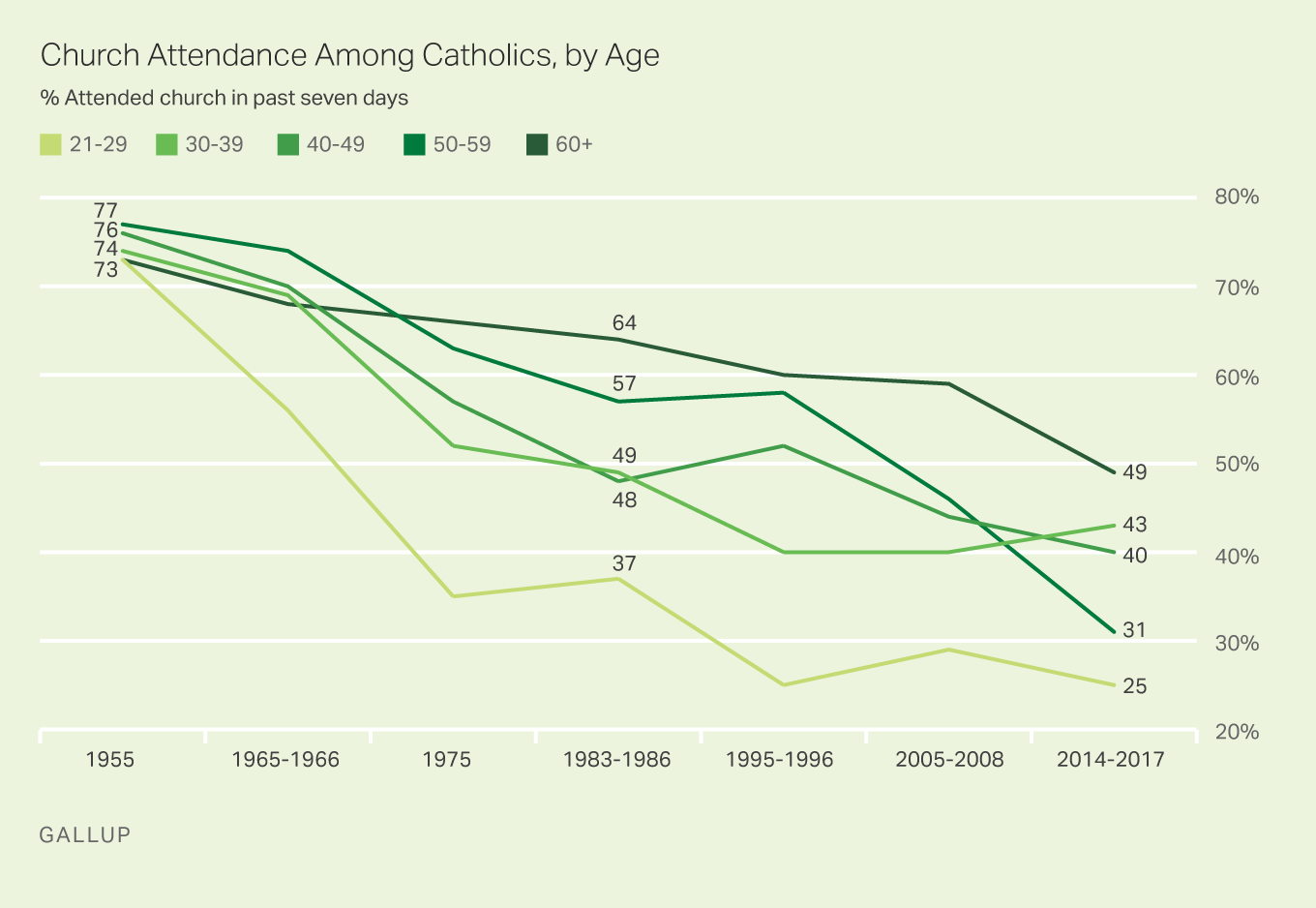 We are wobbling on the edge of a point where two demographic cliff faces converge.
 At
At 

 By the way, I used the Summa reference here because I just recently reviewed it on account of it’s being referenced in a footnote in Pope Francis’ recent Gaudete et exsultate 106. What’s puzzling is that, once again, whoever did his homework for the Pope in that paragraph seems to have misused Aquinas, as also occurs in Amoris laetitia. The use in GEE 116 simply picks out part of St. Thomas’ response. In respect to our neighbor, mercy is more important than external acts of worship. However, just as charity is greater than mercy, so too worship is greater than external acts of mercy because worship moves us to external acts of mercy. Somehow that last part was ignored.

 I’ve been working my way through the very long Apostolic Exhortation
  While I was in L.A. I met with some pro-life heavy hitters in Arizona. I was told of a recent debate in the Arizona House about a bill – SB1394 – touching on pro-life issues.





























